| (19) |
 |
|
(11) |
EP 0 526 431 A1 |
| (12) |
EUROPEAN PATENT APPLICATION |
| (43) |
Date of publication: |
|
03.02.1993 Bulletin 1993/05 |
| (22) |
Date of filing: 27.07.1992 |
|
| (51) |
International Patent Classification (IPC)5: B23Q 3/10 |
|
| (84) |
Designated Contracting States: |
|
AT BE CH DE DK ES FR GB GR IT LI MC NL PT SE |
| (30) |
Priority: |
30.07.1991 IT BA910087
|
| (71) |
Applicant: CUTER S.p.A. |
|
I-25037 Pontoglio (Brescia) (IT) |
|
| (72) |
Inventor: |
|
- Cuter, Pietro
I-25037 Pontoglio (Brescia) (IT)
|
| (74) |
Representative: Manzoni, Alessandro |
|
MANZONI & MANZONI,
UFFICIO INTERNAZIONALE BREVETTI,
P.le Arnaldo 2
I-25121 Brescia
I-25121 Brescia (IT) |
|
| |
|
| (54) |
Rest for the modular fixing of clamping fixtures on machine tools |
(57) This invention refers to a rest for the modular fixing of clamping fixtures on machine
tools, characterized in that the surface of each front face (12), the internal surface
of a smooth section (13a) and a threaded section (13b) of each securing hole is fully
protected with an even high resistant topcoat (14).
|
|
[0001] This invention refers to a rest for the modular fixing of clamping fixtures on machine
tools, and in particular to supports with one or more faces and a grid of partly threaded
calibrated holes placed at the same centre-to-centre distance, onto which the means
normally used to clamp the workpiece during mechanical working are screwed down.
These rests can be in the shape of prismatic or plate cubes and are designed to hold
the workpiece by clamping means or fixtures which are fitted from time to time to
the desired position using the grid of holes provided. These rests are generally made
of cast iron, steel or aluminium and are fitted with a tempered bushing with an inserted
thread to make all points on the workpiece securing or clamping fixtures resistant
to wear and abrasion. Said tempered bushings and inserted threads are fitted with
adhesive, which apart from requiring a lot of time and money, they do not always give
reliable alignment and squareness of the holes with respect to the workpiece resting
face or clamping fixtures. Moreover, protection of the resting front flat surfaces
is practically lacking as they are rarely coated or treated so they are easily subjected
to the effects of abrasion, rust, etc. that can negatively affect the surface flatness.
[0002] This invention aims to provide a remedy to the above-mentioned inconveniences and
eliminate all the bushings and inserted threads by providing rests characterized by
simple construction and design.
[0003] The aim of this invention is to provide rests of the type and for the application
mentioned above in which the front flat surfaces, and the surfaces of the holes and
threads in the grid are treated and fully protected with a high resistant coat, e.i.
chemical nickel-plating by means of the so-called Niploy process.
[0004] The advantages involved are numerous and evident:
- no need for bushings and inserted threads, which means less execution times and reduced
costs;
- high resistant topcoat which gives improved protection of the hole and thread surfaces
against wear and abrasion resulting from friction with other bodies;
- protection of all surfaces against rust and chemical and atmospheric agents, which
are normally present in the work environment and that might alter surface flatness;
- a reduced friction coefficient of the treated surfaces, which makes them substantially
self-lubricating and ensures wear-free resting and sliding, without affecting surface
flatness;
- excellent surface evenness owing to calibrated application of the topcoat with very
low tolerances, which gives better accuracy in workpiece clamping and working;
- no effect on correct squareness of the holes with respect to the front flat surfaces;
- long-lasting top performance and reliable conditions of the rest assembly.
[0005] A practical application of this invention is shown in the attached drawings, and
more precisely:
Figure 1 is a prismatic rest in accordance with the invention, in which some holes
are plugged by screw caps; and
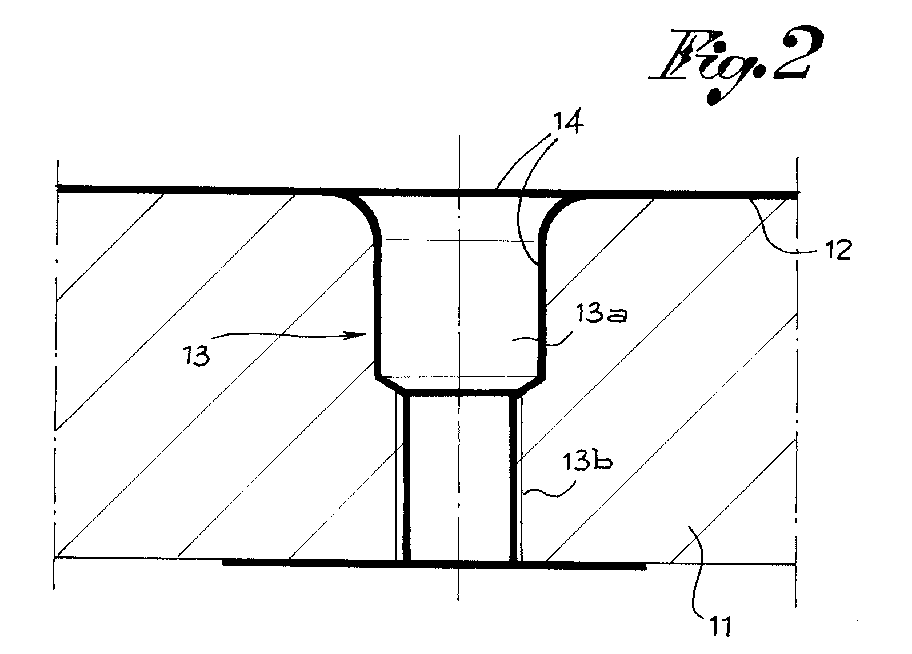
Figure 2 is a partial view of the rest in the area of a securing hole.
[0006] The rest covered by this invention is comprised of a body or plate (11) with at least
one front face (12) having a grid of securing holes (13) all at the same centre-to-centre
distance, each hole featuring a cylindrical flat section (13a) and a deep threaded
section (13b). At least the visible surface of the front face (12) and the surfaces
of said flat section (13a) and the threaded section (13b) of each hole (13) are chemically
processed to give protection and increase hardness. The process consist of the application
of a nickel alloy onto all the surfaces involved, i.e. the formation of a nickel-plating
topcoat (14) by means of the so-called Niploy process.
[0007] Figure 2 of the drawing shows a detailed view of a hole of the rest, where the topcoat
(14) is represented by a large line onto the front, hole and thread surfaces. The
coating gives the surfaces excellent hardness and features that improve performance
as referred hereabove. The holes that are not used can be from time to time plugged
using fluid-tight screw caps (15).
1) Rest for the modular fixing of clamping fixtures on machine tools, which is made
up of a prismatic or plate-shaped body with a grid of calibrated securing holes placed
at the same centre-to-centre distance on one or more front faces, each hole having
a cylindrical flat surface and a deep threaded section, characterized in that the
surface of each front face (12), the internal smooth surface (13a) and the thread
(13b) of each securing hole are fully protected with an even high resistant topcoat
(14).
2) A rest in accordance with claim 1), characterized in that said protective topcoat
(14) consists of nickel plating using a nickel alloy.
3) A rest in accordance with claim 2), characterized in that said surface nickel plating
is applied by a chemical process.