|
(11) | EP 0 526 942 A1 |

| (12) | EUROPEAN PATENT APPLICATION |
|
|
|
|
|||||||||||||||||||||||
| (54) | Liquid composition |
| (57) The invention relates to a liquid composition in the form of a solution comprising
a) an alkylated xylenesulphonic acid salt; b) a glycol having a molecular weight of between 200 and 1500; c) an aromatic, paraffinic or naphthenic oil; and d) less than 1 percent by weight of water, calculated on the total composition. |
[0001] The invention relates to a liquid composition and to a process for the preparation of such a liquid composition. The invention specifically relates to a liquid composition comprising
a) an alkylated xylenesulphonic acid salt:
b) a glycol having a molecular weight of between 200 and 1500;
c) an aromatic, paraffinic or naphthenic oil; and
d) less than 1 percent by weight of water, calculated on the total composition.
[0002] From European patent application 413374 is known a composition comprising an alkylated xylenesulphonic acid salt and a glycol having a molecular weight of between 200 and 1500, suitable for enhancing recovery of oil from a subterranean oil-containing reservoir.
[0003] The composition according to the invention, however, is an oil-containing clear and liquid solution of an alkylated xylenesulphonic acid salt, which is substantially anhydrous as herein defined. The composition has an excellent storage stability and a suitable viscosity. It may be used as a protective fluid in metal-working industry. It may also be used as a quenching oil in metal processing. It shows no phase separation nor crystallization at zero degree C.
[0004] Preferred compositions are those wherein an alkylated xylenesulphonic acid salt is an ortho-xylenesulphonic acid salt of the formula
wherein M is an alkali metal or ammonium and A is a C8-C30 alkyl group, preferably a C12-C2o alkyl group.
[0005] The long chain-alkyl group is bound to the aromatic ring from its 2-position to its mid-position.
[0006] Preferably the glycol is polyethylene glycol or polypropylene glycol. Preferred molecular weights range from 200 to 1200, more preferred from 300 to 1000.
[0007] Preferred compositions comprise 50 to 65 percent by weight of alkylated xylenesulphonic acid salt; 5 to 20 percent by weight of glycol; less than one percent by weight of water and the balance being an oil, preferably a naphthenic oil or paraffinic oil.
[0008] The compositions according to the invention may be prepared by neutralizing an alkylated xylenesulphonic acid in the presence of an aromatic, paraffinic or naphthenic oil, subsequently adding a glycol to the neutralized reaction mixture and distilling off the water to a level of less than one percent by weight. The distillation is carried out at a temperature of 80 ° C to 100 ° c.
[0009] Of special importance in the compositions according to the invention are the Cl 3, C, 4-alkyl ortho-xylene sulphonic acid salt and the C16-C18-alkyl ortho-xylene sulphonic acid salt, specifically the sodium salt.
[0010] It is possible to prepare alkyl ortho-xylene sulphonates in a concentration of about 60 percent by weight of active material in an oil, containing also less than 10 percent by weight of water (without a glycol). Said composition is generally a rigid gel and with only containing water in a small range of 4.2 to 4.8 percent by weight, the composition is liquid. Low water content formulations of this type (without glycol) are generally solids.
[0011] For preparing liquid formulations the water content is replaced by polyglycol. After the glycol has been added to the formulation, the water is distilled off. This process may be facilitated by introducing in the neutralization vessel nitrogen or air.
Example 1
[0012] 610 g of alkylated ortho-xylene sulphonic acids having the chemical structure
wherein A represents C16- and C18-alkyl (average mol. weight 425) were neutralized with 124.6 g of aqueous 47% by weight of sodium hydroxide solution in 257.7 g of paraffinic oil.
[0013] The formulation comprised 60% by weight of active matter, 10% by weight of water and had a kinematic viscosity of 340 mm2/s at 60 ° c and a solidification point of 30 °C to 40 °c.
[0014] Subsequently 95 g of polyethylene glycol (average mol. weight 300) was admixed with the neutralized formulation and the temperature was raised to 95 °c in order to remove the water by stripping. Stripping was continued until 87.4 g of water was removed.
[0015] The water content was 0.6 percent by weight on the total composition of 1000 g. This product had a kinematic viscosity of 1780 mm2/s at 60 °C, and remained a liquid even below 0 °C without crystallization.
Example 2
[0016] 609.2 g of alkylated ortho-xylene sulphonic acids having the chemical structure
wherein A is C13- and C14-alkyl (average mol. weight 380) were neutralized with 134.8 g of aqueous 47% by weight of sodium hydroxide solution in 256.0 g of paraffinic oil. This formulation had a kinematic viscosity of 190 mm2/s and a solidification point of 30 °C to 40 °c.
[0017] Subsequently 95 g of polyethylene glycol (average mol. weight 300) was admixed with the neutralized formulation and the temperature was raised to 95 ° C to remove the water by stripping. Stripping was continued until 95 g of water was removed.
[0018] The water content was 0.5 percent by weight on the total composition of 1000 g. This product had a kinematic viscosity of 4950 mm2/s, and remained a liquid even at 0 °C.
Example 3
[0019] The process of Example 1 was repeated, whereby instead of a paraffinic oil a naphthenic oil was used. The amounts of the components were the same as those used in the process of Example 1.
[0020] Subsequently 95 g of polyethylene glycol with an average mol. weight of 1000 was admixed with the neutralized formulation and the temperature was raised to 95 °C to remove the water by stripping. Stripping was continued until 87.4 g of water was removed.
1. A liquid composition in the form of a solution comprising
a) an alkylated xylenesulphonic acid salt;
b) a glycol having a molecular weight of between 200 and 1500;
c) an aromatic, paraffinic or naphthenic oil; and
d) less than 1 percent by weight of water, calculated on the total composition.
2. A composition as claimed in claim 1, wherein is used an ortho-xylene sulphonic
acid salt of the formula
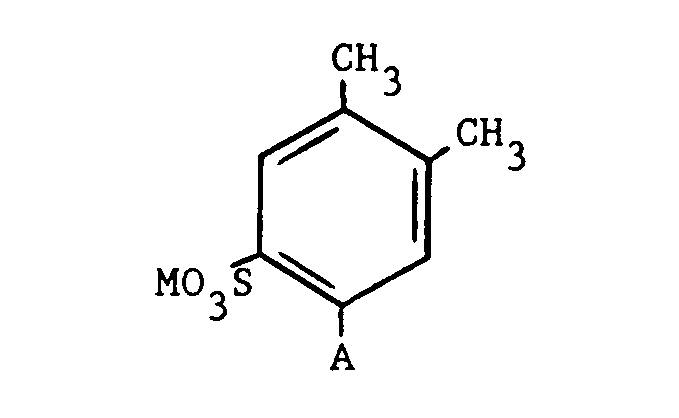
wherein M is an alkali metal or ammonium and A is a C8-C30 alkyl group.
wherein M is an alkali metal or ammonium and A is a C8-C30 alkyl group.
3. A composition as claimed in claim 2, wherein the alkyl group is a C12-C2o alkyl group.
4. A composition as claimed in claims 1-3, wherein polyethylene glycol having an average
molecular weight between 200 and 1000 is used.
5. A composition as claimed in claims 1-4, wherein 50 to 65 percent by weight of alkylated
xylenesulphonic acid salt; 5 to 20 percent by weight of glycol; less than 1 percent
by weight of water and 14 to 44 percent by weight of the oil are present.
6. A process for the preparation of a composition as claimed in claim 1 which comprises
neutralizing an alkylated xylenesulphonic acid in the presence of an aromatic, paraffinic
or naphthenic oil to the alkylated xylenesulphonic acid salt and water; subsequently
adding a glycol to the neutralized reaction mixture and distilling off the water to
a level of less than 1 percent by weight.
7. A process as claimed in claim 6 wherein the distillation takes place at a temperature
of 80 ° C to 100 ° c.