|
(11) | EP 0 527 049 A1 |

| (12) | EUROPEAN PATENT APPLICATION |
|
|
|
|
|||||||||||||||||||||||||||
| (54) | Quinophthalone compound |
| (57) A novel quinophthalone compound is here disclosed which is represented by the formula
(1)
[wherein when R₁ is an alkyl group having 8 or less carbon atoms which may branch, or cycloalkyl group, R₂ is a hydrogen atom, halogen atom, alkoxy group which may be substituted, alkylthio group, arylthio group which may be substituted, each of R₃ and R₄ is a hydrogen atom, alkyl group, N-substituted aminocarbonyl group, or substituted or unsubstituted heterocyclic ring having two or more atom of one or more kinds selected from the group consisting of a nitrogen atom, oxygen atom and sulfur atom, and R₃ and R₄ may be bonded to each other to form a ring; however, when R₁ is a hydrogen atom, each of R₃ and R₄ is a hydrogen atom, or substituted or unsubstituted heterocyclic ring having two or more atoms of one or more kinds selected from the group consisting of a nitrogen atom, oxygen atom and sulfur atom]. The above-mentioned compound is useful for coloring of polymeric materials, liquid crystal materials and the like. |
[0001] The present invention relates to a quinophthalone compound which is useful in coloring liquid crystal materials and organic polymeric materials.
[0002] Heretofore, it has been known that liquid crystal materials and organic polymeric materials are colored by using quinophthalone derivatives represented by the formula
[wherein R is an alkoxy group, alkylamino group or aralkyloxy group, and n is an integer of from 1 to 8] as dyestuffs (e.g., Japanese Patent Publication No. 20476/1973, and Japanese Patent Laid-open Nos. 93778/1983, 4674/1984, 4675/1984, 182877/1984 and 182878/1984).
[0003] However, when used to color the liquid crystal materials and organic polymeric materials, these compounds are unusable on occasion, because they are less compatible with a liquid crystal compound, a solvent, a binder matrix and the like. For example, in the case that the compatibility of the quinophthalone compound with the liquid crystal compound is low, a contrast required for a guest host type liquid crystal composition cannot be obtained. Furthermore, in the case that the solubility of the quinophthalone compound in the solvent is low, a dye-stuff organic polymer coating film formed by a solvent coating method cannot possess a sufficient optical density. In the case that the compatibility of the quinophthalone compound with the binder matrix is low, a polymeric film cannot be dyed at a high concentration, and the film in which the known quinophthalone compound is dispersed at a high concentration is opaque and cannot be used as a color filter or the like where transparency is required.
[0004] The present inventors have intensively investigated to develop a quinophthalone derivative compound which has a high solubility in a liquid crystal material and various resins and which can be colored and dyed at a high concentration, and as a result, they have found that a specific derivative is suitable to achieve the above-mentioned object. The present invention has been attained on the basis of this knowledge.
[0005] That is, the present invention is directed to a quinophthalone compound represented by the formula (1)
[wherein when R₁ is an alkyl group having 8 or less carbon atoms which may branch, or cycloalkyl group, R₂ is a hydrogen atom, halogen atom, alkoxy group which may be substituted, alkylthio group, arylthio group which may be substituted, each of R₃ and R₄ is a hydrogen atom, alkyl group, N-substituted aminocarbonyl group, or substituted or unsubstituted heterocyclic ring having two or more atoms of one or more kinds selected from the group consisting of a nitrogen atom, oxygen atom and sulfur atom, and R₃ and R₄ may be bonded to each other to form a ring;
however, when R₁ is a hydrogen atom, each of R₃ and R₄ is a hydrogen atom, or substituted or unsubstituted heterocyclic ring having two or more atoms of one or more kinds selected from the group consisting of a nitrogen atom, oxygen atom and sulfur atom].
[0006] Furthermore, the compound of the formula (1) can be present as a tautomer represented by the following formula (1′), and this tautomer is also within the category of the present invention:
[0007] Preferred embodiments of the present invention may provide a novel quinophthalone compound which has a high solubility in a solvent, a high compatibility with a binder and a stability to heat and light and which is suitable to color liquid crystal materials and organic polymeric materials.
[0008] With regard to a quinophthalone compound represented by the formula (1) of the present invention, R₁ is a hydrogen atom, alkyl group or cycloalkyl group having 8 or less carbon atoms which may branch, examples of this alkyl group include methyl, ethyl, n-propyl, iso-propyl, n-butyl, iso-butyl, sec-butyl, tert-butyl, n-pentyl, n-hexyl, n-heptyl and n-octyl groups.
[0009] The above-mentioned cycloalkyl group preferably has 5 to 6 carbon atoms, and its examples include cyclopentyl and cyclohexyl groups.
[0010] R₂ is a hydrogen atom, halogen atom, alkoxy group which may be substituted, alkylthio group, arylthio group which may be substituted.
[0012] The preferable alkoxy which may be substituted has 8 or less carbon atoms, and its typical examples include methoxy, ethoxy, n-propoxy, iso-propoxy, n-butoxy, isobutoxy and tert-butoxy groups.
[0013] The preferable alkylthio group has 8 or less carbon atoms, and its typical examples include methylthio, ethylthio, n-propylthio, iso-propylthio, n-butylthio and isobutylthio groups.
[0014] Preferable examples of the arylthio group which may be substituted include phenylthio groups substituted by alkyl groups having 10 or less carbon atoms such as phenylthio, o-methylphenylthio, m-methylphenylthio and p-methylphenylthio groups.
[0015] Each of R₃ and R₄ is a hydrogen atom, alkyl group, N-substituted aminocarbonyl group, or substituted or unsubstituted heterocyclic ring having two or more atoms of one or more kinds selected from the group consisting of a nitrogen atom, oxygen atom and sulfur atom, and R₃ and R₄ may be bonded to each other to form a ring.
[0016] The preferable alkyl group has 1 to 6 carbon atoms, and its typical examples include methyl, ethyl, n-propyl, iso-propyl, butyl, pentyl and hexyl groups.
[0017] The preferable N-substituted aminocarbonyl group has 1 to 18 carbon atoms, and its typical examples include methylaminocarbonyl, ethylaminocarbonyl, n-propylaminocarbonyl, n-butylaminocarbonyl, n-pentylaminocarbonyl, n-hexylaminocarbonyl, n-heptylaminocarbonyl, n-octylaminocarbonyl, dimethyaminocarbonyl, diethylaminocarbonyl, di-n-propylaminocarbonyl, di-iso-propylaminocarbonyl, di-n-butylaminocarbonyl, di-n-pentylaminocarbonyl, di-n-hexylaminocarbonyl, di-n-heptylaminocarbonyl and di-n-octylaminocarbonyl groups.
[0018] The preferable substituted or unsubstituted heterocyclic ring group having two or more atoms of one or more kinds selected from the group consisting of a nitrogen atom, oxygen atom and sulfur atom has a five-membered ring or six-membered ring. Typical examples of the substituent in the ring include alkyl groups such as methyl, ethyl, n-propyl, iso-propyl, n-butyl, iso-butyl and tert-butyl groups; alkoxy groups such as methoxy, ethoxy, n-propoxy and n-butoxy; alkylcarboxyalkyl groups such as methylcarboxymethyl, ethylcarboxymethyl, n-propylcarboxymethyl, isopropylcarboxymethyl and n-butylcarboxymethyl groups; and alkoxycarboxyalkyl groups such as methoxycarboxymethyl, ethoxycarboxymethyl, n-propoxycarboxymethyl, iso-propoxycarboxymethyl and n-butoxycarboxymethyl groups. Typical examples of the heterocyclic ring group include oxazoline, oxazole, benzooxazole, thiazoline, thiazole, benzothiazole, imidazoline, imidazole, benzoimidazole, oxadiazole and thiadiazole.
[0019] Furthermore, in the case that the adjacent groups of R₃ and R₄ form a ring, the compound of the formula (1) can take the following chemical structure
wherein Y is any one of the following groups,
[wherein R₅ is an alkyl group having 1 to 8 carbon atoms such as a methyl, ethyl, n-propyl, iso-propyl, n-butyl, n-pentyl, n-hexyl, n-heptyl or n-octyl group, or a substituted or unsaubstituted phenyl group such as a p-methoxyphenyl, p-butoxyphenyl, p-octyloxyphenyl, p-t-butylphenyl, 4′-butoxybiphene-4-yl, 4′-octyloxybiphene-4-yl or 4′-(5-methylbenzoxazo-2-yl)biphene-4-yl] group.
[0020] However, in the case that R₁ is a hydrogen atom, each of R₃ and R₄ is a hydrogen atom, or a substituted or unsubstituted heterocyclic ring having two or more atoms of one or more kinds selected from the group consisting of a nitrogen atom, oxygen atom and sulfur atom.
[0021] The substituted or unsubstituted heterocyclic ring group having two or more atoms of one or more kinds selected from the group consisting of a nitrogen atom, oxygen atom and sulfur atom is preferably a five-membered ring or six-membered ring. Examples of the substituent by which the ring can be substituted include alkyl groups such as methyl, ethyl, n-propyl, iso-propyl, n-butyl, iso-butyl and tert-butyl groups; alkoxy groups such as methoxy, ethoxy, n-propoxy and n-butoxy groups; alkylcarboxyalkyl groups such as methylcarboxymethyl, ethylcarboxymethyl, n-propyl-carboxymethyl, iso-propylcarboxymethyl and n-butylcarboxymethyl groups; and alkoxycarboxyalkyl groups such as methoxycarboxymethyl, ethoxycarboxymethyl, n-propoxycarboxymethyl, iso-propoxycarboxymethyl and n-butoxycarboxymethyl groups. Typical examples of the heterocyclic ring group include oxazoline, oxazole, benzooxazole, thiazoline, thiazole, benzothiazole, imidazoline, imidazole, benzoimidazole, oxadiazole and thiadiazole.
[0022] The quinophthalone compound represented by the formula (1) of the present invention can be prepared by reacting (a) 3-hydroxy-2-methyl-4-cinchonic acid with (b) a phthalic anhydride to obtain quinophthalone (c), and substituting the 4-position of the thus obtained quinophthalone (c) by a usual electrophilic reagent, or alternatively first substituting the 4-position by a halogen and then replacing the halogen with a usual nucleophilic reagent, whereby the substituent is introduced into the 4-position:
[0023] The reaction of the compound (a) with the compound (b) is carried out in a high-boiling solvent such as nitrobenzene, o-dichlorobenzene, sulfolane, DMF or DMI at a temperature of from 150 to 230°C, preferably 180 to 210°C. In order to introduce a substituent such as an alkoxycarbonyl or alkylaminocarbonyl heterocyclic ring as R₃ or R₄, the compound (b) in which a carboxylic acid has been previously introduced into the substituent-introducing position is subjected to the above-mentioned reaction to obtain the compound (c) in which the carboxylic acid is introduced. Afterward, the compound (c) is subjected to an amidation or cyclization to obtain the desired compound.
[0024] The introduction of the substituent into the 4-position of the obtained quinophthalone (c) can be achieved by substituting the 4-position by a usual electrophilic reagent, or alternatively first substituting the 4-position by a halogen and then replacing the halogen with a usual nucleophilic reagent.
[0025] A liquid crystal composition in which the quinophthalone compound of the present invention is used as a dyestuff can be prepared by first dissolving the dyestuff in a suitable liquid crystal compound, pouring the solution into a liquid crystal cell having a thickness of 10 µm which has been treated for homogeneous orientation, and then hermetically sealing the cell. In this case, the amount of the dyestuff is usually in the range of from 0.5 to 5.0% by weight, preferably from 1.0 to 3.0% by weight Used on the weight of the liquid crystals. Examples of the liquid crystal which can be usually used include E-8, E-7, E-44, ZLI-1132, ZLI-1840 and ZLI-2806 (Merck AG). Additionally, for the PDLC type liquid crystal in which a solution of the dyestuff and the liquid crystal compound is dispersed in a polymeric matrix, the dyestuff of the present invention is useful.
[0026] The coloring of a resin with the present dyestuff can be achieved by dissolving the dyestuff in a suitable synthetic resin at a temperature suitable for the resin, and then molding the resin in compliance with an application. Alternatively, the already molded resin can be colored by the use of a suitable dyestuff bath containing the present dyestuff. Examples of the usually usable resin include PS, ABS, PMMA, PC, PVC, PET and 6-nylon. The amount of the dyestuff is in the range of from 0.01 to 10% by weight, preferably from 0.01 to 5% by weight based on the weight of the resin.
[0027] The compound of the present invention is very suitable for the coloring of the liquid crystal materials and organic polymeric materials at a high concentration.
[0028] In addition, the compound of the present invention is stable to heat, light, humidity and chemicals, and in the materials colored with this compound, a sharp and transparent color tone can be kept up. Thus, it is fair to say that the compound of the present invention is very excellent in shelf stability.
[0029] Now, the present invention will be described in more detail in reference to examples. In these examples, "part(s)" and "%" are on weight.
Example 1
[0031] 53.8 parts of trimellitic anhydride and 50.8 parts of 3-hydroxy-2-methylquinoline-4-carboxylic acid were added to 538 parts of sulfolane, and reaction was then carried out at 200°C for 1 hour to obtain 68 parts of a compound having the formula (A) which was the precursor of the desired compound.
[0032] 10 parts of the compound having the formula (A) and 0.4 part of pyridine were added to 60 parts of o-dichlorobenzene, and the solution was heated up to 100°C. Successively, 7.2 parts of thionyl chloride were added thereto, and reaction was then carried out at 100°C for 2 hours. Afterward, excessive thionyl chloride was removed at 100°C under reduced pressure, and 3.4 parts of 3-amino-2-propanol were added, followed by reaction at 100°C for 1 hour. Furthermore, the solution was heated up to 170°C and reaction was carried out for 7 hours to obtain 9.5 parts of the compound represented by the formula (B).
[0033] In the compound (B), a melting point was from 244 to 246°C, and a maximum absorption wavelength in toluene was 448 nm.
Example 2
[0036] 10 parts of a compound having the formula (A) and 0.4 part of pyridine were added to 50 parts of nitrobenzene, and the solution was then heated up to 100°C. Next, 7.2 parts of thionyl chloride were added thereto, and reaction was then carried out at 100°C for 2 hours. Afterward, excessive thionyl chloride was removed at 100°C under reduced pressure, and 4.6 parts of iso-propylcarbonylhydrazine were then added, followed by reaction for 1 hour. Furthermore, 14.3 parts of thionyl chloride were added thereto, the solution was heated up to 130°C and reaction was then carried out for 4 hours to obtain 7.9 parts of the compound represented by the formula (C).
[0037] With regard to the compound (C), a melting point was from 210 to 211°C, and a maximum absorption wavelength in toluene was 450 nm.
Example 3
[0039] Preparation of a compound having a formula (D):
9.8 parts of phthalic anhydride and 10.5 parts of 3-hydroxy-2-methyl-6-isopropyl-4-cinchonic acid were added to 150 parts of sulfolane, and reaction was then carried out at 195°C for 1 hour. Insolubles were then removed from the solution at 100°C by hot filtration, and the resultant filtrate was then poured into water at room temperature. The deposited crystals were collected by filtration to obtain 18.2 parts of the compound represented by the formula (D).
[0040] With regard to the compound (D), a melting point was from 215 to 218°C, and a maximum absorption wavelength in toluene was 450 nm.
Example 4
[0042] Preparation of a compound having a formula (F):
21.1 parts of trimellitic anhydride were added to 285 parts of sulfolane, and the solution was then heated up to 185°C. 24.6 parts of 3-hydroxy-2-methyl-6-iso-propyl-quinoline-4-carboxylic acid were further added thereto, and reaction was then carried out at 200°C for 1 hour to obtain 37.2 parts of a compound having the formula (E) which was the precursor of the desired compound.
[0043] 5 parts of the compound (E) were added to 25 parts of o-dichlorobenzene and the solution was then heated up to 100°C. Next, 3.6,parts of thionyl chloride were added dropwise thereto, and the solution was then maintained at this temperature for 2.5 hours. Then, excessive thionyl chloride was removed under reduced pressure. At the same temperature, 6 parts of dibutylamine were added dropwise, and this temperature was maintained for 2 hours. The resultant reaction solution was cooled to room temperature, and then poured into 50 parts of methanol to obtain 6 parts of the compound having the formula (F):
[0044] With regard to the compound (F), a melting point was from 143 to 144°C, and a maximum absorption wavelength in toluene was 450 nm.
Example 5
[0046] Preparation of a compound having a formula (G):
6 parts of a compound having a formula (E) and 0.2 part of pyridine were added to 42 parts of o-dichlorobenzene, and the solution was heated up to 100°C. Successively, 3.8 parts of thionyl chloride were added thereto, and reaction was then carried out at 100°C for 2 hours. Afterward, excessive thionyl chloride was removed at 100°C under reduced pressure. The solution was cooled to 80°C and 6.9 parts of 2-amino-2-ethyl-1,3-propanediol were added thereto, and reaction was then carried out at 80°C for 2 hours. Afterward, the solution was heated up to 170°C, and reaction was then carried out for 5 hours to obtain 4.2 parts of the compound represented by the formula (G).
[0047] With regard to the compound (G), a melting point was from 239 to 241°C, and a maximum absorption wavelength in toluene was 450 nm.
Example 6
[0049] Preparation of a compound having a formula (H):
4 parts of a compound having a formula (G) were added to 40 parts of N-methylpyrrolidone, and 14 parts of isobutyryl chloride were added thereto. Then, reaction was carried out at room temperature for 5 hours to obtain 4.4 parts of the compound represented by the formula (H):
[0050] With regard to the compound (H), a melting point was from 163 to 165°C, and a maximum absorption wavelength in toluene was 450 nm.
Examples 7 to 13
Liquid Crystal Preparation Examples 1 to 2, Comparative Preparation Examples 1 and 2
[0053] Each of the dyestuffs in Examples 12 and 13 was added to 9.8 parts of a liquid crystal mixture of a trade name E-8 made by Merck AG, and the mixture was then heated up to about 60°C to completely dissolve the dyestuff. After cooling, the solution was poured into a liquid crystal display element, and it was then hermetically sealed. This display device showed a sharp and deep yellow during applying no voltage, and when the voltage was applied, electrode parts were only colorless, so that a good contract was obtained.
[0054] Each sample was put on a light path of a spectrophotometer, and an absorbance A was measured by applying straight polarized light to the liquid crystal in parallel with the arrangement of the liquid crystal and an absorbance A′ was measured by applying straight polarized light to the liquid crystal at a right angle to the arrangement of the liquid crystal. By the use of the thus measured absorbances A and A′, a dichroic ratio was calculated in accordance with the following formula:
[0055] Furthermore, as comparative preparation examples, about the same liquid crystals as mentioned above were prepared from compounds for comparison represented by the following formulae (K) and (L). The results are set forth in Table 2.
Solubility Measurement Examples 1 to 6, Comparative Measurement Examples 1 and 2
[0056] For the six compounds (B) to (H) of Examples 1 to 6 and the compounds (I) and (J) for comparison, the solubility of each compound in a solvent was measured. The results are set forth in Table 3.
[0057] As is apparent from the results in Table 3, the products of the present invention had the high solubilities in the various solvents.
Resin Coloring Suitability Test
[0058] For the compounds (B, C, D, F, G and H), a resin coloring suitability test was made. The results are set forth in Table 4.
Examples 14 to 21
1. A quinophthalone compound represented by the formula (1)
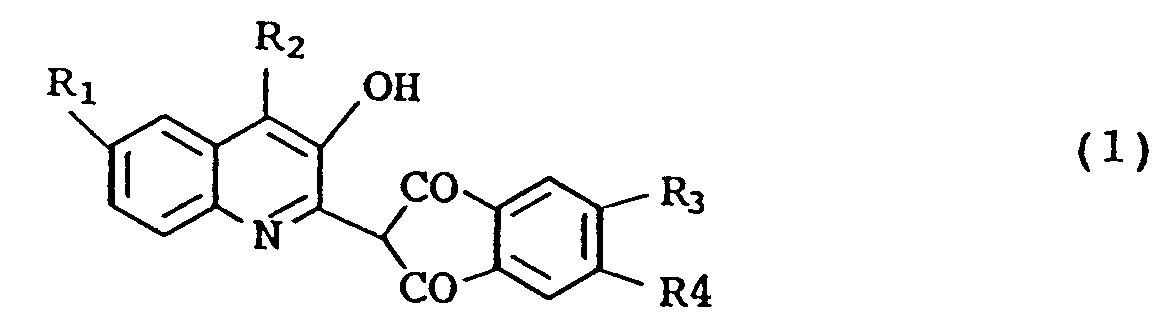
[wherein when R₁ is an alkyl group having 8 or less carbon atoms which may branch, or cycloalkyl group, R₂ is a hydrogen atom, halogen atom, alkoxy group which may be substituted, alkylthio group, arylthio group which may be substituted, each of R₃ and R₄ is a hydrogen atom, alkyl group, N-substituted aminocarbonyl group, or substituted or unsubstituted heterocyclic ring having two or more atoms of one or more kinds selected from the group consisting of a nitrogen atom, oxygen atom and sulfur atom, and R₃ and R₄ may be bonded to'each other to form a ring;
however, when R₁ is a hydrogen atom, each of R₃ and R₄ is a hydrogen atom; or substituted or unsubstituted heterocyclic ring having two or more atoms of one or more kinds selected from the group consisting of a nitrogen atom, oxygen atom and sulfur atom].
[wherein when R₁ is an alkyl group having 8 or less carbon atoms which may branch, or cycloalkyl group, R₂ is a hydrogen atom, halogen atom, alkoxy group which may be substituted, alkylthio group, arylthio group which may be substituted, each of R₃ and R₄ is a hydrogen atom, alkyl group, N-substituted aminocarbonyl group, or substituted or unsubstituted heterocyclic ring having two or more atoms of one or more kinds selected from the group consisting of a nitrogen atom, oxygen atom and sulfur atom, and R₃ and R₄ may be bonded to'each other to form a ring;
however, when R₁ is a hydrogen atom, each of R₃ and R₄ is a hydrogen atom; or substituted or unsubstituted heterocyclic ring having two or more atoms of one or more kinds selected from the group consisting of a nitrogen atom, oxygen atom and sulfur atom].