|
(11) | EP 0 530 011 A1 |

| (12) | EUROPEAN PATENT APPLICATION |
|
|
|
|
|||||||||||||||||||||||||||
| (54) | Silver halide colour photographic light sensitive material |
| (57) This invention can provide a silver halide color photographic light sensitive material
low in for production, capable of preventing the photographic characteristics thereof
from deterioration produced by any harmful substance such as formaldehyde which affects
the photographic characteristics thereof and capable of reducing an inter-printer
variation. The light sensitive material comprises a support bearing the photographic
component layers including blue-sensitive, green-sensitive and red-sensitive silver
halide emulsion layers, wherein the green-sensitive silver halide emulsion layer contains
a colored magenta coupler represented by the following Formula 1 and the photographic
component layer contains a formalin scavenger represented by the following Formulas
[II] through [VI];
wherein R₁ represents a substituent; R₂ represents an acylamino group, a sulfonamido group, an imido group, a carbamoyl group, a sulfamoyl group, an alkoxy group, an alkoxycarbonyl group or an alkoxycarbonylamino group; R₃ represents a halogen atom or an alkoxy group; m is an integer of 0 to 5; and n is an integer of 0 to 4. wherein R₄ represents a hydrogen atom, an alkyl group, an aryl group, an alkoxy group, an acylamino group or an amino group; R₅ represents a hydrogen atom, an alkyl group, an aryl group, an acyl group, an alkoxycarbonyl group, a carbamoyl group, an amino group or an amidino group; R₆, R₇ and R₈ represent each a hydrogen atom, an alkyl group, an alkenyl group, an aralkyl group, an aryl group or an acyl group; R₈, R₁₀ and R₁₆ represent each a hydrogen atom or an alkyl group; R₁₁ represents an alkyl group or an aryl group; R₁₂ represents a substituent; R₁₃, R₁₄ and R₁₅ represent each a hydrogen atom or a substituent; X represents >CH- or >N-; Z represents a hydrogen atom, an alkyl group, an aryl group, -SO₂R₁₇ or -SO₂N(R₁₇)(R₁₈); R₁₇ represents an alkyl group, an aryl group or a heterocyclic group; R₁₈ represents a hydrogen atom or an alkyl group; and n is an integer of not less than 2. |
FIELD OF THE INVENTION
[0001] This invention relates to a silver halide color photographic light sensitive material and particularly to a silver halide color photographic light sensitive material in which a fog production can be reduced and the photographic characteristics can be prevented from any deterioration produced by a harmful substance such as formaldehyde which affects the photographic characteristics in storing the photographic light sensitive material and, further, any printing erraticism caused between printers can also reduced.
BACKGROUND OF THE INVENTION
[0002] In a color photographic light sensitive material, each of the yellow, magenta and cyan dyes formed of couplers is not always ideal in absorption characteristics. For example, it is usual that a magenta dye image absorbs not only necessary green rays of light but also some blue rays of light, so that the resulting color reproduction produces a distortion. For eliminating such a color reproduction distortion, a yellow or magenta colored coupler has been used before making a coupling reaction with the oxidized products of an aromatic primary amine color developing agent. The former is so-called a colored magenta coupler and the latter is so-called colored cyan coupler.
[0003] The auto-masking methods in which the above-mentioned colored couplers are used are detailed in, for example, J. Phot. Soc. Am., 13,94 (1947); J. Opt.Soc.Am., 40,166 (1950) or J. Am. Chem. Soc., 72,1533 (1950).
[0004] Of the colored magenta couplers each having the principal absorption in a blue light region, U.S. Patent Nos. 2,428,054 and 2,449,966 describe 1-phenyl-3-acylamino-4-phenylazo-5-pyrazolone; U.S. Patent No. 2,763,552 describes those having a 4-methoxyarylazo group; U.S. Patent No. 2,983,608 describes 1-phenyl-3-anilino-4-phenylazo-5-pyrazolone; U.S. Patent Nos. 3,519,429 and 3,615,506 describe those having a naphthylazo group; U.S. Patent No. 1,044,778 describes those having a water-soluble group; U.S. Patent No. 3,476,564 and Japanese Patent Publication Open to Public Inspection (hereinafter abbreviated to JP OPI Publication) Nos. 49-123625/1974, 49-131448/1974 and 54-52532/1979 describe those having a hydroxyphenylazo group; JP OPI Publication No. 52-102723/1977 describes those having a substituted alkoxyphenylazo group; and JP OPI Publication No. 53-63016/1978 describes those having a thiophenylazo group; respectively.
[0005] However, for example, the molar absorption coefficients of the above-given colored magenta couplers are so small that the couplers should be added in a large quantity, their principal absorption are hardly kept in a preferable region, their development activities are so low that a masking effect may not be displayed satisfactorily, a fog is liable to produce though the development activities are rather high and, further, their stabilities are low against light, heat or humidity or a magenta dye produced upon reaction with a color developing agent has a short wavelength, so that these couplers have not been satisfactory. It has therefore been the actual situations that the characteristics of the couplers have been kept barely effective by making combination use of some kinds of the couplers. Particularly, since high-speed fine-grained silver halide emulsions and high color-developable magenta couplers have been used in recent years, the characteristics required for the colored magenta couplers have been made a step forward to much higher quality.
[0006] Particularly in recent years, in the case of making prints on color papers from a color film through the different models of printing equipments (hereinafter referred to as 'printers'), it was found that the errastic color hues of the finished prints are produced, (hereinafter referred to as an 'inter-printer erraticism') As one of the reasons of the above-mentioned fact, it was proved that the inter-printer erraticism is produced by the color tones of a color developing dye produced of a colored magenta coupler used in a subject color negative film.
[0007] The above-mentioned inter-printer erraticism was much improved by making use of the colored magenta couplers described in JP OPI Publication No.4-16939. The present invention is to develope the utility of the colored magenta coupler.
SUMMARY OF THE INVENTION
[0008] It is an object of the invention to provide a silver halide color photographic light sensitive material low in fog production, capable of preventing the light sensitive material form being deteriorated by a harmful substance such as formaldehyde affecting the photographic characteristics and, further, capable of reducing the inter-printer erraticism.
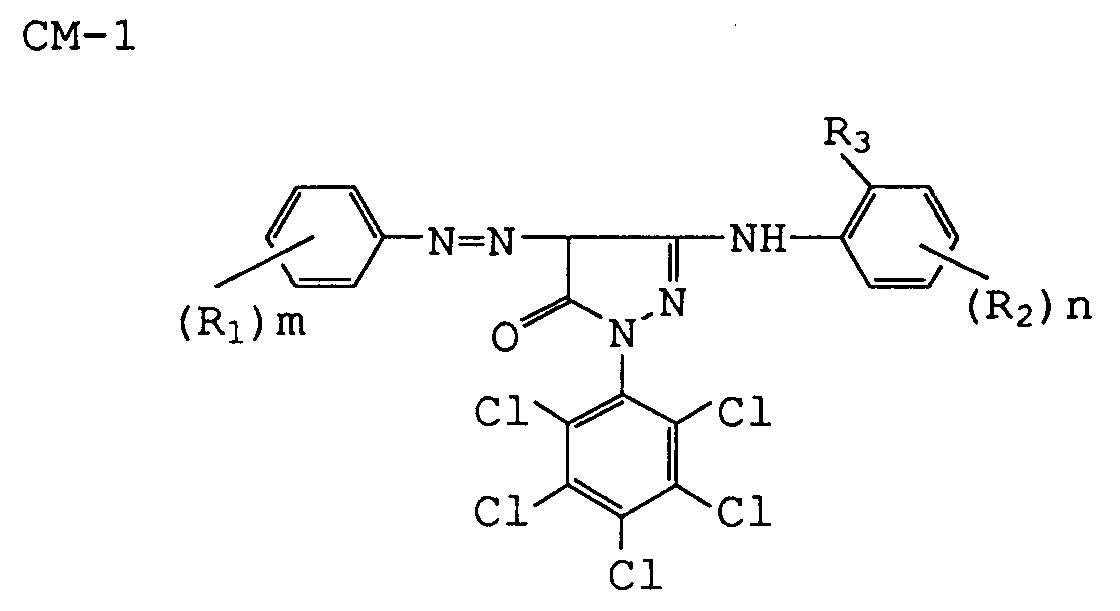
[0009] A silver halide color photographic light sensitive material of the invention comprises a support and photographic component layers including a blue-sensitive silver halide emulsion layer, a green-sensitive silver halide emulsion layer and a red-sensitive silver halide emulsion layer, wherein the green-sensitive silver halide emulsion layer contains at least one of the colored magenta couplers represented by the following Formula CM-I and at least one of the photographic component layers contains at least one of the formalin scavengers represented by the Formulas II through VI.
wherein R₁ represents a substituent; R₂ represents an acylamino group, a sulfonamido group, an imido group, a carbamoyl group, a sulfamoyl group, an alkoxy group, an alkoxycarbonyl group or an alkoxycarbonylamino group; R₃ represents a halogen atom or an alkoxy group; m is an integer of 0 to 5; and n is an integer of 0 to 4.
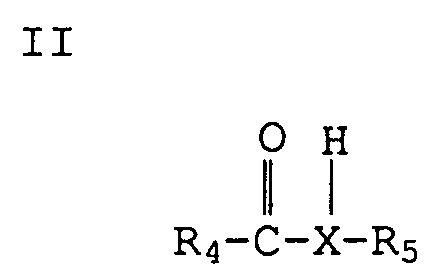
wherein R₄ represents a hydrogen atom, an alkyl group, an aryl group, an alkoxy group, an acylamino group or an amino group; R₅ represents a hydrogen atom, an alkyl group, an aryl group, an acyl group, an alkoxycarbonyl group, a carbamoyl group, an amino group or an amidino group, provided, R₄ and R₅ may be coupled together so as to form a ring; and X represents >CH- or >N-.
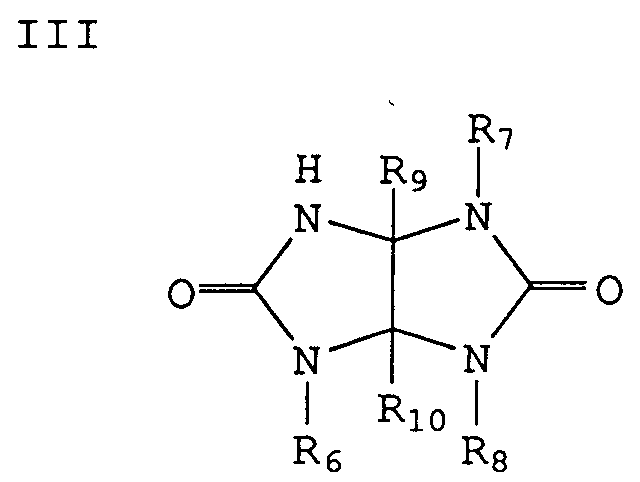
wherein R₆, R₇ and R₈ represent each a hydrogen atom, an alkyl group, an alkenyl group, an aralkyl group, an aryl group or an acyl group; and R₉ and R₁₀ represent each a hydrogen atom or an alkyl group.
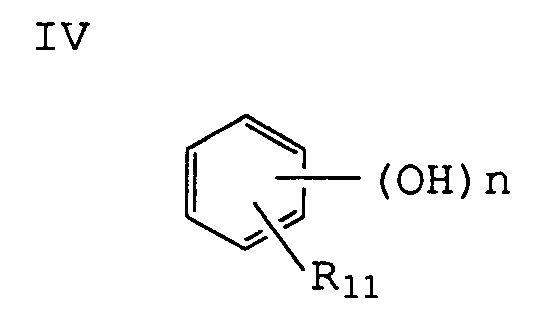
wherein R₁₁ represents a hydrogen atom, an alkyl group or an aryl group, provided, R₁₁ may form a naphthalene ring together with a phenyl ring; and n is an integer of 2 or more.
wherein R₁₂ represents a hydrogen atom or a substituent; and R₁₃ represents a hydrogen atom or a substituent.
wherein R₁₄ and R₁₅5 represent each a hydrogen atom or a substituent; R₁₆ represents a hydrogen atom or an alkyl group; Z represents a hydrogen atom, an alkyl group, an aryl group, -SO₂R₁₇ or
R₁₇ represents an alkyl group, an aryl group or a heterocyclic group; and R₁₈ is synonymous with R₁₆; provided, R₁₆ and Z may be coupled together so as to form a ring.
[0010] The photographic component layers stated in the invention include an inter layer, a UV absorbing layer, a yellow filter layer, a protective layer and other auxiliary layers each serving as the non-light sensitive layers, as well as a silver halide light sensitive emulsion layer.
DETAILED DESCRIPTION OF THE INVENTION
[0012] In Formula CM-I, the substituents represented by R₁ include, for example, an alkyl group, an alkoxy group, an aryl group, an acylamino group, a sulfonamido group, a hydroxyl group, a halogen atom, an alkoxycarbonyl group, an acyl group, a carbamoyl group, a sulfamoyl group and a carboxyl group. These groups may also have a substituent. R₁ include, desirably, an alkyl group, an alkoxy group or an acylamino group and, preferably, an alkoxy group.
[0013] The acylamino groups represented by R₂ include, for example, a 2,4-di-t-pentylphenoxy acetamido group and a 4-(2,4-di-t-pentylphenoxy)butanamido group. The sulfonamido groups include, for example, a 4-dodecyloxyphenyl sulfonamido group. The imido groups include, for example, an octadecenyl succinimido group. The carbamoyl groups include, for example, a 4-(2,4-di-t-pentylphenoxy)butylaminocarbonyl group. The sulfamoyl groups include, for example, a tetradecane sulfamoyl group. The alkoxy groups include, for example, a methoxy group, an ethoxy group and an acetyloxy group. The alkoxycarbonyl groups include, for example, a tetradecaneoxy carbonyl group. And, the alkoxycarbonylamino groups include, for example, a dodecyloxy carbonyl group. The preferable groups represented by R₂ include, for example, an acylamino group substituted to the para-position of R₃.
[0014] The halogen atoms represented by R₃ include, for example, a chlorine atom, a bromine atom and a fluorine atom. The alkoxy groups include, for example, a methoxy group and a dodecyloxy group. The preferable atoms represented by R₃ include, for example, a chlorine atom. m is preferably 1 or 2 and n is preferably 1.
[0015] The typical examples of the compounds relating to the invention, which are represented by the foregoing Formula CM-I will now be given below.
[0016] The colored magenta couplers of the invention represented by Formula CM-I can be synthesizes in the so-called diazo-coupling reaction which has commonly been carried out. The couplers can be synthesized in the method detailed in, for example, Japanese Patent Examined Publication No. 56-6540/1981. To be more concrete, an aniline derivative is diazotized at 0 to -10°C in water, water-containing alcohol or water-containing acetone by making use of conc. hydrochloric acid in a mol 1 to 5 times as much and sodium nitrite in a mol 1 to 1.2 times as much. The resulting solution is added at a temperature of -5 to -10°C into a separately prepared pyridine solution containing magenta couplers of the same mols as that of the aniline derivative and they are subject to a diazo-coupling reaction, so that the objective colored couplers can be prepared.
[0017] Next, the typical synthesizing examples of the colored magenta couplers of the invention represented by Formula CM-I will be given below.
Synthesizing Example 1 (Synthesis of CM-7)
[0018] With once heating 1.4 g of 3,4-diethoxy aniline, after it was dissolved in 3 ml of conc. hydrochloric acid and 18 ml of water and then cooled down to -3°C. The resulting solution was added by 5.3 ml of an aqueous 10% sodium nitrite solution and the resulting mixture was diazotized and then stirred for 20 minuted at -3°C. After that, 0.1 g of urea was added thereto and an excess nitrous acid was decomposed. Separate from the above, 5.2 g of 1-(2,3,4,5,6-pentachlorophenyl)-3-(2-chloro-5-tetradecaneamido anilino)-5-pyrazolone was dissolved in 100 ml of pyridine and the resulting solution was cooled down to -5 to -10°C and stirred. Thereto, the above-mentioned prepared diazonium salt solution was gradually added.
[0019] After 3 hours passed, the reacted solution was poured into 400 ml of ice water containing 100 ml of conc. hydrochloric acid. After filtrating, washing and then drying the resulting crystals, they were recrystallized out of a mixed solution of ethyl acetate and acetonitrile, so that 5.5 g of CM-7 could be obtained.
Synthesizing Example 2 (Synthesis of CM-13)
[0020] After 1.0 g of 4-methoxy aniline was heated once and dissolved in 3 ml of conc. hydrochloric acid and 20 ml of water, the resulting solution was cooled down to -3°C. The resulting cooled solution was added by 5.3 ml of an aqueous 10% sodium nitrite solution so as to be diazotized and the solution was then stirred for 20 minuted at -3°C. After that, 0.1 g of urea was added thereto, an excess nitrous acid was decomposed.
[0021] Separate from the above, 5.6 g of 1-(2,3,4,5,6-pentachlorophenyl)-3-{2-chloro-5-[α-(2,4-di-t-amylphenoxy) butanamido] anilino}-5-pyrazolone was dissolved in 100 ml of pyridine and the resulting solution was cooled down to -5 to -10°C and was then stirred. Thereto, the above-mentioned prepared diazonium salt solution was gradually added. After 3 hours passed, the reacted solution was poured into 400 ml of ice water containing 100 ml of conc. hydrochloric acid. After the resulting crystals were filtrated, washed and dried, they were recrystallized out of a mixed solution of acetonitrile and ethyl acetate, so that 5.1 g of CM-13 could be prepared.
[0023] The colored magenta couplers of the invention represented by the foregoing Formula CM-I may be used independently or in combination. However, they are commonly used with one or more kinds of substantially colorless magenta couplers in combination by taking an auto-masking principle into consideration.
[0025] In Formula II, R₄ represents a hydrogen atom, an alkyl group, an aryl group, an alkoxy group, an acylamino group or an amino group; R₅ represents a hydrogen atom, an alkyl group, an aryl group, an acyl group, an alkoxycarbonyl group, a carbamoyl group, an amino group or an amidino group, provided, R₄ and R₅ may be coupled together to form a ring and these groups may have a further substituent (such as a hydroxyl group, a carboxyl group, an amino group, a ureido group, a nitro group and a halogen atom); and X represents >CH- or >N-.
[0026] In Formula III, R₆, R₇ and R₈ may be the same with or the different from each other and represent each a hydrogen atom, an alkyl group (such as each group of methyl, ethyl, propyl, i-propyl, butyl, hydroxymethyl, 2-hydroxyethyl, methoxymethyl, chloromethyl, carboxymethyl and cyanoethyl), an alkenyl group (such as each group of allyl, 2-butenyl and 2-chloroallyl), an aralkyl group (such as each group of benzyl, phenetyl and p-methoxybenzyl), an aryl group (such as each group of phenyl, p-tolyl, p-methoxyphenyl, o-chlorophenyl and m-hydroxyphenyl) or an acyl group (such as each group of acetyl, propionyl, trifluoroacetyl, chloroacetyl, acryloyl and methacryloyl).
[0027] R₉ and R₁₀ represent each a hydrogen atom or an alkyl group (such as the similar groups given in the cases of R₆ through R₈).
[0028] The compounds represented by Formula III include, for example, a macromolecular compound coupled to a macromolecular chain (such as a polyethylene chain and a polypropylene chain) through a group represented by any one of R₆ through R₈. In the above-mentioned case, the compounds further include, for example, those having a group represented by any one of R₆ through R₈ and a macromolecular chain coupled to each other by a coupling group such as -CO-, -COO- or -CONH-.
[0029] In Formula IV, R₁₁ represents a hydrogen atom, an alkyl group or an aryl group, provided, R₁₁ may form a naphthalene ring together with a phenyl ring. The alkyl and aryl groups include those having a substituent; and n is an integer of 2 to 4.
[0030] In Formula V, R₁₂ represents a hydrogen atom or a substituent. The substituents include, for example, an alkyl group, an aryl group, a cycloalkyl group, an acyl group, a carbamoyl group, a sulfamoyl group and an alkoxycarbonyl group, provided, these groups may have a further substituent (such as a carboxyl group, a sulfo group, a hydroxyl group and an amino group).
[0031] R₁₃ represents a hydrogen atom or a substituent. The substituents include, for example, an alkyl group, an aryl group, a cyano group, a carbamoyl group, a carboxyl group, an alkoxycarbonyl group, an acyl group, a haloalkyl group, a nitro group, a sulfamoyl group, an alkylsulfamoyl group and an alkylsulfonyl group.
[0032] In Formula [VI], R₁₄ and R₁₅ represent each a hydrogen atom or a substituent, R₁₄ is preferably an aryl group, more preferably a sulpho-phenyl group and R₁₅ is preferably an alkyl group; R₁₆ represents a hydrogen atom or an alkyl group; and Z represents a hydrogen atom, an alkyl group, an aryl group, -SO₂R₁₇ or
R₁₇ represents an alkyl group, an aryl group or a heterocyclic group; R₁₈ is synonymous with the above-given R₁₆; provided, R₁₆ and Z may be coupled together to form a ring.
[0033] The substituents represented by R₁₄ include, for example, a straight-chained or branched alkyl group having 1 to 18 carbon atoms (such as each group of methyl, ethyl or dodecyl), a cycloalkyl group having 5 to 7 carbon atoms (such as each group of cyclopentyl or cyclohexyl), an aryl group (such as each group of phenyl or naphthyl), a heterocyclic group having 5 or 6 members (such as each group of pyridyl, pyrimidyl, pyrrolyl, pyrazolyl, imidazolyl, triazolyl, furyl, thienyl, thiazolyl or piperidino) or
wherein R₁₉ represents an alkyl group, an aryl group or a heterocyclic group; R₂₀ represents a hydrogen atom or an alkyl group; and R₂₁ represents a hydrogen atom, an alkyl group, an aryl group or a heterocyclic group.
[0034] The above-given substituents each may also have a further substituent including, for example, an alkyl group, an alkoxy group, an acylamino group, a sulfonamido group, a carbamoyl group, a sulfamoyl group, an alkoxycarbonyl group, a nitro group, a cyano group, a hydroxyl group, a carboxyl group, a sulfo group or a halogen atom. Among these substituents, a sulfo group, a carboxyl group and hydroxyl group are preferable to be used.
[0035] The groups represented by R₁₄ include, preferably, an alkyl group, an aryl group, an alkylsulfonyl group, an acyl group, a carbamoyl group and an alkoxycarbonyl group.
[0036] The examples of the substituents represented by R₁₅ include a straight-chained or branched alkyl group having 1 to 18 carbon atoms (such as each group of methyl, ethyl or undecyl), a cycloalkyl group having 5 to 7 carbon atoms (such as each group of cyclopentyl or cyclohexyl), an aryl group (such as each group of phenyl or naphthyl), an alkoxy group (such as each group of methoxy or ethoxy), an aryloxy group (such as a phenoxy group), an alkoxycarbonyl group (such as each group of methoxycarbonyl or ethoxycarbonyl), an aryloxycarbonyl group (such as a phenoxycarbonyl group), a carbamoyl group (such as each group of dimethylcarbamoyl or diethylcarbamoyl), an acyl group (such as each group of acetyl or benzoyl), an amino group, an alkylamino group (such as each group of methylamino or dimethylamino), an arylamino group (such as an anilino group), an acylamino group (such as each group of acetylamino or benzamido), a sulfonamido group (such as each group of methanesulfonamido or benzenesulfonamido), a carbamoylamino group (such as a demethylcarbamoylamino group), a sulfamoylamino group (such as a dimethylsulfamoylamino group), an alkoxycarbonylamino group (such as each group of methoxycarbonylamino and ethoxycarbonylamino), a cycloamino group (such as each group of morpholino, pyperidino or pyrrolidino), a carboxyl group or a cyano group.
[0037] The above-given substituents may have a further substituent including, for example, those similar to the substituents given in the case of R₁₄. Those for R₁₅ include, desirably, a hydrogen atom, an alkyl group, an alkoxy group, an alkoxycarbonyl group, a carboxyl group, an acylamino group, a carbamoylamido group, a sulfonamido group, a sulfamoylamino group, and an alkoxycarbonylamino group and, preferably, an alkyl group, an acylamino group, a carbamoylamino group, a sulfonamido group and an alkoxycarbonylamino group.
[0038] The alkyl groups represented by R₁₆ include, for example, a straight-chained or branched alkyl group which may also be substituted with a halogen atom, an alkoxy group, an aryloxy group, an acylamino group, a sulfonamido group, a carbamoyl group, a sulfamoyl group, an alkoxycarbonyl group, a nitro group, a cyano group, a hydroxyl group, a carboxyl group, a sulfo group, an amino group, an alkylamino group or a dialkylamino group.
[0039] Z represents an hydrogen atom, an alkyl group, an aryl group, -SO₂R₁₇ or
wherein R₁₇ represents an alkyl group, an aryl group or a heterocyclic group; R₁₈ is synonymous with those represented by the foregoing R₁₆. The examples thereof include a methyl group, an ethyl group, a butyl group, a methoxymethyl group, a cyanoethyl group, a phenyl group, a methylsulfonyl group, an ethylsulfonyl group, a butylsulfonyl group, a benzenesulfonyl group, a dimethylsulfamoyl group and a diethylsulfamoyl group; and Z represents, preferably, an alkyl group or an alkylsulfonyl group.
[0041] Most of the above-given compounds are commonly available from the market. However, those not available on the market can readily be synthesized in the procedures described in, for example, the following exemplified patents and/or literatures.
[0042] Compounds II-7 and II-8 can readily be synthesized in the procedures described in 'Bulletin of the Chemical Society of Japan', Vol.39, pp.1559∼1567 and pp.1734∼1738, (1966); 'Chemische der Berichte', Vol.54, B, pp.1802∼1833 and pp.1441∼1479, (1921); and 'Beilstein Handbuch der Organischen Chemie', H, p.98, (1921).
[0043] Compound II-13 is a oligomer or a polymer each having ¬ repetition units in which ¬ is an integer of not less than 2.
[0044] Compound II-19 can be synthesized in the procedures described in, for example, 'Beilstein Handbuch der Organischen Chemie', 1st revised/enlarged edition, Vol.4, p.354 and Vol.3, p.63
[0045] Compounds III-1 and III-11 can be synthesized in the procedures described in, for example, British Patent No. 717,287; U.S. Patent Nos. 2,731,472 and 3,187,004; H. Pauly, 'Chemische der Berichte', 63B, p.2063, (1930); F.B. Slezak, 'Journal of Organic Chemistry', 27, p.2181, (1962); or J. Nematollahl, 'Journal of Organic Chemistry', 28, p./2378, (1963). In addition to the above, an alkyl, acyl, hydroxymethyl, alkoxymethyl or halomethyl derivative can be prepared by alkylating, hydroxymethylating, alkoxymethylating or halomethylating glycoluril in an ordinary method.
[0046] Compounds V-1 through V-30 can readily be synthesized in the procedures described in, for example, JP OPI Publication Nos. 61-77327/1976 or 62-273527/1987, or British Patent No. 585,780.
[0047] Compounds VI-1 through V1-24 can readily be synthesized in the procedures described in, for example, 'Berichte der Deutschen Chemischen gesellschaft', 57, p.332, (1924); 'Annalen der Chemie', 520, p.622, (1936); ibid., 397, p.119, (1913); ibid., 568, p.227, (1950); or 'Journal of the American Chemical Society', 734, p.664, (1951).
[0048] The above-mentioned 'photographic component layers' stated in the invention include an inter layer, a UV absorbing layer, a yellow filter layer, a protective layer and other auxiliary layers each serving as the non-light sensitive layers, as well as an optically or chemically sensitized silver halide light sensitive emulsion layer.
[0049] In the case of a silver halide color photographic light sensitive material comprising a photographic component layer provided onto the upper side of a magenta coupler-containing layer, the formalin scavengers relating to the invention may be contained independently or in combination into the magenta coupler-containing layer and/or at least one of the photographic component layers provided onto the upper side of the magenta coupler-containing layer. It is also allowed to contain other well-known formalin scavengers in combination. The preferable scavenger-containing layer is the layer closest to the outside air, that is, effectively, a protective layer.
[0050] The formalin scavengers relating to the invention can be added and contained in the above-mentioned layers by dissolving them in a suitable solvent such as water or methanol and then by adding them in a coating solution for forming the layers. The points of time when adding them may be freely selected. For example, when they are added into a silver halide emulsion, any points of time in the course of the preparation steps. However, it is preferable to add them immediately before the coating is carried out.
[0051] The formalin scavengers may be added in an amount within the range of, desirably, 0.01 to 5.0 g per sq.meter of a color photographic light sensitive material and the preferable results can be enjoyed when adding them in an amount within the range of 0.1 to 2.0 g.
[0052] In the silver halide emulsions applicable to the silver halide photographic light sensitive materials of the invention, the silver halides thereof include, for example, silver bromide, silver iodobromide, silver iodochloride, silver chlorobromide and silver chloride and any one of the silver halides applicable to any ordinary silver halide emulsions can be used therein.
[0053] The silver halide grains applicable to the silver halide emulsions may be those having a uniform distribution of the silver halide compositions in their grains or those having the different layer structures of the silver halide compositions between the inside of the grains and the surface layer thereof.
[0054] The silver halide grains may be those capable of producing a latent image principally on the surface thereof or those capable of producing a latent image inside the grains.
[0055] It is allowed to use the silver halide emulsions having any grain-size distribution, the emulsions having a wide grain-size distribution (hereinafter referred to as a polydisperse emulsion), the emulsions having a narrow grain-size distribution (hereinafter referred to as a monodisperse emulsion) independently or in combination, or the mixture of the polydisperse emulsions and the monodisperse emulsions.
[0056] The silver halide emulsions applicable thereto may be used with one or more separately prepared silver halide emulsions upon mixing together.
[0057] The silver halide grains applicable to the invention may be chemically sensitized in a sulfur sensitization method, a selenium sensitization method, a reduction sensitization method or a noble metal sensitization method.
[0058] Among the silver halide grains applicable to the invention, the silver halide grains other than the silver halide grains spectrally sensitized by the combination of the sensitizing dyes of the invention can be spectrally sensitized with the dyes known as the sensitizing dyes in the Photographic industry.
[0060] In the silver halide photographic light sensitive materials of the invention, gelatin may advantageously be used.as the binders (or the protective colloids) applicable to the emulsions thereof and so forth. Besides the gelatin, it is also allowed to use a gelatin derivative, a graft polymer of gelatin and other macromolecules, protein, a sugar derivative, a cellulose derivative or a polymerized or copolymerized synthetic hydrophilic macromolecular substance.
[0061] In the silver halide photographic light sensitive materials of the invention, the photographic component layers or the other hydrophilic colloidal layers thereof are hardened by cross-coupling the molecules of the binders (or the protective colloids) and making independent or combination use of a layer hardener for making layers stronger.
[0062] The silver halide emulsions are each allowed to contain a plasticizer and a dispersions of a water-soluble or hardly soluble synthetic polymers (that is so-called a latex).
[0063] In the silver halide photographic light sensitive materials of the invention, a coupler may be used. It is also allowed to use a competing coupler capable of displaying a color correction effect and a compound capable of releasing a photographically useful fragment such as a development accelerator, a bleaching accelerator, a developing agent, a silver halide solvent, a color toner, a layer hardener, a foggant, an antifoggant, a chemical sensitizer, a spectral sensitizer and a desensitizer.
[0064] The yellow dye forming couplers desirably applicable thereto include, for example, the well-known acrylacetanilide type couplers. Among them, a benzoylacetanilide or pivaloylacetanilide type compound may be advantageously used.
[0065] The magenta dye forming couplers applicable thereto include, for example, a 5-pyrazolone type coupler, a pyrazoloazole type coupler, a pyrazolobenzimidazole type coupler, an open-chained acylacetonitrile type coupler and an indazole type coupler.
[0066] The cyan dye forming couplers commonly applicable thereto include, for example, a phenol or naphthol type coupler. For containing the couplers in a light sensitive material, it is allowed to apply a well-known technique also applicable to any ordinary type couplers. It is, however, desirable that a coupler is dissolved in a high boiling solvent and, if required, together with a low boiling solvent in combination and is then so dispersed as to be fine grains, so that the resulting dispersion is added into a silver halide emulsion relating to the invention. In this case, it is allowed, if required, to make combination use of a hydroquinone derivative, a UV absorbent and an antifading agent.
[0067] The silver halide photographic light sensitive materials of the invention can be provided with such an auxiliary layer as a filter layer, an antihalation layer and an anti-irradiation layer. These layers and/or the emulsion layers are also allowed to contain a dye capable of either fluxing from the light sensitive material or being bleached therein in the course of developing the light sensitive material.
[0068] The silver halide photographic light sensitive materials of the invention are allowed to contain a matting agent, a lubricant, an image stabilizer, a UV absorbent, a fluorescent whitening agent, a surfactant, a development accelerator, a development retarder and a bleaching accelerator.
[0069] In the silver halide photographic light sensitive materials of the invention, the photographic emulsion layers and other layers thereof can each be provided onto the supports including, for example, a baryta paper, a paper laminated with α-olefin polymer or the like, a paper support from which the α-olefin layer can readily be peeled off, a flexible reflective support such as those made of a synthetic paper, a reflective support coated with a white pigment or a film comprising a semisynthetic or synthetic macromolecular material such as cellulose acetate, cellulose nitrate, polystyrene, polyvinyl chloride, polyethylene terephthalate, polycarbonate or polyamide, and a solid member such as those made of glass, a metal or an earthware. The above-mentioned layers may also be provided onto a thin reflective support having a thickness within the range of 120 to 160µm.
[0070] When a silver halide photographic light sensitive material of the invention contains a coupler, a dye image is obtained by carrying out a commonly well-known color photographic treatment after the light sensitive material is exposed to light.
[0071] In the invention, it is allowed to make a color development and then to treat with a processing solution having a bleaching function and another processing solution having a fixing function. It is otherwise allowed to treat with a processing solution having a bleaching function as well as a fixing function (that is so-called a bleach-fixing solution). The bleaching agent applicable thereto include, for example, the metal complexes of an organic acid.
[0072] After completing a fixing treatment, a washing treatment is usually carried out. As for a substitution for the washing treatment, a stabilizing treatment may be carried out, or the both treatments may also be carried out in combination.
EXAMPLES
EXAMPLE 1
[0074] A multilayered color photographic light sensitive material sample 1 was prepared by forming each of the layer having the following compositions on a triacetyl cellulose film support.
[0075] Every amount of the compositions added to the multilayered color photographic light sensitive material will be indicated in terms of grams per sq,meter, unless otherwise expressly stated. The amounts of silver halides and colloidal silver will be indicated by converting them into the silver contents thereof. And, the amounts of the sensitizing dyes used therein will be indicated in terms of the mol numbers per mol of the silver contents.
| Layer 1; An antihalation layer (HC) | |
| Black colloidal silver | 0.15 |
| UV absorbent (UV-1) | 0.20 |
| Colored cyan coupler (CC-1) | 0.02 |
| High boiling solvent (Oil-1) | 0.20 |
| High boiling solvent (Oil-2) | 0.20 |
| Gelatin | 1.6 |
| Layer 2; An interlayer (IL-1) | |
| Gelatin | 1.3 |
| Layer 4; A high-speed red-sensitive emulsion layer (RH) | |
| Silver iodobromide emulsion (Em-3) | 0.9 |
| Sensitizing dye (S-1) | 1.7x10⁻⁴ |
| Sensitizing dye (S-2) | 1.6x10⁻⁴ |
| Sensitizing dye (S-3) | 0.1x10⁻⁴ |
| Cyan coupler (C-2) | 0.23 |
| Colored cyan coupler (CC-1) | 0.03 |
| DIR compound (D-1) | 0.02 |
| High boiling solvent (Oil-1) | 0.25 |
| Gelatin | 1.0 |
| Layer 5; An interlayer (IL-2) | |
| Gelatin | 0.8 |
| Layer 6; A low-speed green-sensitive emulsion layer (GL) | |
| Silver iodobromide emulsion (Em-1) | 0.6 |
| Silver iodobromide emulsion (Em-2) | 0.2 |
| Sensitizing dye (S-5) | 0.8x10⁻⁴ |
| Sensitizing dye (S-5) | 0.8x10⁻⁴ |
| Magenta couple (M-1) | 0.47 |
| Colored magenta couple (CM-A) | 0.10 |
| DIR compound -D-3) | 0.02 |
| High boiling solvent (Oil-2) | 0.70 |
| Gelatin | 1.0 |
| Layer 8; A yellow filter layer (YC) | |
| Yellow colloidal silver | 0.1 |
| Additive (SC-1) | 0.12 |
| High boiling solvent (Oil-2) | 0.15 |
| Gelatin | 1.0 |
| Layer 9; A low-speed blue-sensitive emulsion layer (BL) | |
| Silver iodobromide emulsion (Em-1) | 0.25 |
| Silver iodobromide emulsion (Em-2) | 0.25 |
| Sensitizing dye (S-9) | 5.8x10⁻⁴ |
| Yellowcoupler (Y-1) | 0.60 |
| Yellow coupler (Y-2) | 0.32 |
| DIR compound (D-2) | 0.01 |
| High boiling solvent (Oil-2) | 0.18 |
| Gelatin | 1.3 |
| Layer 11; Protective layer 1 (PRO-1) | |
| Silver iodobromide emulsion (Em-5) | 0.3 |
| UV absorbent (UV-1) | 0.07 |
| UV absorbent (UV-2) | 0.1 |
| High boiling solvent (Oil-1) | 0.07 |
| High boiling solvent (Oil-3) | 0.07 |
| Gelatin | 0.8 |
| Layer 12; Protective layer 2 (PRO-2) | |
| An alkali-soluble matting agent, (having an average particle size: 2µm) | 0.13 |
| Polymethyl methacrylate, (having an average particle size: 3µm) | 0.02 |
| Gelatin | 0.5 |
[0076] Besides the above-given compositions, each of the layers further contained coating aid SU-2, dispersion aid SU-1, layer hardener H-1 and dyes AI-1 and AI-2 in each suitable amount.
[0077] The emulsions used in the sample were as follows. Every emulsion were the monodisperse emulsions of the internally high-iodine containing type.
| Average silver iodide content | Av. particle size | Particle shape | |
| Em-1 : | 7.5 mol% | 0.55µm | Octahedron |
| Em-2 | 2.5 mol% | 0.36µm | Octahedron |
| Em-3 | 8.0 mol% | 0.84µm | Octahedron |
| Em-4 | 8.5 mol% | 1.02µm | Octahedron |
| Em-5 | 2.0 mol% | 0.08µm |
[0078] Samples 2 through 18 were each prepared by changing the colored magenta couplers of layers 6 and 7 of Sample 1 and then by adding the formalin scavenger shown in Table 1 in an amount of 0.3 g per sq.meter into Layer 11.
[0079] A color-checker manufactured by Macbeth Co. was photographed by making use of each of Samples 1 through 18 prepared in the above-mentioned manner and a camera (Konica Camera Model FT-1 Motor manufactured by Konica Corp.) and then the samples were each developed in the following processing steps.
| Processing step (at 38°C) | Processing time |
| Color developing | 3min.15sec. |
| Bleaching | 6min.30sec. |
| Washing | 3min.15sec. |
| Fixing | 6min.30sec. |
| Washing | 3min.15sec. |
| Stabilizing | 1min.30sec. |
| Drying |
[0080] The compositions of the processing solutions used in the above-mentioned processing steps were as follows.
| <Color developer> | |
| 4-amino-3-methyl-N-ethyl-N-(β-hydroxyethyl)analine sulfate | 4.75 g |
| Sodium sulfite anhydrous | 4.25 g |
| Hydroxylamine ¤sulfate | 2.0 g |
| Potassium carbonate anhydrous | 37.5 g |
| Sodium bromide | 1.3 g |
| Trisodium nitrilotriacetate, monohydrate | 2.5 g |
| Potassium hydroxide | 1.0 g |
| Add water to make | 1 liter |
| Adjust pH to be | pH=10.05 |
<Bleacher>
[0082]
| <Fixer> | |
| Ammonium thiosulfate | 175.0 g |
| Sodium sulfite anhydrous | 8.5 g |
| Sodium metasulfite | 2.3 g |
| Add water to make | 1 liter |
| Adjust pH with acetic acid to be | pH=6.0 |
<Stabilizer>
[0084] Printed samples 1A through 18A were each prepared of the resulting samples by making use of printer A so as to make the grey portions of the color-checker to have a reflection ratio of 18%.
[0085] Next, by making use of printer B having a green regional detector which was different from that of printer A, printed samples 1B through 18B were each prepared under the printing conditions applied to Printer A. And, the variations produced between the different printers were visually judged.
[0086] A series of samples 1 through 18 were each subjected to the following formalin treatment and another series of samples 1 through 18 were each stored under the frozen conditions. Both series of the resulting samples were each exposed to white light through a sensitometric step wedge and were then processed in the foregoing processing steps. The resulting processed samples were each measured through green light and the fogginess and sensitivity (of the same day characteristics) of the frozen samples and the residual ratios of the maximum magenta density of the samples formalin-treated according to the following formula were obtained. The results thereof will be shown in Table-1. The sensitivity was obtained from the reciprocals of an exposure quantity required for giving a density of a fog + 0.3 and the values of the sensitivities will be indicated by the values relative to the value of Sample 1 which is regarded as a value of 100.
[Formalin treatment]
[0087] A solution was prepared by adding 6 ml of an aqueous 35% formaldehyde solution into 300 ml of an aqueous 35% glycerol solution. The resulting solution was put in the bottom of a sealed vessel. The samples were each kept at 30°C for 3 days in the air being kept equilibrated with the above-mentioned resulting solution.
[0088] As is obvious from Table-1, Sample 1 of the invention was low in fog production, however, extremely serious in inter-printer variation. On the other hand, Sample 2 applied with CM-29 as a colored magenta coupler was high in fog production and serious in the maximum magenta density lowering in the formalin treatment, though the inter-printer variation was proved to be improved. In contrast to the above, Samples 3 through 18 applied with the colored magenta coupler of the invention and the formalin scavenger of the invention were each low in fog production, slight in the maximum density lowering in the formalin treatment and proved to be further improved in inter-printer variation.
Advantages of the invention
[0089] According to the invention, a silver halide color photographic light sensitive material can be so provided as to have the following advantages, namely, the fog production can be low; the photographic characteristics can be prevented from deterioration produced by any harmful substance such as formaldehyde which affects the photographic characteristics; and the inter-printer variation can be reduced.
1. A silver halide color photographic light sensitive material comprising a support bearing
thereon photographic component layers including a blue-sensitive silver halide emulsion
layer, a green-sensitive silver halide emulsion layer and a red-sensitive silver halide
emulsion layer, wherein said green-sensitive silver halide emulsion layer contains
at least one kind of the colored magenta couplers represented by Formula CM-1 and
at least one of said photographic component layers contains at least one kind of the
formalin scavengers represented by Formulas II through VI;
wherein R₁ represents a substituent; R₂ represents an acylamino group, a sulfonamido group, an imido group, a carbamoyl group, a sulfamoyl group, an alkoxy group, an alkoxycarbonyl group or an alkoxycarbonylamino group; R₃ represents a halogen atom or an alkoxy group; m is an integer of 0 to 5; and n is an integer of 0 to 4.
wherein R₄ represents a hydrogen atom, an alkyl group, an aryl group, an alkoxy group, an acylamino group or an amino group; R₅ represents a hydrogen atom, an alkyl group, an aryl group, an acyl group, an alkoxycarbonyl group, a carbamoyl group, an amino group or an amidino group, provided, R₄ and R₅ may also be so coupled together as to form a ring; and X represents >CH- or >N-.
wherein R₆, R₇ and R₈ represent each a hydrogen atom, an alkyl group, an alkenyl group, an aralkyl group, an aryl group or an acyl group; and R₉ and R₁₀ represent each a hydrogen atom or an alkyl group.
wherein R₁₁ represents a hydrogen atom, an alkyl group or an aryl group, provided, R₁₁ may form a naphthalene ring together with a phenyl ring; and n is an integer of not less than 2.
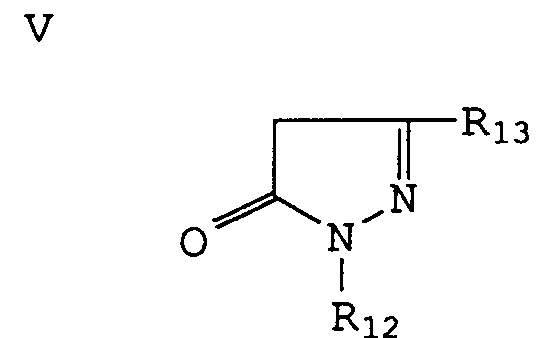
wherein R₁₂ represents a hydrogen atom or a substituent; and R₁₃ represents a hydrogen atom or a substituent.
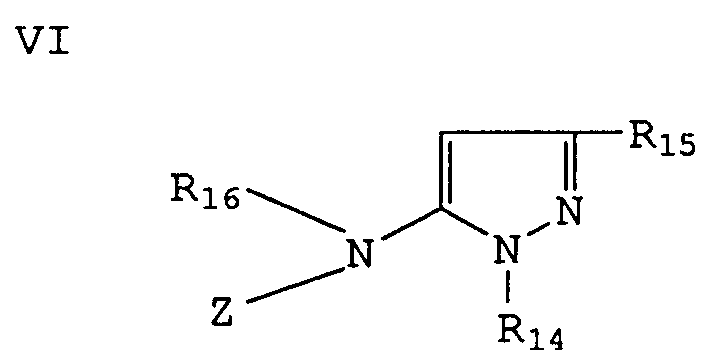
wherein R₁₄ and R₁₅ represent each a hydrogen atom or a substituent; R₁₆ represents a hydrogen atom or an alkyl group; Z represents a hydrogen atom, an alkyl group, an aryl group, -SO₂R₁₇ or
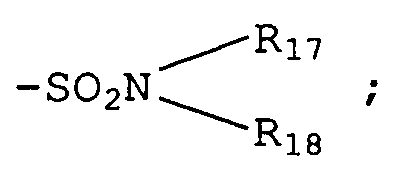
R₁₇ represents an alkyl group, an aryl group or a heterocyclic group; R₁₈ is synonymous with those represented by R₁₆, provided, R₁₆ and Z may also be coupled together so as to form a ring.
wherein R₁ represents a substituent; R₂ represents an acylamino group, a sulfonamido group, an imido group, a carbamoyl group, a sulfamoyl group, an alkoxy group, an alkoxycarbonyl group or an alkoxycarbonylamino group; R₃ represents a halogen atom or an alkoxy group; m is an integer of 0 to 5; and n is an integer of 0 to 4.
wherein R₄ represents a hydrogen atom, an alkyl group, an aryl group, an alkoxy group, an acylamino group or an amino group; R₅ represents a hydrogen atom, an alkyl group, an aryl group, an acyl group, an alkoxycarbonyl group, a carbamoyl group, an amino group or an amidino group, provided, R₄ and R₅ may also be so coupled together as to form a ring; and X represents >CH- or >N-.
wherein R₆, R₇ and R₈ represent each a hydrogen atom, an alkyl group, an alkenyl group, an aralkyl group, an aryl group or an acyl group; and R₉ and R₁₀ represent each a hydrogen atom or an alkyl group.
wherein R₁₁ represents a hydrogen atom, an alkyl group or an aryl group, provided, R₁₁ may form a naphthalene ring together with a phenyl ring; and n is an integer of not less than 2.
wherein R₁₂ represents a hydrogen atom or a substituent; and R₁₃ represents a hydrogen atom or a substituent.
wherein R₁₄ and R₁₅ represent each a hydrogen atom or a substituent; R₁₆ represents a hydrogen atom or an alkyl group; Z represents a hydrogen atom, an alkyl group, an aryl group, -SO₂R₁₇ or
R₁₇ represents an alkyl group, an aryl group or a heterocyclic group; R₁₈ is synonymous with those represented by R₁₆, provided, R₁₆ and Z may also be coupled together so as to form a ring.
2. A silver halide color photographic light sensitive material as claimed in claim 1
wherein in Formula CM-1, R₁ is a alkoxy group, R₂ is an acylamino group located at
the para-position with respect to R₃, R₃ is a chlorine atom, m is 1 ro 2, and n is
1.
3. A silver halide color photographic light sensitive material as claimed in claim 1
wherein the formalin scavenger is contained in the magenta coupler-containing layer
or one of the photographic component layers provided outer than the magenta coupler-containing
layer.
4. A silver halide color photographic light sensitive material as claimed in claim 3
wherein the formalin scavenger is contained in a protective layer.
5. A silver halide color photographic light sensitive material as claimed in claim 3
wherein the formalin scavenger is added in an amount of 0.01 to 5.0 g per square meter
of the color photographic light sensitive material.
6. A silver halide color photographic light sensitive material as claimed in claim 5
wherein the formalin scavenger is added in an amount of 0.1 to 2.0 g per square meter
of the color photographic light sensitive material.
7. A silver halide color photographic light sensitive material as claimed in claim 1
wherein the formalin scavenger is represented by Formula III through VI as claimed.
8. A silver halide color photographic light sensitive material as claimed in claim 7
wherein in Formula VI, R₁₄ is a sulfo-phenyl group, R₁₅ is an alkyl group, R₁₆ and
Z each are a hydrogen atom.
9. A silver halide color photographic light sensitive material as claimed in claim 1
wherein the green-sensitive silver halide emulsion layer contains a magenta dye forming
coupler.
10. A silver halide color photographic light sensitive material as claimed in claim 6
wherein the magenta dye forming coupler.is
a 5-pyrazolone type coupler, a pyrazoloazole type coupler, a pyrazolobenzimidazole type coupler, an open-chained acylacetonitrile type coupler and an indazole type coupler.
a 5-pyrazolone type coupler, a pyrazoloazole type coupler, a pyrazolobenzimidazole type coupler, an open-chained acylacetonitrile type coupler and an indazole type coupler.