|
(11) | EP 0 530 811 A1 |

| (12) | EUROPEAN PATENT APPLICATION |
|
|
|
|
|||||||||||||||||||||||||||
| (54) | 5-Substituted 2-oxazolidinones |
| (57) 5-alkoxymethyl or alkenyloxymethyl-2-oxazolidines, particularly those having a long
chain alkyl or alkenyl moiety are useful as a internal mold release in the polyurea
reaction injection molding technology. |
BACKGROUND OF THE INVENTION
[0001] This invention relates to a novel 2-oxazolidinone derivative having an etherfied methyl group on the 5th position.
[0002] A number of 5-aryloxymethyl-2-oxazolidinone compounds are known in the literature. For examples, 5-[(2-methoxyphenoxy)methyl]-2-oxazolidinone is an anxiolytic and muscle relaxant agent known as the generic name of Mephenoxalone. To our best knowledge, corresponding 5-alkoxymethyl or alkenyloxymethyl-2-oxazolidinones, particularly those having a long chain aliphatic hydrocarbon group as well as their pharmacological activities have not been known.
SUMMARY OF THE INVENTION
[0003] We have now discovered that 5-alkoxymethyl or alkenyloxymethyl-2-oxazolinones, particularly those having a long chain aliphatic moiety are useful as an internal mold release in the polyurea reaction injection molding (RIM) technology.
[0004] The compound of this invention has the formula I:
wherein R is an aliphatic hydrocarbon group having up to 20 carbon atoms.
DETAILED DESCRIPTION OF THE INVENTION
[0005] The compound of the formula (I) may be synthesized, as is well-known in the organic chemistory, by reacting a glycidyl ether of the formula II:
wherein R is as defined, with a carbamate ester of the formula III:
wherein R' is an ester residue.
[0006] Examples of glycidyl ethers of the formula II include methyl glycidyl ether, allyl glycidyl ether, isopropyl glycidyl ether, n-butyl glycidyl ether, 2-ethylhexyl glycidyl ether, octyl glycidyl ether, decyl glycidyl ether, lauryl glycidyl ether, myristyl glycidyl ether, palmityl glycidyl ether, stearyl glycidyl ether, oleyl glycidyl ether, 2-methyloctyl glycidyl ether and the like. C₈-C₂₀ alkyl or alkenyl ethers are preferable including their mixtures derived from naturally occurring oil and fats.
[0007] The ester residue R' of the carbamate of the formula III is a leaving group and, therefore, may be any hydrocarbon moiety including C₁-C₁₀ aliphatic hydrocarbon radicals, aromatic or arylaliphatic hydrocarbon radicals which may optionally have a substituent such as hydroxyl. Specific examples thereof include methyl, ethyl, isopropyl, butyl, benzyl, phenyl, 2-hydroxyethyl and so on. Methyl, ethyl or 2-hydroxyethyl ester is easily available and thus preferable.
[0008] The reaction may be carried out by heating both reactants without solvent while expelling an alcohol corresponding to the ester residue R' from the reaction mixture by, for instance, blowing nitrogen gas into the reaction mixture. It is known that the above reaction may be promoted by adding thereto a small amount of a tertiary amine as a catalyst. We have discovered that when using a tertiary amine and a tin compound as a catalyst of the above reaction in combination, the desired oxazolidinone compound may be obtained in an unexpectedly good yield. Examples of usable tertiary amines include aliphatic amines such as triethylamine or N, N, N', N'-tetramethylethylenedi amine; alicyclic amines such as N, N-dimethylcyclohexylamine ; aralkylamines such as N, N-dimethylbenzylamine; aromatic amines such as N, N-dimethylaniline; and heterocyclic amines such as pyridine, quinoline, imidazole, N-methylmorpholine, 1, 4-diazabicyclo [2.2.2.] octane or 1, 8-diazabicyclo [5.4.0]-7-undecene. Examples usable tin compounds include stannous chloride, dibutyltin dilaurate, stannous octenate, dibutyltin oxide, dioctyltin oxide, 1, 3-diacetoxytetrabutyldistannoxane, 1, 3-dichlorotetrabutylstan noxane, dibutyldibutoxytin and so on.
[0009] The compound of the formula (I), particularly those having a long chain alkyl or alkenyl moiety may be incorporated into a polyurea RIM composition as an internal mold release whereupon the compound is eventually immobilized to the molding by the reaction with the polyamine component thereof to form a urea linkage.
[0010] The following examples are offered for illustrative purposes only without limiting the invention thereto.
Example 1
[0011] 8.9 g (0.10 mole) of ethyl carbamate was dissolved in 13.0g (0.10 mole) of n-butyl glycidyl ether. After adding 0.2g of N, N-dimethylbenzylamine and 0.2g of di-n-butyltin dilaurate, the solution was heated at 160 °C for 2 hours while blowing nitrogen gas into the reaction mixture to remove ethanol. The product was distilled under reduced pressure to give 16.2 g (94% of theory) of 5-n-butoxymethyl-2-oxazolidinone boiling at 203-205 °C /3 mmHg.
[0012] ¹H-NMR (DMSO, δ ) ; 0.71-1.00 (t, 3H), 1.10-1.62 (m,4H), 3.05-3.61 (m,6H), 4.53-4.80 (m,1H), 7.53 (bs, 1H).
Example 2
[0013] 35.6g (0.40 mole) of ethyl carbamate was dissolved in 45.6g (0.40 mole) of allyl glycidyl ether. After adding 1.6 g of N, N-dimethylbenzylamine and 2.5 g of di-n-butyltin dilaurate, the solution was heated at 150 °C for 1 hour while blowing nitrogen gas into the reaction mixture to remove ethanol. The product was distilled under reduced pressure to give 61.7 g (98% of theory) of 5-allyloxymethyl-2-oxazolidinone boiling at 203-205°C /3 mmHg.
[0014] ¹H-NMR (CDC1₃ , δ ) ; 3.31-3.55 (dd, 1H), 3.61(d, 2H), 3.65(dd, 1H), 4.06(d, 2H), 4.60-5.00 (m, 1H), 5.10-5.40 (m, 2H), 5.69-6.17 (m, 1H), 6.75 (bs, 1H).
Example 3
[0015] 8.9 g (0.10 mole) of ethyl carbamate was dissolved in 18.6 g (0.10 mole) of 2-ethylhexyl glycidyl ether. After adding 0.41 g of N, N-dimethylbenzylamine and 0.63 g of di-n-butyltin dilaurate, the solution was heated at 160 °C for 1 hour while blowing nitrogen gas into the reaction mixutre. The product was distilled under reduced pressure to give 20.0 g (88% of theory) of 5-(2-ethylhexyl) oxymethyl-2-oxazolidinone.
[0016] ¹H-NMR (CDC1₃ , δ ) ; 0.70-1.00 (m, 6H), 1.10-1.70(m, 7H), 3.31-3.51(m, 3H), 3.51-3.78(m, 3H), 4.60-4.90 (m, 1H), 6.53(bs, 1H)
Example 4
[0017] 4.45 g (0.050 mole) of ethyl carbamate was dissolved in 16.3 g (0.050 mole) of stearyl glycidyl ether. After adding 2.0 g of N, N-dimethylbenzylamine and 2.0 g of di-n-butyltin dilaurate, the solution was heated at 160°C for 1 hour while blowing nitrogen gas into the reaction mixture. The product was purified by silica gel column chromatography (developing solvent, hexane: ethyl acetate=4:1) to give 15.9 g (85% of theory) of 5-stearyloxymethyl-2-oxazolidinone.
1. A compound of the formula:

wherein R is an alphatic hydrocarbon radical having up to 20 carbon atoms.
wherein R is an alphatic hydrocarbon radical having up to 20 carbon atoms.
2. The compound according to Claim 1, wherein said aliphatic hydrocarbon radical contains
from 8 to 20 carbon atoms.
3. The compound according to Claim 2, wherein said aliphatic hydrocarbon radical is an
alkyl.
4. The compound according to Claim 2, wherein said aliphatic hydrocarbon radical is an
alkenyl.
5. A method for preparing the compound of Claim 1 which comprises:
reacting a glycidyl ether of the formula:
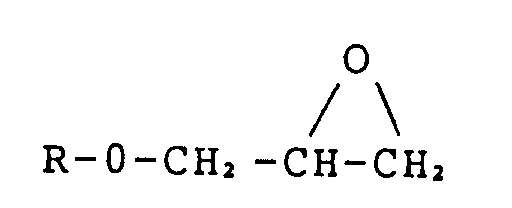
wherein R is an aliphatic hydrocarbon group having up to 20 carbon atoms, with a carbamate ester of the formula:

wherein R' is an ester residue, in the presence of a tertiary amine and a tin compound in combination.
reacting a glycidyl ether of the formula:
wherein R is an aliphatic hydrocarbon group having up to 20 carbon atoms, with a carbamate ester of the formula:
wherein R' is an ester residue, in the presence of a tertiary amine and a tin compound in combination.
6. The method according to Claim 5 wherein said tertiary amine is N, N-dimethylbenzylamine,
N, N-dimethylaniline, triethylamine, N, N-dimethylcyclohexylamine , N, N, N', N'-tetramethylethylenediamine,
N-methylmorpholine, 1, 4-diazabicyclo [ 2.2.2.]octane, 1, 8-diazabicyclo [ 5.4.0 ]-7-undecene,
pyridine, quinoline or imidazole.
7. The method according to Claim 5, wherein said tin compound is stannous chloride, stannous
octenate, di-n-butylitin dilaurate, di-n-butyltin oxide, dioctyltin oxide, 1, 3-dichlorotetrabutylstannoxane,
1, 3-diacetoxytetrabutyl -stannoxane or dibutyldibutoxytin.