|
(11) | EP 0 530 854 A1 |

| (12) | EUROPEAN PATENT APPLICATION |
|
|
|
|
|||||||||||||||||||||||||||||||
|
||||||||||||||||||||||||||||||||
| (54) | Metal-ceramic composite bodies |
| (57) A metal-ceramic composite body has a metallic member (4) and a ceramic member (1)
provided with a recess (5) and a projection (2) respectively and integrally joined
by inserting the projection into the recess. The axial length L₂ of the joined portion
and the diameter D of the projection may be set to satisfy the following relationship: |
[0001] The present invention relates to metal-ceramic composite bodies in which a ceramic member is integrally joined to a metallic member.
[0002] Since ceramic materials such as zirconia, silicon nitride, and silicon carbide have excellent mechanical strength, heat resistance, and wear resistance, they have been put into practical uses as high temperature structural materials or wear-resisting materials for gas turbine engine parts; internal combustion engine parts, etc. However, since ceramics are generally hard and brittle, they are inferior to metallic materials with respect to shapability and processability. Further, since ceramics have poor toughness, they have low resistance against impact forces. For this reason, it is difficult to form mechanical parts such as engine parts from ceramic materials only. In many cases, such ceramic materials are generally used in the form of a composite structure in which a metallic member is joined to a ceramic member.
[0003] When a metallic member is to be joined to a ceramic member, a joined body is generally obtained by shrinkage fitting a projection of the ceramic member into a recess of the metallic member or by brazing them. In this case, stress is likely to be concentrated at an end of a joined portion between the outer surface of the projection of the ceramic member and the inner surface of the recess of the metallic member. Consequently, strength of the joined structure against bending or twisting is reduced, and there is a fear that the ceramic member will break.
[0004] In the case of the metal-ceramic joined composite body in which a projection formed at the ceramic member is integrally joined to the recess of the metallic member, in order to prevent stress concentration at the end of the joined composite body, JP-A-59-159,408 discloses a joined structure in which a groove is formed in the outer peripheral portion of the projection, and joining is effected by a shrinkage fitting, as a mechanical joining method, and such that an end of the groove is located at an end of a joined portion between the projection of the ceramic member and the recess of the metallic member.
[0005] However, even when this structure is attained by the above-mentioned mechanical joining, an edge of the groove provided all around the periphery of the projection of the ceramic member contacts the recess of the metallic member, and excessive stress concentration occurs there. Consequently, bending strength and twisting strength of the joined composite body is lower, and the ceramic member is likely to be broken.
[0006] Even if the edge of the groove is designed as an angular edge or a rounded edge, stress concentration more or less occurs there. For this reason, bending strength and twisting strength of the joined composite body is also lower, and the ceramic member is likely to be broken. Further, when the joined composite body is used in an atmosphere such as a combustion gas, the end of the joined portion is exposed to the combustion gas, so that durability of the joined composite body lowers.
[0007] Further, there have been known metal-ceramic composite bodies in which an outer surface of a projection of a ceramic member is joined to an inner surface of a recess of a metallic member by brazing, and the projection is firmly fixed, in the thus joined portion, to a brazing metal present between the outer surface of the projection of the ceramic member and the inner surface of the recess of the metallic member through chemical joining over the entire surface of the projection.
[0008] Consideration is now made of a case where a projection of a ceramic member is to be joined to a recess of a metallic member by brazing. When temperature is lowered from a solidifying point of the brazing metal to room temperature, the amount of shrinkage of the metallic member or the brazing metal is generally greater, since there is a difference in coefficient of thermal expansion, i.e., since the metallic member or the brazing metal has a larger coefficient of thermal expansion while that of the ceramic member is smaller. However, as mentioned above, in the structure in which the projection of the ceramic member is firmly fixed to the brazing metal over the whole of their contact surfaces through chemical joining, the brazing metal is firmly fixed to the ceramic member due to shrinkage of the metallic member or the brazing metal during cooling. Consequently, the brazing metal cannot slip relative to the ceramic member at their joining interface so that shrinking forces of the metallic member or the brazing metal act upon the ceramic member and excessive tensile stress occurs in the ceramic member. Further, sufficient investigations have not been made upon the relationship between the surface of the tip end of the projection and the bottom surface of the recess, or the relationship between the diameter and the length of the joined portions has not fully been considered.
[0009] Therefore, tensile stress greatly concentrates particularly upon the end of the joined portion of the ceramic member, which reduces resistance of the joined composite body against bending or twisting, and reduces reliability.
[0010] It is an object of the present invention to solve the above-mentioned problems and to provide metal-ceramic joined composite bodies which can readily be produced and which have high joining strength.
[0011] It is another object of the present invention to overcome the above-mentioned problems, and provide metal-ceramic joined composite bodies which have extremely high joining strength both at room temperature and at elevated temperatures.
[0013] In the construction of the present invention, stress concentration occurring at the end of the joined portion due to difference in thermal expansion between the ceramic member and the metallic member can be reduced by selecting the optimum joining length L₂ depending upon the diameter D of the projection of the ceramic member. As a result, bending and twisting strength of the joined composite body increases to enhance reliability. The reason why the value of L₂/D is not less than 0.2 and not more than 0.39 is that if it is more than 0.39, as clear from examples mentioned later, the fracture bending load lowers so that desired strength cannot be obtained. Further, if it is less than 0.2, the brazing area decreases to lower joining strength and to allow easy slip-out of the projection of the ceramic member from the recess of the metallic member.
[0014] The joining length L₂ is a length of a brazed portion between the inner peripheral surface of the recess of the metallic member and the outer peripheral surface of the projection of the ceramic member.
[0015] We refer to our European Patent Application No 0333339, from which the present invention is a divisional and in which are described other aspects of the joining of metal and ceramics parts. The content of that application is hereby incorporated in the present application, in so far as it is not explicitly recited.
[0016] In a preferred construction of the invention, a groove is formed all around the periphery of the projection of the ceramic member in the vicinity of the end of the joined portion, and the brazing metal is interposed at least between the edge of the groove and the recess of the metallic member. Thus the groove may be wholly or partly filled with the brazing metal. Alternatively, the enlargement, e.g. a stepped portion, is provided to increase the inner diameter of the recess of the metallic member at the opening portion thereof, and the brazing metal is interposed at least between the enlargement and the projection of the ceramic member on joining. Thus, stress concentration upon the ceramic member is mitigated by cushioning action of the brazing metal. Accordingly, a high reliability metal-ceramic joined composite body which is difficult to break due to bending or twisting forces can be obtained.
In addition, when the groove is formed substantially all around the periphery of the projection of the ceramic member in the vicinity of the end of the joined portion, the brazing metal is interposed at least between the edge of the groove and the recess of the metallic member, and the brazing metal is arranged in the groove, the ceramic member is prevented from being slipped out from the recess of the metallic member by the brazing metal present in the groove. Thus, the joined composite body has improved reliability against slip-out.
[0017] Furthermore, when the joining between the metallic member and the ceramic member is limited to between the outer peripheral surface of the projection of the ceramic member and the inner peripheral surface of the recess of the metallic member, and the surface of the tip end of the projection of the ceramic member is prevented from being joined to the bottom surface of the recess of the metallic member by providing, therebetween, a space, or an intermediate member or a film which is made of a low elasticity material having no joinability to the brazing metal, stress concentration due to residual stress at the tip end of the projection of the ceramic member and at the end of the joined portion is mitigated. Consequently, a high reliability metal-ceramic joined composite body which is difficult to break due to bending or twisting forces can be obtained. Such a method of joining is thus preferred.
[0018] The brazing metal is present between the groove formed in the projection of the ceramic member and the recess of the metallic member or between the projection of the ceramic member and the enlargement of the recess of the metallic member. Since the brazing metal becomes thicker, stress concentration which would occur at the end of the joined portion of the ceramic member owing to difference in shrinkage amount between the metallic member and the ceramic member during cooling from the brazing temperature can be reduced.
[0019] When the outer peripheral surface of the projection and the inner peripheral surface of the recess of the metallic member are brazed together at the contact portion only, residual stress occurring at the end of the joined portion can be mitigated. Further, since the brazing metal reacts with the ceramic member and the metallic member, a firm joined portion can be formed between the members. Therefore, the joining strength is improved in a range from room temperature to high temperatures. Moreover, the shrinkage fitting effect can additionally be obtained when cooling is effected from the joining temperature. Thus, high strength can be obtained. Therefore, a preferable effect can be obtained in this case.
[0020] In this specification, the term "recess" is used as appropriate both for a recess having a closed inner end and for an open-ended recess i.e. a through-hole.
Embodiments of the invention are described below by way of non-limitative example with reference to the drawings, in which:-
Figs 1a through 1c are partially sectional views of embodiments of the metal-ceramic joined composite bodies according to the present invention; and
Fig 2 is a view illustrating a bending tester used for testing;
Fig 3 is a diagram showing results with respect to embodiments according to the present invention.
[0021] Before explaining the drawings, some general remarks on processes and materials usable in the invention will be made.
[0022] As mentioned above, preferably the tip end of the projection of the ceramic member is not joined to the bottom surface of the metal member. This may be achieved by forming a thin film made of a material having no joinability to the brazing metal on the tip end surface of the projection provided on the ceramic member, by providing the intermediate member made of such a material or a space between the bottom surface of the recess of the metallic member and the tip end surface of the projection of the ceramic member, or by combining these measures.
[0023] As the material having no joinability to the brazing metal, mention may be made of graphite by way of example. A film of graphite can easily be formed on the tip end surface of the projection by brushing or spraying a graphite particle-suspended liquid thereonto or by immersing a graphite particle-suspended liquid thereinto. As the intermediate member, low elasticity materials such as sliver, felt, web, web sintered body, and woven cloth composed of graphite fibers may preferably be used singly or in combination.
[0024] When the intermediate member is interposed between the tip end surface of the projection and the bottom surface of the recess, the positional limitation of the joined portion can easily and assuredly be effected. Therefore, residual stress which would occur at the end of the joined portion of the ceramic member can be reduced and controlled after the joining, and it is possible to increase joining strength and to decrease variations thereof.
[0025] The interposition of the intermediate member made of the low elasticity material is not only to prevent joining between the brazing metal and the bottom surface of the recess, but also to prevent mutual interference between the tip end surface of the projection and the bottom surface of the recess, which would occur due to difference in shrunk amount between the ceramic member and the metallic member during cooling from the joining temperature. Thus, this serves to prevent occurrence of excess residual stress at the joined portion, and to effectively penetrate the molten brazing metal into a gap between the outer peripheral surface of the projection and the inner peripheral surface of the recess.
[0026] As the brazing metal used for joining the ceramic member to the metallic member, use is preferably made of an active brazing metal containing an active metal element capable of chemically joining to the ceramic member. As the brazing metal, use may be made of a brazing alloy containing an active metal element, or a brazing metal in which a metal substrate is coated with an active metal element. In view of easy adjustment of the addition amount of the active metal to the brazing metal, ease of handling easiness, or ease of production easiness, it is preferable to use the brazing metal in which the metal substrate is coated with the active metal element. It is more preferable to use a brazing metal in which an active metal element is vapor deposited upon a metal substrate. As such an active metal element, at least one metallic element selected from the group consisting of Zr, Ti, Ta, Hf, V, Cr, La, Sc, Y and Mo is preferably used when the ceramic member to be joined is made of a ceramic material containing at least a nitride and/or a carbide. When the ceramic member to be joined is made of an oxide type ceramic, at least one metallic element selected from the group consisting of Be, Zr and Ti is preferably used.
[0027] Since the above active brazing metals have good wettability to the ceramic member, it is unnecessary to effect a special pretreatment such as metallizing treatment for the ceramic member. As to the metallic member, its wettability is improved by plating it with Ni. Therefore, since the molten brazing metal can be penetrated into a position to be joined by utilizing capillary action, the brazing can be effected with suffering few defects such as bubbles or shrinkage cavities only by controlling the gap formed at the joining position, without preliminarily arranging the brazing metal at this joining position.
[0028] Even when the brazing is to be effected by using a brazing metal containing no active metal, similar effects as in the case of the brazing metal containing the active metal can be obtained by providing a metallizing layer at the position to be joined on the outer peripheral surface of the projection of the ceramic member, plating the metallizing layer with Ni, and preferably further plating a position to be joined of the inner peripheral surface of the recess of the metallic member with Ni. In this case, since the joining is not effected at the tip end surface of the projection having no metallizing layer because of no reaction between the brazing metal and the ceramic member, a gap is formed between the tip end surface of the projection and the bottom surface of the recess. Furthermore, wettability between the inner surface of the recess and the brazing metal is preferably improved by plating the joining position on the inner surface of the recess of the metallic member with Ni.
[0029] Moreover, when the brazing is effected while an active metal foil is arranged between the outer peripheral surface of the projection of the ceramic member and the inner peripheral surface of the recess of the metallic member at a joining position and a brazing metal containing no active metal is placed between the bottom surface of the recess of the metallic member and the tip end surface of the projection of the ceramic member, similar effects as obtained when the active brazing metal is used can be obtained.
[0030] When the joining is substantially effected by utilizing mechanical joining such as press fitting, shrinkage fitting, or expansion fitting while the brazing metal is located at least between the edge of the groove provided around the entire periphery of the projection in the vicinity of the end of the joined portion and the recess of the metallic member, excess stress concentration at the edge of the groove which would occur through contacting between the edge of the groove and the recess of the metallic member when the joining is effected by the mechanical joining only is reduced so that a corrosive gas such as high temperature combustion gas can be prevented from entering the joining interface. Thus, such a joining is preferred.
[0031] In the above-mentioned process in which when the joining is substantially effected by utilizing the mechanical joining, the brazing metal is interposed between the edge of the groove and the recess of the metallic member, the brazing metal arranged at the groove is melted and penetrated between the edge of the groove and the recess by heating the constituent members up to the melting point of the brazing metal. Thus, the construction according to the present invention can be attained more easily in this process. The brazing metal used in the above process may be an active brazing metal or a brazing metal containing no such an active metal.
[0032] Preferably, the joining is substantially effected by utilizing mechanical joining such as press fitting, shrinkage fitting, or expansion fitting, because when the joining is effected only between the outer peripheral surface of the projection of the ceramic member and the inner peripheral surface of the recess of the metallic member at the contacting surfaces thereof, residual stress which would be caused by mutual interference between the projection and the recess, which results from difference in thermal expansion or thermal shrinkage between the ceramic member and the metallic member, is removed.
[0033] The limitation of the joined portion to the above location is effected by arranging the intermediate member or the space between the bottom surface of the recess and the tip end surface of the projection.
[0034] Further, when the joining is substantially effected by press fitting, a desired space can be provided between the tip end surface of the projection and the bottom surface of the recess. Thus, such joining is preferred.
[0035] Furthermore, when the joining is substantially effected by press fitting, as disclosed by NGK Insulators, Ltd. in Japanese Patent Application No. 61-285,974, when the ceramic member and the metallic member are placed in a vessel, and are press fitted together under reduced pressure of about 10 Torr, compressed air is not left in the space formed between the projection of the ceramic member and the recess of the metallic member. Thereby, more reliable joined composite body can be obtained. Thus, such joining is preferred.
[0036] As the ceramic material constituting the metal-ceramic joined composite bodies according to the present invention, any suitable ceramic material may be used. When practical applicability is taken into consideration, at least one ceramic material selected from the group consisting essentially of silicon nitride, silicon carbide, sialon, zirconia, alumina, mullite, aluminum titanate, and cordierite is preferred. Which ceramic material or materials should be used among them may be determined depending upon use purposes of the metal-ceramic joined composite bodies according to the present invention and kinds of metallic members and brazing metals to which the ceramic members are to be joined.
[0037] As the metallic material constituting the metal-ceramic composite body according to the present invention, a metallic material having a coefficient of thermal expansion near that of the ceramic material used is preferably selected. Particularly, as the metallic material to be joined to the ceramic material having excellent strength at high temperatures, for instance, silicon nitride, silicon carbide, sialon, etc., Incoloy 903 (trade name), Incoloy 909 (trade name), Koval (trade name) or the like is preferably selected. When the metal-ceramic joined composite body according to the present invention is applied as a rotary shaft, such as a turbocharger rotor, rotating at high speeds at high temperatures, Incoloy 903 or Incoloy 909 which has a higher strength than that of Koval is preferably selected as the metallic material. In Table 1, coefficients of thermal expansion of carbon steel and SNCM 439 (JIS) as ordinary metallic materials, as well as coefficients of thermal expansion and tensile strength of Incoloy 903, Incoloy 909 and Koval, are shown.
Table 1
| Metallic material | Coefficient of thermal expansion (room temperature∼500°C) l/°C | Tensile strength (kg/mm²) |
| Incoloy 903 | 8.0 × 10⁻⁶ | 110 |
| Incoloy 909 | 8.0 × 10⁻⁶ | 105 |
| Koval | 6.0 × 10⁻⁶ | 70 |
| Carbon steel | 14 × 10⁻⁶ | - |
| SNCM 439 | 14 × 10⁻⁶ | - |
[0038] The present invention will be explained in more detail with references to the attached drawings.
[0040] Figs 1a through 1c are partially sectional views illustrating embodiments of the metal-ceramic joined composite bodies according to the present invention. In each embodiment, a projection 2 of a ceramic member 1 is joined to a recess 5 of a metallic member 4 by brazing with use of a brazing metal 5. When an axial joined length between the projection 2 and the recess 5 and the outer diameter of the projection 2 are taken as L₂ and D, respectively, the requirement of 0.2≦L₂/D≦0.39 is met.
[0041] In the embodiment shown in Fig. 1a, the entire inner surface of the recess 5 of the metallic member 4 at a position to be joined is plated with Ni, and the joining is effected with use of the active brazing metal 6. Thus, the inner surface of the recess 5 is brazed to the outer surface of the projection 2 of the ceramic member 1 at the substantially entire contact surface. When an ordinary Ag-Cu brazing alloy containing no active metal element is used, the entire inner surface of the recess 5 is plated with Ni as mentioned above, a metallizing layer is formed on the entire outer surface of the projection 2 at a location to be joined, and the metallizing layer is plated with Ni. Thereby, joining can be similarly effected.
[0042] In the embodiment shown in Fig. 1b, at least the inner peripheral surface of the recess 5 at a location to be joined is plated with Ni, graphite is coated onto the tip end surface of the projection 2, the outer peripheral surface of the projection 2 is joined to the inner peripheral surface of the recess 5 by brazing with use of the active brazing metal 6, while a space 7 is provided between the bottom surface of the recess 5 and the tip end surface of the projection 2.
[0043] In the embodiment shown in Fig. 1c, at least the inner peripheral surface of the recess 5 at a location to be joined is plated with Ni, graphite is coated onto the tip end surface of the projection 2, a graphite felt 8 as a low elasticity intermediate member made of a material not joinable to the brazing metal is placed on the bottom surface of the recess 5, the active brazing metal is placed on the graphite felt to contact the tip end surface of the projection, a joining assembly is formed by inserting the projection 2 into the recess 5, the brazing metal is melted by heating the joining assembly in vacuum, and is permeated into a location to be joined by utilizing capillary action. Consequently, the outer peripheral surface of the projection 2 is joined to the inner peripheral surface of the recess 5 by brazing, while the intermediate member is positioned between the bottom surface of the recess 5 and the tip end surface of the projection 2 to make the bottom surface of the recess 5 to be not joined or directly contacted with the tip end surface of the projection 2.
[0044] As shown in Figs.1b and 1c, the bottom surface of the recess 5 is not directly contacted or joined with the tip end surface of the projection 2 due to the space 7 or the graphite felt 8. In such a structure, stress concentration which would occur at the tip end of the projection or near the joined end 20 in the case that the bottom surface of the recess 5 is contacted with or joined to the tip end surface of the projection 2 can preferably be prevented.
[0045] Hereinafter, an actual experiments for the third aspect of the present invention will be explained.
Experiment 1
[0046] Metallic members 4 were prepared from a round rod made of a solution-treated Incoloy 903 having a diameter of 18 mm. The metallic member had a recess 5 having an inner diameter of 11.05 mm and a depth of 8 mm at one end and a thin shaft portion of 12 mm in diameter. Ceramic members 1 each having a projection 2 at one end were prepared from silicon nitride sintered bodies obtained by pressureless sintering. The projection 2 had a diameter of 11.0 mm and a length of 10 mm.
[0047] A bottom corner of the recess 5 was beveled at CO.2, and its open end corner was tapered. An edge of a tip end of the projection 2 was tapered at CO.5, and its base portion was rounded at R2.
[0048] According to the methods shown in Figs. 1a through 1c metal-ceramic joined composite bodies of the present invention and Comparative Examples were obtained with use of an active brazing metal in which Ti was vapor deposited in a thickness of 2 µm upon a Ag-Cu brazing alloy plate of 0.1 mm thickness, while L₂/D values were varied. In Figs. 1a to 1c, the thickness of the Ni plating was 10 µm. In the embodiment of Fig. 1c, a graphite felt 8 of 0.4 mm thickness was used as a low elasticity intermediate member having no joinability to the brazing metal.
[0049] With respect to each of the joined composite bodies in the present invention and Comparative Examples, a load was applied to the ceramic member 1 while the metallic member 4 was fixed to the bending tester shown in Fig. 2. The bending load at which the projection 2 of the ceramic member 1 was broken from the joined end was measured as a fracture bending load. In Fig. 2 , ℓ₁=40 mm and ℓ₂=5 mm. Results are shown in Table 2 and Fig. 3.
Table 2
| L₂/D | Fracture bending load P (kg) | ||
| Fig. 1a | Fig. 1b | Fig. 1c | |
| 0.45 | 31 | ||
| 43 | - | - | |
| 15 | |||
| 0.39 | 76 | 126 | 154 |
| 82 | 144 | 138 | |
| 88 | 132 | 137 | |
| 0.35 | 130 | 170 | 164 |
| 140 | 185 | 179 | |
| 141 | 162 | 175 | |
| 0.30 | 153 | ||
| 135 | - | - | |
| 140 | |||
| 0.25 | 137 | 159 | 176 |
| 120 | 180 | 173 | |
| 145 | 165 | 163 | |
| 0.20 | 101 | 148 | 158 |
| 124 | 170 | 161 | |
| 130 | 154 | 143 | |
[0050] It is seen from Table 2 and Fig. 3 that the fracture bending load of not less than 70 kg can be obtained when L₂/D is not less than 0.2 but not more than 0.39. L₂/D is more preferably not less than 0.25 but not more than 0.35.
[0051] As compared with the joined composite bodies shown in Fig. 1a having the entire surface-brazed structure, those in Fig. 1b in which a space was provided between the bottom surface of the recess and the tip end surface of the projection and those shown in Fig. 1c in which the graphite felt was provided as the low elasticity intermediate member having no joinability to the brazing metal exhibited higher fracture bending loads.
[0052] The present invention is not limited to the above-mentioned embodiments, but various modifications and changes can be made. For example, in the above embodiments, the space or the intermediate member only was provided between the bottom surface of the recess and the tip end surface of the projection. However, the same effect can be obtained by forming a thin film made of a material having no joinability to the brazing material on the tip end surface of the projection of the ceramic member. Also, such an effect can surely be obtained by combining any of the thin film, the space, and the intermediate member.
[0053] As is clear from the above-detailed explanation, according to the metal-ceramic joined composite bodies of the present invention, stress concentration which is caused by residual stress acting upon the joined end due to difference in thermal expansion between the metallic member or the ceramic member and the brazing metal can be reduced by limiting the diameter of the projection, and the joining length. Thus, high reliability metal-ceramic joined composite bodies which are difficult to be broken due to bending or twisting can be obtained.
[0054] When turbocharger rotors in which a turbine vane wheel and a part of a turbine shaft are made of silicon nitride ceramic and the remainder is made of a metal having high strength are constituted by the metal-ceramic joined composite bodies according to the present invention, residual stress can be reduced. Therefore, the turbocharger rotors having excellent durability and excellent response can be obtained.
1. A metal-ceramic composite body in which a projection (2) formed on a ceramic member
(1) is inserted into a recess (5) formed in a metallic member (4) , and the projection
is integrally joined to the recess by brazing, characterised in that the joining is
effected to meet the following relationship:
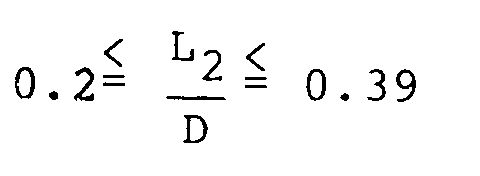
in which L₂ is the axial length of the joined portion between the recess of the metallic member and the projection of the ceramic member and D is the diameter of the projection.
in which L₂ is the axial length of the joined portion between the recess of the metallic member and the projection of the ceramic member and D is the diameter of the projection.
2. The metal-ceramic composite body according to claim 1, wherein the joining is effected
only between an outer peripheral surface of the projection and the inner peripheral
surface of the recess, while a tip end surface of the projection is not joined to
a bottom surface of the recess.
3. The composite body according to claim 1 or claim 2, further comprising an intermediate
member (8) of a material not joinable to the brazing material located between the
projection and a bottom surface of the recess.
4. The composite body according to claim 1 or claim 2, wherein a space (7) is formed
between the projection and a bottom surface of the recess.