|
(11) | EP 0 531 920 A1 |

| (12) | EUROPEAN PATENT APPLICATION |
|
|
|
|
|||||||||||||||||||||||||||
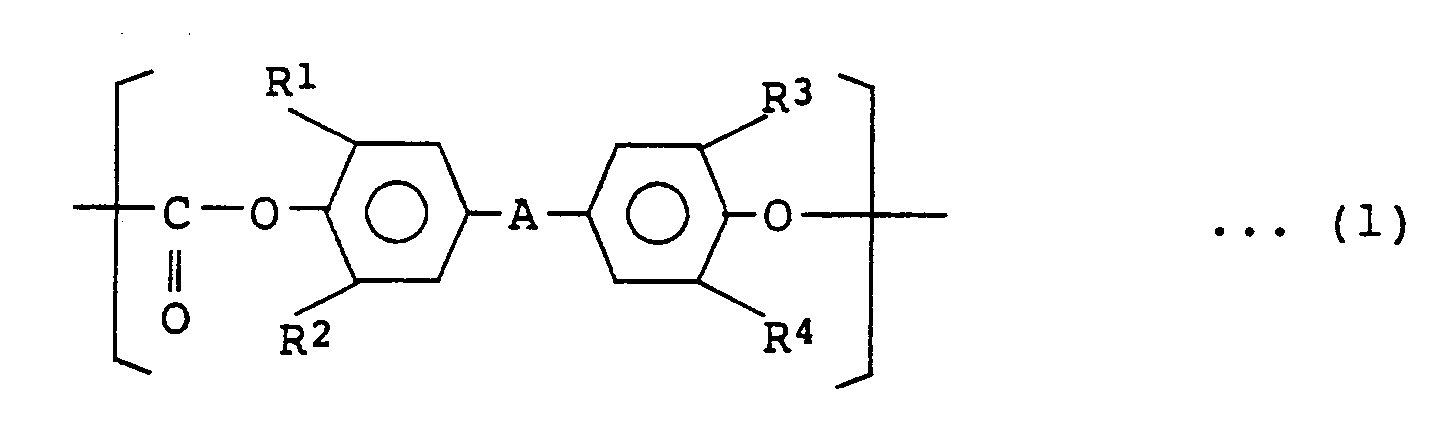
| (54) | Polycarbonate resins having terminal vinyl groups and process for producing the same |
| (57) Novel polycarbonate resins having 2 to 400 structural units of bisphenol carbonate
on average and vinylbenzoic acid terminal groups bonded to the bisphenol residues
have a high stability and are produced by interfacial polymerization or solution polymerization,
using vinylbenzoic acid as a molecular weight modifier. |
BACKGROUND OF THE INVENTION
1) Field of the Invention
[0001] The present invention relates to novel polycarbonate oligomers or resins having terminal vinyl groups and a process for producing the same. By virtue of vinyl groups existing at the polymer terminals, the present polycarbonate oligomers or resin (hereinafter referred to as "polycarbonate resin") are useful for various applications such as raw materials for producing block copolymers with other resins, a reactive resin modifier, or film materials.
2) Prior Art
[0002] Heretofore, it has been known to use monovalent phenols such as p-tertiary butylphenol, phenol, etc. as a terminating agent or a molecular weight modifier for polycarbonate resins or to use long chain alkylphenols to improve their flowability (Japanese Patent Publication No. 52-50078).
[0003] The polycarbonate resins produced with these prior art molecular weight modifiers, have essentially inactive polymer terminals, because their molecular chain terminals are closed. Thus, in their modifications by making their compositions with other resins or fillers, their mating resins are limited or the heat resistance of the resulting compositions are deteriorated due to simple blending.
[0004] Polycarbonate resin block copolymers prepared by addition polymerization of terminally unsaturated polycarbonate resins with a vinyl compound are disclosed in Japanese Patent Publication No. 48-25076, where aliphatic compounds are exemplified as unsaturated groups and vinylphenol is also disclosed. However, since the vinyl group of vinylphenol as an aromatic compound is highly reactive, gels are formed during the reaction. That is, it has been desired to obtain highly stable polycarbonate resins having vinyl terminals.
SUMMARY OF THE INVENTION
[0005] As a result of extensive studies on improvement of these disadvantages of prior art, the present inventors have found that polycarbonate resins having vinylbenzoic acid terminals have a very good stability.
[0006] An object of the present invention is to provide highly stable polycarbonate resins having vinyl terminals.
[0007] Another object of the present invention is to provide a process for producing highly stable polycarbonate resins having vinyl terminals.
[0008] That is, the present invention provide polycarbonate resins having 2 to 400 structural units represented by the following general formula (1) on average:
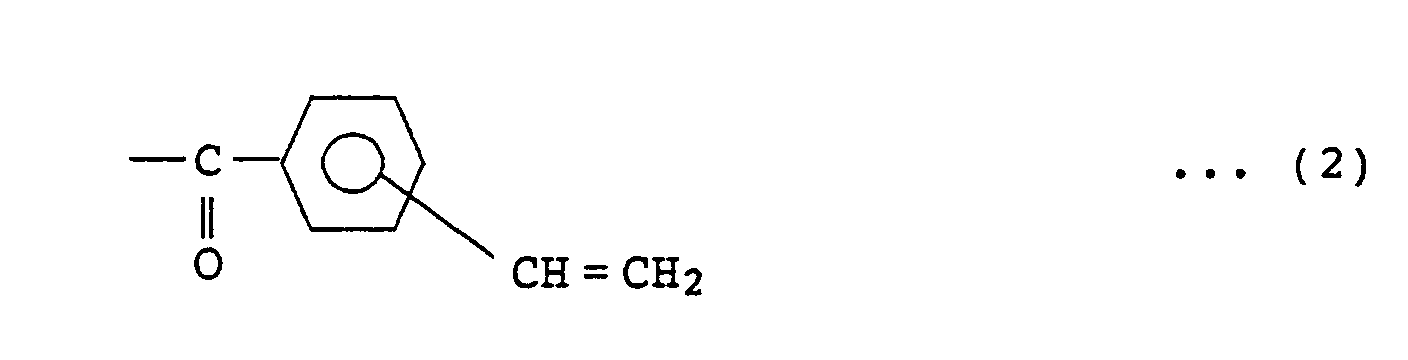
and having a terminal group represented by the following general formula (2), bonded to the bisphenol residue of the general formula (1):
, wherein in the general formula (1) A represents a straight, branched or cyclic alkylidene group having 1 to 10 carbon atoms, an aryl-substituted alkylidene group, an arylene group, or -O-, -S-, -CO-, -SO- or -SO₂-, and R¹, R², R³ and R⁴ are the same or different from one another and each represent hydrogen, halogen, an alkyl having 1 to 6 carbon atoms or an aryl.
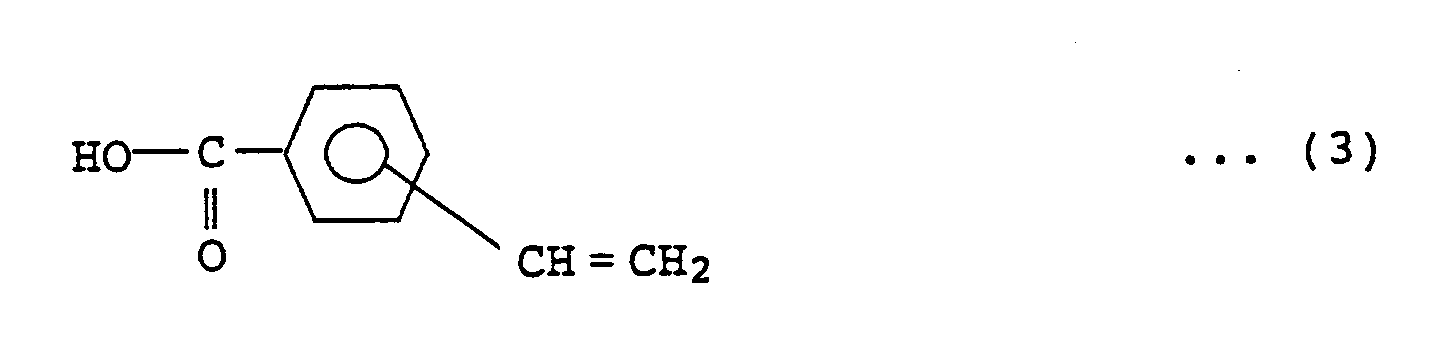
[0009] Furthermore, the present invention provides a process for producing polycarbonate resins having vinyl terminals by interfacial polymerization, comprising reacting a divalent phenol compound with phosgene in an inert organic solvent in the presence of an aqueous alkali solution, then adding a molecular weight modifier and a polymerization catalyst to the reaction mixture, and conducting polymerization or by solution polymerization, comprising dissolving a divalent phenol compound and a molecular weight modifier in pyridine or a mixture of pyridine with an inert solvent, and introducing phosgene thereto, thereby conducting polymerization reaction, wherein a vinylbenzoic acid represented by the following general formula (3) is used as the molecular weight modifier:
DETAILED DESCRIPTION OF THE INVENTION
[0010] The present polycarbonate resins have vinyl groups represented by the general formula (2) as terminal groups and have structural units represented by formula (1) of 2 to 400 on average, and can contain at least one kind of the structural unit represented by the general formula (1).
[0011] In the present invention, the polycarbonates having 2 to 20 of structural units represented by formula (1) are called "polycarbonate oligomers" and polycarbonates having more than 20 of structural units represented by the formula (1) are called "polycarbonate resins".
[0012] The number of the structural units represented by formula (1) roughly depends on an amount of a molecular weight modifier to be used. Thus, in the production of polycarbonate oligomers, 100 to 10 moles, preferably 40 to 20 moles, of vinylbenzoic acid represented by the general formula (3) is used per 100 moles of a divalent phenol compound. In the production of polycarbonate resins, 10 to 0.5 moles, preferably 7 to 2 moles, of the vinylbenzoic acid is used per 100 moles of the divalent phenol compound. In the present invention, a so far well known molecular weight modifier can be used together with the vinylbenzoic acid represent by the general formula (3).
[0013] The present polycarbonate resins can be produced in the same manner as in the conventional process for producing polycarbonate resins except that vinylbenzoic acid represented by the general formula (3), for example, 2-vinylbenzoic acid, 4-vinylbenzoic acid, etc. is used as a molecular weight modifier or a terminating agent. That is, the present polycarbonate resins can be produced by interfacial polymerization or solution polymerization, using a vinylbenzoic acid represented by the general formula (3) as a molecular weight modifier or a terminating agent.
[0014] In the interfacial polymerization, a divalent phenol compound is reacted with phosgene in an inert organic solvent in the presence of an aqueous alkali solution and then the molecular weight modifier and a polymerization catalyst such as a tertiary amine or a quaternary amine are added to the reaction mixture, thereby conducting polymerization.
[0015] In the solution polymerization using pyridine, a divalent phenol compound and the molecular weight modifier are dissolved in pyridine or a mixture of pyridine with an inert solvent, and phosgene is introduced into the solution, thereby directly producing the polycarbonate resins.
[0016] In the interfacial polymerization, the molecular weight modifier can be added during the reaction of the divalent phenol compound with the phosgene.
[0017] The present polycarbonate resins can be used in various applications. In paint applications, polycarbonate oligomers are used, and preferable divalent phenol compounds for the paint applications include 1,1-bis(4-hydroxyphenyl)cyclohexane, 1,1-bis(4-hydroxyphenyl)-1-phenylethane, 2,2-bis(4-hydroxy-3-methylphenyl)propane, etc.
[0018] Specifically preferable divalent phenol compounds for the present polycarbonate resins include, for example, bis(4-hydroxyphenyl)methane, bis(4-hydroxyphenyl)ether, bis(4-hydroxyphenyl)sulfone, bis(4-hydroxyphenyl)sulfoxide, bis(4-hydroxyphenyl)sulfide, bis(4-hydroxyphenyl)ketone, 1,1-bis(4-hydroxyphenyl)-ethane, 2,2-bis(4-hydroxyphenyl)propane, 2,2-bis(4-hydroxyphenyl)butane, 1,1-bis(4-hydroxyphenyl)cyclohexane, 2,2-bis(4-hydroxy-3,5-dibromophenyl)propane, 2,2-bis(4-hydroxy-3,5-dichlorophenyl)propane, 2,2-bis(4-hydroxy-3-bromophenyl)propane, 2,2-bis(4-hydroxy-3-chlorophenyl)propane, 2,2-bis(4-hydroxy-3-methylphenyl)propane, 2,2-bis(4-hydroxy-3,5-dimethylphenyl)propane, 1,1-bis(4-hydroxyphenyl)-1-phenylethane, bis(4-hydroxyphenyl)diphenylmethane, etc.
[0019] Inert organic solvents for use in the present invention include, for example, chlorinated hydrocarbons such as dichloromethane, 1,2-dichloroethane, 1,1,2,2-tetrachloroethane, chloroform, 1,1,1-trichloroethane, carbon tetrachloride, monochlorobenzene, dichlorobenzene, etc.; aromatic hydrocarbons such as benzene, toluene, xylene, ethylbenzene, etc.; and etheral compounds such as diethylether, etc., and can be used in a mixture thereof. If desired, solvents with an affinity to water, such as other ethers than the above-mentioned, ketones, esters, nitriles, etc. can be used within such a range that the resulting solvent mixture may not be completely solvent in water.
[0020] Polymerization catalysts for use in the present invention include, for example, tertiary amines such as trimethylamine, triethylamine, tributylamine, tripropylamine, trihexylamine, tridecylamine, N,N-dimethylcyclohexylamine, pyridine, quinoline, dimethylaniline, etc., and tertiary amines such as trimethylbenzylammonium chloride, tetramethylammonium chloride, triethylbenzylammonium chloride, etc.
[0021] The present polycarbonate resins are produced from the above mentioned components as essential ones. A branching agent can be used together in the present invention. That is, 0.01 to 3% by mole, particularly 0.1 to 1.0% by mole, of a branching agent can be used on the basis of the divalent phenol compound to produce branched polycarbonates. Branching agents for use in the present invention include, for example, polyhydroxy compounds such as fluoroglycine, 2,6-dimethyl-2,4,6-tri(4-hydroxyphenyl)heptene-3, 4,6-dimethyl-2,4,6-tri(4-hydroxyphenyl)heptene-2, 1,3,5-tri(2-hydroxyphenyl)benzene, 1,1,1-tri(4-hydroxyphenyl)ethane, 2,6-bis(2-hydroxy-5-methylbenzyl)-4-methylphenol, α,α',α''-tri(4-hydroxyphenyl)-1,3,5-triisopropylbenzene, etc.; 3,3-bis(4-hydroxyaryl)oxyindol (=isatinbisphenol), 5-chloroisatinbisphenol, 5,7-dichloroisatinbisphenol, 5-bromoisatinbisphenol, etc.
[0022] The present polycarbonate resins have highly active terminals and thus can be used as raw materials for copolymerization or for the production of compositions with such resins that are not readily compatible with the conventional polycarbonates, resulting in failure to form useful compositions, that is, for the production of compositions with other polymers readily reactable with vinyl groups by melt mixing. That is, the present polycarbonate resins can be used alone or together with conventional polycarbonate resins.
[0023] The present polycarbonate resins may further contain an antioxidant, a photo-stabilizer, a coloring agent, an inorganic or organic filler, a reinforcing agent such as carbon fibers, glass fibers, a lubricant, an antistatic agent, etc., when desired in view of end use.
PREFERRED EMBODIMENTS OF THE INVENTION
[0024] The present invention will be described in detail below, referring to Examples and Comparative Examples.
Example 1
[0025] 3.7 kg of sodium hydroxide was dissolved in 42 ℓ of water, and further 7.3 kg of 2,2-bis(4-hydroxyphenyl)propane (which will be hereinafter referred to as "BPA") and 8 g of sodium hydrosulfite were dissolved therein, while keeping the solution at 20°C.
[0026] Then, 28 ℓ of methylene chloride (which will be hereinafter referred to as "MC") was added thereto, and 156 g of p-vinylbenzoic acid (which will be hereinafter referred to "Al") was added thereto with stirring. Then, 3.5 kg of phosgen was introduced therein over 60 minutes.
[0027] After the introduction of phosgen, the reaction solution was vigorously stirred to emulsify the solution. After the emulsification, 8 g of triethylamine (which will be hereinafter referred to as "TEA") was added thereto, and stirring was continued for about one hour to conduct polymerization.
[0028] Then, the polymerization solution was separated into an aqueous phase and an organic phase. The organic phase was neutralized with phosphoric acid and then repeatedly washed with water until the pH of the washing solution became neutral. Then, 35 ℓ of isopropanol was added thereto to precipitate the polymers. Then, the precipitates were recovered therefrom by filtration, and dried, whereby white powdery polycarbonate resin was obtained. Physical properties of the thus obtained polycarbonate resin are shown in Table 1.
Comparative Example 1
[0029] Polymerization was carried out in the same manner as in Example 1 except that 158 g of p-t-butylphenol (which will be hereinafter referred to as "PTBP") was used in place of 156 g of A1. Physical properties of the resulting resin are shown in Table 1.
Examples 2 to 5
[0030] Polycarbonate resins were prepared from of various compositions shown in Table 1 in the same manner as in Example 1, and physical properties of the resulting resins are shown in Table 1.
[0031] Abbreviations used in Table 1 have the following meanings:
- BPA:
- 2,2-bis(4-hydroxyphenyl)propane
- BPZ:
- 1,1-bis(4-hydroxyphenyl)cyclohexane
- BPAP:
- 1,1-bis(4-hydroxyphenyl)-1-phenylethane
- TBA:
- 2,2-bis(4-hydroxy-3,5-dibromophenyl)propane
- A1:
- 4-vinylbenzoic acid
- A2:
- 2-vinylbenzoic acid
- PTBP:
- p-tertiary butylphenol
- Mv:
- viscosity average molecular weight
- IR:
- Infrared absorption spectra by an infrared spectrometer IR-435, made by Shimadzu Seisakusho, K.K., Japan, based on KBr method and film method, where the presence or absence of stretching vibration of ester bond terminal (C=0) is shown.
Table 1
| Ex. & Comp. Ex. No. | Ex. 1 | Ex. 2 | Ex. 3 | Ex. 4 | Ex. 5 | Comp. Ex. 1 |
| Divalent phenol | BPA | BPA | BPAP | BPA/BPZ =1/1 | BPZ | BPA |
| Molecular weight modifier (% by mole) | A1 3.3 | A2 6.4 | A1 5.0 | A1 3.8 | A1 3.3 | PTBP 3.3 |
| Mv × 10⁴ | 2.5 | 1.6 | 2.0 | 2.1 | 2.4 | 2.5 |
| IR (1740 cm-¹) | occurred | occurred | occurred | occurred | occurred | none |
Example 6
[0032] 3.7 kg of sodium hydroxide was dissolved in 42 ℓ of water, and then 7.3 kg of 2,2-bis(4-hydroxyphenyl)propane (which will be hereinafter referred to as "BPA") and 8 g of sodium hydrosulfite were dissolved therein while keeping the solution at 20°C.
[0033] Then, 28 ℓ of methylene chloride (which will be hereinafter referred to as "MC") was added thereto, and 1.44 kg of p-vinylbenzoic acid (which will be hereinafter referred to as "A1") was added thereto with stirring, and then 4.4 kg of phosgene was introduced therein over 60 minutes.
[0034] After the introduction of phosgen, the reaction solution was vigorously stirred to emulsify the solution. After the emulsification, 8 g of triethylamine (which will be hereinafter referred to as "TEA") was added thereto, and stirring was continued for about one hour to carry out polymerization.
[0035] The resulting polymerization solution was separated into an aqueous phase and an organic phase, and the organic phase was neutralized with phosphoric acid and repeatedly washed with water until the pH of the washing solution became neutral, and then 35 ℓ of isopropanol was added thereto to precipitate the polymers. The precipitates were recovered by filtration and dried, whereby white powdery polycarbonate oligomer was obtained. Physical properties of the thus obtained polycarbonate oligomer are shown in Table 2.
Comparative Example 2
[0036] Polymerization was carried out in the same manner as in Example 6 except that 1.46 kg of p-t-butylphenol (which will be hereinafter referred to as "PTBP") was used in place of 1.44 kg of A1. Physical properties of the product are shown in Table 2.
Examples 7 to 10
[0037] Polycarbonate oligomers were prepared from various compositions shown in Table 2 in the same manner as in Example 6. The results are shown in Table 2.
Table 2
| Ex. & Comp. Ex. No. | Ex. 6 | Ex. 7 | Ex. 8 | Ex. 9 | Ex. 10 | Comp. Ex. 2. |
| Divalent phenol | BPA | TBA | BPA | BPAP | BPZ | BPA |
| Molecular weight modifier (% by mole) | A1 30.4 | A1 20.0 | A2 40.0 | A1 28.5 | A1 25.0 | PTBP 30.4 |
| Mv × 10³ | 6.2 | 8.9 | 4.4 | 5.0 | 5.1 | 6.0 |
| IR (1740 cm-¹) | occurred | occurred | occurred | occurred | occurred | none |
[0039] According to the present process, polycarbonate resins having vinyl terminals can be produced in the same manner as in the conventional process for producing an aromatic polycarbonate resin. The present polycarbonate resins having vinyl terminals have a good stability and can be used as blend materials with other resins that cannot produce useful compositions by simple blending due to a poor compatibility or as raw materials for block copolymers, by virtue of the vinyl groups.
1. Polycarbonate resins having 2 to 400 structural units represented by the following
general formula (1) on average:
and having terminal groups represented by the following general formula (2), bonded to the bisphenol residues of the general formula (1):
wherein in the general formula (1) A represents a straight, branched or cyclic alkylidene group having 1 to 10 carbon atoms, an aryl-substituted alkylidene group, an arylene group, or -O-, -S-, -CO-, -SO- or -SO₂-, and R¹, R², R³ and R⁴ are the same or different from one another and each represent hydrogen, halogen, an alkyl having 1 to 6 carbon atoms or an aryl.
and having terminal groups represented by the following general formula (2), bonded to the bisphenol residues of the general formula (1):
wherein in the general formula (1) A represents a straight, branched or cyclic alkylidene group having 1 to 10 carbon atoms, an aryl-substituted alkylidene group, an arylene group, or -O-, -S-, -CO-, -SO- or -SO₂-, and R¹, R², R³ and R⁴ are the same or different from one another and each represent hydrogen, halogen, an alkyl having 1 to 6 carbon atoms or an aryl.
2. Polycarbonate resins according to Claim 1, wherein number of the structural units
represented by the general formula (1) is 2 to 20 on average.
3. Polycarbonate resins according to Claim 1, wherein number of the structural units
represented by the general formula (1) is more than 20 and 400 or below on average.
4. A process for producing polycarbonate resins having vinyl terminals by interfacial
polymerization, comprising reacting a divalent phenol compound with phosgene in an
inert organic solvent in the presence of an aqueous alkali solution, then adding a
molecular weight modifier and a polymerization catalyst to the reaction mixture, and
conducting polymerization or by solution polymerization, comprising dissolving a divalent
phenol compound and a molecular weight modifier in pyridine or a mixture of pyridine
with an inert solvent, and introducing phosgene thereto, thereby conducting polymerization
reaction, wherein a vinylbenzoic acid represented by the following general formula
(3) is used as the molecular weight modifier:
5. A process according to Claim 4, wherein a branching agent is further used.
6. A process according to Claim 5, wherein the branching agent is selected from the group
consisting of fluoroglycine, 2,6-dimethyl-2,4,6-tri(4-hydroxyphenyl)heptene-3, 4,6-dimethyl-2,4,6-tri(4-hydroxyphenyl)heptene-2,
1,3,5-tri(2-hydroxyphenyl)benzene, 1,1,1-tri(4-hydroxyphenyl)ethane, 2,6-bis(2-hydroxy-5-methylbenzyl)-4-methylphenol,
α,α',α''-tri(4-hydroxyphenol)-1,3,5-tri-isopropylbenzene, isatinbisphenol, 5-chloroisatinbisphenol,
5,7-dichloroisatinbisphenol and 5-bromoisatinbisphenol.
7. A process according to Claim 5, wherein 0.01 to 3% by mole of the branching agent
is used on the basis of the divalent phenol compound.
8. A process according to Claim 4, wherein 100 to 10 moles of the vinylbenzoic acid is
used per 100 moles of the divalent phenol compound, thereby forming polycarbonate
oligomers having vinyl terminals.
9. A process according to Claim 4, wherein 10 to 0.5 moles of the vinylbenzoic acid is
used per 100 moles of the divalent phenol compound, thereby forming polycarbonate
resins having vinyl terminals.