|
(11) | EP 0 532 298 A1 |

| (12) | EUROPEAN PATENT APPLICATION |
|
|
|
|
|||||||||||||||||||||||||||
| (54) | Multi-voltage solenoid |
| (57) A solenoid-operated device, for example a pneumatic valve, includes a solenoid coil
(1), the normal operating voltage of which is about X volts, in combination with a
modulating circuit (2) adapted to receive any constant control voltage input within
a pre-determined range, for example 24 V to 240 V DC or AC. The modulating circuit
(2) includes a pulse width modulator (6) which feeds to the coil (1), whilst the voltage
input prevails either a constant voltage signal when the voltage input is equal or
about equal to X volts, or pulsed voltage signals of amplitude equal to the input
voltage and of such a pulse width/frequency that the time-averaged energy input into
the coil (1) during pulsing is substantially equal to the energy input if a constant
voltage signal of X volts were applied to the coil (1). Thus, one and the same coil (1), together with the modulating circuit (2), may be operated by any control voltage signal within a specified range thereby reducing the range of solenoids that, as presently, needs to be made and stocked. |
[0001] This invention relates to solenoids especially, but not exclusively, for actuating fluid flow control valves, for example pneumatic valves.
[0002] Hitherto, a given solenoid has usually been such that it will operate properly only if a constant voltage of more or less pre-determined value is applied to it. By the expression "constant voltage" used herein we mean a conventional, unpulsed, DC or AC voltage. Thus, on the one hand solenoids are commonly designed to operate at say about 24v DC and, on the other hand, some are designed to operate at, say, about 240v. AC, another commonly used control voltage. If desired or necessary, solenoids may of course be designed to operate at another pre-determined voltage, usually intermediate 24v and 240v, either AC or DC. In any event, there is currently a need for solenoid manufacturers and stockists to make and stock a variety of solenoids having differing voltage ratings to suit different applications. This is inconvenient and expensive and it is an object of the present invention to provide a "universal" solenoid that is adapted to operate at any applied constant voltage within a pre-determined range of voltages, for example from 24 to 240v, whether AC or DC.
[0003] According to a first aspect of the present invention, therefore, there is provided a solenoid comprising a solenoid coil and an actuator actuable thereby, the normal operating voltage thereof (as hereinafter defined) being about X volts and, in combination therewith, a modulating circuit adapted to receive any constant voltage input within the range of from about X to Y volts (where Y > X) and including a pulse width modulator adapted to feed to the coil, whilst said constant voltage input prevails, either a constant voltage signal when the voltage input is equal or about equal to X volts, or pulsed voltage signals having a magnitude of about Y′ (where X≦Y′≦Y) equal to the voltage input and at such a pulse width and frequency that the ratio of the pulse 'on' time period : pulse 'off' time period is substantially :
and said frequency being sufficiently high relative to the response time of the coil/actuator that the coil will maintain the actuator in its actuated position throughout application of the said constant voltage input.
[0004] The present invention also provides, in a second aspect, a solenoid coil and a modulating circuit for assembly with an actuator so as to provide a combination in accordance with the first aspect of the invention. In a solenoid/modulating circuit of the invention, it will thus be appreciated that the voltage signal(s) fed to the coil will cause the coil to maintain an average magnetic field that is sufficient to maintain the actuator in its actuated position, but that the average power dissipated within the coil will, regardless of the said constant voltage input (within the limits of X and Y volts), be controlled at an acceptable level such that the coil will not burn out, being a level approximately equal to the power dissipated in the event that the coil were operated by a constant voltage of X volts, ie. the normal operating voltage thereof, by which we mean the constant voltage normally required for the solenoid to operate properly and which enables it to operate continously without overheating, sometimes referred to as its continuous voltage rating.
[0005] Usually, as already indicated, the pulse width modulator and its associated circuitry will be arranged to accept any constant input voltage within the range of 24v to 240v AC or DC whereby, in particular, a given solenoid will accept the commonly used 24v DC or 240v AC constant voltage input. However, the modulator and associated circuitry may be adapted to function over other voltage ranges and will function at any constant input voltage within the designated range.
[0006] An embodiment of the invention will now be described, by way of exmaple only, with reference to the accompanying drawings of which:
Fig 1 is a schematic diagram of a solenoid and associated circuitry in accordance with the invention, and
Fig 2 is a graph of solenoid current against time for the embodiment shown in Fig 1.
[0007] Referring to Fig 1 of the drawings, a solenoid coil 1 surrounding a moveable armature or a fixed core (not shown) is connected to the output of an electronic circuit designated generally by reference numeral 2. The solenoid coil 1 may, for example, be part of a multi-port pneumatic solenoid valve (not shown), the operation of which is controlled by an input voltage signal fed to the circuit 2 via wires connected to input terminals 3, 3′ of the circuit 2, the valve adopting one pre-determined position when there is no such signal and another pre-determined position when there is such a signal.
[0008] Prior solenoid valves and other solenoid-operated devices are conventionally operable only at a more or less pre-determined, constant control voltage, say about 24v DC or 240v AC and are designed so that they can accept such a voltage for an indefinite period of time without overheating, even though in practice it is unlikely that they would be energised continuously for long periods. Thus, a coil of appropriate design has to be selected to suit the control voltage used in any particular application. In accordance with the present invention, the electronic circuit 2 enables one and the same coil 1 having, for example, a continuous rating of about 24 v to function properly, without overheating, at any constant control voltage input between about, for example, 24v DC and 240v AC.
[0009] More particularly, the circuit 2 comprises a bridge rectifier 4 to which the control voltage is fed via the terminals 3, 3′. The rectifier 4 serves to polarise the control voltage signal in known manner. The two output wires from the rectifier 4 are connected in parallel with a filter capacitor 5 which provides smoothing and noise suppression to the rectifier output. The rectifier output wires are also connected to a pulse width modulator 6, incorporating a comparator, which feeds a continuous voltage, or voltage pulses, as the case may be, to the coil 1 as is described below. One of the rectifier wires is also connected directly to the coil 1 via a series resistor 7. The resistor 7 senses the current flowing through the coil 1, the current being proportional to the control voltage, and provides a feedback current signal to the comparator of the modulator 6.
[0010] As will be appreciated by those skilled in the art, a pulse width modulator is essentially a switching device. In the present context, the comparator switches on the pulse width modulator output when the feedback current is below a pre-determined level and switches it off when the feedback current rises to that level and so on, thus feeding pulses of current to the coil 1. The pulse width varies according to the value of the control voltage. Thus, if the coil has a nominal continuous voltage rating of about 24v and the control voltage is about 24v DC then the modulator 6 will feed a constant 24v DC signal to the coil 1 for so long as the control voltage is present, ie for so long as there is a need to actuate the solenoid. If, on the other hand, the control voltage were at mains, ie constant 240v AC voltage, then the modulator 6 would feed a pulsed 240v DC signal to the coil at such a frequency and of such a pulse width that the time-averaged energy input to the coil 1 is substantially equal to the energy that would be put into it if a constant 24v signal were continuously fed to the coil 1. In other words, in the example just given, during a given time period the 240v signal fed to the coil 1 would prevail for 10% of that period but would be absent for the remaining 90% of the period. By way of further example, if a constant 48v control signal were applied, the 48v signal fed to the coil would prevail for 50% of the period. In addition, the frequency of the pulses needs to be high compared to the response time of the coil 1 so that a sufficiently high average magnetic field is produced by the coil to maintain the actuator in its actuated position for so long as the control voltage is applied.
[0011] The circuit 2 additionally includes a capacitor 8 which, because of the energy stored within it during operation, provides an enhanced voltage signal when the control voltage is initially applied upon subsequent actuation of the solenoid,thereby speeding up the solenoid's response time.
[0012] Fig 2 is a graph of solenoid current I mA against time t milliseconds for the specific embodiment described above, the coil 1 having a continuous rating of 24 volts and the control voltage being 240v AC. As can be seen, when the control voltage is first applied at t₀ there is an initial pulse of current I₁ mA which is enhanced by virtue of the energy stored within the capacitor 8 during previous operation. The output from the pulse width modulator 6 is then switched off at t₁ and so the current I drops to zero. The modulator 6 again switches on the power, at a reduced current level I₂ mA, to the coil 1 at time t₂, off at t₃, on at t₄ and so on for so long as the control voltage is applied. The equal pulse widths t₁ - t₀, t₃ - t₂ etc are such that:
ie
1. A solenoid comprising a solenoid coil (1) and an actuator actuable thereby, the normal
operating voltage thereof being about X volts, characterised in that the solenoid
(1) has in combination therewith a modulating circuit (2) for receiving any constant
voltage input within the range of from about X to Y volts (where Y > X), said circuit
(2) including a pulse width modulator (6) adapted to feed to the coil (1), whilst
said constant voltage input prevails, either a substantially constant voltage signal
when the voltage input is equal or about equal to X volts, or pulsed voltage signals
having a magnitude of about Y′ (where X ≦ Y′ ≦ Y) equal to the voltage input and at
such a pulse width and frequency that the ratio of the pulse 'on' time period: pulse
'off' time period is substantially:
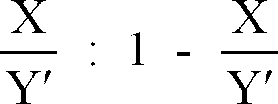
and said pulse frequency being sufficiently high relative to the response time of the coil/actuator that the coil (1) will maintain the actuator in its actuated position throughout application of the voltage input.
and said pulse frequency being sufficiently high relative to the response time of the coil/actuator that the coil (1) will maintain the actuator in its actuated position throughout application of the voltage input.
2. The combination according to claim 1 characterised in that the normal operating voltage
of the solenoid (1) is about 24V and in that it is adapted to receive a control voltage
input of from about 24 V to 240 V, either AC or DC.
3. The combination according to claim 1 or claim 2 characterised in that said modulating
circuit (2) includes a rectifier (4) to which said voltage input is fed, the output
from the rectifier (4) being connected to the pulse width modulator (6), the modulator
(6) including a comparator which feeds a continuous voltage or voltage pulses, as
aforesaid, to the solenoid coil (1) for so long as said voltage input prevails, one
of the output connections of the rectifier (4) being connected directly to the coil
(1) via a series resistor (7), the current flowing through the resistor (7)providing
a feed-back signal proportional to the voltage input that is fed to the comparator
included in the modulator (6).
4. The combination according to claim 3 wherein the output from the rectifier (4) is
additionally connected in parallel to a filter capacitor (5) for providing smoothing
and noise suppression of the rectifier (4) output.
5. The combination according to claim 3 or claim 4 wherein the circuit (2) additionally
includes a capacitor (8) for storing electrical energy whereby, upon subsequent application
of a voltage input, an enhanced voltage signal is initially supplied to the coil (1)
thereby increasing its response time.
6. A solenoid coil (1) characterised in that it has in combination therewith a modulating
circuit (2) as specified in any one of claims 1 to 5.
7. A solenoid operated fluid flow control valve including the combination as claimed
in any one of claims 1 to 5.