|
(11) | EP 0 535 722 A1 |

| (12) | EUROPEAN PATENT APPLICATION |
|
|
|
|
|||||||||||||||||||||||||||
| (54) | 3,4-Dehydropiperidine derivatives |
| (57) The invention relates to a group of new 3,4-dehydropiperidine derivatives of the
formula
wherein
wherein
These compounds have interesting serotonin-1-like (partial) agonistic activity and can be used for the treatment of migraine. |
[0001] The invention relates to new 3-substituted 3,4-dehydropiperidine derivatives having anti-migraine activity.
[0002] It was found that 3,4-dehydropiperidine derivatives of the general formula 1
wherein
- R₁
- is a hydrogen atom or an alkyl group having 1-3 carbon atoms;
- Y
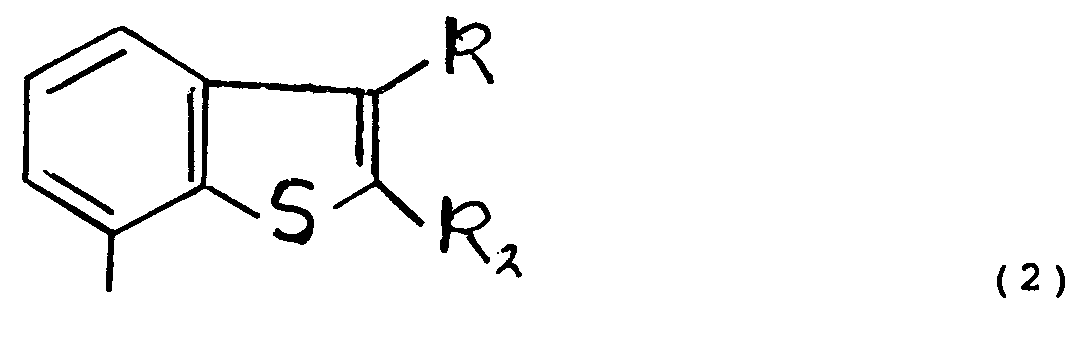
- is a group of the general formula 2
wherein
- R₂
- is a group of the formula -(CH₂)n-C(=X)-NR₃R₄, -(CH₂)n-SO₂-NR₃R₄, -(CH₂)n-NR₅-C(=X)-R₆ or -(CH₂)n-NR₅-SO₂-R₆, wherein R₃, R₄ and R₅ independent of each other represent hydrogen or alkyl (1-3C), R₆ is alkyl (1-3C), X represents O or S; and n is 0-4;
- R
- is hydrogen or alkyl (1-3C),
[0003] The so-called prodrugs and acid addition salts of the compounds of formula 1 also belong to the invention. Prodrugs are to be understood to mean derivatives of these compounds, which are inactive as such but from which, after removal of an easily removable group, i.e. an ester group or an ether group, an active compound of formula 1 is obtained.
[0004] When a chiral center is present both the different enantiomers and the racemate belong to the invention.
[0005] Examples of suitable acids with which the compounds according to the invention can form pharmaceutically acceptable salts are hydrochloric acid, sulphuric acid, phosphoric acid, nitric acid, organic acids, like citric acid, fumaric acid, tartaric acid, acetic acid, maleic acid, benzoic acid, p-toluene sulphonic acid, methane sulphonic acid and the like.
[0006] The compounds of the invention show an interesting serotonin 1-like (partial) agonistic activity. Compounds having this activity are potential antimigraine drugs.
[0007] This activity against migraine is determined by means of the following test model. Serotonin causes via stimulation of 5-HT₁-like receptors a concentration-dependent contraction of isolated strips of A. basilaris of the pig. (Naunyn Schmiedeberg's Arch. of Pharmacol. 1990, suppl to vol. 341, R 89). The compounds according to the invention are active in dosages which as a rule are between 0.1 and 100 mg/kg after oral administration.
[0008] The compounds can be brought into a form suitable for humane application in the conventional manner, that is to say, formulated to compositions suitable for this purpose and to be preferable administered orally.
[0009] The new compounds according to the invention can be obtained in a manner known for the synthesis of analogous compounds.
[0010] Compounds having formula (1) wherein R₁ has the above meanings and Y is a group of formula 3
wherein n, R, R₃ and R₄ have the above meanings can be obtained, for example, by reacting a compound of formula 4
wherein R₇ is alkyl(1-3C) or benzyl with butyllithium, followed a) by a reaction with CO₂, and conversion of the carboxylate so-obtained into an amide, or b) by a reaction with an alkylisocyanate, or c) by alkylation with a suitable functionalised bromoalkylderivative.
[0011] Compounds having formula 1 wherein R₁ has the above meanings and Y is a group having formula 5
wherein n, R and R₅ have the above meanings, and Q is a group of the formula -(C=X)-R₆ or -SO₂-R₆, in which groups X, and R₆ have the above meanings, can be prepared by reduction of a compound obtained according to a), b) or c) above, with LiAlH₄ giving the corresponding amines, followed by reaction with a suitable acylating or sulfonylating agent.
[0012] Compounds of the formula 1 wherein R₁ has the above meanings and Y is a group of formula 6
wherein n, R, R₃ and R₄ has the meaning given above, can be prepared from the corresponding lithium sulfinate of the formula 7
wherein R has the meaning given above, R₇ is alkyl(1-3C) or benzyl according to methods described in Synthesis, (1986), 1031; Synthesis, (1986), 852, and Bull. Chem. Soc. Jpn, 43, (1970), 1256.
[0013] To obtain the final compounds according to these methods wherein R₁ is hydrogen, the protective benzyl group has to be removed by methods known for debenzylation.
[0014] The invention will now be described in greater detail with references to the ensuing specific examples.
EXAMPLE I
2-(N-methylcarbamoyl)-7-(3,4-dehydropiperidyl-3)-benzo[b]thiophene
[0015] 15.25 g (50 mmol) of 7-(N-benzyl-3,4 dehydropiperidyl-3)-benzo[b]thiophene (which can be obtained as described in EP 0398413) is dissolved in 150 ml of dry tetrahydrofuran. The solution is cooled at -70 C. After adding 1.1 equivalent of butyllithium in hexane the reaction mixture is stirred for 30 minutes, after which a solution of methylisocyanate (6 ml) in tetrahydrofuran (50 ml) is added dropwise. The mixture is stirred for 30 minutes at -70 C, and overnight at room temperature. The reaction mixture is poured into 500 ml of water, and extracted with ethylacetate (3 x 200 ml). The combined organic layers are washed with water (2 x 200 ml), with brine (200 ml) dried and evaporated to dryness.
[0016] After purification by chromatografy (silicagel/ethylacetate:hexane = 1:2). 2-(N-methylcarbamoyl)-7-(N-benzyl-3,4 dehydropiperidyl-3)-benzo[b]thiophene is obtained.
[0017] A solution of the so-obtained compound (9.6 g) in 1,2-dichloroethane (100 ml) is cooled to 0 C.
[0018] After adding 5.8 ml of 1-chloroethylchloroformate (53 mmol) the reaction mixture is heated to reflux temperature for two hours.
[0019] After evaporation of the benzylchloride, 100 ml of methanol is added and the reaction mixture is stirred at room temperature for 16 hours.
[0020] The solvent is evaporated and the residue is purified by chromatografy (silicagel/ethylacetate:methanol:ammonia = 95:4.5:0.5. Yield 1.7 g of 2-(N-methylcarbamoyl)-7-(3,4-dehydropiperidyl-3)-benzo[b]thiophene. M.p. 173 C (free base) ; 202 C (fumarate).
[0021] The following compounds have also been prepared:
| EXAMPLE | R | R₁ | R₂ | melting point ( C) |
| II | H | H | -CON(CH₃)₂ | foam (fumarate) |
| III | H | H | -CH₂CON(CH₃)₂ | foam (fumarate) |
| IV | H | H | -CH₂NH-SO₂CH₃ | foam (free base) |
| V | H | H | -CH₂NH-COCH₃ | foam (fumarate) |
| VI | H | H | -CONH₂ | 292 (HCl) |
| VII | H | H | -SO₂NH₂ | >300 (HCl) |
| VIII | H | H | -SO₂NHCH₃ | 191 (HC1) |
| IX | CH₃ | H | -CONHCH₃ | 236 (HC1) |
[0022] The compounds of Examples II to V were obtained as a foam. These compounds have been identified by means of
H-NMR spectra, among others of the protons in substituent R₂:
| Example | Spectrum of group R₂ |
| II | σ=3.24(3H,bs,N-CH₃); 3.08(3H,bs,N-CH₃) |
| III | σ=4.04(2H,s,-CH₂-); 3.09(3H,s,N-CH₃); 2.88(3H,s,N-CH₃) |
| IV | σ=4.45(2H,s,-CH₂); 2.90(3H,s,SO₂-CH₃) |
| V | σ=4.51(2H,d,-CH₂-; 8.59(1H,t,NH-CO); 1.89(3H,s,-CO-CH₃) |
| s=singlet d=doublet t=triplet bs=broad singlet |
|
1. 3,4-dehydropiperidine derivatives of the formula
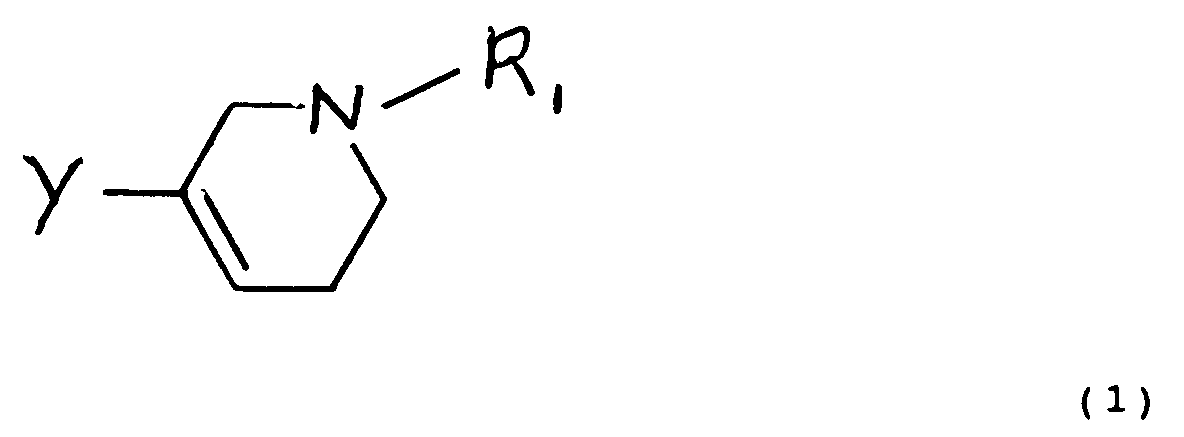
wherein
wherein
wherein
R₁ is a hydrogen atom or an alkyl group having 1-3 carbon atoms;
Y is a group of the general formula 2
wherein
R₂ is a group of the formula -(CH₂)n-C(=X)-NR₃R₄, -(CH₂)n-SO₂-NR₃R₄, -(CH₂)n-NR₅-C(=X)-R₆ or -(CH₂)n-NR₅-SO₂-R₆, wherein R₃, R₄ and R₅ independent of each other represent hydrogen or alkyl (1-3C), R₆ is alkyl (1-3C), X represents O or S; and n is 0-4;
R is hydrogen or alkyl (1-3C),
and prodrugs and pharmaceutically acid addition salts thereof.2. A pharmaceutical composition which comprises a 3,4-dehydropiperidine derivative as
the active substance, characterized in that the composition comprises at least one
compound as claimed in claim 1.
3. A method of preparing a composition having antimigraine activity, characterized in
that a compound as claimed in claim 1 is brought into a form suitable for administration.
4. A method of preparing 3,4-dehydropiperidine derivatives, characterized in that compounds
as claimed in claim 1 are prepared according to methods known for the synthesis of
analogous compounds.
5. A method as claimed in claim 4, characterized in that a compound of formula 1 is prepared
wherein R₁ has the meaning given in claim 1 and Y is a group of formula 3
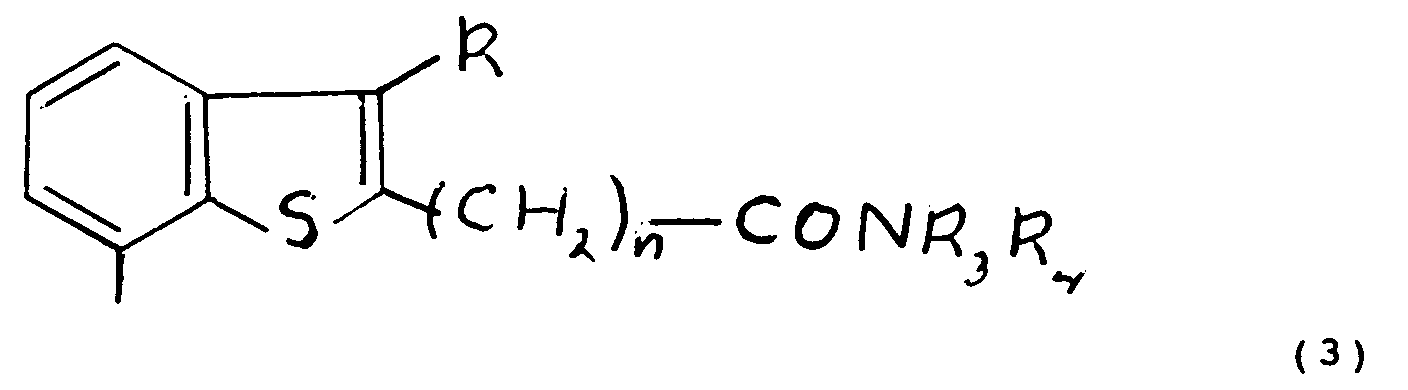
wherein n, R, R₃ and R₄ have the meanings given in claim 1, by reacting a compound of the formula 4
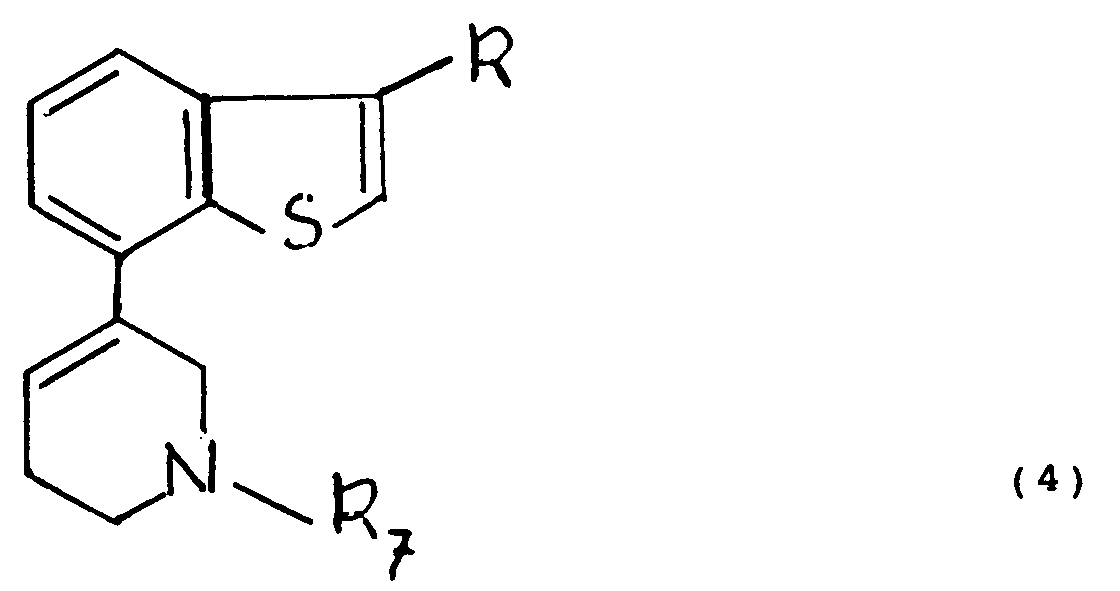
wherein R₇ is alkyl(1-3C) or benzyl, with butyllithium, followed a) by a reaction with CO₂, and conversion of the carboxylate so-obtained into an amide, or b) by a reaction with an alkylisocyanate, or c) by alkylation with a suitable functionalised bromoalkylderivative, and optional removal of the protective benzyl group R₇.
wherein n, R, R₃ and R₄ have the meanings given in claim 1, by reacting a compound of the formula 4
wherein R₇ is alkyl(1-3C) or benzyl, with butyllithium, followed a) by a reaction with CO₂, and conversion of the carboxylate so-obtained into an amide, or b) by a reaction with an alkylisocyanate, or c) by alkylation with a suitable functionalised bromoalkylderivative, and optional removal of the protective benzyl group R₇.
6. A method as claimed in claim 4, characterized in that a compound of formula 1 is prepared
wherein R₁ has the meaning given in claim 1, and Y is a group of formula 5
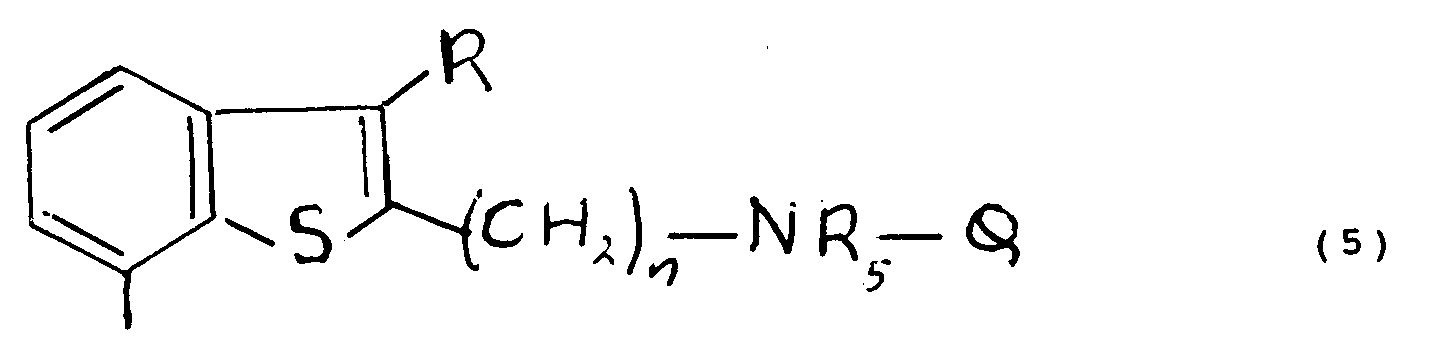
wherein n, R and R₅ have the meanings given in claim 1, and Q is a group of the formula -(C=X)-R₆ or -SO₂-R₆, in which groups X, R₃, R₄ and R₆ have the meanings given in claim 1, by reduction of a compound obtainable according to the method of claim 5a, b or c with LiAlH₄, followed by reaction with a suitable acylating or sulfonylating agent, and, if present, removal of the protective benzyl group R₇.
wherein n, R and R₅ have the meanings given in claim 1, and Q is a group of the formula -(C=X)-R₆ or -SO₂-R₆, in which groups X, R₃, R₄ and R₆ have the meanings given in claim 1, by reduction of a compound obtainable according to the method of claim 5a, b or c with LiAlH₄, followed by reaction with a suitable acylating or sulfonylating agent, and, if present, removal of the protective benzyl group R₇.
7. A method as claimed in claim 4, characterized in that a compound of formula 1 wherein
R₁ has the meaning given in claim 1, and Y is a group of formula 6
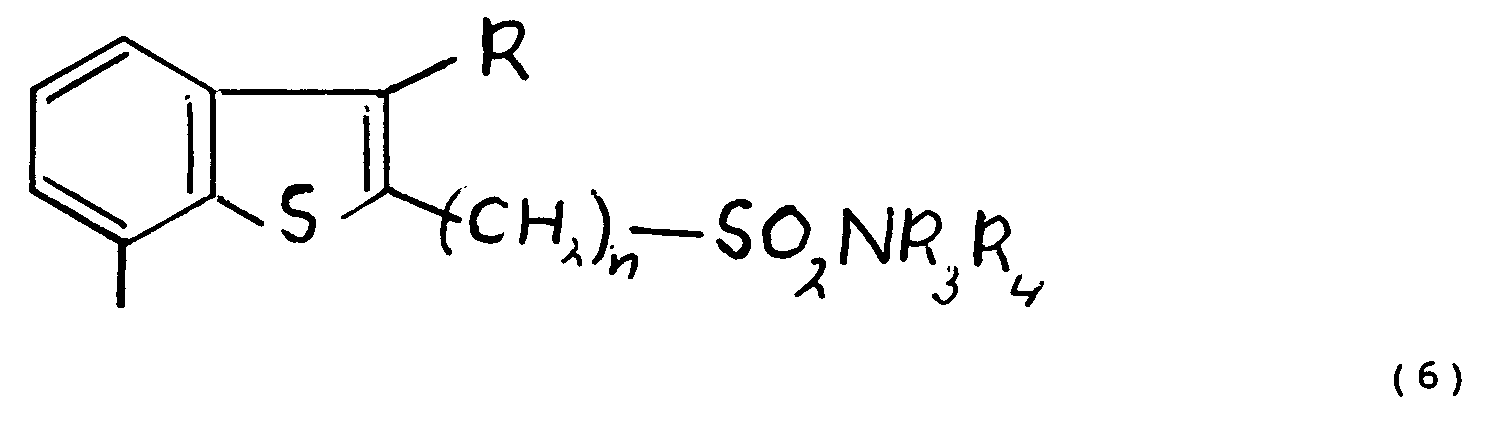
wherein R, R₃, R₄ and n have the meanings given in claim 1 is prepared in a manner known per se from a lithium sulfinate of formula 7
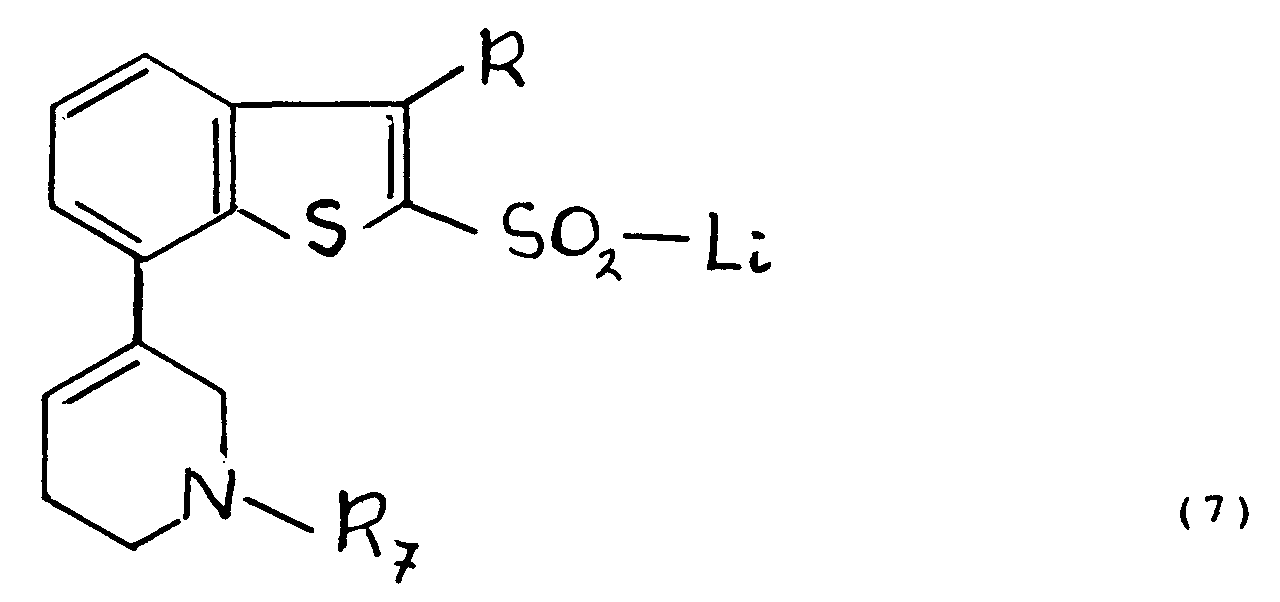
wherein R has the meaning given in claim 1, R₇ is alkyl(1-3C) or benzyl, and, if present, removal of the protective benzyl group R₇.
wherein R, R₃, R₄ and n have the meanings given in claim 1 is prepared in a manner known per se from a lithium sulfinate of formula 7
wherein R has the meaning given in claim 1, R₇ is alkyl(1-3C) or benzyl, and, if present, removal of the protective benzyl group R₇.
8. A method of treating migraine, characterized in that a compound as claimed in claim
1 is used.