|
(11) | EP 0 535 725 A1 |

| (12) | EUROPEAN PATENT APPLICATION |
|
|
|
|
|||||||||||||||||||||||||||
| (54) | Liquid crystal display device |
| (57) In a double layered liquid crystal display the values of d.Δn for both the driving
cell (10) and the compensating layer (20) having opposite twist angles φ are chosen
to be such that they are associated with different Gooch & Tarry extrema for a given
wavelength. The compensation cell may then be thicker and can be obtained in a simpler
manner. A universal compensation cell may alternatively be used. |
[0001] The invention relates to a liquid crystal display device having a first liquid crystal cell between two polarizers and comprising a twisted nematic layer of liquid crystalline material having a twist angle φ₁ and a thickness d₁, while the optical path length difference is d₁.Δn₁ for incident light having a central wavelength λ₀, said display device further comprising a compensating layer of optically anisotropic material having a twist angle φ₂ in the opposite direction.
[0002] Display devices of this type are used, for example in projection television. The difference Δn is the difference in refractive index for the ordinary and the extraordinary wave.
[0003] A display device of the type described above is known from US-P-4,443,065. With the aid of such a device interference effects in a twisted nematic liquid crystal display device are eliminated as much as possible by means of a second twisted nematic liquid crystal cell which has preferably the same twist angle and the same optical path length difference. Notably the last-mentioned condition often imposes stringent requirements on the manufacturing process because a small tolerance in the thicknesses of the two composite cells is permitted when using one and the same liquid in the two cells (the same Δn).
[0004] The interference effects occur to an even stronger extent in liquid crystal display devices having a large twist angle φ. For these devices similar solutions have been given for double cells with
in which an optimum relation is given between the twist angles and the associated values of d.Δn. However, since these are passively driven display devices, this optimization focuses on drive properties (particularly a steep transmission/voltage characteristic curve) with which no high contrasts are achieved (they remain limited to about 10:1).
[0005] It is, inter alia, an object of the invention to provide a display device of the type described in the opening paragraph which is notably suitable for projection television in that a high contrast can be achieved. It is another object of the invention to provide such a device which imposes minor requirements on the manufacture as regards thickness tolerances of the compensating layer. Finally it is an object of the invention to provide a display device having different twist angles φ₁ for which one type of compensation cell is satisfactory.
[0006] To this end a display device according to the invention is characterized in that the twist angle φ₁ is between 65° and 115° and the value of
for the first liquid crystal cell is determined by a Gooch & Tarry extremum, while the twist angle φ₂ is between -115° and -65° for the compensating layer and the value of
is determined by a Gooch & Tarry extremum of a different order than that of the first cell.
[0007] In this connection Gooch & Tarry extremum is understood to mean a minimum value (in the case of parallel polarizers) or a maximum value (in the case of mutually perpendicular polarizers) of the transmission (T) as has been derived for a twisted nematic cell having a twist angle of 90° by Gooch & Tarry in J. Phys., D8, 1575 (1975). More generally, the relevant function is derived as a function of the states of polarization, the twist angle and d.Δn by E.P. Raynes in Mol. Cryst. Liq. Cryst. Lett. 4, 69 (1987).
[0008] It is found that with this choice of the thickness and the birefringence for each cell such values can be chosen that an optimum contrast is achieved, notably if the director halfway the liquid crystal cell extends at a substantially right angle to the director halfway the compensating layer in the voltageless state.
[0009] The angle between the two polarizers is preferably 90°. It is thereby achieved that possibly defective pixels are visible as dark dots due to open connections, which is less disturbing than when they are visible as light dots (with a single cell between crossed polarizers).
[0010] Since the value d.Δn associated with an extremum of a higher order may be much larger when using the same liquid (hence the same Δn), a larger thickness can be chosen at a Δn value remaining equal so that much less stringent requirements are imposed on the manufacture of the compensating layer (thickness variation, manufacturing circumstances). On the other hand a universal compensator can be used, for example, a 90° twistor having such a thickness that it is in a second or third Gooch & Tarry extremum. These and other aspects of the invention will now be described in greater detail with reference to some embodiments and the drawing in which
Fig. 1 shows, in a diagrammatical cross-section, a device according to the invention,
Fig. 2 shows diagrammatically the transmission as a function of the d.Δn value of the compensating layer for different angles φ and d.Δn of the first cell,
Fig. 3 shows diagrammatically the transmission of such a device as a function of the wavelength for two different adjusting values.
[0011] The display device 1 of Fig. 1 comprises a first display cell 10 with a layer 11 of liquid crystalline material having a positive dielectric anisotropy between two transparent supporting plates 2, 3. At the side of the liquid crystal material electrodes 12, 13 defining, for example, a matrix of pixels are provided on the supporting plates 2, 3. The pixels may be driven via switching elements and drive electrodes (active drive); alternatively, the pixels may be defined by overlapping portions of track-shaped electrodes and may then be directly provided with selection signals and data signals (passive drive). These drive voltages are obtained, for example, by means of a drive circuit 7 which converts incoming information 8 (TV signals, information about data-graphic symbols, etc.) into said drive voltages which are applied to the electrodes 12, 13 via connection lines 15. Layers 14 of an insulating material used, in this example, also as orienting layers are present on the layers 12, 13. The layers 14 give the liquid crystal molecules a twist angle φ₁ (for example, 90°) at a voltage of 0 Volt across the electrodes 12, 13.
[0012] The device further comprises a compensating layer, in this example a second cell 20 with a second layer of liquid crystal material 21 between two transparent supporting plates 3, 4, which material also has a positive dielectric anisotropy in this example. The supporting plate 3 is jointly chosen for the two cells 10, 20. Layers 24 for insulation as well as orientation are present on the supporting plates 3, 4. The liquid crystal material 21 and the orienting effect of the layers 24 are chosen to be such that the liquid crystal molecules acquire a twist angle of φ₂ opposed to that of φ₁. The cells 10 and 20 are present between mutually perpendicularly crossed polarizers 5 and 6. The wall orientation of the layers 24 is chosen to be such that the director in the centre of cell 10 is perpendicular to the director in the centre of cell 20.
[0013] According to the invention the thicknesses d₁ and d₂ and also the values Δn₁ and Δn₂ are chosen to be such that the associated values of
are associated with different Gooch & Tarry extrema. These values are also dependent on the chosen twist angle φ and have the following values in the range between approximately 70° and approximately 110°:
| φ(°) | 1°G&T-ext. | 2°G&T-ext. | 3°G&T-ext. | 4°G&T-ext. |
| 65-75 | 0.65-0.75 | 1.60-1.70 | 2.55-2.65 | 3.45-3.65 |
| 75-85 | 0.75-0.85 | 1.70-1.80 | 2.65-2.75 | 3.60-3.80 |
| 85-95 | 0.85-0.95 | 1.90-2.00 | 2.95-3.05 | 3.90-4.10 |
| 95-105 | 0.90-1.00 | 2.10-2.20 | 3.15-3.25 | 4.15-4.35 |
| 105-115 | 1.00-1.10 | 2.15-2.25 | 3.25-3.35 | 4.25-4.45 |
[0014] Fig. 2 shows how for different values of φ₁ (70°, 90° and 110°) and
(0.70, 0.873 and 1.04 corresponding to the first Gooch & Tarry extremum) the transmission changes as a function of
. Also at the higher Gooch & Tarry extrema of the second cell or a compensating layer such low transmission values appear to occur that a good contrast can be realised. This is achieved at high values of d₂ so that a less accurate process control with regard to the second cell is sufficient.
[0015] The high contrast will be further explained with reference to Fig. 3 in which the wavelength dependence of the transmission is shown for two drive voltages (1.0 and 5.0 Volts) for a double cell of the above-described type with
and d.Δn values in the first and the second extremum for the first and the second cell, respectively. It is apparent from the Figure that a high contrast (> 100:1) is achieved over a large wavelength range.
[0016] The invention is of course not limited to the examples described hereinbefore but several variations are possible within the scope of the invention. For example, the higher extrema may alternatively be chosen at the side of the first cell, with, for example the d.Δ.n value of the compensator being chosen in the first extremum. It is found that a universal compensator can also be used in this case, with, for example φ₂ = 90° and d.Δn/λ₀ = 0.70 independent on φ₁.
[0017] Instead of a liquid crystal cell a foil having the required properties may alternatively be used as a compensating layer, which foil is obtained, for example by giving liquid crystalline polymers the required φ and d.Δ.n at temperatures at which these materials are nematic and by subsequently fixing them, for example by freezing or by means of a UV treatment.
1. A liquid crystal display device having a first liquid crystal cell between two polarizers
and comprising a twisted nematic layer of liquid crystalline material having a twist
angle φ₁ and a thickness d₁, while the optical path length difference is d₁.Δn₁ for
incident light having a central wavelength λ₀, said display device further comprising
a compensating layer of optically anisotropic material having a twist angle φ₂ in
the opposite direction, characterized in that the twist angle φ₁ is between 65° and
115° and the value of

for the first liquid crystal cell is determined by a Gooch & Tarry extremum, while the twist angle φ₂ is between -115° and -65° for the compensating layer and the value of

is determined by a Gooch & Tarry extremum of a different order than that of the first cell.
for the first liquid crystal cell is determined by a Gooch & Tarry extremum, while the twist angle φ₂ is between -115° and -65° for the compensating layer and the value of
is determined by a Gooch & Tarry extremum of a different order than that of the first cell.
2. A liquid crystal display device as claimed in Claim 1, characterized in that the polarizers
cross each other mutually perpendicularly.
3. A liquid crystal display device as claimed in any one of the preceding Claims, characterized
in that the compensating layer has a Gooch & Tarry extremum of a higher order than
the first liquid crystal cell.
4. A liquid crystal display device as claimed in any one of Claims 1 to 3, characterized
in that the compensating layer comprises a liquid crystalline material and in that
the director halfway the first liquid crystal cell extends at a substantially right
angle to the director halfway the compensating layer in the voltageless state.
5. A liquid crystal display device as claimed in any one of Claims 1 to 4, characterized
in that the first liquid crystal cell or the compensating layer has a twist angle
of between 65° and 75° and a
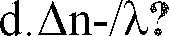
value of 0.65-0.75 or of 1.60-1.70 or of 2.55-2.65 or of 3.45-3.65.
value of 0.65-0.75 or of 1.60-1.70 or of 2.55-2.65 or of 3.45-3.65.
6. A liquid crystal display device as claimed in any one of Claims 1 to 4, characterized
in that the first liquid crystal cell or the compensating layer has a twist angle
of between 75° and 85° and a
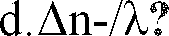
value of 0.75-0.85 or of 1.70-1.80 or of 2.65-2.75 or of 3.60-3.80.
value of 0.75-0.85 or of 1.70-1.80 or of 2.65-2.75 or of 3.60-3.80.
7. A liquid crystal display device as claimed in any one of Claims 1 to 4, characterized
in that the first liquid crystal cell or the compensating layer has a twist angle
of between 85° and 95° and a
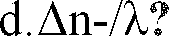
value of 0.85-0.95 or of 1.90-2.00 or of 2.95-3.05 or of 3.90-4.10.
value of 0.85-0.95 or of 1.90-2.00 or of 2.95-3.05 or of 3.90-4.10.
8. A liquid crystal display device as claimed in any one of Claims 1 to 4, characterized
in that the first liquid crystal cell or the compensating layer has a twist angle
of between 95° and 105° and a
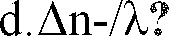
value of 0.90-1.00 or of 2.10-2.20 or of 3.15-3.25 or of 4.15-4.35.
value of 0.90-1.00 or of 2.10-2.20 or of 3.15-3.25 or of 4.15-4.35.
9. A liquid crystal display device as claimed in any one of Claims 1 to 4, characterized
in that the first liquid crystal cell or the compensating layer has a twist angle
of between 105° and 115° and a
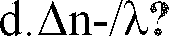
value of 1.00-1.10 or of 2.15-2.25 or of 3.25-3.35 or of 4.25-4.45.
value of 1.00-1.10 or of 2.15-2.25 or of 3.25-3.35 or of 4.25-4.45.
10. A projection display device comprising one or more display devices as claimed in any
one of the preceding Claims.