|
(11) | EP 0 536 743 A1 |

| (12) | EUROPEAN PATENT APPLICATION |
|
|
|
|
|||||||||||||||||||||||||||
| (54) | Resin composition and plastic clad optical fiber comprising the same |
| (57) A resin composition containing an ultraviolet-curing resin and a reactive compound
that contains at least one silicon atom to which an alkoxy group or a halogen atom
is bonded, and at least two functional groups capable of forming a chemical bond to
the ultraviolet-curing resin in a molecule is disclosed. A cured material of the resin
composition can be used as a cladding of a plastic clad optical fiber having high
bond strength between the core and the cladding. |
BACKGROUND OF THE INVENTION
Field of the invention
[0001] The present invention relates to a resin composition and a plastic clad optical fiber which is clad with a cured material of said resin composition. The resin composition according to the present invention is a photosetting resin, particularly an ultraviolet-curing resin.
Description of related art
[0002] An ultraviolet-curing fluorinated acrylate is preferably used as a cladding material of a polymer clad optical fiber, since a cured material of the fluorinated acrylate has good mechanical strength and low light transmission loss. However, when an uncured resin is coated on a glass core and then irradiated by ultraviolet light to cure the resin, a gap is formed between the core and the cladding so that the light transmission loss increases and the tensile strength of the optical fiber decreases. Since the bond strength between the core and the cladding is low, it is impossible to obtain sufficient pull-out strength between the fiber and a connector after the connector is attached to the fiber.
[0003] In order to solve the above problems, Japanese Patent Kokai Publication No. 24203/1989 proposes to add, to a composition for forming a cladding, a compound having one ultraviolet sensitive functional group and a silicon atom to which at least one alkoxy group or halogen atom is bonded in a molecule of the formula:
wherein Z is a functional group capable of forming a chemical bond to an ultraviolet-curing resin by ultraviolet irradiation,
at least one of X₁ to X₃ is an alkoxy group or a halogen atom, and each of the rest of X₁ to X₃ is an alkyl or fluoroalkyl group, and
R is a single bond or a divalent organic group connecting the Z group with the Si atom,
as a compound for forming a chemical bond between the glass core and the polymer cladding.
[0004] However, this prior art does not sufficiently solve the problem of low bond strength between the core and the cladding after the curing. This may be because the compound which is added to the cladding has only one functional group for forming a chemical bond to the ultraviolet-curing resin.
SUMMERY OF THE INVENTION
[0005] An object of the present invention is to provide a plastic clad optical fiber having sufficiently high bond strength between a core and a cladding.
[0006] This or other objects of the present invention are achieved by a resin composition comprising an ultraviolet-curing resin, and a reactive compound that has at least one silicon atom to which an alkoxy group or a halogen atom is bonded, and at least two functional groups capable of forming a chemical bond to the ultraviolet-curing resin in a molecule.
[0007] The present invention provides a plastic clad optical fiber comprising a core made of quartz or optical glass and a cladding made of a plastic having a lower refractive index than the core,
wherein the cladding is made of a cured material of said resin composition.
DETAILED DESCRIPTION OF THE INVENTION
[0008] The resin composition according to the present invention comprises the reactive compound and the ultraviolet-curing resin. The resin composition according to the present invention may contain (meth)acrylic acid.
[0009] The alkoxy group in the reactive compound is preferably -OCH₃, -OCH₂CH₃, -OCH₂CH₂CH₃ or -OCH₂CH₂OCH₃. The halogen atom is preferably a chlorine atom. The functional group capable of forming a chemical bond to the ultraviolet-curing resin is preferably CH₂=CHCO-, CH₂=C(CH₃)CO-, CH₂=C(CF₃)CO-, CF₂=C(CF₃)CO-, CH₂=CH- or I-.
[0010] The specific examples of the reactive compound are a monomer such as diethoxydivinylsilane, dimethoxydivinylsilane and 3-(N-allyl-N-methacryloyl)aminopropyltrimethoxysilane, and a (meth)acrylate polymer of the formula:
wherein each of R¹ is, the same or different, a hydrogen atom or a methyl group,
Rx is a hydrocarbon group having an unsaturated bond in a molecule,
Rf is a fluoroalkyl group,
R is a methyl, ethyl or propyl group,
Z is a single bond, or a divalent organic group comprising carbon, hydrogen and oxygen atoms,
x is the number of 2 to 1000, preferably 2 to 800,
y is the number of 1 to 1000, preferably 1 to 800, and
w is the number of 0 to 1000, preferably 0 to 800.
[0011] Specific examples of the Z group comprising carbon, hydrogen and oxygen atoms are -(CH₂)n-, -(CH₂)n-(CF₂)m- and -COO(CH₂)n-wherein each of m and n is an integer of 1 to 10.
[0012] An amount of the reactive compound is generally 0.01 to 10, preferably 0.1 to 5 parts by weight per 100 parts by weight of the resin composition.
[0013] The resin composition according to the present invention preferably contains acrylic and/or methacrylic acid. Since (meth)acrylic acid acts as an auxiliary for the reactive compound, the addition of (meth)acrylic acid increases the bond strength between the core and cladding. An amount of (meth)acrylic acid is from 0.005 to 10, preferably 0.05 to 5 parts by weight per 100 parts by weight of the resin composition. When the amount is smaller than 0.005 part by weight, the effect as the auxiliary is not sufficient. When the amount is larger than 10 parts by weight, the optical fiber has low light transmittance.
[0014] The ultraviolet-curing resin may be a (meth)acrylate copolymer having a number average molecular weight of 50,000 to 5,000,000 (in terms of polystyrene) and an unsaturated bond in an ester side chain, of the formula:
wherein each of R¹ and R² is a hydrogen atom or a methyl group,
Rf is a fluoroalkyl group,
Rx is a hydrocarbon group having an unsaturated bond,
x is the number of 1 to 5,000, preferably 1 to 1,000, and
y is the number of 1 to 5,000, preferably 1 to 1,000.
[0015] Rx may be a vinyl group, an allyl group, an acryl group, a methacryl group or an internal olefin. Rf may be
-(CH₂)a-(CF₂)b-CF₃
wherein a is 1 or 2, and b is from 2 to 6, or
a perfluoroalkyl group having 2 to 15 carbon atoms.
[0016] The polymer may contain a third component so as to improve heat resistance. Specific examples of the third component are isobornyl (meth)acrylate, dicyclopentanyl (meth)acrylate and adamantyl (meth)acrylate.
[0017] The ultraviolet-curing resin may be a (meth)acrylate copolymer having at least one fluorine atom which is preferably represented by the formula:
wherein Rf is a fluoroalkyl group,
R is an alkyl group,
x is the number of 1 to 5,000, preferably 1 to 1,000,
y is the number of 1 to 5,000, preferably 1 to 1,000, and
z is the number of 1 to 5,000, preferably 1 to 1,000.
Rf may be
-(CH₂)a-(CF₂)b-CF₃
wherein a is 1 or 2, and b is from 2 to 6, or a perfluoroalkyl group having 2 to 15 carbon atoms. R is preferably an alkyl group having 1 to 15 carbon atoms.
[0018] The ultraviolet-curing resin may be a polyurethane acrylate of the formula:
or
wherein R¹, R², R³, R⁴ and R⁵ are the same or different and each an alkyl group or a fluoroalkyl group,
m is the number of 0 to 100, and
n is the number of 1 to 100. The polyurethane acrylate may contain at least one fluorine atom so as to obtain a suitable refractive index. The fluoroalkyl group may be
-(CH₂)a-(CF₂)b-(CH₂)a-
wherein a is 1 or 2, and b is from 2 to 6, or a perfluoroalkyl group having 3 to 15 carbon atoms. The alkyl group may be an alkyl group having 1 to 15 carbon atoms.
[0019] The ultraviolet-curing resin may be a (meth)acrylic compound or a fluorinated (meth)acrylic compound.
[0020] The ultraviolet-curing resin preferably has a molecular weight of 1,000 to 5,000,000, preferably 1,000 to 1,000,000.
[0021] An amount of the ultraviolet-curing resin is generally from 90 to 99.99 parts by weight per 100 parts by weight of total amount of the reactive compound and the ultraviolet-curing resin. Alternatively, the amount of the ultraviolet-curing resin is generally from 5 to 95, preferably from 5 to 80, more preferably 10 to 70 parts by weight per 100 parts by weight of the resin composition.
[0022] The resin composition according to the present invention may further contain a photoinitiator. The photoinitiator is preferably a compound which easily generates a free radical by ultraviolet irradiation. Specific examples of the photoinitiator are benzophenone, acetophenone, benzil, benzoin, benzoin methyl ether, benzoin isobutyl ether, benzyl dimethyl ketal, α,α'-azobisisobutyronitrile, benzoylperoxide, 1-hydroxyoyclohexyl phenyl ketone, 2,2-dimethoxy-2-phenylacetophenone and 2-hydroxy-2-methyl-1-phenylpropan-1-one. 1-Hydroxycyclohexyl phenyl ketone, 2,2-dimethoxy-2-phenylacetophenone and 2-hydroxy-2-methyl-1-phenylpropan-1-one are particularly preferable.
[0023] An amount of the photoinitiator is generally from 0.01 to 10, preferably from 0.05 to 5 parts by weight per 100 parts by weight of the resin composition.
[0024] The resin composition preferably has a viscosity of 100 to 10,000 cps so that the resin composition can be coated on the glass core so as to form a homogeneous and thin layer. The resin composition may contain a reactive diluent so as to control the viscosity of the resin composition. The reactive diluent may be a (meth)acrylic compound. Specific examples of the (meth)acrylic compound are methyl (meth)acrylate, cyclohexyl (meth)acrylate, isobornyl (meth)acrylate, ethylene glycol di(meth)acrylate, neopentyl glycol di(meth)acrylate and trimethylolpropane tri(meth)acrylate.
[0025] The reactive diluent may be a (meth)acrylic compound having at least one fluorine atom so as to control the refractive index of the cladding. Specific examples of such fluorinated (meth)acrylic compound are trifluoroethyl (meth)acrylate, tetrafluoropropyl (meth)acrylate, heptadecafluorodecyl (meth)acrylate, a compound of the formula:
wherein each of R¹ and R² is a hydrogen atom or a methyl group,
x is the number of 1 to 2, and
y is the number of 2 to 6,
a compound of the formula:
wherein each of R is, the same or different, a hydrogen atom or a methyl group, and
n is the number of 4 to 10, and
a compound of the formula:
wherein each of R is, the same or different, a hydrogen atom or a methyl group,
m is the number of 1 to 2, and
n is the number of 4 to 10.
[0026] An amount of the reactive diluent is generally not larger than 94 parts by weight, preferably not larger than 89 parts by weight, more preferably from 20 to 89 parts by weight per 100 parts by weight of the resin composition.
[0027] The plastic clad optical fiber according to the present invention can be prepared by coating the resin composition on the core made of quart or optical glass by, for example, a die coating or spray coating method and then subjecting the resin composition to active light such as ultraviolet so as to cure the resin composition to form the cladding. A dose of the light is generally from 10 to 5,000 mJ/cm². A diameter of the core is generally from 10 to 1,000 µm. A thickness of the cladding is generally from 1 to 100, preferably from 5 to 50 µm.
PREFERRED EMBODIMENT OF THE INVENTION
[0028] The present invention will be illustrated by the following Examples which do not limit the present invention.
Examples 1 to 4 and Comparative Examples 1 and 2
[0029] Immediately after drawing a quartz glass rod to form a core fiber having an outer diameter of 200 µm, a resin composition having components indicated in Table 1 was coated on the core fiber and cured by ultraviolet irradiation to obtain a plastic clad optical fiber having an outer diameter of 230 µm.
[0030] When a crimp type connector was connected with the plastic clad optical fiber, pull-out strength between the fiber and the connector at 25°C was as shown in Table 2.
Table 2
| Example No. | 1 | 2 | Com.1 | 3 | 4 | Com.2 |
| Pull-out strength (kg) | 3.0 | 4.1 | 2.2 | 3.1 | 4.3 | 2.4 |
[0031] The plastic optical fiber according to the present invention has high bond strength between the core and the cladding. Accordingly, the optical fiber according to the present invention has lower possibility of pull-out between the fiber and the connector than conventional optical fibers when the optical fiber connected with the connector is carelessly handled.
1. A resin composition comprising an ultraviolet-curing resin, and a reactive compound
that has at least one silicon atom to which an alkoxy group or a halogen atom is bonded,
and at least two functional groups capable of forming a chemical bond to the ultraviolet-curing
resin in a molecule.
2. The resin composition according to claim 1, which further contains (meth)acrylic acid.
3. The resin composition according to claim 1, which further contains a photoinitiator.
4. The resin composition according to claim 1, which further contains a reactive diluent.
5. The resin composition according to claim 4, wherein the reactive diluent is a (meth)acrylic
compound or a fluorinated (meth)acrylic compound.
6. The resin composition according to claim 1, wherein the alkoxy group in the reactive
compound is -OCH₃, -OCH₂CH₃, -OCH₂CH₂CH₃ or -OCH₂CH₂OCH₃.
7. The resin composition according to claim 1, wherein the halogen atom in the reactive
compound is a chlorine atom.
8. The resin composition according to claim 1, wherein the functional group in the reactive
compound is CH₂=CHCO-, CH₂=C(CH₃)CO-, CH₂=C(CF₃)CO-, CF₂=C(CF₃)CO-, CH₂=CH- or I-.
9. The resin composition according to claim 1, wherein the reactive compound is a monomer
selected from the group consisting of diethoxydivinylsilane, dimethoxydivinylsilane
and 3-(N-allyl-N-methacryloyl)aminopropyltrimethoxysilane, or a (meth)acrylate polymer
of the formula:
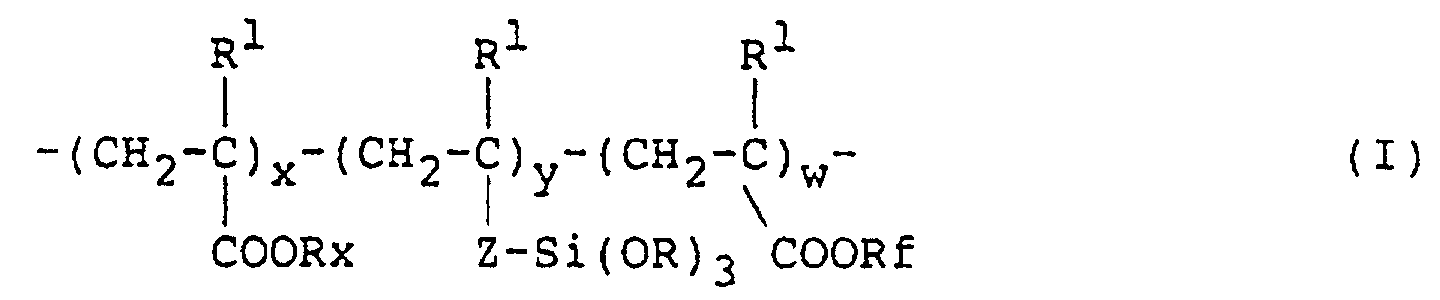
wherein each of R¹ is, the same or different, a hydrogen atom or a methyl group,
Rx is a hydrocarbon group having an unsaturated linkage in a molecule,
Rf is a fluoroalkyl group,
R is a methyl, ethyl or propyl group,
Z is a single bond, or a divalent organic group comprising carbon, hydrogen and oxygen atoms,
x is the number of 2 to 1000,
y is the number of 1 to 1000, and
w is the number of 0 to 1000.
wherein each of R¹ is, the same or different, a hydrogen atom or a methyl group,
Rx is a hydrocarbon group having an unsaturated linkage in a molecule,
Rf is a fluoroalkyl group,
R is a methyl, ethyl or propyl group,
Z is a single bond, or a divalent organic group comprising carbon, hydrogen and oxygen atoms,
x is the number of 2 to 1000,
y is the number of 1 to 1000, and
w is the number of 0 to 1000.
10. The resin composition according to claim 1, wherein the ultraviolet-curing resin is
selected from the group consisting of a (meth)acrylate polymer, a fluorinated (meth)acrylate
polymer, a polyurethane acrylate, a (meth)acrylic compound and a fluorinated (meth)acrylic
compound.
11. The resin composition according to claim 1, wherein the ultraviolet-curing resin has
repeating units derived from at least one monomer selected from the group consisting
of isobornyl (meth)acrylate, dicyclopentanyl (meth)acrylate and adamantyl (meth)acrylate.
12. The resin composition according to claim 1, wherein an amount of the reactive compound
is from 0.01 to 10 parts by weight and an amount of the ultraviolet-curing resin is
from 90 to 99.99 parts by weight.
13. The resin composition according to claim 2, wherein an amount of (meth)acrylic acid
is from 0.005 to 10 parts by weight per 100 parts by weight of the resin composition.
14. The resin composition according to claim 3, wherein an amount of the photoinitiator
is from 0.01 to 10 parts by weight per 100 parts by weight of the resin composition.
15. The resin composition according to claim 4, wherein an amount of the reactive diluent
is not larger than 94 parts by weight per 100 parts by weight of the resin composition.
16. A plastic clad optical fiber comprising a core made of quartz or optical glass and
a cladding made of a plastic having a lower refractive index than the core, wherein
the cladding is made of a cured material of a resin composition comprising an ultraviolet-curing
resin, and a reactive compound that has at least one silicon atom to which an alkoxy
group or a halogen atom is bonded, and at least two functional groups capable of forming
a chemical bond to the ultraviolet-curing resin in a molecule.
17. The optical fiber according to claim 16, wherein the resin composition further contains
(meth)acrylic acid.
18. The optical fiber according to claim 16, wherein the resin composition further contains
a photoinitiator.
19. The optical fiber according to claim 16, wherein the resin composition further contains
a reactive diluent.
20. The optical fiber according to claim 19, wherein the reactive diluent is a (meth)acrylic
compound or a fluorinated (meth)acrylic compound.
21. The optical fiber according to claim 16, wherein the alkoxy group in the reactive
compound is -OCH₃, -OCH₂CH₃, -OCH₂CH₂CH₃ or -OCH₂CH₂OCH₃.
22. The optical fiber according to claim 16, wherein the halogen atom in the reactive
compound is a chlorine atom.
23. The optical fiber according to claim 16, wherein the functional group in the reactive
compound is CH₂=CHCO-, CH₂=C(CH₃)CO-, CH₂=C(CF₃)CO-, CF₂=C(CF₃)CO-, CH₂=CH- or I-.
24. The optical fiber according to claim 16, wherein the reactive compound is a monomer
selected from the group consisting of diethoxydivinylsilane, dimethoxycivinylsilane
and 3-(N-allyl-N-methacryloyl)aminopropyltrimethoxysilane, or a (meth)acrylate polymer
of the formula:
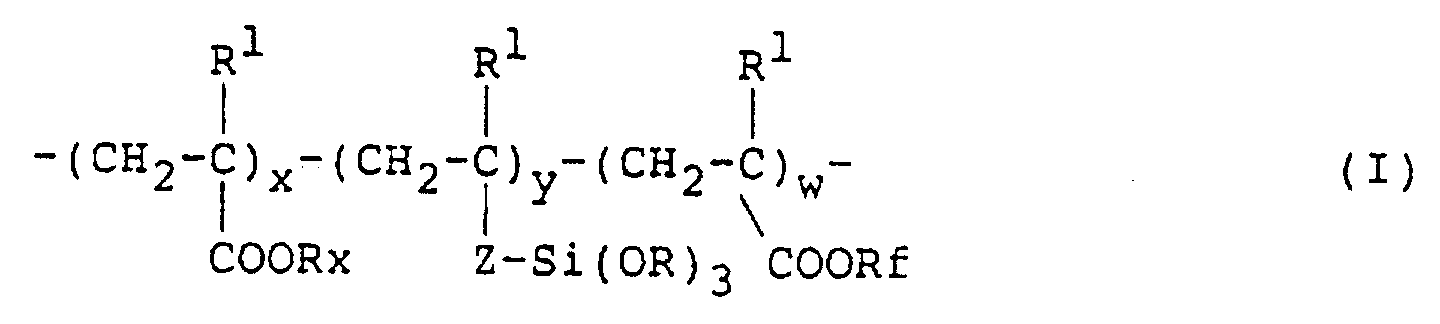
wherein each of R¹ is, the same or different, a hydrogen atom or a methyl group,
Rx is a hydrocarbon group having an unsaturated linkage in a molecule,
Rf is a fluoroalkyl group,
R is a methyl, ethyl or propyl group,
Z is a single bond, or a divalent organic group comprising carbon, hydrogen and oxygen atoms,
x is the number of 2 to 1000,
y is the number of 1 to 1000, and
w is the number of 0 to 1000.
wherein each of R¹ is, the same or different, a hydrogen atom or a methyl group,
Rx is a hydrocarbon group having an unsaturated linkage in a molecule,
Rf is a fluoroalkyl group,
R is a methyl, ethyl or propyl group,
Z is a single bond, or a divalent organic group comprising carbon, hydrogen and oxygen atoms,
x is the number of 2 to 1000,
y is the number of 1 to 1000, and
w is the number of 0 to 1000.
25. The optical fiber according to claim 16, wherein the ultraviolet-curing resin is selected
from the group consisting of a (meth)acrylate polymer, a fluorinated (meth)acrylate
polymer, a polyurethane acrylate, a (meth)acrylic compound and a fluorinated (meth)acrylic
compound.
26. The optical fiber according to claim 16, wherein the ultraviolet-curing resin has
repeating units derived from at least one monomer selected from the group consisting
of isobornyl (meth)acrylate, dicyclopentanyl (meth)acrylate and adamantyl (meth)acrylate.
27. The optical fiber according to claim 16, wherein an amount of the reactive compound
is from 0.01 to 10 parts by weight and-an amount of the ultraviolet-curing resin is
from 90 to 99.99 parts by weight.
28. The optical fiber according to claim 17, wherein an amount of (meth)acrylic acid is
from 0.005 to 10 parts by weight per 100 parts by weight of the resin composition.
29. The optical fiber according to claim 18, wherein an amount of the photoinitiator is
from 0.01 to 10 parts by weight per 100 parts by weight of the resin composition.
30. The optical fiber according to claim 19, wherein an amount of the reactive diluent
is not larger than 94 parts by weight per 100 parts by weight of the resin composition.