|
(11) | EP 0 537 840 A1 |

| (12) | EUROPEAN PATENT APPLICATION |
|
|
|
|
|||||||||||||||||||||||
| (54) | Lubricating compositions containing overbased alkaline earth metal salts of a hydroxyalkyl sulphonic acid |
| (57) The invention provides a lubricating oil composition comprising a major proportion
of a lubricating oil and a minor proportion of an alkaline earth metal salt selected
from calcium and magnesium salts of a hydroxyalkyl sulphonic acid of the general formula:
wherein each of R¹, R², R³ and R⁴ independently represents a hydrogen atom, or a linear or branched alkyl group, subject to the total number of carbon atoms in R¹, R², R³ and R⁴ taken together being in the range from 8 to 30; lubricating oil concentrates containing said salts; a process for preparing said composition; and the use of said salts as detergent additives in lubricating oil compositions. |
[0001] The present invention relates to lubricating oil compositions and concentrates containing an alkaline earth metal salt selected from calcium and magnesium hydroxyalkyl sulphonates, a process for preparing said compositions, and the use of said sulphonates as detergent additives in lubricating oil compositions.
[0002] The use of alkaline earth metal salts of organic sulphonic acids as additives for lubricating oil compositions is well known. These salts have detergent properties so that, when applied in such luboil compositions, they ensure that the insides of the engine cylinders remain clean and that deposition of carbonaceous products on pistons and in piston grooves is counteracted, thereby preventing piston-ring sticking.
[0003] It is also well-known to prepare basic (or overbased) alkaline earth metal salts of such acids. The overbasing provides an alkaline reserve which, when applied in lubricating oil compositions, reacts with and neutralises acidic compounds formed during the operation of the engine in which the composition is applied. Hence, sludge which may arise is maintained dispersed due to the detergent property of the salt, and acids which would enhance sludge and rust formation are neutralised.
[0004] US Patent No. 3,704,105 discloses a process for preparing an overbased barium olefin derived sulphonate which comprises reacting, in a hydrocarbon medium, a sulphonated olefin derivative obtained by sulphonating a mixture of acyclic monoolefins having from about 14 to about 30 carbon atoms; a stoichiometric excess based on the sulphonated olefin derivative of an inorganic barium compound, for example, barium oxide, barium hydroxide and the barium hydroxide hydrates such as barium hydroxide monohydrate and the like, mixed in a C₁-C₅ alkanol and a small amount of water; heating said mixture to a temperature of from about 35°C to about 150°C, and introducing a stream of sulphur dioxide or carbon dioxide into said heated mixture until said mixture becomes acidic. The product obtained by this process is useful as a smoke reducing distillate fuel additive.
[0005] European Patent Application Publication No. 351 928 discloses a process for the preparation of internal olefin sulphonates which comprises reacting in a film reactor an internal olefin having from 8 to 26 carbon atoms with a sulphonating agent, in a mol ratio of sulphonating agent to internal olefin of 1:1 to 1.25:1 while cooling the reactor with a cooling means having a temperature not exceeding 35°C, and allowing to neutralize and hydrolyse the reaction product of the sulphonating step. The hydrolysis may be carried out with hydroxides, carbonates or bicarbonates of (earth) alkali metals. EP-A-351 928 does not, however, contain any statement relating to uses of the products obtained by the process.
[0006] US Patent No. 3,896,057 discloses water-soluble salts or acids of alkene sulphonates and hydroxyalkyl sulphonates containing from about 10 to about 24 carbon atoms per molecule. The sulphonates have useful properties as cleaning and laundering active compositions.
[0007] US Patent No. 3,883,583 discloses a high molecular, oil-soluble anionic surface active agent consisting essentially of at least one member selected from the group consisting of a sulphonic acid, sulphonate (salt), and mixtures thereof, of an aliphatic monoolefin having a number of carbon atoms in the range of 32-40 and expressed by the general formula
wherein R is a saturated alkyl radical having either a straight chain structure or a branched-chain structure; R', R'' and R''' are respectively either hydrogen or a saturated alkyl radical having either a straight chain structure or a branched-chain structure, providing that said R', R'' and R''' should not all be hydrogen and the total number of carbon atoms of said R, R', R'', and R''' is in the range of 30-38. The surface active agent disclosed is said to have a good lubricating effect, anti-corrosive property, emulsifying effect and hydrating effect as required of a dry-cleaning detergent.
[0008] It has now surprisingly been found that certain calcium and magnesium hydroxyalkyl sulphonates are useful as detergent additives in lubricating oils.
[0009] In accordance with the present invention there is provided a lubricating oil composition comprising a major proportion of a lubricating oil and a minor proportion of an alkaline earth metal salt selected from calcium and magnesium salts of a hydroxyalkyl sulphonic acid of the general formula:
wherein each of R¹, R², R³ and R⁴ independently represents a hydrogen atom, or a linear or branched alkyl group, subject to the total number of carbon atoms in R¹, R², R³ and R⁴ taken together being in the range from 8 to 30, preferably from 12 to 22, and especially from 13 to 17.
[0011] It is preferred that at least one of R¹ and R² represents an alkyl group and at least one of R³ and R⁴ represents an alkyl group.
[0012] The calcium and magnesium salts used in the present invention may be neutral salts, i.e. those containing stoichiometrically equivalent amounts of metal and sulphonate moieties, or they may be overbased salts as hereinafter defined. Overbased salts are preferred.
[0013] The lubricating base oils present in the compositions of the invention are preferably hydrocarbon lubricating oils, which may be mineral or synthetic, but ester-type lubricating base oils and vegetable oils can also be used. The compositions may also contain mixtures of lubricating base oils. An example of such a mixture is a mixture of mineral lubricating oils, for instance a mixture of a distillate lubricating oil and a residual lubricating oil. Another example of such a mixture is a mixture of a mineral lubricating oil and a synthetic hydrocarbon lubricating oil. As examples of suitable synthetic hydrocarbon lubricating oils may be mentioned polyolefins, e.g. polyisobutylenes. Preferably the lubricating base oil component of the compositions according to the present invention is a mineral lubricating oil or a mixture of mineral lubricating oils. The viscosity of the lubricating base oils present in the lubricating oil compositions may vary within wide ranges, and is generally from 3 to 35 mm²/s at 100°C.
[0014] In the preparation of the calcium and magnesium hydroxyalkyl sulphonates employed in the present invention, a C₁₀-C₃₂, preferably C₁₄-C₂₄ and especially c₁₅-c₁₉, olefin is sulphonated using a sulphonating agent, for example, as described in EP-A-351 928. The sulphonation is preferably carried out with sulphur trioxide in a film reactor. Preferred is a falling film reactor.
[0015] The beta-sultone thus produced is then converted to a neutral salt by reaction with a magnesium, or preferably calcium, compound in water according to any of the known procedures. For example, if the sulphonation has been carried out in a film reactor, the reaction mixture containing the beta-sultone is then conducted from the film reactor to a hydrolysis/neutralisation unit where it may be mixed with an aqueous suspension of a hydroxide and/or oxide of calcium or magnesium to yield the neutral calcium or magnesium salt of the hydroxyalkyl sulphonic acid of formula I as defined above. The neutral salt is subsequently purified according to conventional known techniques and, if desired, converted to an overbased salt by mixing in an organic solvent with further of the hydroxide and/or oxide of calcium or magnesium, a promoter and a small amount of water and passing carbon dioxide through the resulting mixture. In the present context, an overbased salt denotes a salt in which the basicity index (BI), defined as the equivalent ratio of total calcium or magnesium (as determined by ASTM D874-82) to calcium or magnesium salt of the hydroxyalkyl sulphonic acid of formula I as defined above (as determined by ASTM D2896), is greater than 1. Detailed descriptions of overbasing processes are given in many patent specifications, for example UK Patent No. 786167.
[0016] The organic solvent may conveniently be a hydrocarbon, such as an aromatic hydrocarbon or a hydrocarbon fraction rich in aromatics, such as gasoline, with compounds such as benzene, toluene or, especially, xylene being preferred.
[0017] The promoter may, for example, be a C₁-C₃ alcohol, preferably methanol. The amount of water used is conveniently one mole per equivalent calcium or magnesium hydroxyalkyl sulphonate.
[0018] In the lubricating oil compositions of the present invention, the total amount of calcium and/or magnesium hydroxyalkyl sulphonate(s) can vary within wide ranges e.g. from 0.1 to 20%w, preferably from 0.1 to 10%w, and especially from 0.2 to 5%w, based on the total composition.
[0019] The present invention further provides a lubricating oil concentrate comprising a lubricating oil and an alkaline earth metal salt selected from calcium and magnesium salts of a hydroxyalkyl sulphonic acid of formula I as defined above, in an amount of from 10 to 80%w based on the total concentrate. Such a concentrate generally comprises a lubricating oil as solvent/diluent and one or more additives in a concentrated form.
[0020] The present invention further provides a process for preparing a lubricating oil composition which comprises mixing a lubricating base oil with an alkaline earth metal salt selected from calcium and magnesium salts of a hydroxyalkyl sulphonic acid of formula I as defined above, or with a lubricating oil concentrate in accordance with the invention.
[0021] The lubricating oil compositions of the present invention may further contain a number of other additives, such as antioxidants, anti-wear agents, friction modifiers, foam inhibitors, corrosion inhibitors, viscosity index improvers, and pour point depressants, as can be established by a person skilled in the art.
[0022] If desired, the lubricating oil compositions may additionally contain an alkaline earth metal alkyl salicylate and/or alkylphenate, and/or C₁₅₋₄₀ alkyl orthoxylene sulphonate, and/or C₁₅₋₄₀ alkylbenzene sulphonate.
[0023] The present invention still further provides the use of at least 0.1%w based on the total composition, of an alkaline earth metal salt selected from calcium and magnesium salts of a hydroxyalkyl sulphonic acid of formula I as defined above, as a detergent additive in a lubricating oil composition comprising a major proportion of a lubricating oil.
Example
(A) Preparation of Neutral Calcium Beta-Hydroxyalkyl Sulphonates
[0025] The sulphonation of a mixture of C₁₅-C₁₉ internal olefins derived from the "SHELL" Higher Olefins Process, having average molecular weight 230, was carried out in a continuous falling film reactor having a diameter of 2.54cm and a length of 6m.
[0026] Sulphur trioxide was prepared by reacting sulphur dioxide with oxygen (dry air) over a vanadium pentoxide catalyst at about 450°C.
[0027] The C₁₅-C₁₉ internal olefins flowed along the inner part of the reactor walls as a flowing film in a downward direction and they reacted with the sulphur trioxide (molar ratio sulphur trioxide/olefins was 1.06). The reactor was cooled by flowing water of low temperature along the outside of the reactor tube so that the temperature of the reaction mixture did not exceed 35°C. The reaction mixture was subsequently fed, together with a calcium hydroxide slurry in water (1.45 equivalents calcium hydroxide with respect to sulphur trioxide), into a continuous hydrolysis/neutralisation loop provided with a combined pump/high shear mixer and two heat exchangers. The resulting mixture was intimately mixed by means of the pump/high shear mixer at 35-40°C and then conducted into an open vessel, equipped with stirring means, and charged with a mixture of water and calcium hydroxide. After a residence time of about 40 minutes in the open vessel at a temperature of 35-40°C, the mixture was conducted to a laminar tubular hydrolysis reactor where it was heated to 170-190°C for a period of about 30 minutes.
[0028] Once cooled to ambient temperature (20°C), the mixture was analysed and then purified using conventional known techniques. Analysis of the mixture showed it to contain 24%w neutral calcium beta-hydroxyalkyl sulphonates (as determined by ISO 2271).
(B) Preparation of Overbased Sulphonates
[0029] 420g neutral calcium beta-hydroxyalkyl sulphonates (CaHAS) prepared in (A) above and 1900g xylene were introduced into a 3l glass reactor and heated, with stirring, at 50°C until the CaHAS had all dissolved. 129g calcium hydroxide were then added to the reaction mixture followed by 21g water and 390.7g methanol (97%). The reaction temperature was maintained at 50°C whilst 23.31 carbon dioxide was subsequently fed into the stirred reaction mixture over a period of 20 minutes. The reaction mixture continued to be stirred for a further five minutes and was then centrifuged for 2 hours at 2300 rpm in order to remove excess calcium hydroxide. Centrifugation yielded two liquid layers, a thin, upper layer containing mainly methanol, and a main, lower layer containing xylene and overbased CaHAS. The lower layer was isolated and was mixed with 1796g "HVI 60" base oil (a bright and clear high viscosity index base oil having viscosity at 100°C of 4.4 to 4.9 mm²/s (ASTM D445) and minimum flash point 200°C (ASTM D92)). Xylene and residual methanol were removed from the oil mixture by rotary evaporation at 130°C and 10Pa pressure to yield a clear solution of overbased CaHAS in "HVI 60" base oil having a Total Basicity Number (TBN) as determined by ASTM D2896 of 56.6mg KOH/g and a Basicity Index (BI) of 3.0.
(C) Preparation of Highly Overbased Sulphonates
[0030] 23.0g neutral calcium beta-hydroxyalkyl sulphonates (CaHAS) prepared in (A) above and 105.7g xylene were introduced into a 500ml glass reactor and heated, with stirring, at 50°C until the CaHAS had all dissolved. 22.16g calcium hydroxide were then added to the reaction mixture followed by 1.16g water and 21.9g methanol (97%). The reaction temperature was maintained at 50°C whilst carbon dioxide was subsequently fed into the stirred reaction mixture at a rate of 0.064 litres/minute over a period of 84 minutes. The reaction mixture was then centrifuged for 2 hours at 2300 rpm in order to remove excess calcium hydroxide. Centrifugation yielded two liquid layers, a thin, upper layer containing mainly methanol, and a main, lower layer containing xylene and overbased CaHAS. The lower layer was isolated and was mixed with 66.3g "HVI 60" base oil. Xylene and residual methanol were removed from the oil mixture by rotary evaporation at 130°C and 10Pa pressure to yield a clear solution of overbased CaHAS in "HVI 60" base oil having a TBN of 252.9 mg KOH/g and a BI of 9.2.
(D) Engine Test Performance
[0031] The ability of overbased calcium beta-hydroxyalkyl sulphonates to control the formation of carbonaceous and lacquer deposits in a diesel engine was demonstrated in the 252 hour Caterpillar 1K piston cleanliness test. The caterpillar 1K is a diesel engine test which measures the ability of an oil to control oil consumption and piston deposits and is required for the American Petroleum Institute (API) CF-4 lubricant specification. In this test, a single cylinder supercharged engine is run for 252 hours according to ASTM Research Report RR: D.02-1273. Piston cleanliness is rated in terms of total weighted demerits, which is based on carbon and lacquer deposits in all grooves and lands as well as undercrown and pin bore areas, % heavy carbon on the crown land and % carbon in the top groove.
[0032] To demonstrate diesel detergency of this component, the overbased sulphonate product according to (B) above in "HVI 60" base oil (9.4%w sulphonate detergent) was blended in an amount giving 2.26%w of the sulphonate detergent as active matter in a universal engine oil formulation (SAE 15W40 grade) comprising VI (viscosity index) improver, zinc-based anti-wear additives and dispersants, and the performance of the resulting oil was evaluated. The results obtained are presented in Table I below.
TABLE I
| Product according to (B) | |
| Total weighted demerits | 219 |
| % Top land heavy carbon | 0 |
| % Top groove fill | 3 |
| Brake specific oil consumption, g/kWh | 0.251 |
(E) Engine Test Performance
[0033] The overbased sulphonate product according to (B) above was blended in an amount giving 1.34%w active matter in a base oil containing an additive package comprising VI (viscosity index) improver, zinc-based anti-wear additive and polymethacrylate pour-point depressant. The resulting oil was evaluated according to sequence 5E ASTM (as described in "Sequence 5E test procedure", 7th draft dated 19th May 1988; ASTM Monitoring Centre, 4400 5th Avenue, Pittsburgh, USA). The sequence 5E test is a gasoline engine test required for the API SG lubricant specification. It tests the ability of an oil to control sludge and varnish deposits and valve train wear in a 2.3 litre Ford four cylinder gasoline engine run under a cyclic operating procedure designed to simulate stop-go running conditions. The results obtained are shown in Table II following:
1. A lubricating oil composition comprising a major proportion of a lubricating oil and
a minor proportion of an alkaline earth metal salt selected from calcium and magnesium
salts of a hydroxyalkyl sulphonic acid of the general formula:
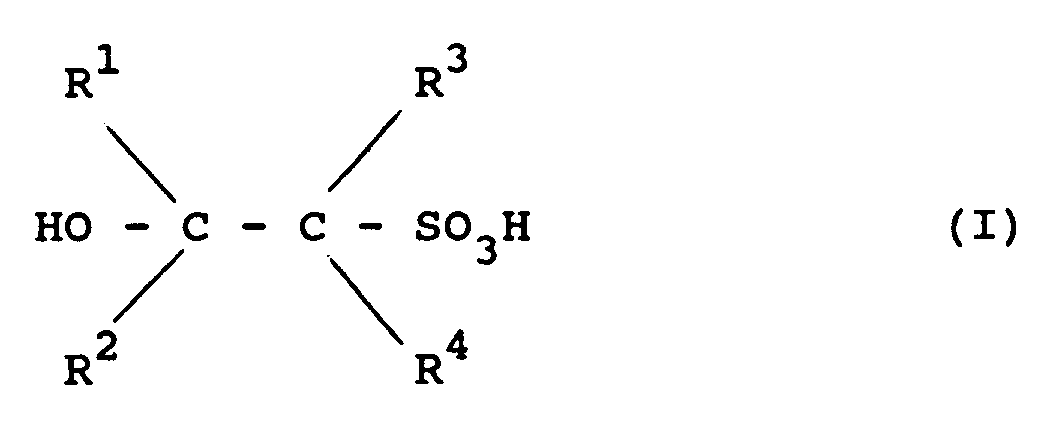
wherein each of R¹, R², R³ and R⁴ independently represents a hydrogen atom, or a linear or branched alkyl group, subject to the total number of carbon atoms in R¹, R², R³ and R⁴ taken together being in the range from 8 to 30.
wherein each of R¹, R², R³ and R⁴ independently represents a hydrogen atom, or a linear or branched alkyl group, subject to the total number of carbon atoms in R¹, R², R³ and R⁴ taken together being in the range from 8 to 30.
2. A composition according to claim 1, wherein the salt is a calcium salt.
3. A composition according to claim 1 or claim 2, wherein the salt is an overbased salt.
4. A composition according to any one of claims 1 to 3, wherein the total number of carbon
atoms in R¹ R², R³ and R⁴ taken together is in the range from 12 to 22.
5. A composition according to claim 4, wherein the total number of carbon atoms in R¹,
R², R³ and R⁴ taken together is in the range from 13 to 17.
6. A composition according to any one of the preceding claims, wherein at least one of
R¹ and R² represents an alkyl group, and at least one of R³ and R⁴ represents an alkyl
group.
7. A composition according to any one of the preceding claims which additionally comprises
an alkaline earth metal alkyl salicylate and/or alkylphenate, and/or C₁₅₋₄₀ alkyl
orthoxylene sulphonate, and/or C₁₅₋₄₀ alkylbenzene sulphonate.
8. A lubricating oil concentrate comprising from 10 to 80%w, based on the total concentrate,
of an alkaline earth metal salt selected from calcium and magnesium salts of a hydroxyalkyl
sulphonic acid of formula I as defined in any one of claims 1 to 7.
9. A process for preparing a lubricating oil composition which comprises mixing a lubricating
base oil with an alkaline earth metal salt selected from calcium and magnesium salts
of a hydroxyalkyl sulphonic acid of formula I as defined in any one of claims 1 to
7, or with a concentrate as claimed in claim 8.
10. Use of at least 0.1%w based on the total composition, of an alkaline earth metal salt
selected from calcium and magnesium salts of a hydroxyalkyl sulphonic acid of formula
I as defined in any one of claims 1 to 7, as a detergent additive in a lubricating
oil composition comprising a major proportion of a lubricating oil.