|
(11) | EP 0 537 931 A1 |

| (12) | EUROPEAN PATENT APPLICATION |
|
|
|
|
|||||||||||||||||||||||||||
| (54) | Fuel compositions |
| (57) Fuels, methods of producing fuels, and methods of using fuels to reduce the amount
of atmospheric pollutants (NOx, CO, and/or hydrocarbons) formed on combustion of middle distillate fuels in engines
or burner apparatus. These results can be achieved without an undesirable increase
in emissions of particulates. The fuels contain less than 500 ppm of sulfur and at
least one organic nitrate combustion improver and at least one tertiary alkyl peroxy
ester alkanoate or peroxy benzoate. |
[0001] This invention relates to preservation of the environment. More particularly, this invention relates to fuel compositions and methods that reduce atmospheric pollution normally caused by the operation of engines or combustion apparatus on middle distillate fuels.
[0002] The importance and desirability of reducing the release of pollutants into the atmosphere are well recognized. Among the pollutants sought to be reduced are nitrogen oxides ("NOx"), carbon monoxide, unburned hydrocarbons, and particulates.
[0003] This invention involves the discovery, inter alia, that it is possible to reduce the amount of NOx or CO or unburned hydrocarbons released into the atmosphere during operation of engines or other combustion apparatus operated on a fuel compo-sition characterized in that it comprises a major proportion of a hydrocarbonaceous middle distillate fuel which has a sulfur con- tent of less than 500 ppm and in that said fuel contains a minor emission reducing amount of (i) at least one organic nitrate combustion improver, and (ii) at least one tertiary alkyl peroxy alkanoate or peroxy benzoate dissolved therein. In fact it has been found possible through use of such fuel compositions to reduce the amount of two and in some cases all three such pollu-tants (NOx, CO and unburned hydrocarbons) emitted by diesel engines. Moreover this important and highly desirable objective has been and thus may be achieved without suffering an undesir-able increase in the emission of particulates. this is a unique discovery since the available experimental evidence and mechanistic theories of combustion suggest that if NOx is reduced, the amount of particulates will be increased, and vice versa.
[0004] Accordingly this invention provides in one of its embodiments a fuel composition characterized in that it comprises a major proportion of a hydrocarbonaceous middle distillate fuel which has a sulfur content of less than 500 ppm (preferably 100 ppm or less and most preferably no more than 60 ppm) and in that said fuel contains a minor emission reducing amount of (i) at least one organic nitrate combustion improver and (ii) at least one tertiary alkyl peroxy alkanoate or peroxy benzoate of the formula
dissolved therein wherein R is a tertiary alkyl group of 4 to 8 carbon atoms and R′ is a hydrocarbon group having 1 to 24 carbon atoms.
[0005] By the term "hydrocarbonaceous" as used in the ensuing description and appended claims is meant the middle distillate fuel is composed principally or entirely of fuels derived from petroleum by any of the usual processing operations. The finished fuels may contain, in addition, minor amounts of non-hydrocarbonaceous fuels or blending components such as alcohols, or like materials, and/or minor amounts of suitably desulfurized auxiliary liquid fuels of appropriate boiling ranges (i.e., between 160° and 370°C) derived from tar sands, shale oil or coal. When using blends composed of such desulfurized auxiliary liquid fuels and hydrocarbonaceous middle distillate fuels, the sulfur content of the total blend must be kept below 500 ppm.
[0006] In another of its embodiments this invention provides improvements in combustion processes wherein a hydrocarbonaceous middle distillate fuel is subjected to combustion in the presence of air. Such improvement comprises providing as a fuel used in such process a hydrocarbonaceous middle distillate fuel having a sulfur content of less than 500 ppm (preferably 100 ppm or less and most preferably no more than 60 ppm) and having dissolved therein a minor emission-reducing amount of (i) at least one organic nitrate combustion improver, and (ii) at least one tertiary alkyl peroxy alkanoate or peroxy benzoate of the formula
wherein R is a tertiary alkyl group of 4 to 8 carbon atoms and R′ is an aliphatic or aromatic hydrocarbon group having 1 to 24 carbon atoms and wherein the organic nitrate combustion improver comprises a nitrate ester of a substituted or unsubstituted aliphatic or cycloaliphatic alcohol.
[0007] Still another embodiment of this invention provides improvements in the production of hydrocarbonaceous middle distillate fuels. Such improvements comprise controlling or reducing the sulfur content of the fuel to a level of 500 ppm or less (preferably 100 ppm or less and most preferably no more than 60 ppm) and blending with the resultant reduced sulfur-containing fuel, (i) at least one organic nitrate combustion improver, and (ii) at least one tertiary alkyl peroxy alkanoate or peroxy benzoate of the formula
wherein R is a tertiary alkyl group of 4 to 8 carbon atoms and R′ is an aliphatic or aromatic hydrocarbon group having 1 to 24 carbon atoms and wherein the organic nitrate combustion improver comprises a nitrate ester of a substituted or unsubstituted aliphatic or cycloaliphatic alcohol.
[0008] Additional embodiments of this invention involve improvements in the operation of motor vehicles and aircraft which operate on middle distillate fuels. These improvements involve fueling the vehicle or aircraft with a hydrocarbonaceous middle distillate fuel characterized by having a sulfur content of less than 500 ppm (preferably 100 ppm or less and most preferably no more than 60 ppm) and containing (i) at least one organic nitrate combustion improver, and (ii) at least one tertiary alkyl peroxy alkanoate or peroxy benzoate of the formula
dissolved therein wherein R is a tertiary alkyl group of 4 to 8 carbon atoms and R′ is an aliphatic or aromatic hydrocarbon group having 1 to 24 carbon atoms and wherein the organic nitrate combustion improver comprises a nitrate ester of a substituted or unsubstituted aliphatic or cycloaliphatic alcohol.
[0009] In accordance with a particularly preferred embodiment of this invention, there is provided a hydrocarbonaceous middle distillate fuel having a sulfur content of not more than 500 ppm (preferably 100 ppm or less and most preferably no more than 60 ppm) and a 10% boiling point (ASTM D-86) in the range of 154° to 230°C, said fuel containing a minor emission-reducing amount of (i) at least one fuel-soluble organic nitrate combustion improver, and (ii) at least one tertiary alkyl peroxy alkanoate or peroxy benzoate of the formula
wherein R is a tertiary alkyl group of 4 to 8 carbon atoms and R′ is an aliphatic or aromatic hydrocarbon group having 1 to 24 carbon atoms and wherein the organic nitrate combustion improver comprises a nitrate ester of a substituted or unsubstituted aliphatic or cycloaliphatic alcohol. Such fuel compositions tend on combustion to emit especially low levels of NOx. Without desiring to be bound by theoretical considerations, one explanation for such highly desirable performance is that fuels with higher 10% boiling points cause a delay in the progression of combustion and consequent higher peak temperatures which increase the amount of NOx formation.
[0011] The hydrocarbonaceous fuels utilized in the practice of this invention are comprised in general of mixtures of hydrocarbons which fall within the distillation range of about 160 to 370°C. Such fuels are frequently referred to as "middle distillate fuels" since they comprise the fractions which distill after gasoline. Such fuels include diesel fuels, burner fuels, kerosenes, gas oils, jet fuels, and gas turbine engine fuels.
[0012] Preferred middle distillate fuels are those characterized by having the following distillation profile:
| °F | °C | |
| IBP | 250 - 500 | 121 - 260 |
| 10% | 310 - 550 | 154 - 288 |
| 50% | 350 - 600 | 177 - 316 |
| 90% | 400 - 700 | 204 - 371 |
| EP | 450 - 750 | 232 - 399 |
[0013] Diesel fuels having a clear cetane number (i.e., a cetane number when devoid of any cetane improver such as an organic nitrate) in the range of 30 to 60 are preferred. Particularly preferred are those in which the clear cetane number is in the range of 40 to 50.
[0014] The organic nitrate combustion improvers (also frequently known as ignition improvers) comprise nitrate esters of substituted or unsubstituted aliphatic or cycloaliphatic alcohols which may be monohydric or polyhydric. Preferred organic nitrates are substituted or unsubstituted alkyl or cycloalkyl nitrates having up to 10 carbon atoms, preferably from 2 to 10 carbon atoms. The alkyl group may be either linear or branched (or a mixture of linear and branched alkyl groups). Specific examples of nitrate compounds suitable for use in the present invention include, but are not limited to, the following: methyl nitrate, ethyl nitrate, n-propyl nitrate, isopropyl nitrate, allyl nitrate, n-butyl nitrate, isobutyl nitrate, sec-butyl nitrate, tert-butyl nitrate, n-amyl nitrate, isoamyl nitrate, 2-amyl nitrate, 3-amyl nitrate, tert-amyl nitrate, n-hexyl nitrate, n-heptyl nitrate, sec-heptyl nitrate, n-octyl nitrate, 2-ethylhexyl nitrate, sec-octyl nitrate, n-nonyl nitrate, n-decyl nitrate, cyclopentylnitrate, cyclohexyl nitrate, methylcyclohexyl nitrate, and isopropylcyclohexyl nitrate. Also suitable are the nitrate esters of alkoxy substituted aliphatic alcohols such as 2-ethoxyethyl nitrate, 2-(2-ethoxy-ethoxy)ethyl nitrate, 1-methoxypropyl-2-nitrate, and 4-ethoxybutyl nitrate, as well as diol nitrates such as 1,6-hexamethylene dinitrate. Preferred are the alkyl nitrates having from 5 to 10 carbon atoms, most especially mixtures of primary amyl nitrates, mixtures of primary hexyl nitrates, and octyl nitrates such as 2-ethylhexyl nitrate.
[0015] As is well known, nitrate esters are usually prepared by the mixed acid nitration of the appropriate alcohol or diol. Mixtures of nitric and sulfuric acids are generally used for this purpose. Another way of making nitrate esters involves reacting an alkyl or cycloalkyl halide with silver nitrate.
[0016] The concentration of nitrate ester component in the fuel can be varied within relatively wide limits with the proviso that the amount employed, when in combination with at least one tertiary alkyl peroxy alkanoate or peroxy benzoate, is at least sufficient to cause a reduction in emissions. Generally speaking, the amount of nitrate ester employed will fall in the range of 250 to 10,000 parts by weight of organic nitrate per million parts by weight of the fuel. Preferred concentrations usually fall within the range of 500 to 2000 parts per million parts of fuel.
[0017] The tertiary alkyl peroxy alkanoates or peroxy benzoates used in the practice of this invention contain at least 6 carbon atoms in the molecule, and preferably the tertiary alkyl group, R above, contains 4 to 8 carbon atoms and the hydrocarbon group, R′ above, is a substantially saturated aliphatic hydrocarbon group or an unsubstituted aromatic group. The tertiary alkyl peroxy alkanoates or peroxy benzoates may be used singly with the nitrate ester component or two or more alkanoate or benzoate compounds may be used in combination with the nitrate ester component. Illustrative peroxy esters include tert-butyl peroxy-acetate, tert-butyl peroxy-butylate, tert-butyl peroxy-hexanoate, tert-butyl peroxy-heptanoate, tert-butyl peroxy-octanoate, tert-butyl peroxy-decanoate, tert-butyl peroxy-dodecanoate, tert-butyl peroxy-tetradecanoate, tert-butyl peroxy-hexadecanoate, tert-butyl peroxy-octadecanoate, tert-butyl peroxy-eicosanoate, tert-butyl peroxy-tetracosanoate, tert-butyl peroxy-hexadecenoate, tert-butyl peroxyoctadecenoate, tert-butyl peroxy-2-methylhexanoate, tert-butyl peroxy-3-methylhexanoate, tert-butyl peroxy-2-ethylhexanoate, tert-butyl peroxy-2-octyloctanoate, tert-butyl peroxy-2,7-dimethyloctanoate, tert-butyl peroxy-benzoate and like compounds in which the tertiary alkyl group is tert-alkyl, 1,1,2-trimethylpropyl, 1,1,3,3-tetra-methyl-butyl or the like.
[0018] The base fuel will normally contain an amount in the range of 100 to 50,000 and preferably, from 500 to 2,000 -- parts of the tertiary alkyl peroxy alkanoate or peroxy benzoate component per million parts by weight of the base fuel (ppm). Such quantities are normally sufficient, when in combination with a substantially similar amount of organic nitrate combustion improver, to reduce the amount of diesel emission as compared to amount of emission that occurs in the same engine operated under the same conditions on the same fuel composition absent the emission-reducing additive of this invention.
[0019] Other additives may be included within the fuel compositions of this invention provided they do not adversely affect the exhaust emission reductions achievable by the practice of this invention. Thus use may be made of such components as organic peroxides and hydroperoxides, corrosion inhibitors, antioxidants, anti-rust agents, detergents and dispersants, friction reducing agents, demulsifiers, dyes, inert diluents, and like materials.
[0020] The advantages achievable by the practice of this invention were demonstrated in a sequential series of engine tests in which a Detroit Diesel 11.1 liter Series 60 engine mounted to an engine dynamometer was used. The system was operated on the "EPA Engine Dynamometer Schedule for Heavy-Duty Diesel Engines" set forth at pages 810-819 of Volume 40, Part 86, Appendix I, of the Code of Federal Regulations (7-1-86). In these tests, the first of nine consecutive tests involved operation of the engine on a conventional DF-2 diesel fuel having a nominal sulfur content in the range of 2000 to 4000 ppm. this test served as one of two baselines. In the next operation the engine was run using a low-sulfur diesel fuel having the following characteristics:
[0021] In the third and fourth tests this same low-sulfur fuel was used except that it had blended therein a diesel ignition improver composed of 2-ethylhexyl nitrate. In the third test the concentration was 2000 ppm of the organic nitrate. In the fourth test, the fuel contained 5000 ppm of the organic nitrate. The fifth involved another baseline run using the initial conventional DF-2 diesel fuel. In the sixth test another unadditized low sulfur fuel was run. The same low sulfur fuel was run in the seventh test except that the fuel contained 1250 ppm of the organic nitrate and 1250 ppm of the peroxy ester (tert-butyl peroxy-2-ethylhexanoate). In the eighth test a different unadditized low sulfur fuel was run. The ninth and final test contained the same fuel as in run eight, except that it contained 500 ppm of the organic nitrate and 500 ppm of the peroxy ester. In all instances the quantities of NOx, unburned hydrocarbons ("HC"), carbon monoxide ("CO") and particulates emitted by the engine were measured and integrated. The results of these tests are summarized in the following table. The values shown therein for NOx, HC, CO, and particulates, are presented in terms of grams per brake horsepower per hour. Thus the lower the value, the lower the rate and amount of emissions.
| Test No. | NOx | HC | CO | Particulates |
| 1 | 4.641 | 0.086 | 1.414 | 0.227 |
| 2 | 4.345 | 0.068 | 1.490 | 0.165 |
| 3 | 4.173 | 0.051 | 1.312 | 0.164 |
| 4 | 4.208 | 0.073 | 1 324 | 0.165 |
| 5 | 4.623 | 0.078 | 1.525 | 0.223 |
| 6 | 4.270 | 0.224 | 1.600 | 0.153 |
| 7 | 4.220 | 0.141 | 1.290 | 0.156 |
| 8 | 4.350 | 0.157 | 1.480 | 0.154 |
| 9 | 4.310 | 0.114 | 1.290 | 0.170 |
[0022] In particularly preferred embodiments of this invention, use of fuels having certain boiling characteristics as well as low sulfur levels, results in still further reductions in either NOx or particulate emissions. Thus by use of fuels meeting the low sulfur parameters set forth hereinabove and additionally having a 10% boiling point (ASTM D-86) in the range of 154° -230°C, the emissions of NOx can be reduced to extremely low levels. Likewise, by use of fuels meeting the low sulfur para-meters set forth hereinabove and additionally having a 90% boiling point (ASTM D-86) in the range of 260°-320° C, particulate emissions tend to be reduced to especially low levels. To illustrate, a Detroit Diesel Corporation Series 60 Engine in the 11.1 liter configuration and nominally rated at 320 hp at 1800 rpm was used in a series of emission tests. The engine was installed in a heavy-duty transient emission cell equipped with a constant volume sampler (CVS) system. A dilution tunnel permitted measurements of HC, CO, NOx and particulates according to the EPA Transient Emissions Cycle Procedure.
[0023] For each individual test case, the engine was started and warmed up. It was then run for 20 minutes at rated speed and load. Rated power was validated. In addition, a power test was conducted, mapping engine torque vs. speed. These parameters are required as part of the EPA Transient Cycle Procedure. Once this information was obtained, two 20-minute EPA Transient Cycles were run and engine controls were adjusted to meet statistical operating limits prescribed for the tests. The engine was shut down and allowed to soak for 20 minutes. At the end of the soak period, the Hot Start EPA Transient Cycle was run to measure NOx, CO and particulate emissions. A second emissions evaluation was conducted after another two-minute soak. Results for the two Hot Transient Cycles were averaged into a final reported value. Whenever a fuel was changed, new fuel was introduced into the fueling system, new fuel filters were installed, and fuel lines were flushed.
[0024] Each fuel (A through D) was evaluated by the same Hot Start EPA Transient Emissions Cycle Procedure. Fuels A, B, and C contained 2-ethylhexyl nitrate in an amount sufficient to raise the cetane number of the respective fuels to a nominal value of 50. Fuel D which had a natural cetane number of 49.8 was used unadditized
[0025] Physical and chemical characterization data for unadditized fuels A through D are shown in the following table:
TABLE
| Fuel Property | A | B | C | D |
| Hydrocarbon Composition, vol % | ||||
| Aromatics | 36.5 | 28.5 | 37.6 | 39.4 |
| Olefins | 1.2 | 1.1 | 2.2 | 2.9 |
| Saturates | 62.3 | 70.4 | 60.2 | 57.7 |
| Carbon, wt% | 86.35 | 86.49 | 86.12 | 87.32 |
| Hydrogen, wt% | 13.15 | 13.25 | 12.89 | 13.35 |
| Nitrogen, ppm | 5.3 | 285 | 356 | 152 |
| Sulfur, ppm | <1 | 225 | 219 | 476 |
| Aniline pt., deg. C | 70.1 | 60.0 | 65.4 | 69.4 |
| Diene content, wt% | <0.1 | 0.2 | <0.1 | <0.1 |
| Viscosity, cSt | ||||
| @ 40 deg. C | 2.99 | 2.20 | 3.10 | 3.53 |
| @ 100 deg. C | 1.22 | 0.97 | 1.23 | 1.34 |
| Heat of combustion BTU/lb | 19,593 | 19,840 | 19,543 | 19,672 |
| Boiling range, deg. C | ||||
| IBP | 170 | 172 | 202 | 218 |
| 10% | 217 | 211 | 234 | 252 |
| 20% | 233 | 222 | 246 | 262 |
| 30% | 249 | 230 | 257 | 271 |
| 40% | 262 | 237 | 267 | 278 |
| 50% | 274 | 244 | 276 | 284 |
| 60% | 288 | 253 | 286 | 291 |
| 70% | 300 | 263 | 294 | 298 |
| 80% | 314 | 276 | 306 | 306 |
| 90% | 331 | 297 | 322 | 317 |
| 95% | 344 | 319 | 338 | 329 |
| FBP | 352 | 334 | 353 | 341 |
| Recovery, % | 98.7 | 98.9 | 98.6 | 98.9 |
| Gravity, deg. API | 34.9 | 36.1 | 34.6 | 34.5 |
| Specific gravity | 0.850 | 0.844 | 0.852 | 0.852 |
| Calculated cetane index | 48.1 | 44.0 | 48.9 | 51.7 |
| Cetane index | 48.5 | 43.8 | 48.3 | 49.7 |
| Cetane number | 45.3 | 39.6 | 47.7 | 49.8 |
[0026] In the above table, the following test methods were used:
Hydrocarbon composition - ASTM D-1319
Carbon - Carlo-Erba 1106
Hydrogen - Carlo-Erba 1106
Nitrogen - ASTM D-4629
Sulfur - ASTM D-3120
Aniline pt. - ASTM D-611
Diene content - UOP 326
Viscosity - ASTM D-445
Heat of combustion - ASTM D-2382
Boiling range - ASTM D-86
Gravity - ASTM D-287
Calculated cetane index - ASTM D-4737
Cetane index - ASTM D-976
Cetane number - ASTM D 613
[0027] Methods for reducing the sulfur content of hydrocarbonaceous middle distillate fuels or their precursors are reported in the literature and are otherwise available to those skilled in the art. Among such processes are solvent extraction using such agents as sulfur dioxide or furfural, sulfuric acid treatment, and hydrodesulfurization processes. Of these, hydrodesulfurization is generally preferred, and includes a number of specific methods and operating conditions as applied to various feedstocks. For example, hydrotreating or hydroprocessing of naphthas or gas oils is generally conducted under mild or moderate severity conditions. On the other hand, sulfur removal by hydrocracking as applied to distillate stocks is usually conducted under more severe operating conditions. Vacuum distillation of bottoms from atmospheric distillations is still another method for controlling or reducing sulfur content of hydrocarbon stocks used in the production of hydrocarbonaceous middle distillate fuels. Further information concerning such processes appears in Kirk-Othmer, Encyclopedia of Chemical Technology, Second Edition, Interscience Publishers, Volume 11, pages 432-445 (copyright 1966) and references cited therein; Idem., Volume 15, pages 1-77 and references cited therein; and Kirk-Othmer, Encyclopedia of Chemical Technology, Volume 17, Third Edition, Wiley-Interscience, pages 183-256 (copyright 1982) and references cited therein.
[0028] Another method which can be used involves treatment of the hydrocarbonaceous middle distillate fuel with a metallic desulfurization agent such as metallic sodium, or mixtures of sodium and calcium metals.
[0029] This invention is applicable to the operation of both stationary diesel engines (e.g., engines used in eletrical power generation installations, or in pumping stations) and in ambulatory diesel engines (e.g., engines used as prime movers in automobiles, trucks, road-grading equipment, or military vehicles).
1. A fuel composition characterized in that it comprises a major proportion of a hydrocarbonaceous
middle distillate fuel which has a sulfur content of less than 500 ppm and in that
said fuel contains a minor emission reducing amount of (i) at least one organic nitrate
combustion improver, and (ii) at least one tertiary alkyl peroxy alkanoate or peroxy
benzoate of the formula
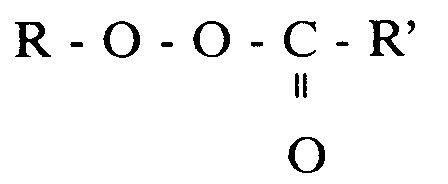
dissolved therein wherein R is a tertiary alkyl group of 4 to 8 carbon atoms and R′ is a hydrocarbon group having 1 to 24 carbon atoms.
dissolved therein wherein R is a tertiary alkyl group of 4 to 8 carbon atoms and R′ is a hydrocarbon group having 1 to 24 carbon atoms.
2. A fuel composition according to Claim 1 in which R is a tert-butyl group, the total
number of carbon atoms in R′ is from 1 to 12, and the organic nitrate combustion improver
comprises a nitrate ester of a substituted or unsubstituted aliphatic or cycloaliphatic
alcohol.
3. A fuel composition according to Claim 1 in which said tertiary alkyl peroxy alkanoate
is tert-butyl peroxy-acetate, said tertiary alkyl peroxy benzoate is tert-butyl peroxy
benzoate, and the organic nitrate combustion improver consists essentially of a nitrate
ester of at least one primary alkanol having 5 to 10 carbon atoms in the molecule.
4. A composition as claimed in Claim 3 wherein the organic nitrate combustion improver
consists essentially of a mixture of primary hexyl nitrates.
5. A composition as claimed in any one of Claims 1 to 4 wherein the base fuel has a clear
cetane number in the range of 30 to 60 and the following distillation profile:
| °C | |
| IBP | 121 - 260 |
| 10% | 154 - 288 |
| 50% | 177 - 316 |
| 90% | 204 - 371 |
| EP | 232 - 399 |
6. A method of reducing the amount of particulates in the exhaust of a diesel engine
which comprises supplying to and burning in said engine a composition as defined in
any one of Claims 1 to 5.
7. A combustion process wherein a middle distillate fuel is subjected to combustion in
the presence of air, characterized by providing as the fuel used in such process a
hydrocarbonaceous middle distillate fuel having a sulfur content of less than 500
ppm and having dissolved therein a minor emission-reducing amount of (i) at least
one organic nitrate combustion improver, and (ii) at least one tertiary alkyl peroxy
alkanoate or peroxy benzoate of the formula
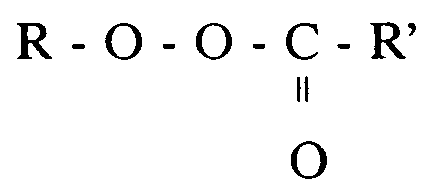
wherein R is a tertiary alkyl group of 4 to 8 carbon atoms and R′ is an aliphatic or aromatic hydrocarbon group having 1 to 24 carbon atoms and wherein the organic nitrate combustion improver comprises a nitrate ester of a substituted or unsubstituted aliphatic or cycloaliphatic alcohol.
wherein R is a tertiary alkyl group of 4 to 8 carbon atoms and R′ is an aliphatic or aromatic hydrocarbon group having 1 to 24 carbon atoms and wherein the organic nitrate combustion improver comprises a nitrate ester of a substituted or unsubstituted aliphatic or cycloaliphatic alcohol.
8. A process as claimed in Claim 7 wherein the combustion is effected within the combustion
chamber of a compression ignition engine being operated on a diesel fuel composition
composed of (i) a major proportion of a hydrocarbonaceous middle distillate fuel having
a sulfur content of 100 ppm or less and a clear cetane number in the range of 30 to
60, and (ii) minor emission reducing amount of (a) at least one nitrate ester of at
least one aliphatic or cycloaliphatic alcohol, and (b) at least one tertiary alkyl
peroxy alkanoate or peroxy benzoate of the formula

dissolved therein wherein R is a tertiary alkyl group of 4 to 8 carbon atoms and R′ is an aliphatic or aromatic hydrocarbon group having 1 to 24 carbon atoms.
dissolved therein wherein R is a tertiary alkyl group of 4 to 8 carbon atoms and R′ is an aliphatic or aromatic hydrocarbon group having 1 to 24 carbon atoms.
9. A process as claimed in Claim 8 wherein the organic nitrate combustion improver consists
essentially of a nitrate ester of at least one primary alkanol having 5 to 10 carbon
atoms in the molecule.
10. A process as claimed in Claim 9 wherein the organic nitrate combustion improver consists
essentially of a mixture of primary hexyl nitrates, the tertiary alkyl peroxy alkanoate
is tert-butyl peroxy acetate, and the tertiary alkyl peroxy benzoate is tert-butyl
peroxy benzoate.