|
(11) | EP 0 539 181 A1 |

| (12) | EUROPEAN PATENT APPLICATION |
|
|
|
|
|||||||||||||||||||||||||||
| (54) | Process for producing coumarin and derivatives thereof |
| (57) A process for producing coumarin or a derivative thereof, which process comprises
dehydrogenation of 3,4-dihydrocoumarin or a derivative thereof in the presence of
a palladium catalyst by heating under reduced pressure. |
[0001] This invention relates to a process for producing coumarin or a derivative thereof from 3,4-dihydrocoumarin or a derivative thereof. Coumarin is an important compound in the perfume industry and is also useful as an intermediate for dyes, agricultural chemicals or pharmaceuticals.
[0002] Known processes for obtaining coumarin or a derivative thereof include cyclization and dehydrogenation of a 3-(2-cyclohexanoyl)propionic acid ester or a derivative thereof in the presence of a hydrogenation-dehydrogenation catalyst, e.g., palladium, as disclosed in U.S. Patent 3,442,910 or in the presence of a noble metal catalyst, e.g., palladium, in combination with a co-catalyst, such as barium sulfate or nickel oxide, as disclosed in JP-A-60-181082 (the term "JP-A" as used herein means an "unexamined published Japanese patent application").
[0003] It is also known to obtain coumarin or a derivative thereof by dehydrogenation of 3,4-dihydrocoumarin or a derivative thereof in the presence of a noble metal catalyst, such as palladium, as disclosed in Ber., 70B, pp. 735-738 (1936) or by using chlorine, bromine, oxygen, or sulfur as disclosed in Monatsh., Vol. 34, pp. 1671-1672 (1913) and German Patent 276,667.
[0004] The cyclization and dehydrogenation of a 3-(2-cyclohexanoyl)propionic ester in the presence of a palladium catalyst under heating does not always attain a high yield of coumarin and is accompanied with by-production of 3,4-dihydrocoumarin in a large proportion. The dehydrogenation of 3,4-dihydrocoumarin using chlorine, sulfur, etc. meets difficulty in removing the chlorine or sulfur, etc. from the reaction mixture and therefore involves complicated purification steps.
[0005] The dehydrogenation of 3,4-dihydrocoumarin in the presence of a palladium catalyst has an advantage of relatively easy purification. However, hydrogen which is by-produced by the dehydrogenation concurrently induces hydrogenation of coumarin produced into 3,4-dihydrocoumarin; the intended hydrogenation does not always proceed sufficiently; and the yield of coumarin is not as high as expected.
[0006] An object of the present invention is to provide a process for producing coumarin or a derivative thereof from 3,4-dihydrocoumarin or a derivative thereof in a high yield.
[0007] As a result of extensive investigation, it has now been found that the yield of coumarin in dehydrogenation of 3,4-dihydrocoumarin can be greatly increased by carrying out the dehydrogenation by heating under reduced pressure.
[0008] The present invention relates to a process for producing coumarin or a derivative thereof represented by formula (2) :
wherein R₁, R₂, R₃, and R₄ each represent a hydrogen atom, a methyl group, or an ethyl group, provided that at least two of them are hydrogen atoms, which process comprises the step of dehydrogenating 3,4-dihydrocoumarin or a derivative thereof represented by formula (1) :
wherein R₁, R₂, R₃, and R₄ are as defined above, in the presence of a palladium catalyst by heating under reduced pressure.
[0009] Examples of the 3,4-dihydrocoumarin or a derivative thereof which can be used in the present invention include 3,4-dihydrocoumarin, 5-methyl-3,4-dihydrocoumarin, 6-methyl-3,4-dihydrocoumarin, 7-methyl-3,4-dihydrocoumarin, 8-methyl-3,4-dihydrocoumarin, 5-ethyl-3,4-dihydrocoumarin, 6-ethyl-3,4-dihydrocoumarin, 7-ethyl-3,4-dihydrocoumarin, 8-ethyl-3,4-dihydrocoumarin, 5,6-dimethyl-3,4-dihydrocoumarin, 5,7-dimethyl-3,4-dihydrocoumarin, 5,8-dimethyl-3,4-dihydrocoumarin, 6,7-dimethyl-3,4-dihydrocoumarin, 6,8-dimethyl-3,4-dihydrocoumarin, 7,8-dimethyl-3,4-dihydrocoumarin, 5-methyl-6-ethyl-3,4-dihydrocoumarin, 5-methyl-7-ethyl-3,4-dihydrocoumarin, 5-methyl-8-ethyl-3,4-dihydrocoumarin, 6-methyl-7-ethyl-3,4-dihydrocoumarin, 6-methyl-8-ethyl-3,4-dihydrocoumarin, 7-methyl-8-ethyl-3,4-dihydrocoumarin, 5-ethyl-6-methyl-3,4-dihydrocoumarin, 5-ethyl-7-methyl-3,4-dihydrocoumarin, 5-ethyl-8-methyl-3,4-dihydrocoumarin, 6-ethyl-7-methyl-3,4-dihydrocoumarin, 6-ethyl-8-methyl-3,4-dihydrocoumarin, and 7-ethyl-8-methyl-3,4-dihydrocoumarin. However, the 3,4-dihydrocoumarin or a derivative thereof is not limited to these examples.
[0010] The palladium catalyst which can be used in the present invention is a solid metallic catalyst comprising palladium supported on at least one carrier selected from the group consisting of an element of Group IIA, IIIA, IVA or VIA and a compound thereof, e.g., carbon, alumina, silica gel, and barium sulfate. The catalyst can be prepared by a known method, for example, an impregnation method described in Shokubai Jikken Manual (Catalyst Experiment Manual) edited by Shokubai Gakkai, published by Maki Shoten, Japan, which comprises impregnating a metal into a carrier followed by reduction in hydrogen at a high temperature. A commercially available palladium-on-carbon catalyst may be used as such. The catalyst can be repeatedly used.
[0011] The catalyst is used in an amount usually of about from 0.005 to 0.25% by weight, and preferably from 0.01 to 0.15% by weight, in terms of metallic palladium based on the amount of 3,4-dihydrocoumarin or a derivative thereof. Too small an amount of the catalyst exerts considerably reduced reaction activity, and too a large an amount causes excessive reaction activity giving much by-product.
[0012] The starting 3,4-dihydrocoumarin or its derivative used in the present invention is generally one obtained by cyclization and dehydrogenation of a 3-(2-cyclohexanoyl)propionic ester or its derivative in the presence of a palladium catalyst followed by separating coumarin or its derivative from the reaction mixture by distillation. However, the starting material is not limited thereto, and 3,4-dihydrocoumarin or its derivative produced by any method can be used in the present invention.
[0013] The reaction of the present invention is carried out under reduced pressure, preferably at about from 300 to 700 Torr. Although the reason for the effectiveness of conducting the reaction under reduced pressure is not clear, it is considered that the hydrogen resulting from the dehydrogenation is forcedly driven out of the reaction system and is thus prevented from reacting with the produced coumarin.
[0014] The dehydrogenation of the present invention is carried out in a temperature ranging usually about from 100 to 300°C, and preferably about from 200 to 270°C. The upper limit of the reaction temperature varied depending on the reaction pressure. While the reaction temperature is lower than that employed in the reactions under normal pressure, it is preferable to conduct the reaction at a temperature elevated as high as possible under a fully refluxing condition.
[0015] The dehydrogenation may be performed in a solvent. Examples of the solvents include phenyl ether, benzyl ether, methyl α-naphthyl ether, ethylnaphthalene, dimethylbiphenyl, dodecane, tetradecane, tetralin, acetophenone, phenyl propyl ketone, methyl benzoate, and dimethyl glutamate. The amount of the solvent is generally about from 0.5 to 10 times by weight the amount of 3,4-dihydrocoumarin or its derivative.
[0016] The dehydrogenation is usually continued at prescribed temperature and pressure for about from 5 to 50 hours, preferably about from 10 to 30 hours.
[0017] The process according to the present invention achieves a markedly increased yield as compared with the conventional techniques and has a great industrial value.
[0018] The present invention is now illustrated in greater detail with reference to Examples, but it should be understood that the present invention is not construed as being limited thereto. All the percents are by weight unless otherwise indicated.
EXAMPLE 1
[0019] In a four-necked flask were charged 200 g of 3,4-dihydrocoumarin and 2.0 g of a 50% hydrated catalyst composed of 5% palladium on activated carbon. The mixture was heated in a nitrogen atmosphere at 250°C under 600 Torr for 15 hours with stirring at 500 rpm. After completion of the reaction, the catalyst was recovered by filtration. Gas chromatography analysis of the filtrate revealed that the coumarin yield was 52.1 mol% based on the charged 3,4-dihydrocoumarin.
EXAMPLE 2
[0020] Dehydrogenation of 3,4-dihydrocoumarin was conducted in the same manner as in Example 1, except for changing the reaction conditions to 230°C and 450 Torr. As a result, the coumarin yield was 65.4 mol% based on the charged 3,4-dihydrocoumarin.
COMPARATIVE EXAMPLE 1
1. A process for producing coumarin or a derivative thereof represented by formula (2)
:
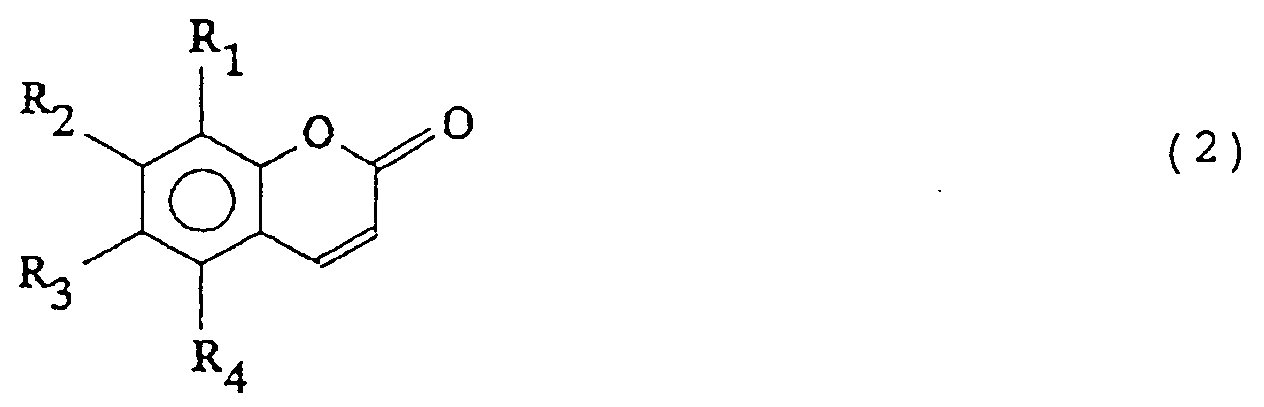
wherein R₁, R₂, R₃, and R₄ each represent a hydrogen atom, a methyl group, or an ethyl group, provided that at least two of them are hydrogen atoms,
said process comprising the step of dehydrogenating 3,4-dihydrocoumarin or a derivative thereof represented by formula (1) :
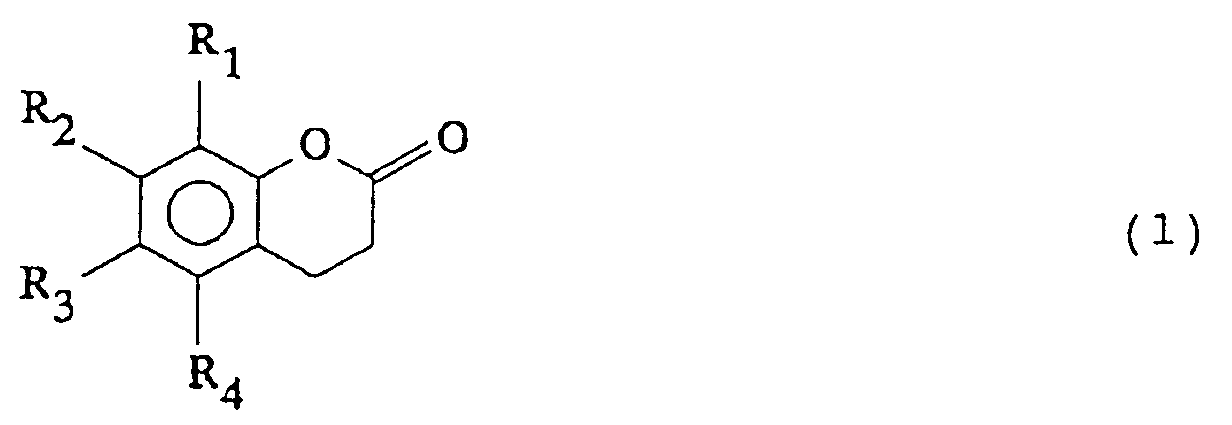
wherein R₁, R₂, R₃, and R₄ are as defined above, in the presence of a palladium catalyst by heating under reduced pressure.
wherein R₁, R₂, R₃, and R₄ each represent a hydrogen atom, a methyl group, or an ethyl group, provided that at least two of them are hydrogen atoms,
said process comprising the step of dehydrogenating 3,4-dihydrocoumarin or a derivative thereof represented by formula (1) :
wherein R₁, R₂, R₃, and R₄ are as defined above, in the presence of a palladium catalyst by heating under reduced pressure.
2. A process as claimed in Claim 1, wherein the reaction pressure is from 300 to 700
Torr.
3. A process as claimed in Claim 1 or 2, wherein said 3,4-dihydrocoumarin or a derivative
thereof represented by the formula (1) is 3,4-dihydrocoumarin.
4. A process as claimed in Claim 1 or 2, wherein said 3,4-dihydrocoumarin or a derivative
thereof represented by the formula (1) is 3,4-dihydrocoumarin or a derivative thereof
obtained by cyclization and dehydrogenation of a 3-(2-cyclohexanoyl)propionic acid
ester or a derivative thereof, followed by separation of coumarin or a derivative
thereof.
5. A process as claimed in any preceding claim, wherein said palladium catalyst is present
in an amount of from 0.005 to 0.25% by weight in terms of metallic palladium based
on the amount of said 3,4-dihydrocoumarin or derivative thereof.
6. A process as claimed in any preceding claim, wherein the heating temperature is from
about 100 to 300°C.