|
(11) | EP 0 540 097 A1 |

| (12) | EUROPEAN PATENT APPLICATION |
|
|
|
|
|||||||||||||||||||||||||||
| (54) | Maleimidic derivatives containing acrylic residues |
| (57) Maleimidic derivatives containing acrylic residues having the general formula (I):
wherein R is equal to H, CH₃; A represents a cycloalkyl radical containing from 5 to 10 carbon atoms or an aryl radical containing from 6 to 12 carbon atoms and with the acryloxy residue -[-OCOC(R)=CH₂] in an ortho, meta or para position. |
[0002] More specifically the present invention relates to a group of maleimidic derivatives containing acrylic or metacrylic residues.
[0003] These products are used as thermostabilizing agents in structural adhesives with an acrylic base.
[0004] In particular the present invention relates to maleimidic derivatives having the general formula (I):
wherein R is equal to H, CH₃; A represents a cycloalkyl radical containing from 5 to 10 carbon atoms or an aryl radical containing from 6 to 12 carbon atoms and with the acryloxy residue -[OCOC(R)=CH₂] in an ortho, meta or para position.
[0005] Products having the general formula (I) which are preferable for the present invention are those wherein A is a cyclohexyl or a phenyl; particularly preferred are phenylmaleimide methacrylate (MPM) and phenylmaleimide acrylate.
[0006] The products having general formula (I) can be obtained with a procedure which involves reacting an acryloyl halide with an N-substituted maleimide.
[0007] The reaction is carried out in the presence of molecular sieves, in an aprotic solvent, for example dichloroethane, at a temperature ranging from 60 to 90°C.
[0008] The molecular sieves, or zeolites, are composed of hydrous aluminosilicates of alkaline or earth-alkaline metals.
[0010] More specifically the products having general formula (I) can be obtained by means of the following reaction:
wherein R and A have the meanings specified above, and Alg is a halogen such as chlorine.
[0011] Compound (III) is well-known and can be synthesized as described in Japanese Patents 61/106.554, 79/66.671 (1979) and 79/66.670 (1979).
[0012] The following examples provide a better illustration of the present invention but do not limit it in any way.
EXAMPLE 1
[0013] 12 g (0.064 moles) of N-[4-hydroxyphenyl]maleimide dissolved in 400 cc of dichloroethane are charged into a two-necked flask equipped with a mechanical stirrer, cooler, nitrogen valve and drip funnel.
[0014] 16 g of molecular sieves (Union Carbide Type 3A) dried at 100°C under vacuum for 16-18 hours, and then 30 cc (0.32 moles) of distilled methacryloylchloride are added and the mixture is heated to reflux temperature (80-90°C) for 26 hours, supplying fresh molecular sieves every 7-8 hours.
[0015] The solution is then washed with a solution of 2% NaOH, then with water and dried on anhydrous sodium sulphate.
[0020] ¹H-NMR (200Hz, CDCl₃): δ 2.1(methylic H), δ 5.8-6.35(ethylenic H); δ 6.85(maleimidic H); δ 7.2-7.4(aromatic H).
EXAMPLE 2 (applicative)
[0021] The product synthesized in Example 1 is used as a thermostabilizing additive in an acrylic adhesive.
[0022] 34.5 g of ethylmethacrylate are added to a mixture composed of: 30 g of polyethylene chlorosulphonate (commercially known as Hypalon 20), 33.8 g of methacrylic acid and 1.0 g of ethylenglycoldimethylacrylate.
[0023] The whole quantity is mixed at room temperature, until all of the polymer has dissolved (time required: 24 hours approx.).
[0024] The adhesive paste thus obtained is completed by adding 0.3 g of di-terbutylparacresol, 0.4 g of a free radical generator of the normal type (initiator) composed of cumene hydroperoxide and 2.05 g of phenylmaleimide methacrylate (MPM).
[0027] A layer of paste of about 0.5 mm in thickness is spread on one test sample, and on another an activator, composed of the condensation product between butyraldehyde and aniline, containing 0.1% by weight of monovalent copper, introduced as copper saccharinate.
[0029] The adhesive is post-cured at 100°C for 1 hour after the test-samples have been joined together.
1. Maleimidic derivatives having the general formula (I):
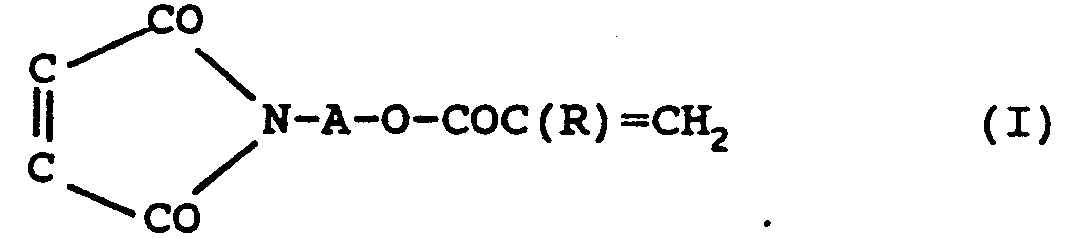
wherein R is equal to H, CH₃; A represents a cycloalkyl radical containing from 5 to 10 carbon atoms or an aryl radical containing from 6 to 12 carbon atoms and with the acryloxy residue -[OCOC(R)=CH₂] in an ortho, meta or para position.
wherein R is equal to H, CH₃; A represents a cycloalkyl radical containing from 5 to 10 carbon atoms or an aryl radical containing from 6 to 12 carbon atoms and with the acryloxy residue -[OCOC(R)=CH₂] in an ortho, meta or para position.
2. Derivatives according to Claim 1, wherein A is a cyclohexyl or a phenyl.
3. Phenylmaleimide methacrylate.
4. Phenylmaleimide acrylate.
5. Procedure for the preparation of maleimidic derivatives according to any of the previous
Claims including reacting an acryloyl halide with an N-substituted maleimide according
to the scheme:

wherein R and A have the meanings defined above, and Alg is a halogen such as chlorine.
wherein R and A have the meanings defined above, and Alg is a halogen such as chlorine.
6. Procedure according to Claim 5, wherein the reaction is carried out in the presence
of molecular sieves or zeolites composed of hydrous aluminosilicates of alkaline or
earth-alkaline metals of the type 3 A at a temperature ranging from 60 to 90°C.