| (19) |
 |
|
(11) |
EP 0 540 596 B1 |
| (12) |
EUROPEAN PATENT SPECIFICATION |
| (45) |
Mention of the grant of the patent: |
|
26.08.1998 Bulletin 1998/35 |
| (22) |
Date of filing: 25.07.1991 |
|
| (51) |
International Patent Classification (IPC)6: G01S 11/06 |
| (86) |
International application number: |
|
PCT/GB9101/241 |
| (87) |
International publication number: |
|
WO 9201/950 (06.02.1992 Gazette 1992/04) |
|
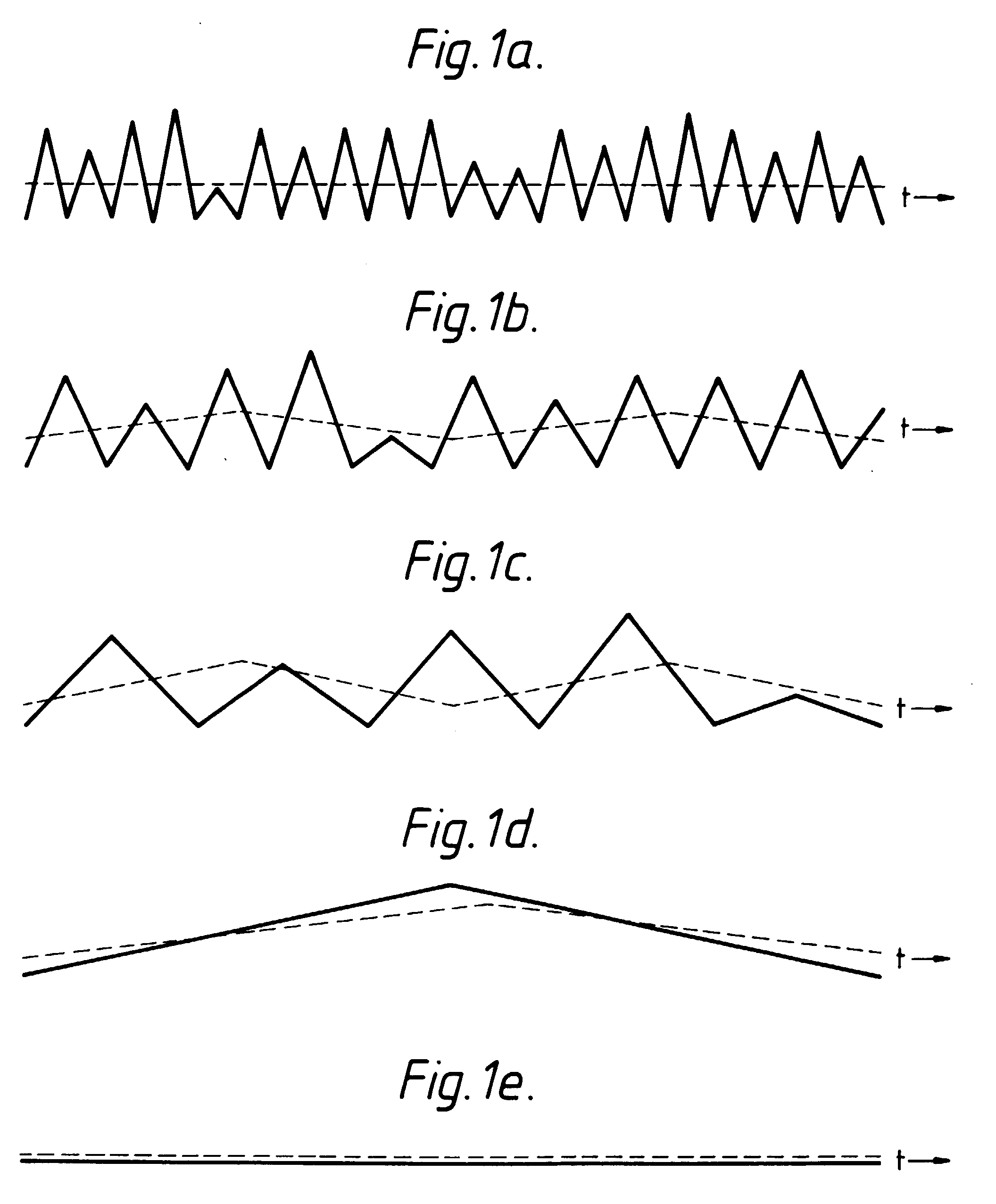
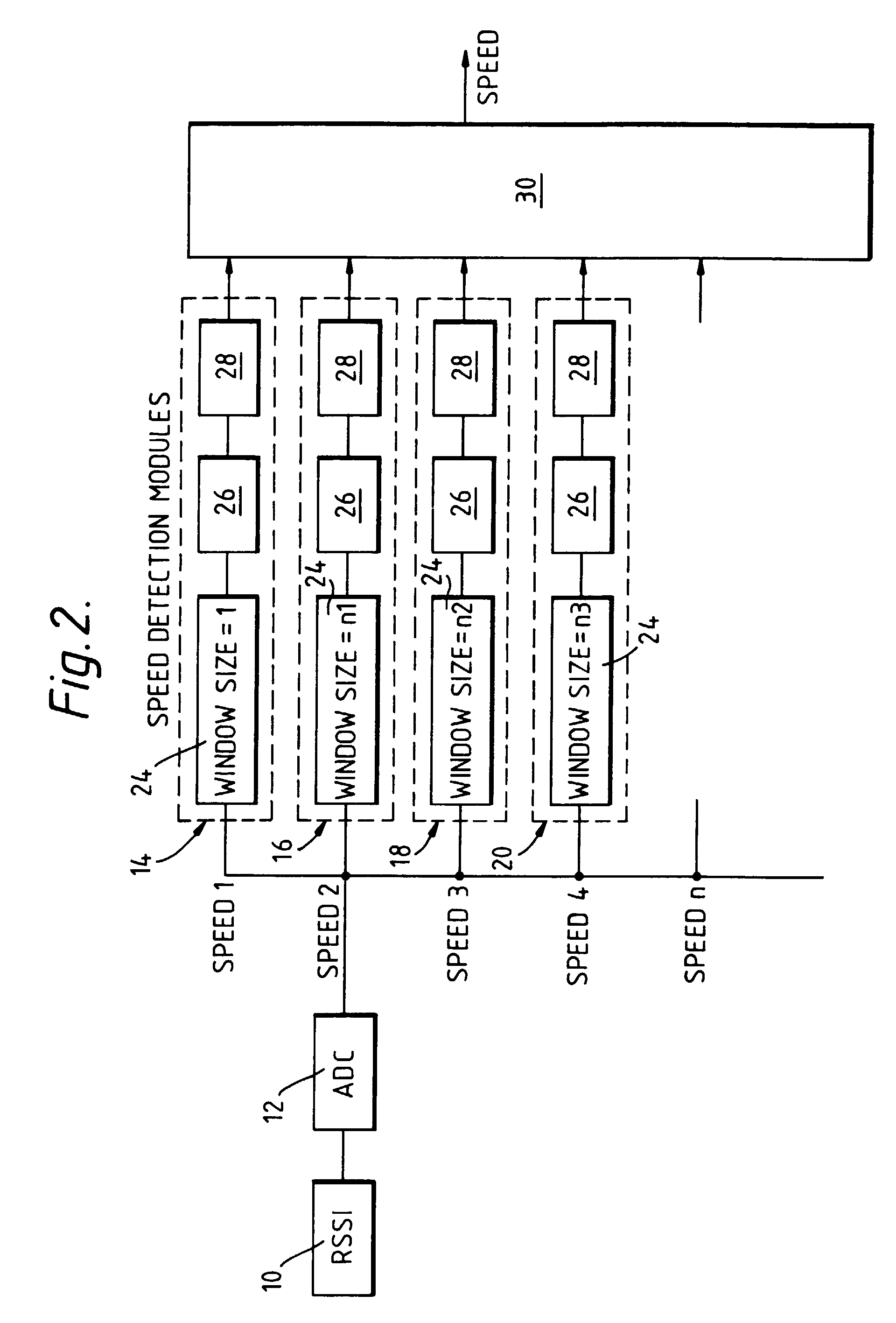
| (54) |
SPEED ESTIMATION
GESCHWINDIGKEITSBESTIMMUNG
ESTIMATION DE VITESSE
|
| (84) |
Designated Contracting States: |
|
AT BE CH DE DK ES FR GR IT LI LU NL SE |
| (30) |
Priority: |
25.07.1990 GB 9016341
|
| (43) |
Date of publication of application: |
|
12.05.1993 Bulletin 1993/19 |
| (73) |
Proprietor: BRITISH TELECOMMUNICATIONS public limited company |
|
London EC1A 7AJ (GB) |
|
| (72) |
Inventor: |
|
- CHIA, Si, Tak, Stanley
Martlesham Heath,
Ipswich IP5 7UD (GB)
|
| (74) |
Representative: Lidbetter, Timothy Guy Edwin et al |
|
BT Group Legal Services,
Intellectual Property Department,
8th Floor, Holborn Centre,
120 Holborn
London EC1N 2TE
London EC1N 2TE (GB) |
| (56) |
References cited: :
EP-A- 0 419 205
DE-A- 3 215 479
US-A- 3 906 503
|
DE-A- 2 849 282
US-A- 3 653 049
|
|
| |
|
|
|
|
| |
|
| Note: Within nine months from the publication of the mention of the grant of the European
patent, any person may give notice to the European Patent Office of opposition to
the European patent
granted. Notice of opposition shall be filed in a written reasoned statement. It shall
not be deemed to
have been filed until the opposition fee has been paid. (Art. 99(1) European Patent
Convention).
|
[0001] This invention relates to a system for estimating the speed of a body remotely. The
invention is particularly applicable to the estimation of speed of a mobile unit in
a mobile communications, e.g. cellular radio, system.
[0002] Methods of effecting handover of a call to or from a mobile unit between cells in
a cellular radio telephone system are very important to the overall efficiency and
quality of the service provided. The object is to achieve a fast and reliable handover
between cells.
[0003] In particular, busy areas having a high call density can comprise a large macrocell,
covering a number of streets extending for one or two kilometres in all directions,
and a number of overlaid microcells which are located in streets where a particularly
heavy call density is expected. These microcells are typically about 200 metres long
and may extend simply along a straight street.
[0004] The handover between a microcell and a macrocell is subject to special considerations.
It is important for the system to be able to determine whether it is worthwhile effecting
a handover of a mobile unit from a macrocell to a microcell as the latter is approached.
It may be that the unit is going to enter the microcell for a significant period or
only relatively momentarily as the microcell is crossed.
[0005] An important factor is the determination of the mobile unit speed. If the mobile
unit is stationary and experiences bad reception, only intracell handover is required.
An assignment of a different channel with less interference or fading within the same
base station can easily improve the quality of the link. By contrast, if the mobile
unit is moving, a decision has to be made on whether an intercell or an intracell
handover has to be initiated. Furthermore, as handportable mobile telephones are anticipated
to be more widely used in future, they may move slowly or stay within a locality for
a long time. However, there is also a chance that the handportable mobile unit is
being used on a vehicle.
[0006] The assessment of vehicle speed can be carried out simply by measuring directly through,
for example, the transmission of a motor vehicle. However this is unsuited to cellular
radio applications.
[0007] As an alternative, the vehicle speed may be estimated by monitoring the Doppler shift
of a carrier frequency. This method requires a stable frequency standard which is
expensive and also impracticable if the frequency generator is to be included in each
hand portable unit.
[0008] Another alternative is to use the elapsed time between two or more successful handovers.
A user moving at walking pace would have a significantly longer elapsed time between
handovers than when the person is travelling in a vehicle. This method, while feasible
when operating on its own, has the disadvantage of requiring a relatively long training
time delay of at least two or more handovers. It cannot adapt to sudden changes of
speed, such as when a user alights or boards a vehicle in between handovers. Furthermore,
it cannot be used immediately after the user joins the system. Consequently, it can
only be used as a backup speed estimator.
[0009] German Offenlegungsschrift Nr 2849282 discloses a method of determining radial distance
r from a beacon by measuring the change in signal strength ΔN
E/N
E over a predetermined distance Δr. However, this system requires the distance Δr to
be known.
[0010] It is an object of the present invention to provide a method of deriving a speed
estimation that can be used in a cellular radio network.
[0011] European Patent Application No. 0419205 (Nippon Telegraph & Telephone Corporation),
designates Sweden, Germany and the United Kingdom. It was published on 27th March
1991 and has an earliest declared priority date of 19th September 1989. It relates
to a system which the periodicity of variations in signal strengths is measured to
determine the speed of a mobile unit.
[0012] The scope of the present invention is defined in the appended claims.
[0013] When a handportable mobile telephone unit is being used by a pedestrian, it is susceptible
both to slow fading and fast fading because of his slow progress. When the same unit
is used in a vehicle travelling at speed it is then largely only susceptible to slow
fading as the fast fading lasts for a greatly reduced period resulting from the vehicle
speed. Thus, the effect of fast fading as a phenomenon is greatly reduced when the
unit is travelling at speed.
[0014] In a mobile radio environment, the fast fading of the received signal may be as deep
as 20 to 30 dB. Likewise, the signal level drop in a microcell when negotiating a
street corner is typically 20 dB. If a slow moving mobile unit encounters a deep fade,
only an intracell handover is required or even no action is needed as the degradation
may only be temporary. However, if the mobile unit is negotiating a corner (although,
the rate of the signal drop is spatially lower than a fast fade, to a relatively fast
moving mobile unit, the time taken is almost the same), an intercell or even a microcell
to macrocell handover may be required.
[0015] The present invention may use time windows as filters during each of which the signal
strength is monitored. Each window is of a different duration. The windows differentiate
the fading rate of the signal transmitted or received at different speeds. A signal
strength average in a long period window will filter out both the fast and slow fades.
A relatively shorter period averaging window will not be able to filter out the slow
fade as effectively. Thus, the amount of slow fade filtering will be dependent on
the period of the time-averaging window.
[0016] The filtering can be performed using any suitable averaged indication of the signal
strength such as the running average, median or root mean squared (RMS) values, using
a windowing function, typically a rectangular window. For a particular application
the optimal window period can be determined experimentally.
[0017] Once the speed of the mobile unit has been estimated it can be used in the assessment
of whether a handover is required based also on such things as signal strength and
interference. One method of measuring interference is to monitor the bit error rate
in a digital communication system. For example, when the mobile unit is travelling
at speed, the interference due to any fading will be a much briefer phenomenon than
when the same mobile unit is moving more slowly. Thus, the frequency with which the
interference level is assessed can be related to the mobile unit speed, because the
faster the speed the less significant will be the transient interference due to fading.
[0018] The use of a long term averaging window can also be applied to an assessment of the
heading of the mobile unit relative to the microcell base station. The running average
/ median / rms values can be used to estimate whether the mobile unit is heading towards
or away from the base station by applying linear regression to the running average
to determine its slope. If the average is declining, the slope will be negative and
the mobile unit can be determined to be moving away from the base station. Similarly,
the heading towards the base station will result in a positive slope of the running
average of received signal strength.
[0019] At least part of the linear regression calculation can be stored in a look-up table
as the sampling interval on which the averages are based is conveniently regular.
Thus, only real-time calculation of the variable related to the average strength signal
part of the linear regression has to be performed. This will assist greatly in reducing
processing delays.
[0020] A handover between a macrocell and a microcell is based on hysteresis and signal
level thresholds as with conventional macrocell to macrocell handover. When the mobile
unit is in a macrocell overlain with microcells, it continues to monitor the signal
levels of neighbouring macrocell base stations in addition to the signal levels of
the surrounding microcells. This maximises the options available to the mobile unit
in the event that a handover becomes necessary.
[0021] When the mobile unit is handed over to the microcell base station, the conditions
for handing over to another base station change and a new algorithm with which to
address adjacent microcell base stations, in order that their signal levels can be
monitored, is adopted. The set of carrier frequencies (of the current and the adjacent
base stations) to be monitored is also down-loaded to the mobile unit from the base
station via the currently established channel. On the basis of the specific carrier
frequency and the calculated gradient of the received signal strength variations for
the current and the adjacent base stations, the mobile unit can determine toward which
adjacent base station it is heading and can most appropriately handover when necessary.
[0022] The mobile unit monitors intensively the adjacent microcell base stations in addition
to the serving microcell base station. If the microcell is located at the boundary
of a parent macrocell the signal level of the adjacent macrocell is also arranged
to be monitored.
[0023] The instructions on which microcell base stations and/or macrocell base stations
are monitored is dependent on the information transmitted from the current serving
microcell base station to the mobile unit when a handover has been completed. The
instructions on monitoring are specific to a particular base station, so that each
time a microcell to microcell handover is effected a new set of monitoring instructions
are required.
[0024] Thus, in one particular form the invention provides a speed estimator comprising:
(a) means for receiving a signal broadcast from a point relative to which the speed
of a body is to be estimated;
(b) first filtering means for filtering out a fast fade component of the transmitted
signal;
(c) second filtering means for filtering out the fast and a slow fade component of
the transmitted signal; and
(d) means for comparing the filtered signals to determine the speed of the body on
the basis of the comparison of the two filtered signals.
[0025] The present invention can be put into practice in various ways one of which will
now be described by way of example with reference to the accompanying drawings in
which:
Figures 1 a) to e) illustrate signal strength variations across a distance of several
wavelengths for a mobile unit travelling at various speeds in a cellular radio system;
and
Figure 2 is a block diagram of a speed estimator according to the present invention.
[0026] For the purpose of handover in a cellular radio system, there are categories of mobile
unit speeds which will be of interest and will need to be distinguished between. Examples
of these are 1) stationary, 2) a walking pace of approximately 1 m/s, 3) a slow mobile
speed of 5 m/s, and 4) a fast mobile speed in excess of 5 m/s. The method according
to the invention is applicable to any set of speeds, however.
[0027] Signal fadings are generally spatially dependent with fades occurring every 0.5 wavelength
(similar to a standing wave pattern). For a stationary mobile unit, an infinitely
long time averaging window is required to average out the fast fading signal, as a
stationary mobile is spatially static and it will remain at a specific point on the
standing wave pattern. Thus, if the instantaneous signal level remains relatively
static, it is possible to infer that the mobile unit is stationary. A series of graphs
showing the variation of the instantaneous value and the running average value is
shown in Figures 1 a) to e). The x-coordinate in each case represents time and the
y-coordinate represents signal amplitude.
[0028] In Figure 1 e) the solid line representing the signal level is constant, as is the
average signal level represented by the dotted line. The Figures 1 a) to d) illustrate
fading patterns for decreasing speeds of mobile unit and associated averages for each,
across a notional window period.
[0029] It can be noted that the variation of the average signal level for any averaging
window size will be similar to the instantaneous value when the mobile unit is moving
very slowly, see Figure 1 (d). As the mobile unit gradually increases speed, the similarity
of the averaged signal from averaging windows will depart from the instantaneous signal
levels. Of a set of windows the output of the largest averaging window (i.e. longest
time frame) will be the first to depart from this trend (i.e. no longer following
the instantaneous signal level) because the averaging is extended over a relatively
longer distance (larger number of wavelengths). Following that, the output from the
second largest averaging window will depart from the instantaneous signal level to
a lesser extent and so forth.
[0030] The variation of the signal levels from the output of the averaging window depends
on the distance equivalent to the number of wavelength the mobile unit spans. However,
in all cases, the variations will be smaller than the instantaneous signal level as
averaging has the effect of filtering the fast varying components from the received
signal. The variations will approach a steady state when the averaging is across 20
wavelength periods or more. In that situation, the average will be tracking the slow
fading only (long term variation) and is substantially independent of the instantaneous
signal level. When the average value becomes relatively static (and the instantaneous
value is varying), we know that a steady state value has been attained, see Figure
1 (a).
[0031] At a walking pace, the time to traverse one wavelength is about 150 ms. The time
to traverse 20 wavelengths (assuming the wavelength at 1.7 GHz is 0.15 m) is 3s. Thus
the window size to establish a steady average output corresponding to a speed of walking
pace or above is set to 3s. When the mobile unit is increasing in speed, as soon as
the average value from the averaging window approaches a steady state, (the steady
state value is independent of the instantaneous signal level variations), we know
that the specified speed of 1 m/s has been attained or exceeded. To summarise, the
algorithm requires checking on the variation of the instantaneous signal level if
the mobile unit is stationary. If it is not, the variation of the average signal levels
is then checked. If the variation is nil or very small, i.e. a steady state is reached,
we know the specified speed must either he attained or exceeded.
[0032] For any other specified speeds, it is always possible to find an averaging window
having a duration corresponding to the time taken to traverse the length of 20 wavelengths
of the signal frequency. The time duration of the averaging window can be calculated
from the most usual speeds at which the mobile unit can be expected to travel. The
following table tabulates typical averaging window sizes:
| speed (m/s) |
window size (ms) |
| 0.5 |
6000 |
| 1 |
3000 |
| 5 |
600 |
| 10 |
300 |
| 30 |
100 |
| 40 |
60 |
[0033] With these averaging windows, if the instantaneous value is relatively static, the
mobile unit must be stationary. If the instantaneous signal levels vary and the average
value is static, the corresponding speed associated with the window duration must
be attained or exceeded.
[0034] If the detection of more than one speed is implemented, the output of the other speed
detection modules (higher speeds and lower speeds) can serve as confirmation of the
current speed. Each stage provides the information on whether the mobile unit is above
or below the specific speed, based on the variation of the average signal.
[0035] From the long-term averaging window the tendency of the signal level is useful in
determining the heading of the mobile unit relative to the microcell base station.
The running average produced by the speed estimator may be used to estimate the change
of speed for a mobile unit. The simplest approach is to monitor the average signal
levels for a sufficiently long period of time (a block of running averages) and decide
the underlying trend of the values. A number of algorithms can be applied to determine
the underlying trend. A simple one is to do a majority voting on all the values. If
the majority of the values in the current block is larger than those in the previous
block, then the underlying trend is increasing and vice-versa. An alternative method
is to perform a least square fit to a block of the running averages. The least square
speed estimation can be achieved by using a look-up table approach instead of real
time calculations in order to minimise the processing delay. One embodiment of a speed
estimator is shown in the block diagram in Figure 2. The speed estimator accepts an
input from a received signal strength indicator circuit (RSSI circuit) 10.
[0036] The voltage level from the RSSI circuit is converted into a digital form in an analogue-to-digital
converter 12 (ADC). The sampling rate of the ADC 12 is determined by the averaging
window duration for the highest required speed. If the highest speed to be determined
is 40 m/s and 100 samples are required to determine a running average, a sampling
rate of 1.7 kHz is required (i.e. 100 samples per 60 ms). A rounded sampling rate
of 2 kHz may be applied.
[0037] In Figure 2, the digital data train from the ADC 12 is fed in parallel to a number
of speed detection modules comprising averaging units 14 to 20 each with an averaging
window of a different duration (1, n1, n2, n3 etc.). The output from each of the averaging
windows is input in blocks via an average-value-buffer 26 into a variation calculator
28 before being fed to speed decision logic 30.
[0038] The averaging unit 14 with a window of 1 sample is equivalent to the instantaneous
signal level. A running average can then be calculated at each clock cycle where a
new sampled value is fed in parallel to all the averaging units 14 to 22. The estimator
will not be operational until all the averaging units and the buffers 26 are filled
with samples. Thus, the time delay for the system to be operational is equivalent
to the size of the largest averaging window (n3) plus the average-value-buffer size.
The size of the buffer 26 is usually small, e.g. 10 samples. Thus, the majority of
the time delay is with the largest averaging unit n3. For instance, if the largest
averaging window n3 is for averaging over 3 s, then the system will have a time delay
of approximately 3 s plus the short time to load the buffer 26.
[0039] This invention can be implemented in hardware and/or software and the number of speeds
can be estimated by implementing a multiple number of basic speed detection modules.
[0040] An increment-decrement heading estimator is an extension of the speed estimator.
Values stored in the average-value-buffers could be easily manipulated by software
to return either a majority logic vote for the underlying trend or the slope of the
least square curve fit.
[0041] To assess whether a monitored mobile unit is increasing or decreasing in speed it
is possible for the values in the average value buffers 26 to be polled and manipulated
by software to derive either a simple majority logic vote or the underlying trend
or a more sophisticated algorithm based on, for example, a least square curve fit.
Claims for the following Contracting State(s): AT, BE, CH, LI, DK, ES, FR, GR, IT,
LU, NL
1. A system for estimating the speed of a body in radio communication with a stationary
point relative to which the speed is to be estimated comprising a speed estimation
unit (14-20) characterised in having:
a) means (10) for receiving a signal strength indication of a signal, having periodic
spatial variations in signal strength, broadcast from the stationary point; and
b) means (24) for producing a quantitative indication of the rate of variation in
received signal strength over a predetermined period, the indication being representative
of the speed of the body during the said predetermined period.
2. A system as claimed in claim 1 in which the means for producing an indication of the
rate of variation in received signal strength comprise averaging means (24) arranged
to produce an indication of the average received signal strength over the said predetermined
period.
3. A system as claimed in Claim 1 or 2, including a plurality of speed estimation units
(14-20), each having means (14) for producing an indication of the received signal
strength in which the said predetermined period is of a different duration.
4. A system as claimed in claim 3 in which each speed estimation unit (24) further comprises
a variation calculator (28) for calculating the variation in the received signal.
5. A system as claimed in claim 3 or 4, including decision means (30) for estimating
the speed of the body on the basis of the output of each of the speed estimating units.
6. A system as claimed in any of Claims 2 to 5 in which the, or each, unit further comprises
a buffer store (26) for storing a plurality of averaged signal strength values produced
by the, or each, means for producing an indication of the received signal strength.
7. A system as claimed in any of claims 1 to 6, including an analogue to digital converter
(12) for converting the received signal strength indication into a digital signal.
8. A system as claimed in any preceding claim in which the, or each, predetermined period
corresponds to the time taken for the body to traverse a distance equivalent to a
predetermined number of wavelengths of the received signal at a particular speed.
9. A system as claimed in claim 8 in which the predetermined periods correspond to the
time taken for a body, travelling at at least some of the speeds of 0.5, 1, 5, 10,
30, and 40 metres per second, to traverse a distance equivalent to 20 wavelengths
of the received signal.
10. A system as claimed in any preceding claim further comprising test means for determining
whether the body is stationary.
11. A system as claimed in claim 10 wherein the test means is able to compare an instantaneous
signal strength received at the body with the received signal strength over the said
predetermined period and, if these values are substantially equal, to indicate that
the body is stationary.
12. A system as claimed in claim 10 wherein the test means is able to measure an instantaneous
signal strength received at the body over a period substantially shorter than the
said predetermined period and, if the instantaneous signal strength over this shorter
period is substantially equal to the signal strength over the predetermined period,
to indicate that the body is stationary.
13. A system as claimed in claim 10 wherein the test means is able to measure a plurality
of consecutive instantaneous signal strengths and, if these are all substantially
equal, to indicate that the body is stationary.
14. A method of speed estimation of a body in radio communication with a stationary point
relative to which the speed of the body is to be estimated comprising:
a) receiving a signal, having periodic spatial variations in signal strength, broadcast
from the stationary point;
b) producing a quantitative indication of the rate of variation of the received signal
strength over a predetermined period; and
c) producing an estimate of the speed from the characteristics of the variation of
the received signal strengths over the said predetermined period.
15. A method as claimed in claim 14 in which the indication of rate of varaiation of received
signal strength is produced by averaging the received signal strength over the said
predetermined period.
16. A method as claimed in claim 14 or 15 including comparing the variation of the signal
strengths received over a plurality of predetermined periods, and estimating the speed
of the body based on the degree of variation between the received signal strength
values.
17. A method as claimed in any of claims 14 to 16 in which the signal strength indication
is derived from a received analogue signal which is first converted into a digital
signal.
18. A method as claimed in any of claims 14 to 17 in which the signal strength indication
is taken across a predetermined period which is the time taken to traverse a distance
equivalent to a predetermined multiple of wavelengths of the received signal at a
particular speed.
19. A method as claimed in any of claims 14 to 18 in which a plurality of signal strength
indications are produced, each over a predetermined period of a different duration.
20. A method as claimed in claim 19 in which the predetermined periods correspond to the
times taken for a body, travelling at at least some of the speeds of 0.5, 1, 5, 10,
30, and 40 metres per second, to traverse a distance equivalent to 20 wavelengths
of the received signal.
21. A method as claimed in any of claims 14 to 20 in which a test is carried out to determine
if the body is stationary.
22. A method as claimed in claim 21 in which the test comprises comparing an instantaneous
signal strength indication received at the body with the received signal strength
over the said predetermined period and, if these values are substantially equal, indicating
that the body is stationary.
23. A method as claimed in claim 21 in which the test comprises measuring an instantaneous
signal strength received at the body over a period substantially shorter than the
said predetermined period and, if the instantaneous signal strength over this shorter
period is substantially equal to the signal strength over the predetermined period,
indicating that the body is stationary.
24. A method as claimed in claim 21 in which the test comprises measuring a plurality
of consecutive instantaneous signal strengths and if these are all substantially equal,
indicating that the body is stationary.
25. A speed estimator according to any of the claims 1 to 13 comprising:
(a) means for receiving a signal broadcast from a point relative to which the speed
of a body is to be estimated;
(b) first filtering means for filtering out a fast fade component of the transmitted
signal;
(c) second filtering means for filtering out the fast and a slow fade component of
the transmitted signal; and
(d) means for comparing the filtered signals to determine the speed of the body on
the basis of the comparison of the two filtered signals.
26. A method according to any of claim 14 to 24, comprising steps of:
(a) receiving a signal broadcast from a point relative to which the speed of a body
is to be estimated;
(b) producing a first filtered signal by filtering out a fast fade component of the
transmitted signal;
(c) producing a second filtered signal by filtering out the fast and a slow fade component
of the transmitted signal; and
(d) comparing the filtered signals to determine the speed of the body on the basis
of the comparison of the two filtered signals.
Claims for the following Contracting State(s): DE, SE
1. A system for estimating the speed of a body in radio communication with a stationary
point relative to which the speed is to be estimated, comprising a speed estimation
unit (14-20), having:
a) means (10) for receiving a signal strength indication of a signal, having periodic
spatial variations in signal strength, broadcast from the stationary point; and
b) averaging means (24) arranged to produce an indication of the average received
signal strength over a predetermined period, the indication being representative of
the speed of the body during the said predetermined period.
2. A system as claimed in Claim 1 including a plurality of speed estimation units (14-20),
each having means (14) for producing an indication of the received signal strength
in which the said predetermined period is of a different duration.
3. A system as claimed in claim 2 in which each speed estimation unit (24) further comprises
a variation calculator (28) for calculating the variation in the received signal.
4. A system as claimed in claim 2 or 3, including decision means (30) for estimating
the speed of the body on the basis of the output of each of the speed estimating units.
5. A system as claimed in any of Claims 1 to 4 in which the, or each, unit further comprises
a buffer store (26) for storing a plurality of averaged signal strength values produced
by the, or each, means for producing an indication of the received signal strength.
6. A system as claimed in any of claims 1 to 5, including an analogue to digital converter
(12) for converting the received signal strength indication into a digital signal.
7. A system as claimed in any preceding claim in which the, or each, predetermined period
corresponds to the time taken for the body to traverse a distance equivalent to a
predetermined number of wavelengths of the received signal at a particular speed.
8. A system as claimed in claim 7 in which the predetermined periods correspond to the
time taken for a body, travelling at at least some of the speeds of 0.5, 1, 5, 10,
30, and 40 metres per second, to traverse a distance equivalent to 20 wavelengths
of the received signal.
9. A system as claimed in any preceding claim, further comprising test means for determining
whether the body is stationary.
10. A system as claimed in claim 9 wherein the test means is able to compare an instantaneous
signal strength received at the body with the received signal strength over the said
predetermined period and, if these values are substantially equal, to indicate that
the body is stationary.
11. A system as claimed in claim 9 wherein the test means is able to measure an instantaneous
signal strength received at the body over a period substantially shorter than the
said predetermined period and, if the instantaneous signal strength over this shorter
period is substantially equal to the signal strength over the predetermined period,
to indicate that the body is stationary.
12. A system as claimed in claim 9 wherein the test means is able to measure a plurality
of consecutive instantaneous signal strengths and, if these are all substantially
equal, to indicate that the body is stationary.
13. A method of speed estimation of a body in radio communication with a stationary point
relative to which the speed of the body is to be estimated, comprising the steps of:
a) receiving a signal, having periodic spatial variations in signal strength, broadcast
from the stationary point;
b) producing an indication of the variation of the received signal strength over a
predetermined period by averaging the received signal strength over the said predetermined
period; and
c) producing an estimate of the speed from the characteristics of the variation of
the received signal strengths over the said predetermined period.
14. A method as claimed in claim 13 including comparing the variation of the signal strengths
received over a plurality of predetermined periods, and estimating the speed of the
body based on the degree of variation between the received signal strength values.
15. A method as claimed in claims 13 or 14 in which the signal strength indication is
derived from a received analogue signal which is first converted into a digital signal.
16. A method as claimed in any of claims 13 to 15 in which the signal strength indication
is taken across a predetermined period which is the time taken to traverse a distance
equivalent to a predetermined multiple of wavelengths of the received signal at a
particular speed.
17. A method as claimed in any of claims 13 to 16 in which a plurality of signal strength
indications are produced, each over a predetermined period of a different duration.
18. A method as claimed in claim 17 in which the predetermined periods correspond to the
times taken for a body, travelling at at least some of the speeds of 0.5, 1, 5, 10,
30, and 40 metres per second, to traverse a distance equivalent to 20 wavelengths
of the received signal.
19. A method as claimed in any of claims 13 to 18 in which a test is carried out to determine
if the body is stationary.
20. A method as claimed in claim 19 in which the test comprises comparing an instantaneous
signal strength indication received at the body with the received signal strength
over the said predetermined period and, if these values are substantially equal, indicating
that the body is stationary.
21. A method as claimed in claim 19 in which the test comprises measuring an instantaneous
signal strength received at the body over a period substantially shorter than the
said predetermined period and, if the instantaneous signal strength over this shorter
period is substantially equal to the signal strength over the predetermined period,
indicating that the body is stationary.
22. A method as claimed in claim 19 in which the test comprises measuring a plurality
of consecutive instantaneous signal strengths and if these are all substantially equal,
indicating that the body is stationary.
23. A speed estimator according to any of claims 1 to 12 comprising:
(a) means for receiving a signal broadcast from a point relative to which the speed
of a body is to be estimated;
(b) first filtering means for filtering out a fast fade component of the transmitted
signal;
(c) second filtering means for filtering out the fast and a slow fade component of
the transmitted signal; and
(d) means for comparing the filtered signals to determine the speed of the body on
the basis of the comparison of the two filtered signals.
24. A method according to any of claim 13 to 22, comprising the steps of:
(a) receiving a signal broadcast from a point relative to which the speed of a body
is to be estimated;
(b) producing a first filtered signal by filtering out a fast fade component of the
transmitted signal;
(c) producing a second filtered signal by filtering out the fast and a slow fade component
of the transmitted signal; and
(d) comparing the filtered signals to determine the speed of the body on the basis
of the comparison of the two filtered signals.
Patentansprüche für folgende(n) Vertragsstaat(en): AT, BE, CH, LI, DK, ES, FR, GR,
IT, LU, NL
1. System zum Schätzen der Geschwindigkeit eines Körpers in einer Funkkommunikation mit
einem stationären Punkt, relativ zu dem die Geschwindigkeit geschätzt werden soll,
das eine Geschwindigkeitsschätzeinheit (14-20) enthält, dadurch gekennzeichnet, daß
es enthält:
a) eine Einrichtung (10) zum Empfangen einer Angabe der Signalstärke eines Signals,
das periodische räumliche Veränderungen der Signalstärke besitzt und vom stationären
Punkt gesendet wird; und
b) eine Einrichtung (24) zum Erzeugen einer quantitativen Angabe der Veränderungsrate
der empfangenen Signalstärke während einer vorgegebenen Periode, wobei die Angabe
die Geschwindigkeit des Körpers während der vorgegebenen Periode repräsentiert.
2. System nach Anspruch 1, in dem die Einrichtung zum Erzeugen einer Angabe der Veränderungsrate
der empfangenen Signalstärke eine Mittelungseinrichtung (24) enthält, die so beschaffen
ist, daß sie eine Angabe der durchschnittlichen empfangenen Signalstärke während der
vorgegebenen Periode erzeugt.
3. System nach Anspruch 1 oder 2, mit mehreren Geschwindigkeitsschätzeinheiten (14-20),
wovon jede eine Einrichtung (14) zum Erzeugen einer Angabe der empfangenen Signalstärke
besitzt, in der die vorgegebene Periode eine unterschiedliche Dauer hat.
4. System nach Anspruch 3, in dem jede Geschwindigkeitsschätzeinheit (24) ferner eine
Veränderungsberechnungseinrichtung (28) zum Berechnen der Veränderung des empfangenen
Signals enthält.
5. System nach Anspruch 3 oder 4, mit einer Entscheidungseinrichtung (30) zum Schätzen
der Geschwindigkeit des Körpers anhand des Ausgangssignals jeder der Geschwindigkeitsschätzeinheiten.
6. System nach irgendeinem der Ansprüche 2 bis 5, in dem die oder jede Einheit ferner
einen Pufferspeicher (26) zum Speichern mehrerer gemittelter Signalstärkewerte, die
von der oder von jeder Einrichtung zum Erzeugen einer Angabe der empfangenen Signalstärke
erzeugt werden, enthält.
7. System nach irgendeinem der Ansprüche 1 bis 6, mit einem Analog/Digital-Umsetzer (12),
der die Angabe der empfangenen Signalstärke in ein digitales Signal umsetzt.
8. System nach irgendeinem vorangehenden Anspruch, in dem die oder jede vorgegebene Periode
der Zeit entspricht, die der Körper benötigt, um mit einer besonderen Geschwindigkeit
eine Strecke zu durchqueren, die einer vorgegebenen Anzahl von Wellenlängen des empfangenen
Signals äquivalent ist.
9. System nach Anspruch 8, in dem die vorgegebenen Perioden der Zeit entsprechen, die
ein Körper benötigt, um mit wenigstens einigen der Geschwindigkeiten von 0,5, 1, 5,
10, 30 und 40 Metern pro Sekunde eine Strecke zu durchqueren, die 20 Wellenlängen
des empfangenen Signals äquivalent ist.
10. System nach irgendeinem vorangehenden Anspruch, ferner mit einer Testeinrichtung,
die bestimmt, ob der Körper stationär ist.
11. System nach Anspruch 10, wobei die Testeinrichtung eine beim Körper empfangene momentane
Signalstärke mit der während der vorgegebenen Periode empfangenen Signalstärke vergleichen
kann und dann, wenn diese Werte im wesentlichen gleich sind, angeben kann, daß der
Körper stationär ist.
12. System nach Anspruch 10, wobei die Testeinrichtung eine momentane Signalstärke messen
kann, die beim Körper während einer Periode empfangen wird, die wesentlich kürzer
als die vorgegebene Periode ist, und wobei die Testeinrichtung angeben kann, daß der
Körper stationär ist, falls die momentane Signalstärke über diese kürzere Periode
im wesentlichen gleich der Signalstärke über die vorgegebene Periode ist.
13. System nach Anspruch 10, wobei die Testeinrichtung mehrere aufeinanderfolgende momentane
Signalstärken messen kann und angeben kann, daß der Körper stationär ist, falls alle
diese Stärken im wesentlichen gleich sind.
14. Verfahren zur Schätzung der Geschwindigkeit eines Körpers in einer Funkkommunikation
mit einem stationären Punkt, relativ zu dem die Geschwindigkeit des Körpers geschätzt
werden soll, enthaltend:
a) Empfangen eines Signals, das periodische räumliche Veränderungen seiner Signalstärke
aufweist und das vom stationären Punkt gesendet wird;
b) Erzeugen einer quantitativen Angabe der Veränderungsrate der empfangenen Signalstärke
über eine vorgegebene Periode; und
c) Erzeugen eines Schätzwerts der Geschwindigkeit aus den Eigenschaften der Veränderung
der empfangenen Signalstärken über die vorgegebene Periode.
15. Verfahren nach Anspruch 14, bei dem die Angabe der Veränderungsrate der empfangenen
Signalstärke durch Mittelung der empfangenen Signalstärke über die vorgegebene Periode
erzeugt wird.
16. Verfahren nach Anspruch 14 oder 15, enthaltend das Vergleichen der Veränderung der
Signalstärken, die über mehrere vorgegebene Perioden empfangen werden, und das Schätzen
der Geschwindigkeit des Körpers anhand des Veränderungsgrades zwischen den empfangenen
Signalstärkewerten.
17. Verfahren nach irgendeinem der Ansprüche 14 bis 16, bei dem die Signalstärkeangabe
aus einem empfangenen analogen Signal abgeleitet wird, das zunächst in ein digitales
Signal umgesetzt wird.
18. Verfahren nach irgendeinem der Ansprüche 14 bis 17, bei dem die Signalstärkeangabe
über eine vorgegebene Periode ermittelt wird, welche der Zeit entspricht, die erforderlich
ist, um mit einer besonderen Geschwindigkeit eine Strecke zu durchqueren, die einem
vorgegebenen Vielfachen der Wellenlängen ist.
19. Verfahren nach irgendeinem der Ansprüche 14 bis 18, bei dem mehrere Signalstärkeangaben,
jede über eine vorgegebene Periode mit unterschiedlicher Dauer, erzeugt werden.
20. Verfahren nach Anspruch 19, bei dem die vorgegebenen Perioden den Zeiten entsprechen,
die ein Körper benötigt, um mit wenigstens einigen der Geschwindigkeiten von 0,5,
1, 5, 10, 30 und 40 Metern pro Sekunde eine Strecke zu durchqueren, die 20 Wellenlängen
des empfangenen Signals äquivalent ist.
21. Verfahren nach irgendeinem der Ansprüche 14 bis 20, bei dem ein Test ausgeführt wird,
um festzustellen, ob der Körper stationär ist.
22. Verfahren nach Anspruch 21, bei dem der Test das Vergleichen einer beim Körper empfangenen
Angabe einer momentanen Signalstärke mit der empfangenen Signalstärke während der
vorgegebenen Periode und, falls diese Werte im wesentlichen gleich sind, die Angabe,
daß der Körper stationär ist, umfaßt.
23. Verfahren nach Anspruch 21, bei dem der Test das Messen einer momentanen Signalstärke,
die beim Körper während einer Periode empfangen wird, die wesentlich kürzer als die
vorgegebene Periode ist, und, falls die momentane Signalstärke während dieser kürzeren
Periode im wesentlichen gleich der Signalstärke über die vorgegebene Periode ist,
die Angabe, daß der Körper stationär ist, umfaßt.
24. Verfahren nach Anspruch 21, bei dem der Test das Messen mehrerer aufeinanderfolgender
momentaner Signalstärken und, falls alle diese Stärken im wesentlichen gleich sind,
die Angabe, daß der Körper stationär ist, umfaßt.
25. Geschwindigkeitsschätzvorrichtung nach irgendeinem der Ansprüche 1 bis 13 mit:
(a) einer Einrichtung zum Empfangen eines Signals, das von einem Punkt gesendet wird,
relativ zu dem die Geschwindigkeit eines Körpers geschätzt werden soll;
(b) einer ersten Filterungseinrichtung zum Herausfiltern einer schnellen Schwundkomponente
des gesendeten Signals;
(c) einer zweiten Filterungseinrichtung zum Herausfiltern der schnellen und einer
langsamen Schwundkomponente des gesendeten Signals; und
(d) einer Einrichtung zum Vergleichen der gefilterten Signale, um die Geschwindigkeit
des Körpers auf der Grundlage des Vergleichs der beiden gefilterten Signale zu bestimmen.
26. Verfahren nach irgendeinem der Ansprüche 14 bis 24, mit den folgenden Schritten:
(a) Empfangen eines Signals, das von einem Punkt gesendet wird, relativ zu dem die
Geschwindigkeit eines Körpers geschätzt werden soll;
(b) Erzeugen eines ersten gefilterten Signals durch Herausfiltern einer schnellen
Schwundkomponente des gesendeten Signals;
(c) Erzeugen eines zweiten gefilterten Signals durch Herausfiltern der schnellen und
einer langsamen Schwundkomponente aus dem gesendeten Signal; und
(d) Vergleichen der gefilterten Signale, um die Geschwindigkeit des Körpers anhand
des Vergleichs der beiden gefilterten Signale zu bestimmen.
Patentansprüche für folgende(n) Vertragsstaat(en): DE, SE
1. System zum Schätzen der Geschwindigkeit eines Körpers in einer Funkkommunikation mit
einem stationären Punkt, relativ zu dem die Geschwindigkeit geschätzt werden soll,
das eine Geschwindigkeitsschätzeinheit (14-20) enthält, mit:
a) einer Einrichtung (10) zum Empfangen einer Angabe der Signalstärke eines Signals,
das periodische räumliche Veränderungen der Signalstärke besitzt und vom stationären
Punkt gesendet wird; und
b) einer Mittelungseinrichtung (24), die so beschaffen ist, daß sie eine Angabe der
gemittelten empfangenen Signalstärke während einer vorgegebenen Periode erzeugt, wobei
die Angabe die Geschwindigkeit des Körpers während der vorgegebenen Periode repräsentiert.
2. System nach Anspruch 1, mit mehreren Geschwindigkeitsschätzeinheiten (14-20), wovon
jede eine Einrichtung (14) zum Erzeugen einer Angabe der empfangenen Signalstärke
besitzt, in der die vorgegebene Periode eine unterschiedliche Dauer hat.
3. System nach Anspruch 2, in dem jede Geschwindigkeitsschätzeinheit (24) ferner eine
Veränderungsberechnungseinrichtung (28) zum Berechnen der Veränderung des empfangenen
Signals enthält.
4. System nach Anspruch 2 oder 3, mit einer Entscheidungseinrichtung (30) zum Schätzen
der Geschwindigkeit des Körpers anhand des Ausgangssignals jeder der Geschwindigkeitsschätzeinheiten.
5. System nach irgendeinem der Ansprüche 1 bis 4, in dem die oder jede Einheit ferner
einen Pufferspeicher (26) zum Speichern mehrerer gemittelter Signalstärkewerte, die
von der oder von jeder Einrichtung zum Erzeugen einer Angabe der empfangenen Signalstärke
erzeugt werden, enthält.
6. System nach irgendeinem der Ansprüche 1 bis 5, mit einem Analog/Digital-Umsetzer (12),
der die Angabe der empfangenen Signalstärke in ein digitales Signal umsetzt.
7. System nach irgendeinem vorangehenden Anspruch, in dem die oder jede vorgegebene Periode
der Zeit entspricht, die der Körper benötigt, um mit einer besonderen Geschwindigkeit
eine Strecke zu durchqueren, die einer vorgegebenen Anzahl von Wellenlängen des empfangenen
Signals äquivalent ist.
8. System nach Anspruch 7, in dem die vorgegebenen Perioden der Zeit entsprechen, die
ein Körper benötigt, um mit wenigstens einigen der Geschwindigkeiten von 0,5, 1, 5,
10, 30 und 40 Metern pro Sekunde eine Strecke zu durchqueren, die 20 Wellenlängen
des empfangenen Signals äquivalent ist.
9. System nach irgendeinem vorangehenden Anspruch, ferner mit einer Testeinrichtung,
die bestimmt, ob der Körper stationär ist.
10. System nach Anspruch 9, wobei die Testeinrichtung eine beim Körper empfangene momentane
Signalstärke mit der während der vorgegebenen Periode empfangenen Signalstärke vergleichen
kann und dann, wenn diese Werte im wesentlichen gleich sind, angeben kann, daß der
Körper stationär ist.
11. System nach Anspruch 9, wobei die Testeinrichtung eine momentane Signalstärke messen
kann, die beim Körper während einer Periode empfangen wird, die wesentlich kürzer
als die vorgegebene Periode ist, und wobei die Testeinrichtung angeben kann, daß der
Körper stationär ist, falls die momentane Signalstärke über diese kürzere Periode
im wesentlichen gleich der Signalstärke über die vorgegebene Periode ist.
12. System nach Anspruch 9, wobei die Testeinrichtung mehrere aufeinanderfolgende momentane
Signalstärken messen kann und angeben kann, daß der Körper stationär ist, falls alle
diese Stärken im wesentlichen gleich sind.
13. Verfahren zum Schätzen der Geschwindigkeit eines Körpers in einer Funkkommunikation
mit einem stationären Punkt, relativ zu dem die Geschwindigkeit des Körpers geschätzt
werden soll, mit den folgenden Schritten:
a) Empfangen eines Signals mit periodischen räumlichen Veränderungen der Signalstärke,
das vom stationären Punkt gesendet wird;
b) Erzeugen einer Angabe bezüglich der Veränderung der empfangenen Signalstärke während
einer vorgegebenen Periode durch Mittelung der empfangenen Signalstärke während der
vorgegebenen Periode; und
c) Erzeugen eines Schätzwerts der Geschwindigkeit aus den Eigenschaften der Veränderung
der empfangenen Signalstärken während der vorgegebenen Periode.
14. Verfahren nach Anspruch 13, enthaltend das Vergleichen der Veränderung der Signalstärken,
die über mehrere vorgegebene Perioden empfangen werden, und das Schätzen der Geschwindigkeit
des Körpers anhand des Veränderungsgrades zwischen den empfangenen Signalstärkewerten.
15. Verfahren nach irgendeinem der Ansprüche 13 oder 14, bei dem die Signalstärkeangabe
aus einem empfangenen analogen Signal abgeleitet wird, das zunächst in ein digitales
Signal umgesetzt wird.
16. Verfahren nach irgendeinem der Ansprüche 13 bis 15, bei dem die Signalstärkeangabe
über eine vorgegebene Periode ermittelt wird, welche der Zeit entspricht, die erforderlich
ist, um mit einer besonderen Geschwindigkeit eine Strecke zu durchqueren, die einem
vorgegebenen Vielfachen der Wellenlängen ist.
17. Verfahren nach irgendeinem der Ansprüche 13 bis 16, bei dem mehrere Signalstärkeangaben,
jede über eine vorgegebene Periode mit unterschiedlicher Dauer, erzeugt werden.
18. Verfahren nach Anspruch 17, bei dem die vorgegebenen Perioden den Zeiten entsprechen,
die ein Körper benötigt, um mit wenigstens einigen der Geschwindigkeiten von 0,5,
1, 5, 10, 30 und 40 Metern pro Sekunde eine Strecke zu durchqueren, die 20 Wellenlängen
des empfangenen Signals äquivalent ist.
19. Verfahren nach irgendeinem der Ansprüche 13 bis 18, bei dem ein Test ausgeführt wird,
um festzustellen, ob der Körper stationär ist.
20. Verfahren nach Anspruch 19, bei dem der Test das Vergleichen einer beim Körper empfangenen
Angabe einer momentanen Signalstärke mit der empfangenen Signalstärke während der
vorgegebenen Periode und, falls diese Werte im wesentlichen gleich sind, die Angabe,
daß der Körper stationär ist, umfaßt.
21. Verfahren nach Anspruch 19, bei dem der Test das Messen einer momentanen Signalstärke,
die beim Körper während einer Periode empfangen wird, die wesentlich kürzer als die
vorgegebene Periode ist, und, falls die momentane Signalstärke während dieser kürzeren
Periode im wesentlichen gleich der Signalstärke über die vorgegebene Periode ist,
die Angabe, daß der Körper stationär ist, umfaßt.
22. Verfahren nach Anspruch 19, bei dem der Test das Messen mehrerer aufeinanderfolgender
momentaner Signalstärken und, falls alle diese Stärken im wesentlichen gleich sind,
die Angabe, daß der Körper stationär ist, umfaßt.
23. Geschwindigkeitsschätzvorrichtung nach irgendeinem der Ansprüche 1 bis 12 mit:
(a) einer Einrichtung zum Empfangen eines Signals, das von einem Punkt gesendet wird,
relativ zu dem die Geschwindigkeit eines Körpers geschätzt werden soll;
(b) einer ersten Filterungseinrichtung zum Herausfiltern einer schnellen Schwundkomponente
des gesendeten Signals;
(c) einer zweiten Filterungseinrichtung zum Herausfiltern der schnellen und einer
langsamen Schwundkomponente des gesendeten Signals; und
(d) einer Einrichtung zum Vergleichen der gefilterten Signale, um die Geschwindigkeit
des Körpers auf der Grundlage des Vergleichs der beiden gefilterten Signale zu bestimmen.
24. Verfahren nach irgendeinem der Ansprüche 13 bis 22, mit den folgenden Schritten:
(a) Empfangen eines Signals, das von einem Punkt gesendet wird, relativ zu dem die
Geschwindigkeit eines Körpers geschätzt werden soll;
(b) Erzeugen eines ersten gefilterten Signals durch Herausfiltern einer schnellen
Schwundkomponente des gesendeten Signals;
(c) Erzeugen eines zweiten gefilterten Signals durch Herausfiltern der schnellen und
einer langsamen Schwundkomponente aus dem gesendeten Signal; und
(d) Vergleichen der gefilterten Signale, um die Geschwindigkeit des Körpers anhand
des Vergleichs der beiden gefilterten Signale zu bestimmen.
Revendications pour l'(les) Etat(s) contractant(s) suivant(s): AT, BE, CH, LI, DK,
ES, FR, GR, IT, LU, NL
1. Système destiné à estimer la vitesse d'un corps en communication radio avec un point
immobile par rapport auquel la vitesse doit être estimée, comprenant une unité d'estimation
de vitesse (14 à 20) caractérisé en ce qu'il comporte :
a) un moyen (10) destiné à recevoir l'indication d'intensité de signal d'un signal,
présentant des variations périodiques dans l'espace de l'intensité du signal, diffusé
à partir du point immobile, et
b) un moyen (24) destiné à produire une indication quantitative de la vitesse de variation
de l'intensité du signal reçu sur une période prédéterminée, l'indication étant représentative
de la vitesse du corps pendant ladite période prédéterminée.
2. Système selon la revendication 1, dans lequel le moyen destiné à produire une indication
de la vitesse de variation de l'intensité du signal reçu comprend un moyen d'application
de moyenne (24) agencé pour produire une indication de l'intensité moyenne du signal
reçu sur ladite période prédéterminée.
3. Système selon la revendication 1 ou 2, comprenant une pluralité d'unités d'estimation
de vitesse (14 à 20), chacune comportant un moyen (14) destiné à produire une indication
de l'intensité du signal reçu, dans lequel ladite période prédéterminée est de durée
différente.
4. Système selon la revendication 3, dans lequel chaque unité d'estimation de vitesse
(24) comprend en outre un calculateur de variation (28) destiné à calculer la variation
du signal reçu.
5. Système selon la revendication 3 ou 4, comprenant un moyen de décision (30) destiné
à estimer la vitesse du corps sur la base de la sortie de chacune des unités d'estimation
de vitesse.
6. Système selon l'une quelconque des revendications 2 à 5, dans lequel l'unité, ou chaque
unité, comprend en outre une mémoire tampon (26) destinée à mémoriser une pluralité
de valeurs d'intensité de signal mises en moyenne produites par le moyen, ou chaque
moyen destiné à produire une indication de l'intensité du signal reçu.
7. Système selon l'une quelconque des revendications 1 à 6, comprenant un convertisseur
analogique vers numérique (12) destiné à convertir l'indication d'intensité du signal
reçu en un signal numérique.
8. Système selon l'une quelconque des revendications précédentes, dans lequel la période,
ou chaque période, prédéterminée correspond au temps pris par le corps pour parcourir
une distance équivalente à un nombre prédéterminé de longueurs d'onde du signal reçu
à une vitesse particulière.
9. Système selon la revendication 8, dans lequel les périodes prédéterminées correspondent
au temps pris par un corps, se déplaçant à au moins certaines des vitesses parmi 0,5,
1, 5, 10, 30 et 40 mètres par seconde, pour parcourir une distance équivalente à 20
longueurs d'onde du signal reçu.
10. Système selon l'une quelconque des revendications précédentes comprenant en outre
un moyen de test destiné à déterminer si le corps est immobile.
11. Système selon la revendication 10, dans lequel le moyen de test peut comparer une
intensité de signal instantané reçu au niveau du corps à l'intensité du signal reçu
sur ladite période prédéterminée et, si ces valeurs sont pratiquement égales, peut
indiquer que le corps est immobile.
12. Système selon la revendication 10, dans lequel le moyen de test peut mesurer une intensité
du signal instantané reçu au niveau du corps sur une période substantiellement plus
courte que ladite période prédéterminée, et si l'intensité du signal instantané sur
cette période plus courte est pratiquement égale à l'intensité du signal sur la période
prédéterminée, peut indiquer que le corps est immobile.
13. Système selon la revendication 10, dans lequel le moyen de test peut mesurer une pluralité
d'intensités du signal instantané consécutives et, si celles-ci sont toutes pratiquement
égales, peut indiquer que le corps est immobile.
14. Procédé d'estimation de vitesse d'un corps en communication radio avec un point immobile
par rapport auquel la vitesse du corps doit être estimée comprenant :
a) la réception d'un signal, présentant des variations périodiques dans l'espace de
l'intensité du signal, diffusé à partir du point immobile,
b) la production d'une indication quantitative de la vitesse de variation de l'intensité
du signal reçu sur une période prédéterminée, et
c) la production d'une estimation de la vitesse à partir des caractéristiques de la
variation des intensités du signal reçu sur ladite période prédéterminée.
15. Procédé selon la revendication 14, dans lequel l'indication de la vitesse de variation
de l'intensité du signal reçu est produite par l'application d'une moyenne de l'intensité
du signal reçu sur ladite période prédéterminée.
16. Procédé selon la revendication 14 ou 15, comprenant la comparaison de la variation
des intensités des signaux reçus sur une pluralité de périodes prédéterminées, et
l'estimation de la vitesse du corps sur la base du taux de variation entre les valeurs
d'intensité des signaux reçus.
17. Procédé selon l'une quelconque des revendications 14 à 16, dans lequel l'indication
d'intensité du signal est obtenue à partir d'un signal analogique reçu qui est tout
d'abord converti en un signal numérique.
18. Procédé selon l'une quelconque des revendications 14 à 17, dans lequel l'indication
d'intensité du signal est prise sur une période prédéterminée qui est le temps pris
pour parcourir une distance équivalente à un multiple prédéterminé de longueurs d'onde
du signal reçu à une vitesse particulière.
19. Procédé selon l'une quelconque des revendications 14 à 18, dans lequel une pluralité
d'indications d'intensité du signal sont produites, chacune sur une période prédéterminée
de durée différente.
20. Procédé selon la revendication 19, dans lequel les périodes prédéterminées correspondent
aux temps pris pour un corps, se déplaçant à au moins certaines des vitesses parmi
0,5, 1, 5, 10, 30 et 40 mètres par seconde, pour parcourir une distance équivalente
à 20 longueurs d'onde du signal reçu.
21. Procédé selon l'une quelconque des revendications 14 à 20, dans lequel un test est
exécuté pour déterminer si le corps est immobile.
22. Procédé selon la revendication 21, dans lequel le test comprend la comparaison d'une
indication d'intensité du signal instantané reçu au niveau du corps à l'intensité
du signal reçu sur ladite période prédéterminée et, si ces valeurs sont pratiquement
égales, l'indication de ce que le corps est immobile.
23. Procédé selon la revendication 21, dans lequel le test comprend la mesure d'une intensité
de signal instantané reçu au niveau du corps sur une période substantiellement plus
courte que ladite période prédéterminée et, si l'intensité du signal instantané sur
cette période plus courte est pratiquement égale à l'intensité du signal sur la période
prédéterminée, l'indication de ce que le corps est immobile.
24. Procédé selon la revendication 21, dans lequel le test comprend la mesure d'une pluralité
d'intensités de signaux instantanés consécutifs et, si celles-ci sont pratiquement
égales, l'indication de ce que le corps est immobile.
25. Estimateur de vitesse selon l'une quelconque des revendications 1 à 13, comprenant
:
(a) un moyen destiné à recevoir un signal diffusé à partir d'un point relativement
auquel la vitesse d'un corps doit être estimée,
(b) un premier moyen de filtrage destiné à filtrer une composante d'évanouissement
rapide du signal émis,
(c) un second moyen de filtrage destiné à filtrer la composante d'évanouissements
rapide et lent du signal émis, et
(d) un moyen destiné à comparer les signaux filtrés afin de déterminer la vitesse
du corps sur la base de la comparaison des deux signaux filtrés.
26. Procédé selon l'une quelconque des revendications 14 à 24, comprenant les étapes consistant
à :
(a) recevoir un signal diffusé à partir d'un point relativement auquel la vitesse
d'un corps doit être estimée,
(b) produire un premier signal filtré en filtrant une composante d'évanouissement
rapide du signal émis,
(c) produire un second signal filtré en filtrant la composante d'évanouissements rapide
et lent du signal émis, et
(d) comparer les signaux filtrés afin de déterminer la vitesse du corps sur la base
de la comparaison des deux signaux filtrés.
Revendications pour l'(les) Etat(s) contractant(s) suivant(s): DE, SE
1. Système destiné à estimer la vitesse d'un corps en communication radio avec un point
immobile relativement auquel la vitesse doit être estimée, comprenant une unité d'estimation
de vitesse (14 à 20) comportant :
a) un moyen (10) destiné à recevoir une indication d'intensité de signal d'un signal,
présentant des variations périodiques dans l'espace de l'intensité du signal, diffusé
à partir du point immobile, et
b) un moyen d'application de moyenne (24) agencé pour produire une indication de la
moyenne de l'intensité du signal reçu sur une période prédéterminée, l'indication
étant représentative de la vitesse du corps pendant ladite période prédéterminée.
2. Système selon la revendication 1, comprenant une pluralité d'unités d'estimation de
vitesse (14 à 20), chacune comportant un moyen (14) destiné à produire une indication
de l'intensité du signal reçu, dans lequel ladite période prédéterminée est de durée
différente.
3. Système selon la revendication 2, dans lequel chaque unité d'estimation de vitesse
(24) comprend en outre un calculateur de variation (28) destiné à calculer la variation
du signal reçu.
4. Système selon la revendication 2 ou 3, comprenant un moyen de décision (30) destiné
à estimer la vitesse du corps sur la base de la sortie de chacune des unités d'estimation
de vitesse.
5. Système selon l'une quelconque des revendications 1 à 4, dans lequel l'unité, ou chaque
unité comprend en outre une mémoire tampon (26) afin de mémoriser une pluralité de
valeurs moyennes d'intensité du signal reçu produites par le moyen, ou chaque moyen,
destiné à produire une indication de l'intensité du signal reçu.
6. Système selon l'une quelconque des revendications 1 à 5, comprenant un convertisseur
analogique vers numérique (12) destiné à convertir l'indication d'intensité du signal
reçu en un signal numérique.
7. Système selon l'une quelconque des revendications précédentes, dans lequel la période,
ou chaque période, prédéterminée correspond au temps pris par le corps pour parcourir
une distance équivalente à un nombre prédéterminé de longueurs d'onde du signal reçu
à une vitesse particulière.
8. Système selon la revendication 8, dans lequel les périodes prédéterminées correspondent
au temps pris par un corps, se déplaçant à au moins certaines des vitesses parmi 0,5,
1, 5, 10, 30 et 40 mètres par seconde, pour parcourir une distance équivalente à 20
longueurs d'onde du signal reçu.
9. Système selon l'une quelconque des revendications précédentes, comprenant en outre
un moyen de test destiné à déterminer si le corps est immobile.
10. Système selon la revendication 9, dans lequel le moyen de test peut comparer une intensité
de signal instantané reçu au niveau du corps à l'intensité du signal reçu sur ladite
période prédéterminée et, si ces valeurs sont pratiquement égales, peut indiquer que
le corps est immobile.
11. Système selon la revendication 9, dans lequel le moyen de test peut mesurer une intensité
du signal instantané reçu au niveau du corps sur une période substantiellement plus
courte que ladite période prédéterminée et, si l'intensité du signal instantané sur
cette période plus courte est pratiquement égale à l'intensité du signal sur la période
prédéterminée, peut indiquer que le corps est immobile.
12. Système selon la revendication 9, dans lequel le moyen de test peut mesurer une pluralité
d'intensités de signaux instantanés consécutifs et, si celles-ci sont pratiquement
égales, peut indiquer que le corps est immobile.
13. Procédé d'estimation de vitesse d'un corps en communication radio avec un point immobile
relativement auquel la vitesse du corps doit être estimée, comprenant les étapes consistant
à :
a) recevoir un signal, présentant des variations périodiques dans l'espace de l'intensité
du signal, diffusé à partir du point immobile,
b) produire une indication de la variation de l'intensité du signal reçu sur une période
prédéterminée en établissant la moyenne de l'intensité du signal reçu sur ladite période
prédéterminée, et
c) produire une estimation de la vitesse à partir des caractéristiques de la variation
des intensités des signaux reçus sur ladite période prédéterminée.
14. Procédé selon la revendication 13, comprenant la comparaison de la variation des intensités
des signaux reçus sur une pluralité de périodes prédéterminées, et l'estimation de
la vitesse du corps sur la base du taux de variation entre les valeurs d'intensité
des signaux reçus.
15. Procédé selon l'une quelconque des revendications 13 ou 14, dans lequel l'indication
d'intensité du signal est obtenue à partir d'un signal analogique reçu qui est tout
d'abord converti en un signal numérique.
16. Procédé selon l'une quelconque des revendications 13 à 15, dans lequel l'indication
d'intensité du signal est prise sur une période prédéterminée qui est le temps pris
pour parcourir une distance équivalente à un multiple prédéterminé de longueurs d'onde
du signal reçu à une vitesse particulière.
17. Procédé selon l'une quelconque des revendications 13 à 16, dans lequel une pluralité
d'indications d'intensité du signal sont produites, chacune sur une période prédéterminée
de durée différente.
18. Procédé selon la revendication 17, dans lequel les périodes prédéterminées correspondent
aux temps pris pour un corps, se déplaçant à au moins certaines des vitesses parmi
0,5, 1, 5, 10, 30 et 40 mètres par seconde, pour parcourir une distance équivalente
à 20 longueurs d'onde du signal reçu.
19. Procédé selon l'une quelconque des revendications 13 à 18, dans lequel un test est
exécuté pour déterminer si le corps est immobile.
20. Procédé selon la revendication 19, dans lequel le test comprend la comparaison d'une
indication d'intensité de signal instantané reçu au niveau du corps à l'intensité
du signal reçu sur ladite période prédéterminée et, si ces valeurs sont pratiquement
égales, l'indication de ce que le corps est immobile.
21. Procédé selon la revendication 19, dans lequel le test comprend la mesure d'une intensité
de signal instantané reçu au niveau du corps sur une période substantiellement plus
courte que ladite période prédéterminée et, si l'intensité du signal instantané sur
cette période plus courte est pratiquement égale à l'intensité du signal sur la période
prédéterminée, l'indication de ce que le corps est immobile.
22. Procédé selon la revendication 19, dans lequel le test comprend la mesure d'une pluralité
d'intensités de signaux instantanés consécutifs et, si celles-ci sont toutes pratiquement
égales, l'indication de ce que le corps est immobile.
23. Estimateur de vitesse selon l'une quelconque des revendications 1 à 12, comprenant
:
(a) un moyen destiné à recevoir un signal diffusé à partir d'un point relativement
auquel la vitesse d'un corps doit être estimée,
(b) un premier moyen de filtrage destiné à filtrer une composante d'évanouissement
rapide du signal émis,
(c) un second moyen de filtrage destiné à filtrer la composante d'évanouissement rapide
et d'évanouissement lent du signal émis, et
(d) un moyen destiné à comparer les signaux filtrés afin de déterminer la vitesse
du corps sur la base de la comparaison des deux signaux filtrés.
24. Procédé selon l'une quelconque des revendications 13 à 22, comprenant les étapes consistant
à :
(a) recevoir un signal diffusé à partir d'un point relativement auquel la vitesse
d'un corps doit être estimée,
(b) produire un premier signal filtré en filtrant une composante d'évanouissement
rapide du signal émis,
(c) produire un second signal filtré en filtrant la composante d'évanouissement rapide
et d'évanouissement lent du signal émis, et
(d) comparer les signaux filtrés afin de déterminer la vitesse du corps sur la base
de la comparaison des deux signaux filtrés.