|
(11) | EP 0 540 666 B1 |

| (12) | EUROPEAN PATENT SPECIFICATION |
|
|
| (54) |
METHODS FOR REDUCING SULFIDES IN SEWAGE GAS METHODEN ZUR VERMINDERUNG VON SULFIDEN IN ABWASSERGAS PROCEDES SERVANT A REDUIRE LES QUANTITES DE SULFURES CONTENUES DANS DES GAZ D'EAUX RESIDUAIRES |
|
|
|||||||||||||||||||||||||||||||
| Note: Within nine months from the publication of the mention of the grant of the European patent, any person may give notice to the European Patent Office of opposition to the European patent granted. Notice of opposition shall be filed in a written reasoned statement. It shall not be deemed to have been filed until the opposition fee has been paid. (Art. 99(1) European Patent Convention). |
Field of the Invention
[0001] The present invention relates to methods for controlling odor, toxicity and corrosion of sulfides in sewage gas. More specifically, this invention relates to methods for reducing the hydrogen sulfide and organic sulfide levels in sewage gas systems.
Background of the Invention
[0002] Sewage gas contains hydrogen sulfide and other organic sulfides which cause it to be malodorous. Also, the majority of the chemical compounds which cause the odor in sewage gas also cause it to be toxic and corrosive. Numerous sulfur-containing substances have been identified as causing the odor in sewage gas. Examples of these compounds are allyl mercaptan, amyl mercaptan, benzyl mercaptan, crotyl mercaptan, dimethyl sulfide, ethyl mercaptan, hydrogen sulfide, methyl mercaptan, propyl mercaptan, sulfur dioxide, tert-butyl mercaptan, thiocresol and thiophenol, to name a few.
[0003] However, hydrogen sulfide is generally one of the main components of sewage gas, being usually contained in relatively high concentrations therein. Accordingly, the degree to which hydrogen sulfide is present in a sample of sewage gas is used as a measure of the odor intensity and corrosiveness of that particular sample.
[0004] Not only will hydrogen sulfide cause an intense odor in sewage gas, this compound can have numerous physiological effects and can be quite hazardous. For example, the odor associated with hydrogen sulfide ("rotten eggs") can be detected when the concentration of the hydrogen sulfide is as low as about 0.1 parts per million of sewage gas. As the concentration of the hydrogen sulfide increases, various physical effects are seen, such as headache, nausea, throat and eye irritation, etc. Once the hydrogen sulfide level reaches a concentration of about 500 parts per million of sewage gas or more, serious life threatening effects will result, such as pulmonary edema, nervous system stimulation and apnea. If the hydrogen sulfide level were to reach a concentration of between about 1,000 to 2,000 parts per million of sewage gas, respiratory collapse and paralysis resulting in death may result.
[0005] Traditional sanitary sewer design practice has not fully acknowledged the importance of eliminating corrosion and controlling the odor caused by sulfides. This is evidenced by the widespread occurrence of these problems in conventional sewage treatment systems. In conventional systems, odor problems are managed by ventilating sewer systems so that the sewage gas becomes diluted with air. Although this practice may reduce gas concentrations to less than toxic levels and may be useful for controlling corrosion, large volumes of malodorous gas are produced.
[0006] In order to address this odor problem, such air-diluted sewage gas is often further chemically treated. For example, offending odors can be made less objectionable through the use of odor-masking and counter-active agents such as vanillin and juniper oil. An example of this method is disclosed in, e.g., EPA Design Manual, "Odor and Corrosion Control in Sanitary Sewage Systems and Treatment Plants", EPA/625/1-85/018, pp 71-93 (1985). However, this approach merely involves replacing an objectionable odor with a more pleasant one. Accordingly, this method is generally the least preferred of the available techniques for reducing sewage gas odor.
[0007] Also, strong oxidizing agents, such as chlorine, hydrogen peroxide and strong alkalis, such as sodium hydroxide and lime, have been used to react with the offending substances present in sewage gas. An example of these methods is set forth in "Odor and Corrosion Control in Sanitary Sewage Systems and Treatment Plants", Bowker et al, Noyes Data Corporation, pp 52-60 and 71-78 (1989). However, these approaches have generally not proven to be commercially and/or economically successful since, although removal rates may appear high, the concentration of malodorous components in the treated sewage gas remains above threshold levels for odor detection.
[0008] Since such sulfide-containing sewage gas or sludge gas (i.e., gas resulting from waste water or waste water constituents which have undergone anaerobic decomposition) is present in nearly all conventional sewage treatment systems, it can be seen that there is a need for an effective and efficient method for reducing the levels of hydrogen sulfide and other organic sulfides in waste water treatment systems. Such a method is needed, not only to remove the offensive odor and corrosivity associated with the sewage gas, but to reduce the possible occurrence of the adverse physiological effects discussed above.
Summary of the Invention
[0009] The above-stated objectives are obtained by the present method for selectively reducing the levels of hydrogen sulfide and organic sulfides from sewage gas to remove the odor and corrosivity associated therewith, which comprises contacting the sewage gas with a composition comprising a trisubstituted hexahydro-s-triazine. This method may be used in various installations, such as a lift station fume exhauster or wet scrubber system.
Detailed Description of the Preferred Embodiments
[0010] Preferred sulfide-reducing agents for use in the present invention are compounds of the following Formula I:
wherein R' is hydrogen; lower(C1-C6)alkyl, such as CH3-, CH3CH2-, CH3CH2CH2-, (CH3)2CH-; hydroxyalkyls of lower(C1-C6)alkyl groups, such as HOCH2CH2-, HOCH2-, HO(CH3)CH-; and N,N-dialkylalkylene amines of lower(C1-C6)alkyl groups, such as (CH3)2NCH2- or (C2H5)2NCH2-; and R'' is selected from hydrogen or lower(C1-C6)alkyl, such as CH3-, or CH3CH2-. As used herein "lower" means C1 to C6, and preferably C1 to C3.
[0011] In particularly preferred embodiments, R' is HOCH2-, HOCH2CH2- or HO(CH3)CH- and R'' is H or CH3. In the presently most preferred embodiment, the compound of Formula I is N,N',N''-tris(2-hydroxyethyl)hexahydro-s-triazine.
[0012] The compounds of Formula I employed in the method of the present invention may be prepared by reacting formaldehyde and a primary amine. Preferred primary amines for use in preparing the compounds of Formula I are:
wherein R' and R'' are defined as set forth above for Formula I. The formaldehyde and the primary amine may be reacted in any ratio which will produce the desired triazines in the desired amounts. Appropriate ratios for specific instances will be evident to one skilled in the art, based upon the present disclosure. However, preferably, the formaldehyde and primary amine are reacted in a ratio of 1:1.
[0013] The reaction may be carried out by any appropriate means known in the art. However, in the presently preferred embodiment, gaseous or aqueous formaldehyde may be reacted directly with the primary amine. Alternatively, solid paraformaldehyde may be used instead of the gaseous or aqueous formaldehyde and be reacted directly with the primary amine. The preferred procedure comprises mixing the primary amine with gaseous formaldehyde or an aqueous solution of formaldehyde at a temperature of about 35 to about 60°C for about 30 to about 45 minutes. Once the reaction is complete, the water formed during the course of the reaction may be removed from the resultant reaction mixture by appropriate means. For example, the water may be removed by azeotropic distillation, distillation in vacuo, etc. The reaction mixture containing the trisubstituted hexahydro-s-triazines of the present invention is then ready for use in the present method. However, if desired, the resulting reaction mixture may be used directly in the method of the present invention without removing the water formed during the reaction.
[0014] Commercially available trisubstituted hexahydro-s-triazines, such as Grotan® by Ciba-Geigy of Summit, New Jersey, which is a preparation of N,N',N''-tris(2-hydroxyethyl)hexahydro-s-trianzine, may be used in the present method. Such commercially available triazines are generally marketed for use as biocides, but may find use in the present method.
[0015] The composition contacted with the sewage gas in accordance with the present method may comprise one or more of the above triazines in an amount of about 20 to about 80 weight percent and preferably about 25 to about 40 weight percent by total weight of the composition.
[0016] The compositions useful in the present method may further comprise water and a lower mono- or dihydric alcohol as a medium for the triazines. Preferably, the alcohol is a lower alcohol of about 1 to about 3 carbons. More preferably, the mono- or dihydric alcohols are selected from the group consisting of CH3OH, CH3CH2OH, (CH3)2CHOH and HOCH2CH2OH.
[0017] The compositions may contain water in an amount of about 20 to about 80 weight percent and preferably about 48 to about 60 weight percent of the total composition. The compositions may also comprise about 0 to about 60 weight percent and preferably about 12 to about 20 weight percent of the mono- or dihydric alcohol per total weight of the composition.
[0018] The present method provides a selective and nearly instantaneous reaction with the malodorous and corrosive sulfides present in sewage gas, producing no precipitates, solids or deleterious environmental effects. Moreover, the efficacy of the reduction of hydrogen sulfide and other organic sulfide compounds is not affected by the concentration of carbon dioxide in the sewage gas, the temperature of the gas or the pressure of the system. However, it has been determined that good results are achieved when the following conditions exist: the carbon dioxide concentration in the gas to be treated is about .03 to about 5.0% by volume; the temperature of the gas is maintained in the range of about 0 to about 93°C; and the pressure of the system is maintained in the range of about 5 to about 500 psig. However, the present method is not limited to the above-noted reaction conditions.
[0019] The above triazines selectively react with sulfides present in sewage gas streams regardless of the CO2 level in the sewage gas, forming water soluble products. The water soluble products formed appear to be predominantly water soluble dithiazines and non-volatile organic sulfides as determined by 13C NMR analysis and comparison to model systems.
[0020] Once formed, the water soluble products may be removed from the sewage treatment system by any appropriate means, and the system may then be recharged with an appropriate amount of fresh or unreacted triazine composition. That is, once the composition containing the triazine compound has reached its saturation point (i.e., once all of the triazine has reacted with the sulfides present in the sewage gas), the saturated composition may be removed and the sewage treatment system recharged with an appropriate amount of a "fresh" composition comprising the triazine compound. It can be determined that the saturation point has been reached by monitoring the gas exiting the scrubber for the presence of sulfides.
[0021] The triazines useful in the invention are extremely selective in their ability to react with sulfides, e.g., hydrogen sulfides, carbonyl sulfides, carbon disulfides, etc., in the presence of any amount of carbon dioxide. Such selective removal of sulfides is advantageous and economical, particularly in systems wherein a simultaneous reduction in the amount of carbon dioxide is not required or desirable. Also, this selective removal is much more efficient than conventional systems in which the carbon dioxide competes with the sulfides for reaction with the active compound.
[0022] In the selective removal of hydrogen sulfide and other organic sulfides from sewage gas, the present invention may be used in combination with any known, conventional sewage gas treatment method, including absorptive processes (such as those using activated carbon), as well as chemical injection treatments (such as those injecting sodium hydroxide or sodium hydroxide/sodium hypochlorite mixtures into the sewage system).
[0023] The present method may be carried out by directly injecting the reaction product into the sewage gas flow lines, as well as directly into the sewage itself. Alternatively, the sewage gas may be bubbled through a layer of the present composition or the present composition may be introduced into the system by atomizers in the ducting or inlet systems feeding wet scrubbers. Moreover, the present method may be carried out by contacting the gas with the triazine compositions in wet scrubbers placed at appropriate points in the system. When using the wet scrubbers, preferably, the compositions of the invention are allowed to contact the sewage gas by counter-current flow or cross-flow and most preferably, conventional packing and/or baffling systems are used to increase the contact between the compositions of the invention and the sewage gas. In any method of introduction into the sewage system, the present composition should be contacted with the sewage gas for a period of time sufficient to reduce the sulfide levels to the desired concentration. Appropriate lengths of time will be evident to the artisan based upon the present disclosure.
[0024] The present method may be used at any point in a waste water treatment system which will provide efficient and economical results. Preferably, the compositions containing the present reaction product are contacted with the sewage gas at the points of the sewage treatment system commonly known as the lift station fume exhauster or digester, as these are generally the most odorous points of the system.
[0025] Generally, about 6.5 to about 9.5g of a 25% aqueous solution of the triazine compound will effectively remove 1.0g of hydrogen sulfide from sewage gas. This corresponds to about 0.03 to about 0.10 gallons of a 25% solution of the compound per 1ppm H2S per MMscf.
[0026] Generally, in any system in which the present method is employed, the reaction temperature of the composition with the hydrogen sulfide and/or other organic sulfides in the sewage gas should be maintained at about 32 to about 200°F and preferably 60 to about 180°F.
[0027] The sulfide level in a sewage gas system may be reduced to about 0 ppm when the method of the present invention is employed. The determination of the sulfide level in the sewage gas systems may be made by various methods known to those skilled in the art. For example, the sulfide level may be determined by passing the gas exiting the system into colorimetric tubes, such as "Dräger Tubes" which comprise lead acetate on a solid support. A change in color in the lead acetate indicates the presence of a specific concentration of organic sulfide. Alternatively, electrochemical sensors, metal oxide semi-conductors and/or IR spectroscopy may be used to determine the parts per million concentration of sulfide in the sewage gas. Each of these methods are applied at the point of the sewage gas treatment system when the gas exits the system.
[0028] The invention will now be illustrated further with reference to the following specific, non-limiting examples.
Preparation Examples
Example 1
N,N',N''-tris(2-N,N-dimethylaminoethyl)hexahydro-s-triazine
[0029] One mole of N,N-dimethylethylenediamine was stirred at 30°C in a reaction flask, while one mole of aqueous formaldehyde was added dropwise thereto over a 40 minute period. During the addition of the aqueous formaldehyde, the temperature of the reaction mixture was maintained at 50-55°C. After the addition of the aqueous formaldehyde was complete, stirring was continued for 30 minutes. The reaction water was distilled off and the resulting product was isolated, purified and identified as the compound indicated above.
Example 2
N,N',N''-tris(2-hydroxyethyl)hexahydro-s-triazine
[0030] One mole of 37% aqueous formaldehyde was added to one mole of monoethanolamine at 60°C with stirring. Following the addition of the formaldehyde, stirring was continued for additional 30 minutes and the mixture was cooled to room temperature. The water of reaction was then removed by vacuum distillation and the N,N',N''-tris(2-hydroxyethyl)hexahydro-s-triazine was isolated by fractional distillation in vacuo.
Use Examples
Example 3
[0031] A 25% solution of N,N',N''-tris(2-hydroxyethyl)hexahydro-s-triazine in a medium of 58.8% water and 16.2% methanol was tested in a typical scrubber system in a waste water treatment plant. The plant typically utilized activated carbon/caustic in a 4 ft. diameter by 7 ft. height scrubber. The system was charged with a 25% solution of the indicated triazine compound. Polypropylene packing was added to the scrubber to yield improved contact between the composition and the malodorous gases. Prior to treatment, the gas was generally found to contain about 35 parts per million (ppm) of hydrogen sulfide. After treatment was initiated with the indicated solution, the hydrogen sulfide level was reduced to 0 ppm in the gas exiting the scrubber. The hydrogen sulfide level remained at 0 ppm throughout 65 days of treatment. During this period, 220 gallons of the triazine solution were charged into the scrubber.
Example 4
[0032] 80 gallons of a 25% solution of N,N',N''-tris(2-hydroxyethyl)hexahydro-s-triazine in 58.8% water and 16.2% methanol was used in a scrubbing unit in a lift station. Prior to charging the system with the 25% triazine solution, the hydrogen sulfide level of the gas effluent was found to be about 18 ppm. Five minutes after charging the scrubber with the triazine solution, the hydrogen sulfide level of the gas exiting the scrubber was 0 ppm. The hydrogen sulfide level was maintained at 0 ppm for the 72 days in which the scrubber was charged with the 25% triazine solution.
Example 5
[0033] 220 gallons of a 50% solution of N,N',N''-tris(2-hydroxyethyl)hexahydro-s-triazine in 58.8% water and 16.2% methanol was tested in a 8 ft. diameter by 16 ft. height scrubber in a waste water plant lift station. Previously, this facility employed a conventional sodium hypochlorite solution treatment which generally yielded a hydrogen sulfide level of about 55 ppm in the gas exiting the scrubber. After the addition of the 50% triazine solution, a rapid drop of the hydrogen sulfide level in the exiting gas to 0 ppm was observed. The level of hydrogen sulfide remained constant at 0 ppm during 28 days of treatment.
Example 6
[0034] 220 gallons of a 50% solution of N,N',N''-tris(2-hydroxyethyl)hexahydro-s-triazine in 58.8% water and 16.2% methanol was charged to a 6 ft. diameter by 16 ft. height scrubber in a waste water treatment plant mixing tank and thickener. The previous chemical treatment at this plant comprised the addition of a 50% sodium hydroxide solution to the system, typically resulting in hydrogen sulfide levels of about 40 ppm. After addition of the 50% triazine solution, the hydrogen sulfide levels in the gas exiting the scrubber were observed to be 0 ppm. The hydrogen sulfide level remained constant at 0 ppm for 24 days.
Example 7
[0035] The following laboratory example was designed to simulate actual use conditions in order to demonstrate the superior effectiveness of the present method.
[0036] An experimental apparatus was devised which comprised the following components connected in tandem:
a lecture bottle;
a flow meter;
a flask;
a flow meter;
an infrared spectrometer;
an air trap;
a sodium hydroxide trap;
a dry ice and acetone trap;
an air trap; and
a water trap.
The performance capabilities of the present method to complex and retain the various sulfide compounds present in waste water and municipal waste plant effluents was determined as follows.[0037] Sulfide gases were introduced at a flow rate of 46-60 ml min-1 into the apparatus containing 10% solutions of the triazine solutions identified in Tables 1 and 2 as A, B and C, with subsequent monitoring of the process by IR spectroscopy. The sulfide gases were also treated with water and a conventional 10% NaOH solution for purposes of comparison. The results of the testing are set forth below in Tables 1 and 2.
1. A method for selectively reducing the levels of hydrogen sulfide and organic sulfides
present in sewage gas to reduce or remove the odor, toxicity and corrosivity associated
therewith, comprising contacting said sewage gas with a composition comprising a trisubstituted
hexahydro-s-triazine.
2. A method as in claim 1, wherein said trisubstituted hexahydro-s-triazine is represented
by
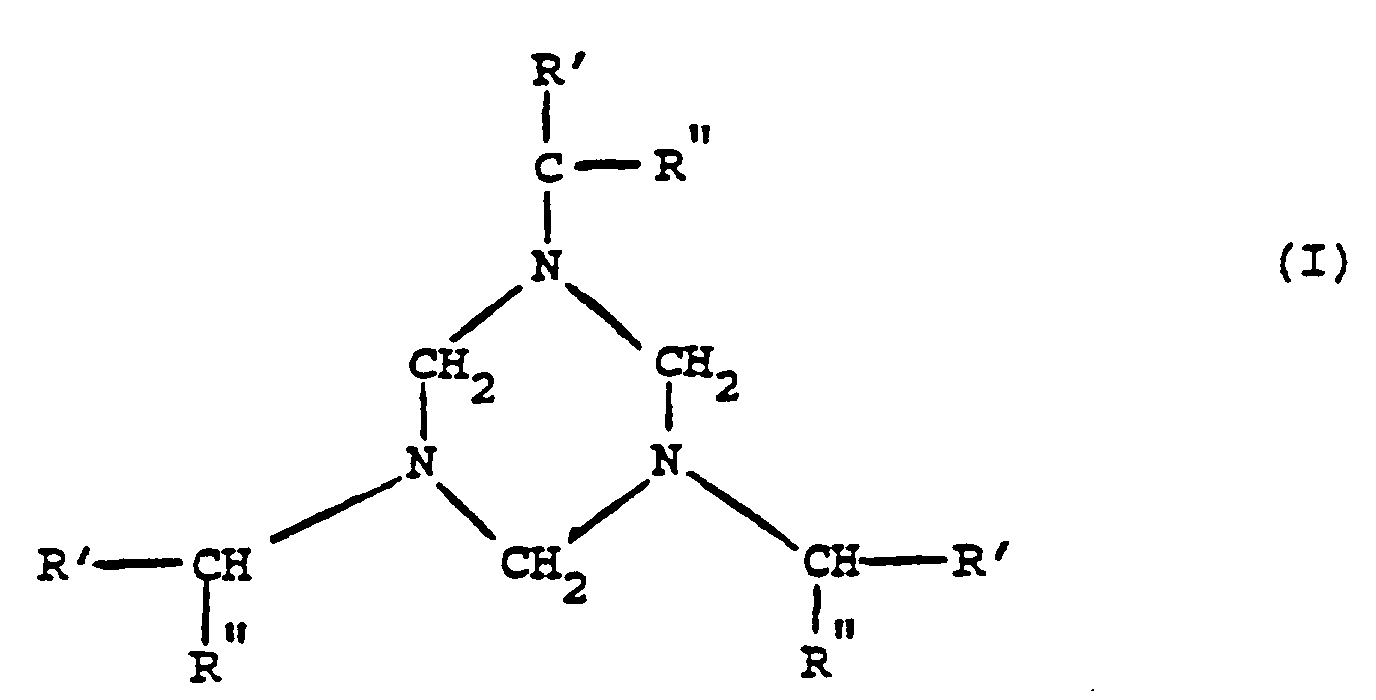
wherein R' is H, a lower(C1-C6)alkyl, a hydroxyalkyl of a C1 to C6 alkyl group or an N-N-dialkylalkylene amine of a C1 to C6 alkyl group; and R'' is H or a C1 to C6 alkyl.
wherein R' is H, a lower(C1-C6)alkyl, a hydroxyalkyl of a C1 to C6 alkyl group or an N-N-dialkylalkylene amine of a C1 to C6 alkyl group; and R'' is H or a C1 to C6 alkyl.
3. A method as in claim 2 wherein R' comprises H, CH3-, CH3CH2-, CH3CH2CH2-, (CH3)2CH-, HOCH2CH2-, HOCH2-, HO(CH3)CH-, (CH3)2NCH2- or (C2H5)2NCH2-; and R'' comprises H, CH3-, or CH3CH2-.
4. A method as in claim 1, wherein said composition further comprises water and a lower
mono- or dihydric alcohol.
5. A method as in claim 4, wherein said alcohol comprises CH3OH, CH3CH2OH, (CH3)2CHOH or HOCH2CH2OH.
6. A method as in claim 3, wherein R' comprises HOCH2-, HOCH2CH2- or HO(CH3)CH-and R'' comprises H or CH3-.
7. A method as in claim 4, wherein said composition comprises 20 to 80 weight percent
of a compound of Formula I, 20 to 80 weight percent of water and 0 to 60 weight percent
of a lower mono- or dihydric alcohol.
8. A method as in claim 7, wherein said composition comprises 25 to 40 weight percent
of a compound of Formula I, 48 to 60 weight percent of water and 12 to 20 weight percent
of a lower mono- or dihydric alcohol.
9. A method as in claim 1, wherein said composition is contacted with said sewage gas
in a lift station fume exhauster.
10. A method as in claim 1, wherein said composition is contacted with said sewage gas
in a wet scrubber in a counter-current or cross-flow manner.
11. A method as in claim 1, wherein said composition is contacted with said gas sewage
by direct injection into the gas flow lines.
1. Verfahren zum selektiven Verringern der Gehalte an in Klärgas vorhandenem Schwefelwasserstoff
und organischen Sulfiden unter Verringern oder Beseitigen des damit verbundenen Geruches,
der Toxizität und Korrosivität, das das Zusammenbringen des Klärgases mit einer ein
trisubstituiertes Hexahydro-s-triazin umfassenden Zusammensetzung umfaßt.
2. Verfahren wie in Anspruch 1, wobei das trisubstituierte Hexahydro-s-triazin durch
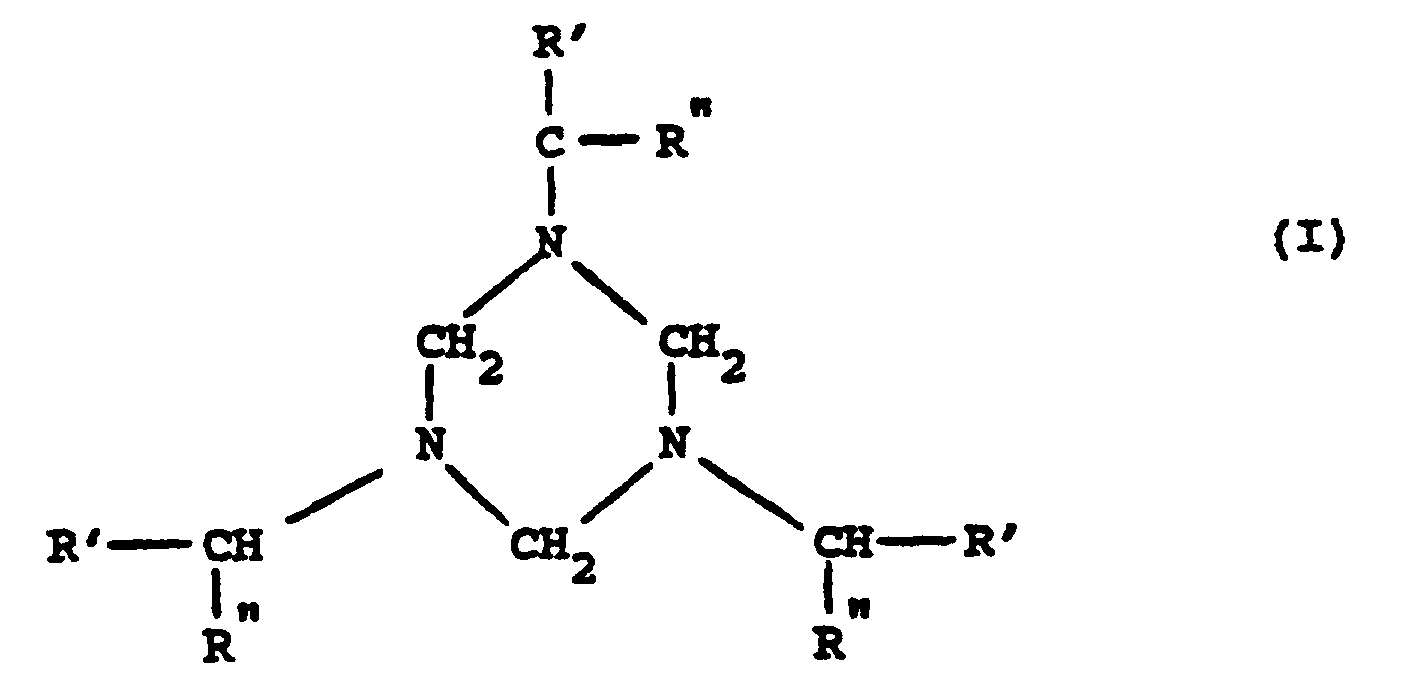
dargestellt wird, worin R' H, Nieder-C1-C6-alkyl, Hydroxyalkyl einer C1-C6-Alkylgruppe oder ein N,N-Dialkylalkylenamin einer C1-C6-Alkylgruppe ist und R'' H oder C1-C6-Alkyl ist.
dargestellt wird, worin R' H, Nieder-C1-C6-alkyl, Hydroxyalkyl einer C1-C6-Alkylgruppe oder ein N,N-Dialkylalkylenamin einer C1-C6-Alkylgruppe ist und R'' H oder C1-C6-Alkyl ist.
3. Verfahren wie in Anspruch 2, wobei R' H, CH3-, CH3CH2-, CH3CH2CH2-, (CH3)2CH-, HOCH2CH2-, HOCH2-, HO(CH3)CH-, (CH3)2NCH2- oder (C2H5)2NCH2- umfaßt und R'' H, CH3- oder CH3CH2- umfaßt.
4. Verfahren wie in Anspruch 1, wobei die Zusammensetzung weiter Wasser und einen niederen
ein- oder zweiwertigen Alkohol umfaßt.
5. Verfahren wie in Anspruch 4, wobei der Alkohol CH3OH, CH3CH2OH, (CH3)2CHOH oder HOCH2CH2OH umfaßt.
6. Verfahren wie in Anspruch 3, wobei R' HOCH2-, HOCH2CH2- oder HO(CH3)CH- umfaßt und R'' H oder CH3- umfaßt.
7. Verfahren wie in Anspruch 4, wobei die Zusammensetzung 20 bis 80 Gew.-% einer Verbindung
der Formel I, 20 bis 80 Gew.-% Wasser und 0 bis 60 Gew.-% eines niederen ein- oder
zweiwertigen Alkohols umfaßt.
8. Verfahren wie in Anspruch 7, wobei die Zusammensetzung 25 bis 40 Gew.-% einer Verbindung
der Formel I, 48 bis 60 Gew.-% Wasser und 12 bis 20 Gew.-% eines niederen ein- oder
zweiwertigen Alkohols umfaßt.
9. Verfahren wie in Anspruch 1, wobei die Zusammensetzung in einem Rauchabsauger einer
Hubstation mit dem Klärgas zusammengebracht wird.
10. Verfahren wie in Anspruch 1, wobei die Zusammensetzung in einem Naßabscheider im Gegenstrom
oder Querstrom mit dem Klärgas zusammengebracht wird.
11. Verfahren wie in Anspruch 1, wobei die Zusammensetzung durch Direkteinspritzung in
die Gasstromleitungen mit dem Klärgas zusammengebracht wird.
1. Procédé pour réduire de manière sélective les teneurs d'hydrogène sulfuré et de sulfures
organiques dans des gaz d'égouts, afin d'en réduire la mauvaise odeur ainsi que le
caractère toxique et corrosif, dans lequel on fait agir sur ces gaz d'égouts un produit
composé qui contient une hexahydro-s-triazine trisubstituée.
2. Procédé selon la revendication 1, dans lequel l'hexahydro-s-triazine est représentée
par la formule (I) ci-après:
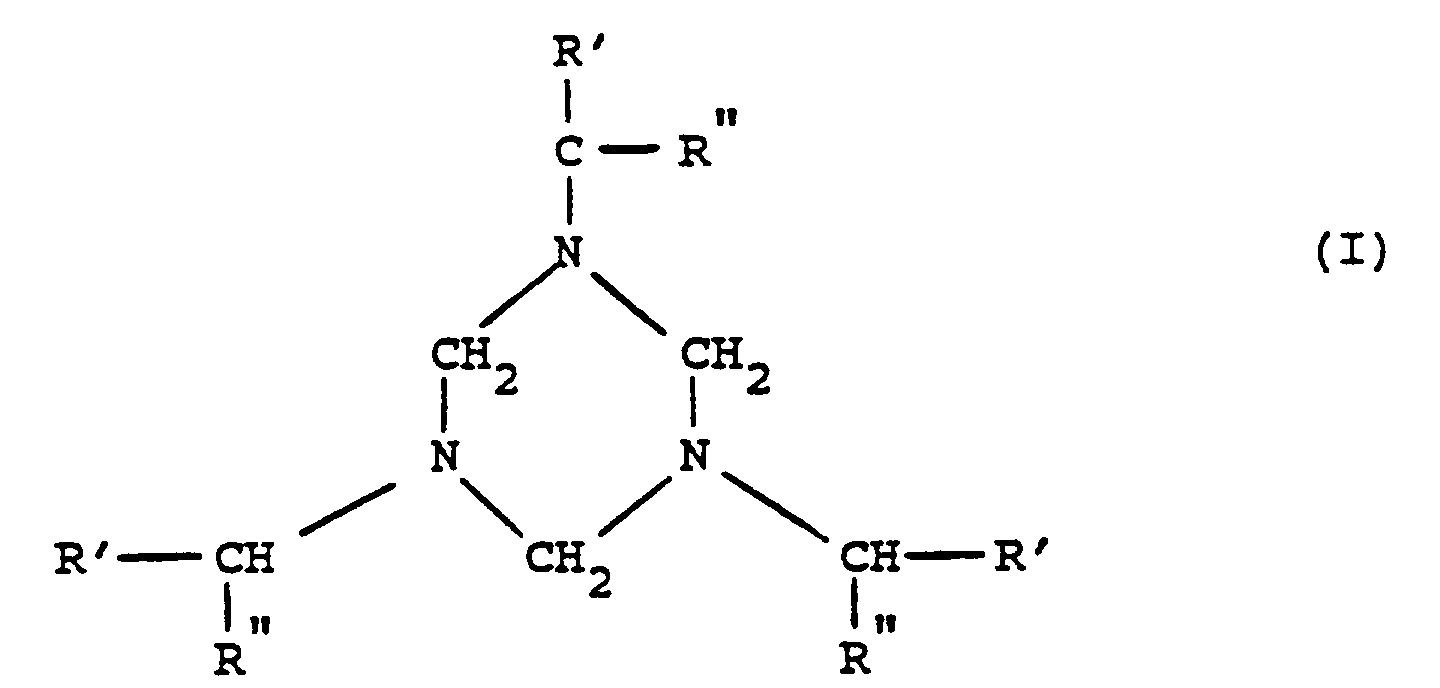
dans laquelle R' est constitué par de l'hydrogène H, ou par un alkyle d'ordre inférieur C1 à C6, ou par un hydrooxyalkyle d'un groupe alkyle d'ordre C1 à C6, ou encore par une amine N - N - dialkylalkylène d'un groupe alkyle d'ordre C1 à C6; R'' étant constitué par de l'hydrogène H, ou par un alkyle d'ordre C1 à C6.
dans laquelle R' est constitué par de l'hydrogène H, ou par un alkyle d'ordre inférieur C1 à C6, ou par un hydrooxyalkyle d'un groupe alkyle d'ordre C1 à C6, ou encore par une amine N - N - dialkylalkylène d'un groupe alkyle d'ordre C1 à C6; R'' étant constitué par de l'hydrogène H, ou par un alkyle d'ordre C1 à C6.
3. Procédé selon la revendication 2, dans lequel R' comporte de l'hydrogène H, ou un
radical tel que CH3-, ou CH3 CH2-, ou CH3 CH2 CH2- ou (CH3)2 CH-, ou HOCH2CH2-, ou HOCH2-, ou HO(CH3)CH-, ou (CH3)2NCH2-, ou encore (C2H5)2NCH2-; et R'' comporte de l'hydrogène H, ou un radical tel que CH3-, ou CH3CH2-.
4. Procédé selon la revendication 1, dans lequel le produit composé contient en outre
de l'eau et un alcool mono- ou dihydrique d'ordre inférieur.
5. Procédé selon la revendication 4, dans lequel l'alcool en question comporte un radical
du type CH3OH, ou CH3CH2OH, ou (CH3)2CHOH, ou encore HOCH2CH2OH.
6. Procédé selon la revendication 3, dans lequel R' comporte un radical tel que HOCH2-, ou HOCH2CH2-, ou encore HO(CH3)CH-, et R'' comporte de l'hydrogène ou un radical CH3-.
7. Procédé selon la revendication 4, dans lequel le produit composé contient en proportions
pondérales de 20 à 80% d'un composé de Formule (I), plus 20 à 80% d'eau avec 0 à 60%
d'un alcool mono- ou dihydrique d'ordre inférieur.
8. Procédé selon la revendication 7,dans lequel le produit composé contient en proportions
pondérales de 25 à 40% d'un composé de Formule (I), plus 48 à 60% d'eau avec 12 à
20% d'un alcool mono- ou dihydrique d'ordre inférieur.
9. Procédé selon la revendication 1, dans lequel on fait agir le produit composé en question
sur les gaz d'égouts dans un appareil d'extraction des émanations d'une usine de traitement
d'eaux usées.
10. Procédé selon la revendication 1, dans lequel on fait agir le produit composé en question
sur les gaz d'égouts dans un appareil d'épuration par voie humide, en opérant à contre-courant
ou par un effet de courant transversal.
11. Procédé selon la revendication 1, dans lequel on fait agir le produit composé en question
sur les gaz d'égouts en opérant par injection directe dans les canalisations d'écoulement
des gaz.