|
(11) | EP 0 544 035 A1 |

| (12) | EUROPEAN PATENT APPLICATION |
|
|
|
|
||||||||||||||||||||
| (54) | Cleansing composition |
| (57) The invention relates to a cleansing composition comprising from 50 to 99 per cent
by weight of a non-aromatic liquid hydrocarbon having an atmospheric initial boiling
point of at least 100 °C and from 1 to 50 per cent by weight of a secondary or tertiary
alcohol. |
[0001] The invention relates to a cleansing composition comprising a non-aromatic liquid hydrocarbon.
[0002] In the cleaning of metal surfaces halogenated hydrocarbons were used to remove grease, fat or oil during a long time. However, since it has become apparent that these halogenated hydrocarbons come into the earth's atmosphere and cause ozone depletion in the stratosphere, there has been sought for substitutes.
[0003] In the literature aromatic and aliphatic hydrocarbons have been proposed, whereby for environmental reasons non-aromatic hydrocarbons are preferred.
[0004] Aliphatic hydrocarbons do not suffice completely in cleaning colophonium contaminated metal surfaces (derived from colophonium containing solder flux used in connecting metal parts in e.g. electrical apparatuses).
[0005] It has been found that the cleaning of metal surfaces could be improved by a cleansing composition comprising from 50 to 99 per cent by weight of a non-aromatic liquid hydrocarbon having an atmospheric initial boiling point of at least 100 °C and from 1 to 50 per cent by weight of a secondary or tertiary alcohol.
[0006] Cleansing compositions preferably comprise from 5 to 45, more preferably from 10 to 40 per cent by weight of alcohol on the weight of the composition of non-aromatic hydrocarbon and alcohol. Preferred non-aromatic liquid hydrocarbons have an end-boiling point below 320 °C. More preferred non-aromatic liquid hydrocarbons have an initial boiling point of at least 130 °C and an end-boiling point below 250 °C.
[0007] More preferred non-aromatic liquid hydrocarbons are white spirits having a boiling range within the range of from 180 °C to 250 °C. Other preferred non-aromatic liquid hydrocarbons have a boiling point range from 140 to 165 °C.
[0008] The cleansing composition according to the invention comprises a secondary or a tertiary alcohol, preferably having the chemical formula:
in which R and R¹ independently represent a C₁ to C₆ - alkyl group and (R+R¹) together have at least 5 carbon atoms.
[0010] R and R¹ in the formulae may be methyl, ethyl, propyl, isopropyl, butyl, isobutyl, sec.butyl, tert.butyl, pentyl, isopentyl, neopentyl, tert.pentyl, or a hexyl group.
[0011] Most preferred alcohols are diisobutyl carbinol and methyl isobutyl carbinol. Diisobutyl carbinol may have the structure:
The two compounds are also called 3,5-dimethylheptanol-4 and 2,6-dimethylheptanol-4, respectively. Other examples of compounds falling under the above-mentioned general formulae are:
2-methylheptanol-2 (dimethyl-n-amyl carbinol)
2-methylheptanol-3 (isopropyl butyl carbinol)
2-methylheptanol-4 (propyl isobutyl carbinol)
2-methylheptanol-5 (ethyl isoamyl carbinol)
2-methylheptanol-6 (methyl isohexyl carbinol)
3-methylheptanol-3 (methyl ethyl butyl carbinol)
3-methylheptanol-4 (propyl-sec-n-butyl carbinol)
3-methylheptanol-5 (ethyl amyl carbinol)
4-methylheptanol-4 (methyl dipropyl carbinol)
2-methylhexanol-2 (dimethyl butyl carbinol)
2-methylhexanol-3 (propyl isopropyl carbinol)
2-methylhexanol-4 (ethyl isobutyl carbinol)
2-methylhexanol-5 (methyl isoamyl carbinol)
3-methylhexanol-3 (methyl ethyl propyl carbinol)
3-methylhexanol-4 (ethyl sec-butyl carbinol)
The compositions according to the invention have high and constant solubility parameters well over 90 per cent evaporation area.
[0012] The compositions according to the invention dissolve any mineral oil, resin or elastomer with a Hildebrand Solubility parameter up to 8.2, in particular remains of colophonium from solder fluxes. The compositions are resistant to oxidation and have a negligible hazard potential regarding health, air- and water-quality.
[0013] While the compositions according to the invention have a high solubility performance vis-à-vis colophonium, the alcohols themselves have not.
[0014] The compositions have a very low water-miscibility, which allows them to be used for cleaning with temporary emulsions. The compositions according to the invention only form a temporary emulsion in water under mechanical stress. The inner tension of the small organic spheres in water depends on their size which latter is dependent on the mechanical force used and the duration of the mechanical force. The steady stream of small organic particles absorbing onto the dirt layers proportionally to their inner tension, dissolves and displaces oils, fats, greases and resins. With the less compressible water spheres more power is transmitted to quickly peel-off layers. Moreover, the water disperses inorganic dirt. Water contents between 3 and 95 per cent by weight on the weight of composition according to the invention may be used, preferably from 10 to 50 per cent by weight. After the mechanical stress is finished the organic phase is immediately allowed to separate from the water phase.
[0015] The organic and inorganic dirt will dissolve in the organic phase and water phase, respectively according to Nernst's Rule. The organic dirt virtually does not contaminate the water. The necessity of treating the water phase is largely reduced. The temperature for cleaning may range from room temperature to 60 °C.
Example
[0016] The following formulations were prepared:
| I | II | III | |
| SBP 140/165 | 75 | - | - |
| White spirit 180/200 (dearomatized) | - | 90 | - |
| White spirit 195/245 (dearomatized) | - | - | 60 |
| methyl isobutyl carbinol | 25 | - | - |
| diisobutyl carbinol | - | 10 | 40 |
| The percentages are volume percentages. | |||
[0017] The water miscibility of the formulations I, II and III was 3.4 g, 0.2 g and 0.34 g per kg water, respectively.
[0018] The formulations are used in cleaning lids of pans, having a diameter of 16 cm, which were all covered with 10 gram of colophonium.
[0019] The amount of solvent used was 2 l, which was contacted with recycling velocity of 1.77 1.min⁻¹ with the lid. The formulations were also used in cleaning together with 10 per cent by weight of water and 50 per cent by weight of water in the form of a temporary emulsion under the same conditions.
[0020] Hereafter are given the cleaning results of the formulations I, II and III, whereby 100 per cent removal of the colophonium is reached after a certain time (given in minutes).
| I | II | III | |
| pure | 15 | 10 | 15 |
| with 10% | 30 | 20 | 25 |
| with 50% | 30 | 10 | 15 |
| formulation I at 20 °C formulation II at 50 °C formulation III at 60 °C |
|||
Comparative Example
1. Cleansing composition comprising from 50 to 99 per cent by weight of a non-aromatic
liquid hydrocarbon having an atmospheric initial boiling point of at least 100 °C
and from 1 to 50 per cent by weight of a secondary or tertiary alcohol.
2. Cleansing composition as claimed in claim 1 wherein the non-aromatic liquid hydrocarbon
has an end-boiling point below 320 °C.
3. Cleansing composition as claimed in claim 1 or 2 wherein the non-aromatic hydrocarbon
has an initial boiling point of at least 130 °C and an end-boiling point below 250
°C.
4. Cleansing composition as claimed in one or more of the claims 1-3 wherein the non-aromatic
hydrocarbon is white spirit having a boiling range within the range of from 180 °C
to 250 °C.
5. Cleansing composition as claimed in one or more of the claims 1-3 wherein the non-aromatic
hydrocarbon has a boiling range of from 140 °C to 165 °C.
6. Cleansing composition as claimed in one or more of the claims 1-5 wherein the alcohol
has the chemical formula:
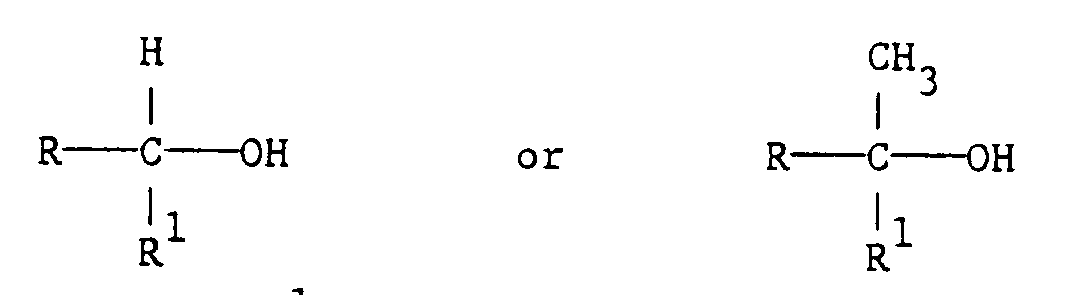
in which R and R¹ independently represent a C₁ to C₆-alkyl group and (R+R¹) together have at least 5 carbon atoms.
in which R and R¹ independently represent a C₁ to C₆-alkyl group and (R+R¹) together have at least 5 carbon atoms.
7. Cleansing composition as claimed in claim 6 wherein R and R¹ are methyl, ethyl, propyl,
isopropyl, butyl, isobutyl, sec.butyl, tert.butyl, pentyl, isopentyl, neopentyl, tert.pentyl
or a hexyl group.
8. Cleansing composition as claimed in claim 6 or 7 wherein the total number of carbon
atoms is from 6 to 9.
9. Cleansing composition as claimed in one or more of the claims 6-8 wherein the alcohol
is methyl isobutyl carbinol or diisobutyl carbinol.
10. Cleansing composition as claimed in claim 1 as hereinbefore described with special
reference to the Example.
11. Use of a cleansing composition as claimed in one or more of the claims 1-10, in admixture
with water, forming a temporary emulsion under mechanical stress, to remove grease,
fats, oils or resins from a surface.