|
(11) | EP 0 550 230 A1 |

| (12) | EUROPEAN PATENT APPLICATION |
|
|
|
|
|||||||||||||||||||||||||||
| (54) | Felt conditioning |
| (57) A process for the felts of a papermaking operation in order to inhibit the deposition
of particulate matter in the felt comprising applying to the felt a fatty acid imidazoline
compound. |
[0001] The present invention relates to inhibiting the deposition of particulate materials in the press felts of a papermaking operation. Specifically, this invention pertains to the use of a press felt conditioner directed at controlling the deposition of polymerically flocculated particulate materials, especially in neutral to alkaline papermaking systems.
[0002] In a paper manufacturing process, ionically charged, relatively high molecular weight, water soluble polymers are often employed to enhance retention of cellulosic fibres, fines, and inorganic fillers. The addition of these polymers produces a cleaner process stream by reducing the solids level in the process filtrate. The high molecular weight, ionically charged polymers control solids by adsorbing onto solid particulate surfaces in the papermaking furnish slurry and invoking charge neutralization (coagulation) and/or bridging (flocculation) mechanisms which cause the solid particles to flocculate. The flocculate can be retained by the formed mat of cellulosic fibres more easily than smaller individual particles. However, these flocculated particulate materials can be transferred from the surface of the sheet to the papermachine press felts. In the flocculated state, the particles cannot pass through the fine, porous structure of the press felt(s) and become entrapped therein. If not controlled by adequate felt conditioning practices, these agglomerated particulate substances can severely impair the ability of the press felts to absorb water thereby requiring reduced production rates and shortening the useful life of the felts. In addition, it has been found that common polymeric retention aids can render normally effective prior art felt conditioners useless or marginally effective.
[0003] Typical polymers employed as retention aids are generally relatively high in molecular weight; for example, copolymers made from monomers such as; acrylic acid, acrylamide, dimethyl/diallyl ammonium chloride, dimethylamine, epichlorohydrin, and ethylene diamine. Typically, polymeric retention aids have average molecular weights greater than 1,000,000 and can range up to around 20,000,000 for anionically charged polymers and up to 15,000,000 for cationically charged polymers. These ionically charged polymers adsorb onto the various solid particulate surfaces within the papermaking furnish causing flocculation.
[0004] In neutral and alkaline papermaking (pH approximately 6.0 - 8.5), the utilization of polymeric retention aids is particularly critical for efficient operation. Without them, such common system additives as cellulosic reactive sizes, Alkenyl Succinic Anhydride (ASA) and Alkene Ketene Dimer (AKD), can cycle up on the process system and hydrolyze causing numerous operational problems, particularly in the press section. Subsequently, most of the particulates that are transferred from the sheet to the press felts in the neutral and alkaline papermaking system are generally in a flocculated state and are therefore too large to easily pass through a press felt. Subsequently, these contaminants are either embedded into the felt structure or transferred back to the sheet and cause spots, holes or the like, or deposit in the dryer section and cause problems there. Because of their size, they are relatively unresponsive to prior art felt conditioning treatments.
[0005] In addition to the aforementioned contaminants, most press felts associated with coated alkaline fine paper experience excessive filling due to white pitch deposition. This arises from natural wood resins such as fatty esters, fatty acids, resin acids and other typical papermaking furnish components such as sizing agents, alumina and fibre fines. The paper coating binders such as polyvinyl acetate or styrene butadiene latices and inorganic coating pigments such as clay, calcium carbonate and titanium dioxide also contribute to the felt filling. If not effectively controlled by adequate chemical and mechanical press felt conditioning practices, this high level of contaminating material plugging or filling the paper machine press felt severely impairs their water absorbancy capability, which in turn, reduces paper machine production rates, produces paper quality defects and/or requires the premature removal and replacement of the expensive felts.
[0006] Chemical analyses of used press felts associated with coated neutral and alkaline papermaking also reveal a number of polymerically flocculated components. Significant quantities of inorganic fillers such as calcium carbonate, clay and titanium dioxide are typically found in addition to normally smaller amounts of sizing agents and wood pitch components.
[0007] While various anionic or nonionic surfactant-type felt conditioners commonly employed in the art demonstrate substantial efficacy for conditioning press felts subject to wood pitch and/or paper sizing agent-related contamination, they have proven to possess limited efficacy against white pitch contamination at commercially viable treatment dosage levels.
[0008] Processes to inhibit contamination deposition in paper-making felts are known in the art. US-A- 4 715 931 (Shellhamer et al.) discloses a process for inhibiting aluminium hydroxide deposition in papermaking systems which comprises adding to the felts a hydroxylated carboxylic acid. The use of the carboxylic acid in combination with surfactants, such as octyl phenol ethoxylates, nonyl phenol ethoxylates and others listed therein inhibit aluminium hydroxide deposition and associated organic contaminants.
[0009] In addition to the control of inorganic contaminants, pitch formation is of concern in papermaking systems. Filler materials can become trapped within the organic matrix formed by pitch coalescence compounding deposition problems. Methods of controlling the pitch deposition formation are known in the art. US-A- 4 184 912 (Payton) discloses a method of preventing pitch formation by dispersing and emulsifying pitch particles in the pulp furnish to an exceptionally fine state and uniformally distributing the particles throughout the finished paper. The pitch deposition is controlled by the addition of a three component formulation comprising a nonionic surfactant plus an anionic surfactant and a low molecular weight anionic polymer. The three component mixture is added to the papermaking pulp system at a point prior to where pitch deposits normally form. In US-A- 3 992 249 (Farley) a process for inhibiting pitch deposition is disclosed wherein the pulp is washed with an aqueous solution of anionic polymer having between 25 to 85 mole percent hydrophobic-oleophilic linkages and 15 to 70 mole percent hydrophilic acid linkages to complex with the pitch. The pitch-polymer complex is washed away with water.
[0010] US-A- 3 873 417, (Otrhalek et al.), discloses a pitch and pigment dispersant which comprises a neutralized solution of polymer prepared by free radical polymerization of an alpha, beta unsaturated acid with an alkyl ester and an allyl alcohol.
[0011] Another pitch control process is disclosed in US-A-3 398 047, (Michalski). That patent teaches that the use of an organic polydentate ligand such as aminopolycarboxylic acids, and an organic sulphonate offer an efficient pitch deposition inhibitor. Of further interest is US-A- 3 582 461, (Lipowski et al.), which discloses a pitch control process utilizing a dicyandiamideformaldehyde condensate compound.
[0012] US-A- 3 642 572, (Endres et al.), discloses that polyamidoamines are useful not only as flocculants, but also as retention aids and dewatering agents in papermaking processes. Additional polyamines are disclosed in US-A- 3 893 885 (Ziemann et al) as being useful as retention aids and dewatering agents.
[0013] Some treatment programs are directed specifically at the reduction of contaminants within the felt or other sheet forming surfaces. EP-A- 0359590 addresses the control of deposits on and within papermill felts by employing the use of a cationic polymer in conjunction with nonionic or cationic surfactants. The base products used to create the cationic polymers preferably contain amine groups. US-A- 4 895 622, (Barnett et al.) discloses a felt conditioner comprising a relatively low molecular weight anionic organic polymer and a hydrophilic anionic or nonionic surfactant. The polymers preferably contain acrylic acid or methacrylic acid moieties.
[0014] It has now been found that the deposition of polymerically flocculated particulate material in a felt in the press section of a papermaking system can be satisfactorily inhibited. Several functionally similar members of fatty acid imidazolines are surprisingly effective when employed as felt conditioning agents for inhibiting contamination of press felts subjected to the aforementioned flocculated particulate substances.
[0015] Surprisingly, other types of fatty acid imidazolines did not produce positive results when employed as felt conditioners.
[0016] According to the present invention there is provided a process for conditioning the felts of a papermaking system in order to inhibit polymeric retention aid flocculated particulate deposition in the felts which comprises applying to the felts a fatty acid imidazoline having the general formula
wherein R is an alkyl hydrophobe radical having a carbon chain length of C₁₂ or more.
[0017] Fatty acid imidazolines, as used in the present invention, will provide for an effective continuous press felt conditioning treatment when the press felts are subjected to significant quantities of the aforementioned polymerically flocculated particulate substances originating particularly from coated neutral and alkaline pH papermaking furnishes, with or without sizing agent being present. The choice of the fatty acid imidazoline appears to be critical and the imidazoline used in the present invention falls within a hydrophobe carbon chain length of C₁₂ or greater with the preferred hydrophobe chain length of C₁₈.
[0018] The felt conditioning agents used in the present invention may be metered into one or more fresh water showers directed onto a press felt on its runs between the press nip and the vacuum or uhle box utilized for dewatering the treated felts.
[0019] The required amount or concentration of fatty acid imidazoline will depend on, among other things, the volume of shower water employed, the production rate, and the concentration of polymerically flocculated contaminants. Generally the total concentration of fatty acid imidazoline added to the aqueous showering medium is from 10 to 1500 parts per million parts of the aqueous medium. Preferably, they are added at concentrations from 100 parts to 300 parts per million parts of aqueous showering medium.
[0021] In order to more clearly illustrate the present invention the following data were generated. The following Examples are included as illustrations of the present invention and should not be construed as limiting the scope thereof.
EXAMPLES
[0022] The Examples contained herein will demonstrate the unexpected superior responses produced by the present invention. The results were obtained utilizing a continuous press felt conditioning test apparatus and a simulated coated alkaline fine paper contaminant system. The testing incorporates a clean (unused) press felt sample of known initial weight and air permeability placed on a heavy-mesh support screen through which the treated or untreated contaminant solution is pressed. The simulated coated alkaline fine papermaking contaminant test slurry consisted of the following:
| Ingredient | Concentration (ppm) |
| Ground Calcium Carbonate | 375.00 |
| Clay | 125.00 |
| Fatty ester/fatty acid pitch mixture | 50.00 |
| *Coating solids (cured, redispersed 15% slurry) | 300.00 |
| Alkaline Size (ASA/starch, 1:3 ratio, 10% slurry) | 48.75 |
| Cationic Retention Aid (High Molecular Weight, Cationic Polyacrylamide) | 2.00 |
| * Pre-cured coating formulation contains: 5% PVAc latex, 5% SBR latex, 32% Clay, 8% TiO₂ and 50% water |
[0023] Table 1 contains data generated in this slurry system showing the performance characteristics of several commercially available surfactants and polymers as defined below, employed in the art for continuous or intermittent conditioning of paper machine press felts in comparison to the fatty acid imidazolines according to the present invention. Table 2 summarizes data generated to evaluate the effectiveness of the present invention in the same slurry system excluding the alkaline size.
[0024] As can be seen from Tables 1 and 2, the results show that in two critical test parameters, namely percent weight gain and percent permeability loss, the values for the fatty acid imidazolines with a hydrophobe carbon chain length of C₁₂ to C₁₈ were significantly lower than the control or any other surfactant or polymer commonly employed in the continuous or intermittent conditioning of paper machine felts.
[0025] Examples are listed below of the conventional surfactants known in the art which were compared against the fatty acid imidazolines used in the present invention:
[0026] Alkyl or dialkyl phenol ethoxylates used may be represented by the general structure:
where,
R = H or alkyl group
R' = H or alkyl group
n = moles of ethylene oxide;
Sodium lignosulphonates;
Ethoxylated secondary alcohols;
Quaternary imidazolines;
Phosphate esters;
Polymethylnapthalene sulphonates;
Polyacrylic acid; and
Sodium alkylnapthalene sulphonate.
1. A process for conditioning the felts of a papermaking system in order to inhibit polymeric
retention aid flocculated particulate deposition in the felts which comprises applying
to the felts a fatty acid imidazoline having the general formula:
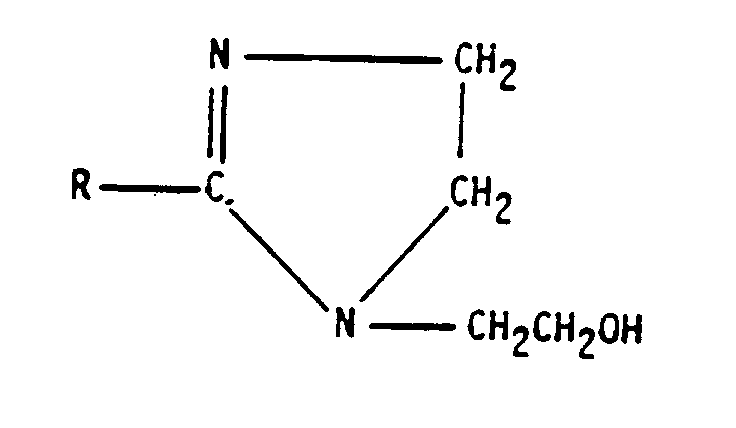
wherein R is an alkyl hydrophobe radical having a carbon chain length of C₁₂ or more.
wherein R is an alkyl hydrophobe radical having a carbon chain length of C₁₂ or more.
2. A process according to claim 1, wherein R is an alkyl hydrophobe radical having a
carbon chain length of C₁₈.
3. A process according to claim 1 or 2, wherein the papermaking system is pH neutral
or alkaline.
4. A process according to any of claims 1 to 3, wherein the felt is conditioned by showering
with an aqueous medium containing the fatty acid imidazoline.
5. A process according to any of claims 1 to 4, wherein the fatty acid imidazoline is
added in an amount of from about 10 to about 1,500 parts per million parts of the
aqueous medium.
6. A process according to claim 5 wherein the fatty acid imidazoline is added in a preferred
amount of from about 100 to about 300 parts per million parts of the aqueous medium.