|
(11) | EP 0 550 351 B1 |

| (12) | EUROPEAN PATENT SPECIFICATION |
|
|
| (54) |
Coating compositions for master media for anhysteretic recording Beschichtungszusammensetzungen für Mastermedien zur hysteresisfreien Aufzeichnung Compositions pour le revêtement d'une matrice en vu d'un enregistrement sans hystérésis |
|
|
|||||||||||||||||||||||||||||||
| Note: Within nine months from the publication of the mention of the grant of the European patent, any person may give notice to the European Patent Office of opposition to the European patent granted. Notice of opposition shall be filed in a written reasoned statement. It shall not be deemed to have been filed until the opposition fee has been paid. (Art. 99(1) European Patent Convention). |
[0001] The invention relates to unique coating compositions suitable for preparing master media for anhysteretic recording and a process for making them. More particularly, the invention relates to coating compositions which provide master media having superior durability and anhysteretic recording characteristics notwithstanding surface roughness and coercivities significantly less than three times those of copy media.
[0002] Conventionally, contact printing has been used as a system for the high speed duplication of audio and/or video signals prerecorded on a master. In contact printing, the master medium must have a coercivity three times higher than that of the copy tape. To attain high duplicating speeds, generally more than one hundred times normal speed, the master and copy are wrapped around something like a transfer drum so that the coated surfaces of each face one another. Air pressure is generally used to press the master and copy together and a bias field is applied using a stationary transfer bias head. The mirror image of the magnetic pattern on the master becomes transferred onto the copy.
[0003] Devices for printing or copying signals by tape-to-tape copying processes from a master magnetic tape on which the signals are already recorded in a mirror image to a slave or copying magnetic medium such as a tape using either a magnetic printing or thermal printing method have been described, for example, in U.S. Patents 3,592,977; 4,755,888. Other devices for anhysteretic recording are also known for tape-to-tape copying as well as for copying from a tape to photographic film base or from magnetically recorded layers onto transparent magnetic layers on a copying substrate such as transparent magnetic layers in the cellulose acetate base of photographic film.
[0004] Currently available master tapes which provide sufficient signal to transfer a mirror image to a copy medium, particularly a photographic layer, are quite fragile. When attempts were made to record to photographic film, the commercial master failed so quickly that it was not possible to evaluate the record/playback apparatus to be used. The commercial master was brittle and had poor adhesion to base with particularly rapid failure at the edges.
[0005] To function adequately, a master must not only have high durability but it must also function without scratching or otherwise damaging the magnetic, photographic, or other layers of the copying medium. High coercivity (2000 Oe) master tapes are generally used with low coercivity (650 Oe) copy media.
[0006] Further, the master must function without "preexposure" of the receiving sensitized layers due to sparks from electrostatic discharge of charges accumulated during the transport and transfer processes when film webs are driven, brought together, and parted at high speed. In magnetic transfer from a master to a magnetic film base, such problems are resolved by back coating the master with a conductive layer, preferably a thin and durable conductive carbon containing layer. However, mobile components transfer from the magnetic layer and back coat on contact with the receiving medium during high speed copying. While such mobile components as well as volatile molecules or particulate debris in the air flow do not generally present a significant problem during transfer to magnetic receiving media, they are quite detrimental to a photographic layer since static changes anywhere in the system can destroy the photographic properties of a photosensitive layer.
[0007] DE-A-4,041,738 discloses a magnetic recording medium for 8 mm video which comprises a high coercive ferromagnetic powder and a binder which is a specific polyurethane having an average molecular weight of not more than 30,000 and a polar group -SO3M of which the S atom is not less than 0.35 % by weight of the polyurethane, and a Tg less than 0°C preferably between -10 and -50°C. The binder solves the problem of head rapping, by stabilizing the video tape running. The coercivity of the magnetic particles in the example is 1580 Oe.
[0008] It has now been found that coating compositions for high durability, non-brittle, and adherent master media for anhysteretic transfer of magnetically recorded information to a copy medium, particularly to a photographic layer, comprise from 59 to 69% of a magnetic pigment, preferably from 64 to 68%, most preferably 64%; from 2.9 to 6.9% of an abrasive powder, preferably from 3.8 to 5.4, most preferably 5.36%; from 0 to 5.5% of a colloidal inorganic powder, preferably from 1 to 3%, most preferably 1.34%; from 2.9 to 4.5% of a wetting agent, preferably from 3.3 to 4.4, most preferably 3.8%; from 0.7 to 3.1% of a lubricant, preferably from 0.8 to 2.3, most preferably 1.54%; from. 14.1 to 35.6% of a binder, preferably from 20 to 25.5%, most preferably 21%, at least 85% of which is a polyurethane as defined in claim 1 from 0.05 to 15% of which is a polyisocyanate crosslinking agent as defined in claim 1, preferably 10%. (All percentages of the components of the coating composition described herein are by weight based on the total dry weight of the coating composition except the polyurethane and crosslinking agent, which are percent by weight of the binder.)
[0009] The coating compositions of invention can be disposed on a substrate or support, preferably back-coated with a composition containing from 15 to 25% of carbon black, from 15 to 25% of an inorganic filler, from 0.5 to 2% by weight of an abrasive, from 20 to 30% of a vinyl copolymeric binder, from 15 to 25% of a polyurethane binder, from 7.5 to 17.5% of a crosslinking agent, from 0.9 to 2% of a lubricant, from 0.06 to 0.6% of a coating aid. All percentages are by weight of the dry weight of the backcoating which is preferably applied to provide a dry coating thickness of from: about 0.3 to about 1.5 microns, most preferably about 0.5 micron. The backcoating composition is applied as a dispersion, preferably containing from about 8 to about 15% by weight of solids, most preferably 10%, in any suitable solvent such as any of those described herein, preferably mixtures thereof, most preferably approximately 4:3:3 mixtures of methylethylketone: methylisobutylketone:cyclohexanone.
[0010] Backcoating compositions which obviate the problems caused by electrostatic charges which arise during the transport and transfer processes generally in signal transfer to a magnetic film base do not behave satisfactorily when a signal is being transferred to a photographic layer. The backcoating of the invention obviates preexposure problems associated with sparks from electrostatic discharge of charges accumulated when webs are driven, brought together, and parted at high speed. Problems arising from mobile component transfer including volatile molecules or particulate debris in the air which can be detrimental to a photographic receiving layer are obviated when the backcoat of the invention is used.
[0011] The master media of the invention have good durability and electrical and recording performance characteristics. The master media of the invention, which generally have a coercivity of at least about 2000 Oe, efficiently and effectively transfer signals to copy media having coercivities ranging as high as from about 850 to about 1000 Oe. The master media of the invention have similar output characteristics to known high coercivity master tapes but, because they provide thinner coatings, the master media of the invention have better overwrite. They also have superior adhesion to substrates, particularly polyester substrates whether subbed or unsubbed, with none of the brittleness noted with prior master media. Also, the ability to use a thicker film base improves handling and transport characteristics. In addition, scratches and other damage to copying media, particularly the magnetic layers of cellulose acetate or polyester photographic film base, are reduced or prevented using the master media of the invention.
[0012] The magnetic coating compositions of the invention are prepared by an essentially three-step process involving a wet-out stage, a grind stage, and a let-down stage. The process involves wetting out by mixing magnetic pigment, abrasive powder, colloidal inorganic or carbon powder, and wetting agent with a solvent, grinding the wet-out mixture, letting down the wet-out/grind mixture by adding binder, lubricant and polyisocyanate crosslinking agent thereto and, optionally, milling further at reduced rpm, or "polishing" the resulting dispersion.
[0013] In this process, the polishing step is preferred. Further, the magnetic pigment is preferably wetted with a solvent containing dissolved wetting agent before it is mixed with the abrasive powder, colloidal inorganic powder, and, optionally, the remainder of the solvent. It is also preferred that the binder is added in solution and that the binder is added to the wet-out/grind mixture before the lubricant and crosslinking agent. It is further preferred that the polished dispersion is filtered in the preparation of a coating composition of the invention.
[0014] The resulting dispersion of any suitable solids content in any suitable solvent or solvent mixture can then be coated onto a suitable substrate and the magnetic particles oriented before the coated substrate is dried, calendered, and wound up. Preferably, the dispersions contain from about 60 to about 75 weight %, preferably 68 weight %, based on the total weight of the dispersion, of a solvent, preferably a mixture of tetrahydrofuran, cyclohexanone, methylethyl ketone, and toluene. Most preferably the solids content ranges from about 27-33 percent.
[0015] The performance properties of the master media of the invention are impressive. Signal strength using direct recording mode for the master tapes is within +/- 1-2 db compared to a video master tape. Also the signal strength of a copy medium which was written or encoded using anhysteric transfer from the master medium but read directly from the copy or slave medium using a benchmark recording head is better than direct recording and playback of the copy medium using a benchmark recording head. A master of the invention is equivalent electrically to master tapes such as Sony Mirror Mother when reading the anhysteretically recorded copy and because of the thinness of the coating (about 2-2.8 microns) compared to Sony Mirror Mother (about 4-5 microns), the overwrite of the master media of the invention is about 8-10db better than Sony Mirror Mother. The master media of the invention also have better durability and adhesion of the magnetic layers than prior master tapes.
[0016] The master media of the invention tend to be smoother than known master tapes. However, they can be provided with a much rougher surface than master tapes used heretofore. This helps get rid of striction problems while still providing good transfer of longer wave length information.
[0017] Polyester supports for the master media of the invention are generally from about 1.3 to about 3 mils thick or 2-4 times thicker than prior master tapes. This provides the master media of the invention with a robustness and durability as well as handling and transport characteristics heretofore unattainable.
[0018] The master media of the invention are also capable of transferring recorded signals efficiently and effectively to receiving media having coercivities higher than those used heretofore. This may in part be due to the ability to record at lower frequencies or longer wavelengths than video tapes or masters. Such a result was unexpected. The ratio of coercivity of master to slave in the practice of the invention is about 2 to 1.
[0019] Coating compositions of the invention can be prepared using any suitable materials of the classes specified herein or mixtures thereof and any suitable equipment. Generally, from about 59-69%, preferably 64-67%, most preferably 67 dry weight % of any suitable magnetic pigment mixture can be used to prepare the coating compositions of the invention. Total pigment content greatly influences the physical properties of the tape. Too low a pigment content (binder rich) gives higher stick-slip tendency when the tape is run against the head, or against various transport mechanisms that move and direct the tape. Too high a pigment content produces a tape that is fragile because it is too brittle. The relationship between magnetic pigment content and electrical properties is straightforward: the higher the pigment content, the higher the electrical signal. Also, the higher the abrasive pigment content (e.g. alumina) and the larger the abrasive particles, the greater the contribution of the media to the total electrical noise. This kind of noise, however, does not appear to impact the performance of the master tapes of the invention since the wavelength of the magnetic information is significantly greater than the abrasive particle diameter.
[0020] A useful magnetic particle in the practice of the invention has a coercivity, Hc, equal to or greater than about 2000 Oe, the highest possible saturation magnetization (emu/9), and a specific surface area (SSA) ranging from about 50-60 m2/g.
[0021] Any suitable pigment can be used including pure iron or an alloy of Fe, Co, Ni, Co-Ni, Co-Pt, Co-Ni-Pt, Fe-Co, Fe-Ni, Fe-Ni-Co, Fe-Co-B, Co-Ni-Fe-B, Co-Cr, chromium dioxide, doped, modified, coated magnetic particles or pigments and mixtures thereof. Metallic iron, preferably needle-like particles having a metallic iron core surrounded by a passivity shell of iron oxide (largely Fe203) which prevents the particle from spontaneously catching fire when exposed to air, is preferred. The magnetic properties of such particles can be thought to be a weighted average of the properties of pure iron and the iron oxide. Pferromet PK2000, available from Harcross Pigments, Easton, PA 18042-1497, is an example of a most preferred pigment.
[0022] The magnetic pigment, abrasive powder, and colloidal inorganic powder, are first wetted with a suitable solvent using any suitable wetting agent or dispersant. Components such as the abrasive powder and/or the colloidal inorganic, which is preferably carbon black, can be added as dry powders but are preferably added as predispersed slurries. Preferably, the abrasive dispersion is stabilized with a small amount of the hydroxy terminated polyurethane binder to be employed.
[0023] Generally, amounts of the polyurethane as small as from 2-4 weight percent based on the weight of the solids in the abrasive dispersion are adequate. The use of a small amount of a wetting agent as defined herein has also been found advantageous. Generally, amounts as small as from 1-3 weight percent of wetting agent based on the weight of the solids in the abrasive dispersion are adequate.
[0024] Generally, from 2.95 to 6.9%, preferably 3.8-5.4%, most preferably 5.36 dry weight %, of any suitable abrasive material can be employed. Typically, fine inorganic particles are used such as, for example, aluminum oxide, silicon carbide, chromium trioxide, diamond, artificial diamond, garnet, emery and the like and mixtures thereof having an average particle diameter of from about 0.1 to about 2 microns and a specific surface area (SSA) ranging from about 1 to about 15 m2/g can be used. Alumina, particularly crystalline alpha alumina is preferred because it has the appropriate hardness and shape, is readily dispersible, and widely available in the preferred 0.1 - 0.6 micrometers diameter range which allows the tops of the particles to protrude from the tape surface and exert their "cleaning" action on the head.
[0025] Up to 5.4%, preferably 1-3%, and most preferably 1.34 dry weight %, of any suitable colloidal inorganic powder and mixtures thereof can be used in the preparation of the coating compositions of the invention provided that carbon black is a component thereof. Preferably, up to 2.68%, preferably 1.34 dry weight % of colloidal carbon (carbon at 43 m2/g) is used as the colloidal inorganic powder. Conductive carbon black, furnace carbon, channel carbon, acetylene carbon, thermal carbon, lamp carbon, commercially available carbon blacks such as Elftex 12, Sterling R, and Cabot XC-72 (Cabot Corp, Boston, MA 01821) and Accufluor CFx (Allied Engineered Materials, Morristown, NJ 07960), and the like and mixtures thereof are preferred.
[0026] Inorganic pigments, conductors, extenders and the like such as alumina having a particle diameter of from 0.01 to 0.04 micrometers and a specific surface area (SSA) ranging from 20 to 300 m2/g can also be used as an inorganic colloidal component. Alpha FeOOH, alpha Fe2O3, Cr2O3, TiO2, ZnO, SiO2, SiO2 .2H2O, Al2O3 .2SiO2 .2H2O, 3MgO.4SiO2 .H2O, CaCO3, MgCO3, Sb2O3 commercial counterparts such as Aluminium Oxid C, Aerosil 200, and Aerosil 972 (Degussa Corp, Pigments Div, Teterboro, NJ 17608) and mixtures thereof can also be used. Alumina, particularly less dense gamma-Al2O3, is preferred, e.g., Oxid C. The colloidal inorganic materials improve durability and control surface roughness. They are too small to act as abrasives but capable of acting as spacers, as extenders to reinforce the polymer matrix, or as dispersion aids.
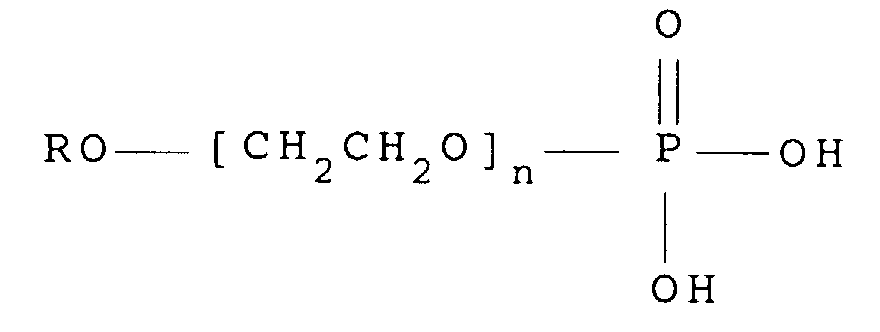
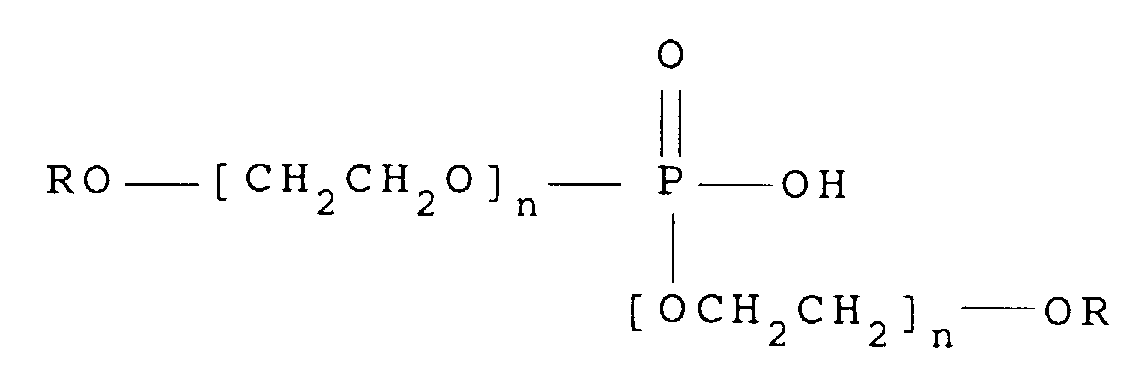
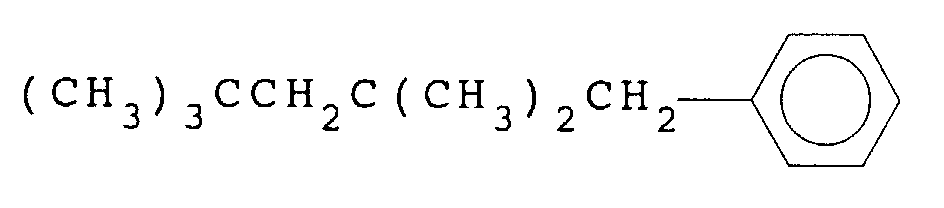
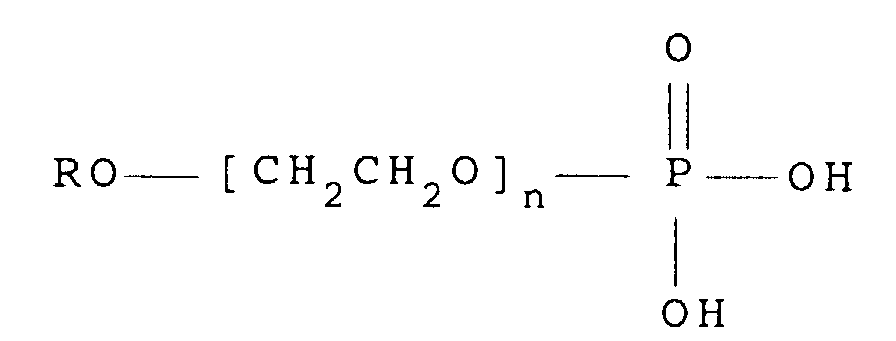
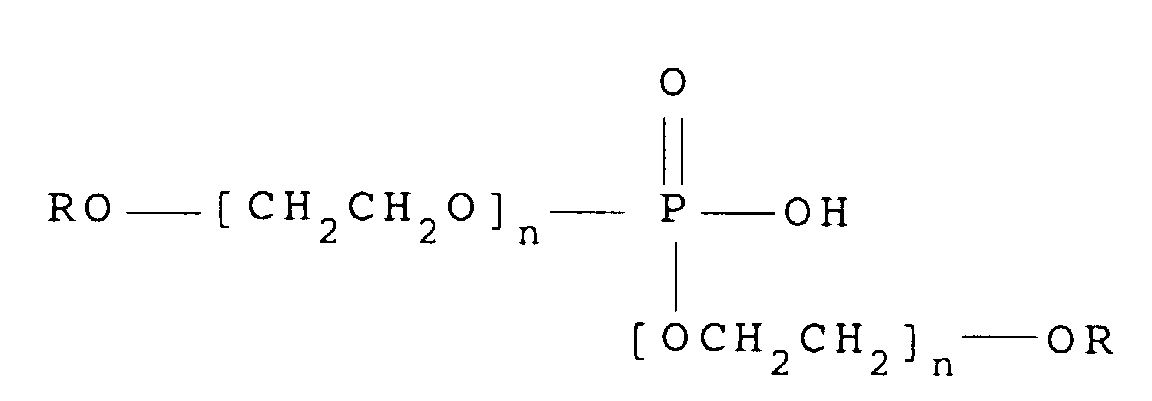
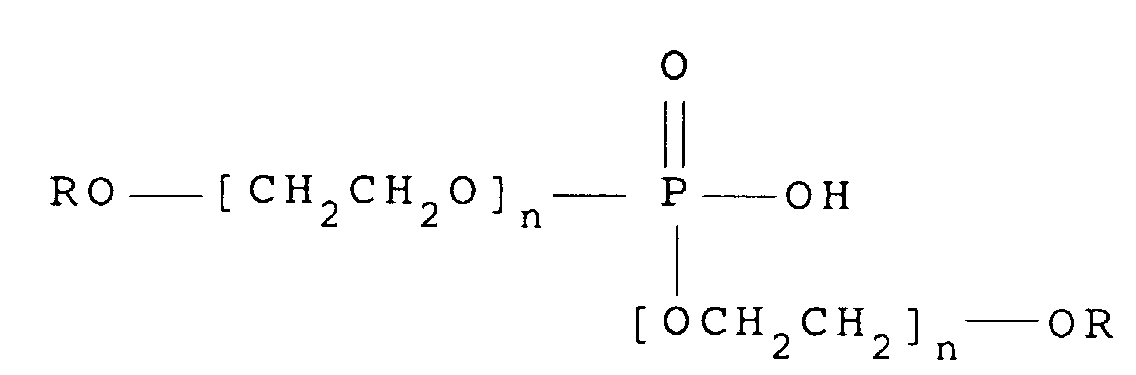
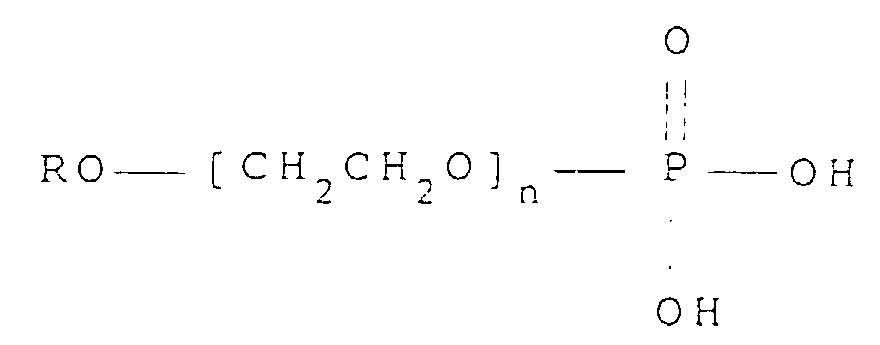
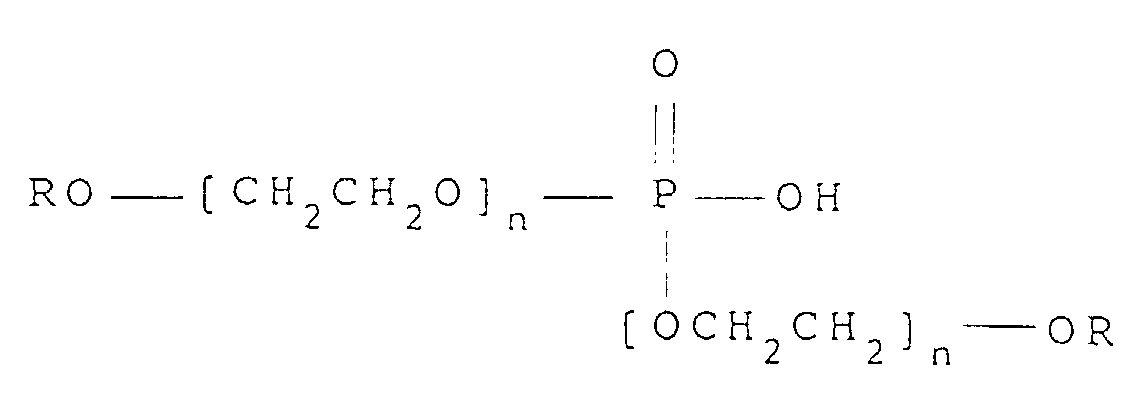
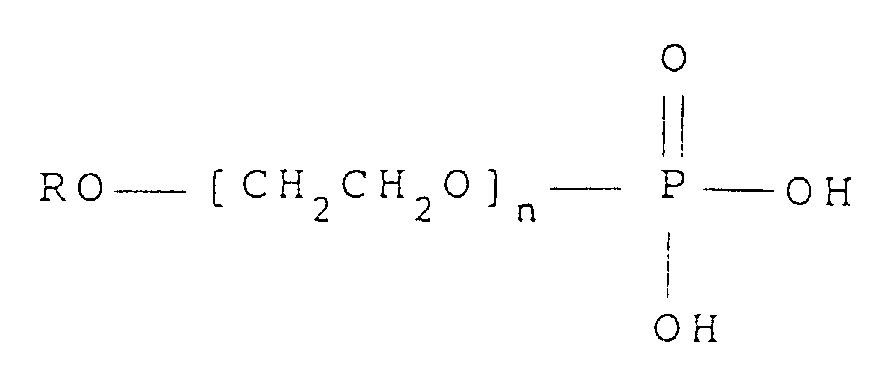
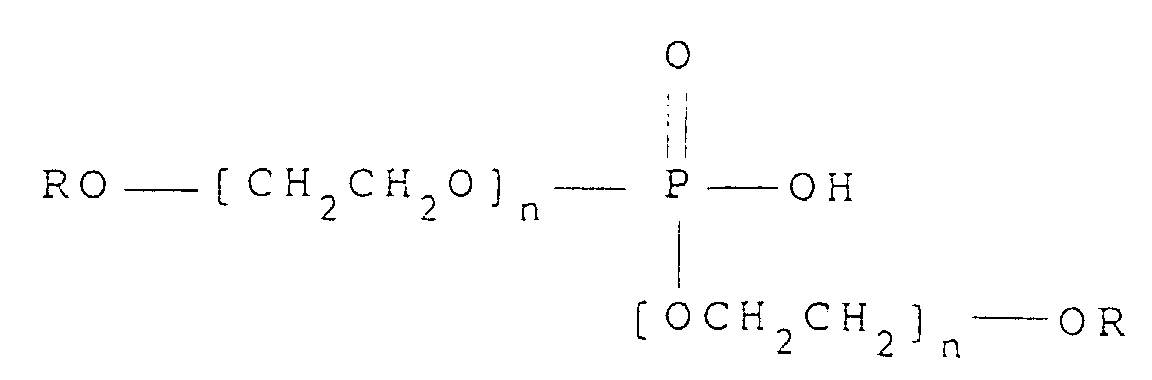
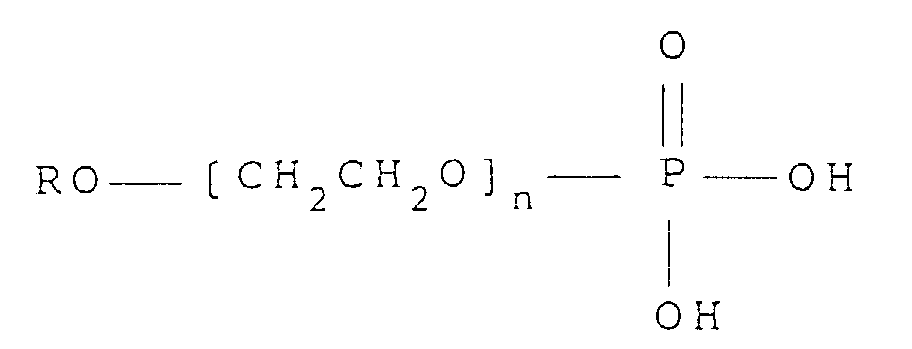
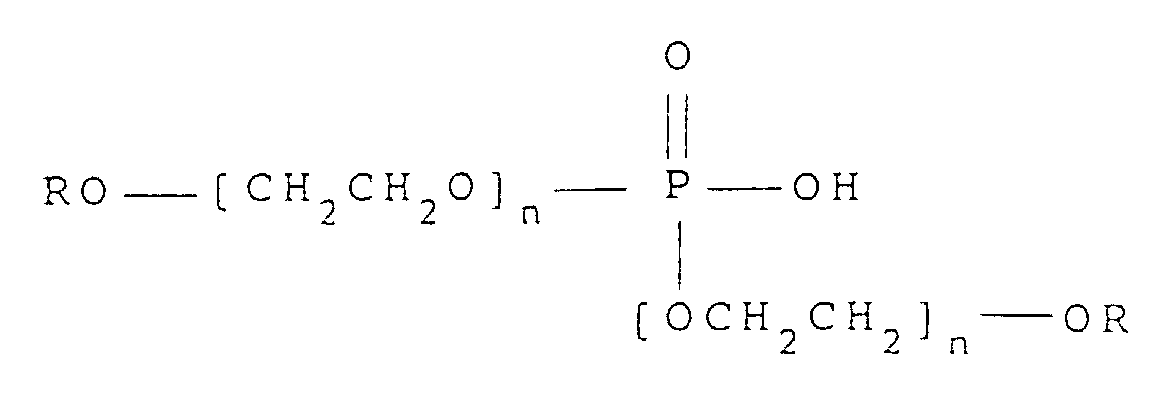
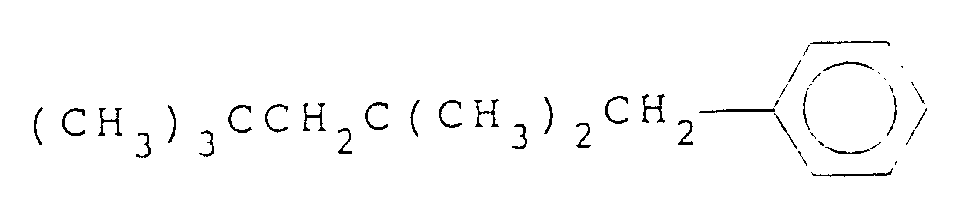
[0027] Generally, from 2.9 to 4.5%, preferably 3.3-4.5%, most preferably 3.8 dry weight %, of any suitable wetting agent and mixtures thereof can be employed. As used herein, the term wetting agent is intended to include dispersants and any other expedients which facilitate the dispersion of the magnetic particles and other components of the coating compositions of the invention in solvent provided that one component of the wetting agent is a phospholipid, preferably lecithin, and another is a complex organic phosphate fatty acid ester, preferably a mixture of mono- and di-alkarylpolyoxy ethylene phosphoric acid esters. Most preferably, the wetting agent includes a mixture of mono and diesters of the formulae
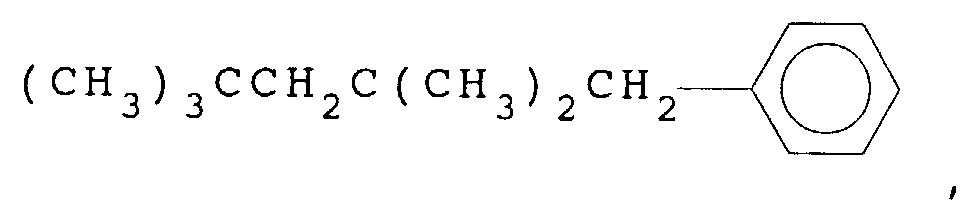
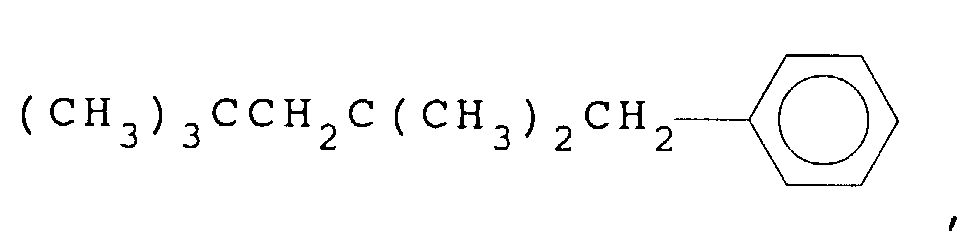
wherein
n is 9.
[0028] Preferably the ratio of mono to diester ranges from 3-6 to 1-1 (average ratio 4-1), so that the effective molecular weight of the mixture is about 815.8 g/mol. In the most preferred embodiment of the invention, the wetting agent comprises 2.9-4.14 dry weight % lecithin, preferably 3.55%, and a trace amount (0-0.72 dry weight %) of the phosphoric acid ester mixture described above, preferably 0.11%. Other suitable wetting agents that can be used include dodecylbenzenesulfonic acid and any of the wetting agents disclosed, for example, in U.S. Patent 4,407,901. Lecithin and acid phosphate esters such as Gafac RE610 (GAF Corp, NY, NY, 10020) are preferred since they provide excellent dispersions without interfering with the crosslinking reaction, particularly at the preferred concentrations.
[0029] Some materials which operate as lubricants in the practice of the invention as well as suitable wetting agents include, for example, fatty acids having alkyl or alkenyl groups having 11 to 17 carbon atoms including caprylic acid, capric acid, lauric acid, myristic acid, palmitic acid, stearic acid, oleic acid, elaidic acid, linoleic acid, stearolic acid ; an ester of the above fatty acids having, for example, from 1 to 20 carbon atoms in the ester group, preferably 1 to 4, such as methyl laurate, butyl myristate, ethyl linoleate, propyl stearate, butyl palmitate ; a metallic soap of the above fatty acids with an alkali metal such as lithium, sodium, potassium or an alkaline earth metal such as magnesium, calcium, barium a compound containing fluorine of the above fatty acid esters, amides of the above fatty acids, polyalkylene oxide alkyl phosphoric acid esters, trialkyl polyolefinoxy quaternary ammonium salts, particularly those having alkyl groups having from 1 to 5 carbon atoms; polyolefins such as polyethylene, polypropylene, ; higher alcohols having 12 or more carbon atoms; sulfuric acid esters and so on.
[0030] Any suitable solvent can be employed in the preparation of the coating compositions of the invention. Generally from 60 to 75%, preferably 68% by weight of solvent based on the total weight of the dispersion, of any organic solvent or solvent mixture normally used for the preparation of dispersions is suitable for this purpose. Some suitable solvents include ketones such as methylethylketone, methylisobutylketone, cyclohexanone; alcohols; esters such as methyl acetate, ethyl acetate, butyl acetate, ethyl lactate, cellosolves; ethers such as acetic acid glycol monoethyl ether, glycol dimethylether, glycolmonoethylether, dioxane; aliphatic and aromatic hydrocarbon solvents such as benzene, toluene, xylene, tetrahydrofuran, hexane, heptane; chlorinated hydrocarbons such as methylene chloride, ethylene chloride, carbon tetrachloride, chloroform, ethylene chlorohydrin, dichlorobenzene, and mixtures thereof. Cyclohexanone, methylethylketone, tetrahydrofuran, and toluene are preferred and a mixture of from 1-2 parts of tetrahydrofuran, 59-63 parts of methylethylketone, 30-33 parts of cyclohexanone, and 6 parts of toluene is most preferred.
[0031] Any other suitable solvent or solvent mixture can be used that will dissolve binders, lubricants and other organic species and keep them dissolved until the coating is almost completely dry. The solvent should evaporate at a proper rate given the coating speed and dryer conditions used, with some slight solvent retention to assist during calendering. In combination with dispersants, the solvent should wet the pigments in the dispersion, have low toxicity, low cost, be easy to recover, and evaporate slowly during the milling and filtering operations. A combination of tetrahydrofuran, methylethylketone, cyclohexanone, and toluene worked well in the process of the invention.
[0032] Preferably, the magnetic pigment, abrasive powder, colloidal inorganic powder, and wetting agent are wetted with the solvent and dispersed therein using a high speed disk disperser such as a Cowles blade fixed to a shaft, preferably operated at a minimum tip speed of about 1220m/min (4000 ft/min). The wetting/dispersing operation is preferably carried out in an inert atmosphere containing no more than 5% oxygen, preferably 1 - 3% oxygen, using a glove box or any other such suitable expedient, preferably equipped with a monitoring device to assist in oxygen manipulation and an alarm bell. Caution is observed during this operation since metallic iron particles of high surface area are pyrophoric and are being introduced into a large quantity of highly flammable organic solvent.
[0033] The wetting/dispersing operation is continued for a suitable time, generally from 1 hour to 48 hours, and preferably about 24 hours when the preferred components of the invention are employed. Preferably, the wetting/dispersing operation is continued until aggregates no larger than about 0.1 mm are obtained. This not only assists the media milling process but also insures that no large, dry clumps of pigment have escaped being wet with solvent.
[0034] The proportions of the components in a typical wet-out composition are generally as follows:
| SOLIDS % | of dry weight | |||
| range | g total preferred | range | preferred | |
| Magnetic pigment | 443.0 - 464.2 | 450 | 85 - 89 | 86.49 |
| Abrasive powder | 18.2 - 51.2 | 36 | 3.5 -10 | 6.91 |
| Colloidal | 0 - 41.7 | 9 | 0 - 8 | 1.73 |
| Wetting agent | 10.4 - 36.5 | 25.47 | 2-7.2 | 4.88 |
| Total dry | 520.49 | 100.00 | ||
| SOLVENTS | ||||
| Methylethylketone | 400 - 550 | 506.22 | ||
| Cyclohexanone | 350 - 500 | 404.96 | ||
| Toluene | 50 - 200 | 101.24 | ||
| Tetrahydrofuran | 0 - 100 | 0 | ||
| Total Solvent | 1012.42 | |||
| Total Weight | 1532.89 | |||
| Percent Solids | 34.00 | |||
[0035] Milling is carried out carefully in such a manner as to avoid breaking particles due to overmilling. A B/H meter can be used to record the hysteresis loops in order to monitor the dispersion. Initially, the metal pigment particles are tightly aggregated, even sintered, but are individually porous and fragile once separated. The consequence of breakage is to produce small particles of low coercivity which would switch in the applied transfer field and be useless in the practice of the invention. Such particles dilute the effective particles in the tape product resulting in lower signal-to-noise ratios.
[0036] Particles can be broken using too long a residence time (too many passes, too long total milling time), too high a tip speed (rpm), substitution of steel or ceramic beads for glass beads, lower mill base viscosity (lower solids, higher dispersant levels), and so on. Under-milling produces poor filterability because pigment is stripped from dispersion as filter cake with the result that the tape product contains a lower pigment concentration than intended.
[0037] The aim of the dispersion process is to reduce the aggregates of metal particles (which have a primary particle length of preferably about 0.2 micrometers) by orders of magnitude in size. For example, if the original dry metal pigment granules are 5 - 10 an (500010,000 micrometers), then the diameter of the wet out pigment aggregates may be 0.1 mm (100 micrometers) and the milled pigment may be less than 5 and usually less than 1 micrometer in diameter to provide thin coatings. To achieve this, the composition is milled or ground in a small media mill for about 3 hours at about 14 metres/sec tip speed and filtered through a 5 micron filter. Particular attention should be paid to the RPM or tip speed of the mill and the time or number of passes through the mill.
[0038] The grind phase composition which is the same as the wet-out composition is then "let down" with a binder solution, lubricant, and crosslinking agent added slowly to the grind composition. The "let down" should be carried out as slowly and with as much stirring/shear action as practical. Simply dumping the binder solution into the grind phase composition can produce "colloidal shock" which is a reaggregation phenomenon that may be irreversible, even with additional milling. In a system already sensitive to overmilling, colloidal shock can be catastrophic.
[0039] Preferably, the binder is added first followed by lubricant, crosslinking agent, and other minor additions which may be desired. Binder solutions preferably have a solids content ranging from about 10 - 25% in any suitable solvent, including any of those already described herein (75 - 90% solvent). Generally from 14.12 to 33.56%, preferably from 18.73 to 22.71%, most preferably 18.87 dry weight % of the coating of any suitable polyurethane binder as defined in claim 1 can be used. The polyurethane has a number average molecular weight (mn) of from about 20,000 to 50,000, preferably a minimum mn of from about 25,000 to about 30,000.
[0040] The polyurethanes which can be used include those prepared by reacting isocyanates with an excess of compounds containing active hydrogen atoms such as polyesters.
[0041] The isocyanate can be reacted with the active hydrogen containing compound to prepare the polyurethane binder of the coating compositions of the invention.
[0042] From 0.01 to 5.03%, preferably from 0.01 to 2.68 dry weight %, most preferably 2.1 dry weight based on the dry weight of the coating, of polyisocyanate crosslinking agent as defined in claim 1 can be employed and particularly polyisocyanates prepared by reacting an excess of a polyisocyanate with polyhydroxy compound as disclosed above. Preferred polyisocyanate crosslinking agents have a molecular weight ranging from about 150 to about 7,000.
[0043] The crosslinking agent is preferably added in solution at any desired concentration in one of the coating composition solvents.
[0044] As used herein, the term "crosslinking" refers to reaction between isocyanate groups and ambient water to form an inter-penetrating polymer network. An effective amount of any suitable catalyst which will initiate the NCO/HOH reaction can be used to catalyze the crosslinking reaction including stannous octoate, stannous oleate, dibutyltin dilaurate, tertiary amines, ferric acetonyl acetate, and the like and mixtures thereof.
[0045] Generally from 0.7 to 3.1%, preferably 0.8 to 2.3%, most preferably 1.54 dry weight % of any suitable lubricant can be employed in the preparation of the coating compositions of the invention provided that the lubricant provides a suitable coefficient of friction and provided that one of the lubricants is a fatty acid and another is a fatty acid ester. A static coefficient of friction of 0.1 to 0.3 and a dynamic coefficient of friction of from 0.04 to 0.1 are preferred.
[0046] Any suitable fatty acid and fatty acid ester can be used in a preferred embodiment of the invention with butyl myristate and myristic acid preferred. Most preferably, 0.77 dry weight % of butyl myristate and 0.77 dry weight % of myristic acid are employed. The lubricant is preferably added in solution at any desired concentration in one of the solvents of the invention.
[0047] Some other suitable lubricants include, for example, fatty acids having alkyl or alkenyl groups having 11 to 17 carbon atoms including caprylic acid, capric acid, lauric acid, myristic acid, paimitic acid, stearic acid, oleic acid, elaidic acid, linoleic acid, stearolic acid, an ester of the above fatty acids having, for example, from 1 to 20 carbon atoms in the ester group, preferably 1 to 4, such as methyl laurate, butyl myristate, ethyl linoleate, propyl stearate, butyl palmitate ; a metallic soap of the above fatty acids with an alkali metal such as lithium, sodium, potassium and the like or an alkaline earth metal such as magnesium, calcium, barium ; a compound containing fluorine of the above fatty acid esters, amides of the above fatty acids, polyalkylene oxide alkyl phosphoric acid esters, trialkyl polyolefinoxy quaternary ammonium salts, particularly those having alkyl groups having from 1 to 5 carbon atoms; polyolefins such as polyethylene, polypropylene ; higher alcohols having 12 or more carbon atoms; sulfuric acid esters and so on.
[0048] The component additions are made slowly to avoid "colloidal shock" as described above and the dispersion is milled for a short period of time, preferably from about 15 to about 30 minutes, in a polishing step. For smooth, uniform, and durable tapse, the polished dispersion must be filtered, preferably through a 5 micrometers "absolute" PALL filter (available from PALL Trinity Corp., Cortland, NY, 13045), before it is coated onto a suitable support.
[0049] The proportions of the components in a typical let-down composition of the invention are generally as follows:
| SOLIDS | ||||
| g added | ||||
| range | preferred | g total preferred | % dry weight preferred | |
| Magnetic pigment | 0 | 0 | 450 | 67 |
| Abrasive powder | 0 | 0 | 36 | 5.36 |
| Colloidal | 0 | 0 | 9 | 8.34 |
| Wetting agent | 0 | 0 | 25.47 | 3.8 |
| Lubricant | 5 - 30 | 10.34 | 10.34 | 1.54 |
| Binder | 80 - 200 | 125.67 | 125.67 | 18.87 |
| Crosslinker | 1 - 20 | 14.08 | 14.08 | 2.10 |
| Total Dry | 100.01 | |||
| SOLVENTS | g added preferred | g total preferred | ||
| Tetrahydrofuran | 34.54 | 34.54 | ||
| Methylethylketone | 512.76 | 1018.98 | ||
| Cyclohexanone | 164.97 | 598.94 | ||
| Toluene | 2.38 | 103.62 | ||
| Total solvent | 714.65 | 1727.08 | ||
| Total Weight | 2398.72 | |||
| Percent Solids | 28.00 |
[0050] The dispersions can be coated at any suitable thickness onto any suitable support or substrate having any suitable thickness using any suitable method. Preferably the dispersion is coated onto a 25.4 - 76.2 µm (1.3 to 3 mil) subbed polyester film base back-coated with a conductive carbon containing layer using an extrusion hopper, roll coater, gravure printer or other suitable method.
[0051] Other suitable supports which can be used include films of synthetic resins such as polyesters including polyethylene terephthalate, modified polyethylene terephthalate such as polyethylene terephthalate coextruded with silica or filled polyethylene terephthalate, polyethylene-2,6-naphthalate; polyolefins such as polyethylene, polypropylene; cellulose derivatives such as cellulose triacetate, cellulose diacetate, cellulose acetate butyrate, cellulose acetate propionate; polyvinyl resins such as polyvinyl chloride, polyvinylidene chloride; polycarbonates; polyamides; polyimides; metals such as aluminum, copper, tin, zinc, or a non-magnetic alloy containing them; ceramics such as glass, earthware, porcelain; barytes or papers such as paper spread coated or laminated with an alpha polyolefin.
[0052] The substrate can take any form including film, tape, sheet, disc, card, drum, and so on, particularly any form having a carbon containing backcoating, particularly a preferred carbon backcoating of the invention.
[0053] Carbon backcoatings of the invention generally contain from 15 to 25% of carbon black, from 15 to 25% of an inorganic filler, from 0.5 to 2% by weight of an abrasive, from 20 to 30% of a vinyl copolymeric binder, from 15 to 25% of a polyurethane binder, from 7.5 to 17.5% of a crosslinking agent, from 0.9 to 2% of a lubricant, and from 0.06 to 0.6% of a coating aid. All percentages are by weight of the dry weight of the backcoating which is preferably applied to provide a dry coating thickness of from 0.3 to 1.5 micrometers, most preferably 0.5 micrometers. The backcoating composition is applied as a dispersion, preferably containing from 8 to 15% by weight of solids, most preferably 10%, in any suitable solvent such as any of those described herein, preferably mixtures thereof, most preferably approximately 4:3:3 mixtures of methylethylketone:methylisobutylketone:cyclohexanone. The backcoating layer can be applied by any suitable method using any suitable applicator means including an extrusion hopper, roll coater, gravure printer.
[0054] More particularly, preferred carbon backcoatings of the invention contain from 15 to 25%, most preferably 19% by weight of any suitable carbon black such as those already described herein. The backcoating contains from 15 to 25%, preferably 19% by weight of any suitable inorganic filler such as any of the colloidal inorganic powders described herein, preferably a soft inorganic filler. Any of the silicates, oxides such as titanium dioxide, zinc oxide, carbonates such as sodium carbonate, potassium carbonate, calcium carbonate, magnesium carbonate, barium carbonate, and mixtures thereof can be used. Calcium carbonate is most preferred.
[0055] Preferred backcoatings of the invention contain from 0.5 to 2% by weight, most preferably 1.5% of any suitable abrasive, particularly any of those already described herein, most preferably alpha alumina having a diameter in the range of 0.1 - 0.6 micrometers and a specific surface area ranging from about 1 to about 15 m2/g.
[0056] Preferred backcoatings of the invention contain from 20 to 30% of a copolymeric vinyl binder, particularly a polyvinylchloride/polyacetate binder containing hydroxyl and/or carboxyl functional groups. Preferably, the vinyl binder contains (A) from 6 to 18% by weight, most preferably 11.6%, of a carboxy modified vinyl chloride/vinyl acetate copolymer and (B) from 9 to 20%, most preferably 14.5%, of an hydroxy modified vinyl chloride/vinyl acetate copolymer.
[0057] Preferred copolymer A is a 90:5 vinyl chloride:vinyl acetate copolymer containing carboxy groups (maleic acid) and having a number average molecular weight of about 28,000 and a Tg of 80 C. The copolymer is hydrolyzed to an hydroxy equivalent weight of about 850 g/g mol and has an hydroxyl content of about 2.3% by weight. Copolymer B is an hydroxy modified (6% hydroxy as vinyl alcohol) polyvinyl chloride:polyvinyl acetate (91:03) copolymer having a number average molecular weight of about 23,000 and a Tg of 79 C.
[0058] Preferred backcoatings of the invention contain from 15 to 30%, most preferably 20.4% of any suitable polyurethane binder including those disclosed in U.S. Patent 2,871,218 particularly a polyether or polyester polyurethane, most preferably a polyester polyurethane. The most preferred polyurethane binder in the practice of the invention is a thermoplastic adduct of adipic acid, butanediol, and 4,4'-diphenylmethane diisocyanate having a weight average molecular weight of about 124,000.
[0059] A preferred backcoating of the invention contains from 7.5 to 17.5%, most preferably 12.3% of a suitable crosslinking agent. Any of the crosslinking agents described herein can be used. An NCO terminated adduct of trimethylol propane and tolylene diisocyanate (1:3) is particularly preferred.
[0060] Preferred backcoatings of the invention also contain from 0.9 to 2% of any suitable lubricant as already disclosed herein. More preferably, 1.4% of any suitable fatty acid ester, most particularly a mixture of fatty acid esters, is employed. A most preferred fatty acid ester lubricant mixture is a 4:2:2:6 mixture of butyl stearate, isocetyl stearate, tridecyl stearate, and ethylhexyl palmitate, respectively.
[0061] A preferred coating of the invention will contain from 0.06 to 0.6%, most preferably 0.13%, of any suitable coating aid such as, for example, those disclosed in U.S. Patent 4,916,054, Preferred are organofunctional silicone fluids such as silicone carbinols. The most preferred coating aid of the invention as used in Example 5 is a silicone carbinol having secondary alcohol functionality, a weight % OH of 0.9 - 1.1, and the formula
(CH3)3-Si-O-[Si(CH3)2-O]x-[CH3-Si(ROH)-O]y-Si-(CH3)3
where x and y are any integers providing an average of 3 hydroxyl groups per molecule, an average hydroxyl equivalent weight of about 2000, a weight average molecular weight of about 6,000, and R is an alkyl group having 5-20 carbon atoms, preferably 10.
[0063] The amount of the magnetic dispersion to be coated or applied to the substrate should yield a dry film thickness ranging from about 2 to about 3 µm. Coating compositions of the invention have better durability and adhesion of the magnetic layer to base compared to Sony Mirror Mother. The thinness of the coatings of the invention also provides improved overwrite characteristics, about 8-12 db better than Sony Mirror Mother.
[0064] The magnetic particles on the coated substrate can then be oriented, for example, by an orienting magnet immediately after the substrate is coated. The oriented coated substrate can then be dried, calendered, cured, and stored. When the substrate is a film, preferably a subbed polyester support, the coating is redried and recalendared and wound onto spools at low tension to reduce embossing patterns from being transferred through the wound media. After curing, for example at about 55 degrees C for a suitable time (e.g., 0, 3 1/2, 7 days), the coated film can be slit to the desired dimension. Three and a half days cure time is optimum for the coatings of the invention.
[0065] Master tapes thus prepared have a high coercivity, about 2000 Oe, and are capable of transfering signals to a lower coercivity copy medium (about 850 to 1000 Oe). The master tapes have high durability and good electrical and recording performance. The adhesion of the magnetic coating to the base is superior to prior master tapes.
[0066] The master media of the invention can have any other form suitable for containing signals to be duplicated one or multiple times to a suitable copy medium without erasing the signals from the master.
[0067] Master media of the invention are particularly suitable for use in an anhysteretic duplicating system in which signals are transferred to suitable copy media including video tapes, the transparent magnetic layers in photographic film base, particularly cellulose acetate and polyethylene terephthalate film base, cards, discs. Such processes are described, for example, in U.S. Patents 3,782,947; 4,279,945; and 4,363,035.
[0068] A preferred system for anhysteretic duplicating includes means for impressing a magnetic recording pattern on master media of the invention, a copy medium capable of becoming remanently magnetized when an external magnetic field is impressed thereon, means for temporarily maintaining the master and copy medium in surface contact with substantially no relative movement in the machine or transverse direction between them, and a power source to apply an AC bias magnetic field to the contacted media or a laminated permanent magnet array, thereby promoting duplication of the magnetic pattern from the master to the copy medium without erasing the pattern on the master. Preferably, the copy medium is a photographic film containing a transparent magnetic layer or layers in the photographic film base to duplicate a pattern or signal from the master. Most preferably, the photographic film base is cellulose acetate or polyethylene terephthalate.
[0069] A preferred process of the invention for the anhysteretic duplication of a signal from a master to a copy medium includes impressing a magnetic recording pattern on a master recording medium of the invention, providing a copy medium capable of becoming remanently magnetized when an external magnetic field is impressed thereon, temporarily maintaining the master and copy magnetic media in surface contact with substantially no relative movement between them, and applying an AC bias magnetic field to the contacted media to promote duplication of the magnetic signals from the master medium to the copy medium without erasing the pattern on the master.
[0070] The invention is further illustrated but is not intended to be limited by the following examples in which all parts and percentages are by weight unless otherwise indicated.
EXAMPLE 1
[0071] The wet out stage, grind stage, and let down stage including the polishing step and post preparation filtration of the process of the invention and the wet out and let down compositions of the invention are illustrated.
[0072] Stock solutions and dispersions were prepared as follows: Cyclohexanone (C), tetrahydrofuran (THF), methylethylketone (MEK) and toluene (T) were filtered through a 5 micrometer polypropylene filter and used to prepare stock solutions as in Table 1.
Table 1
| Solvent Mixture | |||||
| Solute | Solution % | THF | MEK | C | T |
| A - Lubricant Stock Solution | |||||
| Butyl myristate | 25 | 100 | 0 | 0 | 0 |
| Myristic acid | 25 | ||||
| B - Binder Stock Solution | |||||
| Polyurethane (1) | 20 | 0 | 90 | 10 | 0 |
| C - Crosslinking Agent Stock Solution | |||||
| Polyisocyanate (2) | 50 | 0 | 100 | 0 | 0 |
| (1)A linear hydroxy terminated polymer of butanediol-adipate and diphenylmethane diisocyanate having a molecular weight of 20,000-50,000 and a Tg of 58-61 C (Morthane CA118, Morton Thiokol, Inc, Chicago, IL 60606). | |||||
| (2)An adduct of tritmethylolpropane and tolylene diisocyanate (1:3) (Mondur CB-75, Mobay Chemical Corp, Pittsburgh, PA 15205). |
D - Abrastive Stock Dispersion
[0073] A dispersion of alpha alumina having a median particle diameter of 0.38 micrometers and a specific surface area of 6 m2/g (or Alumina AKP30 available from Sumitomo Corp, Chuo-ku, Tokyo, Japan) in 11 parts MEK and 89 parts of C contained 57% by weight of solids. As weight % of solids, the dispersion contained 95.24% of alumina, 1.9% of the 4:1 mixture of mono- and dialkarylethyleneoxy esters of phorphoric acid (or Gafac RE610 available from GAF Corp, New York, NY 10020), and 2.86% of polyurethaned (1).
E - Carbon Black Stock Dispersion
[0074] A carbon black dispersion containing 31% by weight of solids in 50 parts of MEK, 40 parts of C and 10 parts of T was also prepared. The carbon black dispersion comprised 96.15% of Elftex 12 (available from Cabot Corp, Boston, MA 02110) and 3.85% of Centrolex P (available from Central Soya, Fort Wayne, IN 46802).
[0075] The abrasive and carbon dispersions were each prepared by ball milling using known procedures.
Wet Out Stage
[0076] Metallic iron particles of high surface area are pyrophoric in ambient air. Accordingly, cans of raw pigment chunks were opened in a large glove box from which oxygen had been purged with nitrogen gas until the atmosphere contained less than 3% oxygen. An oxygen analyzer and audible alarm system were used to monitor the atmosphere in the glove box continuously throughout the wet out process. For small scale experiments (e.g., two kilograms of dispersion), the solvent-wetted pigment slurry could subsequently be exposed to air without concern. For pilot scale experiments (e.g.,thirty kilograms of dispersion), the complete wet out process should be conducted in an inert atmosphere (97-98% nitrogen, 3-2% oxygen).
[0077] A glove box purged with nitrogen as described above was used. Solvent comprising about 492.66 g MEK, 391.26 g C, and 99.16 g T were placed in a grounded metal container and mixed with about 24.4 g of lecithin (Centrolex P) using a Cowles type disperser. Then, 450 g of metallic iron magnetic pigment (Pferromet PK2000) were carefully added to the container with continuous stirring using the Cowles blade. The abrasive stock dispersion (66.31 g) and about 30.19 g of carbon black stock dispersion (Elftex 12) were added to the resulting slurry at this stage.
[0078] After being mixed for two hours, the slurry was sealed and allowed to stand for from 4 to 24 hours.
Grind Stage
[0079] The slurry was transferred to a funnel on a small media mill (Eiger Machinery Inc, Model 250) which was loaded with 85% by volume of glass beads having a diameter of 1 to 1.3 mm.
[0080] The dispersion was mixed continuously using a Cowles blade in the funnel/reservoir to which the mill base was recirculated for 3 hours in the mill at 14 m/sec rotor tip speed.
[0081] The progress of milling of the dispersion was monitored at half hour intervals by microscopic examination at 100x of a small sample drawn down on a Fineness of Grind Gauge, and by measuring the B/H meter hysteresis loop of a dry hand coated sample transferred to adhesive tape. The latter is the most sensitive method for determining whether primary particles have been broken in the milling step.
Let Down Stage
[0082] The stock binder solution (628.3 g at 20% solids) was diluted with a solvent mixture containing 24.2 g THF, 46.28 g MEK, 114.7 g C, and 2.38 g T. The resulting solution was added slowly with continuous stirring and milling to the grind phase composition over a period of 1 to 2 hours to avoid "colloidal shock". During the addition, the tip speed of the mill was gradually reduced to about 10 m/sec as the mill base viscosity decreased. This further reduces the probability of fracturing the pigment particles.
[0083] When the addition of the binder is complete, the stock lubricant mixture of 1:1 w/w myristic acid/butyl myristate (20.7 g) was slowly added. The resulting dispersion was then "polished" at a tip speed of about 10 m/sec for about thirty minutes. The dispersion quality parameters were again assessed by microscopic examination at 100x of the draw down on a fineness of grade gauge to confirm the absence of oversized particles or flocculation of the dispersion. In addition, the shape of the hysteresis loop and its derivative can be used to assess coercivity squareness and absence of particle breakage.
[0084] The crosslinking agent stock solution (28.2 g) was then slowly stirred into the dispersion with continued milling for 10 minutes after addition was complete.
[0085] The dispersion was then removed from the mill and filtered through a 6 micrometers absolute rating polypropylene woven filter (PALL Trinity Corp, Cortland, NY, 13045).
EXAMPLE 2
[0086] The wet out stage, grind stage, and let down stage procedures outlined in Example 1 were followed except that the solvent mixture for the wet out stage contained 505.77 g MEK, 404.62 g C, and 101.16 g T with 24 g of lecithin (Centrolex P) dissolved therein. About 49.74 g of the alumina stock dispersion and 60.39 g of the carbon black dispersion were used in the wet out stage.
[0088] In the let down stage, stock binder solution (630.5 g at 204 solids) was diluted with a solvent mixture containing 24.2 g THF, 45.16 g MEK, 114.88 g C, and 2.47 g T. The resulting solution was added slowly with continuous stirring and milling to the grind phase composition over a period of 1 to 2 hours to avoid "colloidal shock". During the addition, the tip speed of the mill was gradually reduced to about 10 m/sec as the mill base viscosity decreased. This further reduces the likelihood of fracturing pigment particles.
EXAMPLE 3
[0090] The wet out stage, grind stage, and let down stage procedures outlined in Example 1 were followed except that the solvent mixture for the wet out stage contained 470.66 g MEK, 376.53 g C, and 94.13 g T with 21 g of lecithin (Centrolex P) dissolved therein. Then, 420 g of metallic iron granules (Pferromet PK2000) were carefully added to the solvent/lecithin solution with continuous stirring using a Cowles type disperser. Thereafter, about 42.61 g of the alumina stock dispersion and 56.36 g of the carbon black dispersion were used in the wet out stage process described in Example 1.
[0092] In the let down stage, stock binder solution (741.3 g at 20% solids) was diluted with a solvent mixture containing 7.64 g THF, 100.46 g NEK, 94.46 g C, and 12.32 g T. The resulting solution was added slowly with continuous stirring and milling to the grind phase composition over a period of 1 to 2 hours to avoid "colloidal shock". During the addition, the tip speed of the mill was gradually reduced to about 10 m/sec as the mill base viscosity decreased. This further reduces the likelihood of fracturing pigment particles.
[0093] When the addition of the binder is complete, the stock lubricant mixture 1:1 w/w myristic acid/butyl myristate (20.2 g) was slowly added. The resulting dispersion was then "polished" at a tip speed of about 10 m/sec for about thirty minutes. The dispersion quality parameters were again assessed as described in Example 1.
[0094] The crosslinking agent stock solution (25.9 g) was then slowly stirred into the dispersion with continued milling for 10 minutes after addition was complete.
EXAMPLE 4
[0096] The wet out stage, grind stage, and let down stage procedures outlined in Example 1 were followed except that the solvent mixture for the wet out stage contained 8.93 g THF, 437.54 g MEK, 357.18 g C, and 89.29 g T with 20 g of lecithin (Centrolex P) dissolved therein. About 400 g of metallic iron granules (Pferromet PK 2000) were carefully added to the lecithin solution with continuous stirring using the Cowles blade. About 24 g of alumina having a median particle diameter of 0.38 micrometers and a specific surface area of 6m2/g (Sumitomo AKP-30) abrasive powder and an aluminum oxide filler having a median crystallite diameter of about 0.02 micron and a specific surface area of 100 m2/g (Degussa Oxid C) were added to the metallic iron dispersion with stirring. After the slurry was mixed for about two hours, it was sealed and allowed to stand for from about 24 hours.
[0098] In the let down stage, stock binder solution (559.2 g at 20% solids) was diluted with a solvent mixture containing 12.58 g THF, 4.86 g MEK, 149.44 g C, and 2.82 g T. The resulting solution was added slowly with continuous stirring and milling to the grind phase composition over a period of 1 to 2 hours to avoid "colloidal shock". During the addition, the tip speed of the mill was gradually reduced to about 10 m/sec as the mill base viscosity decreased. This further reduces the likelihood of fracturing of pigment particles.
[0099] When the addition of the binder is complete, the lubricant stock solution (18.4 g) was added slowly. The resulting dispersion was then "polished" at a tip speed of about 10 m/sec for about thirty minutes. The dispersion quality parameters were again assessed as described in Example 1.
[0100] The crosslinking agent stock solution (32 g) was then slowly stirred into the dispersion with continued milling for 10 minutes after addition was complete.
EXAMPLE 5
[0102] A subbed polyethylene terephthalate substrate having a thickness of about 1.3 mil or 33 micrometers is backcoated at a rate of about 10.75 cc/m2 (2cc/ft2) with a carbon dispersion having a 10% solids content using an extrusion die to provide a dry backcoat thickness of about half a micrometers.
[0103] The backcoating was prepared by ball milling about 175 g of carbon black, 175 g of calcium carbonate, 14 g of alumina abrasive, and about 428 g of a 25% by weight solution in a solvent mixture of a 90:5 vinyl chloride:vinyl acetate copolymer containing carboxyl (maleic acid) groups and having a number average molecular weight of about 28,000 and a Tg of 80 C. The copolymer is hydrolyzed to an hydroxy equivalent weight of about 850 g/g mol and the solvent mixture contains about 438 parts of methylethylketone (MEK), about 328.5 parts of methyl isobutylketone (MIBK), and about 328.5 parts of cyclohexanone (C). Milling was continued for about 72 hours at about 80 rpm. The solids content of the milled dispersion was about 25%.
[0104] About 360 g of a mixture of about 144 g of MEK, about 108 g of MIBK, about 108 g of C were added to the ball mill and mixed for about 5 minutes. The resulting dispersion was poured through a wire mesh strainer. The solids content is reduced to about 21% in this step.
[0105] About 558 g of a 15% solution in the above solvent mixture of a polyesterurethane having a weight average molecular weight of about 124,000 and prepared from adipic acid, butanediol, and 4,41-diphenylmethane diisocyanate were added with mixing over about a two minute period for each 1000 g of the resulting 21% solids dispersion. Thereafter, about 237 g of a 25% solution in the above solvent mixture of an hydroxy modified (6% hydroxy as vinyl alcohol) vinyl chloride:vinyl acetate (91:03) copolymer having a number average molecular weight of about 23,000 and a Tg of 79 C were added with mixing over about a two minute period for each 1000 g of the dispersion. The solids content was reduced to 20% in this step.
[0106] Sequentially, (1) about 3.2 g of of a 4:2:2:6 mixture of butyl stearate, isocetyl stearate, tridecyl stearate and ethylhexyl palmitate; (2) about 0.3 g of a graft copolymer silicone polycarbinol having about 1 weight % of secondary alcohol functionality and average number of OH groups per molecule of 3, a viscosity of 160 cps and an average hydroxy equivalent weight of about 2000; and (3) about 38.2 g of an NCO terminated adduct of trimethylolpropane and tolylene dilsocyanate, each in a small amount of the solvent mixture, are added per 1000 g of the 204 solids dispersion while stirring with a Cowles blade. Additional solvent mixture to total about 1280 g of solvent mixture was added while stirring with a Cowles blade. The mixture was polished in an Eiger mill for one pass at 3500 rpm shaft speed, filtered through a 7,65 cm (3 inch) Pall Sealkleen 5 micron absolute polypropylene cartridge, and contained about 10% nonvolatiles. The backcoat formula contained about 1.384 total lubricants, about 39.6% total pigments and about 59% total binders for a pigment/binder ratio of about 0.67 and a solids content of about 10% by weight.
[0107] Master media were prepared by applying magnetic dispersions of Examples 1 - 4 containing about 32% solids laid down at a rate of about 10.75 cc/m2 (2 cc/ft2) onto backcoated substrates as described above to provide a dry magnetic layer thickness for testing of about 2.5 micrometers.
[0108] The webs, freshly coated using an extrusion die, were passed through an orientation magnet to enhance the longitudinal orientation of the pigment (measurable by B/H meter or VSM) and then conveyed through a series of driers before being calendered and wound up on a tape spool. The webs were subsequently passed through the driers and then calendared and rewound onto a core at reduced tension to prevent the formation of embossing patterns on winding up and subsequent curing at 55° C.
[0109] The coated and cured media were slit to 1/2 inch widths and tested for electrical performance, friction coefficient, and master-to-slave transfer. Excellent results were obtained which were, in all cases, far superior to those obtained using master tapes which are commercially available. The results of the adhesion tests are exemplary of the kind of test data obtained.
Adhesion Tests
[0110] Samples of the master media of the invention prepared as described above using the coating compositions of Examples 1 - 4 and samples of Sony Mirror Mother (V-1/2M-2M and V-1/2-4M as used in the Sony Sprinter, High Speed Video Duplicating System) were tested using procedures described in "Tribology and Mechanics of Magnetic Storage Devices" by Bharat Bhushan, Springer-Verlag, NY, 1990, page 898, paragraphs A4.1 to A4.1.2.
Test A. Scotch Tape Test - 90 Degree Peel Method
[0111] A 12.7 cm (5 inch) long strip of 1.27 cm (half inch) wide double sided tape was laid down on a backing plate. The magnetic layer containing side of about an 20.3 cm (8 inch long) half inch width of master tape to be tested is bonded to the double sided tape on the backing plate so that a length of about 7.6 cm (3 inches) remains free of the adhesive. The free end of the master tape is then pulled slowly away from the backing plate at an angle of about 90 degrees. The amount of material transferred from the master tape to the adhesive tape on the backing plate is measured. The area which delaminated divided by the area originally bonded to the adhesive tape surface and multiplied by 100 represents the percent delamination experienced by the test piece.
Test B. Scotch Tape Test - 180 Degree Peel Method
[0112] A 12.7 cm (5 inch) long strip of half inch wide double sided tape was laid down on a backing plate. The magnetic layer containing side of about an 20.3 cm (8 inch) long half inch width of master tape to be tested is bonded to the double sided tape on the backing plate so that a length of about 7.6 cm (3 inches) remains free of the adhesive. The free end of the master tape is then pulled slowly away from the backing plate at an angle of about 180 degrees. The amount of material transferred from the master tape to the adhesive tape on the backing plate is measured. The area which delaminated divided by the area originally bonded to the adhesive tape surface and multiplied by 100 represents the percent delamination experienced by the test piece.
Test C. Scotch Tape Test-90 Degree Adhesive Peel Method
[0113] Two strips of half inch wide double sided tape, each about 5.1 cm (2 inches) long, were laid down in line on a backing plate with about a 2.55 cm (one inch) gap or strip of exposed backing plate between them. A 12.7 cm (5 inch) long strip of half inch wide master to be tested was laid on top of the two strips and across the gap between them with the back or non-magnetic layer surface down. Another strip of adhesive tape, 1.27 cm (half inch) wide, seven inches long, was laid, with adhesive layer down on top of the magnetic layer of the master medium being tested. The excess length of the 17.8 cm (7 inch) long adhesive tape was peeled away at an angle of about 90 degrees. The amount of magnetic coating transferred to the adhesive tape from the unsupported section of tape over the gap was measured. The area which delaminated in the unsupported area divided by the area of the unsupported section and multiplied by 100 represents the percent delamination experienced by the test piece.
[0114] Ten tests were performed for each tape type. No delamination was observed for any of the samples of the invention. Delamination results for the Sony Mirror Mother V1/2M-4M, Serial No. 0206110071, samples is contained in Table I. In particular, the mode of failure of the Sony Mirror Mother tape in Test C appeared to be more complex than in Test A or B. In Test C, the delamination was less than in Test A or B but the areas that did not delaminate showed a significant amount of cracking in the magnetic layer with cracks in a direction across the width of the tape. This phenomenon was not observed in any of the tapes of the invention.
TABLE I
| Test A | Test B % Delamination | Test C |
| 99.2 | 99.2 | 4.69 |
| 99.2 | 99.7 | 80.0 |
| 99.2 | 99.7 | 88.8 |
| 99.3 | 99.9 | 15.4 |
| 99.1 | 99.3 | 57.7 |
| 99.5 | 99.9 | 23.8 |
| 94.9 | 100.0 | 71.4 |
| 99.7 | 99.9 | 46.0 |
| 99.9 | 100.0 | 90.0 |
| 89.1 | 99.9 | 91.7 |
1. An anhysteretic master recording medium having a coercivity of at least 2000 Oe comprising
a support having disposed thereon a recording layer obtained from a coating composition
which comprises from 59 to 69% of a magnetic pigment, from 2.95 to 6.90% of an abrasive
powder, from 0 to 5.4% of a colloidal inorganic powder, from 2.90 to 4.5% of a wetting
agent, from 0.7 to 3.1% of a lubricant, from 14.1 to 33.6% of a binder, at least 85%
of which is a polyurethane consisting of linear hydroxy terminated polymer of butanediol-adipate
and diphenylmethane diisocyanate having a molecular weight of 20,000-50,000 and a
Tg of 58-61°C and from 0.05 to 15% of which is a polyisocyanate crosslinking agent
consisting of an adduct of trimethylolpropane and tolylene diisocyanate (1:3), all
percentages being by weight based on the total dry weight of the coating composition
except the polyurethane and crosslinking agent, which are percent by weight of the
binder.
2. The master recording medium of claim 1 containing 67% of magnetic pigment.
3. The master recording medium of claim 1 containing 5.36% of abrasive powder.
4. The master recording medium of claim 1 containing 1.344 of colloidal carbon black
powder.
5. The master recording medium of claim 1 containing 3.80% of wetting agent.
6. The master recording medium of claim 1 containing 1.54% of a lubricant.
7. The master recording medium of claim 1 containing 21% of a binder.
8. The master recording medium of claim 1 containing 10% by weight in the binder of a
polyisocyanate crosslinking agent.
9. The master recording medium of claim 1 wherein the colloidal inorganic powder is carbon
black.
10. The master recording medium of claim 1 wherein the lubricant is a mixture comprising
a fatty acid and a fatty acid ester.
11. The master recording medium of claim 15 wherein the lubricant is a mixture of myristic
acid and butyl myristate.
12. The master recording medium of claim 1 wherein the wetting agent is a mixture of lecithin
and an acid phosphate ester mixture of the formula
wherein R is
n is 9 and the ratio of mono to diester ranges from 3-6 to 1-1 to provide an effective molecular weight of the phosphate ester mixture of 815.8 g/mol.
wherein R is
n is 9 and the ratio of mono to diester ranges from 3-6 to 1-1 to provide an effective molecular weight of the phosphate ester mixture of 815.8 g/mol.
13. The master recording medium of claim 1 wherein the coating composition comprises 67%
of a magnetic pigment, 5.36% of an abrasive powder, 1.34% of a colloidal inorganic
powder, 3.8% of a wetting agent, 1.54% of a lubricant, 21% of a binder, at least 85%
of which is the polyurethane and 10% of which is the polyisocyanate crosslinking agent.
14. The master recording medium of claim 1 wherein the coating composition comprises from
59 to 69% of a magnetic iron particles; from 2.95 to 6.90% of an alumina abrasive
powder; from 0 to 5.4% of a colloidal carbon black powder; from 2.9 to 4.14% of lecithin;
up to 0.72% of an acid phosphate ester mixture of the formulae
wherein R is
n is 9, and the ratio of mono to diester averages 4 to 1 to provide an effective molecular weight of acid ester mixture of 815.8 g/mol; 0.77% of butyl myristate, about 0.77 to 2.31% of myristic acid; from 14.1 to 33.6% of a binder, at least 85% of which is the hydroxy terminated polyester polyurethane and from 0.05 to 15% of which is the isocyanate terminated adduct of trimethylol propane and tolylene diisocyanate.
wherein R is
n is 9, and the ratio of mono to diester averages 4 to 1 to provide an effective molecular weight of acid ester mixture of 815.8 g/mol; 0.77% of butyl myristate, about 0.77 to 2.31% of myristic acid; from 14.1 to 33.6% of a binder, at least 85% of which is the hydroxy terminated polyester polyurethane and from 0.05 to 15% of which is the isocyanate terminated adduct of trimethylol propane and tolylene diisocyanate.
15. The master recording medium of claim 1 wherein the coating composition comprises 64%
of magnetic iron particles, 4.90% of alumina abrasive powder, 1.4% of a colloidal
carbon black, 3.55% of lecithin, 0.11% of an acid phosphate ester mixture of the formula

wherein R is
n is 9, and the ratio of mono to diester averages 4 to 1 to provide an effective molecular weight of the mixture of 815.8 g/mol, 0.77% of butyl myristate, 1.54% of myristic acid, 21% of a binder at least 85% of which is the hydroxy terminated polyester polyurethane and 10% of which is the isocyanate terminated adduct of trimethylol propane and tolylene diisocyanate.
wherein R is
n is 9, and the ratio of mono to diester averages 4 to 1 to provide an effective molecular weight of the mixture of 815.8 g/mol, 0.77% of butyl myristate, 1.54% of myristic acid, 21% of a binder at least 85% of which is the hydroxy terminated polyester polyurethane and 10% of which is the isocyanate terminated adduct of trimethylol propane and tolylene diisocyanate.
16. The master recording medium of claim 1 wherein the coating composition comprises from
64 to 68% of a magnetic pigment, from 3.8 to 5.4% of an abrasive powder, from 1 to
3% of a colloidal inorganic powder, from 3.3 to 4.4% of a wetting agent, from 0.8
to 2.3% of a lubricant, from 20 to 25.5% of a binder, at least 85% of which is the
polyurethane and from 0.05 to 15% of which is the polyisocyanate crosslinking agent.
17. The master recording medium of claim 1 comprising a coating composition of any of
claims 1 to 16 at a dry thickness of from 2 to 3 µm.
18. The master recording medium according to claim 17 comprising a backcoat layer obtained
from a composition which comprises from 15 to 25% of carbon black, from 15 to 25%
of an inorganic filler, from 0.5 to 2% of an abrasive, from 20 to 30% of a vinyl copolymeric
binder, from 15 to 25% of the polyurethane binder, from 7.5 to 17.5% of the crosslinking
agent, from 0.9 to 2% of a lubricant and from 0.06 to 0.6% of a coating aid.
19. The master recording medium according to claim 18 wherein the backcoat composition
comprises 19% of carbon black, 19% of an inorganic filler, 1.5% of an abrasive, 6
to 18% of a partially hydrolyzed carboxy modified vinyl chloride/vinyl acetate copolymer
and from 9 to 20% of an hydroxy modified vinyl chloride/vinyl acetate copolymer, 20.4%
of the polyurethane binder, 12.3% of the crosslinking agent, 1.4% of a lubricant,
and 0.13% of a coating aid.
20. The master recording medium according to claim 19 wherein in the backcoat layer the
inorganic filler is calcium carbonate, the abrasive is alpha alumina having a diameter
of 0.1 - 0.6 µm and a specific surface area of from 1 to 15 m2/g, the carboxy modified vinyl copolymer has a molecular weight of about 28,000 and
is hydrolyzed to an hydroxy equivalent weight of 850 g/mol, the hydroxy modified vinyl
copolymer has a molecular weight of about 23,000 and contains about 6% hydroxy as
vinyl alcohol, the polyurethane, and the crosslinking agent as defined in Claim 1,
the lubricant is a 4:2:2:6 mixture of butyl stearate, isocetyl stearate, tridecyl
stearate, and ethylhexyl palmitate, and the coating aid is
(CH3)3-Si-O-[Si(CH3)2-O]x-[CH3-Si(ROH)-O]y-Si-(CH3)3
where x and y are any integers which provide an average of 3 hydroxyl groups per molecule, an average hydroxyl equivalent weight of about 2000, an average molecular weight of about 6000, and R is alkyl having 5 - 20 carbon atoms.
(CH3)3-Si-O-[Si(CH3)2-O]x-[CH3-Si(ROH)-O]y-Si-(CH3)3
where x and y are any integers which provide an average of 3 hydroxyl groups per molecule, an average hydroxyl equivalent weight of about 2000, an average molecular weight of about 6000, and R is alkyl having 5 - 20 carbon atoms.
21. The master recording medium according to any of claims 1 to 20 wherein the substrate
is a polyester film base having a thickness from 25.4 to 76.2 µm (1.3 to 3 mils).
22. A process for the preparation of an anhysteretic master recording medium which comprises
coating a substrate with a coating composition and optionally a backcoat composition
as defined in any of claims 1 to 21, orienting the magnetic particles, and drying
and calendering the coated substrate.
23. The process of claim 22 which comprises heating the coated substrate at about 55°C
for up to about 7 days.
24. The process of claim 22 which comprises heating the coated substrate at about 55°C
for 3 1/2 days.
25. The process of claim 22 which comprises back coating the substrate with a carbon layer
having a dry thickness of 0.3 - 1.5 µm before applying the coating composition to
the substrate on the side opposite the back coating.
26. A method for duplicating a signal from a master medium onto a copy medium which comprises
impressing a magnetic recording pattern on the master recording medium of any of claims
1 to 21, providing a copy magnetic recording medium capable of becoming remanently
magnetized when an external magnetic field is impressed thereon, temporarily maintaining
the master and copy magnetic media in surface contact with substantially no relative
movement therebetween, and applying an AC bias magnetic field to the contacted media
to promote duplication of a magnetic pattern of the master medium to the copy medium
without erasing the pattern on the master medium.
27. The method of claim 26 wherein the copy medium is a transparent magnetic layer in
photographic film base.
28. The method of claim 27 wherein the photographic film base is cellulose acetate.
29. The method of claim 27 wherein the copy medium is a tape.
30. The method of claim 27 wherein the photographic film base is a polyethylene terephthalate.
31. The method of claim 27 wherein the photographic film base is a modified polyethylene
terephthalate.
1. Hysteresefreies Master-Aufzeichnungsmedium mit einer Koerzivität von mindestens 2000
Oe mit einem Träger, auf dem eine Aufzeichnungsschicht abgeschieden ist, erhalten
von einer Beschichtungszusammensetzung, die aufweist 59 bis 69 % eines magnetischen
Pigments, 2,95 bis 6,90 % eines Abriebpulvers, 0 bis 5,4 % eines kolloidalen anorganischen
Pulvers, 2,90 bis 4,5 % eines Netzmittels, 0,7 bis 3,1 % eines Gleitmittels, 14,1
bis 33,6 % eines Bindemittels, von dem mindestens 85 % aus einem Polyurethan bestehen,
bestehend aus einem linearen, mit Hydroxygruppen abgeschlossenen Polymer aus Butandioladipat
und Diphenylmethandiisocyanat mit einem Molekulargewicht von 20000-50000 und einem
Tg-Wert von 58-61°C, und von dem 0,05 bis 15 % aus einem Polyisocyanat-Quervernetzungsmittel
bestehen, bestehend aus einem Addukt von Trimethylolpropan und Tolylendiisocyanat
(1:3), wobei sich sämtliche Prozentangaben auf das Gewicht beziehen, bezogen auf das
Gesamt-Trockengewicht der Beschichtungszusammensetzung mit Ausnahme des Polyurethans
und des Quervernetzungsmittels, deren Prozentmengen sich auf das Gewicht des Bindemittels
beziehen.
2. Master-Aufzeichnungsmedium nach Anspruch 1, enthaltend 67 % magnetisches Pigment.
3. Master-Aufzeichnungsmedium nach Anspruch 1, enthaltend 5,36 % Abriebpulver.
4. Master-Aufzeichnungsmedium nach Anspruch 1, enthaltend 1,344 % kolloidales Rußpulver.
5. Master-Aufzeichnungsmedium nach Anspruch 1, enthaltend 3,80 % Netzmittel.
6. Master-Aufzeichnungsmedium nach Anspruch 1, enthaltend 1,54 % Gleitmittel.
7. Master-Aufzeichnungsmedium nach Anspruch 1, enthaltend 21 % Bindemittel.
8. Master-Aufzeichnungsmedium nach Anspruch 1, enthaltend 10 Gew.-% eines Polyisocyanat-Quervernetzungsmittels
im Bindemittel.
9. Master-Aufzeichnungsmedium nach Anspruch 1, in dem das kolloidale anorganische Pulver
aus Ruß besteht.
10. Master-Aufzeichnungsmedium nach Anspruch 1, in dem das Gleitmittel eine Mischung mit
einer Fettsäure und einem Fettsäureester ist.
11. Master-Aufzeichnungsmedium nach Anspruch 1, in dem das Gleitmittel eine Mischung aus
Myristinsäure und Butylmyristat ist.
12. Master-Aufzeichnungsmedium nach Anspruch 1, in dem das Netzmittel eine Mischung aus
Lecithin sowie einer Säure-Phosphatestermischung der Formel ist:
worin R ist

n gleich 9 ist, und worin das Verhältnis von Mono- zu Diester im Bereich von 3-6 bis 1-1 liegt, um ein effektives Molekulargewicht der Phosphatestermischung von 815,8 g/Mol zu liefern.
worin R ist
n gleich 9 ist, und worin das Verhältnis von Mono- zu Diester im Bereich von 3-6 bis 1-1 liegt, um ein effektives Molekulargewicht der Phosphatestermischung von 815,8 g/Mol zu liefern.
13. Master-Aufzeichnungsmedium nach Anspruch 1, in dem die Beschichtungszusammensetzung
umfaßt 67 % eines magnetischen Pigments, 5,36 % eines Abriebpulvers, 1,34 % eines
kolloidalen anorganischen Pulvers, 3,8 % eines Netzmittels, 1,54 % eines Gleitmittels,
21 % eines Bindemittels, wovon mindestens 85 % das Polyurethan sind und 10 % das Polyisocyanat-Quervernetzungsmittel.
14. Master-Aufzeichnungsmedium nach Anspruch 1, in dem die Beschichtungszusammensetzung
aufweist 59 bis 69 % magnetischer Eisenteilchen, 2,95 bis 6,90 % eines Aluminiumoxid-Abriebpulvers,
0 bis 5,4 % eines kolloidalen Rußpulvers, 2,9 bis 4,14 % Lecithin, bis 0,72 % einer
Säure-Phosphatestermischung der Formeln:
worin R ist

n gleich 9 ist, und
das Verhältnis von Mono- zu Diester im Mittel liegt bei 4 zu 1, um ein effektives Molekulargewicht der Säure-Estermischung von 815,8 g/Mol zu liefern; 0,77 % Butylmyristat, etwa 0,77 bis 2,31 % Myristinsäure; 14,1 bis 33,6 % eines Bindemittels, von dem mindestens 85 % das endständige Hydroxygruppen aufweisende Polyesterpolyurethan sind und 0,05 bis 15 % das mit Isocyanatgruppen abgeschlossene Addukt von Trimethylolpropan und Tolylendiisocyanat sind.
worin R ist
n gleich 9 ist, und
das Verhältnis von Mono- zu Diester im Mittel liegt bei 4 zu 1, um ein effektives Molekulargewicht der Säure-Estermischung von 815,8 g/Mol zu liefern; 0,77 % Butylmyristat, etwa 0,77 bis 2,31 % Myristinsäure; 14,1 bis 33,6 % eines Bindemittels, von dem mindestens 85 % das endständige Hydroxygruppen aufweisende Polyesterpolyurethan sind und 0,05 bis 15 % das mit Isocyanatgruppen abgeschlossene Addukt von Trimethylolpropan und Tolylendiisocyanat sind.
15. Master-Aufzeichnungsmedium nach Anspruch 1, in dem die Beschichtungszusammensetzung
umfaßt 64 % magnetische Eisenteilchen, 4,90 % Aluminiumoxid-Abriebpulver, 1,4 % kolloidalen
Ruß, 3,55 % Lecithin, 0,11 % einer Säure-Phosphatestermischung der Formeln:
worin: R ist
n gleich 9 ist, und worin das Verhältnis von Mono- zu Diester im Mittel bei 4 zu 1 liegt, um ein effektives Molekulargewicht der Mischung von 815,8 g/Mol herbeizuführen, 0,77 % Butylmyristat, 1,54 % Myristinsäure; 21 % eines Bindemittels, von dem mindestens 85 % aus dem endständige Hydroxygruppen aufweisenden Polyesterpolyurethan bestehen und 10 % aus dem endständige Isocyanatgruppen aufweisenden Addukt von Trimethylolpropan und Tolylendiisocyanat.
worin: R ist
n gleich 9 ist, und worin das Verhältnis von Mono- zu Diester im Mittel bei 4 zu 1 liegt, um ein effektives Molekulargewicht der Mischung von 815,8 g/Mol herbeizuführen, 0,77 % Butylmyristat, 1,54 % Myristinsäure; 21 % eines Bindemittels, von dem mindestens 85 % aus dem endständige Hydroxygruppen aufweisenden Polyesterpolyurethan bestehen und 10 % aus dem endständige Isocyanatgruppen aufweisenden Addukt von Trimethylolpropan und Tolylendiisocyanat.
16. Master-Aufzeichnungsmedium nach Anspruch 1, in dem die Beschichtungszusammensetzung
umfaßt 64 bis 68 % eines magnetischen Pigments, 3,8 bis 5,4 % eines Abriebpulvers,
1 bis 3 % eines kolloidalen anorganischen Pulvers, 3,3 bis 4,4 % eines Netzmittels,
0,8 bis 2,3 % eines Gleitmittels, 20 bis 25,5 % eines Bindemittels, von dem mindestens
85 % aus dem Polyurethan bestehen und 0,05 bis 15 % aus dem Polyisocyanat-Quervernetzungsmittel.
17. Master-Aufzeichnungsmedium nach Anspruch 1 mit einer Beschichtungszusammensetzung
nach einem der Ansprüche 1 bis 16 bei einer Trockendicke von 2 bis 3 µm.
18. Master-Aufzeichnungsmedium nach Anspruch 17 mit einer Rückschicht, erhalten aus einer
Zusammensetzung, die umfaßt 15 bis 25 % Ruß, 15 bis 25 % eines anorganischen Füllstoffes,
0,5 bis 2 % eines Abriebmittels, 20 bis 30 % eines Vinylcopolymer-Bindemittels, 15
bis 25 % des Polyurethan-Bindemittels, 7,5 bis 17,5 % des Quervernetzungsmittels,
0,9 bis 2 % eines Gleitmittels und 0,06 bis 0,6 % eines Beschichtungshilfsmittels.
19. Master-Aufzeichnungsmedium nach Anspruch 18, in dem die Rückschicht-Zusammensetzung
umfaßt 19 % Ruß, 19 % eines anorganischen Füllstoffes, 1,5 % eines Abriebmittels,
6 bis 18 % eines teilweise hydrolysierten, mit Carboxygruppen modifizierten Vinylchlorid/Vinylacetat-Copolymeren
und 9 bis 20 % eines mit Hydroxygruppen modifizierten Vinylchlorid/Vinylacetat-Copolymeren,
20,4 % des Polyurethan-Bindemittels, 12,3 % des Quervernetzungsmittels, 1,4 % eines
Gleitmittels und 0,13 % eines Beschichtungshilfsmittels.
20. Master-Aufzeichnungsmedium nach Anspruch 19, in dem in der Rückschicht der anorganische
Füllstoff Calziumcarbonat ist, in der das Abriebmittel alpha-Aluminiumoxid mit einem
Durchmesser von 0,1-0,6 µm sowie einem spezifischen Oberflächenbereich von 1 bis 15
m2/g ist, worin das mit Carboxygruppen modifizierte Vinylcopolymer ein Molekulargewicht
von etwa 28000 hat und auf ein Hydroxy-Äquivalentgewicht von 850 g/Mol hydrolysiert
ist, worin das durch Hydroxygruppen modifizierte Vinylcopolymer ein Molekulargewicht
von etwa 23000 aufweist und etwa 6 % Hydroxygruppen als Vinylalkohol enthält, worin
das Polyurethan und das Quervernetzungsmittel die in Anspruch 1 angegebene Definition
haben, in der das Gleitmittel eine 4:2:2:6-Mischung von Butylstearat, Isocetylstearat,
Tridecylstearat und Ethylhexylpalmitat ist, und in der das Beschichtungshilfsmittel
die Formel hat:
(CH3)3-Si-O-[Si(CH3)2-O]x-[CH3-Si(ROH)-O]y-Si-(CH3)3
worin x und y ganze Zahlen sind, die einem Mittel von drei Hydroxylgruppen pro Molekül entsprechen, mit einem mittleren Hydroxyl-Äquivalentgewicht von etwa 2000, einem mittleren Molekulargewicht von etwa 6000, wobei R für Alkyl für 5 bis 20 Kohlenstoffatomen steht.
(CH3)3-Si-O-[Si(CH3)2-O]x-[CH3-Si(ROH)-O]y-Si-(CH3)3
worin x und y ganze Zahlen sind, die einem Mittel von drei Hydroxylgruppen pro Molekül entsprechen, mit einem mittleren Hydroxyl-Äquivalentgewicht von etwa 2000, einem mittleren Molekulargewicht von etwa 6000, wobei R für Alkyl für 5 bis 20 Kohlenstoffatomen steht.
21. Master-Aufzeichnungsmedium nach einem der Ansprüche 1 bis 20, in dem das Substrat
eine Polyesterfilmbase mit einer Dicke von 25,4 bis 76,2 µm (1,3 bis 3 Mil) ist.
22. Verfahren zur Herstellung eines hysteresefreien Master-Aufzeichnungsmediums, das umfaßt
die Beschichtung eines Substrates mit einer Beschichtungszusammensetzung und gegebenenfalls
einer Rückschicht-Zusammensetzung nach einem der Ansprüche 1 bis 21, die Orientierung
der magnetischen Teilchen und die Trocknung und Kalandrierung des beschichteten Substrates.
23. Verfahren nach Anspruch 22, das umfaßt die Erhitzung des beschichteten Substrates
auf etwa 55°C bis zu etwa 7 Tage lang.
24. Verfahren nach Anspruch 22, das umfaßt die Erhitzung des beschichteten Substrates
auf etwa 55°C, 3 1/2 Tage lang.
25. Verfahren nach Anspruch 22, das umfaßt die Rückseitenbeschichtung des Substrates mit
einer Rußschicht mit einer Trockendicke von 0,3 bis 1,5 µm vor dem Auftrag der Beschichtungszusammensetzung
auf das Substrat auf die Seite, die der Rückschicht gegenüberliegt.
26. Verfahren zur Vervielfältigung eines Signals von einem Master-Medium auf ein Kopiermedium,
das umfaßt das Aufprägen eines magnetischen Aufzeichnungsmusters auf dem Master-Aufzeichnungsmedium
nach einem der Ansprüche 1 bis 21, die Bereitstellung eines Kopiemediums für die magnetische
Aufzeichnung, das remanent magnetisierbar ist, wenn ein äußeres Magnetfeld hierauf
aufgedruckt wird, bei dem man das Master-Medium und das magnetische Kopiermedium in
Oberflächenkontakt bei praktisch keiner relativen Bewegung zwischen den beiden Medien
hält, und bei dem man ein Wechselstrom-Vormagnetisierungsfeld an die in Kontakt miteinander
befindlichen Medien anlegt, um eine Vervielfältigung eines Magnetmusters von dem Master-Medium
auf das Kopiermedium herbeizuführen, ohne das Muster auf dem Master-Medium zu löschen.
27. Verfahren nach Anspruch 26, bei dem das Kopiermedium eine transparente magnetische
Schicht in einer photographischen Filmbasis ist.
28. Verfahren nach Anspruch 27, in dem die photographische Filmbase Celluloseacetat ist.
29. Verfahren nach Anspruch 27, in dem das Kopiermedium ein Band ist.
30. Verfahren nach Anspruch 27, in dem die photographische Filmbasis ein Polyethylenterephthalat
ist.
31. Verfahren nach Anspruch 27, in dem die photographische Filmbasis ein modifiziertes
Polyethylenterephthalat ist.
1. Support d'enregistrement maître sans hystérésis présentant un champ coercitif d'au
moins 2 000 Oe comprenant un support ayant, disposée sur celui-ci, une couche d'enregistrement
obtenue à partir d'une composition de couchage qui comprend de 59 à 69 % d'un pigment
magnétique, de 2,95 à 6,90 % d'une poudre abrasive, de 0 à 5,4 % d'une poudre minérale
colloïdale, de 2,90 à 4,5 % d'un agent mouillant, de 0,7 à 3,1 % d'un lubrifiant,
de 14,1 à 33,6 % d'un liant, dont au moins 85 % est un polyuréthane constitué d'un
polymère linéaire à terminaison hydroxyle d'adipate de butanediol et de diisocyanate
de diphénylméthane présentant un poids moléculaire de 20 000 à 50 000 et une température
de transition vitreuse Tg de 58 à 61° C et dont 0,05 à 15 % est un agent de réticulation de polyisocyanate
consistant en un adduct de trimétylolpropane et de diisocyanate de tolylène (1:3),
tous les pourcentages étant en poids sur la base du poids sec total de la composition
de couchage à l'exception du polyuréthane et de l'agent de réticulation, qui sont
des pourcentages en poids du liant.
2. Support d'enregistrement maître selon la revendication 1 contenant 67 % de pigment
magnétique.
3. Support d'enregistrement maître selon la revendication 1 contenant 5,36 % de poudre
abrasive.
4. Support d'enregistrement maître selon la revendication 1 contenant 1,34 % de poudre
de noir de carbone colloïdal.
5. Support d'enregistrement maître selon la revendication 1 contenant 3,80 % d'agent
mouillant.
6. Support d'enregistrement maître selon la revendication 1 contenant 1,54 % d'un lubrifiant.
7. Support d'enregistrement maître selon la revendication 1 contenant 21 % d'un liant.
8. Support d'enregistrement maître selon la revendication 1 contenant 10 % en poids dans
le liant d'un agent de réticulation de polyisocyanate.
9. Support d'enregistrement maître selon la revendication 1 dans lequel la poudre minérale
colloïdale est du noir de carbone.
10. Support d'enregistrement maître selon la revendication 1 dans lequel le lubrifiant
est un mélange comprenant un acide gras et d'un ester d'acide gras.
11. Support d'enregistrement maître selon la revendication 1 dans lequel le lubrifiant
est un mélange d'acide myristique et de myristate de butyle.
12. Support d'enregistrement maître selon la revendication 1 dans lequel l'agent mouillant
est un mélange de lécithine et d'un mélange d'esters de l'acide phosphorique de formules
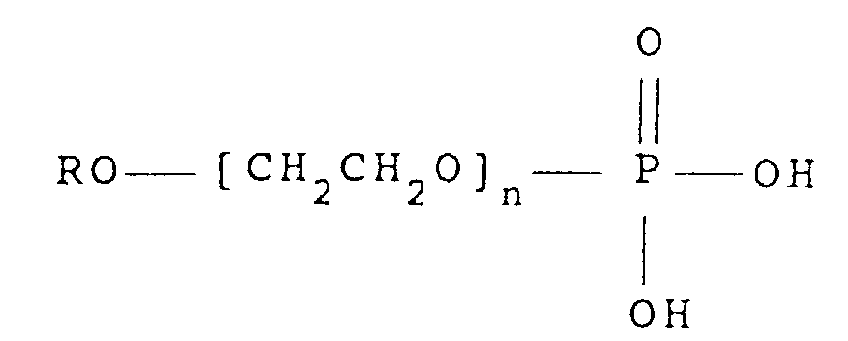
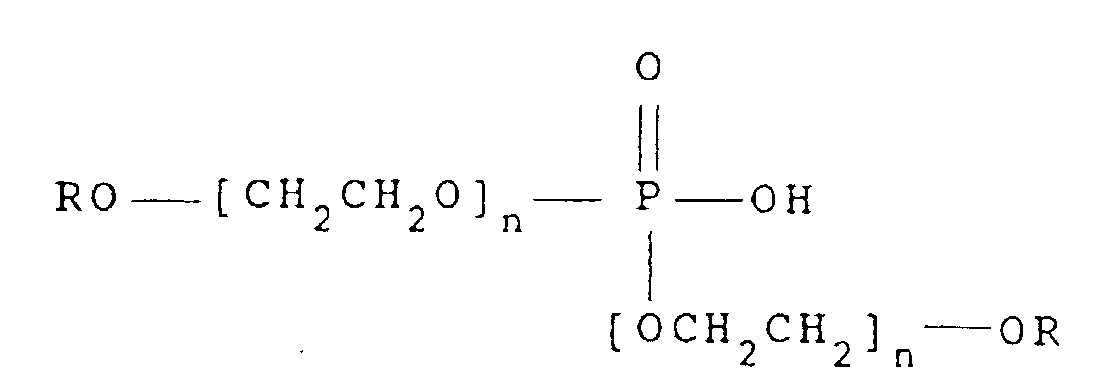
dans lesquelles R est
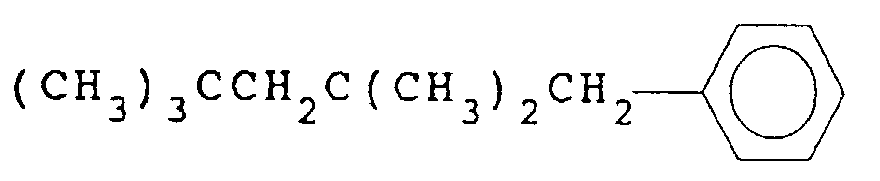
n vaut 9 et le rapport entre le mono et le diester va de 3 à 6 jusqu'à 1 à 1, afin de procurer une masse moléculaire effective du mélange d'ester de phosphate de 815,8 g/mole.
dans lesquelles R est
n vaut 9 et le rapport entre le mono et le diester va de 3 à 6 jusqu'à 1 à 1, afin de procurer une masse moléculaire effective du mélange d'ester de phosphate de 815,8 g/mole.
13. Support d'enregistrement maître selon la revendication 1 dans lequel la composition
de couchage comprend 67 % d'un pigment magnétique, 5,36 % d'une poudre abrasive, 1,34
% d'une poudre minérale colloïdale, 3,8 % d'un agent mouillant, 1,54 % d'un lubrifiant,
21 % d'un liant, dont au moins 85 % est le polyuréthane et dont 10 % est l'agent de
réticulation de polyisocyanate.
14. Support d'enregistrement maître selon la revendication 1 dans lequel la composition
de couchage comprend 59 à 69 % de particules de fer magnétique, de 2,95 à 6,90 % d'une
poudre abrasive d'alumine, de 0 à 5,4 % d'une poudre de noir de carbone colloïdal,
de 2,90 à 4,5 % de lécithine, jusqu'à 0,72 % d'un mélange d'esters de l'acide phosphorique
de formules
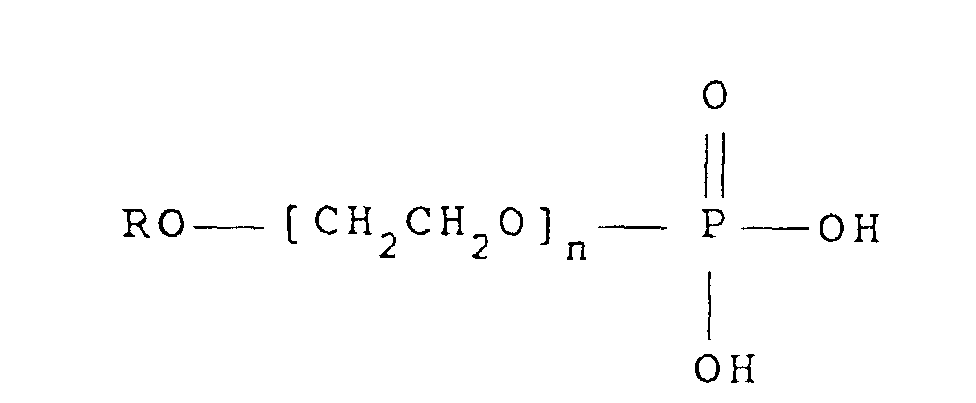
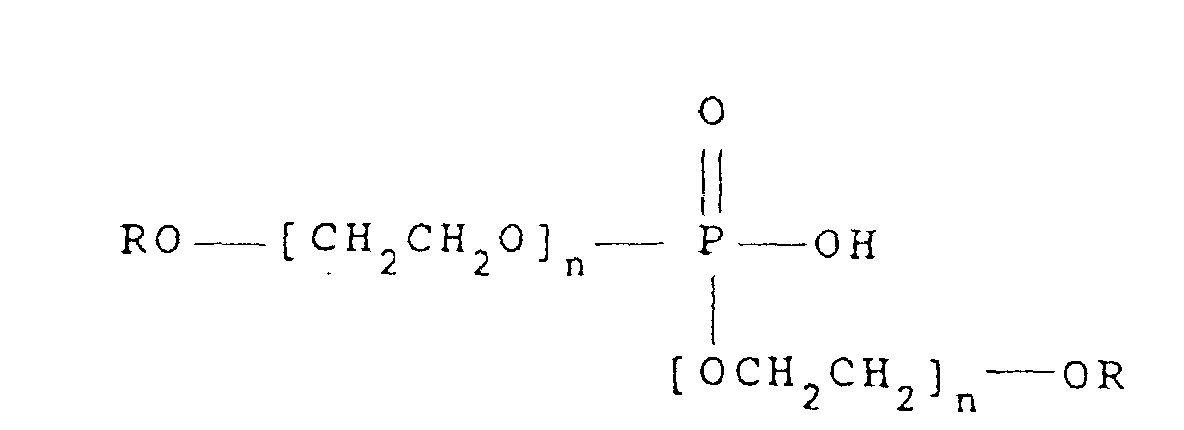
dans lesquelles R est
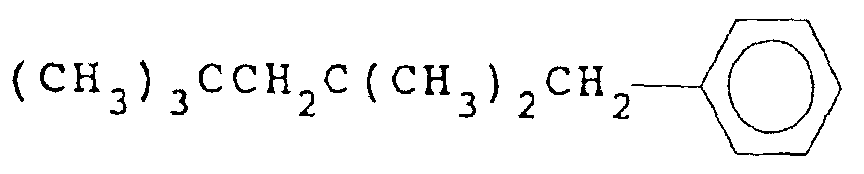
n vaut 9 et le rapport du mono au diester est en moyenne de 4 à 1 afin de procurer une masse moléculaire effective du mélange d'ester d'acide de 815,8 g/mole, 0,77 % de myristate de butyle, environ 0,77 % à 2,31 % d'acide myristique, de 14,1 à 33,6 % d'un liant, dont au moins 85 % est le polyuréthane de polyester à terminaison hydroxyle et dont 0,05 à 15 % est l'adduct à terminaison isocyanate de triméthylolpropane et de diisocyanate de tolylène.
dans lesquelles R est
n vaut 9 et le rapport du mono au diester est en moyenne de 4 à 1 afin de procurer une masse moléculaire effective du mélange d'ester d'acide de 815,8 g/mole, 0,77 % de myristate de butyle, environ 0,77 % à 2,31 % d'acide myristique, de 14,1 à 33,6 % d'un liant, dont au moins 85 % est le polyuréthane de polyester à terminaison hydroxyle et dont 0,05 à 15 % est l'adduct à terminaison isocyanate de triméthylolpropane et de diisocyanate de tolylène.
15. Support d'enregistrement maître selon la revendication 1 dans lequel la composition
de couchage comprend 64 % de particules de fer magnétique, 4,90 % de poudre abrasive
d'alumine, 1,4 % d'un noir de carbone colloïdal, 3,55 % de lécithine, 0,11 % d'un
mélange d'esters de l'acide phosphorique de formules
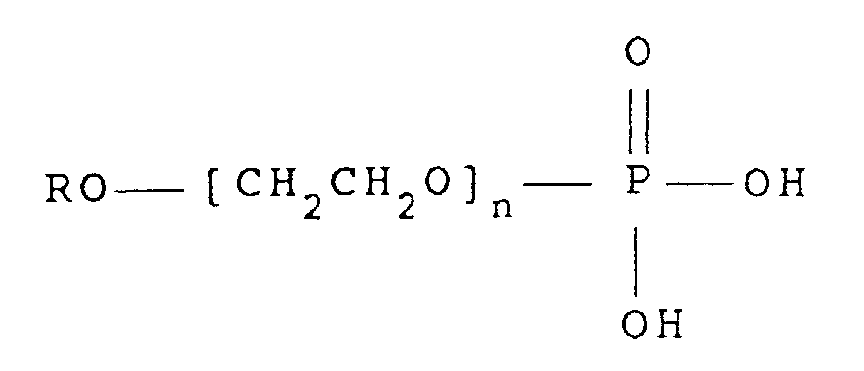
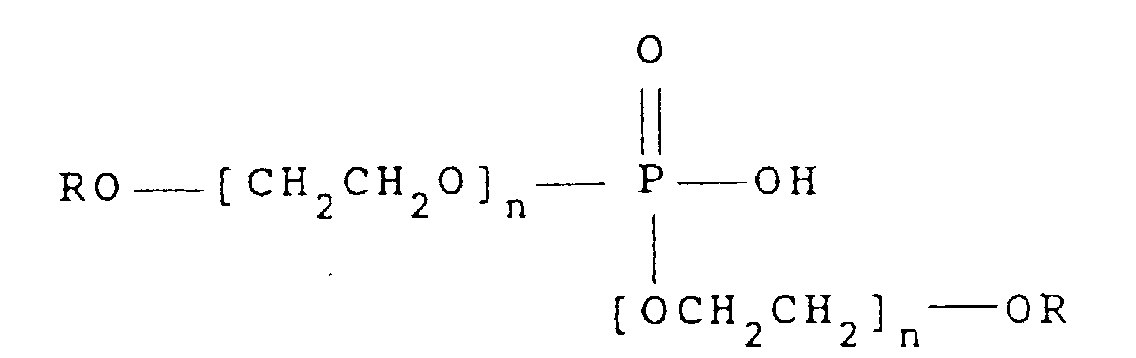
dans lesquelles R est
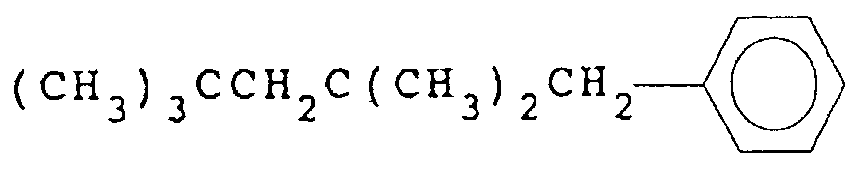
n vaut 9 et le rapport du mono au diester est en moyenne de 4 à 1 afin de procurer un poids moléculaire effectif du mélange de 815,8 g/mole, 0,77 % de myristate de butyle, 1,54 % d'acide myristique, 21 % d'un liant, dont au moins 85 % est le polyuréthane de polyester à terminaison hydroxyle et dont 10 % est l'adduct à terminaison isocyanate de triméthylolpropane et de diisocyanate de tolylène.
dans lesquelles R est
n vaut 9 et le rapport du mono au diester est en moyenne de 4 à 1 afin de procurer un poids moléculaire effectif du mélange de 815,8 g/mole, 0,77 % de myristate de butyle, 1,54 % d'acide myristique, 21 % d'un liant, dont au moins 85 % est le polyuréthane de polyester à terminaison hydroxyle et dont 10 % est l'adduct à terminaison isocyanate de triméthylolpropane et de diisocyanate de tolylène.
16. Support d'enregistrement maître selon la revendication 1 dans lequel la composition
de couchage comprend 64 à 68 % d'un pigment magnétique, de 3,8 à 5,4 % d'une poudre
abrasive, de 1 à 3 % d'une poudre minérale colloïdale, de 3,3 à 4,4 % d'un agent mouillant,
de 0,8 à 2,3 % d'un lubrifiant, de 20 à 25,5 % d'un liant, dont au moins 85 % est
le polyuréthane et dont de 0,05 à 15 % est l'agent de réticulation de polyisocyanate.
17. Support d'enregistrement maître selon la revendication 1 comprenant une composition
de couchage selon l'une quelconque des revendications 1 à 16 à une épaisseur à sec
allant de 2 à 3 µm.
18. Support d'enregistrement maître selon la revendication 17 comprenant une couche d'enduit
d'envers obtenue à partir d'une composition qui comprend 15 à 25 % de noir de carbone,
de 15 à 25 % d'une charge minérale, de 0,5 à 2 % d'un abrasif, de 20 à 30 % d'un liant
copolymère vinylique, de 15 à 25 % du liant de polyuréthane, de 7,5 à 17,5 % de l'agent
de réticulation, de 0,9 à 2 % d'un lubrifiant et de 0,06 à 0,6 % d'un agent d'aide
à l'enduction.
19. Support d'enregistrement maître selon la revendication 18 dans lequel la composition
de couchage comprend 19 % de noir de carbone, 19 % d'une charge minérale, 1,5 % d'un
abrasif, 6 à 18 % d'un copolymère chlorure de vinyle/acétate de vinyle modifié en
carboxy partiellement hydrolysé et 9 à 20 % d'un copolymère chlorure de vinyle/acétate
de vinyle modifié en hydroxy, 20,4 % du liant de polyuréthane, 12,3 % de l'agent de
réticulation, 1,4 % d'un lubrifiant et de 0,13 % d'un agent d'aide à l'enduction.
20. Support d'enregistrement maître selon la revendication 19 dans lequel dans la couche
d'enduit d'envers, la charge minérale est du carbonate de calcium, l'abrasif est de
l'alumine alpha présentant un diamètre de 0,1 à 0,6 µm et une surface spécifique de
1 à 15 m2/g, le copolymère de vinyle modifié en carboxy présente une masse moléculaire d'environ
28 000 et est hydrolysé jusqu'à un poids équivalent en hydroxyle de 850 g/mol, le
copolymère vinylique hydroxylé présente une masse moléculaire d'environ 23 000 et
contient environ 6 % de groupe hydroxyle exprimé en alcool vinylique, le polyuréthane,
et l'agent de réticulation tels que définis dans la revendication 1, le lubrifiant
est un mélange 4:2:2:6 de stéarate de butyle, de stéarate d'isocétyle, de stéarate
de trydécyle, et de palmitate d'éthyléxyle, et l'agent d'aide à l'enduction est
(CH3)3-Si-O-[Si(CH3)2-O]x-[CH3-Si(ROH)-O]y-Si-(CH3)3
dans laquelle x et y sont tous nombres entiers qui procurent une moyenne de trois groupements hydroxyles par molécule, un poids équivalent en hydroxyle moyen d'environ 2 000, une masse moléculaire moyenne d'environ 6 000, et R est un groupe alkyle comportant de 5 à 20 atomes de carbone.
(CH3)3-Si-O-[Si(CH3)2-O]x-[CH3-Si(ROH)-O]y-Si-(CH3)3
dans laquelle x et y sont tous nombres entiers qui procurent une moyenne de trois groupements hydroxyles par molécule, un poids équivalent en hydroxyle moyen d'environ 2 000, une masse moléculaire moyenne d'environ 6 000, et R est un groupe alkyle comportant de 5 à 20 atomes de carbone.
21. Support d'enregistrement maître selon l'une quelconque des revendications 1 à 20 dans
lequel le support est une base de film de polyester présentant une épaisseur de 25,4
à 76,2 µm (1,3 à 3 mils).
22. Procédé destiné à la préparation d'un support d'enregistrement maître sans hystérésis
qui comprend le couchage sur un support d'une composition de couchage et en option
d'une composition d'enduit d'envers telle que définie dans l'une quelconque des revendications
1 à 21, l'orientation des particules magnétiques, et le séchage ainsi que le calandrage
du support revêtu.
23. Procédé selon la revendication 22 qui comprend le chauffage du support revêtu à environ
55° C pendant jusqu'à environ 7 jours.
24. Procédé selon la revendication 22 qui comprend le chauffage du support revêtu à environ
55° C pendant 3 jours 1/2.
25. Procédé selon la revendication 22 qui comprend l'enduction de l'envers du support
avec une couche de carbone présentant une épaisseur sèche de 0,3 à 1,5 µm avant l'application
de la composition de couchage sur le support sur la face opposée à l'enduit d'envers.
26. Procédé destiné à la duplication d'un signal à partir d'un support maître sur un support
de copie qui comprend l'impression d'un motif d'enregistrement magnétique sur le support
d'enregistrement maître selon l'une quelconque des revendications 1 à 21, la fourniture
d'un support d'enregistrement magnétique de copie capable de devenir aimanté de façon
rémanente lorsqu'un champ magnétique externe est appliqué sur celui-ci, le maintien
temporaire des supports magnétiques maître et de copie en contact de surface sans
mouvement relatif substantiel entre eux, et l'application d'un champ magnétique de
polarisation en courant alternatif aux supports mis en contact afin de favoriser la
duplication d'un motif magnétique du support maître sur le support de copie sans effacer
le motif se trouvant sur le support maître.
27. Procédé selon la revendication 26 dans lequel le support de copie est une couche magnétique
transparente dans une base de film photographique.
28. Procédé selon la revendication 27 dans lequel la base du film photographique est de
l'acétate de cellulose.
29. Procédé selon la revendication 27 dans lequel le support de copie est une bande.
30. Procédé selon la revendication 27 dans lequel la base du film photographique est un
téréphtalate de polyéthylène.
31. Procédé selon la revendication 27 dans lequel la base du film photographique est un
téréphtalate de polyéthylène modifié.