|
(11) | EP 0 551 021 A1 |

| (12) | EUROPEAN PATENT APPLICATION |
|
|
|
|
|||||||||||||||||||||||||||
| (54) | Method of gelling hydrocarbons and treatment of subterranean formations therewith |
| (57) A liquid hydrocarbon is rapidly thickened or gelled by mixing it with a first component
comprising an alkyl orthophosphate acid ester and an alkali metal hydroxide present
in an amount sufficient to at least partially neutralize said ester, and a second
component comprising a source of aluminum or ferric ions, a C₈ - C₁₈ surface active
amine and a C₂ - C₄ monohydric alcohol. The mixture rapidly viscosifies to a level
sufficient to transport proppant and then can be introduced into a subterranean formation
to treat the formation in a desired manner. |
[0001] This invention relates to a method of rapidly gelling hydrocarbons, and to the use of such gelled hydrocarbons to treat subterranean formations to enhance oil and/or gas production therefrom.
[0002] Hydraulic fracturing is a widely used method of stimulating hydrocarbon producing subterranean formations. Fracturing commonly is performed by contacting a subterranean formation with a viscous fracturing fluid having propping agents therein, applying sufficient pressure to the viscous fluid to open at least one fracture in the formation and maintaining sufficient pressure upon said formation to inject the viscous fluid into the created fracture at a sufficient rate to extend the fracture into the formation. When the pressure upon the fluid is subsequently reduced, the propping agent prevents the complete closure of the created fracture.
[0003] Compositions containing gelled hydrocarbons often are used to achieve formation fracturing when water sensitive layers exist in the formation. The gelling of hydrocarbons and the use of gelled hydrocarbons in fracturing has been described in numerous patents, for example: U.S. Patent 3,757,864; U.S. Patent 3,575,859; U.S. Patent 4,007,128; U.S. Patent 4,200,540; U.S. Patent 4,507,213 and U.S. Patent 4,622,155. The gelling process described in the prior art can be outlined as follows: a tri-dimensional polymer is created by the reaction of an orthophosphoric acid ester with an aluminum salt, and optionally a base, to result in neutralization of the aluminum orthophosphate salt. Various methods have been proposed to yield the viscosifying polymer; however, each method fails to provide a means by which a gelled hydrocarbon may be rapidly prepared, without any significant ageing period to permit viscosity to develop, to facilitate "on the fly" gelation of just those quantities of gelled fluid actually needed for a fracturing treatment.
[0004] We have now found a way in which a hydrocarbon fluid may be rapidly gelled to a viscosity sufficiently high to facilitate transport of a propping agent and achieve fracture creation and extension in a subterranean formation.
[0005] According to the present invention, there is provided a method of treating a subterranean formation penetrated by a wellbore, which method comprises introducing into said formation a composition formed by mixing a liquid hydrocarbon with a viscosifying effective amount of a first component comprising an admixture of an alkyl orthophosphate acid ester and an alkali metal hydroxide whereby said ester is at least partially neutralized, and a second component comprising a water soluble source of aluminum or ferric ions, a C₈ - C₁₈ surface active amine and a water miscible organic solvent, whereby said mixture is caused to viscosify.
[0006] The invention also provides a method of rapidly viscosifying a liquid hydrocarbon, which method comprises mixing said liquid hydrocarbon with an effective viscosifying amount of a first component comprising an admixture of an orthophosphate ester having the general formula:
wherein R is C₆ to C₁₈ and R' is a C₂ to C₄ alkyl radical, and an alkali metal hydroxide, and a second component comprising a soluble source of aluminum or ferric ions, a C₈ to C₁₈ surface active amine, and a C₂ to C₄ monohydric alcohol whereby said mixture is caused to rapidly viscosify.
[0007] In accordance with the present invention, the gelling system can viscosify a hydrocarbon to a viscosity of at least about 4000 centipoise (4 Pa s) in less than 30 seconds as measured by a BrookfieldR Synchro-lectric Viscometer Model LTV, using a no. 3 spindle rotating at 12 rpm at ambient temperature when added at a concentration of 0.5% by volume.
[0008] The liquid hydrocarbons that can be gelled by the method of the present invention include crude oil, kerosene, diesel, gasoline and other aliphatic or aromatic hydrocarbons such as octane, heptane, lubricating oils and the like. The hydrocarbon is gelled by the addition of two components to the liquid hydrocarbon while the liquid is mixed or otherwise agitated. The first component comprises an alkyl orthophosphate acid ester which is admixed with a quantity of an alkali metal hydroxide whereby the ester is partially neutralized. The alkyl orthophosphate esters generally have the formula:
wherein R is an alkyl radical having from about 6 to 18 carbon atoms and R' is an alkyl radical having from 2 to 4 carbon atoms. The orthophosphate also may comprise a mixture of different compounds. Preferably, R has an average value of from about 8 to 10 carbon atoms and R' is ethyl. The alkylorthophosphate ester may be prepared by any of the well known methods, such as those disclosed in U.S. Patent 3,757,864, to which reference should be made. Such compounds are available from manufacturers such as Witco Chemical Company, Houston Texas; Nalco Chemical Company, Sugar Land Texas; Petrolite Corporation, St. Louis Missouri; Ethox Chemicals Inc. Greenville South Carolina; Rhone-Poulenc, Cranbury New Jersey and Borg-Warner Corporation, Chicago Illinois.
[0009] The alkali metal hydroxide can comprise lithium, sodium, potassium and the like. Preferably, the alkali metal is potassium. The alkali metal hydroxide is admixed with the alkyl orthophosphate ester in an amount sufficient to at least partially neutralize the ester. The alkali metal hydroxide is preferably admixed with the ester in an amount of from about 5 to about 30% by weight. The alkali metal hydroxide is preferably admixed with the ester in an amount sufficient to adjust the pH of the final two component mixture of gelling agent in the hydrocarbon to a level of from about 3.5 to about 6.5. The pH of the gelled hydrocarbon mixture is determined by ASTM STANDARD D664 - 81.
[0010] The second component of the gelling agent is prepared by admixing a soluble source of aluminum or ferric ions or an admixture thereof, such as aluminum chloride or ferric sulfate, with a C₈ - C₁₈ surface active amine and a C₂ - C₄ monohydric alcohol.
[0011] The surface active amine employed in the second component includes alkyl and alkanol amines having from about 8-18 carbon atoms, N-heterocyclic amines, alkyl substituted derivatives of such heterocyclics and mixtures thereof. Preferably, amines having more than one nitrogen group are utilized and most preferably the amine comprises an imidazoline such as that prepared from the reaction of a tall oil fatty acid with diethylenetriamine.
[0012] The monohydric alcohol preferably comprises isopropanol, but ethanol or butanol also can be utilized, as well as mixtures. The alcohol functions to solubilize the mixture of the constituents. It should be understood that acetone or any other water miscible organic solvent capable of solubilizing the mixture, also could be utilized to solubilize the mixture.
[0013] The source of aluminum or ferric ions is admixed with the alcohol in an amount of from about 10 to about 25% by weight. The amine is admixed with the alcohol in an amount of from about 30 to about 70% by weight. Preferably, the ion source is present in an amount of from about 80 to about 90% and the amine is present in an amount of from about 50 to about 60% by weight of the alcohol or solvent.
[0014] The first component is admixed with the second component in a ratio of from about 1 : 0.75 to about 1 : 1.75 by volume. Preferably, the first component is admixed with the second component in a ratio of from about 1 : 0.75 to about 1 : 1.25.
[0015] The first component and second component may be admixed with the hydrocarbon liquid in any order or substantially simultaneously. The admixing may occur in substantially any of the conventionally known mixing apparatus or blenders. The total amount of the first and second components used to viscosify a hydrocarbon generally is in a range of from about 3 to 20 volumes per 1000 volumes of hydrocabon.
[0016] Surprisingly, it has been found that the method of the present invention can effect gelation of the hydrocarbon in a matter of a few seconds after both components have been added to the hydrocarbon. The hydrocarbon typically develops a viscosity in excess of about 4000 centipoise (4 Pa s) within about 30 seconds after admixing with the gelling system as determined on a Brookfield· Model LTV viscometer utilizing a No. 3 spindle rotating at 12 rpm at ambient temperature at a concentration of 0.5% volume. It should be understood that the method of the present invention also can be utilized to prepare viscosified hydrocarbon fluids in batch processes in addition to the substantially continuous process described herein. The techniques required for batch processing are well known to individuals of any skill in the art.
[0017] The gelled hydrocarbon can be admixed with any of the conventionally known proppants, such as sand, sintered bauxite, ceramic spheres and the like. The proppants may be present in an amount of from less than 1 pound (0.45 kg) to in excess of 20 pounds (9.1 kg) per gallon (3.79 dm³) of gelled hydrocarbons.
[0018] The gelled hydrocarbon also may contain substantially any of the conventionally known breakers for gelled oils to return the viscosity of the hydrocarbon liquid to a level at least 50 percent less than its gelled viscosity at the conclusion of the treatment. Examples of breakers include various organic acids such as acetic or benzoic acids, salts of such acids, ammonium carbonate or bicarbonate, other alkali metal carbonates or fluorides, organic acid anhydrides and esters and the like. The amount of breaker employed will vary depending on such parameters as the temperature of the gelled fluid at the time breaking is desired, original viscosity of the gelled fluid, exact salt and orthophosphate esters employed, the concentration of the orthophosphate ester and the like. Generally an effective amount of breaker may range from about 5 pounds (2.3 kg) to about 100 pounds (45.4 kg) per 1000 gallons (3.79 m³) of the gelled fluid.
[0019] Other types of fracturing fluid additives such as surfactants, corrosion inhibitors, scale inhibitors and the like well known in the art also can be added to the gelled hydrocarbon fluid.
[0020] After thorough blending of the proppant and any other additives with the gelled hydrocarbon fluid, the gel is pumped into a wellbore where it is ultimately caused to enter the subterranean formation which is to be treated. The gelled fluid is pumped at a sufficient rate and pressure to effect a fracture and propagate the same in the subterranean formation. Upon completion of the desired treatment, injection of the gelled hydrocarbon is discontinued and the well is shut-in for a sufficient time to permit the formation to at least begin to close upon the proppant to thereby retain the proppant within the created fracture and create a propped flow passage for subsequent hydrocarbon production.
[0021] To further illustrate the present invention and not by way of limitation, the following examples is provided.
Example
[0022] The gelation rate of kerosene by the compositions of the present invention is compared to that achieved by prior art compositions. The gelation rate is evaluated by the time required to effect vortex closure in a quantity of kerosene within a Waring Blendor. The Waring Blendor jar is provided with a Polytron Rotor Stator, Waring Blendor attachment and 250 ml. of kerosene is placed in the jar for each test. The speed of the blender is adjusted to the maximum agitation that could be achieved while minimizing air entrainment which is approximately 3450 rpm. The same speed setting is used for all tests. The quantities of the constituents are set forth in the table below. The phosphate ester first component is added to the jar followed immediately by the second component. The second component was prepared using either aluminum or ferric ion sources as set forth below.
[0023] The composition of the components was as follows:
| First Component: | |
| C₈ - C₁₈ orthophosphate di-ester | 15 gm |
| 45% KOH | 4.5 gm |
| Second Component: when Al used | |
| 32°Baume AlCl₃ | 50 gm |
| imidazoline | 12 gm |
| isopropyl alcohol | 10 gm |
| Second Component: when Fe used | |
| ferric sulfate liquid (10% Fe³) | 50 gm |
| imidazoline | 12 gm |
| water | 5 gm |
| isopropyl alcohol | 10 gm |
[0024] The prior art composition comprised the following:
First Component - C₈ - C₁₀ orthophosphate di-ester
Second Component - sodium aluminate solution (20% by weight Na₂ Al₂ O₄).
This composition corresponds to the conventional gellants disclosed on page 60 of the American Chemical Society Symposium Series 396 entitled "Oilfield Chemistry," copyright 1989. The composition is utilized at a concentration to provide the ratio of 100 moles of ester to 33 moles of aluminate described in the ACS publication.
1. A method of treating a subterranean formation penetrated by a wellbore, which method
comprises introducing into said formation a composition formed by mixing a liquid
hydrocarbon with a viscosifying effective amount of a first component comprising an
admixture of an alkyl orthophosphate acid ester and an alkali metal hydroxide whereby
said ester is at least partially neutralized, and a second component comprising a
water soluble source of aluminum or ferric ions, a C₈ - C₁₈ surface active amine and
a water miscible organic solvent, whereby said mixture is caused to viscosify.
2. A method according to claim 1, wherein a propping agent is mixed with the viscosified
mixture.
3. A method according to claim 1 or 2, wherein the alkali metal hydroxide is potassium
hydroxide and said surface active amine is imidazoline.
4. A method according to claim 1,2 or 3, wherein said first component is admixed with
said second component in a ratio of from 1 : 0.75 to 1 : 1.75.
5. A method according to claim 1,2,3 or 4, wherein the total amount of said first and
second components admixed with said liquid hydrocarbon is in the range of from 3 to
20 volumes per 1000 volumes of said hydrocarbon.
6. A method of rapidly viscosifying a liquid hydrocarbon, which method comprises mixing
said liquid hydrocarbon with an effective viscosifying amount of a first component
comprising an admixture of an orthophosphate ester having the general formula:
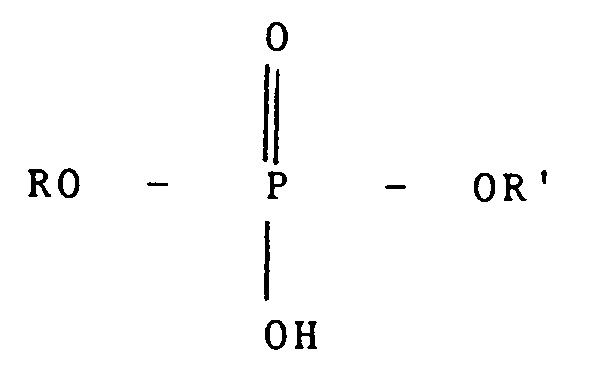
wherein R is C₆ to C₁₈ and R' is a C₂ to C₄ alkyl radical, and an alkali metal hydroxide, and a second component comprising a soluble source of aluminum or ferric ions, a C₈ to C₁₈ surface active amine, and a C₂ to C₄ monohydric alcohol whereby said mixture is caused to achieve a viscosity of at least 4000 centipoise (4 Pa s) in less than 30 seconds as measured by a Brookfield Synchrolectric Viscometer Model LTV using a no. 3 spindle rotating at 12 rpm at ambient temperature when said first and second component are at a concentration of 0.5% by volume.
wherein R is C₆ to C₁₈ and R' is a C₂ to C₄ alkyl radical, and an alkali metal hydroxide, and a second component comprising a soluble source of aluminum or ferric ions, a C₈ to C₁₈ surface active amine, and a C₂ to C₄ monohydric alcohol whereby said mixture is caused to achieve a viscosity of at least 4000 centipoise (4 Pa s) in less than 30 seconds as measured by a Brookfield Synchrolectric Viscometer Model LTV using a no. 3 spindle rotating at 12 rpm at ambient temperature when said first and second component are at a concentration of 0.5% by volume.
7. A method according to claim 6, wherein R of said first component has an average value
of from 8 to 10, and R' is ethyl.
8. A method according to claim 6 or 7, wherein said C₈ to C₁₈ surface active amine comprises
at least one compound selected from C₈ to C₁₈ alkyl and alkanol amines, N-heterocyclic
amines and alkyl substituted derivatives of such heterocyclic amines.
9. A method according to claim 6,7 or 8, wherein said first component is admixed with
said second component in a ratio of from 1 : 0.75 to 1: 1.75.
10. A method according to claim 6,7,8 or 9, wherein said mixture of first and second component
is present in said liquid hydrocarbon in an amount of from 3 to 20 volumes per 1000
volumes of liquid hydrocarbon.