|
(11) | EP 0 552 511 A1 |

| (12) | EUROPEAN PATENT APPLICATION |
|
|
|
|
|||||||||||||||||||||||
| (54) | Method for controlling the PH of an ascorbic acid type developer |
| (57) A method is disclosed for developing an exposed radiation-sensitive silver halide
material by means of a developing solution containing an ascorbic acid type developing
agent, characterized in that the alkalinity of the developing solution is maintained
at a desired constant pH level by means of a redox potential measuring system, e.g.
a carbon / calomel electrode pair or a platinum / calomel electrode pair. Preferred
developing agents are l-ascorbic acid and iso-ascorbic acid. Equally disclosed is an apparatus for maintaining the pH of a ascorbic acid type developer at a constant value comprising a redox electrode system and a control arrangement capable of feeding an alkali solution to the developer. |
1. Field of the invention.
[0001] The present invention relates to a method of developing an exposed radiation-sensitive silver halide material by means of a photographic ascorbic acid developer wherein the activity level of the developer is maintained at a constant level by the controlled addition of alkali solution by means of an electrochemical sensing device.
2. Background of the invention.
[0002] In any industrial application of photographic processing a major problem consists in obtaining reproducibility of processing conditions. Important factors which must be controlled are temperature, agitation, time and development activity of the developer solution. One method of controlling development activity is to make chemical additions to the solution such that a constant level of activity is maintained. This method is generally referred to in the art as replenishment or rejuvenation.
[0003] Replenishment procedures are often adopted in photographic processing applications where there is a large throughput of film to be processed and the quantity of developer in the tank is usually at least several liters. Typical examples are bulk processing of colour film either continuously or in batches, machine processing of X-ray film, and the processing for graphic arts applications of continuous tone or high contrast (litho) film, either manually in tanks or by automatic machine.
[0004] The activity of a developer is reduced by two major processes :
(a) oxidation processes which occur in the developer by the action of aerial oxygen.
(b) the development of film which leads to a reduction of the developing agent concentration together with a corresponding increase in the concentration of developer oxidation products.
[0005] It is common practice to formulate developers so that these processes are reduced to a minumum, for example by the inclusion of sulphite. However anti-oxidation products like sulphite cannot be used at high concentrations in certain applications such as lith processing on the basis of hydroquinone.
[0006] The purpose of a replenisher solution is to readjust the concentration of the important components of the developer solution to a standard value. The components which are considered are e.g. developing agents, halide ion, sulphite ion and buffering agents, the concentration of which has to be increased from time to time, and oxidation products, the concentration of which has to be decreased from time to time.
[0007] The problem assumes negligible proportions in situations where film is processed continuously or on a regular basis throughout 24 hours, day after day. The rates of reaction will be virtually constant and the replenisher can be added as required with good results. However when use of developer is intermittent as is often the case, e.g. no film is processed at night or over the weekend, a constant activity level cannot be obtained. In most cases, a boost of developer solution or replenisher solution is given in order to bring the activity of the developer to the desired level leading to an excessive consumption of replenisher solution.
[0008] A method has been published which is able to keep the activity of a developer solution at a constant level by means of a controlled replenishing based on the oxidation state of the developer which is measured by means of a redox electrode system (GB 1,313,796). This method can be very useful when aerial oxidation or oxidation through development leads to a decrease in activity of the developer as the result of a decrease in concentration of developing agent(s), and nearly no changes in pH occur due to the presence of buffers. Replenishing then means adding a solution of developing agent in order to keep the concentration of the agent and hence the activity of the developer constant.
[0009] However, an ecologically safe developer, e.g. a developer containing ascorbic acid or an analoguous compound as developing agent, preferably contains substantially no sulphite and no buffers for ecological reasons. A kind of such a developer, containing a rather high concentration of ascorbic acid or a related compound, and showing a rather high pH in order to obtain excellent lith quality, is disclosed in European Patent Application, filed 1991-02-14, appl . No. 91200311.8. When such ecologically interesting developers are used, the activity depends on the concentration of the active developing species which are likely to be the mono- and dianion of ascorbic acid or analogue as described by Willis and Pontius in Phot. Sci. Eng. Vol . 14 (6), p.384 (1970) and these concentrations are also pH dependent. When oxidation occurs due to aerial oxygen or film development, the pH and the concentration of active developing species will decrease leading to a gradual decrease of gradation, dot quality and sensitivity. Replenishing by means of a solution containing ascorbic acid or analogue will bring the concentration of the developing agent to the desired level but will not necessarely reestablish the pH to the original value. The supplementary addition of a concentrated solution of alkali hydroxide will be needed in order to increase the pH to the desired level.
[0010] The addition of acid or alkali solutions to developers, controlled by a pH sensor has been mentioned in GB 1,313,796. However conventional pH measuring systems, e.g. a glass electrode, can not be used in a permanent mode due to the high pH of the ascorbic acid type developer solution as disclosed in the Patent Application cited above.
3. Objects and summary of the invention.
[0011] It is an object of the present invention to provide a method of developing an exposed radiation-sensitive silver halide material by means of an ascorbic acid type developing solution wherein the activity of the developing solution is maintained at a constant level by the addition of alkali.
[0012] It is a particular object of the present invention to provide a method wherein said addition of alkali is monitored automatically by a particular pH controlling system.
[0014] The above objects are accomplished by a method of developing an exposed radiation-sensitive silver halide material by means of a developing solution containing an ascorbic acid type developing agent, characterized in that the alkalinity of the developing solution is maintained at a desired constant pH level by means of a redox potential measuring system, in casu a redox electrode pair.
[0015] The ascorbic acid type developing agent is represented by following general formula (I):
wherein X represents an oxygen atom or an imino group, and
n represents a positive integer from 1 to 4, and
R represents a hydroxy group when n is 1, and R represents a hydroxy group or a hydrogen atom when n is 2 to 4.
[0016] Preferred compounds for use in accordance with the present invention are l-ascorbic acid and iso-ascorbic acid.
[0017] It has been found experimentally that a linear relationship exists between the redox potential E and the pH of an ascorbic acid type developer; for example, for a developer containing 0.8 mole ascorbic acid per liter the slope of this linear relationship is 30 mV/pH-unit when measured with a carbon / calomel electrode pair (see fig.1).
[0018] By means of a redox potential controlled addition of a concentrated alkali hydroxide solution the pH and hence the activity of the developer solution can be maintained at the desired level during replenishment with unoxidized developing agent.
[0019] The apparatus for carrying out the method of the invention wherein the pH of an ascorbic acid type developer is maintained at the desired level comprises means for feeding an alkali solution to the developer and means for controlling the addition of an alkali solution, said control means being a redox electrode system. Next to the controlled addition of alkali solution based on a redox measurement, simultaneously one or more replenisher solution(s) can be added based on film throughput, on regular time basis or through manual intervention in order to keep the concentration of the developing agent constant. Both keeping the pH and concentration of ascorbic acid leads to a constant activity level of the ascorbic acid type developer.
[0020] The invention will now be further described in detail, with reference to the accompanying drawing, showing diagrammatically one embodiment of apparatus for carrying out the method and means by which substantially constant developer activity may be maintained under any regime of film throughput and without excessive use of replenisher solution.
4. Detailled description of the invention.
[0021] As stated above the most preferred developing agents for use in accordance with the present invention are l-ascorbic acid and iso-ascorbic acid. Other useful compounds include imino-l-ascorbic acid, 6-desoxy-l-ascorbic acid, l-rhamnoascorbic acid, l-fucoascorbic acid, d-glucoheptoascorbic acid, d-glucoascorbic acid, l-erythroascorbic acid, and their stereoisomers. The developing agents can be incorporated in the developing solution in the free acid form or as a salt, preferably an alkali salt.
[0022] Referring to the drawing (fig.2), the developer solution is contained within a processing tank 1 (e.g. making part of a RAPILINE 66 processor, marketed by AGFA-GEVAERT N.V.) wich is equipped with a sensing device in the form of a redox electrode system 2. The permanent pH measuring is effected by this redox electrode measuring system consisting of e.g. a carbon electrode / calomel reference electrode. Other redox electrodes such as Pt, gold or glassy carbon can be used.
[0023] The replenisment with solution A in tank 3 having the same chemical composition of the developer solution is added to the processing tank by means of pump 4 based on film throughput. The flow of replenisher A can be varied. The alkali solution B in tank 5 contains an alkali solution, preferably an alkali hydroxide solution, e.g. a 50% KOH solution, and is added to the processing tank through pump 6 (e.g. Prominent Electronic E) which is controlled by the permanent measuring device 2. The alkali solution may also contain agents which can adjust the development activity of a photographic silver halide developer solution such as stabilizers, activators and halide ions. The measuring device produces a signal dependent on the state of oxidation of the developer solution and the value of said signal is compared with a reference signal generated by device 7 (e.g. a Metrohm Impulsomat 64). The difference signal resulting from said comparison controls the flow of the alkali solution B until the difference signal is reduced substantially to zero. The difference signal is converted into a timing pulse which is employed to actuate the appropiate relay unit which is incorporated in device 7 to control the operation of the associated replenisher pump. The pulses created by the timing pulse generator 7 are employed to generate a ramp function serving as the reference signal with which the output voltage from the electrode system is compared in order to produce an output pulse whose duration varies in dependence on the magnitude of the difference between the reference potential and the output from the electrode system. This output pulse is fed to the associated relay unit to control the operation of the pump 6, connected thereto. Replenisher pump 6 may be replaced by a control valve operated by the relay unit and controlling the flow of the alkali solution B from its storage container 5. In the preferred embodiment of a high concentration of ascorbic acid type developing agent, required for high lith quality, aerial oxidation will nearly not affect the ascorbic acid concentration. Therefore, when no film is processed the pH and hence activity of the developer solution is then permanently held constant only by means of the redox potential controlled addition of alkali solution B. From this description it is also clear that the activity level of the developer solution can be varied by altering the reference potential with which the redox potential of the solution is compared.
[0024] Other adjuvants well known to those skilled in the art can be incorporated into the developer solution. A survey of conventional developer addenda is given by Grant Haist in "Modern Photographic Processing" - John Wiley and Sons - New York (1979) p. 220-224. Examples of such addenda include complexing agents for calcium and magnesium ions, present in hard water, e.g. ethylene diamine tetraacetic acid and analogous compounds. Further can be present anti-foaming agents, surface-active agents, biocides, thickening agents like polystyrene sulphonate and antioxidants like benzoate and cyclodextrine. The developing liquid can contain so-called anti-sludge agents in order to reduce dirt streaks on developed photographic material. Finally the solution can contain development accelerating agents like polyalkyleneoxides and alkonolamines and hardening agents including latent hardeners.
[0025] To achieve the optimal sensitometric and lith quality results of the present invention there is no need for a second auxiliary developing agent. Sulphite ions too can be omitted without detrimental effect on stability. So in a most preferred embodiment of the invention there are substantially no second developing agent and no sulphite ions present in the developer liquid. As stated above no substantial amount of buffering agents is present.
[0026] The developing solutions used in accordance with the present invention can be employed to develop various types of photographic black-and-white materials, e.g. amateur and professional materials for still photography, radiographic recording and duplicating materials, cinematographic recording and duplicating materials, and microfilm. However the merits of the present invention become most obvious in developing camera or duplicating materials for graphic arts in view of the importance of exact reproduction of line and screen dot originals. In this case the best results are obtained when applying these ascorbic acid type developing solutions to photographic materials containing negative chlorobromide emulsions as is commonly the case in various types of graphic arts materials. Especially useful chlorobromide emulsions in connection with an ascorbic acid developer are cubic, essentially (iodo)bromide, emulsions showing epitaxial deposition of a minor amount of chloride (about 1 to 5 %) on their corners. It was stated experimentally that an example of such an emulsion showed a selective speed advantage in ascorbic acid type developers compared to classical hydroquinone-Phenidone developers which was not found with a comparable (iodo)bromide emulsion showing no epitaxial chloride deposition. This kind of epitaxial deposition proved to be especially beneficial in the case of core-shell type emulsions. Two emulsions showing the same grain size were prepared both comprising a AgBrI core with 4% of iodide and a AgBrCl shell with 5 % of chloride. In the first case the chloride was distributed homogeneously over the shell while in the second case it was deposited epitaxially on the crystal corners. While the first emulsion lost about 0.10 log Et relative speed in an ascorbic acid developer compared to a hydroquinone-Phenidone developer this was not the case with the emulsion showing epitaxy which completely maintained its sensitivity.
EXAMPLE
[0027] A typical graphic arts chlorobromide emulsion was prepared by a double jet technique. The silver halide composition was 83.6 mole % of chloride, 16 mole % of bromide and 0.4 mole % of iodide, and the average grain size was 0.27 micron. After addition of inert gelatin the emulsion was chemically ripened to an optimal fog-sensitivity relationship and then spectrally sensitized to the blue and the green spectral region.
[0028] Finally the emulsion was stabilized by means of 4-hydroxy-6-methyl-1,3,3a,7-tetraazaindene. After addition of a conventional coating aid and a conventional hardener the emulsion was coated on one side of a transparent polyethylene terephtalate support at a silver coverage of 6.25 g/m², expressed as AgNO₃/m2.
[0029] Dried coated samples of the prepared photographic material were exposed by a conventional white light source, on the one hand through a continuous tone wedge, on the other hand through a contact screen with a ruling of 54 lines/cm combined with a continuous tone wedge.
[0030] These samples were developed in the processing tank twice a day. The developer composition was :
| iso-ascorbic acid | 150 g/l |
| 1-phenyl-5-mercaptotetrazole | 80 mg/l |
| potassium bromide | 30 g/l |
| 50 % KOH solution to adjust pH to 12.5 | |
[0031] In order to simulate oxidation by film development, 10 m² of exposed material a day was developed in the same development tank.The pH was maintained at a constant llevel by the mechanism described in section Detailled Description using a carbon / calomel electrode pair as redox potential measuring unit ; a 50 % KOH solution was used as solution B. The rate of replenisher A amounted to 0.25 liter per m² processed film. For fixing and drying conventional procedures were followed. As can be seen in fig. 3 the sensitivity, measured at density 3+fog, and the pH did not decrease within the experimental error in a period of 20 days. The lith quality, evaluated as dot quality variation, remained also at the desired level during this period of time.
[0032] These results clearly demonstrate that with the use of a permanent redox potential controlled addition of a 50% solution of KOH and replenishing with unoxidized developer solution based on film througput, the activity of the developer solution can be held at the desired level without excessive bath consumption and without employing sulphite or other substances against aerial oxidation. The absence of such substances improves the quality of hard dots and leads to a lower COD (Chemical Oxygen Demand) of the developer solutions.
1. Method of developing an exposed radiation-sensitive silver halide material by means
of a developing solution containing a developing agent according to general formula
(I) or a salt thereof :
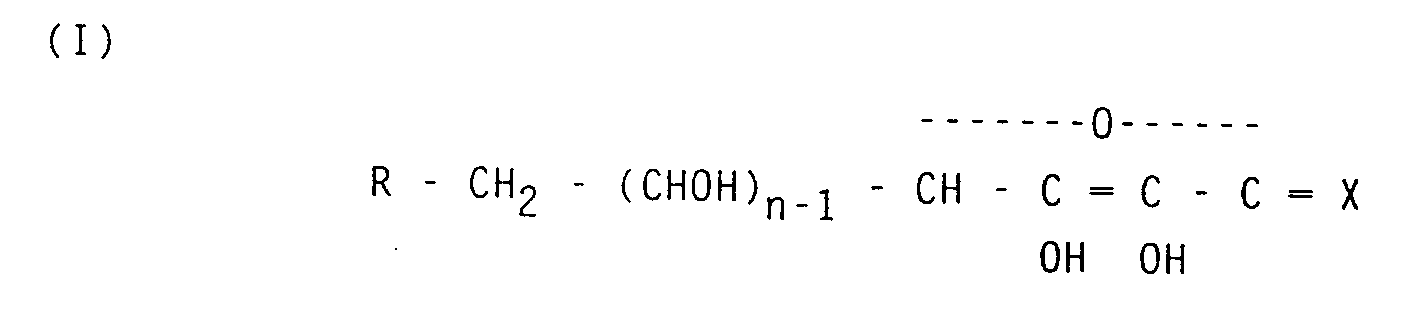
wherein X represents an oxygen atom or an imino group, and
n represents a positive integer from 1 to 4, and
R represents a hydroxy group when n is 1, and R represents a hydroxy group or a hydrogen atom when n is 2 to 4,
characterized in that the alkalinity of the developing solution is maintained at a desired constant pH level by means of a redox potential measuring system.
wherein X represents an oxygen atom or an imino group, and
n represents a positive integer from 1 to 4, and
R represents a hydroxy group when n is 1, and R represents a hydroxy group or a hydrogen atom when n is 2 to 4,
characterized in that the alkalinity of the developing solution is maintained at a desired constant pH level by means of a redox potential measuring system.
2. Method according to claim 1 wherein said redox potential measuring system is a redox
electrode system producing an electrochemical potential dependent on the state of
oxidation of the developing agent and on the pH of the developing solution.
3. Method according to claim 1 or 2 wherein said electrochemical potential is compared
with a reference potential and the difference signal resulting from said comparison
controls the flow of an alkali solution until the difference signal is substantially
reduced to zero.
4. Method according to any of claims 1 to 3 wherein said redox potential measuring system
is a carbon / calomel electrode pair.
5. Method according to any of claims 1 to 3 wherein said redox potential measuring system
is a platinum / calomel electrode pair.
6. Method according to any of claims 1 to 5 wherein said developing agent is l-ascorbic
acid.
7. Method according to any of claims 1 to 5 wherein said developing agent is iso-ascorbic
acid.
8. Method according to any of claims 1 to 7 wherein said developing agent is present
in the developing solution at a concentration of more than 0.4 mole/l.
9. Method according to claim 8 wherein the pH of said solution is at least 12.0.
10. Apparatus for maintaining the pH of a photographic silver halide developer, which
contains a developing agent according to general formula (I), at a constant value,
comprising a redox electrode system capable of feeding, on the basis of a redox potential
measurement, an alkali solution to said developer :
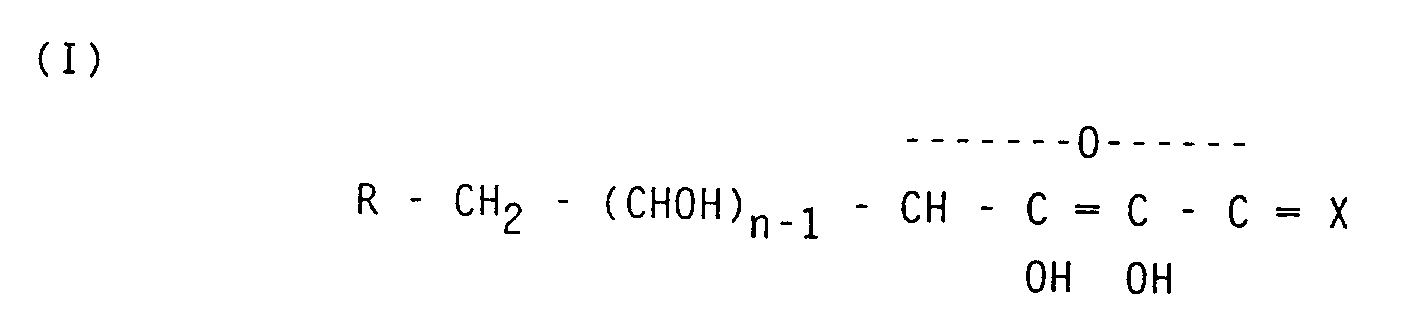
wherein X represents an oxygen atom or an imino group, and
n represents a positive integer from 1 to 4, and
R represents a hydroxy group when n is 1, and R represents a hydroxy group or a hydrogen atom when n is 2 to 4.
wherein X represents an oxygen atom or an imino group, and
n represents a positive integer from 1 to 4, and
R represents a hydroxy group when n is 1, and R represents a hydroxy group or a hydrogen atom when n is 2 to 4.
11. Apparatus according to claim 10 comprising a control arrangement capable of producing
an output pulse whose duration varies in dependence of the potential difference between
a reference potential and the potential measured by the redox electrode system, whereby
said output pulse is used to operate a relay device controlling the operation of adding
said alkali solution to said developer.
12. Apparatus according to claim 10 or 11 further comprising a system for feeding replenishment
solutions to the developer based on throughput volume of photographic material.