|
(11) | EP 0 554 463 A1 |

| (12) | EUROPEAN PATENT APPLICATION |
| published in accordance with Art. 158(3) EPC |
|
|
|
|
|||||||||||||||||||||||||||
| (54) | FLUORORUBBER COATING COMPOSITION |
| (57) A fluororubber coating composition comprising a fluororubber, a liquid carrier, a
coupling agent, a cross-linking agent, and a carboxylic acid. It has a long pot life
and yields a coating film free from any unevenness in its thickness. |
FIELD OF THE INVENTION
[0001] The present invention relates to a fluororubber coating composition. In particular, the present invention relates to a fluororubber coating composition which has a long pot life and provides a film with a uniform thickness.
DESCRIPTION OF THE PRIOR ART
[0002] Since a conventional fluororubber coating composition suffers from gellation within 24 hours after the addition of a crosslinking agent, its pot life is short and it has some troubles in storage and application. If the composition is not gelled, crosslinking of the fluororubber will increase a viscosity of the composition, so that a coated film has an uneven thickness depending on a coating manner (See Industrial Material (KOGYO ZAIRYO), Vol. 26, No. 12 (December 1978) 46-49).
SUMMARY OF THE INVENTION
[0003] One object of the present invention is to provide a fluororubber coating composition having a long pot life.
[0004] Another object of the present invention is to provide a fluororubber coating composition which provides a film having a uniform thickness when coated.
[0005] According to the present invention, there is provided a fluororubber coating composition comprising a fluororubber, a liquid medium, a coupling agent, a cross-linking agent and a carboxylic acid.
BRIEF DESCRIPTION OF THE DRAWINGS
[0006]
Fig. 1 is a graph showing the change of the viscosity with time of the compositions prepared in Example 1 and Comparative Example 1,
Fig. 2 is a graph showing the change of the viscosity with time of the composition prepared in Example 2 containing various concentrations of formic acid, and
Fig. 3 is a graph showing the change of the viscosity with time of the composition prepared in Example 3 containing various concentrations of acetic acid.
DETAILED DESCRIPTION OF THE INVENTION
[0007] As the fluororubber contained in the coating composition of the present invention, a highly fluorinated elastomeric copolymer may be used. A preferred example of the fluororubber is an elastomeric copolymer comprising 40 to 85 % of vinylidene fluoride and at least one other fluorine-containing ethylenically unsaturated monomer copolymerizable with vinylidene fluoride.
[0008] As the fluororubber, one containing iodine atoms in the polymer chain may be used. An example of the fluororubber containing iodine atoms is an elastomeric copolymer comprising 40 to 85 % of vinylidene fluoride and at least one other fluorine-containing ethylenically unsaturated monomer copolymerizable with vinylidene fluoride and having 0.001 to 10 % by weight, preferably 0.01 to 5 % by weight of iodine atoms which are bonded to terminals of polymer chains (see Japanese Patent Kokai Publication No. 125491/1978 and U.S. Patent No. 4,243,770).
[0009] Typical examples of the other fluorine-containing ethylenically unsaturated monomer copolymerizable with vinylidene fluoride are hexafluoropropylene, pentafluoropropylene, trifluoroethylene, trifluorochloroethylene, tetrafluoroethylene, vinyl fluoride, perfluoro(methyl vinyl ether), perfluoro(ethyl vinyl ether), perfluoro(propyl vinyl ether) and the like.
[0010] Preferred examples of the fluororubber are vinylidene fluoride/hexafluoropropylene copolymers and vinylidene fluoride/tetrafluoroethylene/hexafluoropropylene terpolymers.
[0011] Examples of other fluororubber which may be used according to the present invention are tetrafluoroethylene/propylene copolymer, ethylene/hexafluoropropylene copolymer, tetrafluoroethylene/fluorovinyl ether copolymer, vinylidene fluoride/tetrafluoroethylene/hexafluoropropylene/fluorovinyl ether copolymer, vinylidene fluoride/hexafluoropropylene copolymer and the like.
[0012] To the fluororubber coating composition, a fluororesin may be added, if desired. Examples of the fluororesin are polytetrafluoroethylene, a copolymer of tetrafluoroethylene with at least other ethylenically unsaturated monomer (e.g. olefins such as ethylene and propylene; halogenated olefins such as hexafluoropropylene, vinylidene fluoride, chlorotrifluoroethylene and vinyl fluoride; perfluoro(alkyl vinyl ether), etc.), polychlorotrifluoroethylene, polyvinylidene fluoride, and the like. Among them, polytetrafluoroethylene and a copolymer of tetrafluoroethylene with at least one monomer selected from the group consisting of hexafluoropropylene, perfluoro(methyl vinyl ether), perfluoro(ethyl vinyl ether) and perfluoro(propyl vinyl ether) in an amount of 40 % by mole or less based on the amount of tetrafluoroethylene are preferred.
[0013] As the liquid medium, an organic solvent such as a ketone and an ester is used. As the ketone or ester, any one can be used insofar as the fluororubber is dissolved therein. Specific examples are acetone, methyl ethyl ketone, 2-pentanone, 3-pentanone, 2-hexanone, methyl isobutyl ketone, 2-heptanone, diisobutyl ketone, isophorone, cyclohexanone, propyl acetate, isopropyl acetate, butyl acetate, isobutyl acetate, sec.-butyl acetate, pentyl acetate, isopentyl acetate, and the like.
[0014] To the fluororubber coating composition, a liquid which can be dissolved in the liquid medium, for example, alcohols (e.g. methanol, ethanol, propanol, ethylene glycol Carbitol, cellosolve, etc.), lower ethers and DMA may be added.
[0015] The coupling agent is intended to mean a compound which acts on an interface between an organic material and an inorganic material and forms a strong bridge through a chemical or physical bond between them. Usually, the coupling agent is a compound of silicon, titanium, zirconium, hafnium, thorium, tin, aluminum or magnesium having a group which bonds the organic material and the inorganic material.
[0016] Preferred examples of the coupling agent are silane coupling agents and orthoacid esters of a transition element of the IV group in the Periodic Table or their derivatives. Among them, aminosilane compounds are preferred.
[0017] A typical example of the silane coupling agent is a silane compound of the formula:
wherein R¹ is a C₁-C₁₀ alkyl group having at least one functional group selected from the group consisting of a chlorine atom, an amino group, an aminoalkyl group, a ureido group, a glycidoxy group, an epoxycyclohexyl group, an acryloyloxy group, a methacryloyloxy group, a mercapto group and a vinyl group, or a vinyl group; R² and R³ are independently an atom or a group selected from the group consisting of a chlorine atom, a hydroxyl group, a C₁-C₁₀ alkoxyl group, a C₂-C₁₅ alkoxyl-substituted alkoxyl group, a C₂-C₄ hydroxyalkyloxy group and a C₂-C₁₅ acyloxy group; and a is 0, 1 or 2.
[0018] R¹ can be an alkyl group having a functional group. Preferred examples of such alkyl group are a β-aminoethyl group, a γ-aminopropyl group, a N-(β-aminoethyl)-γ-aminopropyl group, a γ-ureidopropyl group, γ-glycidoxypropyl group, a β-(3,4-epoxycyclohexyl)ethyl group, a γ-acryloyloxypropyl group, a γ-methacryloyloxypropyl group, a γ -mercaptopropyl group, a β-chloroethyl group, a γ-chloropropyl group, a γ-vinylpropyl group and the like. R¹ can be a vinyl group.
[0019] Preferred examples of the above silane compound are γ-aminopropyltriethoxysilane, N-β-aminoethyl-γ-aminopropyltrimethoxysilane, γ-ureidopropyltriethoxysilane, γ-glycidoxypropyltrimethoxysilane, β-(3,4-epoxycyclohexyl)ethyltrimethylsilane, γ-methacryloxypropyltrimethoxysilane, γ-mercaptopropyltrimethoxysilane, γ-chloropropyltrimethoxysilane, vinyltris(β-methoxyethoxy)silane, vinyltriethoxysilane, vinyltrichlorosilane, vinyltriacetoxysilane, N-(trimethoxysilylpropyl)ethylenediamine, N-β-aminoethyl-γ-aminopropylmethyldimethoxysilane, β-aminoethyl-β-aminoethyl-γ-aminopropyltrimethoxysilane, and the like.
[0020] Among them, the aminosilane compounds such as γ-aminopropyltriethoxysilane, N-β-aminoethyl-γ-aminopropyltrimethoxysilane, N-(trimethoxysilylpropyl)ethylenediamine, N-β-aminoethyl-γ-aminopropylmethyldimethoxysilane, γ-ureidopropyltriethoxysilane and β-aminoethyl-β-aminoethyl-γ-aminopropyltrimethoxysilane are particularly preferred, since they act as crosslinking agents of the fluororubber, greatly contribute to the increase of adhesion of the composition to a substrate and are safely used together with the liquid medium.
[0021] As the crosslinking agent, any of conventionally used ones such as amine crosslinking agents and polyol crosslinking agents may be used.
[0022] Specific examples of the amine compound are monoamines such as ethylamine, propylamine, butylamine, benzylamine, allylamine, n-amylamine and ethanolamine; diamines such as trimethylenediamine, ethylenediamine, tetramethylenediamine, hexamethylenediamine and 3,9-bis(3-aminopropyl)-2,4,8,10-tetraoxaspiro(5.5]undecane; and polyamines such as diethylenetriamine, triethylenetetramine, tetraethylenepentamine and pentaethylenehexamine. Among them, those having at least two terminal amino groups are preferred. In addition, a compound which has a functional group such as -NH₂, =NH, =N-, =N⁺= or =P⁺=, a dehydrogen fluoride ability and a crosslinking ability may be used.
[0023] As the carboxylic acid, a carboxylic acid having 1 to 8 carbon atoms is preferably used. Specific examples of the carboxylic acid are HCOOH, CH₃COOH, C₂H₅COOH, C₇H₁₃COOH and the like.
[0024] Among them, formic acid is preferred since its boiling point is 101°C so that it is evaporated off during heating for crosslinking and has no influence on the coated film.
[0025] The fluororubber coating composition of the present invention may be prepared by adding a pigment, an acid acceptor, a filler, etc. and optionally a surfactant to a mixture of the fluororubber, the liquid medium and optionally the fluororesin, then adding the coupling agent, the carboxylic acid and optionally the amine compound as well as optionally the pigment, the acid acceptor or the filler, and thoroughly mixing them. Thereby, a homogeneous fluororubber coating composition is prepared.
[0026] In general, a concentration of the fluororubber in the composition is from 10 to 50 % by weight.
[0027] An amount of the coupling agent is usually from 1 to 50 parts by weight, preferably 1 to 20 parts by weight per 100 parts by weight of the fluororubber.
[0028] When the amine compound is optionally used, a total amount of the coupling agent and the amine compound is in the above range. A molar ratio of the coupling agent to the amine compound is from 99:1 to 1:99.
[0029] As the acid acceptor, any one that is conventionally used in the crosslinking of the fluororubber can be used. Examples of the acid acceptor are oxides or hydroxides of divalent metals. Specific examples are hydrotalcite, and oxides and hydroxides of magnesium, calcium, zinc and lead.
[0031] The fluororubber coating composition of the present invention is coated on a substrate by a conventional method such as brush coating, dip coating and spray coating and then hardened at a temperature from room temperature to 400°C, preferably from 60°C to 400°C for a suitable time period to form a desired fluororubber coating film. If necessary, the coated film may be baked at a temperature of, for example, 100 to 300°C.
[0032] The fluororubber coating composition of the present invention can be used for surface modification of a gasket of an automobile or motorcycle engine head, various industrial gaskets, parts of copying machines, and other resin or rubber materials.
PREFERRED EMBODIMENTS OF THE INVENTION
[0033] The present invention will be illustrated more in detail by following Examples, in which "parts" are by weight.
Example 1
Comparative Example 1
Example 2
[0038] Liquid A consisting of the fluororubber (G-501) (20.8 parts), carbon black (4.16 parts), the acid acceptor (DHT-4A) (1.04 parts), methyl isobutyl ketone (74 parts) and formic acid (0.1, 0.3, 0.5, 0.7 or 0.9 part) was prepared and mixed with the same Liquid B as used in Example 1. Then, a viscosity of the mixture was measured. The results are shown in Fig. 2.
Example 3
1. A fluororubber coating composition comprising a fluororubber, a liquid medium, a coupling
agent, a cross-linking agent and a carboxylic acid.
2. The fluororubber coating composition according to claim 1, wherein said fluororubber
is an elastomeric copolymer comprising 40 to 85 % of vinylidene fluoride and at least
one other fluorine-containing ethylenically unsaturated monomer copolymerizable with
vinylidene fluoride.
3. The fluororubber coating composition according to claim 2, wherein said other fluorine-containing
ethylenically unsaturated monomer copolymerizable with vinylidene fluoride is at least
one monomer selected from the group consisting of hexafluoropropylene, pentafluoropropylene,
trifluoroethylene, trifluorochloroethylene, tetrafluoroethylene, vinyl fluoride, perfluoro(methyl
vinyl ether), perfluoro(ethyl vinyl ether) and perfluoro(propyl vinyl ether).
4. The fluororubber coating composition according to claim 2, wherein said fluororubber
is a fluororubber selected from the group consisting of vinylidene fluoride/hexafluoropropylene
copolymers and vinylidene fluoride/tetrafluoroethylene/hexafluoropropylene terpolymers.
5. The fluororubber coating composition according to claim 1, wherein said coupling agent
is a silane coupling agent.
6. The fluororubber coating composition according to claim 5, wherein said silane coupling
agent is a silane compound of the formula:
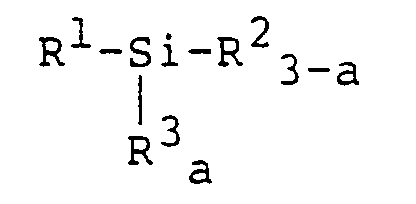
wherein R¹ is a C₁-C₁₀ alkyl group having at least one functional group selected from the group consisting of a chlorine atom, an amino group, an aminoalkyl group, a ureido group, a glycidoxy group, an epoxycyclohexyl group, an acryloyloxy group, a methacryloyloxy group, a mercapto group and a vinyl group, or a vinyl group; R² and R³ are independently an atom or a group selected from the group consisting of a chlorine atom, a hydroxyl group, a C₁-C₁₀ alkoxyl group, a C₂-C₁₅ alkoxyl-substituted alkoxyl group, a C₂-C₄ hydroxyalkyloxy group and a C₂-C₁₅ acyloxy group; and a is 0, 1 or 2.
wherein R¹ is a C₁-C₁₀ alkyl group having at least one functional group selected from the group consisting of a chlorine atom, an amino group, an aminoalkyl group, a ureido group, a glycidoxy group, an epoxycyclohexyl group, an acryloyloxy group, a methacryloyloxy group, a mercapto group and a vinyl group, or a vinyl group; R² and R³ are independently an atom or a group selected from the group consisting of a chlorine atom, a hydroxyl group, a C₁-C₁₀ alkoxyl group, a C₂-C₁₅ alkoxyl-substituted alkoxyl group, a C₂-C₄ hydroxyalkyloxy group and a C₂-C₁₅ acyloxy group; and a is 0, 1 or 2.
7. The fluororubber coating composition according to claim 1, wherein said carboxylic
acid is a carboxylic acid having 1 to 8 carbon atoms.
8. The fluororubber coating composition according to claim 7, wherein said carboxylic
acid is at least one selected from the group consisting of HCOOH, CH₃COOH, C₂H₅-COOH
and C₇H₁₃COOH.
9. The fluororubber coating composition according to claim 8, wherein said carboxylic
acid is formic acid.
10. The fluororubber coating composition according to claim 1, wherein a concentration
of said fluororubber is from 10 to 50 % by weight based on the weight of the whole
composition.
11. The fluororubber coating composition according to claim 1, wherein an amount of said
coupling agent is from 1 to 50 parts by weight per 100 parts by weight of said fluororubber.