|
(11) | EP 0 557 105 A1 |

| (12) | EUROPEAN PATENT APPLICATION |
|
|
|
|
|||||||||||||||||||||||||||
| (54) | Refrigerator oil composition for fluoroalkane refrigerant |
| (57) A refrigerator oil composition, which is composed of a synthetic ester oil as a base
oil and is suited for use in a compression-type refrigerator employing a fluoroalkane
as a refrigerant, comprises, based on the total weight of the composition, 0.001-1.0
wt.% of a secondary phosphite ester represented by the following formula (1):
wherein R¹ and R² may be the same or different and individually represent a C₁₋₂₀ hydrocarbon or oxygen-containing hydrocarbon group. |
[0001] The present invention relates to refrigerator oil compositions, and specifically to refrigerator oil compositions which have excellent lubricating property and high hydrolytic stability and are suitable for use in compression refrigerators operated using a fluoroalkane refrigerant.
[0002] Refrigerator oils composed of a base oil such as a mineral oil, alkyl benzene, polyglycol, ester or a mixture thereof and optionally added with an extreme pressure additive have heretofore been used widely in compression refrigerators which employ CFC-11, CFC-12, CFC-115, HCFC-22 or the like as a chlorine-containing refrigerant.
[0003] Among these refrigerants, CFC types including CFC-11, CFC-12 and CFC-115 are subjected to control as they are considered to lead to destruction of the ozone layer. There is also a move toward controlling hydrogen-containing halogenated hydrocarbon refrigerants such as HCFC-22 because they are considered to cause destruction of the ozone layer and global warming.
[0004] Fluoroalkane refrigerants, particularly HFC-32, HFC-125, HFC-134a and HFC-152a are similar in thermodynamic properties to CFC-12 and HCFC-22 so that they are under investigation or are being used as substitutes for Cl-containing refrigerants.
[0005] A refrigerator lubricating oil is required to satisfy a variety of properties. Of these, lubricating property is extremely important from the viewpoint of the reliability of a refrigerator system.
[0006] As lubricating oils for refrigerators cooled using a Cl-containing refrigerant such as CFC-12 or HCFC-22, there have been known lubricating oils containing, in addition to a base oil such as a mineral oil, alkylbenzene or a mixture thereof, a phosphate ester and/or a tertiary phosphite ester (Japanese Patent Laid-Open No. 91502/1979), trioleyl phosphate (Japanese Patent Laid-Open No. 86506/1976), a tertiary phosphite ester (Japanese Patent Laid-Open No. 139608/1979), tricresyl phosphate and/or triphenyl phosphite (Japanese Laid-Open No. 27372/1980), a phosphate ester and a hydrogen phosphite ester (Japanese Patent Laid-Open No. 92799/1980), an organomolybdenum compound and an acid phosphate ester (Japanese Patent Laid-Open No. 75995/1984) or a thiophosphate (Japanese Patent Laid-Open No.293286/1986).
[0007] Chlorine atoms which are contained in a large amount in the system and bonded to refrigerant molecules act as an extreme pressure additive, as have already been reported by Honma et al. in the Preprint D.9 (1989) of the 34-th National Meeting of Japan Society of Lubrication Engineers, when such conventional lubricating oils are employed in combination with a Cl-containing refrigerant such as CFC-11, CFC-12, CFC-115 or HCFC-22. Their function as extreme pressure additives are not particularly important. The addition of a phosphate ester, tertiary phosphite ester, acid phosphate ester or hydrogen phosphite ester alone has heretofore been sufficient. However, two or three extreme pressure additives have ordinarily been used in combination for convenience.
[0008] Fluoroalkane refrigerants containing no chlorine atom or atoms in their molecules, such as HFC-32, HFC-125, HFC-134a and HFC-152a, however, have no effects as an extreme pressure additive by themselves so that the addition of an extreme pressure additive is indispensable for a lubricating oil employed in a compression refrigerators using a fluoroalkane as a refrigerant.
[0009] It is, on the other hand, important for a refrigerator oil to have good miscibility with a refrigerant. Refrigerator oils for a fluoroalkane refrigerant employ a base oil having strong polarity such as an ester oil, carbonate ester oil or polyglycol oil in view of their miscibility with the refrigerant. Particularly for a hermetic-type compressor which requires a lubricating oil having high electrical insulating property, a base oil having strong polarity, such as an ester oil or carbonate oil is employed. In this case, however, strong polarity of the ester oil significantly deteriorates physical and chemical adsorption of an extreme pressure additive on a sliding metal surface, thereby lowering the effects of the extreme pressure additive so added.
[0010] In addition, an ester oil tends to have a large water-in-oil content because of its high polarity and hygroscopicity. When a hydrolyzable phosphate-ester type extreme pressure additive is added in a large amount to the ester oil, ferrous and/or ferric phosphates are formed as a result of a reaction between phosphoric acid, formed by the hydrolysis of the extreme pressure agent, and iron present in the refrigerator system. The ferrous and/or ferric phosphates so formed may cause troubles on the refrigerator, because they become sludge and may clog an expansion valve and/or capillary tubing.
[0011] As disclosed in Japanese Patent Laid-Open Nos. 91502/1979, 86506/1976, 139608/1979 and 92799/1980 and USP 4,755,316, use of a normal phosphate ester such as tricresyl phosphate or a tertiary phosphite ester as an extreme pressure additive in combination with a fluoroalkane refrigerant requires addition of a relatively large amount of the extreme pressure additive to a base oil because, otherwise, no sufficient extreme pressure effects can be obtained. This, however, leads to formation of sludge in a large amount, tending to cause the trouble referred to above.
[0012] Further, as disclosed in Japanese Patent Laid-Open No. 102296/1990, dioleyl hydrogenphosphite, a secondary phosphite ester, may be added to polyoxyalkylene glycol oil in some instances. Polyoxyalkylene glycol oil having low electrical insulating property is, however, not suited for hermetic-type compressors employed in refrigerators or the like. There is hence a demand for the development of a refrigerator oil composition having good electrical insulating property.
[0013] The present inventors have proceeded with an extensive investigation on lubricating property and stability when a fluoroalkane is used as a refrigerant and an ester oil or the like is used as a refrigerator oil. As a result, it has been found that an abrasion-resistant and practically-usable refrigerator oil composition can be obtained by using as an extreme pressure additive a secondary phosphite ester, leading to the completion of the present invention.
[0014] An object of the present invention is to overcome the drawback of a refrigerator oil composed of an ester oil, neo-acid ester oil or carbonate ester oil, namely, its poor lubricating property and to provide a refrigerator oil composition which has excellent abrasion resistance and high hydrolytic stability and is useful in a refrigerant-compression type refrigerator employing a fluoroalkane as a refrigerant.
[0015] The present invention therefore provides a refrigerator oil composition containing a base oil and suited for use in a compression-type refrigerator employing a fluoroalkane as a refrigerant, said base oil comprising at least a synthetic ester oil, which comprises, based on the total weight of the composition:
0.001-1.0 wt.% of a secondary phosphite ester represented by the following formula (1):
wherein R¹ and R² may be the same or different and individually represent a C₁₋₂₀ hydrocarbon or oxygen-containing hydrocarbon group.
[0016] The base oil contained in the refrigerator oil composition according to the present invention is a synthetic ester oil itself or contains a synthetic ester oil as a component. Any synthetic ester oil is usable as long as it can be employed as a base oil in a compressor of a refrigerator. Specific examples of the synthetic ester oil include dibasic acid esters, polyol esters, complex esters and polyol carbonate esters.
[0017] Exemplary dibasic acid esters include esters of C₅₋₁₀ dibasic acids, such as glutaric acid, adipic acid, pimelic acid, suberic acid, azelaic acid and sebacic acid, and linear- or branched-alkyl-containing C₁₋₁₅ monohydric alcohols such as methanol, ethanol, propanol, butanol, pentanol, hexanol, heptanol, octanol, nonanol, decanol, undecanol, dodecanol, tridecanol, tetradecanol and pentadecanol. Specific examples include ditridecyl glutarate, di-2-ethylhexyl adipate, diisodecyl adipate, ditridecyl adipate and di-3-ethylhexyl sebacate.
[0018] As polyol esters, esters of diols or polyols containing 3-20 OH groups and C₆₋₂₀ fatty acids can be used preferably. Preferred diols are C₂₋₁₂ diols. Specific examples of C₂₋₁₂ diols include ethylene glycol, 1,3-propanediol, propylene glycol, 1,4-butanediol, 1,2-butanediol, 2-methyl-1,3-propanediol, 1,5-pentanediol, neopentyl glycol, 1,6-hexanediol, 2-ethyl-2-methyl-1,3-propanediol, 1,7-heptanediol, 2-methyl-2-propyl-1,3-propanediol, 2,2-diethyl-1,3-propanediol, 1,8-octanediol, 1,9-nonanediol, 1,10-decanediol, 1,11-undecanediol and 1,12-dodecanediol. As polyols, on the other hand, C₃₋₆₀ polyols are preferred. Specific examples include polyhydric alcohols such as trimethylolethane, trimethylolpropane, trimethylolbutane, di(trimethylolpropane), tri-(trimethylolpropane), pentaerythritol, di-(pentaerythritol), tri-(pentaerythritol), glycerin, polyglycerins (dimer to eicosamer of glycerin), 1,3,5-pentanetriol, sorbitol, sorbitane, sorbitol-glycerin condensates, adonitol, arabitol, xylitol and mannitol; saccharides such as xylose, arabinose, ribose, rhamnose, glucose, fructose, galactose, mannose, sorbose, cellobiose, maltose, isomaltose, trehalose, sucrose, raffinose, gentianose and melezitose; partially-etherified products thereof; and methyl glycoside (glycoside).
[0019] Illustrative fatty acids include linear or branched fatty acids such as hexanoic acid, heptanoic acid, octanoic acid, nonanoic acid, decanoic acid, undecanoic acid, dodecanoic acid, tridecanoic acid, tetradecanoic acid, pentadecanoic acid, hexadecanoic acid, heptadecanoic acid, octadecanoic acid, nonadecanoic acid, eicosanoic acid and oleic acid; and so-called neo-acids having a quaternary α-carbon atom. These polyol esters may contain one or more free hydroxyl groups. Particularly preferred examples of polyol esters include esters of hindered alcohols such as neopentyl glycol, trimethylolethane, trimethylolpropane, trimethylolbutane, di-(trimethylolpropane), tri-(trimethylolpropane), pentaerythritol, di-(pentaerythritol) or tri-(pentaerythritol). Specific examples include trimethylolpropane caprylate, trimethylolpropane pelargonate, pentaerythritol 2-ethylhexanoate and pentaerythritol pelargonate.
[0020] The term "complex ester" as used herein means a mixture of esters of a monohydric alcohol and polyol with a fatty acid and a dibasic acid. No particular limitation is imposed on their mixing ratio. As the fatty acid, dibasic acid, monohydric alcohol and polyol, those exemplified above with respect to the dibasic acid ester and polyol ester can be used.
[0021] The polyol carbonate ester is an ester of a carbonic acid and a polyol. As illustrative polyols, those exemplified above with respect to the polyol ester, polyglycols obtained by homo- or co-polymerization of diols as well as those obtained by adding a polyglycol to the polyols exemplified above can be used.
[0022] The synthetic ester oils described above can be used either singly or in combination. The kinematic viscosity of the synthetic ester oil in the present invention is 2-150 cSt, preferably 4-100 cSt, at 100°C.
[0023] In the composition according to the present invention, the above synthetic ester oils, i.e., the oxygen-containing compounds can be used singly. Alternatively, a mineral oil, a synthetic oil or the like, which is employed in refrigerator oils for chlorine-containing refrigerants such as CFC-12 and HCFC-22, can also be used in combination. As mineral oils, paraffin mineral oils, naphthene mineral oils and the like can be used. They are obtained by subjecting a lubricating oil fraction, which has been obtained by atmospheric distillation and vacuum distillation of a crude oil, to a suitable combination of refining treatment steps such as solvent deasphalting, solvent extraction, hydrogenolysis, solvent dewaxing, catalytic dewaxing, hydrorefining, sulfuric acid treatment and clay treatment. As synthetic oils, known poly-α-olefins such as polybutene, 1-octene oligomer and 1-decene oligomer; alkylbenzenes, alkylnaphthalenes, polyglycols and mixtures of at least two of them are usable. In this case, it is desirable that the synthetic ester oil is contained in an amount of at least 50 wt.%, preferably at least 70 wt.%, based on the total amount of the base oil. The preferred dynamic viscosity of the base oil ranges from 2.0 cSt to 100 cSt at 100°C.
[0024] The composition according to the present invention comprises the base oil described above and, based on the total amount of the composition, 0.001-1.0 wt.%, preferably 0.005-0.5 wt.% of a secondary phosphite ester represented by the following formula (1):
wherein R¹ and R² may be the same or different and individually represent a C₁₋₂₀ hydrocarbon or oxygen-containing hydrocarbon group.
[0025] If the content of the secondary phosphite ester is smaller than the above range, the resultant lubricating oil will be less effective for the improvement of abrasion resistance. Even if the content exceeds the above range, on the other hand, the resultant lubricating oil will not show improving effects in proportion to the increase in the content. Furthermore, the secondary phosphite ester reacts with water existing in a dissolved form in the synthetic ester oil, thereby forming phosphoric acid. It is then converted to ferrous and/or ferric phosphates, thereby forming sludge. The sludge in turn causes clogging of capillary tubing or the like of the refrigerator. Contents outside the above range, therefore, are not preferred.
[0026] R¹ and R² in the formula (1) may be the same or different and individually represent a C₁₋₂₀, preferably C₃₋₁₈ hydrocarbon or oxygen-containing hydrocarbon group. Preferred examples of the hydrocarbon group include alkyl, phenyl, cresyl and xylyl. The term "oxygen-containing hydrocarbon group" as used herein means a hydrocarbon group in which at least one of the carbon atoms has been substituted by a corresponding number of oxygen atom(s). Preferred is the group represented by the formula -(AO)n-R³ wherein A represents a C₂₋₄ alkylene group, R³ represents a C₁₋₁₈ hydrocarbon group (preferably, an alkyl group) and n represents an integer of 1-20. Specific examples of the C₁₋₂₀ alkyl group include methyl, ethyl, n-propyl, iso-propyl, n-butyl, iso-butyl, sec-butyl, tert-butyl, n-pentyl, iso-pentyl, neo-pentyl, n-hexyl, iso-hexyl, n-heptyl, iso-heptyl, n-octyl, iso-octyl, n-nonyl, isononyl, n-decyl, iso-decyl, n-undecyl, iso-undecyl, n-dodecyl, iso-dodecyl, n-tridecyl, iso-tridecyl, n-tetradecyl, iso-tetradecyl, n-pentadecyl, iso-pentadecyl, n-hexadecyl, iso-hexadecyl, n-heptadecyl, isoheptadecyl, n-octadecyl, iso-octadecyl, n-nonadecyl, iso-nonadecyl, n-eicosyl and iso-eicosyl groups.
[0027] To improve the overall performance of the refrigerator oil composition of the present invention, the composition can be added with one or more of ordinarily-used additives, for example, scavengers for acid substances and/or active substances such as free radicals, e.g., phenyl glycidyl ether, butylphenylglycidyl ether, nonylphenyl glycidyl ether, polyalkyleneglycol glycidyl ether and epoxy compounds such as epoxylated vegetable oils; phenol-type and amine-type antioxidants; oiliness improvers such as higher alcohols and higher fatty acids; metal deactivators such as benzotriazole. These additives can be added in proportions generally employed.
[0028] Specific examples of the refrigerant usable in combination with the refrigerator oil composition of the present invention include fluoroalkane refrigerants such as difluoromethane (HFC-32), trifluoromethane (HFC-23), pentafluoroethane (HFC-125), 1,1,2,2-tetrafluoroethane (HFC-134), 1,1,1,2-tetrafluoroethane (HFC-134a) and 1,1-difluoroethane (HFC-152a).
[0029] The refrigerator oil compositions according to the invention can be widely used in apparatuses employing a hermetic refrigerant-compression type refrigerator, such as refrigerators, freezing chambers, automatic vending machines, display cases, room air conditioners and dehumidifiers and also in refrigerators of other types.
[0030] When a refrigerator oil composition according to the present invention is used in such a refrigerant-compression type refrigerator as exemplified above, it is ordinarily used in the form of a fluid composition containing the above refrigerant mixed therein. No particular limitation is imposed on their mixing ratio, however, it is desirable to use, in a mixed state, 1-500 parts by weight, preferably 2-400 parts by weight of the refrigerator oil composition per 100 parts by weight of the refrigerant.
[0031] A refrigerator oil composition according to the present invention has excellent abrasion resistance and tends to form less sludge so that it can be used as a preferred refrigerator oil for a fluoroalkane refrigerant containing as a base oil a synthetic ester oil.
[0032] The present invention will next be described in detail by the following examples and comparative examples. It should however be borne in mind that this invention is by no means limited to or by the examples. Examples 1-9.
[0033] In order to evaluate the performance of refrigerator oil compositions of the present invention, their lubricating property was evaluated using a high-pressure atmosphere friction tester which was reported under B-S7 at the Tribology Conference held by Japan Society of Lubrication Engineers in the spring of 1991 in Tokyo. Hydrolytic stability was also evaluated at the same time. The results are shown in Table 1.
[0034] For comparison, evaluation results of comparative products with which one or more extreme pressure additives had been blended in a conventional manner are also presented in Table 1.
[0035] Incidentally, the base oils employed in the Examples and Comparative Examples and their properties are shown in Table 2.
[Wear Test]
[0036] A sample refrigerator oil composition (420 g) and 150 g of 1,1,1,2-tetrafluoroethane (HFC-134a) were weighed in a high-pressure metal vessel. In a state dipped in the resulting mixture which had been heated to 80°C, a disc-shaped stationary test piece (made of SCM3 cast iron) was placed on a loading arbor installed on an inner bottom of the vessel. Three vanes (made of S-55C cast iron) of 1 mm wide were brought into contact with the test piece, whereby a wear test was conducted for 6 hours at 500 rpm under a load of 250 kgf. After the completion of the test, a wear loss of the disc-shaped test piece was determined in terms of weight.
[Hydrolysis Test]
[0037] A sample refrigerator oil composition (100 g) was weighed in a 200-mℓ glass test tube. Three iron sheets having a surface area of about 10 cm² were placed in the test tube as a deterioration accelerating catalyst. The test tube was placed in a stainless-steel autoclave and dissolved oxygen in the refrigerator oil composition was purged out in a vacuum. Purified water (0.1 g) was then added to the refrigerator oil composition. After the autoclave was hermetically sealed, the resulting mixture was heated at 150°C for 2 weeks. The sample oil thus treated was filtered through a membrane filter having a pore size of 0.4 µm. The filtrate was washed with hexane. The weight of a precipitate so collected was recorded as the weight (mg) of sludge formed per 100 g of the sample refrigerator oil composition.
[0038] As can be seen from Examples 1-9 in Table 1, even though the amount of the secondary phosphite ester added to the polyol tetraester, that is, a base oil, was small, the resulting refrigerator oil composition according to this invention showed excellent wear resistance in the refrigerant, namely, 1,1,1,2-tetrafluoroethane or difluoromethane compared with the composition in Comparative Example 2 which contained tricresyl phosphate, a conventional extreme pressure additive. Further, the former composition produced by far less sludge than the latter and thus, was superior in hydrolytic stability.
[0039] In addition, compared with the refrigerator oil compositions in Comparative Examples 3 and 4 which contained the known acid phosphate ester or tertiary phosphite ester as a conventional extreme pressure additive, the refrigerator oil compositions in Examples 1-9 each exhibited excellent wear resistance and also excellent hydrolytic stability, thereby forming less sludge.
1. A refrigerator oil composition containing a base oil and suited for use in a compression-type
refrigerator employing a fluoroalkane as a refrigerant, said base oil comprising at
least a synthetic ester oil, which comprises, based on the total weight of the composition:
0.001-1.0 wt.% of a secondary phosphite ester represented by the following formula (1):
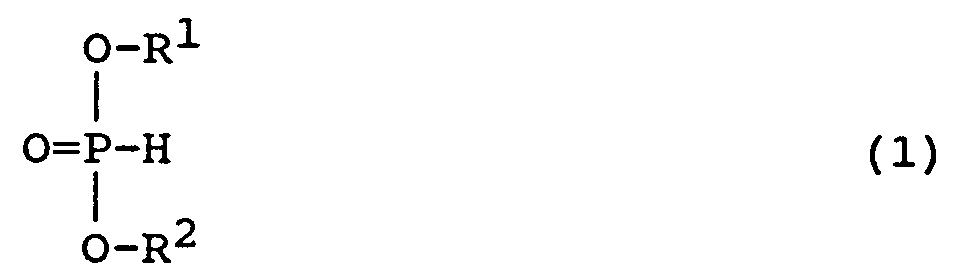
wherein R¹ and R² may be the same or different and individually represent a C₁₋₂₀ hydrocarbon or oxygen-containing hydrocarbon group.
0.001-1.0 wt.% of a secondary phosphite ester represented by the following formula (1):
wherein R¹ and R² may be the same or different and individually represent a C₁₋₂₀ hydrocarbon or oxygen-containing hydrocarbon group.
2. The composition of claim 1, wherein the synthetic ester oil amounts to 50-100 wt.%
of the whole base oil.
3. The composition of claim 2, wherein R¹ and R² may be the same or different and individually
represent a C₁₋₂₀ hydrocarbon group.
4. The composition of claim 2, wherein R¹ and R² may be the same or different and individually
represent an oxygen-containing C₁₋₂₀ hydrocarbon group.
5. A fluid composition for a refrigerator, which comprises 100 parts by weight of a fluoroalkane
refrigerant and 1-500 parts by weight of the refrigerator oil composition of claim
1.