|
(11) | EP 0 557 993 A1 |

| (12) | EUROPEAN PATENT APPLICATION |
|
|
|
|
|||||||||||||||||||||||||||
| (54) | Process for production of N-substituted carbazoles |
| (57) There is disclosed a process for the production of N-substituted carbazoles with
high efficiency, in which a carbazole compound is reacted with an appropriate halogenated
compound in an inert solvent in the presence of an acid-removing agent and an amine
without using any quaternary ammonium salt which is required in the conventional process. |
[0001] The present invention relates to a process for the production of N-substituted carbazoles with high efficiency.
[0002] As a conventional process of producing N-substituted carbazoles, there has been a process in which a carbazole compound is reacted with an alkyl halide in the presence of a quaternary ammonium salt such as benzyltriethylammonium chloride using 50% aqueous sodium hydroxide as an acid-removing agent (Bull. Chem. Soc. Jpn., 54, 1879 (1981)). This process, however, requires the use of a certain quaternary ammonium salt which is relatively expensive, and it can attain only a low yield, even if the alkyl halide used is relatively reactive, such as ethyl bromide, methyl iodide or allyl chloride; therefore, it cannot always be said that this process is suitable for the production on an industrial scale.
[0003] Under these circumstances, the present inventors have intensively studied to solve the problems of the conventional process as described above and to provide a process for the production of N-substituted carbazoles at a low cost with high yield. As the result, they have found that N-substituted carbazoles can be obtained with high yield by reacting a carbazole compound with an appropriate halogenated compound in the presence of an amine without using any quaternary ammonium salt, thereby completing the present invention.
[0004] That is, the present invention provides a process for the production of N-substituted carbazoles of the general formula:
wherein R₁ is a hydrogen atom, a C₁-C₆ alkyl group, a nitro group, a C₁-C₆ alkoxy group or a halogen atom, and R₂ is a C₁-C₆ alkyl group, a C₂-C₆ alkenyl group or a C₇-C₈ aralkyl group, comprising the step of reacting a carbazole compound of the general formula:
wherein R₁ is the same as defined above, with a halogenated compound of the general formula:
R₂-X (II)
wherein R₂ is the same as defined above and X is a halogen atom, in an inert solvent in the presence of an acid-removing agent and an amine of the general formula:
R₃R₄R₅N (III)
wherein R₃, R₄ and R₅ are the same or different and are a hydrogen atom, a C₁-C₆ alkyl group or a C₇-C₈ aralkyl group.
DETAILED DESCRIPTION OF THE INVENTION
[0005] According to the process of the present invention, N-substituted carbazoles (IV) can be obtained by reacting the carbazole compound (I) with the halogenated compound (II) in an inert solvent in the presence of a certain acid-removing agent and the amine (III).
[0006] The substituent R₁ of the carbazole compound (I) as the raw material used in the reaction is a hydrogen atom; a C₁-C₆ alkyl group such as a methyl group or an ethyl group; a C₁-C₆ alkoxy group such as a methoxy group or an ethoxy group; a nitro group or a halogen atom. Typical examples of the carbazole compound (I) are carbazole, 3-nitrocarbazole, 1-nitrocarbazole, 2-methoxycarbazole, 1-methylcarbazole, 3-methylcarbazole, 1-chlorocarbazole and 3-chlorocarbazole.
[0007] The substituent R₂ of the halogenated compound (II) is a C₁-C₆ alkyl group such as a methyl group, an ethyl group, a propyl group, an isopropyl group or a butyl group; a C₂-C₆ alkenyl group such as an allyl group or a 2-butenyl group; or a C₇-C₈ aralkyl group such as a benzyl group, a 1-phenethyl group or a 2-phenethyl group.
[0008] The substituent X of the halogenated compound (II) is a halogen atom such as a chlorine atom, a bromine atom or an iodine atom, with preferred being a chlorine atom.
[0009] The amount of halogenated compound to be used is usually in the range of from 1 to 10 moles, preferably from 1 to 5 moles, and more preferably from 1 to 2 moles, per mole of the carbazole compound as the raw material.
[0010] The substituents R₃, R₄ and R₅ of the amine (III) are the same or different and are a hydrogen atom; a C₁-C₆ alkyl group such as a methyl group, an ethyl group, a n-propyl group, an i-propyl group, a n-butyl group, an i-butyl group, a sec-butyl group, a t-butyl group, a n-pentyl group, an i-amyl group, a sec-amyl group, a t-amyl, neo-pentyl group, a n-hexyl group, a 1-methylpentyl group, a 2-methylpentyl group or a 3-methylpentyl group; or a C₇-C₈ aralkyl group such as a benzyl group, a 1-phenethyl group or a 2-phenethyl group.
[0011] Typical examples of the amine (III) are mono-(C₁-C₆)alkylamines such as methylamine, ethylamine, n-propylamine, i-propylamine and n-butylamine; di(C₁-C₆)-alkylamines such as dimethylamine, diethylamine, di-n-propylamine, di-i-propylamine and di-n-butylamine; and tri(C₁-C₆)alkylamines such as trimethylamine, N-methyldiethylamine, N,N-dimethylethylamine, triethylamine, tri-n-propylamine, tri-n-butylamine, N-ethyldiisopropylamine and N,N-diethylbutylamine. Besides these amines, any other amine can also be used, such as N,N-dimethylbenzylamine, N,N-diethylbenzylamine, 1-phenethylamine or 2-phenethylamine. Among these amines, preferred are n-butylamine, diethylamine, di-n-butylamine, triethylamine, tri-n-butylamine N,N-diethylbenzylamine and N,N-dimethylbenzylamine.
[0012] The amount of amine to be used is usually in the range of from 0.1% to 30% by mole, preferably from 1% to 20% by mole, based on the mole of the carbazole compound as the raw material.
[0013] As the acid-removing agent, inorganic bases can usually be used. Typical examples of the acid-removing agent are hydroxides of alkali metals, such as sodium hydroxide, potassium hydroxide and lithium hydroxide; hydroxides of alkaline earth metals, such as barium hydroxide and calcium hydroxide; carbonates of alkali metals, such as sodium carbonate and potassium carbonate; and hydrogencarbonates of alkali metals, such as sodium hydrogencarbonate and potassium hydrogencarbonate. Among these inorganic bases, preferred are hydroxides of alkali metals with particularly preferred being sodium hydroxide and potassium hydroxide. These acid-removing agents may be used solely or in admixture with each other. Although these acid-removing agents can be used as they are in solid state, they are preferably used in the form of an aqueous solution.
[0014] The amount of acid-removing agent to be used is usually in the range of from 1 to 5 moles, preferably from 1 to 3 moles, per mole of the carbazole compound as the raw material.
[0015] The solvent to be used in the above reaction is not particularly limited, so long as it is an inert solvent. Preferred examples of the solvent are aromatic hydrocarbons such as benzene, toluene and xylene; halogenated aromatic hydrocarbons such as monochlorobenzene, dichlorobenzene and trichlorobenzene; and aromatic nitro compounds such as nitrobenzene. Particularly preferred are halogenated aromatic hydrocarbons.
[0016] The solvent is usually used at a 0.5- to 20-fold weight, preferably 1- to 5-fold weight, based on the weight of the carbazole compound as the raw material.
[0017] The above reaction is usually carried out at a temperature of from room temperature to 200°C, preferably from 30° to 150°C, under normal pressure or under pressure up to about 20 kg/cm².
[0018] After completion of the reaction, for example, the cooled reaction mass is transferred into a separatory funnel. The reactor is washed with the reaction solvent and water. The washings are combined with the reaction mass, and the separated organic layer is washed with a mineral acid solution to neutralize base traces. The obtained N-substituted carbazole solution may be transferred to the subsequent step or concentrated to give the product.
[0019] Thus, N-substituted carbazoles (IV) can be obtained, such as N-methylcarbazole, N-ethylcarbazole, N-propylcarbazole, N-butylcarbazole, N-allylcarbazole and N-benzylcarbazole.
[0020] According to the present invention, N-substituted carbazoles (IV) can be produced at a low cost with high yield.
[0021] The present invention will be further illustrated by way of the following examples which are not to be construed to limit the scope thereof.
Example 1
[0022] A 0.5-liter autoclave equipped with a stirrer was charged with carbazole (82.0 g), o-dichlorobenzene (100 g), ethyl chloride (40.2 g), 48% sodium hydroxide (73.9 g) and triethylamine (5 g). After the atmosphere in the autoclave was replaced with nitrogen gas, the autoclave was heated to the reaction temperature of 100°C and the reaction mixture was stirred at the same temperature for 9 hours, while keeping the temperature. After completion of the reaction, the mixture was cooled to 50°C, and was transferred into a separatory funnel. The autoclave was washed with o-dichlorobenzene and water. The washings were combined with the reaction mass, and the combined mixture was separated. The separated organic layer was washed with a 25% sulfuric acid solution to neutralize base traces, and the water layer was removed by separation to give 273.0 g of an o-dichlorobenzene solution of N-ethylcarbazole. The analysis of this solution by chromatography revealed that the content of N-ethylcarbazole was 34.9% and the yield thereof was 99.6%.
Example 2
[0023] A 0.5-liter autoclave equipped with a stirrer was charged with carbazole (82.4 g), o-dichlorobenzene (100 g), ethyl chloride (40.2 g), 48% sodium hydroxide (55.8 g) and tributylamine (9.2 g). After the atmosphere in the autoclave was replaced with nitrogen gas, the autoclave was heated to the reaction temperature of 100°C and the reaction mixture was stirred at the same temperature for 9 hours, while keeping the temperature. After completion of the reaction, the mixture was cooled to 50°C. The same procedures as those described in Example 1 gave 275.9 g of an o-dichlorobenzene solution of N-ethylcarbazole. The analysis of this solution by chromatography revealed that the content of N-ethylcarbazole was 32.9% and the yield thereof was 94.3%.
Example 3
[0024] N-ethylcarbazole was obtained by the same reaction under the same conditions as described in Example 2, except that n-butylamine was used in place of tributylamine, and ethyl chloride and sodium hydroxide were used at an amount of 1.5 moles and 2.0 moles, respectively, per mole of carbazole. The conversion of carbazole was 93.1% and the yield of N-ethylcarbazole was 90.9%.
Example 4
[0025] N-ethylcarbazole was obtained by the same reaction under the same conditions as described in Example 2, except that diethylamine was used in place of tributylamine, and ethyl chloride and sodium hydroxide were used at an amount of 1.4 moles and 1.9 moles, respectively, per mole of carbazole. The conversion of carbazole was 98.1% and the yield of N-ethylcarbazole was 99.0%.
Example 5
[0026] N-ethylcarbazole was obtained by the same reaction under the same conditions as described in Example 2, except that N,N-dimethylbenzylamine was used in place of tributylamine, and ethyl chloride and sodium hydroxide were used at an amount of 1.3 moles and 1.8 moles, respectively, per mole of carbazole. The conversion of carbazole was 100.0% and the yield of N-ethylcarbazole was 96.2%.
Examples 6-8
[0027] Various N-substituted carbazoles such as N-ethyl-2-methylcarbazole (Example 6), N-ethyl-1-methoxycarbazole (Example 7) and N-ethyl-3-chlorocarbazole (Example 8) were obtained by the same reaction under the same conditions as described in Example 1, except that 2-methylcarbazole, 1-methoxycarbazole and 3-chlorocarbazole were used, respectively, in place of carbazole.
1. A process for the production of an N-substituted carbazole compound of the formula:
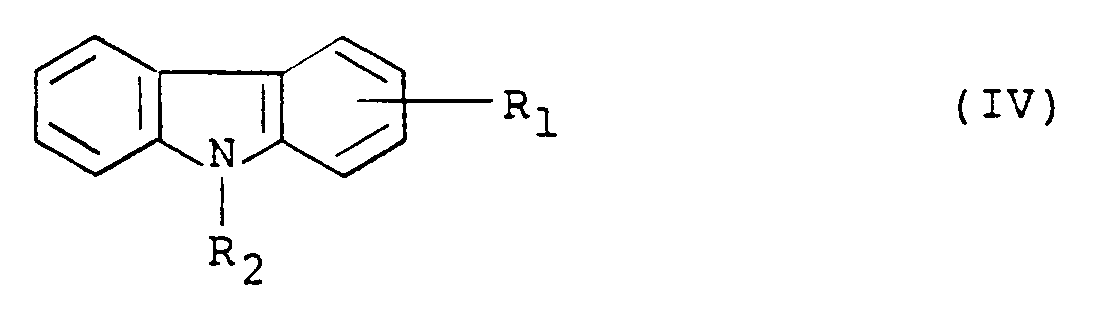
wherein R₁ is a hydrogen atom, a C₁-C₆ alkyl group, a nitro group, a C₁-C₆ alkoxy group or a halogen atom, and R₂ is a C₁-C₆ alkyl group, a C₂-C₆ alkenyl group or a C₇-C₈ aralkyl group, comprising the step of reacting a carbazole compound of the formula:
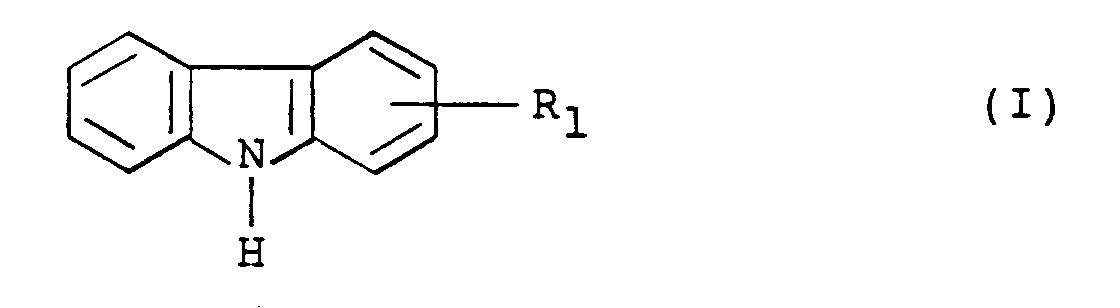
wherein R₁ is the same as defined above, with a halogenated compound of the formula:
R₂-X (II)
wherein R₂ is the same as defined above and X is a halogen atom, in an inert solvent in the presence of an acid-removing agent and an amine of the formula:
R₃R₄R₅N (III)
wherein R₃, R₄ and R₅ are the same or different and are a hydrogen atom, a C₁-C₆ alkyl group or a C₇-C₈ aralkyl group.
wherein R₁ is a hydrogen atom, a C₁-C₆ alkyl group, a nitro group, a C₁-C₆ alkoxy group or a halogen atom, and R₂ is a C₁-C₆ alkyl group, a C₂-C₆ alkenyl group or a C₇-C₈ aralkyl group, comprising the step of reacting a carbazole compound of the formula:
wherein R₁ is the same as defined above, with a halogenated compound of the formula:
R₂-X (II)
wherein R₂ is the same as defined above and X is a halogen atom, in an inert solvent in the presence of an acid-removing agent and an amine of the formula:
R₃R₄R₅N (III)
wherein R₃, R₄ and R₅ are the same or different and are a hydrogen atom, a C₁-C₆ alkyl group or a C₇-C₈ aralkyl group.
2. A process according to claim 1, wherein at least one of the R₃, R₄ and R₅ is a C₁-C₆
alkyl group.
3. A process according to claim 2, wherein all of the R₃, R₄ and R₅ are ethyl groups.
4. A process according to claim 1, wherein at least one of the R₃, R₄ and R₅ is a benzyl
group.
5. A process according to claim 4, wherein one of the R₃, R₄ and R₅ is a benzyl group
and the other two are methyl groups.
6. A process according to claim 4, wherein one of the R₃, R₄ and R₅ is a benzyl group
and the other two are ethyl groups.
7. A process according to claim 1, wherein the inert solvent is an aromatic hydrocarbon
optionally substituted with at least one halogen atom.
8. A process according to claim 1, wherein the acid-removing agent is a hydroxide of
alkali metals.
9. A process according to claim 2, wherein all of the R₃, R₄ and R₅ are butyl groups.
10. A process according to claim 2, wherein the R₃ is a hydrogen atom and the other two
are butyl groups.
11. A process according to claim 2, wherein the R₃ is a hydrogen atom and the other two
are ethyl groups.
12. A process according to claim 2, wherein the R₃ is a butyl group and the other two
are hydrogen atoms.