| (84) |
Designated Contracting States: |
|
AT BE CH DE DK FR GB IT LI NL SE |
| (30) |
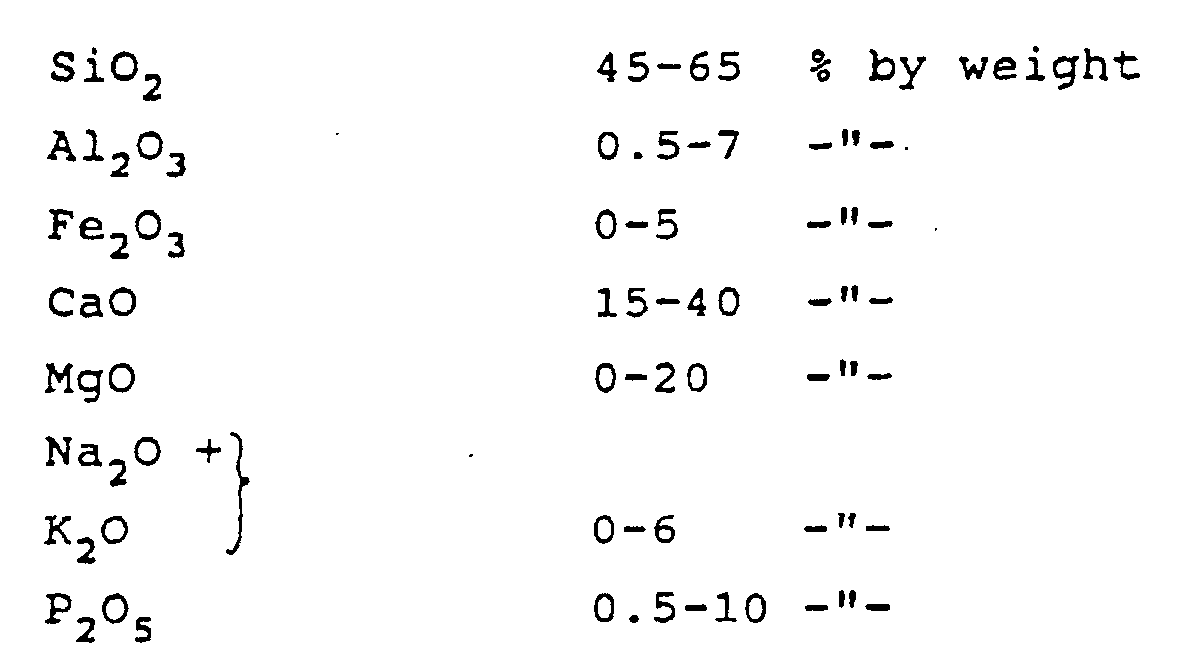
Priority: |
23.11.1990 FI 905797
|
| (43) |
Date of publication of application: |
|
08.09.1993 Bulletin 1993/36 |
| (73) |
Proprietor: Paroc Group Oy Ab |
|
01300 Vantaa (FI) |
|
| (72) |
Inventors: |
|
- KARPPINEN, Kirsti, Marjatta
SF-20350 Abo (FI)
- PERANDER, Michael, Stig, Folke
SF-21600 Pargas (FI)
- SOLIN, Peter, Arnold, Henrik
SF-20760 Piispanristi (FI)
- PEHKONEN, Antero, Olavi
SF-02940 Esbo (FI)
- MAINE, Seija, Marketta
SF-21600 Pargas (FI)
|
| (74) |
Representative: Woods, Geoffrey Corlett et al |
|
J.A. KEMP & CO.
Gray's Inn
14 South Square
London WC1R 5JJ
London WC1R 5JJ (GB) |
| (56) |
References cited: :
EP-A- 0 009 418
EP-A- 0 459 897
WO-A-89/05007
GB-A- 520 247
US-A- 4 482 541
US-A- 5 055 428
|
EP-A- 0 412 878
WO-A-87/05007
WO-A-89/12032
SU-A- 541 808
US-A- 4 678 659
|
|
| |
|
|
- Uhlman, Bd. 11, pages 359-365
- Anderson, Glastechnik, Ber. 61, 10, 300-305
- Hensch, Biomterials, 1982, Academic Press, pages 69-71, 134-148
- Mitra, Indian Ceramics, July 1968, pages 97-102
- McVay, Material Research Society Symposia Proceedings, Vol. 26,1984, pages 755-761
- Ohta et al. Ceramic Bulletin, vol. 57, no. 6, 1978, pages 602-604
- The Constitution of Glass, Weyl&Marboc, Vol.II, part 1, pages 567-571
- "Erfahrungsaustausch" aus "Silikattechnik", 10, (1959), Nr. 2, pages 88-90
- Hench, Biomaterials, 1982, Academic Press, pages 69-71
|
|
| |
|
[0001] The present invention relates to a mineral fibre composition which is soluble in
biological fluids.
[0002] Mineral fibres made by melting and spinning of mineral raw materials, such as rock,
slag and the like, are to a great extent used for the manufacture of mineral fibre
mats and blankets, primarily for heat and sound insulation purposes within the construction
industry. In addition to the formed mat exhibiting good insulation characteristics
with respect to heat and sound, increasingly more importance has been recently attached
to the characteristics of the mat from the viewpoint of health, primarily of industrial
hygiene. This has lead to attention being directed increasingly more to developing
fibres which are soluble in biological fluids in order to ensure that fibre particles,
which are not transported out of the body, dissolve in the body fluid.
[0003] Thus e.g. the patent application WO 89/12032 describes a fibre composition which
exhibits an increased solubility in physiological saline solutions. According to the
specification, the components in the said compositions may vary within wide limits,
but according to the specification, an increase in the amount of amphoteric oxides,
i.a. of aluminium, zirconium and titanium, tends to increase the stability of the
compositions against extraction. Even though the application does not at all discuss
the effects of the presence of phosphorus, there is included an example of a composition
containing a little over 6 % by weight of P
2O
5, in combination with a low content of Al
2O
3. This composition exhibits a fairly good solubility, primarily due to the small amount
of Al
2O
3 present.
[0004] According to the invention it has now been discovered that compositions which contain
aluminium and/or iron oxides, as well as phosphorus oxide, and wherein the weight
ratio of phosphorus to the sum of aluminium and iron, all calculated as their oxides,
lies within a fairly narrow range, surprisingly exhibit very favourable solubility
characteristics in physiological saline solutions.
[0005] The object of the present invention is thus a mineral fibre composition which is
soluble in biological fluids and which is characterized in that it contains substantially
| 45-65 % |
by weight of SiO2 |
| 0.5-7% |
by weight of Al2O3 |
| 0-5% |
by weight of Fe2O3 |
| 15-40 % |
by weight of CaO |
| 0-20 % |
by weight of MgO |
| 0-6 % |
by weight of Na2O + K2O |
| 0.5-10% |
by weight of P2O5 |
the total amount of Al
2O
3 and iron oxide being 0.5 to 7% by weight, the weight ratio of P
2O
5 to the sum of Al
2O
3 and iron oxide is 0.5 to 6.
[0006] The said weight ratio is preferably 0.5 to 2.
[0007] The invention thus makes it possible to utilize such common natural and economically
feasible raw materials which generally contain a certain amount of aluminium and iron,
which reduce the solubility and the presence of which consequently is not desirable
in the manufacture of a solube fibre. According to the invention the solubility of
fibres made from such materials is increased by adding phosphorus in a suitable amount.
This increases substantially the variation possibilities in the choice of raw materials
whereby also economically advantageous raw materials can come into use.
[0008] The upper limit of added phosphorus oxide, which does not exceed 10 % by weight of
the composition, depends naturally on the aluminium and iron content and also on the
fact that higher phosphorus oxide levels contribute to an undesired crystallization
of the fibre and difficulties in raw material supply. An increase of the phosphorus
oxide content also raises the melting temperature which leads to even poorer production
economics.
[0009] In order for mineral fibre to be bioactive or soluble in biological fluids, a layer
of calcium phosphate or apatite type material has to be formed on the surface of the
fibre. This outer layer is a result of migration of calcium and phosphate ions from
the glass matrix outwards to the surface directed towards the biological fluid, which
surface layer formation is further facilitated by the phosphate ions present in the
biological fluid.
[0010] This formed layer gradually then separates in the form of very small particles thus
exposing new fibre surface onto which new surface layers then can form. The glass
matrix gradually being leached, the fibre disintegrates and disappears.
[0011] The presence of trivalent aluminium and iron has a stabilizing effect on the leaching
of the glass matrix due to the fact that these metals tend to move to disrupted oxygen
bridges in the glass, where the detoriation and leaching reactions of the glass take
place. The phosphate ions, however, form complexes with these trivalent metal ions
and weaken the oxygen bridges between the Si- and Al- and Fe-atoms, respectively.
As a consequence of this, the network forming properties of these metals weaken in
turn, which facilitates the breaking down of the glass.
[0012] The present invention is consequently based on a joint effect between phosphate and
aluminium and trivalent iron, respectively, which cooperation in the mineral fibres
according to the invention increases the solubility of the fibre.
[0013] In the following, when iron oxide is expressed as Fe
2O
3, this expression is intended to cover all types of iron oxides Fe
xO
y present in the composition.
[0014] A fiberizable mineral fibre composition contains the following components at the
amounts indicated:
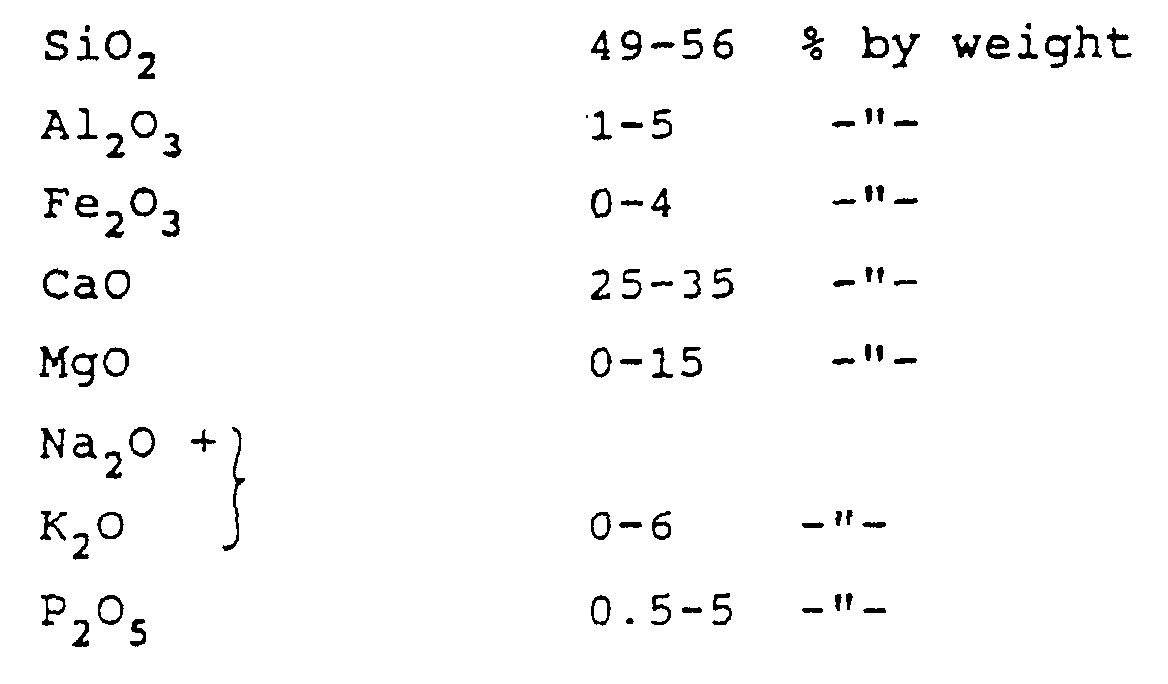
[0015] An especially advantageous composition has the following composition:
Solubility tests
1. Solubility in a Gamble solution
[0016] In order to test the solubility, mineral fibre compositions according to the invention
were compared with corresponding compositions which, however, contained no phosphate.
[0017] From quartz sand, calcium carbonate, Al-, Mg- and P-compounds a melt was prepared
which after solidification was crushed and pulverized. The chemical composition was
controlled, as was the particle size distribution. A specimen of 200 ml was rinsed
with a Gamble solution having a flow rate of 2 ml/h. The Gamble solution had the following
composition:
| MgCl2 * 6H2O |
0.16 g/l |
| NaCl |
6.11 g/l |
| KCl |
0.31 g/l |
| Na2HPO4 |
0.148 g/l |
| Na2SO4 |
0.079 g/l |
| CaCl2 * 2H2O |
0.06 g/l |
| NaCH3COO *3H2O |
1.065 g/l |
| NaHCO3 |
1.95 g/l |
[0018] The rate of dissolution was determined by measuring the concentrations of the main
components of the material in the Gamble solution after specific time intervals. An
atomic absorption spectrofotometer was used for the determinations.
| Composition (% by weight) |
| |
Ia |
Ib |
IIa |
IIb |
| SiO2 |
55.2 |
58.8 |
54.1 |
54.2 |
| Al2O3 |
1.2 |
1.2 |
4.2 |
4.4 |
| Fe2O3 |
0.1 |
0.05 |
0.05 |
0.0 |
| CaO |
29.3 |
30.2 |
27.7 |
30.2 |
| MgO |
10.2 |
9.7 |
9.7 |
10.4 |
| Na2O |
0.1 |
0.03 |
0.09 |
0.1 |
| K2O |
0.0 |
0.02 |
0.02 |
0.02 |
| P2O5 |
1.7 |
- |
3.9 |
- |
| Solubility (mg/l) (1 day) |
| |
Ia |
Ib |
IIa |
IIb |
| Si |
62.2 |
58.6 |
34.5 |
32.1 |
| Ca |
27.8 |
27.7 |
22.7 |
30.3 |
| Mg |
16.5 |
14.0 |
13.4 |
14.5 |
[0019] From the results it can be seen that the compositions Ia and IIa according to the
invention which contained phosphate, had a better silicon solubility than the corresponding
compositions Ib and IIb which were phosphate free. Magnesium and calcium solubilities
remained rather constant.
2. Solubility in cultur media with or without macrophages
[0020] In this test the dissolution of three mineral fibre compositions were tested on the
one hand in a commercial culture medium (RPMI 1640 Medium, Gibco Ltd, England) and
also in the same culture medium containing in addition macrophages. The latter medium
was prepared by suspending rat alveolar macrophages, the viability of which was over
95%, in a RPMI 1640 medium containing pencillin 100 IU/ml, streptomycin 100 µg/ml,
10 IU/ml heparin, 10% foetal calf serum and 2 mM L-glutamine, to a cell concentration
of 1x10
6 cells/ml. 2 ml of cell suspension was added to and incubated in each well of Costar
tissue culture clusters (Costar Europe Ltd, Holland), changing the medium to remove
non-adherent cells, and incubated overnight. Following incubation, the medium was
removed and fresh medium containing 200 µg/ml of mineral fibres were added to the
wells. In control wells, only RPMI 1640 Medium with 200 µg/ml of mineral fibre was
used. The clusters were incubated and the cells exposed to fibres for a predetermined
time.. The concentration of dissolved silicon from each of the samples was determined
from the culture medium using atomic absorption spectrofotometer.
| Fibre compositions (% by weight) |
| |
A |
B |
C |
| SiO2 |
54.7 |
50.4 |
59.0 |
| Al2O3 |
1.7 |
3.3 |
0.9 |
| Fe2O3 |
1.4 |
3.0 |
0.3 |
| CaO |
25.1 |
31.2 |
35.5 |
| MgO |
11.9 |
10.6 |
4.6 |
| Na2O |
0.3 |
0.6 |
0.1 |
| K2O |
0.1 |
0.4 |
0.1 |
| P2O5 |
5.2 |
- |
- |
[0021] Composition A is in accordance with the invention, compositions B and C otherwise
fulfill the conditions of the invention, except that they do not contain any phosphorus.
[0022] The diameter of the fibres used in the tests was less than 3 µm.
[0023] The following solubility results for silicon were obtained after 2 days, 4 days and
8 days respectively.
| Composition |
A |
B |
C |
| |
Si (ppm; 2 days) |
| Culture medium |
26 |
5 |
26 |
| -"- + macrophages |
26 |
5 |
14 |
| |
Si (ppm; 4 days) |
| Culture medium |
45 |
12 |
45 |
| -"- + macrophages |
45 |
8 |
35 |
| |
Si (ppm; 8 days) |
| Culture medium |
162 |
45 |
144 |
| -"- + macrophages |
153 |
37 |
82 |
[0024] From the results it is apparent that the solubility of the composition B, which has
a relatively high total content of aluminium and iron oxides, is very low. The composition
C, which has a very low total content of aluminium and iron oxides, has a high solubility
in culture medium, but a significantly lower solubility in a culture medium containing
macrophages.
[0025] Fibre A, however, which is according to the invention and which has a considerably
higher total aluminium and iron oxide content than the composition C, and which also
contains phosphorus, has the same high solubility as the composition C in plain culture
medium but, in addition, a correspondingly high solubility also in a culture medium
containing macrophages.
[0026] The results thus show that in the compositions according to the invention, phosphorus
has a solubility increasing effect which is especially pronounced in conditions resembling
the true biological conditions in the organism.
1. Une composition de fibre minérale qui est soluble dans des fluides biologiques,
caractérisée en ce qu'elle contient sensiblement:
| SiO2 |
45-65 % en poids |
| Al2O3 |
0,5-7 -"- |
| Fe2O3 |
0-5 -"- |
| CaO |
15-40 -"- |
| MgO |
0-20 -"- |
| Na2O + K2O |
0-6 -"- |
| P2O5 |
0,5-10 -"- |
la proportion totale de Al
2O
3 et d'oxyde de fer étant entre 0,5 et 7 % en poids, le taux en poids de P
2O
5 par rapport à la somme de Al
2O
3 et d'oxyde de fer étant compris entre 0,5 et 6.
2. Une composition de fibre minérale selon la revendication 1, caractérisée en ce que le taux en poids de P2O5 par rapport à la somme de Al2O3 et d'oxyde de fer est compris entre 0,5 et 2.
3. Une composition de fibre minérale selon la revendication 1,
caractérisée en ce qu'elle a sensiblement la composition suivante:
| SiO2 |
49-56 % en poids |
| Al2O3 |
1-5 -"- |
| Fe2O3 |
0-4 -"- |
| CaO |
25-35 -"- |
| MgO |
0-15 -"- |
| Na2O + K2O |
0-6 -"- |
| P2O5 |
0,5-5 -"- |
