|
(11) | EP 0 559 891 A1 |

| (12) | EUROPEAN PATENT APPLICATION |
| published in accordance with Art. 158(3) EPC |
|
|
|
|
||||||||||||||||||||||||
| (54) | THIENODIAZEPINE COMPOUND AND ITS USE |
| (57) A thienodiazepine compound represented by general formula (I), pharmaceutically acceptable
salt thereof, and pharmaceutical composition containing the same; wherein each symbol
is as defined in the text of specification. The compound is excellent in the inhibitory
action on cholecystokinin and gastrin and has a potent and persistent activity of
inhibiting secretion of pancreatic enzyme and hydrochloric acid in the stomach. Therefore
it is useful as a medicine acting on central and peripheral nerves and as a medicine
preventing or treating pancreatic disorder and gastrointestinal ulcer. Further it
is useful as an antidemential drug, because it is expected to develop an antidemential
action based on the cholecystokinin inhibitory action.
|
[Technical Field]
[0001] The present invention relates to novel thienodiazepine compounds having superior antagonistic action on cholecystokinin and gastrin, pharmaceutically acceptable salts thereof, and pharmaceutical use thereof.
[Background Art]
[0002] International Publication No. WO 89/05812 discloses a thienodiazepine compound having an antagonistic action on cholecystokinin and gastrin.
[0003] The cholecystokinin (also referred to as CCK) is a neuropeptide consisting of 33 amino acids, and CCK-8 which consists of 8 amino acids at the C terminus also reveals activity. The gastrin consists of 34 amino acids, and pentagastrin which consists of 5 amino acids at the C terminus also shows activity. The amino acid sequence of pentagastrin is identical with that at the C terminus of CCK. The both exist in gastrointestinal tissues and the central nervous system, and are concerned with the control of pancreatic enzyme secretion and gastric acid secretion.
[0004] Since the substances which exhibit an antagonistic action on these CCK and gastrin are effective in the prophylaxis and therapy of such diseases as pancreatic disorders and gastrointestinal ulcers, a number of such antagonistic substances have been studied so far. Also, it has recently been reported that the antagonistic action on CCK is related to an anti-dementia action.
[0005] As an antagonistic substance to CCK, benzotripto is known [Proc. Natl. Acad. Sci. U.S.A., vol. 78, p. 6304 (1981)], and proglumide is known as an antagonistic substance to gastrin [J. Med. Chem., vol. 27, p. 1597 (1984)]. Their actions are, however, relatively weak, and compounds having higher activities have been desired.
[0006] Besides, peptide antagonistic substances are not entirely satisfactory in that the durability of their actions is short and in that they are unstable and poorly absorbed.
[Disclosure of the Invention]
[0007] The present inventors have conducted intensive studies with the aim of solving the above-mentioned problems, and found that a certain kind of thienodiazepine compound achieves the purpose, which resulted in the completion of the invention.
[0008] That is, the present invention relates to thienodiazepine compounds of the formula
wherein R¹ and R² are the same or different and respectively stand for a hydrogen, a halogen, an alkyl or an aralkyl, or mean a group wherein R¹ and R² combinedly together form a ring; R³ stands for an oxygen, R⁴ stands for a hydrogen, an alkyl, an alkenyl or a group of the formula -(CH₂)mCOOR⁶ (wherein R⁶ stands for a hydrogen, an alkyl, an alkenyl or an aralkyl and m stands for an integer of 1-6), or R³ and R⁴ stand for a group wherein R³ and R⁴ combinedly together form a group of the formula =N-N=C(R⁵)- [wherein R⁵ stands for a hydrogen, an alkyl, an alkenyl, an aralkyl or a group of the formula -(CH₂)nCOOR⁷ (wherein R⁷ stands for a hydrogen, an alkyl, an alkenyl or an aralkyl and n stands for an integer of 1-6]; and Ar and X are the same or different and respectively stand for an aryl, an aralkyl or a heteroaryl, and pharmaceutically acceptable salts thereof.
[0009] The present invention also relates to pharmaceutical compositions containing the above-mentioned compound.
[0010] In the foregoing definition and the present specification, the halogen means chlorine, bromine, fluorine or iodine; the alkyl means an alkyl having 1 to 20 carbon atoms such as methyl, ethyl, propyl, isopropyl, butyl, isobutyl, tert-butyl, pentyl, isopentyl, tert-pentyl, hexyl, octyl, 2-ethylhexyl, 1,1,3,3-tetramethylbutyl, nonyl, decyl, dodecyl, tetradecyl, octadecyl or eicosyl; the alkenyl means an alkenyl having 2 to 8 carbon atoms such as vinyl, 1-propenyl, allyl, isopropenyl, 2-butenyl, 2-pentenyl, 3-hexenyl or 6-octenyl; the alkoxy means an alkoxy having 1 to 20 carbon atoms such as methoxy, ethoxy, propoxy, isopropoxy, butoxy, isobutoxy, tert-butoxy, pentyloxy, hexyloxy, octyloxy, decyloxy, dodecyloxy, octadecyloxy or eicosyloxy; the aralkyl means benzyl, 1-phenylethyl, 2-phenylethyl, 3-phenylpropyl, 4-phenylbutyl, 1-naphthylmethyl, 2-naphthylmethyl or diphenylmethyl which may have, on the aromatic ring, 1 to 3 substituents selected from among halogen, alkyl, alkoxy, trifluoromethyl, nitro, amino, cyano and hydroxyl group; the aryl means phenyl, 1-naphthyl, 2-naphthyl or the like which may have, on the aromatic ring, 1 to 3 substituents selected from among halogen, alkyl, alkoxy, trifluoromethyl, nitro, amino, cyano and hydroxyl group; the heteroaryl means pyridyl (2-pyridyl, 3-pyridyl, 4-pyridyl), quinolyl (2-quinolyl, 3-quinolyl), indolyl (2-indolyl, 3-indolyl), thienyl (2-thienyl, 3-thienyl), furyl (2-furyl, 3-furyl), benzofuranyl (2-benzofuranyl, 3-benzofuranyl), 1H-benzimidazol-2-yl, 2-benzothiazolyl or the like which may have, on the ring, 1 to 3 substituents selected from among halogen, alkyl, alkoxy, trifluoromethyl, nitro, amino, cyano and hydroxyl group; and the ring formed combinedly together by R¹ and R² means cyclopentene ring, cyclopentadiene ring, cyclohexene ring, cyclohexadiene ring, benzene ring, cycloheptene ring, cycloheptadiene ring, cycloheptatriene, or the like.
[0011] As the pharmaceutically acceptable salts of the compounds of the formula (I), exemplified are acid addition salts with inorganic acids or organic acids and salts with inorganic bases, organic bases or amino acids. From the purposes of the present invention, substantially nontoxic salts are preferable.
[0012] Since the compounds of the formula (I) have at least one chiral carbon atom, they can exist as a racemate, an optically active isomer or a diastereomer, all of which are encompassed in the present invention.
[0013] The compounds of the formula (I) of the present invention can be produced by condensing a compound of the formula
wherein each symbol is as defined above, with an isocyanate of the formula
X - NCO (III)
wherein X is as defined above.
[0014] The condensation of a compound of the formula (II) and a compound of the formula (III) is carried out in a suitable solvent which does not adversely affect the reaction. The solvent is exemplified by an organic solvent such as tetrahydrofuran, diethyl ether, diisopropyl ether, dioxane, dichloromethane, chloroform, ethyl acetate, benzene, toluene, xylene, dimethylformamide or dimethylacetamide.
[0015] While the temperature of the condensation varies depending on the reagent and solvent to be used, it is preferably between -20°C and the boiling point of the solvent used.
[0016] The compounds of the formula (I) wherein R³ and R⁴ combinedly form a group of the formula =N-N=C(R⁵)- can be produced by reacting a compound (I) wherein R³ is an oxygen and R⁴ is a hydrogen which is represented by the formula
wherein each symbol is as defined above, with a thionation reagent to obtain a compound of the formula
wherein each symbol is as defined above, followed by the reaction of this compound of the formula (V) with a compound of the formula
R⁵CONHNH₂ (VI)
wherein R⁵ is as defined above, or alternatively by the reaction of the compound of the formula (V) with hydrazine hydrate to obtain a compound of the formula
wherein each symbol is as defined above, followed by the reaction of the compound (VII) with a compound of the formula
R⁵COOH (VIII)
wherein R⁵ is as defined above, or its reactive derivative or with a compound of the formula
R⁵C(OR⁸)₃ (IX
)
wherein R⁸ stands for an alkyl such as methyl or ethyl and R⁵ is as defined above.
[0017] As the thionation reagent to be used for the above-mentioned method, exemplified are phosphorus pentasulfide, Lowesson reagent [2,4-bis(4-methoxyphenyl)-1,3,2,4-diphosphetane-2,4-disulfide], and the like. As the reactive derivatives of the compounds of the formula (VIII), exemplified are acid halides, acid anhydrides, mixed acid anhydrides, C₁-C₅ alkyl esters, benzylesters, and the like.
[0018] The reaction of the compound of the formula (IV) with a thionation reagent usually proceeds in a solvent inert to the reaction (pyridine, dimethylaniline, benzene, toluene, xylene, tetrahydrofuran, chloroform, dioxane, etc. or a mixed solvent thereof) at a temperature ranging from 30°C to 100°C for 30 minutes to 5 hours.
[0019] The reaction of the compound of the formula (V) with the compound of the formula (VI) usually proceeds in a solvent inert to the reaction (benzene, toluene, xylene, tetrahydrofuran, dioxane, etc. or a mixed solvent thereof) in the presence of an organic acid (acetic acid, propionic acid, etc.), an inorganic acid (hydrochloric acid, sulfuric acid, etc.) or silica gel at a temperature ranging from room temperature to the refluxing temperature of the solvent used, for 30 minutes to 5 hours. The reaction of the compound of the formula (V) with hydrazine hydrate usually proceeds in a solvent inert to the reaction (methanol, ethanol, propanol, isopropyl alcohol, butanol, etc. at a temperature ranging from 0°C to 40°C for about 5 minutes to about 3 hours.
[0020] The reaction of the compound of the formula (VII) with the compound of the formula (VIII) or its reactive derivative or the compound of the formula (IX) proceeds in a solvent inert to the reaction (benzene, toluene, xylene, tetrahydrofuran, dioxane, etc. or a mixed solvent thereof) in the presence of an organic acid (acetic acid, propionic acid, etc.), an inorganic acid (hydrochloric acid, sulfuric acid, etc.) or silica gel at a temperature ranging from room temperature to the refluxing temperature of the solvent used, for 30 minutes to 6 hours.
[0021] The thus-obtained compounds of the formula (I) can be separated from the reaction mixture and purified by the methods known per se such as recrystallization and chromatography.
[0022] The compounds of the formula (I) can be converted into their salts by the treatment with an inorganic acid (hydrochloric acid, hydrobromic acid, sulfuric acid, phosphoric acid, nitric acid, etc.), an organic acid (acetic acid, propionic acid, succinic acid, glycolic acid, lactic acid, malic acid, tartaric acid, citric acid, maleic acid, fumaric acid, methanesulfonic acid, ascorbic acid, etc.), an inorganic base (sodium hydroxide, potassium hydroxide, calcium hydroxide, magnesium hydroxide, zinc hydroxide, ammonium hydroxide, etc.), an organic base (methylamine, diethylamine, triethylamine, dicyclohexylamine, triethanolamine, ethylenediamine, trishydroxymethylaminomethane, quinine, guanidine, cinchonine, etc.) or an amino acid (lysine, ornithine, arginine, alanine, etc.).
[0023] Among the compounds of the present invention, those having a chiral carbon are usually obtained as racemates. The racemates can be resolved into their optical isomers. These optical isomers can be also produced by using optically active starting compounds. The individual diastereomers can be purified by fractional recrystallization or chromatography.
[0025] Since the compounds of the present invention and their pharmaceutically acceptable salts possess excellent antagonistic actions on cholecystokinin and gastrin, and exhibit potent and durable suppressive actions on pancreatic enzyme secretion and gastric acid secretion, they are useful as medicaments acting on the central nervous system and the peripheral nervous system, as well as prophylactic and therapeutic medicines for pancreatic disorders and gastrointestinal ulcers. Furthermore, the compounds of the present invention are expected to exhibit anti-dementia actions based on their antagonistic actions on cholecystokinin, and are useful as an anti-dementia.
[0027] The compounds of the present invention used for the test were as follows:
- Compound A :
- 4-(2-chlorophenyl)-2-ethyl-8-methyl-6-(3-(3-methylphenyl)ureido)-8H-6,7-dihydro-thieno[3,2-f]-[1,4]diazepin-7-one
- Compound B :
- 4-(2-chlorophenyl)-2-ethyl-9-methyl-6-(3-(3-methylphenyl)ureido)-6H-thieno[3,2-f][1,2,4]-triazolo[4,3-a][1,4]diazepine
- L-364718 :
- N-(2,3-dihydro-1-methyl-2-oxo-5-phenyl-1H-1,4-benzodiazepin-3-yl)-1H-indole-2-carboxamide
Experiment Example 1
CCK receptor-binding
[0029] The entire pancreas of a male mongrel adult dog was extracted and the fat tissues thereof were removed. The residual portion was homogenized in 50 mM Tris hydrochloride (pH 7.5) (Blinkman · Polytron PT20). After the filtration with nylon cloth (120 mesh) and subsequent centrifugation (50,000× g, 12 minutes), the obtained sediment was homogenized in a Tris buffer solution in the same manner as mentioned above and the homogenate was centrifuged. The obtained sediment was suspended in a buffer solution for binding assay (5 mM magnesium chloride, 5 mM dithiothreitol, 2 mg/ml bovine serum albumin, 0.1 mg/ml bacitracin, and 50 mM Tris hydrochloride, pH 7.2) containing 0.14 mg/ml trypsin-inhibitor (soy bean), and the suspension was used as a receptor source.
[0030] The binding assay was conducted by adding 50 µl of buffer solution (for the entire binding), unlabeled CCK-8 sulfate (for non-specific binding) or test compound (for the measurement of binding-inhibitory capability of ¹²⁵I-CCK) having the final concentration of 1 µM and 50 µl of ¹²⁵I-CCK-8 (63-67 TBq/mmol, 40,000-50,000 cpm) to 450 µl of membrane suspension (containing 100 µl of protein), incubating the reaction mixture at 20°C for 30 minutes, suction-filtering the mixture with glass fiber filter paper (Whatmann G/FB), washing three times with 2.5 ml per each tube of an ice-cooled Tris buffer solution immediately after the suction-filtration, and measuring the radio activity concentration on the filter paper.
[0031] The effect of the test compound on binding to CCK receptor was estimated by the concentration at which the specific binding was suppressed by 50% (IC₅₀, nM) based on the inhibitory rate calculated by the following formula.
The results are shown in Table 1.
Table 1
| Test compound | CCK binding, pancreas | IC₅₀ (nM) brain |
| A | 11 | 31 |
| B | 1.2 | 10 |
| L-364718 | 0.4 | 85 |
| CCK-8 | 0.4 | 0.5 |
| CCK-4 | 800 | 83 |
[0032] When the compounds of the present invention are used as medicaments, they are usually admixed with pharmaceutically acceptable additives such as carriers, excipients, diluents and solubilizing agents (lactose, corn starch, talc, kaolin, physiological saline, sterilized water, etc.) and safely administered to patients in the form of tablets (including sugar-coated tablets and film-coated tablets), capsules, powders, injections, transfusions, suppositories, cataplasms, or the like.
[0033] While the dosage varies depending on sex, age, body weight, symptom and so on of patients, the preferable daily dosage for oral administration is usually in the range of from about 1 to about 500 mg per adult.
[0034] The present invention is specifically explained by illustrating examples, to which the present invention is not limited.
Example 1
[0035] 6-Amino-4-(2-chlorophenyl)-2-ethyl-8-methyl-8H-6,7-dihydro-thieno[3,2-f][1,4]diazepin-7-one (610 mg) was dissolved in 10 ml of tetrahydrofuran, and 277 mg of 3-methylphenyl isocyanate was added thereto. The mixture was kept standing for 30 minutes, and the solvent was distilled away under reduced pressure, followed by washing of the residue with diisopropyl ether. Ethyl acetate was added thereto, and the resulting crystals were filtered off. Recrystallization from chloroform-ethanol gave 470 mg of 4-(2-chlorophenyl)-2-ethyl-8-methyl-6-(3-(3-methylphenyl)ureido)-8H-6,7-dihydro-thieno[3,2-f][1,4]diazepin-7-one having a melting point of 226-227°C.
Example 2
[0036] In the same manner as in Example 1, 850 mg of 4-(2-chlorophenyl)-2-ethyl-9-methyl-6-(3-(3-methylphenyl)ureido)-6H-thieno[3,2-f][1,2,4]triazolo[4,3-a][1,4]diazepine having a melting point of 250-252°C was obtained from 1.04 g of 6-amino-4-(2-chlorophenyl)-2-ethyl-9-methyl-6H-thieno[3,2-f][1,2,4]-triazolo[4,3-a][1,4]diazepine and 3-methylphenyl isocyanate.
Example 3
[0037] 6-(R,S)-4-(2-Chlorophenyl)-2-ethyl-9-methyl-6-(3-(3-methylphenyl)ureido)-6H-thieno[3,2-f][1,2,4]triazolo[4,3-a][1,4]diazepine (1.12 g) was optically resolved by chromatography (hexane:dioxane:isopropyl alcohol = 40:60:0.5) using an optically active column (Chiraspher, manufactured by Merck). The optical purity was determined by HPLC conducted under the similar conditions. Obtained were 380 mg of 6-(R) compound and 270 mg of 6-(S) compound.
| optical purity (e.e.%) | optical rotation (0.5% methanol) | melting point | |
| 6-(R) compound | >99.5 | +129.1 | amorphous |
| 6-(S) compound | >99.5 | -129.9 | 242-244°C (ethanol) |
1. A thienodiazepine compound of the formula
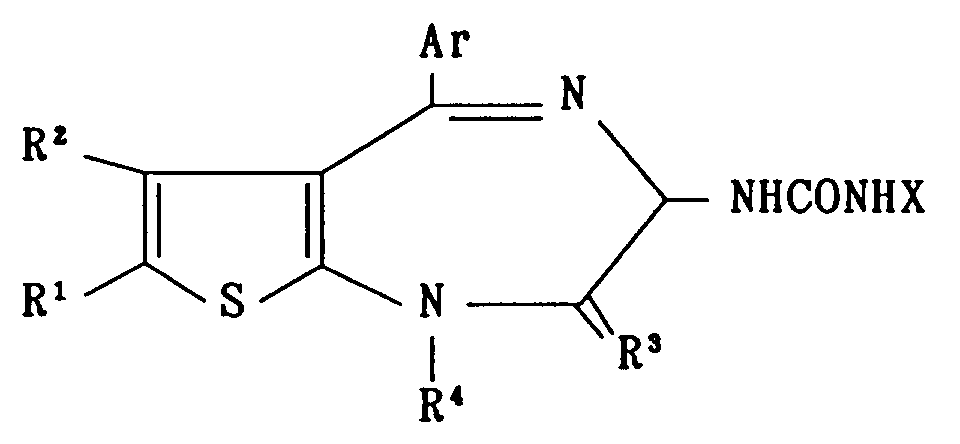
wherein R¹ and R² are the same or different and respectively stand for a hydrogen, a halogen, an alkyl or an aralkyl, or mean a group wherein R¹ and R² combinedly together form a ring; R³ stands for an oxygen, R⁴ stands for a hydrogen, an alkyl, an alkenyl or a group of the formula -(CH₂)mCOOR⁶ (wherein R⁶ stands for a hydrogen, an alkyl, an alkenyl or an aralkyl and m stands for an integer of 1-6), or R³ and R⁴ stand for a group wherein R³ and R⁴ combinedly together form a group of the formula =N-N=C(R⁵)- [wherein R⁵ stands for a hydrogen, an alkyl, an alkenyl, an aralkyl or a group of the formula -(CH₂)nCOOR⁷ (wherein R⁷ stands for a hydrogen, an alkyl, an alkenyl or an aralkyl and n stands for an integer of 1-6]; and Ar and X are the same or different and respectively stand for an aryl, an aralkyl or a heteroaryl, or a pharmaceutically acceptable salt thereof.
wherein R¹ and R² are the same or different and respectively stand for a hydrogen, a halogen, an alkyl or an aralkyl, or mean a group wherein R¹ and R² combinedly together form a ring; R³ stands for an oxygen, R⁴ stands for a hydrogen, an alkyl, an alkenyl or a group of the formula -(CH₂)mCOOR⁶ (wherein R⁶ stands for a hydrogen, an alkyl, an alkenyl or an aralkyl and m stands for an integer of 1-6), or R³ and R⁴ stand for a group wherein R³ and R⁴ combinedly together form a group of the formula =N-N=C(R⁵)- [wherein R⁵ stands for a hydrogen, an alkyl, an alkenyl, an aralkyl or a group of the formula -(CH₂)nCOOR⁷ (wherein R⁷ stands for a hydrogen, an alkyl, an alkenyl or an aralkyl and n stands for an integer of 1-6]; and Ar and X are the same or different and respectively stand for an aryl, an aralkyl or a heteroaryl, or a pharmaceutically acceptable salt thereof.
2. The compound of Claim 1 which is selected from the group consisting of 4-(2-chlorophenyl)-2-ethyl-8-methyl-6-(3-(3-methylphenyl)ureido)-8H-6,7-dihydro-thieno[3,2-f][1,4]diazepin-7-one
and 4-(2-chlorophenyl)-2-ethyl-9-methyl-6-(3-(3-methylphenyl)ureido)-6H-thieno[3,2-f][1,2,4]triazolo[4,3-
a][1,4]diazepine.
3. A pharmaceutical composition comprising the compound of Claim 1 or a pharmaceutically
acceptable salt thereof.