|
(11) | EP 0 560 541 A1 |

| (12) | EUROPEAN PATENT APPLICATION |
|
|
|
|
|||||||||||||||||||||||||||
|
||||||||||||||||||||||||||||
| (54) | Method of treating dry skin |
| (57) A method of treating human skin by topically administering alone an alkylmethylpolysiloxane
having the formula
in which x has a value of 1-300 and z has a value of 5-50. |
[0001] This invention relates to a method of treating dry human skin by the topical administration alone of certain alkylmethylpolysiloxanes.
[0002] The water content of the outer layers of the stratum corneum of human skin is a controlling factor in the appearance of dry skin symptoms. When the stratum corneum contains an adequate amount of water within the range of ten to twenty percent the skin remains flexible. However, when the water content falls below ten percent, the stratum corneum often becomes brittle and rough and can exhibit scaling and cracking.
[0003] The stratum corneum receives its water from the deep layers of the epidermis by diffusion or when it is brought into direct contact with water. The diffusion process is controlled by the water content of the skin as well as the concentration gradient. In a very dry environment, the water loss from the external skin layers can be significant and often exceeds the rate of replacement by diffusion. An occlusive barrier placed onto the surface of the skin acts to retard the water loss to the environment and allows the skin to rehydrate by the diffusion process.
[0004] The convenient availability and low cost of nonprescription drugs and over-the-counter medicines has spawned an increase in responsible consumer self-medication in the field of dry skin treatment. Numerous dry skin preparations are available. Typical dermatological moisturizers containing one or more emollients can be found marketed under trademarks such as EUCERIN® and NIVEA® by Beiersdorff Incorporated, Norwalk, Connecticut; KERI® by Westwood Pharmaceuticals Incorporated, Buffalo, New York; LUBRIDERM® by Warn- er-Lambert Company; and NEUTROGENA@ by Neutrogena Corporation, Los Angeles, California.
[0005] The present invention provides a dry skin preparation containing certain alkylmethylendblocked polysiloxanes which has been found to alleviate the symptoms of dry skin more effectively than some of the currently available over-the-counter dermatological formulations. While alkylmethylendblocked siloxanes are known in the prior art as evidenced by United States Patents 3,632,619 issued January 4, 1972; 3,756,052 issued September4, 1973; and 4,973,476 issued November 27, 1990; their use in the treatment of dry skin in the fashion contemplated by the present invention is not disclosed.
[0006] The invention is directed to a skin treatment method in which the symptoms of dry skin are alleviated by the topical application to the skin of a dermatological formulation which consists of only an alkylmethylendblocked polysiloxane.
[0007] It is an object of the present invention to provide a skin care composition which will effectively protect all skin types from dryness.
[0008] It is a further object of the present invention to provide a skin treatment which is long-lasting, safe and which will soften and moisturize the skin leaving it supple.
[0009] It is an additional object of the present invention to provide an effective skin protectant which is nonirritating and nonsensitizing.
[0010] These and other features, object and advantages of the herein described present invention will become more apparent from a consideration of the following detailed description thereof.
[0011] There are two types of dry skin. The first is caused by prolonged exposure to low humidity and low temperature with the result that the drying stress increase to such an extent that the normal hydration gradient of the stratum corneum is modified. The second type of dry skin is caused by the modification of the normal hydration gradient as a result of physical or chemical changes of the skin such as aging and in cases of pathological skin dryness.
[0012] Materials, preparations and formulations which seek to correct the condition of loss of skin flexibility due to dryness are termed emollients. Emollient formulations are available in a wide variety of delivery forms such as emulsion, microemulsions, dispersions, gels, aerosols, stick products, ointments, lotions, creams, solutions, sprays and oils. Since water is an essential emollient, many of these products function by either facilitating the process of rehydration or by the prevention of subsequent dehydration. Typically, such products function by a purely physical mechanism although in some cases the mechanism may be physiological.
[0013] In accordance with a first aspect of the present invention, dry skin is cosmetically treated by rubbing onto the dry or potentially dry skin alkylmethylpolysiloxane having the formula:
in which x has a value of 1-300 and z has a value of 5-50. Preferably, x has a value of 6-24 and z has a value of 21-25. Most preferably, x has a value of 12 and z has a value of 26.
[0014] In accordance with a second aspect of the invention there is provided use of an alkylmethylpolysiloxane of the above formula in the manufacture of a preparation for the treatment, by topical administration, of dry human skin.
[0015] The method in accordance with the present, invention consists of administering the alkylmethylpolysiloxane alone to the affected skin. By alone is meant that ingredients normally present in skin conditioning formulations are not compatible with the method of the present invention. Thus, other than normal impurities present in the alkylmethylpolysiloxanes, the skin treatment formulation of the present invention is free of solvents, emulsifiers, emollients, antioxidants, thickeners, neutralizers, moisturizers, humectants and buffers, for example. The skin treatment formulation may however tolerate minor amounts of ingredients required to market a product which is aesthetically pleasant to the consumer such as a fragrance or colorant.
[0016] Alkylmethylpolysiloxanes are commercially available materials and can be produced by methods known in the prior art. Cyclic alkylmethylpolysiloxanes are produced by the reaction of a cyclic siloxane possessing Si-H functional units such as (MeHSiO)x with a slight stoichiometric excess of an alkene in the presence of a platinum on carbon catalyst. Linear and cyclic alkylmethylpolysiloxanes are produced by the reaction of a linear siloxane possessing SiH functionality in the chain such as (Me3SiOO.5)2(MeHSiO)x and a cyclic siloxane having (Me2SiO)x units. The reaction product typically includes about ten percent of cyclic siloxane and about ninety percent of linear siloxane and is contacted with a slight excess of an alkene in the presence of a platinum on carbon catalyst.
[0017] Batch production of the alkylmethylpolysiloxanes can be conducted by the addition of the reaction product to a nonagitated suspension of the catalyst in the alkene at a temperature of about 60°C. Continuous production can be conducted by pumping a preheated solution of a stoichiometric excess of the alkene CH2=CHR and the reaction product through a packed column containing platinum on carbon catalyst in the form of chips. Because of the exothermic nature of the reaction, the column requires some provision for the removal of heat. Alkylmethylpolysiloxanes according to the present invention must be further processed in order to provide a cosmetically acceptable product by the removal of any residual cyclic siloxane or any residual methylhydrogendimethylsiloxane cocyclics which may be present as (MeHSiO)(Me2SiO)3. For the purposes of the present invention, the alkylmethylpolysiloxanes should contain no measurable residual amount of platinum and at most about 0.5 percent residual alkene resulting in a product which is about 99.5 percent alkylmethylpolysiloxane.
[0018] When applied in accordance with the present invention, the alkylmethylendblocked polysiloxane alleviates severely dry skin and restores it to near normal condition within a few days when administered alone to the affected skin area of the body. The alkylmethylsilicone material of preference is a wax having a softening point between room temperature of about 20°C. and normal skin temperature of about 33°C. The average composition of the preferred material is C24H49Me2SiO(Me2SiO)12SiMe2C24H49. As noted previously, the number of (Me2SiO) units may range from 1-300 but preferably have a value within the range of about 6-24. The end blocking units include an alkyl group which may have from 22-26 carbon atoms as indicated above. An increase in the number of carbon atoms beyond twenty-six is generally not suitable in accordance with the present invention. Thus, an increase to C30 for example increases the softening point of the wax material to an excess of 50°C. rendering its spreadability on the skin surface more difficult.
[0019] The concept of the present invention was demonstrated by in vivo testing of the silicone materials. The subjects tested had a history of severe dry skin problems for more than seven years. Their history indicated that skin dryness was less during humid summer months than during dry winter months. In the winter, the test subjects indicated that skin dryness at its worst was manifested by cracks in the stratum corneum accompanied by frequent bleeding particularly when there had been exposure to water and detergents or when the skin was dry and physically abraded.
[0020] In vivo testing consisted of applying to the affected skin areas of the test subjects the compound C24H49Me2SiO(Me2SiO)12SiMe2C24H49 alone. A light application of the compound was administered to the skin daily for a period of one week. Within a few days the test subjects reported that the affected skin areas exhibited signs of crack recession and that by the end of the week, cracks had disappeared and that the normal dry appearance of the skin had virtually disappeared.
[0021] The test subjects reported that commercially available over-the-counter products as well as prescription preparations intended to alleviate dry skin had been used by the test subjects at various times over the previous five years, but that regular daily application of these materials had not provided any relief. The test subjects reported that the commercially available over-the-counter products included (i) a water in oil emulsion containing water, petrolatum and mineral oil marketed by Beiersdorf Incorporated, Norwalk, Connecticut under the trademark EUCERIN®; (ii) an emulsion containing water, glycerin, aloe vera gel and mineral oil marketed by Chesebrough-Ponds Incorporated, Greenwich, Connecticut under the trademarks VASELINE® INTENSIVE CARE@ LOTION; and prescription preparations (iii) 0.1 % Halog containing halcinonide which is an adrenocorticoid for topical application; (iv) 0.05 % Psorcon Ointment containing diflorasone diacetate; and (v) 2.5 % Hydrocortisone Cream.
[0022] The following examples are set forth for the purpose of illustrating a method of preparing alkylmethylpolysiloxane materials suitable for use in accordance with the present invention.
Example I
[0023] Into a container, there was added ten grams of a platinum on carbon catalyst and 430 grams of a ninety- five percent pure C24 to C28 alpha olefin fraction. The alpha olefin fraction was a blend of alpha olefins containing a weight distribution of mixed C22 to C30 alpha olefins with (i) one percent being C22; (ii) thirty percent being C24; (iii) thirty-nine percent being C26; (iv) twenty percent being C28; and (v) ten percent being C30+. The C24 to C28 alpha olefin fraction is a product of the Chevron Chemical Company, Houston, Texas and is sold under the trademark GULFTENE@ 24-28. The container contents were heated to 100°C. accompanied by slow stirring and there was added 55 grams of mixed cyclic siloxanes of the formula (Me2SiO)x in which x was four to six and 570 grams of the methylhydrogensiloxane HMe2SiO(Me2SiO)12SiMe2H. The slurry was stirred for one hour at 100°C. and cooled to 50°C. While at 50°C., the slurry was filtered to remove the catalyst. The container was heated to 150°C. at one millimeter to remove the cyclic siloxane mixture. The recovered alkylmethylpolysiloxane product was a soft wax.
Example 11
[0024] Example I was repeated except that 1-octadecene was employed in place of the C24 to C28 alpha olefin fraction GULFTENE@ 24-28. The product recovered was a liquid alkylmethylpolysiloxane C18H37Me2SiO(Me2SiO)12SiMe2C18H37.
Example III
[0025] Example I was repeated except that in place of the C24 to C28 alpha olefin fraction GULFTENE@ 24-28, there was employed a C28 to C30 alpha olefin fraction. The alpha olefin fraction was a blend of alpha olefins containing a weight distribution of mixed C28 to C30+ alpha olefins with 28 percent being C28 and 78 percent being C30+. The C28 to C30+ alpha olefin fraction is a product of the Chevron Chemical Company, Houston, Texas and is sold under the trademark GULFTENE@ 30+. The product recovered was an alkylmethylpolysiloxane which was a high melting point wax.
Example IV
[0026] A 1:1 molar blend of the products of Examples II and III was produced by heating 55 grams of the high melting point was product of Example III to a liquid state and adding 45 grams of the liquid product of Example II. Upon cooling, the product blend provided a soft wax alkylmethylpolysiloxane which exhibited the same consistency as the soft wax of Example I.
1. Use of an alkylmethylpolysiloxane having the formula:
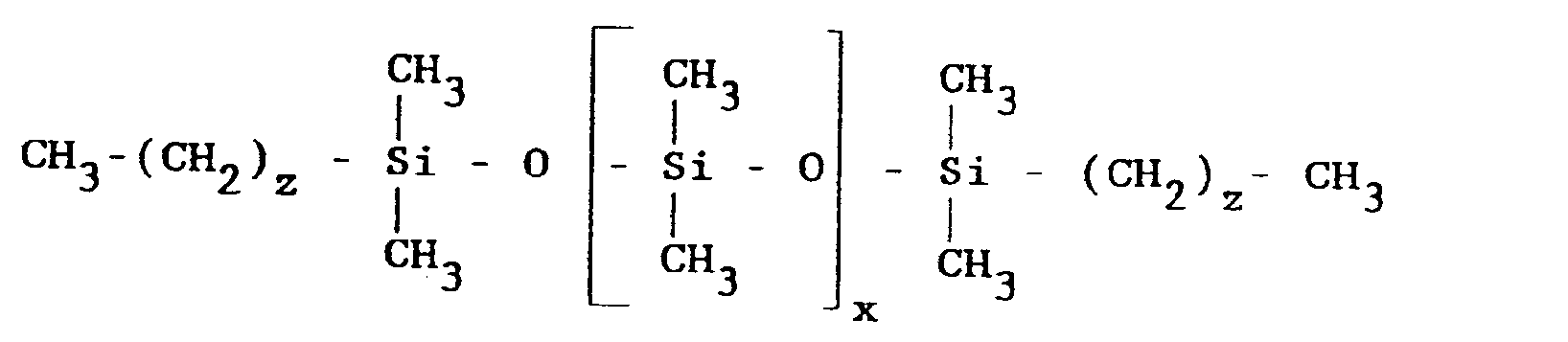
in which x has a value of 1-300 and z has a value of 5-50, in the manufacture of a preparation for the treatment, by topical administration, of dry human skin.
in which x has a value of 1-300 and z has a value of 5-50, in the manufacture of a preparation for the treatment, by topical administration, of dry human skin.
2. Use according to claim 1, wherein the preparation contains a minor amount of a
fragrance and/or a colorant.
3. Use according to claim 1 or 2, wherein, in the formula x is 6 to 24 and z is 21
to 25.
4. Use according to claim 3, wherein, in the formula x is 12 and z is 26.
5. A method of cosmetically treating human skin comprising topically administering
to the dry or potentially dry human skin an alkylmethylpolysiloxane having the formula:
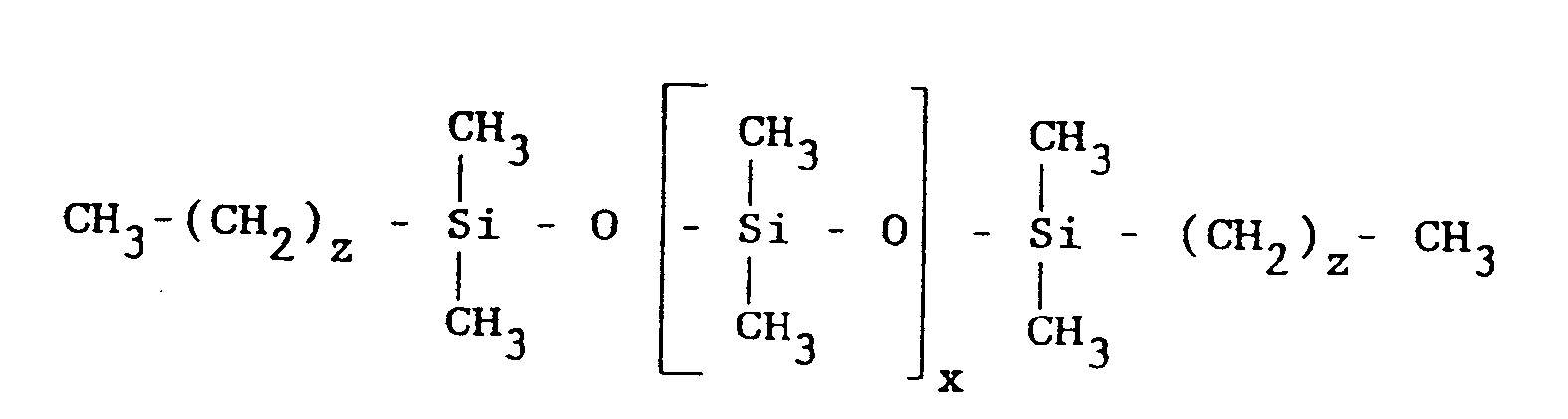
in which x has a value of 1-300 and z has a value of 5-50.
in which x has a value of 1-300 and z has a value of 5-50.
6. A method according to claim 5, wherein the alkylmethylpolysiloxane is administered
alone.
7. A method according to claim 5, wherein the alkylmethylpolysiloxane is administered
as a preparation containing a minor amount of a fragrance and/or a colorant.
8. A method according to claim 7, wherein, in the formula x is 6 to 24 and z is 21
to 25.
9. A method according to claim 8, wherein, in the formula x is 12 and Z is 26.