| (19) |
 |
|
(11) |
EP 0 561 098 A1 |
| (12) |
EUROPEAN PATENT APPLICATION |
| (43) |
Date of publication: |
|
22.09.1993 Bulletin 1993/38 |
| (22) |
Date of filing: 16.03.1992 |
|
|
| (84) |
Designated Contracting States: |
|
AT BE CH DE DK ES FR GB GR IT LI LU MC NL PT SE |
| (71) |
Applicants: |
|
- Zanni, Roberto
I-41012 Carpi (Modena) (IT)
- Montori, Giampaolo
I-40053 Bazzano (Bologna) (IT)
|
|
| (72) |
Inventors: |
|
- Zanni, Roberto
I-41012 Carpi (Modena) (IT)
- Montori, Giampaolo
I-40053 Bazzano (Bologna) (IT)
|
| (74) |
Representative: Sassatelli, Franco T., Dr. |
|
c/o INIP
5, via Ruggi
I-40137 Bologna
I-40137 Bologna (IT) |
|
| |
|
| (54) |
Automatic machine for packaging a palettized load |
(57) The invention foresees an automatic packing machine of bales to realize on a pallet
(7) a parallelepipedal bale by means of consecutive combined loading phases on the
pallet (7) and of packing so realizing the packing phase contemporary to the palletizing
phase. The machine foresees an idler (6) on which the line of parcels, formed against
a beating device (3), is positioned by an alternative pusher device (5) and so in
continuation to form a first layer of parcels. At the completion of the first layer
said idler (6) brings itself in opening by withdrawal of its moving halfpart (9) on
the fixed frame (10) so to permit the layer of parcels unloading on the pallet (7)
positioned below on a faceplate (8) moving to more levels. While the moving halfpart
(9) of the idler (6) closes again to continue the compacting cicly, the faceplate
(8) goes down to a first level permitting to the pallet (7) with the first layer of
parcels to come in packaging station where a thrust-bearing (13), on which is mounted
a reel (14) of thin extensible plastic material, by means of one or more turns winds
the set made of the pallet (7) and the first layer of parcels.
When said winding is ended the thrust-bearing stops and, always by opening of the
moving halfpart (9) of the idler (6), the second layer which has been forming contemporary
to the winding of the first layer is unloading and so in continuous to the packing
of the last prefixed layer. At this point, by means of a pliers (15), the plastic
film which has wound the pallet (7) and the various layers of parcels is cutting and
holding in position for the next binding phase. Then by means of another idler (16)
with catching hooks the so formed and packed bale going out from the working sector
and it can be drawn by the normal transport means.
|
|
[0001] The invention refers to an automatic machine to form on a pallet a parallelepipedal
bale by means of consecutive loading phases on said pallet and of packing with thin
plastic film of every single layer during its stacking so realizing the packing phase
contemporary to the palletizing phase. So formed the bale is then withdrawn by a lift
truck from the loading plane foreseen in the forming station.
[0002] Actually to realize this kind of bales it is necessary a palletizing machine which
carries out the pile placing for continuous loading phases of the parcels coming from
a feeding conveyor on a wood or cardboard pallet, then said working parallelepipedal
body must be withdrawn from the plane of said machine and it must be put on a rotating
lay packing machine realizing the packing wrapping by binding of a thin plastic film
for packing. In comparison with said actual working the invented machine permits a
lot of advantages because it realizes very saving in the plant costs, of the operating
costs and of the working area since that the two working phases, the palletizing one
and the packing, are contemporary. Moreover this machine permits very saving in the
working times because the present working requires the direct presence of the worker
only to withdraw, by means of a lift truck, the bale just formed. Further since that
the present working does not require the moving of the palletizing body it is compatible
for packing instable goods such as plastic containers for liquid, goods in sacks or
similar. The parcels which must be packing from a belt conveyor 1 advance spaced on
a first idler 2 and they come in compacting against the beating device 3. When the
prefixed number of parcels compated on line is reached a photocell 4 drives the belt
conveyor 1 and the idler 2 stopping and an alternative pusher device 5 transfers the
line of parcels so formed laterally on a second idler 6. Said idler 6 moves the line
of parcels in position upon the farest part of the pallet 7 carried, in below position,
by a faceplaste 8 with vertical movement. In such way it is coming to form in position
the first line of parcels of the first layer.
[0003] The pusher device 5 went back in the meantime in its original position has put back
in movement the belt conveyor 1 and the idler 2 so to form a second line of parcels
which in the same way of the previous one will be moved on the idler 6. Then this
second line is moved by the same idler in compacting position with the first line
of parcels for forming with this one the first two lines of parcels of the first layer
where this is possible because the rollers which bear the first line of parcels do
not move during the second transport phase while the running of the moving rollers
has been opportunely programmed.
[0004] The forming cycle of the line of parcels and the compacting cycle of the lines are
repeated in continuous to form on the idler 6 the compacting of the first layer of
parcels. For loading of the first layer of parcels as a first step the pallet 7 is
put in position directly under the idler 6 for lifting of the faceplate 8, then the
moving halfpart 9 of the idler 6 brings itself in opening, withdrawing slowly on the
fixed frame 10, to permit the gradual unloading of the subsequent lines of parcels
on the pallet 7 effects by the rollers with counterclockwise motion synchro-mesh with
the clockwise motion of the moving halfpart 9, where the position keeping of the lines
is guaranteed by the mold planning out 11 delimited the open 12.
[0005] Then the faceplate 8 gets down at the first level brought the pallet 7 with the first
layer of parcels in packaging station while the moving halfpart 9 of the idler 6 closes
again so to permit in continuation the compacting cycle of the lines of parcels for
forming a second layer of parcels on the idler 6. Coming the pallet 7 with the first
layer of parcels in packaging station, a thrust-bearing 13 on which is mounted a reel
14 of thin extensible plastic material and feeds on a pliers 15 by means of one or
more turns winds the set, made of the pallet 7 and the first layer of parcels, with
a bending external effect. Then the thrust-bearing 13 stops so to arrange the just
packing part of the bale for the loading on it of the second layer of parcels which
becomes in the same way of the loading of the first layer by opening of the moving
halfpart 9 of the idler 6. While when the unloading is ended the moving halfpart 9
closes again for the compacting phase of the third layer, the faceplate 8 gets down
at the second level permitting the packing also of the second layer of parcels. The
cycle so proceeds in continuous with the packing phases of each layer realization
in the dead time which passes between one loading phase and the subsequent one. When
also the last prefixed layer is packed and so all the bale packing is concluded, the
pliers 15 cuts the plastic film holding the same in position for the next packing
phase. The bale just packed reaches then a taking area for descent of the faceplate
8 and by means of an idler 16 goes out from the working sector. The invented machine
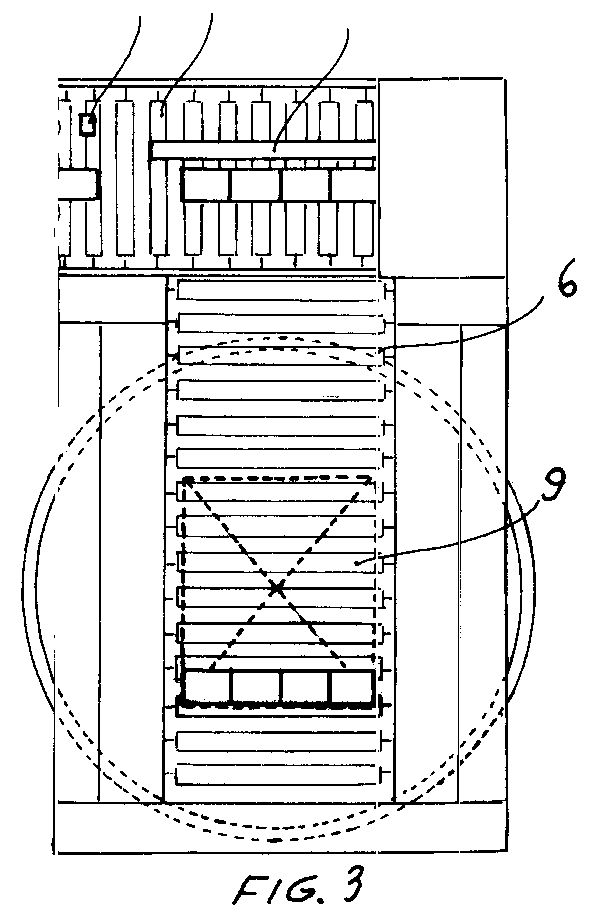
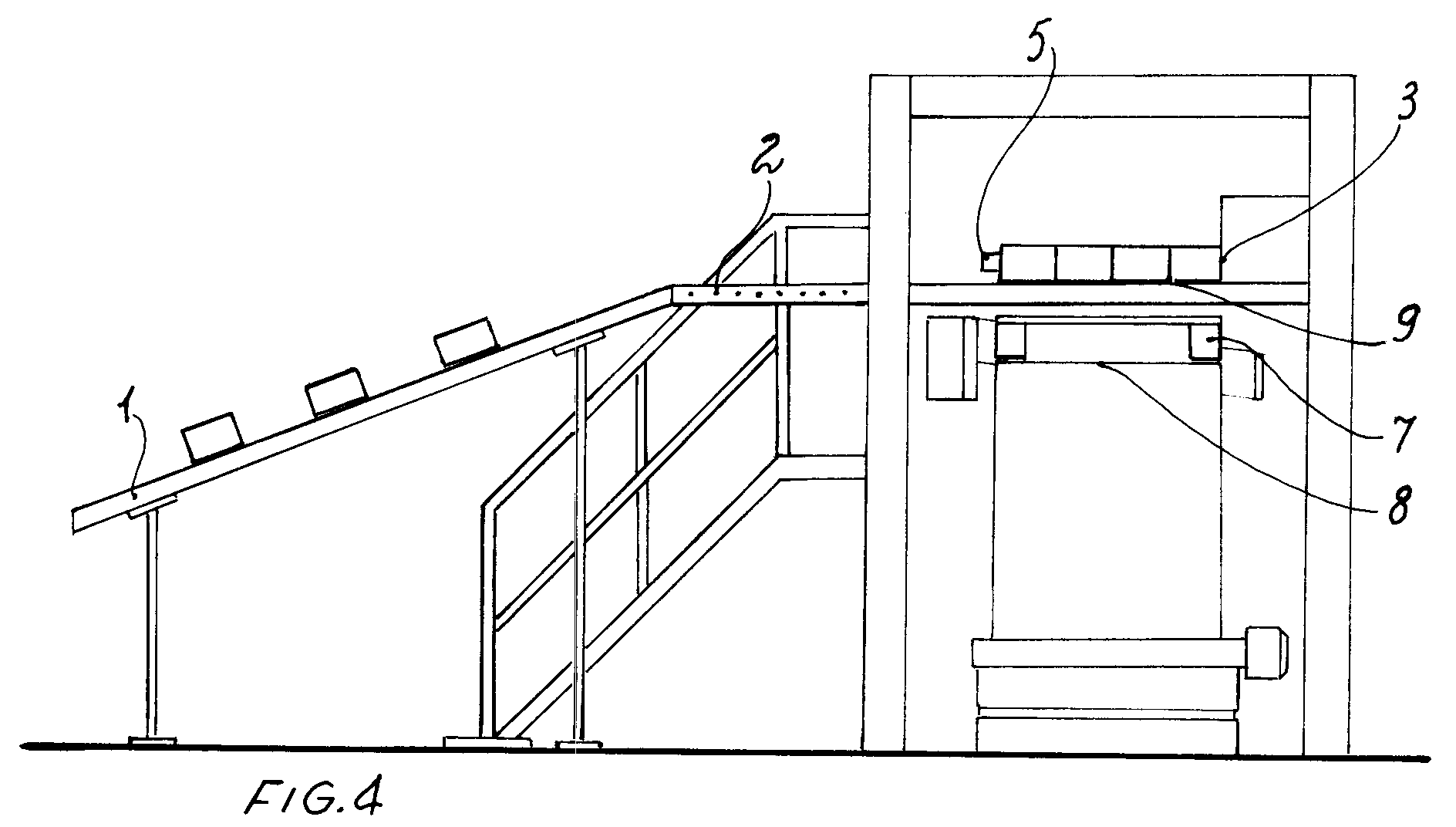
is illustrated in schematic views in drawings of sheets 1, 2 and 3. In sheet 1 fig.
1 is top view of a working sector forming the compacting of a layer of parcels on
the moving halfpart 9 of the idler 6 with the alternative pusher device 5 in its original
position previous to its movement for transporting the first line consists of four
parcels. It is visible on the moving halfpart 9 of the idler 6 in hatching view the
underlying pallet 7. Fig. 2 is view of a detail of previous fig. 1 to point out the
first line of parcels moved by the pusher device 5 on the idler 6. Fig. 3 is view
of the same complex detail of fig. 1 with the first line of parcels arrived in position
on the moving halfpart 9 of the idler 6 while a second line of parcels is already
formed on the initial position. In sheet 2 fig. 4 is frontal view of the working sector
with the pallet 7 brought in loading initial position by the faceplate 8 movible in
vertical.
[0006] It is visible in its position the first layer of parcels foresees on the moving halfpart
9. Fig 5 is view of a detail of the loading phase of the first layer of parcels on
a pallet 7. It is seen the moving halfpart 9 of the idler 6 in opening while the rollers,
moving in counterclockwise, actuate the loading of the first layer of parcels on the
pallet 7. Fig. 6 is top view of a layer of parcels compacted on the moving halfpart
9 of the idler 6. Fig. 7 is top view of the same layer of fig. 6 already arrived on
the pallet 7. In sheet 3 fig. 8 is other prospective view of the machine for permitting
the view of the palletizing body already visible from the other side in fig. 4 and
of the idler 16 which transports the already packed bales outwards. In said figure
is visible the first layer of parcels in packing phase. Fig. 9 is view of the detail
of fig. 8 with in view the bale of four layers already packed and which is withdrawn.
[0007] In the versions: the single elements of movement and of driving, the other auxiliar
and coumbined parts could be different foreseen.
1. Automatic packing machine of bales foreseen a belt conveyor (1), three different idlers
(2, 6 and 16) and a beating device (3) against which come in compacting the line of
parcels which by means of a pusher device (5) are laterally moved on the second idler
(6) formed by a moving halpart (9), foreseen a faceplate (8) which brings in position
under the idler (6) the pallet (7), and equipped in packing station with a thrust-bearing
(13), characterized by the fact that when the first line of parcels is formed the
same comes on the second idler (6) which transports the same in position upon the
farest part of the pallet (7) carried, in below position, by a faceplate (8) with
vertical movement. The pusher device (5) went back in the meantime in its original
position has put back in movement the belt conveyor (1) and the first idler (2) so
to form a second line of parcels which in the same way of the previous one will be
moved on the idler (6). Then this second line is moved by the same idler in compacting
position with the first line of parcels for forming with this one the first two lines
of parcels of the first layer where this is possible because the rollers which bear
the first line of parcels do not move during the second transport phase while the
running of the moving rollers has been opportunely programmed. The forming cycle of
the line of parcels and the compacting cycle of the lines are repeated in continuous
to form on the idler (6) the compacting of the first layer of parcels. For loading
of the first layer of parcels as a first step the pallet (7) is put in position directly
under the idler (6) for lifting of the faceplate (8), then the moving halfpar (9)
of the idler (6) brings itself in opening, withdrawing slowly on the fixed frame (10),
to permit the gradual unloading of the subsequent lines of parcels on the pallet (7)
effects by the rollers with counterclockwise motion synchro-mesh with the clockwise
motion of the moving halfpart (9), where the position keeping of the lines is guaranteed
by the mold planning out (11) delimited the open (12). Then the faceplate (8) gets
down at the first level brought the pallet (7) with the first layer of parcels in
packaging station while the moving halfpart (9) of the idler (6) closes again so to
permit in continuation the compacting cycle of the lines of parcels for forming a
second layer of parcels on the idler (6). Coming the pallet (7) with the first layer
of parcels in packaging station, a thrust-bearing (13) on which is mounted a reel
(14) of thin extensible plastic material and feeds on a pliers (15) by means of one
or more turns winds the set, made of the pallet (7) and the first layer of parcels,
with a bending external effect. Then the thrust-bearing (13) stops so to arrange the
just packing part of the bale for the loading on it of the second layer of parcels
which becomes in the same way of the loading of the first layer by opening of the
moving halfpart (9) of the idler (6). While when the unloading is ended the moving
halfpart (9) closes again for the compacting phase of the third layer, the faceplate
(8) gets down at the second level permitting the packing also of the second layer
of parcels. The cycle so proceeds in continuous whith the packing phases of each layer
realization in the dead time which passes between one loading phase and the subsequent
one. When also the last prefixed layer is packed and so all the bake packing is concluded,
the pliers (15) cuts the plastic film holding the same in position for the next packing
phase. The base just packed reaches then a taking are for descent of the faceplate
(8) and by means of a third idler (16) goes out from the working sector.