|
(11) | EP 0 562 016 B1 |

| (12) | EUROPEAN PATENT SPECIFICATION |
|
|
| (54) |
2-DECARBOXYL-2-ALKOXYALKYL PROSTAGLANDINS AS OCULAR HYPOTENSIVES 2-DECARBOXYL-2-ALKOXYALKYL-PROSTAGLANDINE ALS AUGENBINNENDRUCKSENKENDE MITTEL PROSTAGLANDINES A BASE DE 2-DECARBOXYL-2-ALCOXYALKYLE UTILISEES COMME HYPOTENSEURS OCULAIRES |
|
|
|||||||||||||||||||||||||||||||
| Note: Within nine months from the publication of the mention of the grant of the European patent, any person may give notice to the European Patent Office of opposition to the European patent granted. Notice of opposition shall be filed in a written reasoned statement. It shall not be deemed to have been filed until the opposition fee has been paid. (Art. 99(1) European Patent Convention). |
[0001] The present invention relates to 2-decarboxyl-2-alkoxyalkyl prostaglandins that are potent ocular hypotentives, and are particularly suitable for the management of glaucoma.
Background of the Invention
[0002] Ocular hypotensive agents are useful in the treatment of a number of various ocular hypertensive conditions, such as post-surgical and post-laser trabeculectomy ocular hypertensive episodes, glaucoma, and as presurgical adjuncts.
[0003] Glaucoma is a disease of the eye characterized by increased intraocular pressure. On the basis of its etiology, glaucoma has been classified as primary or secondary. For example, primary glaucoma in adults (congenital glaucoma) may be either open-angle or acute or chronic angle-closure. Secondary glaucoma results from pre-existing ocular diseases such as uveitis, intraocular tumor or an enlarged cataract.
[0004] The underlying causes of primary glaucoma are not yet known. The increased intraocular tension is due to the obstruction of aqueous humor outflow. In chronic open-angle glaucoma, the anterior chamber and its anatomic structures appear normal, but drainage of the aqueous humor is impeded. In acute or chronic angle-closure angle-closure glaucoma, the anterior chamber is shallow, the filtration angle is narrowed, and the iris may obstruct the trabecular meshwork at the entrance of the canal of Schlemm. Dilation of the pupil may push the root of the iris forward against the angle, and may produce pupillary block and thus precipitate an acute attack. Eyes with narrow anterior chamber angles are predisposed to acute angle-closure glaucoma attacks of various degrees of severity.
[0005] Secondary glaucoma is caused by any interference with the flow of aqueous humor from the posterior chamber into the anterior chamber and subsequently, into the canal of Schlemm. Inflammatory disease of the anterior segment may prevent aqueous escape by causing complete posterior synechia in iris bombe, and may plug the drainage channel with exudates. Other common causes are intraocular tumors, enlarged cataracts, central retinal vein occlusion, trauma to the eye, operative procedures and intraocular hemorrhage.
[0006] Considering all types together, glaucoma occurs in about 2% of all persons over the age of 40 and may be asymptotic for years before progressing to rapid loss of vision. In cases where surgery is not indicated, topical β-adrenoreceptor antagonists have traditionally been the drugs of choice for treating glaucoma.
[0007] Certain eicosanoids and their derivatives have been reported to possess ocular hypotensive activity, and have been recommended for use in glaucoma management. Eicosanoids and derivatives include numerous biologically important compounds such as prostaglandins and their derivatives. Prostaglandins can be described as derivatives of prostanoic acid which has the following structural formula:
Various types of prostaglandins are known, depending on the structure and substituents carried on the alicyclic ring of the prostanoic acid skeleton. Further classification is based on the number of unsaturated bonds in the side chain indicated by numerical subscripts after the generic type of prostaglandin [e.g. prostaglandin E₁ (PGE₁), prostaglandin E₂ (PGE₂)], and on the configuration of the substituents on the alicyclic ring indicated by α or β [e.g. prostaglandin F2α (PGF2α)].
[0008] Prostaglandins were earlier regarded as potent ocular hypertensives, however, evidence accumulated in the last decade shows that some protaglandins are highly effective ocular hypotensive agents, and are ideally suited for the long-term medical management of glaucoma (see, for example, Bito, L. Z. Biological Protection With Prostaglandins Cohen, M. M., ed., Boca Raton, Fla, CRC Press Inc., 1985, pp. 231-252; and Bito, L. Z., Applied Pharmacology in the Medical Treatment of Glaucomas Drance, S. M. and Neufeld, A. H. eds., New York, Grune & Stratton, 1984, pp. 477-505). Such prostaglandins include PGF2α, PGF1α, PGE₂, and certain lipid-soluble esters, such as C₁ to C₂ alkyl esters, e.g. 1-isopropyl ester, of such compounds.
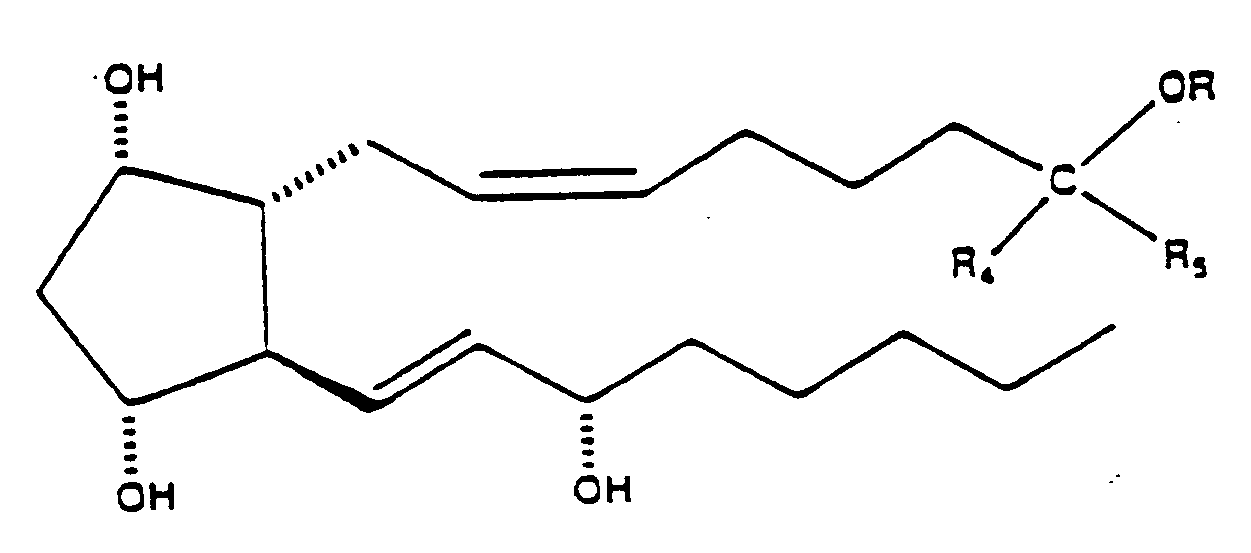
[0009] Although the precise mechanism is not yet known, recent experimental results indicate that the prostaglandin-induced reduction in intraocular pressure results from increased uveoscleral outflow [Nilsson et al., Invest. Ophthalmol. Vis. Sci. 28 (suppl), 284 (1987)].
[0010] The isopropyl ester of PGF2α has been shown to have significantly greater hypotensive potency than the parent compound, presumably as a result of its more effective penetration through the cornea. In 1987 this compound was described as "the most potent ocular hypotensive agent ever reported" [see, for example, Bito, L. Z., Arch. Ophthalmol. 105, 1036 (1987), and Siebold et al., Prodrug 5, 3 (1989)].
[0011] Whereas prostaglandins appear to be devoid of significant intraocular side effects, ocular surface (conjunctival) hyperemia and foreign-body sensation have been consistently associated with the topical ocular use of such compounds, in particular PGF2α and its prodrugs, e.g. its 1-isopropyl ester, in humans. The clinical potentials of prostaglandins in the management of conditions associated with increased ocular pressure, e.g. glaucoma are greatly limited by these side effects.
[0012] In a series of co-pending United States patent applications assigned to Allergan, Inc. prostaglandin esters with increased ocular hypotensive activity accompanied with no or substantially reduced side-effects are disclosed. The co-pending USSN 386,835 (filed 27 July 1989), relates to certain 11-acyl-prostaglandins, such as 11-pivaloyl, 11-acetyl, 11-isobutyryl, 11-valeryl, and 11-isovaleryl PGF2α. Intraocular pressure reducing 15-acyl prostaglandins are disclosed in the co-pending application USSN 357,394 (filed 25 May 1989). Similarly, 11,15- 9,15-and 9,11-diesters of prostaglandins, for example 11,15-dipivaloyl PGF2α are known to have ocular hypotensive activity. See the co-pending patent applications USSN Nos. 385,645, 386,312 and 386,834 (all filed 27 July 1989). PGF 1-alcohols are disclosed in the co-pending application USSN 07/538,204, filed 14 June 1990. The disclosures of all of these patent applications are hereby expressly incorporated by reference.
[0013] Prostan-1-ols and their esters are disclosed in the U.S. Patent No. 4,256,745, as useful in triggering abortion or labor and in regulating the menstrual cycle in female mammals.
Summary of the Invention
[0014] We have surprisingly found that "ether-type" prostaglandin compounds, i.e. 2-decarboxyl-prostaglandins containing an alkoxyalkyl group in the 2-position, are more potent ocular hypotensives than PGF2α, and, unexpectedly, cause significantly less ocular surface hyperemia than the parent compounds.
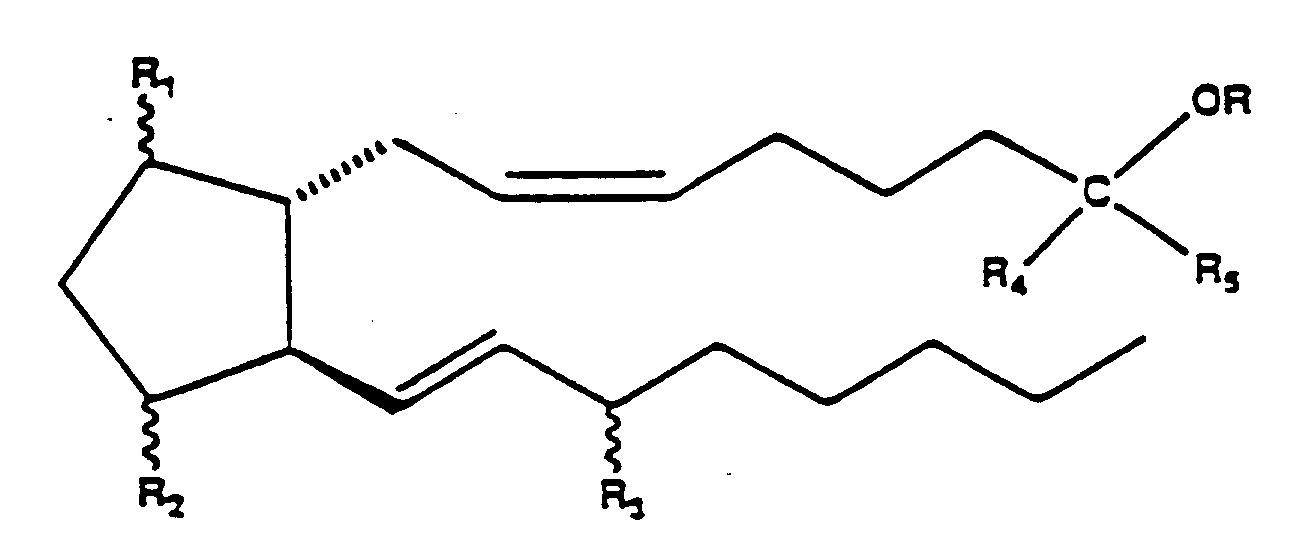
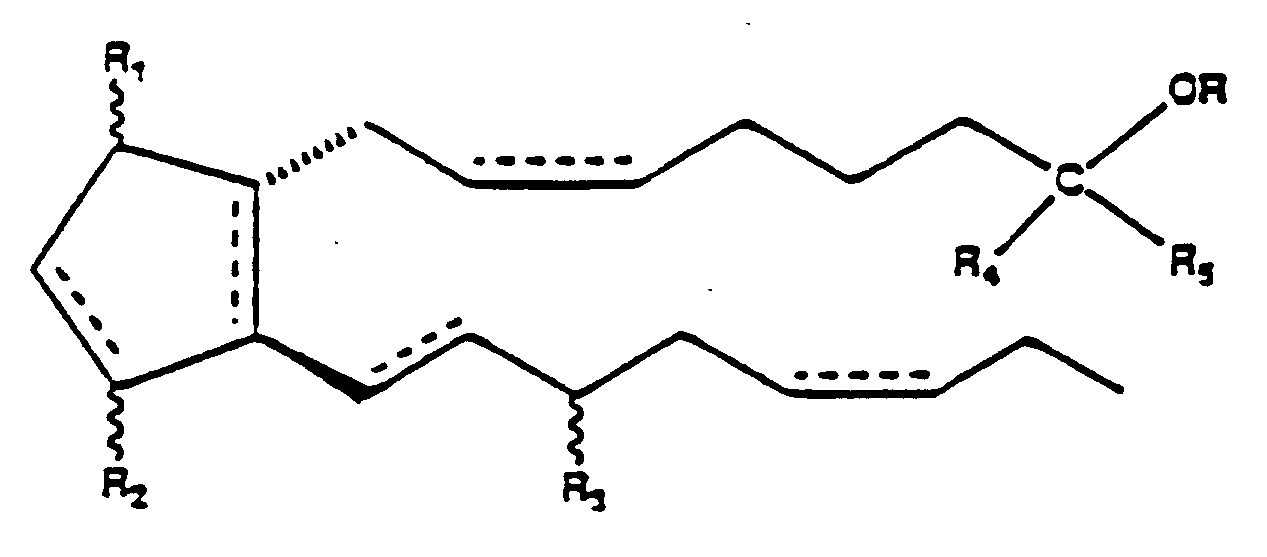
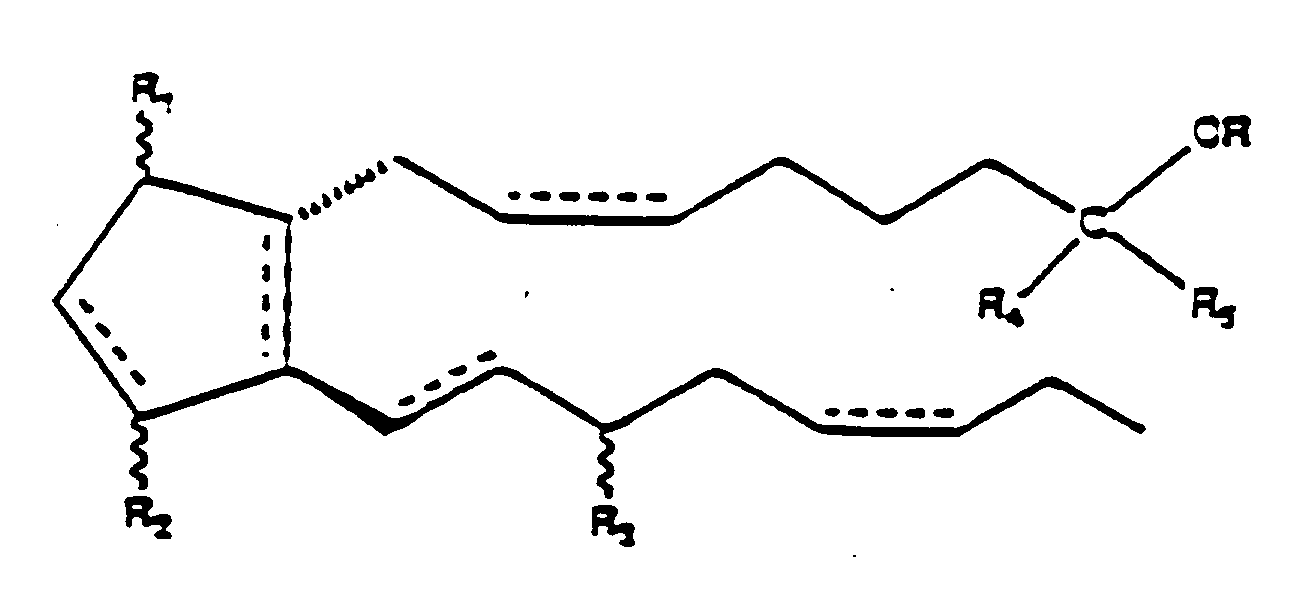
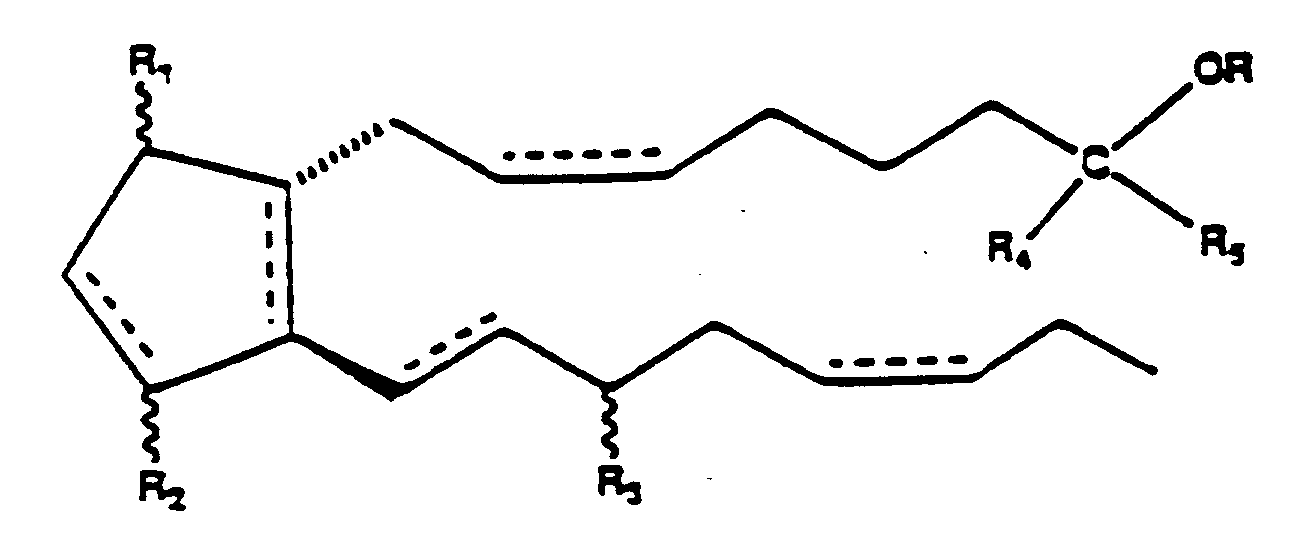
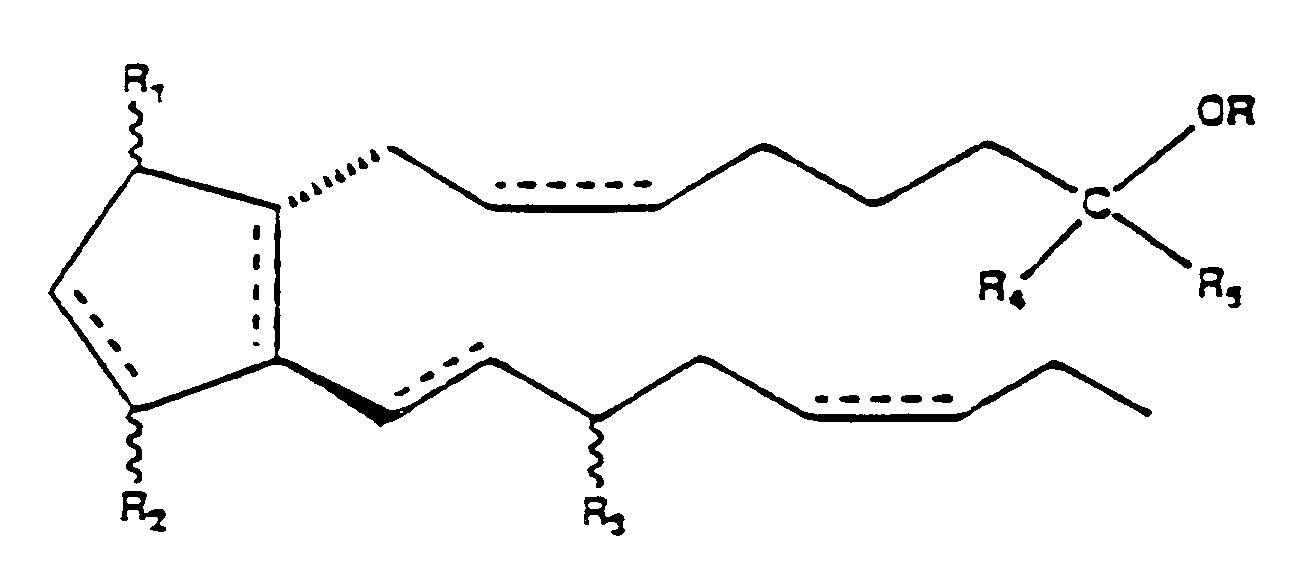
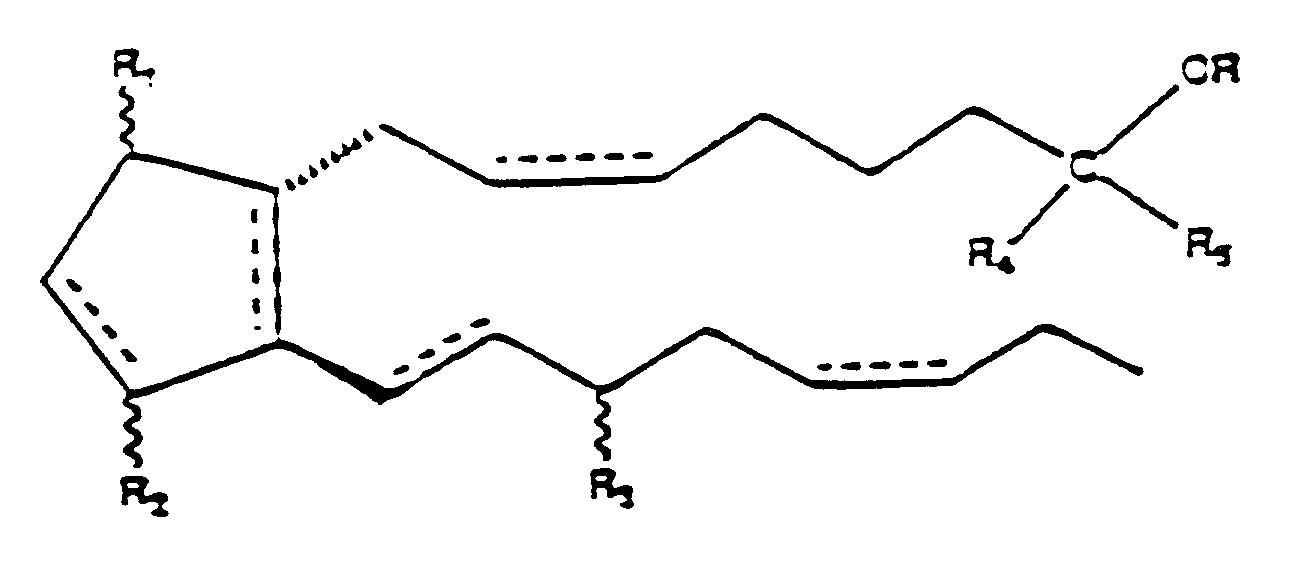
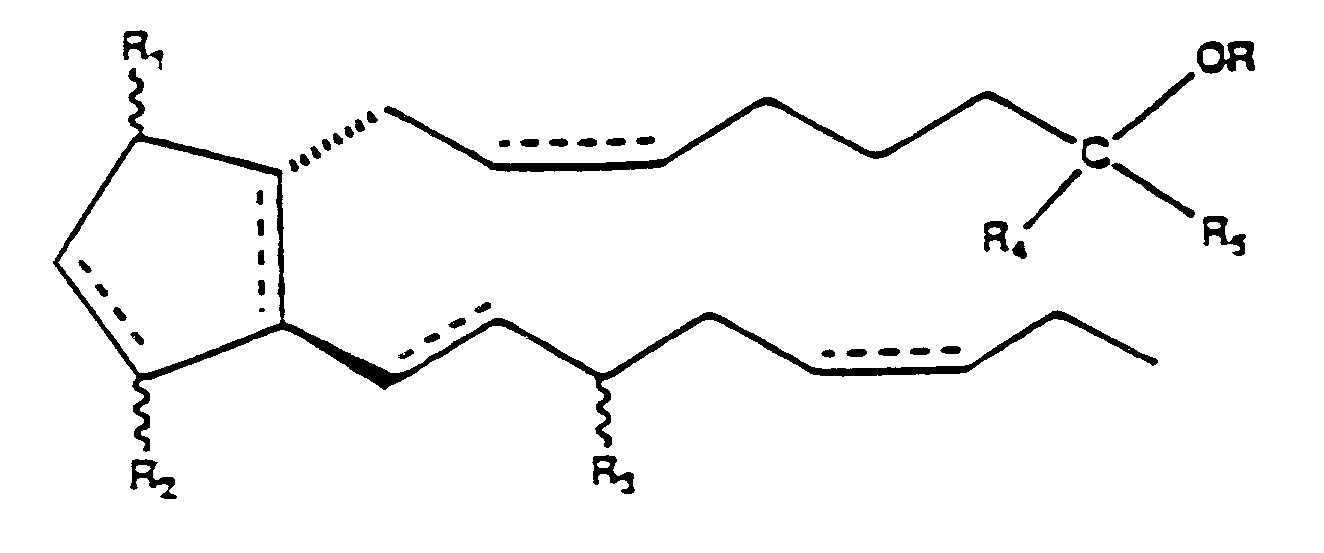
[0015] In one aspect, the present invention relates to novel 2-decarboxyl-2-alkoxyalkyl prostaglandin derivatives of the formula (I)
wherein the wavy line attachments indicate either alpha (α) or beta (β) configuration; hatched lines indicate α configuration, solid triangles are used to indicate β configuration; the dashed bonds represent a single bond or a double bond which can be in the cis or trans configuration; R is an aliphatic hydrocarbon group having from 1 to 6 carbon atoms; one of R₁ and R₂ is =O, -OH or an -O(CO)R₆ group, and the other one is -OH or an -O(CO)R₆ group or R₁ is =0 and R₂ is H; R₃ is -OH or -O(CO)R₆; R₄ and R₅ independently are hydrogen, or an aliphatic hydrocarbon group having from 1 to 6 carbon atoms; R₆ is a saturated or unsaturated acyclic hydrocarbon group having from 1 to 20 carbon atoms, or -(CH₂)nR₇ wherein n is 0-10, and R₇ is an aliphatic ring from 3 to 7 carbon atoms, or an aromatic or heteroaromatic ring; or a pharmaceutically acceptable salt thereof.
[0016] In an other aspect, the present invention relates to pharmaceutical compositions for the treatment of ocular hypertension, comprising an amount sufficient to treat ocular hypertension of a compound of formula (I), wherein the symbols have the above meanings, in admixture with a non-toxic, ophthalmically acceptable carrier.
[0017] In a further aspect, the invention concerns ophthalmic solutions for the treatment of ocular hypertension, comprising an amount sufficient to treat ocular hypertension of a compound of formula (I), in admixture with a non-toxic, ophthalmically acceptable liquid vehicle, packaged in a container suitable for metered application.
[0018] In another aspect, the present invention relates to a pharmaceutical product, comprising:
a container adapted to dispense its contents in metered form; and
an ophthalmic solution therein, as hereinabove defined.
Detailed Description of the Invention
[0019] The present invention relates to ether derivatives of prostaglandins that are useful as ocular hypotensives. The prostaglandin derivatives used in accordance with the present invention are encompassed by the following structural formula (I)
wherein the substituents and symbols are as herenabove defined.
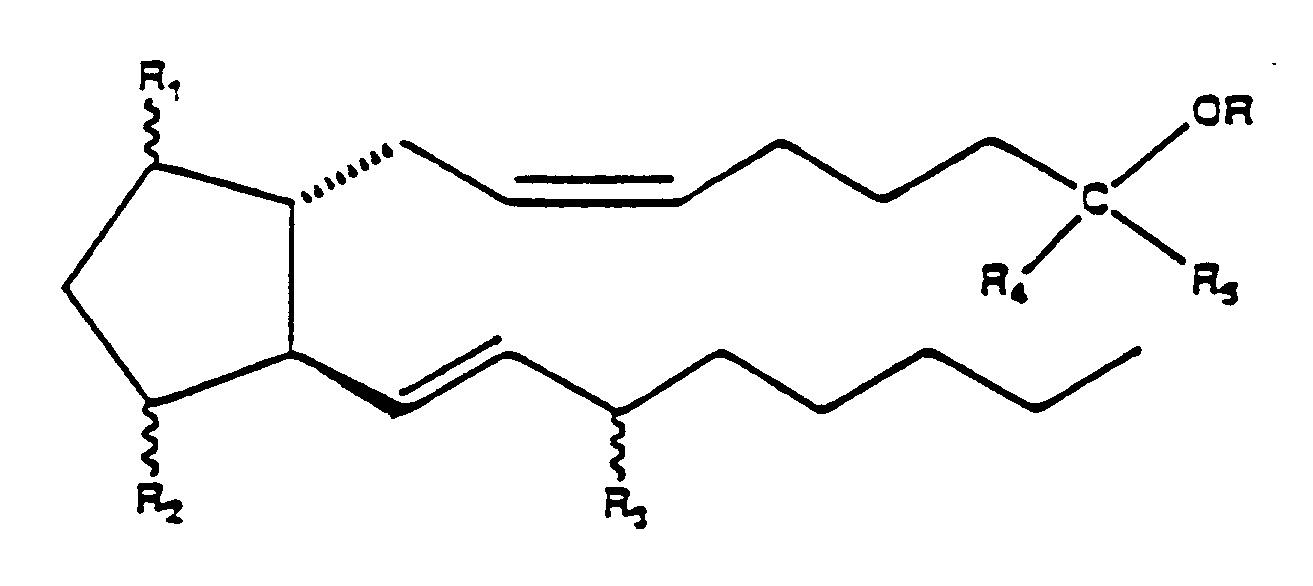
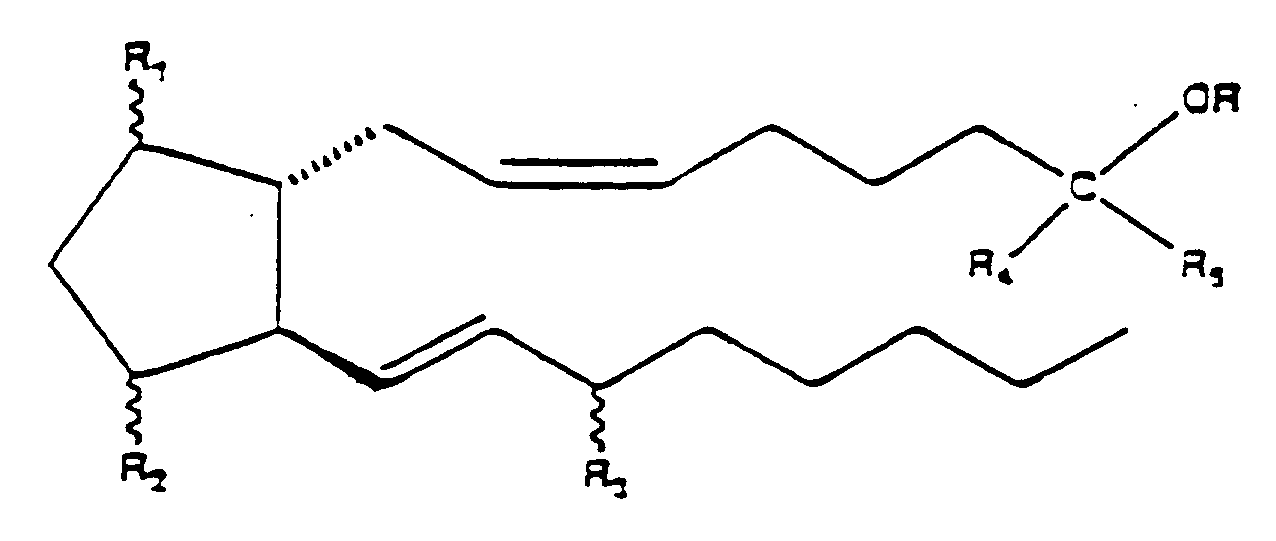
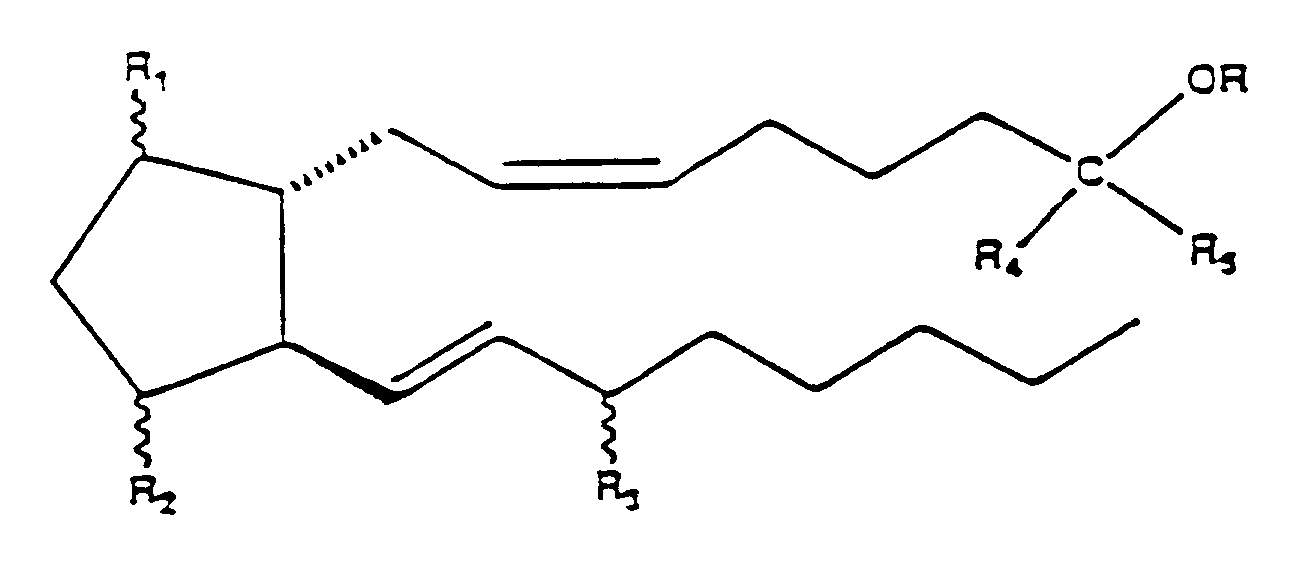
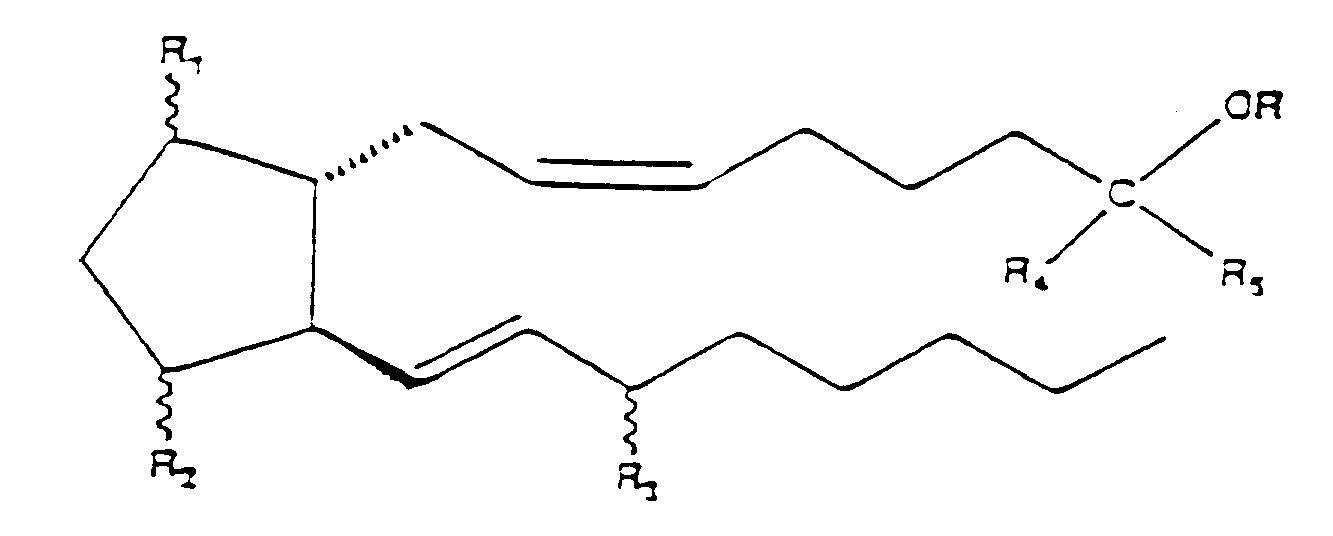
[0020] The above formula includes 2-decarboxyl-2-alkoxyalkyl derivatives of prostaglandins of the F, D, E, A and B series. A preferred group of the compounds of the present invention is encompassed by the following formula (II)
wherein R₁/R₂ is -OH/-OH, =O/-OH, -OH/=O and the esters of these compounds. This definition includes PGF, PGE and PGD derivatives.
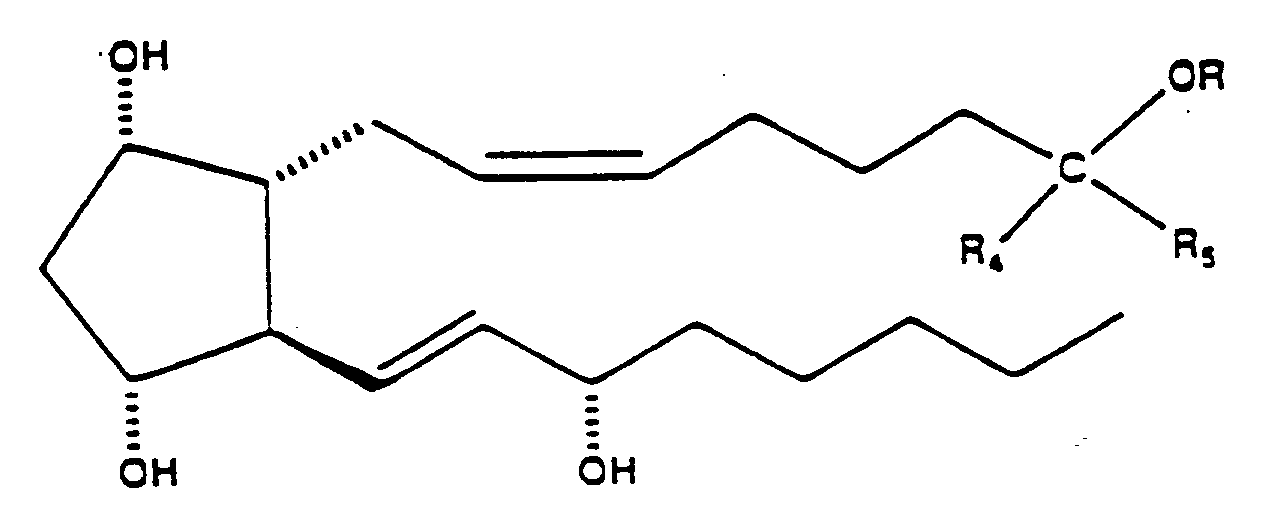
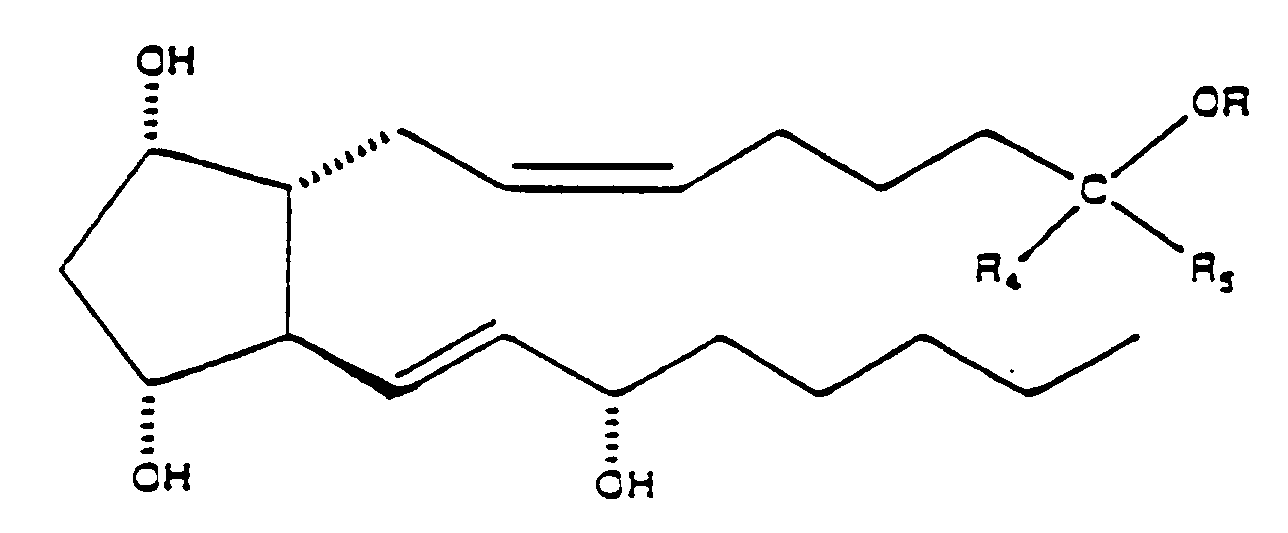
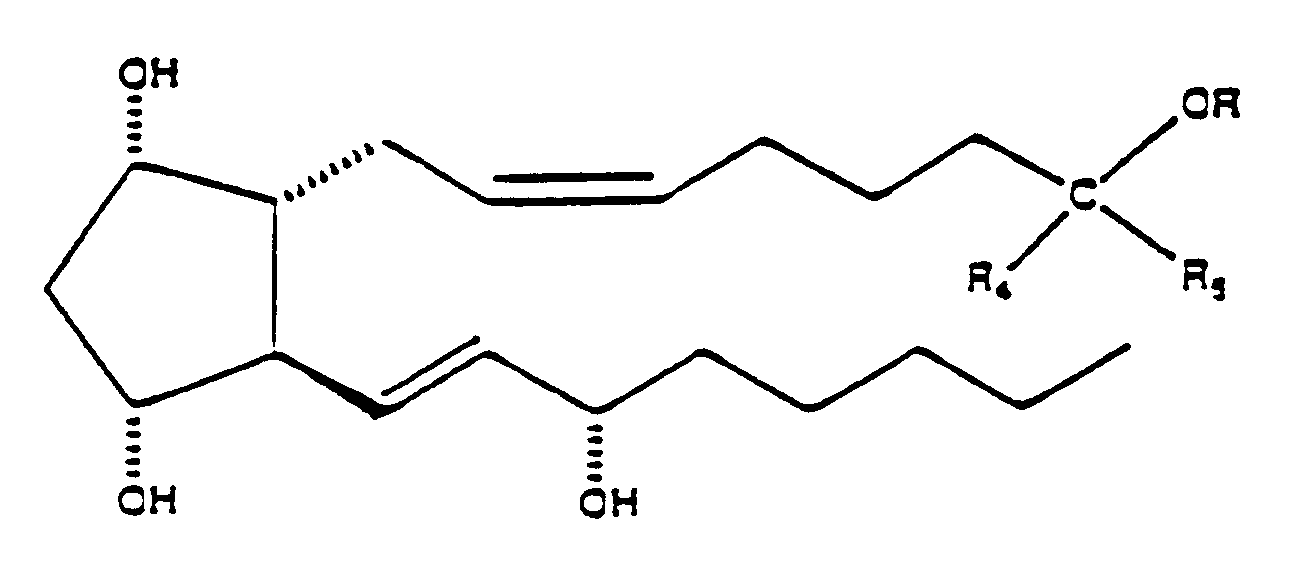
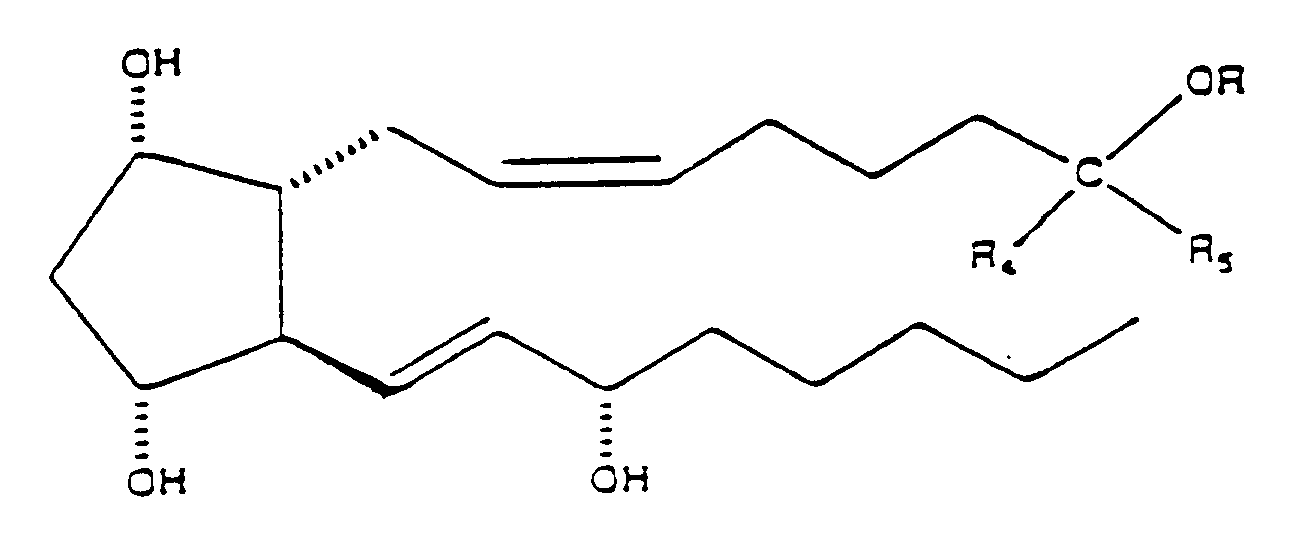
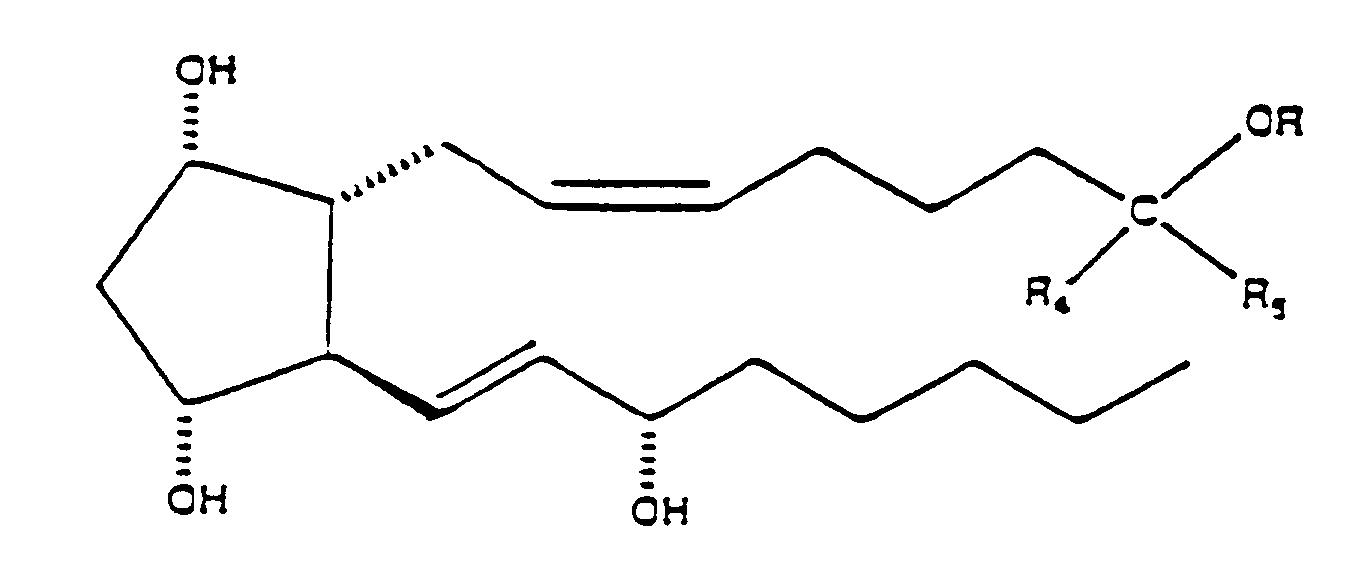
[0021] Particularly preferred are the PGF2α derivatives of the formula (III)
and their 9- and/or 11- and/or 15-esters.
[0022] In all of the above formulae, as well as in those provided hereinafter, the dotted lines on bonds between carbons 5 and 6 (C-5); between carbons 8 and 12 (C-8); between carbons 10 and 11 (C-10); between carbons 13 and 14 (C-13), and between carbons 17 and 18 (C-17) indicate a single or a double bond which can be in the cis or trans configuration. If two solid lines are used, that indicates a specific configuration for that double bond. Hatched lines at positions C-9, C-11 and C-15 indicate the α configuration. If one were to draw the β configuration, a solid triangular line would be used.
[0023] The naturally occurring stereochemistry of PGF2α includes the C-9, C-11, and C-15 hydroxyl groups in the α configuration. In the compounds used in accorance with the present invention, however, prostaglandins having the C-9 or C-11 or C-15 substituents in β configuration are also contemplated. As hereinabove mentioned, in all formulas provided herein broken line attachments to the cyclopentane ring indicate substituents in the α configuration. Thickened solid line attachments to the cyclopentane ring indicate substituents in the β configuration. For instance, 9β-PGF compounds have the same structure as PGFα compounds, except that the hydroxyl at the C-9 position is in the β configuration. Also, the broken line attachment of the hydroxyl group or other substituent to the C-11 and C-15 carbon atoms signifies the α configuration; therefore, compounds with the epi configuration for the hydroxyl group at C-15 are designated by using 15β and if there is no indication of the β configuration, the configuration is assumed α.
[0024] In the above formula the term "aliphatic hydrocarbon group" is used to refer to straight of branched chained, saturated or unsaturated acyclic hydrocarbon groups having from one to 6, preferably one to 4 carbon atoms. Such groups include alkyl, alkenyl and alkynyl groups of appropriate lenghts, and preferably are alkyl, e.g. methyl, ethyl, propyl, butyl, pentyl, or hexyl, or an isomeric form thereof.
[0025] The definition of R₆ may include a cyclic component, -(CH₂)nR₇, wherein n is 0-10, R₇ is an aliphatic ring from 3 to 7 carbon atoms, or an aromatic or heteroaromatic ring. The "aliphatic ring" may be saturated or unsaturated, and preferably is a saturated ring having 3-7 carbon atoms, inclusive. As an aromatic ring, R₇ preferably is phenyl, and the heteroaromatic rings have oxygen, nitrogen or sulfur as a heteroatom. Preferably n is 0-4.
[0026] The most preferred compounds are those PGF2α derivatives in which both R₄ and R₅ are hydrogen or one of R₄ and R₅ is hydrogen, and the other one is an aliphatic hydrocarbon group having from 1 to 6, preferably 1 to 4 carbon atoms. Particularly preferred are the compounds in which R₄ and R₅ both represent hydrogen, and R is lower alkyl, having from 1 to 4 carbon atoms. Most preferred are those compounds in which R₄ and R₅ are hydrogen, and R is methyl, the 2-decarboxyl-2-methoxymethyl compounds.
[0027] An especially preferred compound within the scope of the present invention is 2-decarboxyl-2-methoxymethyl PGF2α.
[0028] The 2-decarboxyl-2-alkoxyalkyl prostaglandins of the present invention can be conveniently prepared from the corresponding 2-decarboxyl-2-hydroxyalkyl prostaglandin derivatives. The primary alcohol starting compounds are prepared by reduction of the 1-carboxyl group of the corresponding PG compounds, for example, as described by Maddox et al., Nature 273, 549 (1978), or in the U.S. Patent No. 4,256,745.
[0029] The secondary and tertiary alcohols are usually prepared from the corresponding primary alcohols via oxydation to aldehydes or ketones and subsequent reaction with a suitable Grignard reagent. These reactions are well known in the organic chemistry.
[0030] The prostaglandin 2-alcohols may be converted into the corresponding alkoxy derivatives by conventional techniques well known in the art for the preparation of ether-type compounds. For example, a prostaglandin-2-decarboxyl-2-ol starting compound can be reacted with the desired alkyl halide in a suitable organic solvent. During this step, the hydroxyl groups present in any of the 9-, 11- and 15-positions are protected by protecting groups known in the art, which can subsequently be easily removed.
[0031] A specific route for the synthesis of 2-decarboxyl-2-methoxymethyl-prostaglandin F2α starting from PGF2α, is illustrated in the attached Reaction Scheme. In a first step, the methyl ester of PGF2α is prepared with diazomethane, in a mixture of ether and methanol. The hydroxyls in the 9-, 11- and 15-positions are masked by reaction with dihydropyran, which yields tetrahydropyranyl (THP) ethers that are stable during the subsequent reduction and methylation steps, but can be easily decomposed with methanol, in the presence of pyridinium tosylate as a catalyst. The 1-carboxyl ester group of the obtained PGF2α compound is reduced to the corresponding hydroxyl with diisobutylaluminium hydride. Other chemical reducing agents, including other hydrides, e.g., lithiumaluminium hydride may be equally used to perform this reaction. According to the Reaction Scheme, the methyl ester of the 2-OH compound is formed with methyl iodide, in the presence of sodium hydride, in dimethyl formamide solvent, at ambient temperature. In the final step, the THP protecting groups are removed to yield the desired 2-decarboxyl-2-methoxymethyl-PGF2α.
[0032] Pharmaceutical compositions may be prepared by combining a therapeutically effective amount of at least one compound according to the present invention, as an active ingredient, with conventional ophthalmically acceptable pharmaceutical excipients, and by preparation of unit dosage forms suitable for topical ocular use. The therapeutically efficient amount typically is between about 0.0001 and about 5% (w/v), preferably about 0.001 to about 1.0% (w/v) in liquid formulations.
[0033] For ophthalmic application, preferably solutions are prepared using a physiological saline solution as a major vehicle. The pH of such ophthalmic solutions should preferably be maintained between 6.5 and 7.2 with an appropriate buffer system. The formulations may also contain conventional, pharmaceutically acceptable preservatives, stabilizers and surfactants.
[0034] Preferred preservatives that may be used in the pharmaceutical compositions of the present invention include, but are not limited to, benzalkonium chloride, chlorobutanol, thimerosal, phenylmercuric acetate and phenylmercuric nitrate. A preferred surfactant is, for example, Tween 80. Likewise, various preferred vehicles may be used in the ophthalmic preparations of the present invention. These vehicles include, but are not limited to, polyvinyl alcohol, povidone, hydroxypropyl methyl cellulose, poloxamers, carboxymethyl cellulose, hydroxyethyl cellulose and purified water.
[0035] Tonicity adjustors may be added as needed or convenient. They include, but are not limited to, salts, particularly sodium chloride, potassium chloride, mannitol and glycerin, or any other suitable opthalmically acceptable tonicity adjustor.
[0036] Various buffers and means for adjusting pH may be used so long as the resulting preparation is ophthalmically acceptable. Accordingly, buffers include acetate buffers, citrate buffers, phosphate buffers and borate buffers. Acids or bases may be used to adjust the pH of these formulations as needed.
[0037] In a similar vein, an ophthalmically acceptable antioxidant for use in the present invention includes, but is not limited to, sodium metabisulfite, sodium thiosulfate, acetylcysteine, butylated hydroxyanisole and butylated hydroxytoluene.
[0038] Other excipient components which may be included in the ophthalmic preparations are chelating agents. The preferred chelating agent is edentate disodium, although other chelating agents may also be used in place or in conjunction with it.
[0039] The ingredients are usually used in the following amounts:
| Ingredient | Amount (% w/v) |
| active ingredient | about 0.001-5 |
| preservative | 0-0.10 |
| vehicle | 0-40 |
| tonicity adjustor | 1-10 |
| buffer | 0.01-10 |
| pH adjustor | q.s. pH 4.5-7.5 |
| antioxidant | as needed |
| surfactant | as needed |
| purified water | as needed to make 100% |
[0040] The actual dose of the active compounds of the present invention depends on the specific compound, and on the condition to be treated; the selection of the appropriate dose is well within the knowledge of the skilled artisan.
[0041] The ophthalmic formulations of the present invention are conveniently packaged in forms suitable for metered application, such as in containers equipped with a dropper, to facilitate the application to the eye. Containers suitable for dropwise application are usually made of suitable inert, non-toxic plastic material, and generally contain between about 0.5 and about 15 ml solution.
Example 1
Preparation of 2-Decarboxyl-2-Methoxymethyl Prostaglandin F2α
[0043] PGF₂α (153 mg, 0.43 mmol) was dissolved in 2:1 methanol/methylene chloride (1.5 ml) and cooled to 0°C. A solution of diazoethane in ether was added until a yellow color persisted. The reaction was allowed to warm up to 25°C and stirred for an additional 30 minutes. The solvents were evaporated to yield 158 mg of PGF2α methyl ester as a yellow oil. The crude methyl ester was dissolved in methylene chloride (0.36 ml). 3,4-Dihydro-2H-pyran (0.40 ml, 4.3 mmol) and pyridinium ρ-toluenesulfonate (10 mg, 0.04 mmol) were added and the solution was stirred for 24 hours. The reaction mixture was partitioned between 10% citric acid and ethyl acetate and extracted with ethyl acetate. The organic extract was washed with saturated sodium bicarbonate solution and brine, dried over magnesium sulfate and concentrated to give 568 mg crude product. Purification by silica gel chromatography (40% ethyl acetate in hexanes, Rf 0.60) afforded 401 mg PGF2α tris(tetrahydropyranyl) ether methyl ester.
[0044] PGF2α tris(tetrahydropyranyl) ether methyl ester obtained above was dissolved in methylene chloride, cooled to 0°C and a solution of diisobutylaluminum hydride in methylene chloride (1.94 ml of 1.0 M solution, 1.94 mmol) was added. After 45 minutes at 0°C, the reaction was quenched with 0.5 M sodium hydroxide solution. The product was extracted into ethyl acetate, washed with brine and dried over anhydrous magnesium sulfate. The solvent was evaporated to give a crude product which was purified by column chromatography (silica gel, 30-40% ethyl acetate in hexanes, Rf 0.15) to yield 219 mg PGF₂α 2-alcohol tris(tetrahydropyranyl) ether.
[0045] A solution of the purified alcohol from the above step (158 mg, 0.267 mmol) in dimethylformamide (0.5 ml) was added dropwise to a suspension of sodium hydride (16 mg of a 60% dispersion in mineral oil, 0.4 mmol) in dimethylformamide at 0°C under a nitrogen atmosphere. The solution was warmed up to 25°C for 15 minutes and recooled to 0°C. Methyl iodide (170 mg, 1.2 mmol) was added dropwise and the reaction was slowly warmed up to room temperature and stirred for an additional 28 hours. The reaction was worked up by adding 10% citric acid and extraction with ethyl acetate. The organic extract was washed with brine dried (magnesium sulfate) and concentrated to give 149 mg of crude product which was purified by column chromatography (silica gel, 30% ethyl acetate in hexanes, Rf 0.38) to give 39 mg of 2-decarboxyl-2-methoxymethyl PGF2a tris(tetrahydropyranyl) ether and 50 mg of starting material.
[0046] 2-Decarboxyl-2-methoxymethyl PGF₂α tris (tetrahydropyranyl) ether (39 mg, 0.064 mmol) and pyridinium ρ-toluenesulfonate (10 mg) were dissolved in methanol (3 ml) and heated at 50°C for 4 hours. The solvent was evaporated under reduced pressure. The residue was partitioned between water and ethyl acetate. The aqueous layer was further extracted with ethyl acetate twice and the combined organic extracts were washed with brine and dried over magnesium sulfate. On evaporation of the solvent, 21 mg crude product was obtained which was chromatographed on silica gel using 1% acetic acid in ethyl acetate as eluent (Rf, 0.33) to give 11 mg 2-decarboxyl-2-methoxymethyl PGF₂α.
Example 2
Intraocular Pressure Reducing Activity
[0047] Experimental quantities of PGF₂α-2-OCH₃ (2-decarboxyl-2-methoxymethyl-PGF₂α) were prepared in an ophthalmic formulation containing 0.1% polysorbate (Tween 80) - 10mM TRIS. One eye of each experimental animal was treated by applying one 25 »l drop of the drug formulation to the ocular surface, the contralateral eye received 25 »l of vehicle as a control. Intraocular pressure was measured by applanation pneumatonometry immediately before drug administration and at subsequent, predetermined times thereafter. New Zealand albino/dutch belted cross rabbits were employed as experimental animals.
[0048] Ocular surface hyperemia was assessed by observation at predetermined times after drug administration and is described as either present or absent.
[0049] The effects of PGF₂α-2-OCH₃ and PGF₂α on ocular hypertension and ocular surface hyperemia are summarized in Tables 1 and 2. The differences in activity are most clearly appreciated by comparing activities at the lowest dose (0.01%). Thus, PGF₂α caused only a modest decrease in intraocular pressure (-2/3), whereas the effect of PGF₂α-2-OCH₃ produced significant decreases in intraocular pressure with a reduced incidence of ocular surface hyperemia. In the case of PGF₂α, a similarly consistent separation of these two effects was not apparent.
Claims for the following Contracting State(s): AT, BE, CH, DE, DK, FR, GB, GR, IT,
LI, LU, MC, NL, SE
1. A compound of the formula (I)
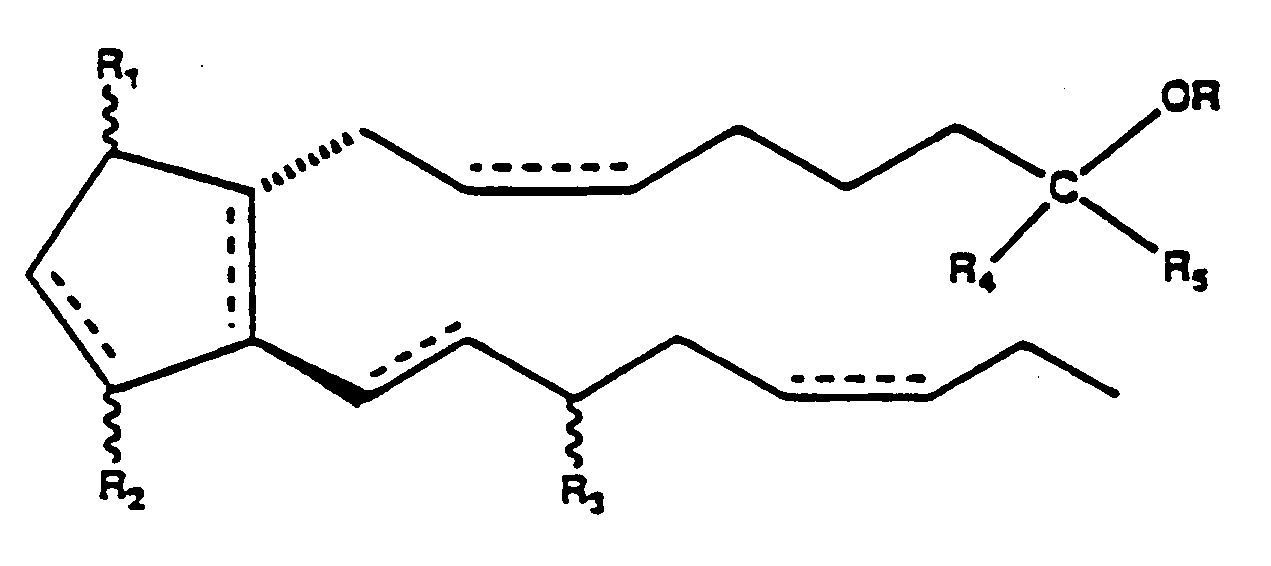
wherein the wavy line attachments indicate either alpha (α) or beta (β) configuration; hatched lines indicate α configuration, solid triangles are used to indicate β configuration; the dashed bonds represent a single bond or a double bond which can be in the cis or trans configuration; R is an aliphatic hydrocarbon group having from 1 to 6 carbon atoms; one of R₁ and R₂ is =O, -OH or an -O(CO)R₆ group, and the other one is -OH or an -O(CO)R₆ group or R₁ is =O and R₂ is H; R₃ is -OH or-O(CO)R₆; R₄ and R₅ independently are hydrogen, or an aliphatic hydrocarbon group having from 1 to 6 carbon atoms; R₆ is a saturated or unsaturated acyclic hydrocarbon group having from 1 to 20 carbon atoms, or -(CH₂)nR₇ wherein n is 0-10, and R₇ is an aliphatic ring from 3 to 7 carbon atoms, or an aromatic or heteroaromatic ring; or a pharmaceutically acceptable salt thereof.
wherein the wavy line attachments indicate either alpha (α) or beta (β) configuration; hatched lines indicate α configuration, solid triangles are used to indicate β configuration; the dashed bonds represent a single bond or a double bond which can be in the cis or trans configuration; R is an aliphatic hydrocarbon group having from 1 to 6 carbon atoms; one of R₁ and R₂ is =O, -OH or an -O(CO)R₆ group, and the other one is -OH or an -O(CO)R₆ group or R₁ is =O and R₂ is H; R₃ is -OH or-O(CO)R₆; R₄ and R₅ independently are hydrogen, or an aliphatic hydrocarbon group having from 1 to 6 carbon atoms; R₆ is a saturated or unsaturated acyclic hydrocarbon group having from 1 to 20 carbon atoms, or -(CH₂)nR₇ wherein n is 0-10, and R₇ is an aliphatic ring from 3 to 7 carbon atoms, or an aromatic or heteroaromatic ring; or a pharmaceutically acceptable salt thereof.
2. The compound according to Claim 1 selected from the group consisting of naturally
occurring prostaglandins of the D, E and F series.
3. The compound according to Claim 2 having the formula (II)
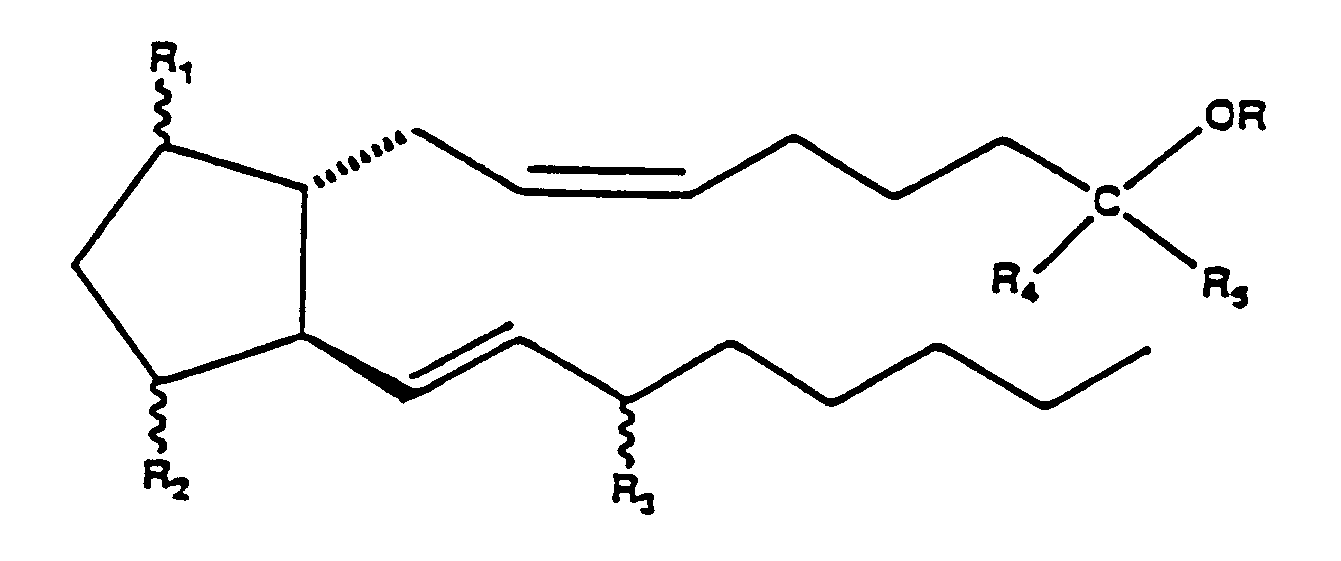
wherein R, R3, R₄ and R₅ are as defined in Claim 1, and R₁/R₂ is -OH/-OH, =O/-OH, -OH/=O, or an -O(CO)R₆ ester thereof.
wherein R, R3, R₄ and R₅ are as defined in Claim 1, and R₁/R₂ is -OH/-OH, =O/-OH, -OH/=O, or an -O(CO)R₆ ester thereof.
4. The compound according to Claim 3 which is a PGF2α derivative of the formula (III)

wherein R, R₄ and R₅ are as defined in Claim 1.
wherein R, R₄ and R₅ are as defined in Claim 1.
5. The compound according to Claim 4, in which R is alkyl having from 1 to 6 carbon atoms,
and both R₄ and R₅ are hydrogen.
6. The compound according to Claim 5, in which R is methyl, and R₄ and R₅ are hydrogen,
2-decarboxyl-2-methoxymethyl PGF2α.
7. A pharmaceutical composition for the treatment of ocular hypertension, comprising
an amount sufficient to treat ocular hypertension of a compound of formula (I)
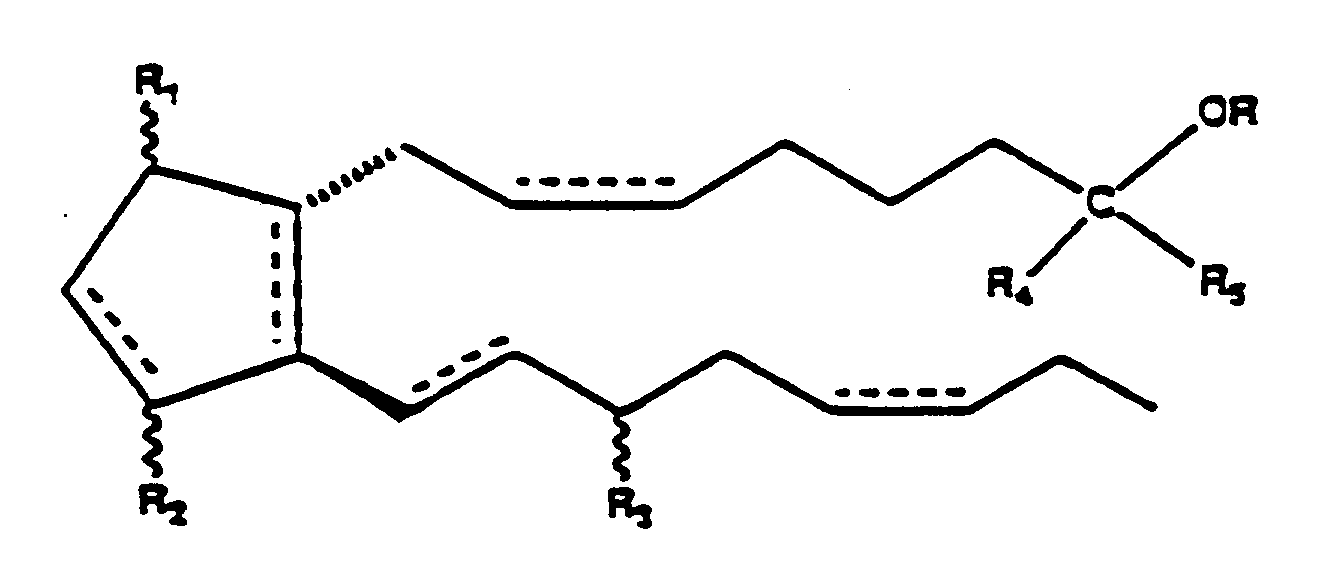
wherein the wavy line attachments indicate either alpha (α) or beta (β) configuration; hatched lines indicate α configuration, solid triangles are used to indicate β configuration; the dashed bonds represent a single bond or a double bond which can be in the cis or trans configuration; R is an aliphatic hydrocarbon group having from 1 to 6 carbon atoms; one of R₁ and R₂ is =O, -OH or an -O(CO)R₆ group, and the other one is -OH or an -O(CO)R₆ group, or R₁ is =O and R₂ is H; R₃ is -OH or-O(CO)R₆; R₄ and R₅ independently are hydrogen, or an aliphatic hydrocarbon group having from 1 to 6 carbon atoms; R₆ is a saturated or unsaturated acyclic hydrocarbon group having from 1 to 20 carbon atoms, or -(CH₂)nR₇ wherein n is 0-10, and R₇ is an aliphatic ring from 3 to 7 carbon atoms, or an aromatic or heteroaromatic ring; or a pharmaceutically acceptable salt thereof.
wherein the wavy line attachments indicate either alpha (α) or beta (β) configuration; hatched lines indicate α configuration, solid triangles are used to indicate β configuration; the dashed bonds represent a single bond or a double bond which can be in the cis or trans configuration; R is an aliphatic hydrocarbon group having from 1 to 6 carbon atoms; one of R₁ and R₂ is =O, -OH or an -O(CO)R₆ group, and the other one is -OH or an -O(CO)R₆ group, or R₁ is =O and R₂ is H; R₃ is -OH or-O(CO)R₆; R₄ and R₅ independently are hydrogen, or an aliphatic hydrocarbon group having from 1 to 6 carbon atoms; R₆ is a saturated or unsaturated acyclic hydrocarbon group having from 1 to 20 carbon atoms, or -(CH₂)nR₇ wherein n is 0-10, and R₇ is an aliphatic ring from 3 to 7 carbon atoms, or an aromatic or heteroaromatic ring; or a pharmaceutically acceptable salt thereof.
8. The composition according to Claim 7 wherein said compound is selected from the group
consisting of naturally occurring prostaglandins of the D, E and F series.
9. The composition according to Claim 8 wherein said compound has the formula (II)
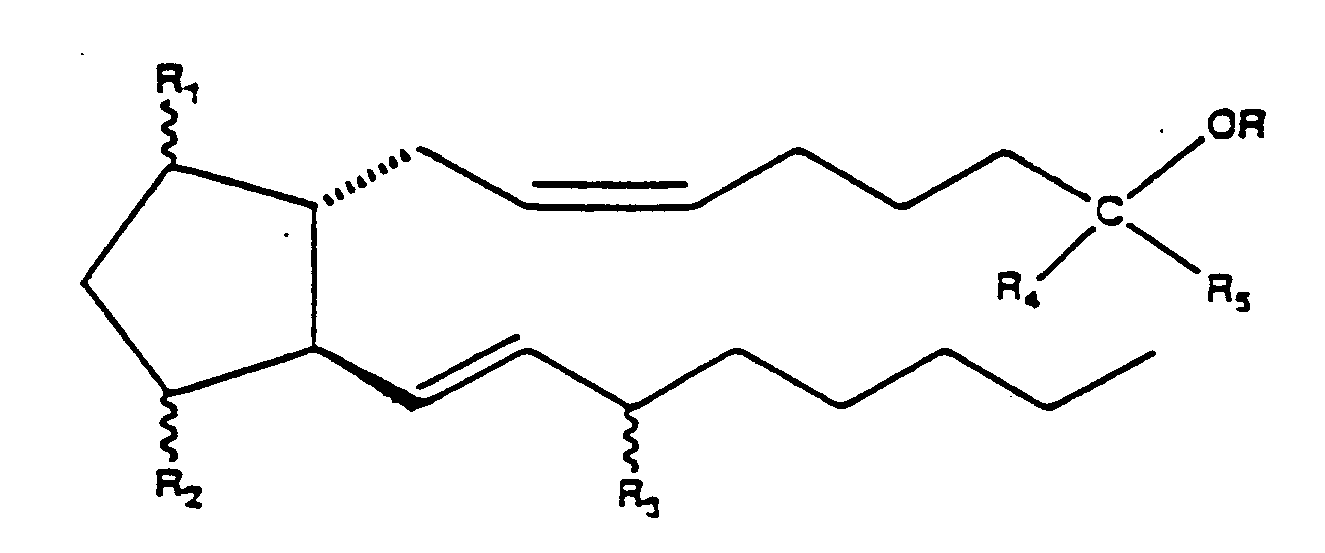
wherein R, R₃, R₄ and R₅ are as defined in Claim 7, and R₁/R₂ is -OH/-OH, =O/-OH, -OH/=O, or an -O(CO)R₆ ester thereof.
wherein R, R₃, R₄ and R₅ are as defined in Claim 7, and R₁/R₂ is -OH/-OH, =O/-OH, -OH/=O, or an -O(CO)R₆ ester thereof.
10. The composition according to Claim 9, wherein said compound is a PGF2α derivative of the formula (III)
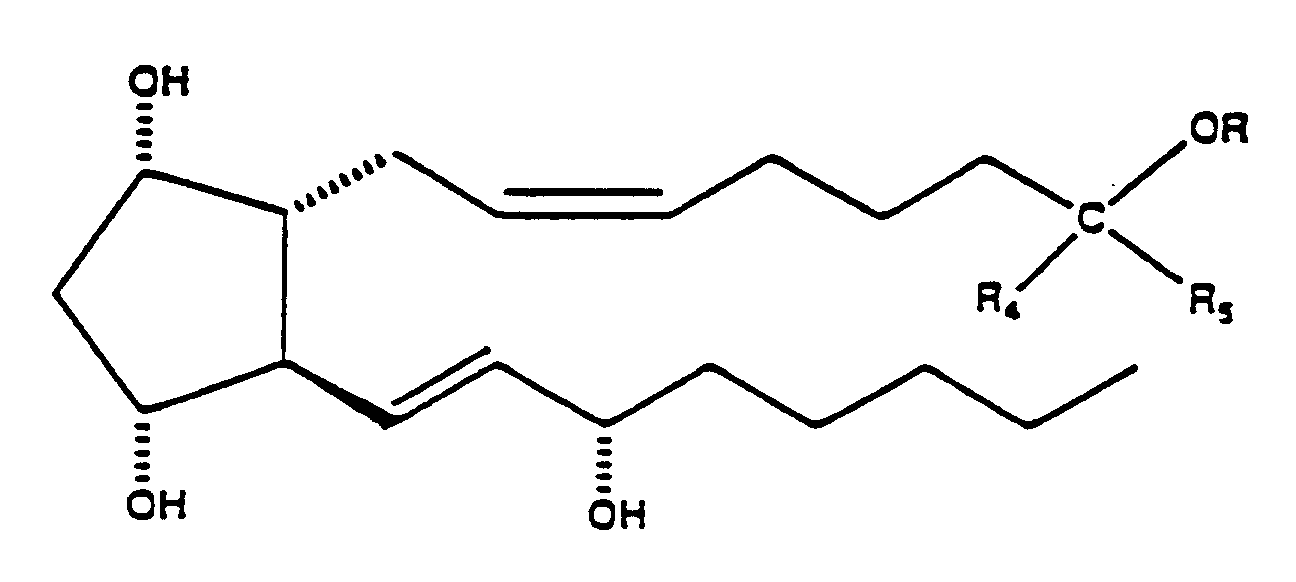
wherein R, R₄ and R₅ are as defined in Claim 7.
wherein R, R₄ and R₅ are as defined in Claim 7.
11. The composition according to Claim 10, in which in formula (III) R is alkyl having
from 1 to 6 carbon atoms, and both R₄ and R₅ are hydrogen.
12. The composition according to Claim 11, in which in formula (III) R is methyl, and
R₄ and R₅ are hydrogen, 2-decarboxyl-2-methoxymethyl PGF2α.
13. An ophthalmic solution for the treatment of ocular hypertension, comprising an amount
sufficient to treat ocular hypertension of a compound of formula (I) according to
Claim 1, in admixture with a non-toxic, ophthalmically acceptable liquid vehicle,
packaged in a container suitable for metered application.
14. The ophthalmic solution according to Claim 13, wherein said compound is a PGF2α derivative.
15. The ophthalmic solution according to Claim 14, wherein said PGF2α derivative is 2-decarboxyl-2-methoxymethyl PGF2α.
16. A pharmaceutical product, comprising
a container adapted to dispense its contents in metered form; and
an ophthalmic solution therein, as defined in Claim 13.
a container adapted to dispense its contents in metered form; and
an ophthalmic solution therein, as defined in Claim 13.
Claims for the following Contracting State(s): ES
1. A method for preparing a compound of the formula (I)
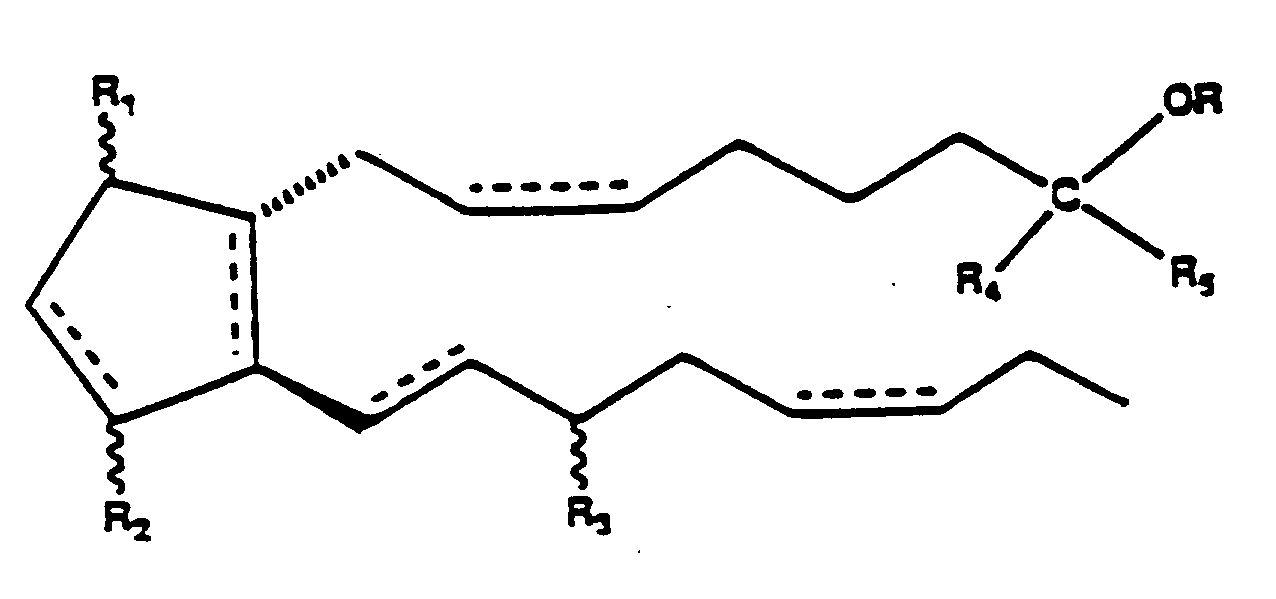
wherein the wavy line attachments indicate either alpha (α) or beta (β) configuration; hatched lines indicate α configuration, solid triangles are used to indicate β configuration; the dashed bonds represent a single bond or a double bond which can be in the cis or trans configuration; R is an aliphatic hydrocarbon group having from 1 to 6 carbon atoms; R₁, R₂ and R₃ are each -OH; R₄ and R₅ independently are hydrogen, or an aliphatic hydrocarbon group having from 1 to 6 carbon atoms; or a pharmaceutically acceptable salt thereof, comprising removing the protecting groups X from a compound of formula (IV)
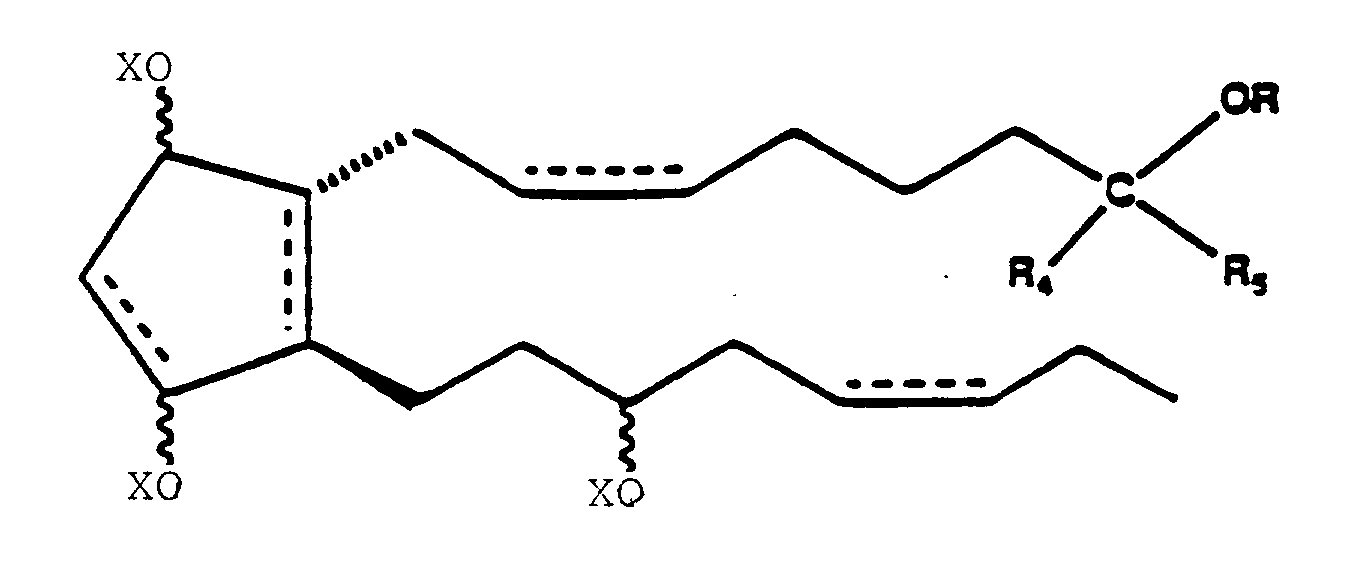
wherein the wavy line attachments indicate either alpha (α) or beta (β) configuration; hatched lines indicate α configuration, solid triangles are used to indicate β configuration; the dashed bonds represent a single bond or a double bond which can be in the cis or trans configuration; R is an aliphatic hydrocarbon group having from 1 to 6 carbon atoms; R₁, R₂ and R₃ are each -OH; R₄ and R₅ independently are hydrogen, or an aliphatic hydrocarbon group having from 1 to 6 carbon atoms; or a pharmaceutically acceptable salt thereof, comprising removing the protecting groups X from a compound of formula (IV)
2. The method according to Claim 1, wherein the compound of formula (I) is selected from
the group consisting of naturally occurring prostaglandins of the D, E and F series.
3. The method according to Claim 1, in which R is alkyl having from 1 to 6 carbon atoms,
and both R₄ and R₅ are hyrdogen.
4. The method according to Claim 3, in which R is methyl, and R₄ and R₅ are hydrogen,
2-decarboxyl-2-methoxymethyl PGF2α.
5. A method for preparing a pharmaceutical composition for the treatment of ocular hypertension,
comprising combining an amount sufficient to treat ocular hypertension of a compound
of formula (I)
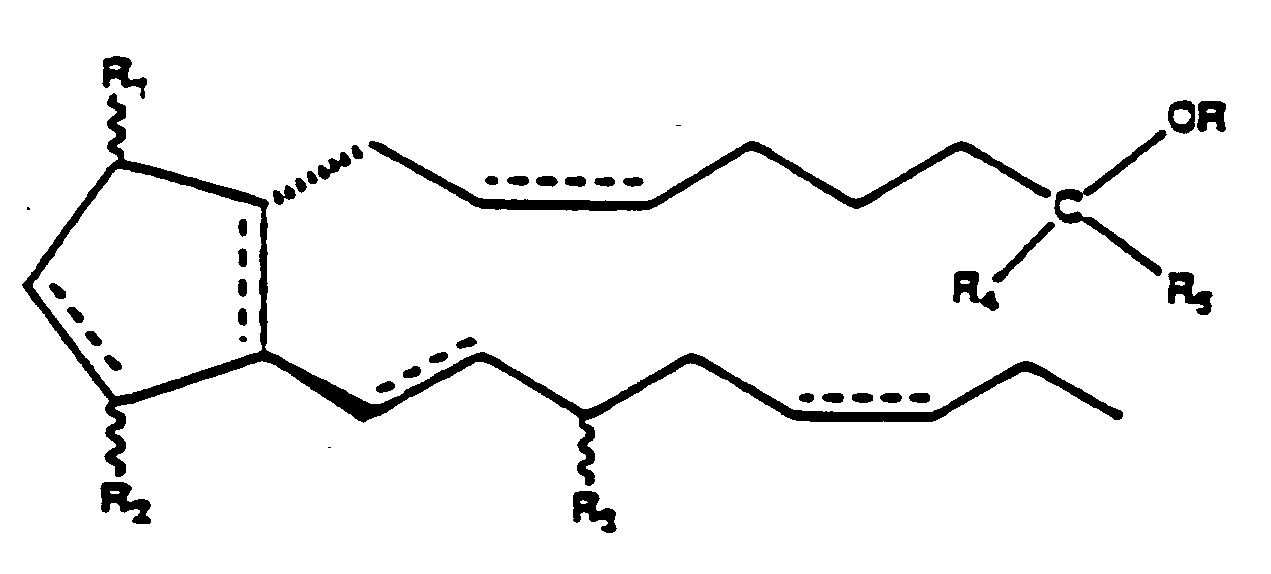
wherein the wavy line attachments indicate either alpha (α) or beta (β) configuration; hatched lines indicate α configuration, solid triangles are used to indicate β configuration; the dashed bonds represent a single bond or a double bond which can be in cis or trans configuration; R is an aliphatic hydrocarbon group having from 1 to 6 carbon atoms; one of R₁ and R₂ is =O, -OH or an -O(CO)R₆ group, and the other one is -OH or an -O(CO)R₆ group, or R₁ is =O and R₂ is H; R₃ is -OH or -O(CO)R₆; R₄ and R₅ independently are hydrogen, or an aliphatic hydrocarbon group having from 1 to 6 carbon atoms; R₆ is a saturated or unsaturated acyclic hydrocarbon group having from 1 to 20 carbon atoms, or -(CH₂)nR₇ wherein n is 0-10, and R₇ is an aliphatic ring from 3 to 7 carbon atoms, or an aromatic or heteroaromatic ring; or a pharmaceutically acceptable salt thereof, with ophthalmically acceptable pharmaceutical excipients.
wherein the wavy line attachments indicate either alpha (α) or beta (β) configuration; hatched lines indicate α configuration, solid triangles are used to indicate β configuration; the dashed bonds represent a single bond or a double bond which can be in cis or trans configuration; R is an aliphatic hydrocarbon group having from 1 to 6 carbon atoms; one of R₁ and R₂ is =O, -OH or an -O(CO)R₆ group, and the other one is -OH or an -O(CO)R₆ group, or R₁ is =O and R₂ is H; R₃ is -OH or -O(CO)R₆; R₄ and R₅ independently are hydrogen, or an aliphatic hydrocarbon group having from 1 to 6 carbon atoms; R₆ is a saturated or unsaturated acyclic hydrocarbon group having from 1 to 20 carbon atoms, or -(CH₂)nR₇ wherein n is 0-10, and R₇ is an aliphatic ring from 3 to 7 carbon atoms, or an aromatic or heteroaromatic ring; or a pharmaceutically acceptable salt thereof, with ophthalmically acceptable pharmaceutical excipients.
6. The method according to Claim 5, wherein said compound is selected from the group
consisting of naturally occurring prostaglandins of the D, E and F series.
7. The method according to Claim 6, wherein said compound has the formula (II)
wherein R, R₃, R₄ and R₅ are as defined in Claim 5, and R₁/R₂ is -OH/-OH, =O/-OH, -OH/=O, or an -O(CO)R₆ ester thereof.
wherein R, R₃, R₄ and R₅ are as defined in Claim 5, and R₁/R₂ is -OH/-OH, =O/-OH, -OH/=O, or an -O(CO)R₆ ester thereof.
8. The method according to Claim 7, wherein said compound is a PGF2α derivative of the formula (III)
wherein R, R₄ and R₅ are as defined in Claim 5.
wherein R, R₄ and R₅ are as defined in Claim 5.
9. The method according to Claim 8, in which in formula (III) R is alkyl having from
1 to 6 carbon atoms, and both R₄ and R₅ are hydrogen.
10. The method according to Claim 9, in which in formula (III) R is methyl, and R₄ and
R₅ are hydrogen, 2-decarboxyl-2-methoxymethyl PGF2α.
11. A method for preparing an ophthalmic solution for the treatment of ocular hypertension,
comprising combining an amount sufficient to treat ocular hypertension of a compound
of formula (I) according to Claim 5, with a non-toxic ophthalmically acceptable liquid
vehicle, and packaging said ophthalmic solution in a container suitable for metered
application.
12. The method for preparing an ophthalmic solution according to Claim 11, wherein said
compound is a PGF2α derivative.
13. The method for preparing an ophthalmic solution according to Claim 12, wherein said
PGF2α derivative is 2-decarboxyl-2-methoxymethyl PGF2α.
Patentansprüche für folgende(n) Vertragsstaat(en): AT, BE, CH, DE, DK, FR, GB, GR,
IT, LI, LU, MC, NL, SE
1. Verbindung mit der allgemeinen Formel (I)
in der geschlängelte Bindungsstriche entweder alpha (α)- oder beta (β)-Konfiguration, schraffierte Bindungsstriche α-Konfiguration und ausgefüllte Dreiecke β-Konfiguration bedeuten; in der weiterhin die gestrichelten Bindungen eine Einfachbindung oder eine Doppelbindung mit cis- oder trans-Konfiguration darstellen; in der ferner R einen aliphatischen Kohlenwasserstoff-Rest mit 1 bis 6 C-Atomen bedeutet, entweder einer der Reste R₁ und R₂ =O, -OH oder eine -O(CO)R₆-Gruppe und der andere Rest -OH oder eine - O(CO)R₆-Gruppe bedeutet oder R₁ =O und R₂ H bedeutet, R₃ - OH oder eine -O(CO)R₆-Gruppe bedeutet, R₄ und R₅ unabhängig voneinander Wasserstoff oder einen aliphatischen Kohlenwasserstoff-Rest mit 1 bis 6 C-Atomen bedeuten, R₆ einen gesättigten oder ungesättigten acyclischen Kohlenwasserstoff-Rest mit 1 bis 20 C-Atomen oder eine -(CH₂)nR₇-Gruppe bedeutet, in welcher n = 0-10 ist und R₇ einen aliphatischen Ring mit 3 bis 7 C-Atomen oder einen aromatischen oder heteroaromatischen Ring bedeutet; oder ein pharmazeutisch akzeptables Salz dieser Verbindung.
in der geschlängelte Bindungsstriche entweder alpha (α)- oder beta (β)-Konfiguration, schraffierte Bindungsstriche α-Konfiguration und ausgefüllte Dreiecke β-Konfiguration bedeuten; in der weiterhin die gestrichelten Bindungen eine Einfachbindung oder eine Doppelbindung mit cis- oder trans-Konfiguration darstellen; in der ferner R einen aliphatischen Kohlenwasserstoff-Rest mit 1 bis 6 C-Atomen bedeutet, entweder einer der Reste R₁ und R₂ =O, -OH oder eine -O(CO)R₆-Gruppe und der andere Rest -OH oder eine - O(CO)R₆-Gruppe bedeutet oder R₁ =O und R₂ H bedeutet, R₃ - OH oder eine -O(CO)R₆-Gruppe bedeutet, R₄ und R₅ unabhängig voneinander Wasserstoff oder einen aliphatischen Kohlenwasserstoff-Rest mit 1 bis 6 C-Atomen bedeuten, R₆ einen gesättigten oder ungesättigten acyclischen Kohlenwasserstoff-Rest mit 1 bis 20 C-Atomen oder eine -(CH₂)nR₇-Gruppe bedeutet, in welcher n = 0-10 ist und R₇ einen aliphatischen Ring mit 3 bis 7 C-Atomen oder einen aromatischen oder heteroaromatischen Ring bedeutet; oder ein pharmazeutisch akzeptables Salz dieser Verbindung.
2. Verbindung nach Anspruch 1, die aus der Gruppe bestehend aus natürlich vorkommenden
Prostaglandinen der D-, E- und F-Serie ausgewählt ist.
3. Verbindung nach Anspruch 2 mit der allgemeinen Formel (II)
in der R, R₃, R₄ und R₅ die in Anspruch 1 definierte Bedeutung haben und R₁/R₂ -OH/-OH, =O/-OH, -OH/=O oder einen -O(CO)R₆-Ester davon bedeuten.
in der R, R₃, R₄ und R₅ die in Anspruch 1 definierte Bedeutung haben und R₁/R₂ -OH/-OH, =O/-OH, -OH/=O oder einen -O(CO)R₆-Ester davon bedeuten.
4. Verbindung nach Anspruch 3, die ein PGF2α-Derivat mit der allgemeinen Formel (III)
ist, in der R, R₄ und R₅ die in Anspruch 1 definierte Bedeutung haben.
ist, in der R, R₄ und R₅ die in Anspruch 1 definierte Bedeutung haben.
5. Verbindung nach Anspruch 4, in der R einen Alkylrest mit 1 bis 6 C-Atomen und R₄ und
R₅ Wasserstoff bedeuten.
6. Verbindung nach Anspruch 5, in der R einen Methylrest und R₄ und R₅ Wasserstoff bedeuten,
nämlich 2-Decarboxyl-2-methoxymethyl-PGF2α.
7. Pharmazeutische Zusammensetzung zur Behandlung von erhöhtem Augeninnendruck, die eine
zur Behandlung von erhöhtem Augeninnendruck ausreichende Menge einer Verbindung mit
der allgemeinen Formel (I)
enthält, in der geschlängelte Bindungsstriche entweder alpha (α)- oder beta (β)-Konfiguration, schraffierte Bindungsstriche α-Konfiguration und ausgefüllte Dreiecke β-Konfiguration bedeuten; in der weiterhin die gestrichelten Bindungen eine Einfachbindung oder eine Doppelbindung mit cis- oder trans-Konfiguration darstellen; in der ferner R einen aliphatischen Kohlenwasserstoff-Rest mit 1 bis 6 C-Atomen bedeutet, entweder einer der Reste R₁ und R₂ =O, -OH oder eine - O(CO)R₆-Gruppe und der andere Rest -OH oder eine -O(CO)R₆-Gruppe bedeutet oder R₁ =O und R₂ H bedeutet, R₃ -OH oder eine -O(CO)R₆-Gruppe bedeutet, R₄ und R₅ unabhängig voneinander Wasserstoff oder einen aliphatischen Kohlenwasserstoff-Rest mit 1 bis 6 C-Atomen bedeuten, R₆ einen gesättigten oder ungesättigten acyclischen Kohlenwasserstoff-Rest mit 1 bis 20 C-Atomen oder eine - (CH₂)nR₇-Gruppe bedeutet, in welcher n = 0-10 ist und R₇ einen aliphatischen Ring mit 3 bis 7 C-Atomen oder einen aromatischen oder heteroaromatischen Ring bedeutet; oder ein pharmazeutisch akzeptables Salz dieser Verbindung.
enthält, in der geschlängelte Bindungsstriche entweder alpha (α)- oder beta (β)-Konfiguration, schraffierte Bindungsstriche α-Konfiguration und ausgefüllte Dreiecke β-Konfiguration bedeuten; in der weiterhin die gestrichelten Bindungen eine Einfachbindung oder eine Doppelbindung mit cis- oder trans-Konfiguration darstellen; in der ferner R einen aliphatischen Kohlenwasserstoff-Rest mit 1 bis 6 C-Atomen bedeutet, entweder einer der Reste R₁ und R₂ =O, -OH oder eine - O(CO)R₆-Gruppe und der andere Rest -OH oder eine -O(CO)R₆-Gruppe bedeutet oder R₁ =O und R₂ H bedeutet, R₃ -OH oder eine -O(CO)R₆-Gruppe bedeutet, R₄ und R₅ unabhängig voneinander Wasserstoff oder einen aliphatischen Kohlenwasserstoff-Rest mit 1 bis 6 C-Atomen bedeuten, R₆ einen gesättigten oder ungesättigten acyclischen Kohlenwasserstoff-Rest mit 1 bis 20 C-Atomen oder eine - (CH₂)nR₇-Gruppe bedeutet, in welcher n = 0-10 ist und R₇ einen aliphatischen Ring mit 3 bis 7 C-Atomen oder einen aromatischen oder heteroaromatischen Ring bedeutet; oder ein pharmazeutisch akzeptables Salz dieser Verbindung.
8. Zusammensetzung nach Anspruch 7, in der die Verbindung aus der Gruppe bestehend aus
natürlich vorkommenden Prostaglandinen der D-, E- und F-Serie ausgewählt ist.
9. Zusammensetzung nach Anspruch 8, in der die Verbindung die allgemeine Formel (II)
aufweist, in der R, R₃, R₄ und R₅ die in Anspruch 7 definierte Bedeutung haben und R₁/R₂ -OH/-OH, =O/-OH, - OH/=O oder einen -O(CO)R₆-Ester davon bedeuten.
aufweist, in der R, R₃, R₄ und R₅ die in Anspruch 7 definierte Bedeutung haben und R₁/R₂ -OH/-OH, =O/-OH, - OH/=O oder einen -O(CO)R₆-Ester davon bedeuten.
10. Zusammensetzung nach Anspruch 9, in der die Verbindung ein PGF2α-Derivat mit der allgemeinen Formel (III)
ist, in der R, R₄ und R₅ die in Anspruch 7 definierte Bedeutung haben.
ist, in der R, R₄ und R₅ die in Anspruch 7 definierte Bedeutung haben.
11. Zusammensetzung nach Anspruch 10, in der in der allgemeinen Formel (III) R einen Alkylrest
mit 1 bis 6 C-Atomen und R₄ und R₅ Wasserstoff bedeuten.
12. Zusammensetzung nach Anspruch 11, in der in der allgemeinen Formel (III) R einen Methylrest
und R₄ und R₅ Wasserstoff bedeuten, nämlich 2-Decarboxyl-2-methoxymethyl-PGF2α.
13. Ophthalmische Lösung zur Behandlung von erhöhtem Augeninnendruck, die eine zur Behandlung
von erhöhtem Augeninnendruck ausreichende Menge einer Verbindung mit der allgemeinen
Formel (I) nach Anspruch 1 mit einem Zusatz eines nicht-toxischen, ophthalmisch akzeptablen
flüssigen Trägers enthält und in einem für eine dosierte Anwendung geeigneten Behälter
verpackt ist.
14. Ophthalmische Lösung nach Anspruch 13, in der die Verbindung ein PGF2α-Derivat ist.
15. Ophthalmische Lösung nach Anspruch 14, in der das PGF2α-Derivat 2-decarboxyl-2-methoxymethyl-PGF2α ist.
16. Pharmazeutisches Produkt mit einem zur Abgabe seines Inhalts in dosierter Form geeigneten
Behälter und einer darin befindlichen ophthalmischen Lösung nach Anspruch 13.
Patentansprüche für folgende(n) Vertragsstaat(en): ES
1. Verfahren zur Herstellung einer Verbindung mit der allgemeinen Formel (I)
in der geschlängelte Bindungsstriche entweder alpha (α)-oder beta (β)-Konfiguration, schraffierte Bindungsstriche α-Konfiguration und ausgefüllte Dreiecke β-Konfiguration bedeuten; in der weiterhin die gestrichelten Bindungen eine Einfachbindung oder eine Doppelbindung mit cis- oder trans-Konfiguration darstellen; in der ferner R einen aliphatischen Kohlenwasserstoff-Rest mit 1 bis 6 C-Atomen bedeutet, R₁, R₂ und R₃ jeweils -OH bedeuten, R₄ und R₅ unabhängig voneinander entweder Wasserstoff oder einen aliphatischen Kohlenwasserstoff-Rest mit 1 bis 6 C-Atomen bedeuten; oder ein pharmazeutisch akzeptables Salz dieser Verbindung; wobei das Verfahren die Entfernung der Schutzgruppen X aus einer Verbindung mit der allgemeinen Formel (IV)
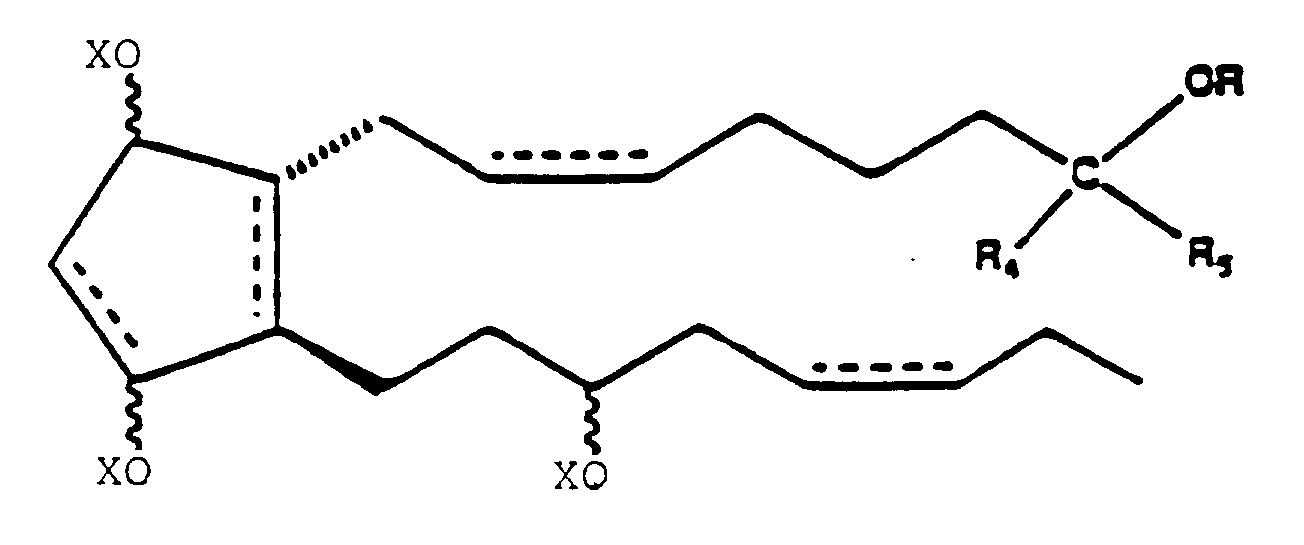
beinhaltet.
in der geschlängelte Bindungsstriche entweder alpha (α)-oder beta (β)-Konfiguration, schraffierte Bindungsstriche α-Konfiguration und ausgefüllte Dreiecke β-Konfiguration bedeuten; in der weiterhin die gestrichelten Bindungen eine Einfachbindung oder eine Doppelbindung mit cis- oder trans-Konfiguration darstellen; in der ferner R einen aliphatischen Kohlenwasserstoff-Rest mit 1 bis 6 C-Atomen bedeutet, R₁, R₂ und R₃ jeweils -OH bedeuten, R₄ und R₅ unabhängig voneinander entweder Wasserstoff oder einen aliphatischen Kohlenwasserstoff-Rest mit 1 bis 6 C-Atomen bedeuten; oder ein pharmazeutisch akzeptables Salz dieser Verbindung; wobei das Verfahren die Entfernung der Schutzgruppen X aus einer Verbindung mit der allgemeinen Formel (IV)
beinhaltet.
2. Verfahren nach Anspruch 1, bei dem die Verbindung mit der allgemeinen Formel (I) aus
der Gruppe bestehend aus natürlich vorkommenden Prostaglandinen der D-, E- und F-Serie
ausgewählt ist.
3. Verfahren nach Anspruch 1, bei dem R einen Alkylrest mit 1 bis 6 C-Atomen und R₄ und
R₅ Wasserstoff bedeuten.
4. Verfahren nach Anspruch 3, bei dem R einen Methylrest und R₄ und R₅ Wasserstoff bedeuten,
nämlich 2-Decarboxyl-2-methoxymethyl-PGF2α.
5. Verfahren zur Herstellung einer pharmazeutischen Zusammensetzung zur Behandlung von
erhöhtem Augeninnendruck, das die Mischung einer zur Behandlung von erhöhtem Augeninnendruck
ausreichenden Menge einer Verbindung mit der allgemeinen Formel (I)
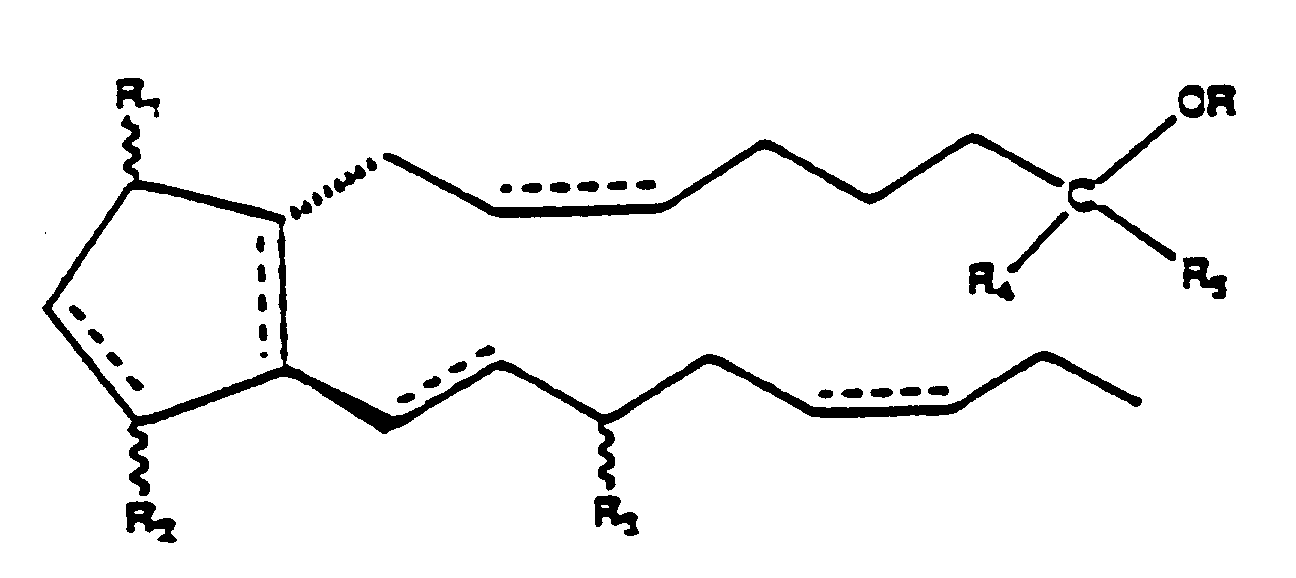
in der geschlängelte Bindungsstriche entweder alpha (α)- oder beta (β)-Konfiguration, schraffierte Bindungsstriche α-Konfiguration und ausgefüllte Dreiecke β-Konfiguration bedeuten; in der weiterhin die gestrichelten Bindungen eine Einfachbindung oder eine Doppelbindung mit cis- oder trans-Konfiguration darstellen; in der ferner R einen aliphatischen Kohlenwasserstoff-Rest mit 1 bis 6 C-Atomen bedeutet, entweder einer der Reste R₁ und R₂ =O, -OH oder eine -O(CO)R₆-Gruppe und der andere Rest -OH oder eine - O(CO)R₆-Gruppe bedeutet oder R₁ =O und R₂ H bedeutet, R₃ - OH oder eine -O(CO)R₆-Gruppe bedeutet, R₄ und R₅ unabhängig voneinander Wasserstoff oder einen aliphatischen Kohlenwasserstoff-Rest mit 1 bis 6 C-Atomen bedeuten, R₆ einen gesättigten oder ungesättigten acyclischen Kohlenwasserstoff-Rest mit 1 bis 20 C-Atomen oder eine -(CH₂)nR₇-Gruppe bedeutet, in welcher n = 0-10 ist und R₇ einen aliphatischen Ring mit 3 bis 7 C-Atomen oder einen aromatischen oder heteroaromatischen Ring bedeutet, oder eines pharmazeutisch akzeptablen Salzes dieser Verbindung mit ophthalmisch akzeptablen pharmazeutischen Trägersubstanzen beinhaltet.
in der geschlängelte Bindungsstriche entweder alpha (α)- oder beta (β)-Konfiguration, schraffierte Bindungsstriche α-Konfiguration und ausgefüllte Dreiecke β-Konfiguration bedeuten; in der weiterhin die gestrichelten Bindungen eine Einfachbindung oder eine Doppelbindung mit cis- oder trans-Konfiguration darstellen; in der ferner R einen aliphatischen Kohlenwasserstoff-Rest mit 1 bis 6 C-Atomen bedeutet, entweder einer der Reste R₁ und R₂ =O, -OH oder eine -O(CO)R₆-Gruppe und der andere Rest -OH oder eine - O(CO)R₆-Gruppe bedeutet oder R₁ =O und R₂ H bedeutet, R₃ - OH oder eine -O(CO)R₆-Gruppe bedeutet, R₄ und R₅ unabhängig voneinander Wasserstoff oder einen aliphatischen Kohlenwasserstoff-Rest mit 1 bis 6 C-Atomen bedeuten, R₆ einen gesättigten oder ungesättigten acyclischen Kohlenwasserstoff-Rest mit 1 bis 20 C-Atomen oder eine -(CH₂)nR₇-Gruppe bedeutet, in welcher n = 0-10 ist und R₇ einen aliphatischen Ring mit 3 bis 7 C-Atomen oder einen aromatischen oder heteroaromatischen Ring bedeutet, oder eines pharmazeutisch akzeptablen Salzes dieser Verbindung mit ophthalmisch akzeptablen pharmazeutischen Trägersubstanzen beinhaltet.
6. Verfahren nach Anspruch 5, bei dem die Verbindung aus der Gruppe bestehend aus natürlich
vorkommenden Prostaglandinen der D-, E- und F-Serie ausgewählt ist.
7. Verfahren nach Anspruch 6, bei dem die Verbindung die allgemeine Formel (II)
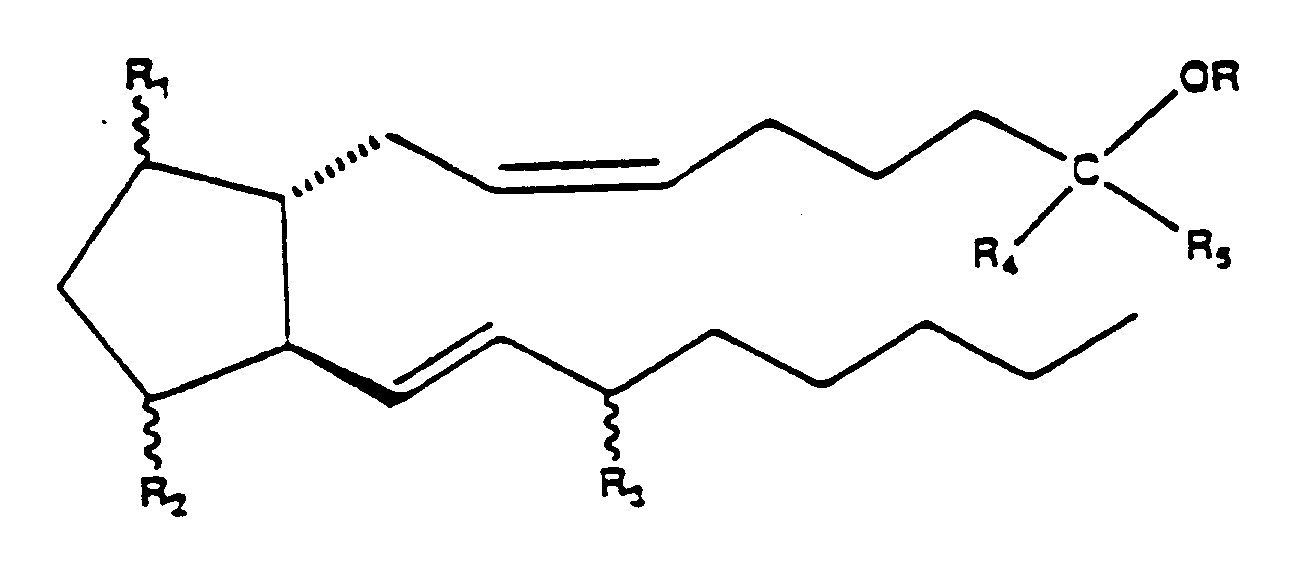
aufweist, in der R, R₃, R₄ und R₅ die in Anspruch 5 definierte Bedeutung haben und R₁/R₂ -OH/-OH, =O/-OH, - OH/=O oder einen -O(CO)R₆-Ester davon bedeuten.
aufweist, in der R, R₃, R₄ und R₅ die in Anspruch 5 definierte Bedeutung haben und R₁/R₂ -OH/-OH, =O/-OH, - OH/=O oder einen -O(CO)R₆-Ester davon bedeuten.
8. Verfahren nach Anspruch 7, bei dem die Verbindung ein PGF2α-Derivat mit der allgemeinen Formel (III)
ist, in der R, R₄ und R₆ die in Anspruch 5 definierte Bedeutung haben.
ist, in der R, R₄ und R₆ die in Anspruch 5 definierte Bedeutung haben.
9. Verfahren nach Anspruch 8, bei dem in der allgemeinen Formel (III) R einen Alkylrest
mit 1 bis 6 C-Atomen und R₄ und R₅ Wasserstoff bedeuten.
10. Verfahren nach Anspruch 9, bei dem in der allgemeinen Formel (III) R einen Methylrest
und R₄ und R₅ Wasserstoff bedeuten, nämlich 2-Decarboxyl-2-methoxymethyl-PGF2α.
11. Verfahren zur Herstellung einer ophthalmischen Lösung zur Behandlung von erhöhtem
Augeninnendruck, das die Mischung einer zur Behandlung von erhöhtem Augeninnendruck
ausreichenden Menge einer Verbindung mit der allgemeinen Formel (I) nach Anspruch
5 mit einem nicht-toxischen, ophthalmisch akzeptablen flüssigen Träger und das Verpacken
dieser ophthalmischen Lösung in einem für eine dosierte Anwendung geeigneten Behälter
beinhaltet.
12. Verfahren zur Herstellung einer ophthalmischen Lösung nach Anspruch 11, bei dem die
Verbindung ein PGF2α-Derivat ist.
13. Verfahren zur Herstellung einer ophthalmischen Lösung nach Anspruch 12, bei dem das
PGF2α-Derivat 2-decarboxyl-2-methoxymethyl-PGF2α ist.
Revendications pour l'(les) Etat(s) contractant(s) suivant(s): AT, BE, CH, DE, DK,
FR, GB, GR, IT, LI, LU, MC, NL, SE
1. Composé de formule (I) :
dans laquelle les traits ondulés représentent la configuration soit alpha (α), soit bêta (β); les lignes en pointillés représentent la configuration α, les triangles pleins servent à représenter la configuration β; les liaisons en pointillés représentent une simple liaison ou une double liaison qui peut se trouver en configuration cis ou trans; R est un groupe hydrocarboné aliphatique de 1 à 6 atomes de carbone; l'un de R₁ et R₂ est le radical =O, -OH ou un groupe -O(CO)R₆, et l'autre est le radical -OH ou un groupe -O(CO)R₆, ou R₁ est le radical =O et R₂ est H; R₃ est le radical -OH ou -O(CO)R₆; R₄ et R₅ sont indépendamment l'atome d'hydrogène ou un groupe hydrocarboné aliphatique de 1 à 6 atomes de carbone; R₆ est un groupe hydrocarboné acyclique, saturé ou insaturé, de 1 à 20 atomes de carbone, ou le radical -(CH₂)nR₇ où n est un nombre entier de 0 à 10 et R₇ est un cycle aliphatique de 3 à 7 atomes de carbone, ou un cycle aromatique ou hétéro-aromatique; ou un sel de celui-ci acceptable au plan pharmaceutique.
dans laquelle les traits ondulés représentent la configuration soit alpha (α), soit bêta (β); les lignes en pointillés représentent la configuration α, les triangles pleins servent à représenter la configuration β; les liaisons en pointillés représentent une simple liaison ou une double liaison qui peut se trouver en configuration cis ou trans; R est un groupe hydrocarboné aliphatique de 1 à 6 atomes de carbone; l'un de R₁ et R₂ est le radical =O, -OH ou un groupe -O(CO)R₆, et l'autre est le radical -OH ou un groupe -O(CO)R₆, ou R₁ est le radical =O et R₂ est H; R₃ est le radical -OH ou -O(CO)R₆; R₄ et R₅ sont indépendamment l'atome d'hydrogène ou un groupe hydrocarboné aliphatique de 1 à 6 atomes de carbone; R₆ est un groupe hydrocarboné acyclique, saturé ou insaturé, de 1 à 20 atomes de carbone, ou le radical -(CH₂)nR₇ où n est un nombre entier de 0 à 10 et R₇ est un cycle aliphatique de 3 à 7 atomes de carbone, ou un cycle aromatique ou hétéro-aromatique; ou un sel de celui-ci acceptable au plan pharmaceutique.
2. Composé selon la revendication 1, choisi dans le groupe constitué des prostaglandines
naturelles des séries D, E et F.
3. Composé selon la revendication 2, de formule (II) :
dans laquelle R, R₃, R₄ et R₅ sont tels que définis dans la revendication 1, et R₁/R₂ est -OH/-OH, =O/-OH, -OH/=O, ou un ester -O(CO)R₆ de ceux-ci.
dans laquelle R, R₃, R₄ et R₅ sont tels que définis dans la revendication 1, et R₁/R₂ est -OH/-OH, =O/-OH, -OH/=O, ou un ester -O(CO)R₆ de ceux-ci.
4. Composé selon la revendication 3, qui un dérivé de la PGF2α, de formule (III) :
dans laquelle R, R₄ et R₅ sont tels que définis dans la revendication 1.
dans laquelle R, R₄ et R₅ sont tels que définis dans la revendication 1.
5. Composé selon la revendication 4, dans lequel R est un groupe alcoyle de 1 à 6 atomes
de carbone, et R₄ et R₅ sont tous deux l'atome d'hydrogène.
6. Composé selon la revendication 5, dans lequel R est un groupe méthyle, et R₄ et R₅
sont l'atome d'hydrogène, formant la 2-décarboxyl-2-méthoxyméthyl-PGF2α.
7. Composition pharmaceutique destinée au traitement de l'hypertension oculaire, comprenant
une quantité suffisante pour traiter l'hypertension oculaire d'un composé de formule
(I) :
dans laquelle les traits ondulés représentent soit la configuration alpha (α), soit la configuration bêta (β); les lignes pointillés représentent la configuration α, les triangles pleins servent à représenter la configuration β; les liaisons en pointillés représentent une simple liaison ou une double liaison qui peut se trouver en configuration cis ou trans; R est un groupe hydrocarboné aliphatique de 1 à 6 atomes de carbone; l'un de R₁ et R₂ est le radical =O, -OH ou un groupe -O(CO)R₆ et l'autre est le radical -OH ou un groupe -O(CO)R₆, ou R₁ est le radical =O et R₂ est H; R₃ est le radical -OH ou -O(CO)R₆; R₄ et R₅ sont indépendamment l'atome d'hydrogène ou un groupe hydrocarboné aliphatique de 1 à 6 atomes de carbone; R₆ est un groupe hydrocarboné acyclique, saturé ou insaturé, de 1 à 20 atomes de carbone, ou le radical -(CH₂)nR₇ où n est un nombre entier de 0 à 10, et R₇ est un cycle aliphatique de 3 à 7 atomes de carbone, ou un cycle aromatique ou hétéro-aromatique; ou un sel de celui-ci acceptable au plan pharmaceutique.
dans laquelle les traits ondulés représentent soit la configuration alpha (α), soit la configuration bêta (β); les lignes pointillés représentent la configuration α, les triangles pleins servent à représenter la configuration β; les liaisons en pointillés représentent une simple liaison ou une double liaison qui peut se trouver en configuration cis ou trans; R est un groupe hydrocarboné aliphatique de 1 à 6 atomes de carbone; l'un de R₁ et R₂ est le radical =O, -OH ou un groupe -O(CO)R₆ et l'autre est le radical -OH ou un groupe -O(CO)R₆, ou R₁ est le radical =O et R₂ est H; R₃ est le radical -OH ou -O(CO)R₆; R₄ et R₅ sont indépendamment l'atome d'hydrogène ou un groupe hydrocarboné aliphatique de 1 à 6 atomes de carbone; R₆ est un groupe hydrocarboné acyclique, saturé ou insaturé, de 1 à 20 atomes de carbone, ou le radical -(CH₂)nR₇ où n est un nombre entier de 0 à 10, et R₇ est un cycle aliphatique de 3 à 7 atomes de carbone, ou un cycle aromatique ou hétéro-aromatique; ou un sel de celui-ci acceptable au plan pharmaceutique.
8. Composition selon la revendication 7, dans laquelle ledit composé est choisi dans
le groupe constitué des prostaglandines naturelles des séries D, E et F.
9. Composition selon la revendication 8, dans laquelle ledit composé est de formule (II)
:
dans laquelle R, R₃, R₄ et R₅ sont tels que définis dans la revendication 7, et R₁/R₂ est -OH/-OH, =O/-OH, -OH/=O,ou un ester -O(CO)R₆ de ceux-ci.
dans laquelle R, R₃, R₄ et R₅ sont tels que définis dans la revendication 7, et R₁/R₂ est -OH/-OH, =O/-OH, -OH/=O,ou un ester -O(CO)R₆ de ceux-ci.
10. Composition selon la revendication 9, dans laquelle ledit composé est un dérivé de
PGF2α de formule (III):
dans laquelle R, R₄ et R₅ sont tels que définis dans la revendication 7.
dans laquelle R, R₄ et R₅ sont tels que définis dans la revendication 7.
11. Composition selon la revendication 10, dans laquelle, dans la formule (III), R est
un groupe alcoyle de 1 à 6 atomes de carbone, et R₄ et R₅ sont tous deux l'atome d'hydrogène.
12. Composition selon la revendication 11, dans laquelle, dans la formule (III), R est
un groupe méthyle, et R₄ et R₅ sont l'atome d'hydrogène, formant la 2-décarboxyl-2-méthoxyméthyl-PGF2α.
13. Solution ophtalmique destinée au traitement de l'hypertension oculaire, comprenant
une quantité suffisante pour traiter l'hypertension oculaire d'un composé de formule
(I) selon la revendication 1, mélangée à un véhicule liquide non toxique acceptable
sur le plan ophtalmique, et conditionnée dans un récipient approprié pour une application
dosée.
14. Solution ophtalmique selon la revendication 13, dans laquelle ledit composé est un
dérivé de PGF2α.
15. Solution ophtalmique selon la revendication 14, dans laquelle ledit dérivé de PGF2α est la 2-décarboxyl-2-méthoxyméthyl-PGF2α.
16. Produit pharmaceutique, comprenant :
un récipient adapté pour dispenser son contenu sous forme dosée; et
une solution ophtalmique telle que définie dans la revendication 13 contenue dans ledit récipient.
un récipient adapté pour dispenser son contenu sous forme dosée; et
une solution ophtalmique telle que définie dans la revendication 13 contenue dans ledit récipient.
Revendications pour l'(les) Etat(s) contractant(s) suivant(s): ES
1. Procédé pour préparer un composé de formule (I):
dans laquelle les traits ondulés représentent la configuration soit alpha (α), soit bêta (β); les lignes en pointillés représentent la configuration α, les triangles pleins servent à représenter la configuration β; les liaisons en pointillés représentent une simple liaison ou une double liaison qui peut se trouver en configuration cis ou trans; R est un groupe hydrocarboné aliphatique de 1 à 6 atomes de carbone; R₁, R₂, et R₃ sont chacun le radical -OH; R₄ et R₅ sont indépendamment l'atome d'hydrogène ou un groupe hydrocarboné aliphatique de 1 à 6 atomes de carbone; ou un sel de celui-ci acceptable au plan pharmaceutique, comportant l'enlèvement des groupes protecteurs X d'un composé de formule (IV):
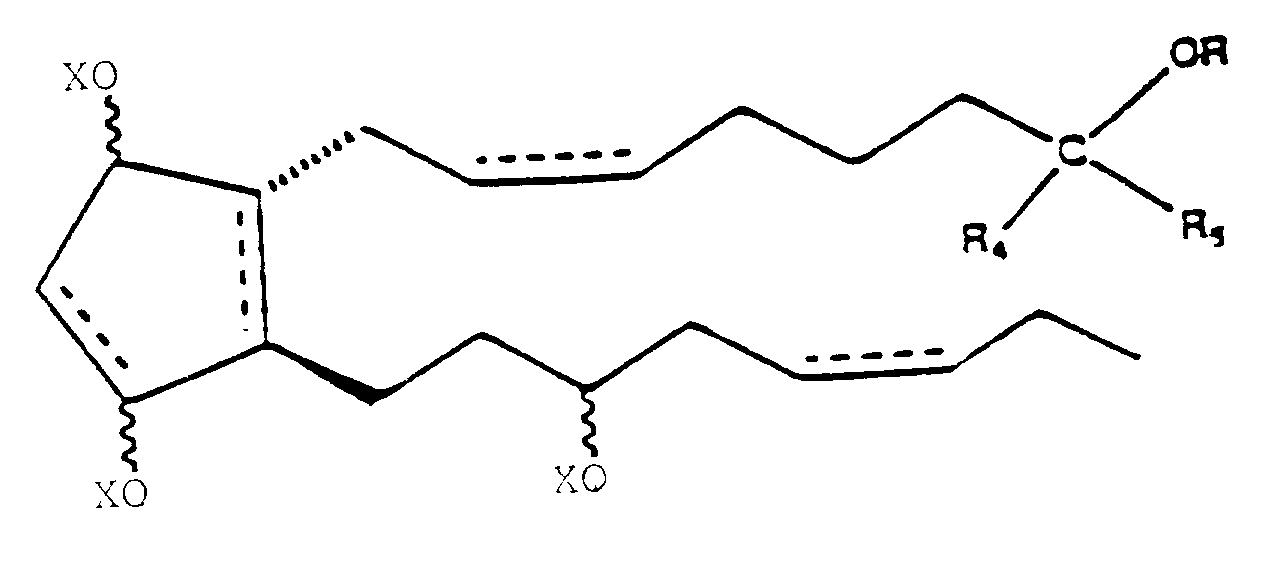
dans laquelle les traits ondulés représentent la configuration soit alpha (α), soit bêta (β); les lignes en pointillés représentent la configuration α, les triangles pleins servent à représenter la configuration β; les liaisons en pointillés représentent une simple liaison ou une double liaison qui peut se trouver en configuration cis ou trans; R est un groupe hydrocarboné aliphatique de 1 à 6 atomes de carbone; R₁, R₂, et R₃ sont chacun le radical -OH; R₄ et R₅ sont indépendamment l'atome d'hydrogène ou un groupe hydrocarboné aliphatique de 1 à 6 atomes de carbone; ou un sel de celui-ci acceptable au plan pharmaceutique, comportant l'enlèvement des groupes protecteurs X d'un composé de formule (IV):
2. Procédé selon la revendication 1, dans lequel le composé de formule (I) est choisi
dans le groupe constitué des prostaglandines naturelles des séries D, E et F.
3. Procédé selon la revendication 1, dans lequel R est un groupe alcoyle de 1 à 6 atomes
de carbone, et R₄ et R₅ sont tous deux l'atome d'hydrogène.
4. Procédé selon la revendication 3, dans lequel R est un groupe méthyle, et R₄ et R₅
sont l'atome d'hydrogène, formant la 2-décarboxyl-2-méthoxyméthyl-PGF2α.
5. Procédé pour préparer une composition pharmaceutique destinée au traitement de l'hypertension
oculaire, comprenant la combinaison d'une quantité suffisante pour traiter l'hypertension
oculaire d'un composé de formule (I):
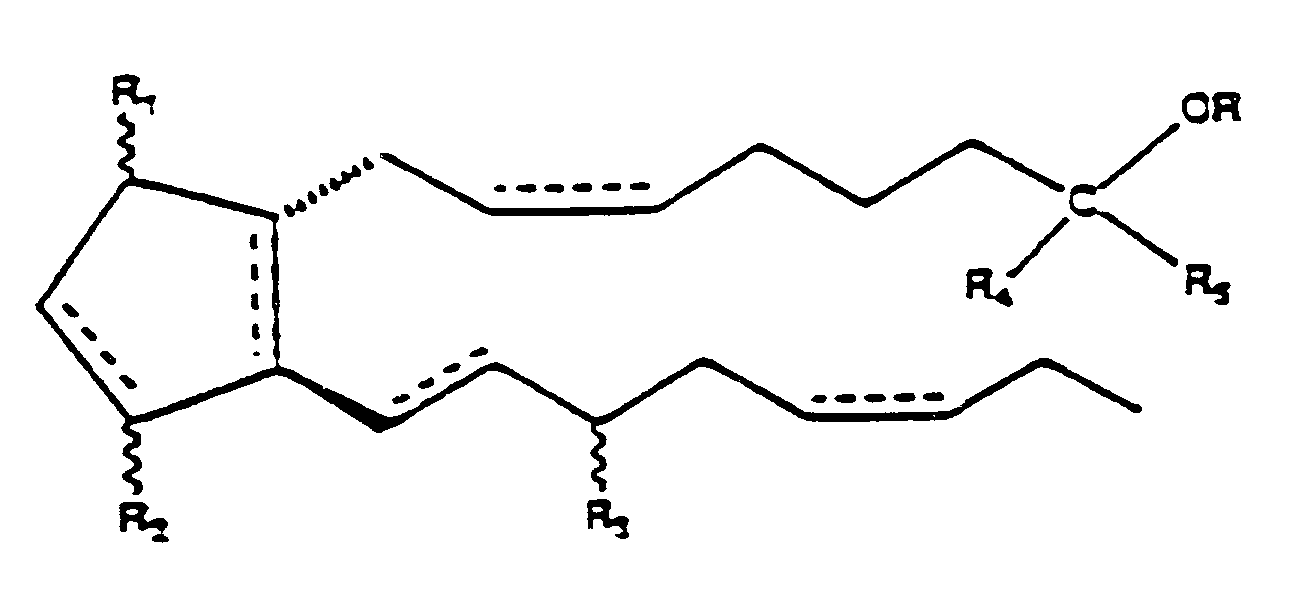
dans laquelle les traits ondulés représentent soit la configuration alpha (α), soit la configuration bêta (β); les lignes pointillés représentent la configuration α, les triangles pleins servent à représenter la configuration β; les liaisons en pointillés représentent une simple liaison ou une double liaison qui peut se trouver en configuration cis ou trans; R est un groupe hydrocarboné aliphatique de 1 à 6 atomes de carbone; l'un de R₁ et R₂ est le radical =O, -OH ou un groupe -O(CO)R₆ et l'autre est le radical -OH ou un groupe -O(CO)R₆, ou R₁ est le radical =O et R₂ est H; R₃ est le radical -OH ou -O(CO)R₆; R₄ et R₅ sont indépendamment l'atome d'hydrogène ou un groupe hydrocarboné aliphatique de 1 à 6 atomes de carbone; R₆ est un groupe hydrocarboné acyclique, saturé ou insaturé, de 1 à 20 atomes de carbone, ou le radical -(CH₂)nR₇ où n est un nombre entier de 0 à 10, et R₇ est un cycle aliphatique de 3 à 7 atomes de carbone, ou un cycle aromatique ou hétéro-aromatique; ou un sel de celui-ci acceptable au plan pharmaceutique, avec des excipients pharmaceutiques qui sont acceptables sur le plan ophtalmique.
dans laquelle les traits ondulés représentent soit la configuration alpha (α), soit la configuration bêta (β); les lignes pointillés représentent la configuration α, les triangles pleins servent à représenter la configuration β; les liaisons en pointillés représentent une simple liaison ou une double liaison qui peut se trouver en configuration cis ou trans; R est un groupe hydrocarboné aliphatique de 1 à 6 atomes de carbone; l'un de R₁ et R₂ est le radical =O, -OH ou un groupe -O(CO)R₆ et l'autre est le radical -OH ou un groupe -O(CO)R₆, ou R₁ est le radical =O et R₂ est H; R₃ est le radical -OH ou -O(CO)R₆; R₄ et R₅ sont indépendamment l'atome d'hydrogène ou un groupe hydrocarboné aliphatique de 1 à 6 atomes de carbone; R₆ est un groupe hydrocarboné acyclique, saturé ou insaturé, de 1 à 20 atomes de carbone, ou le radical -(CH₂)nR₇ où n est un nombre entier de 0 à 10, et R₇ est un cycle aliphatique de 3 à 7 atomes de carbone, ou un cycle aromatique ou hétéro-aromatique; ou un sel de celui-ci acceptable au plan pharmaceutique, avec des excipients pharmaceutiques qui sont acceptables sur le plan ophtalmique.
6. Procédé selon la revendication 5, dans lequel ledit composé est choisi dans le groupe
constitué des prostaglandines naturelles des séries D, E et F.
7. Procédé selon la revendication 6, dans lequel ledit composé est de formule (II) :
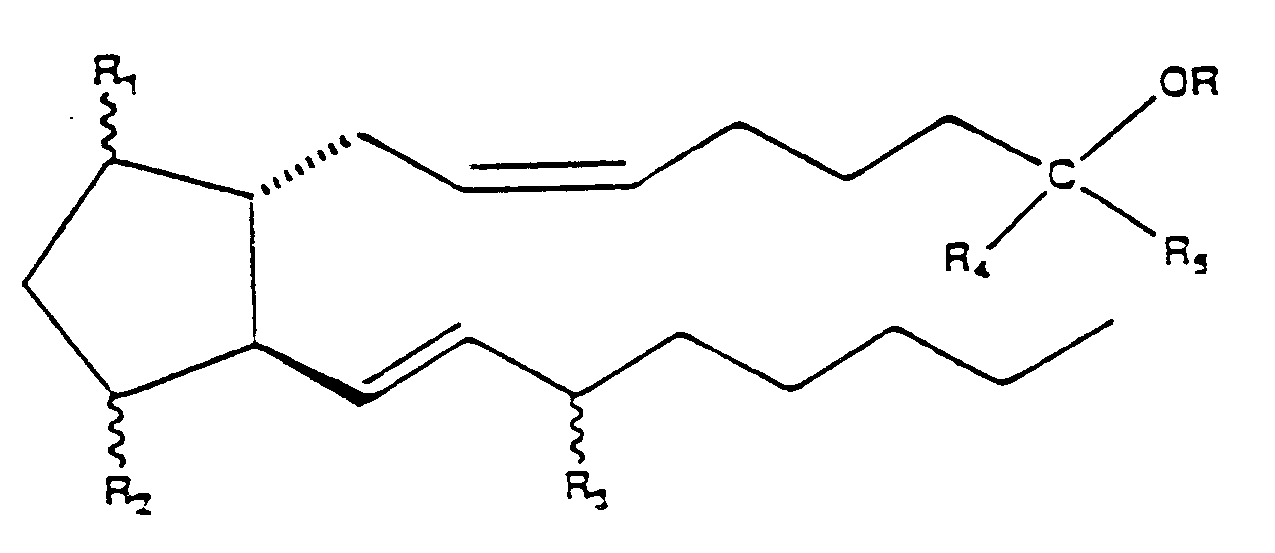
dans laquelle R, R₃, R₄ et R₅ sont tels que définis dans la revendication 5, et R₁/R₂ est -OH/-OH, =O/-OH, -OH/=O ou un ester -O(CO)R₆ de ceux-ci.
dans laquelle R, R₃, R₄ et R₅ sont tels que définis dans la revendication 5, et R₁/R₂ est -OH/-OH, =O/-OH, -OH/=O ou un ester -O(CO)R₆ de ceux-ci.
8. Procédé selon la revendication 7, dans lequel ledit composé est un dérivé de PGF2α de formule (III):
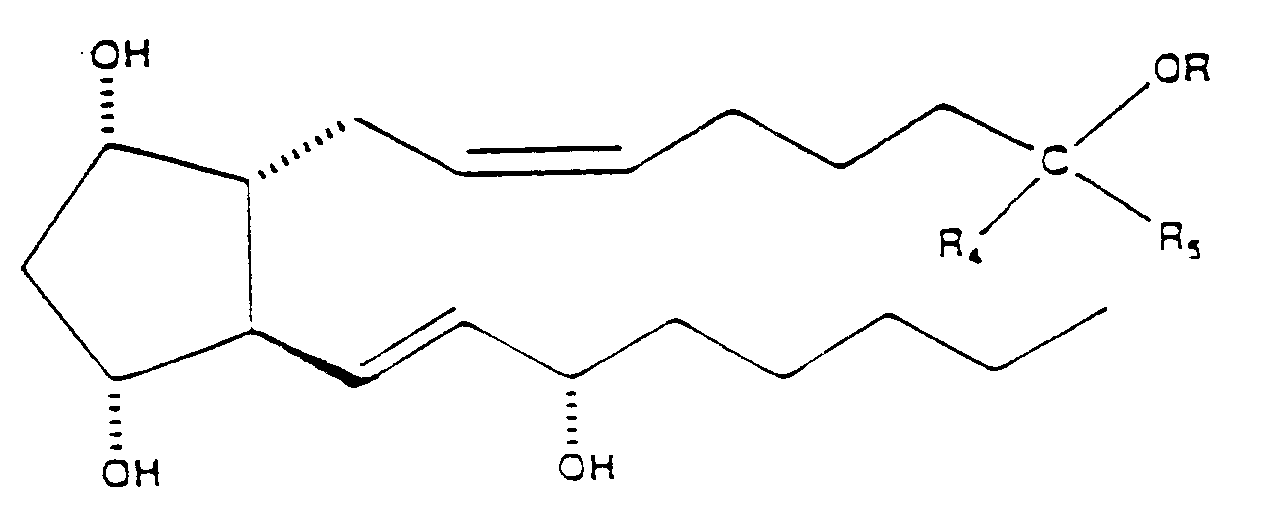
dans laquelle R, R₄ et R₅ sont tels que définis dans la revendication 5.
dans laquelle R, R₄ et R₅ sont tels que définis dans la revendication 5.
9. Procédé selon la revendication 8, dans lequel, dans la formule (III), R est un groupe
alcoyle de 1 à 6 atomes de carbone, et R₄ et R₅ sont tous deux l'atome d'hydrogène.
10. Procédé selon la revendication 9, dans lequel, dans la formule (III), R est un groupe
méthyle, et R₄ et R₅ sont l'atome d'hydrogène, formant la 2-décarboxyl-2-méthoxyméthyl-PGF2α.
11. Procédé pour préparer une solution ophtalmique destinée au traitement de l'hypertension
oculaire, comprenant la combinaison d'une quantité suffisante pour traiter l'hypertension
oculaire d'un composé de formule (I) selon la revendication 5, avec un véhicule liquide
non toxique acceptable sur le plan ophtalmique, et le conditionnement de ladite solution
ophtalmique dans un récipient approprié pour une application dosée.
12. Procédé pour préparer une solution ophtalmique selon la revendication 11, dans lequel
ledit composé est un dérivé de PGF2α.
13. Procédé pour préparer une solution ophtalmique selon la revendication 12, dans lequel
ledit dérivé de PGF2α est la 2-décarboxyl-2-méthoxyméthyl-PGF2α.