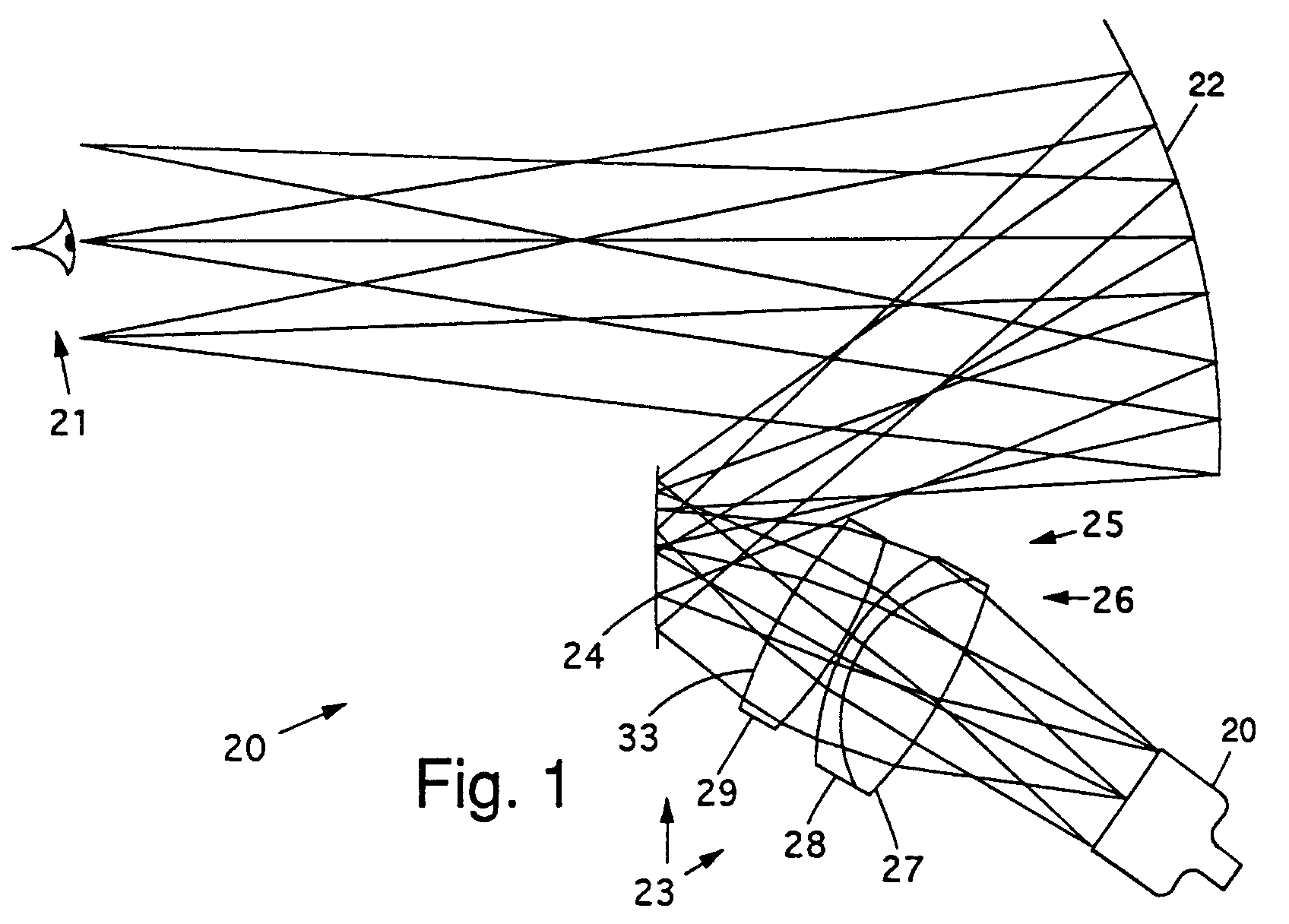
(57) A wide spectral bandwidth virtual image display optical system. The system includes
an image source, a combiner, and a relay group. The relay group is a catatrioptric
relay group that includes a reflective optical element, and a refractive lens group
that includes at least one doublet and a diffractive lens. For some applications,
the catatrioptric relay group may be replaced by a hybrid refractive-diffractive relay
group, thus eliminating the reflective element. The diffractive optical element of
the hybrid optical element is encoded on one side of a lens. The hybrid optical element
forms a refractive/diffractive achromat to provide for primary chromatic aberration
correction. The refractive lens group is also an achromat to provide for chromatic
aberration correction. Power distribution between the hybrid optical element and the
refractive lens group is such that secondary chromatic aberration of the refractive
lens group is balanced out by the secondary chromatic aberration of the hybrid optical
element. The diffractive optical element is desired using higher order wavefront correction
terms encoded on one side to reduce spherochromatism and secondary spherochromatism
of the relay group. One lens may have a conic or an aspherical surface to further
reduce the spherochromatism and secondary spherochromatism. Asymmetrical aberration
and distortion resulting from the combiner are compensated for by the reflective optical
element. To minimize the residual aberration of the optical system, the reflective
optical element is tilted and/or decentered. The system has a relatively wide spectral
bandwidth, has good image quality, has simple optics, is ultracompact, and provides
wide field coverage and large field overlaying.
|
|
