|
(11) | EP 0 566 422 B1 |

| (12) | EUROPEAN PATENT SPECIFICATION |
|
|
| (54) |
Coating composition Überzugzusammensetzung Composition de revêtement |
|
|
|||||||||||||||||||||||||||||||
| Note: Within nine months from the publication of the mention of the grant of the European patent, any person may give notice to the European Patent Office of opposition to the European patent granted. Notice of opposition shall be filed in a written reasoned statement. It shall not be deemed to have been filed until the opposition fee has been paid. (Art. 99(1) European Patent Convention). |
Field of the Invention
[0001] The present invention relates to a coating composition which is free from the formation of aggregates, free from the substantial growth and dislocation of a crystal and excellent in fluidity, and which gives a coating having a clear color tone and high gloss.
Prior Art
[0002] A coating composition containing an organic solvent causes air pollution, etc., and the organic solvent content therefore tends to be decreased. A high-solid coating composition is one typical example of coating compositions whose organic solid contents are decreased. The high-solid coating composition has excellent coating properties, e.g., excellent weatherability over conventional coating compositions, and it reportedly has excellent resistance to acid rain which has been recently taken as one of social issues. The high-solid coating composition is attracting attention as a coating composition for automobiles.
[0003] When the organic solvent content of a coating composition is decreased, the viscosity of the coating composition increases. In order to overcome this problem, the high-solid coating composition is improved by decreasing the molecular weight of a resin constituting the coating composition or by completely etherifying an amino resin. However, there arises another problem that the curing of the coating composition is slow. It is therefore required to promote the curing by adding an acid catalyst or by changing a curing catalyst to a strong acid catalyst.
[0004] An acid-curing coating composition containing an acid catalyst is poor in the stability of a dispersed pigment, and it is therefore desired to develop an effective dispersant for the pigment. A variety of pigment dispersants such as pigment derivatives have been conventionally used. A pigment derivative having a basic substituent is remarkably effective for dispersing a pigment contained in a general coating composition. However, it has been found that the pigment derivative having a basic substituent is not necessarily effective for dispersing a pigment contained in an acid-curing coating composition, since the pigment derivative and an acid catalyst mutually act on each other.
[0005] Further, JP-B-2-35786 discloses an aluminium salt of an anthraquinone derivative having a carboxyl group. However, this salt has been found to have almost no effect on improvement in pigment dispersibility.
[0006] EP-A-0535774 which was published after the present priority date relates to a coating composition comprising a pigment composition prepared from a pigment, an organic dyestuff having a sulfone group and an acid-curing coating composition varnish.
Summary of the Invention
[0007] It is an object of the present invention to provide an acid-curing coating composition which is improved in pigment dispersibility.
[0008] It is another object of the present invention to provide an acid-curing coating composition which is free from the formation of aggregates, free from the substantial growth of a crystal and excellent in fluidity.
[0009] It is further another object of the present invention to provide an acid-curing coating composition which gives a coating having a clear colour tone and high gloss.
[0010] According to the present invention, the above objects and advantages of the present invention are achieved by a coating composition comprising (A) a pigment composition containing 100 parts by weight of a pigment and 0.5 to 30 parts by weight of a sulfonic acid group-containing anthraquinone compound of the following formula or its metal salt, and (B) an acid-curing paint varnish.
[0011] The sulfonic acid-containing anthraquinone compound used in the present invention is a compound of the formula
wherein X is halogen, nitro, amino, hydroxyl or alkyl (for example C1 to C12 alkyl, preferably C1 to C6 alkyl); Y is hydrogen or a metal; k is the valence of Y; m is an integer from 0 to 4; and n is 1 or 2.
[0012] The pigment used in the present invention is selected from those which do not cause any practical problem concerning the various resistances when used in a coating composition such as light resistance, weathering resistance and solvent resistance. Examples of the pigment include organic pigments such as a phthalocyanine pigment, a quinacridone pigment, an isoindolin pigment, a perylene perinon pigment, a dioxazine pigment, a diketopyrropyrrole pigment, an anthraquinone pigment, a benzimidazolone pigment and an azo pigment and inorganic pigments such as carbon black, titanium oxide, Chrome Yellow, cadmium yellow, cadmium red, red iron oxide, black iron oxide, zinc white, iron blue and ultramarine blue. The above pigments may be used alone or in combination.
[0013] Specific examples of the sulfonic acid-containing anthraquinone compound include anthraquinone-1-sulfonic acid, anthraquinone-2-sulfonic acid, anthraquinone-1,5-disulfonic acid, 1-chloroanthraquinone-2-sulfonic acid, 1-nitroanthraquinone-5-sulfonic acid, 1-aminoanthraquinone-5-sulfonic acid, 1-aminoanthraquinone-2-sulfonic acid, 1,4-dihydroxyanthraquinone-2-sulfonic acid and 2-methylanthraquinone-1-sulfonic acid. Examples of the metal salt of the sulfonic acid-containing anthraquinone compound include aluminum salts, calcium salts, strontium salts and barium salts of the above sulfonic acid-containing anthraquinone compounds.
[0014] The sulfonic acid group-containing anthraquinone compound can fully serve to achieve the above objects and advantages of the present invention when at least one sulfone group is substituted on anthraquinone. The other substituent such as a halogen atom, a nitro group, an amino group, a hydroxyl group or an alkyl group when present, has only a slight effect on the achievement of the objects and advantages of the present invention.
[0015] The sulfonic acid group-containing anthraquinone compound in the form of a metal salt can fully serve to achieve the above objects and advantages of the present invention. In particular, a metal salt, e.g., aluminum salt, is advantageous in view of its preparation. That is, the sulfonic acid group-containing anthraquinone compound is generally prepared by introducing a sulfone group into an anthraquinone compound, placing the sulfonic acid group-containing anthraquinone compound in a large amount of water and recovering it by filtration. Since, however, the sulfonic acid group-containing anthraquinone compound has high solubility in water, the filtration takes a long time, or the yield thereof is low. The metal salt of the sulfonic acid group-containing anthraquinone compound shows decreased solubility in water, and the above problem can be overcome.
[0016] In the present invention, the amount of the sulfonic acid-containing anthraquinone compound per 100 parts by weight of the pigment is preferably 0.5 to 30 parts by weight. When this amount is less than 0.5 part by weight, there is little effect on the pigment dispersibility. When it exceeds 30 parts by weight, there can be obtained no further effect.
[0017] The coating composition of the present invention can be produced by a method in which an acid-curing paint varnish and the sulfonic acid group-containing anthraquinone compound are mixed, the mixture is dispersed with a ball mill, a sand mill, or the like, and optionally, additives such as an antisagging agent and a polymer type dispersant are added. It is preferred to prepare a preliminary paste or slurry of the pigment and the sulfonic acid-containing anthraquinone compound. In a preferred embodiment of this mixing, an aqueous solution of a sodium salt of the sulfonic acid group-containing anthraquinone compound is added to a slurry prepared by fully dispersing the pigment in water, and then water-soluble aluminum such as aluminum chloride or aluminum sulfate is added to deposit an aluminum salt of the sulfonic acid group-containing anthraquinone compound on the pigment particle surface.
[0018] When there is used a pigment which requires a process for converting it to a pigment form, e.g., solvent salt milling or dry salt milling, that is, when copper phthalocyanine, quinacridone or dioxazine is used, the sulfonic acid group-containing anthraquinone compound may be added during the process for converting it to a pigment form.
[0019] The acid-curing paint varnish used in the present invention refers to a varnish prepared by adding a solvent and an acid catalyst to a resin composition containing a hydroxyl group-containing resin as a matrix resin and an aminoaldehyde resin as a crosslinking agent.
[0020] Examples of the hdyroxyl group-containing resin include a polyester polyol resin, an alkyd polyol resin, an acryl polyol resin, an epoxy polyol resin and an epoxyester polyol resin.
[0021] The polyester polyol resin is obtained by reacting a polyhydric alcohol having 2 to 6 hydroxyl groups in the molecule, a polybasic acid having 2 to 4 carboxyl groups in the molecule and optionally a monobasic acid or a monohydric alcohol in an esterifiction reaction. The polyhydric alcohol having 2 to 6 carboxylic acid groups in the molecule includes ethylene glycol, polyethylene glycol, neopentyl glycol, 1,6-hexanediol, pentanediol, butylene glycol, 1,5-pentanediol , trimethylolethane, trimethylolpropane, glycerin and pentaerythritol. The polybasic acid having 2 to 4 carboxylic groups in the molecule includes phthalic acid, isophthalic acid, terephthalic acid, maleic acid, methyl terephthalate, tetrahydrophthalic acid, trimellitic acid, pyromellitic acid and anhydrides of these.
[0022] The alkyd polyol resin is obtained by esterifying the above polyhydric alcohol, the above polybasic acid and either an oil fat such as castor oil, linseed oil, sunflower oil, soybean oil, corn oil, cotton seed oil, hempseed oil, rice bran oil, coconut oil or palm oil or fatty acid such as heptanoic acid, octanoic acid, nonanoic acid, decanoic acid or isostearic acid.
[0023] The acryl polyol resin is a homopolymer obtained from a hydroxyl group-containing vinyl monomer or a copolymer obtained from the above hydroxyl group-containing vinyl monomer and any one of alkyl (meth)acrylates such as methyl (meth)acrylate, ethyl (meth)acrylate and propyl (meth)acrylate, carboxyl group-containing monomers such as acrylic acid, methacrylic acid and itaconic acid, styrene monomers such as styrene and α-methylstyrene and vinyl monomers such as acrylonitrile, methacrylonitrile and vinyl acetate. The above hydroxyl group-containing vinyl monomer includes (meth)acrylic acid hydroxyesters such as hydroxyethyl (meth)acrylate and hydroxypropyl (meth)acrylate and adducts of the above (meth)acrylic acid hydroxyesters with ε-caprolactone and γ-valerolactone.
[0024] The epoxy polyol resin includes hydroxyl group-containing resins such as Epikote 828, 1001, 1004 and 1007 supplied by Shell Chemical Co.
[0025] The epoxyester polyol resin is obtained by reacting the above epoxy polyol resin with a monobasic acid or a polybasic acid.
[0026] The hydroxyl group-containing resin used in the acid-curing paint varnish used in the present invention may be prepared by modifying any one of the above polyol resins with an isocyanate compound such as tolylene diisocyanate, hexamethylene diisocyanate or isophorone diisocyanate or a silicone resin.
[0027] The above aminoaldehyde resin is obtained by reacting an amino group-containing compound and an aldehyde compound in an addition-condensation reaction or by modifying the so-obtained condensation product with an alcohol. The above amino group-containing compound includes melamine, urea, acetoguanamine, benzoguanamine, spiroguanamine and steroguanamine. The above aldehyde compound includes formaldehyde, p-formaldehyde, acetaldehyde and glyoxal. Preferred is an aminoaldehyde resin completely etherified with an alcohol having 1 to 4 carbon atoms.
[0028] Specific examples of the aminoaldehyde resin include hexamethyl etherified methylolmelamine, hexabutyl etherified methylolmelamine, methylbutyl etherified methylolmelamine, methyl etherified methylolmelamine, butyl etherified methylolmelamine and isobutyl etherified methylolmelamine.
[0029] In the resin composition used in the acid-curing paint varnish used in the present invention, the hydroxyl group-containing resin/aminoaldehyde resin mixing ratio by weight is 90/10 to 30/70.
[0030] In the resin composition used in the acid-curing paint varnish used in the present invention, the solvent is selected from hydrocarbon solvents, ketone solvents such as methyl ethyl ketone and methyl isobutyl ketone, ester solvents such as ethyl acetate and butyl acetate, ether solvents such as dioxane and ethylene glycol diethyl ether and alcohol solvents such as butanol and propanol. These solvents may be used alone or in combination.
[0031] In the resin composition used in the acid-curing paint varnish used in the present invention, the acid catalyst is selected from sulfonic acid compounds such as p-toluenesulfonic acid, alkylbenzenesulfonic acid and alkylnaphthalenesulfonic acid, phosphoric acid compounds such as metaphosphoric acid, orthophosphoric acid, pyrophosphoric acid, tripolyphosphoric acid, phosphoric acid, trimetaphosphoric acid, triphosphoric acid, tetrametaphosphoric acid, phosphorous acid, monobutylphosphoric acid, monoethylhexylphosphoric acid and monolaurylphosphoric acid, carboxylic acid compounds such as formic acid, oxalic acid, acetic acid and lactic acid, mineral acids such as sulfuric acid and hydrochloric acid, and mineral acid salts such as ammonium chloride.
[0032] The acid-curing coating composition of the present invention is free from the formation of aggregates, free from the substantial growth and dislocation of a crystal and excellent in fluidity, and gives a coating having a clear color tone, high gloss, excellent hardness, excellent weathering resistance and excellent solvent resistance.
Examples
[0033] The present invention will be further explained hereinafter by reference to Examples, in which "part" stands for "part by weight" and "%" stand for "% by weight".
Example 1 and Comparative Example 1
[0034] An acid-curing coating composition was prepared by dispersing 10 parts of C.I. Pigment Red 178 and 0.5 part of anthraquinone-2-sulfonic acid in 83.5 parts of a varnish containing polyester polyol and methyl etherified methylolmelamine as resin components and dodecylbenzenesulfonic acid as an acidic catalyst (Example 1). For comparison, an acid-curing coating composition was also prepared by dispersing 10 parts of C.I. Pigment 178 alone in 90 parts of the same varnish as above (Comparative Example 1). These acid-curing coating compositions were measured for viscosities. Table shows the results. The results in Table show that the coating composition obtained in Example 1 was excellent over the coating composition obtained in Comparative Example 1 in viscosity. Further, a coating obtained from the coating composition obtained in Example 1 was excellent in a coating obtained from the coating composition obtained in Comparative Example 1 in clearness of color tone and gloss.
[0035] Concerning the properties of being free from aggregate formation and noncrystallizability, the coating compositions were examined with regard to stability against color separation, i.e., the degree of pigment precipitation. Each coating composition was separately mixed with a base coating composition of titanium oxide such that the pigment/titanium oxide mixing ratio by weight was 1/10 to prepare tint-color coating compositions. Then, the tint-color coating compositions were diluted with butyl acetate, and each of the so-diluted coating compositions was separately placed in a test tube to observe it. As a result, the coating composition according to the present invention showed less color separation with time than the coating composition obtained in Comparative Example 1.
Example 2
[0036] A slurry was prepared from 100 parts of C.I. Pigment Red 178, 5 parts of anthraquinone-2-sulfonic acid and 2,000 parts of water, and rendered weakly alkaline by adding sodium hydroxide. Then, the slurry was heated up to 60°C, and 4 parts of aluminum sulfate in the form of an aqueous solution was added to convert the anthraquinone-2-sulfonic acid to aluminum salt in the co-presence of the pigment. The reaction mixture was cooled to 10°C, filtered, washed, dried and pulverized to give 105 parts of a mixture containing the pigment and aluminum anthraquinone-2-sulfonate . This mixture was dispersed in the same varnish as that used in Example 1 such that the pigment content is 10 % to give an acid-curing coating composition. The so-obtained coating composition was measured for viscosities, and Table shows the results. The results in Table show that the coating composition obtained in Example 2 was excellent over the coating composition obtained in Comparative Example 1. Further, the coating composition obtained in Example 2 was excellent over the coating composition obtained in Comparative Example 1 in stability against color separation, clearness of color tone of coating and gloss of coating.
Example 3 and Comparative Example 2
[0037] A slurry was prepared from 100 parts of C.I. Pigment Blue 60, 10 parts of 1-chloroanthraquinone-2-sulfonic acid and 2,000 parts of water, and rendered weakly alkaline by adding sodium hydroxide. Then, the slurry was heated up to 60°C, and 8 parts of aluminum chloride in the form of an aqueous solution was added to convert the 1-chloroanthraquinone-2-sulfonic acid to aluminum salt in the co-presence of the pigment. The reaction mixture was cooled to 10°C, filtered, washed, dried and pulverized to give 110 parts of a mixture containing the pigment and aluminum 1-chloroanthraquinone-2-sulfonate. This mixture was dispersed in the same varnish as that used in Example 1 such that the pigment content was 10 %, to give an acid-curing coating composition (Example 3). For comparison, C.I Pigment Blue 60 alone was dispersed in the same varnish as that used in Example 1 such that the pigment content was 10 % to give an acid-curing coating composition (Comparative Example 2). The so-obtained coating compositions were measured for viscosities, and Table shows the results. The results in Table show that the coating composition obtained in Example 3 was excellent over the coating composition obtained in Comparative Example 2. Further, the coating composition obtained in Example 3 was excellent over the coating composition obtained in Comparative Example 2 in stability against color separation, clearness of color tone of coating and gloss of coating.
Examples 4 - 15 and Comparative Examples 3 - 12
[0038] In each Example, a pigment shown in Table and a sulfonic acid compound shown in Table were dispersed in the same varnish as that used in Example 1 such that the pigment content was 10 % to give an acid-curing coating composition. In each Comparative Example, only a pigment shown in Table was dispersed in the same varnish as that used in Example 1 such that the pigment content was 10 % to give an acid-curing coating composition. The so-obtained coating compositions were measured for viscosities, and Table shows the results. The results in Table show that the coating composition according to the present invention is excellent over the comparative coating composition. Further, the coating compositions obtained according to the present invention were excellent over the comparative coating compositions in stability against color separation, clearness of color tone of coating and gloss of coating.
1. A coating composition comprising (A) a pigment composition containing 100 parts by
weight of a pigment and from 0.5 to 30 parts by weight of a sulfonic acid group-containing
anthraquinone compound of the following formula or a metal salt thereof,
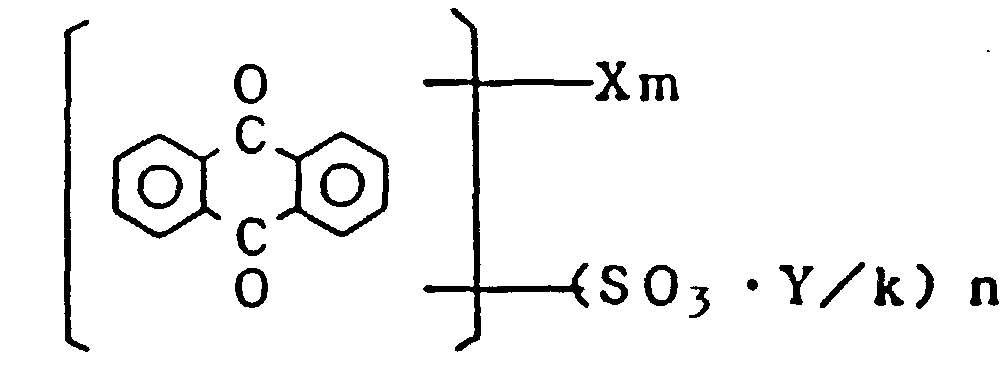
wherein X is halogen, nitro, amino, hydroxyl or alkyl; Y is hydrogen or a metal; k is the valence of Y; m is an integer from 0 to 4; and n is 1 or 2, and (B) an acid-curable paint varnish.
wherein X is halogen, nitro, amino, hydroxyl or alkyl; Y is hydrogen or a metal; k is the valence of Y; m is an integer from 0 to 4; and n is 1 or 2, and (B) an acid-curable paint varnish.
2. A composition according to claim 1, wherein the pigment is an organic pigment and/or
an inorganic pigment.
3. A composition according to claim 1 or 2, wherein the acid-curable paint varnish (B)
comprises a resin composition containing a hydroxyl group-containing resin as a matrix
resin and an aminoaldehyde resin as a crosslinking agent, a solvent and an acid catalyst.
4. A composition according to claim 3, comprising at least one hydroxyl group-containing
resin selected from polyester polyol resins, alkyd polyol resins, acryl polyol resins,
epoxy polyol resins and epoxy ester polyol resins.
5. A composition according to claim 3 or 4, wherein the ratio of hydroxyl group-containing
resin/aminoaldehyde resin is from 90/10 to 30/70 by weight.
6. A composition according to any one of claims 3 to 5, comprising at least one solvent
selected from hydrocarbons, ketones, esters, ethers, and alcohols.
7. A coating composition according to any one of claims 3 to 6, comprising at least one
acid catalyst selected from sulfonic acid compounds, phosphoric acid compounds, carboxylic
acid compounds, mineral acids and mineral acid salts.
1. Beschichtungszusammensetzung, umfassend (A) eine Pigmentzusammensetzung, welche 100
Gewichtsanteile eines Pigments und 0,5 bis 30 Gewichtsanteile einer eine Sulfonsäuregruppe
enthaltenden Anthrachinonverbindung der folgenden Formel oder ein Metallsalz davon
enthält
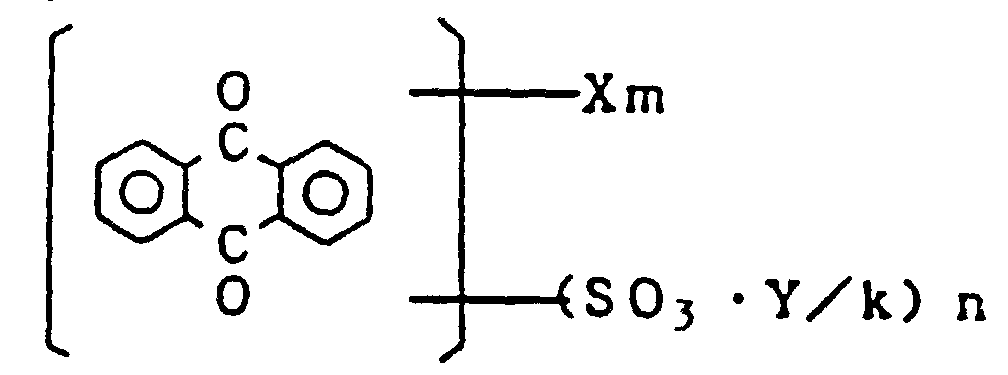
worin X Halogen, Nitro, Amino, Hydroxyl oder Alkyl ist; Y Wasserstoff oder ein Metall ist; k die Wertigkeit von Y ist; m eine ganze Zahl von 0 bis 4 ist; und n 1 oder 2 ist, und (B) einen säurehärtbaren Farblack.
worin X Halogen, Nitro, Amino, Hydroxyl oder Alkyl ist; Y Wasserstoff oder ein Metall ist; k die Wertigkeit von Y ist; m eine ganze Zahl von 0 bis 4 ist; und n 1 oder 2 ist, und (B) einen säurehärtbaren Farblack.
2. Zusammensetzung nach Anspruch 1, worin das Pigment ein organisches Pigment und/oder
ein anorganisches Pigment ist.
3. Zusammensetzung nach Anspruch 1 oder 2, worin der säurehärtbare Farblack (B) eine
Harzzusammensetzung umfaßt, welche ein eine Hydroxylgruppe enthaltendes Harz als ein
Matrixharz und ein Aminoaldehydharz als ein Vernetzungsmittel, ein Lösungsmittel und
einen Säurekatalysator enthält.
4. Zusammensetzung nach Anpruch 3, umfassend mindestens ein eine Hydroxylgruppe enthaltendes
Harz, gewählt aus Polyesterpolyolharzen, Alkydpolyolharzen, Acrylpolyolharzen, Epoxypolyolharzen
und Epoxyesterpolyolharzen.
5. Zusammensetzung nach Anspruch 3 oder 4, worin das Verhältnis des eine Hydroxylgruppe
enthaltenden Harzes/Aminoaldehydharzes von 90/10 bis 30/70 nach Gewicht beträgt.
6. Zusammensetzung nach einem der Ansprüche 3 bis 5, umfassend mindestens ein Lösungsmittel,
gewählt aus Kohlenwasserstoffen, Ketonen, Estern, Ethern und Alkoholen.
7. Beschichtungszusammensetzung nach einem der Ansprüche 3 bis 6, umfassend mindestens
einen Säurekatalysator, gewählt aus Sulfonsäureverbindungen, Phospharsäureverbindungen,
Carboxylsäureverbindungen, Mineralsäuren und Mineralsäuresalzen.
1. Une composition de revêtement comprenant (A) une composition pigmentaire contenant
100 parties en poids d'un pigment et 0,5 à 30 parties en poids d'un composé d'anthraquinone
contenant un groupe acide sulfonique de la formule suivante ou un sel métallique de
celui-ci,
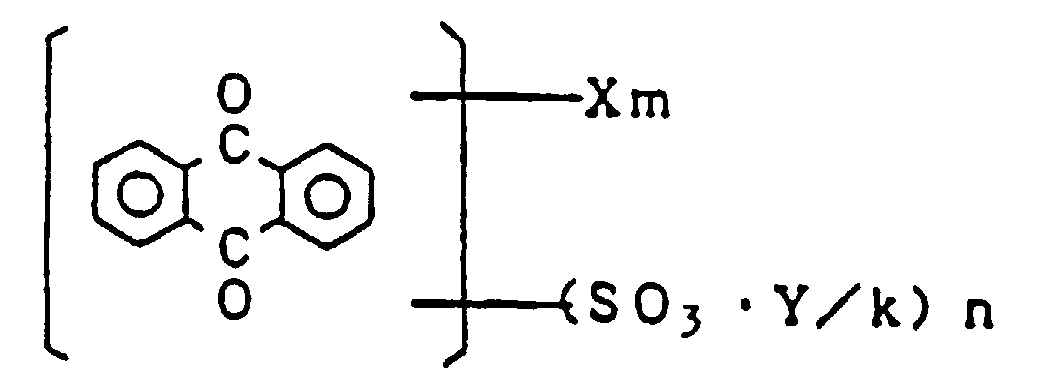
dans laquelle X est un halogène, un groupe nitro, amino, hydroxyle ou alcoyle ; Y est de l'hydrogène ou un métal ; k est la valence de Y ; m est un nombre entier de 0 à 4 ; et n est 1 ou 2, et (B) un vernis peinture durcissable à l'acide.
dans laquelle X est un halogène, un groupe nitro, amino, hydroxyle ou alcoyle ; Y est de l'hydrogène ou un métal ; k est la valence de Y ; m est un nombre entier de 0 à 4 ; et n est 1 ou 2, et (B) un vernis peinture durcissable à l'acide.
2. Une composition selon la revendication 1, dans laquelle le pigment est un pigment
organique et/ou un pigment inorganique.
3. Une composition selon la revendication 1 ou 2, dans laquelle le vernis peinture durcissable
à l'acide (B) comprend une composition de résine constituée d'une résine contenant
un groupe hydroxyle comme résine de base et d'une résine amino-aldéhyde comme agent
de réticulation, un solvant et un catalyseur acide.
4. Une composition selon la revendication 3, comprenant au moins une résine contenant
un groupe hydroxyle sélectionnée parmi des résines polyesters polyalcooliques, des
résines alkydes polyalcooliques, des résines acryliques polyalcooliques, des résines
époxydes polyalcooliques et des résines époxy-esters polyalcooliques.
5. Une composition selon la revendication 3 ou 4, dans laquelle le rapport entre la résine
contenant un groupe hydroxyle et la résine amino-aldéhyde est de 90/10 à 30/70 en
poids.
6. Une composition selon l'une ou l'autre des revendications 3 à 5, comprenant au moins
un solvant sélectionné parmi les hydrocarbures, les cétones, les esters, les éthers
et les alcools.
7. Une composition de revêtement selon l'une ou l'autre des revendications 3 à 6, comprenant
au moins un catalyseur acide sélectionné parmi les composés d'acide sulfonique, les
composés d'acide phosphorique, les composés d'acide carboxylique, les acides minéraux
et les sels d'acides minéraux.