|
(11) | EP 0 567 212 A1 |

| (12) | EUROPEAN PATENT APPLICATION |
|
|
|
|
|||||||||||||||||||||||||||
| (54) | The reaction product of nitrogen bases and phosphate esters as corrosion inhibitors |
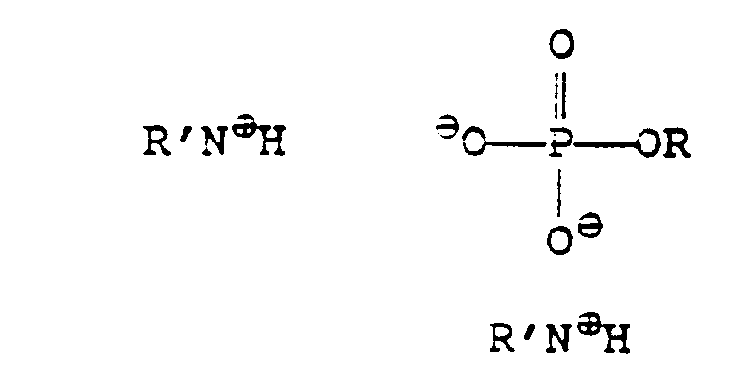
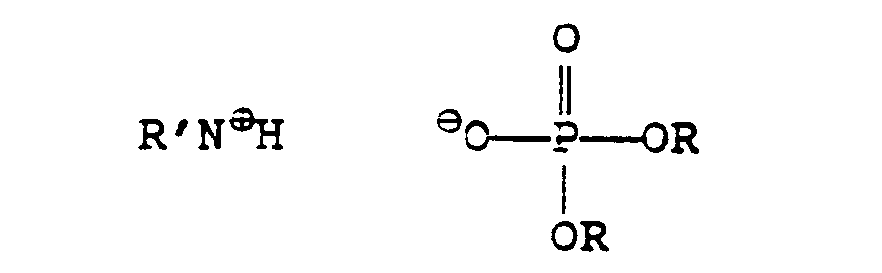
| (57) A method for inhibiting corrosion of metal surfaces in an aqueous medium, comprising
incorporating into the medium a corrosion inhibitor in an amount sufficient to inhibit
corrosion, the corrosion inhibitor comprising a water-soluble agent selected from
the group consisting of compositions of the formula
compositons of the formula and mixtures thereof, wherein R is R2-O(̵CH2CH2O)̵x, wherein R2 is a substituted or unsubstituted alkyl, aryl, or aralkyl group of from about five to about fifteen carbon atoms, each carbon atom having at least one hydrogen and x is an integer of from about one to about ten, and R'N is a basic nitrogen compound that is at least water-dispersible. |
Background of the Invention
1. Field of the Invention
[0001] The present invention is directed to inhibition of corrosion of ferrous metal surfaces in aqueous media and more particularly to corrosion inhibitors that are useful in such media in which protection of living organisms therein is of concern.
2. Description of the Prior Art
[0002] Corrosion of ferrous metal surfaces in aqueous media has long been a problem. This problem is especially troublesome in deep sea operations such as off-shore drilling, where corrosion inhibitors must satisfy several criteria in order to be effective in the demanding conditions encountered. A number of corrosion inhibitors have been developed in attempts to satisfy the demands imposed by such activities. But, because it is difficult to meet each of several independent corrosion inhibition conditions, these efforts have metwith varying success.
[0003] Nevertheless, increasing environmental concerns have introduced even further criteria for corrosion inhibitors to satisfy. In particular, the corrosion inhibitor should be compatible with the sensitive life forms indigenous to the medium into which the inhibitor is incorporated.
[0004] For example, in North Sea operations, survival not only offish, but also ofthe microorganism Skeletonema costatum is of concern. Thus, environmental constraints have been imposed on the types of compositions used in the North Sea, thereby to protect such organisms. However, commercial inhibitors have been found to be too toxic to the organism. More specifically, even a concentration of less than one part per million by weight (ppm) of conventional inhibitors has been found to be lethal to at least half of Skeletonema costatum within 96 hours. This may be written as EC50 < 1 ppm. Thus, a corrosion inhibitor having an EC50 greater than 1 ppm, especially greater than the concentration at which the inhibitor will be employed, is desired.
[0005] In addition, it is desired that the inhibitor meet several other environmental criteria as well. For example, the inhibitor should be sutficiently biodegradable that the basic oxygen demand (BOD) of the organisms in the medium treated should return to at least 70% of the theoretical oxygen consumption within 28 days after treatment (BOD-28 s 70%).
[0006] Further, the water solubility of the inhibitor should be sufficient to avoid or minimize bio-accumulation that otherwise can result in lower life forms with fat soluble inhibitors. The fat soluble inhibitors may become more concentrated as they move up the food chain. This may be quantified by measuring the resulting concentration of inhibitor in the octanol phase and in the water phase of an n-octanol/water medium into which the inhibitor has been injected, and dividing the former by the latter. It is desired that the logarithm (base 10) of the quotient be less than 3. Stated another way, "partitioning" should be less than three.
[0007] Moreover, because evaporation of a toxic solvent (if any) would be undesirable, the solvent evaporation factor (YL) should not be greater than 3. And, because of the dangers of flammability, the flash point should be greater than 56°C.
[0008] The commercial inhibitors have not been found to meet such demanding criteria. Thus, inhibitors that not only provide satisfactory corrosion inhibition, but satisfy such environmental concerns as well, are still being sought.
Summary of the Invention
[0009] Briefly, therefore, the present invention is directed to a novel method for inhibiting corrosion of metal surfaces in an aqueous medium by incorporating into the medium a corrosion inhibitor comprising a composition for the formula
or of the formula
or both wherein R is R2O-(CH2CH2O)x-, wherein R2 is an alkyl, aryl or aralkyl group of from about five to about fifteen carbon atoms, each of which carbon atoms has at least one hydrogen, and x is a positive integer up to about ten, and R'N represents a basic nitrogen compound.
[0010] Among the several advantages of the invention may be noted the provision of highly effective corrosion inhibition in aqueous media with substantially increased environmental compatibility.
Description of the Preferred Embodiments
[0011] In accordance with the present invention, it has been discovered that water-soluble compositions of the formula
or the formula
wherein R is R20-(CH2CH20),-, wherein R2 is an alkyl, aryl or aralkyl group of from about five to about fifteen carbon atoms, each of which carbon atoms has at least one hydrogen, and x is a positive integer up to about ten, and R'N represents a basic nitrogen compound that is water-soluble orwater-dispersible, not only provides excellent corrosion inhibition of ferrous metals in aqueous media, but satisfies the environmental concerns involved in corrosion inhibition in off-shore oil drilling. In fact, it has been found that the noted compositions far exceed the environmental requirements and are surprisingly less toxic than the nitrogen compounds and phosphates esters from which they were derived.
[0012] Thus, it has been found that the EC50, surprisingly, is not only greater than one ppm, but generally greater than ten ppm. This is especially significant in view of the fact that it has also been found than food corrosion inhibition has been found for an active inhibitor concentration as low as five ppm. Moreover, the BOD-28 for such compositions has been found to be well above 70%, the partitioning well below three (in fact, near zero), the solvent evaporation factor (YL) well below three (in fact, near zero), and the flash point well above 56°C.
[0013] The noted inhibitors are derived from phosphate esters. Such esters have been described in, for example, U.S. Patent No. 4,339,349 to Martin (the present inventor) et al. In particular, the phosphate esters may be prepared by reacting an ethoxylated alcohol with polyphosphoric acid or with phosphoric anhydride. Thus, the first step may involve ethoxylating an alcohol. Generally, the alcohol is one that is biodegradable and can be made water-soluble by ethoxylation. Typically, therefore, a C5-15 alcohol is practical. Each carbon atom of the alcohol should have at least one hydrogen to provide superior biodegradability. Accordingly, the desire for biodegradability dictates that the alcohol not have substantial branching. Preferably, the alcohol is a straight chain. Alfol 8-10 has been found to be especially suitable.
[0014] The alcohol may be ethoxylated by standard techniques. Thus, the alcohol may be heated with a base or amine catalyst to about 100 to 150°C, depending on the catalyst, and ethylene oxide added thereto. The resulting ethoxylated alcohol is of the form R20-(CH2CH20)xH, wherein R2 is a substituted or unsubstituted alkyl, aryl or aralkyl group of from about five to about ten carbons, preferably an alkyl group, most preferably, an unsubstituted alkyl group of from about five to about ten carbons. In any even, each carbon of R2 should have at least one hydrogen. The relative proportion of ethylene oxide to alcohol depends on ,the degree of ethoxylation desired to provide sufficient water-solubility and biodegradability. Generally, the heavier the alcohol, the greater the degree of ethoxylation required. Although any degree of ethoxylation is feasible, economic practicalities suggest that it is not desirable that more than about ten moles of ethylene oxide per mole of alcohol be used. Therefore, x is preferably from one to about ten. More preferably x is about two to about five, especially about two to about three.
[0015] A phosphate ester is then prepared from the ethoxylated alcohol. Techniques for preparation of phosphate esters are well known. See, for example, U.S. Patent No. 4,722,805 to Martin (the present inventor), which is incorporated herein by reference. The ester may be prepared by reacting the ethoxylated alcohol with polyphosphoric acid at a temperature of from about 50 to about 75°C. The ester thus is a mono-ester taking the form
wherein R is R20-(CH2CH20),,-, R2 and x having been defined above. Alternatively, the phosphate ester may be produced by a reaction of the ethoxylated alcohol with phosphoric anhydride (P205). However, because of the difficulty in working with phosphoric anhydride, that reaction scheme is less desired. Nevertheless, if the ester is made from phosphoric anhydride, the di-ester of the formula
wherein R is as defined above, is formed in addition to the mono form.
[0016] The ester, whether in mono or di form, is then neutralized in an acid/base reaction with a basic nitrogen compound, preferably an amine or amine derivative. Nitrogen compounds are represented herein by the notation R'N. This notation refers to any nitrogen-containing compound and may signify, for example, morpholine, an amide, a primary, secondary or tertiary amine or even ammonia. See U.S. Patent No. 4,722,805 for examples of suitable nitrogen compounds, which are identified therein as "nitrogen bases". The nitrogen compound should be at least water-dispersible, meaning water-dispersible or water-soluble. Preferably, the nitrogen compound is miscible with water. It is also desirable that the nitrogen be heavy enough to provide a sufficiently high flash point; e.g., more than 56°C. Optimally, the compound should also be biodegradable and nontoxic (or at least of relatively low toxicity) to humans as well as the organisms in the medium to be treated although, as noted above, it has been found that the product formed with the ester has been found to be less toxic by far than the nitrogen compound. The esters themselves are of very low toxicity.
[0017] Preferably, in the notation R'N, R' may represent one or more hydrogens and one or more organic moieties, and R'N may be written in more expanded form as
wherein R3, R4, R5 and R6 are independently selected from among hydrogen and organic moieties, any of which may contain hetero atoms, especially oxygen. Thus, R3, R4, and R5 may be selected independently from, for example, hydrogen and substituted or unsubstituted alkyl, aryl and aralkyl groups with or without carbon replacement, and R6 may be a substituted or unsubstituted alkylene, arylene or aralkylene group in which one or more of the carbons may be replaced with hetero atoms such as oxygen or nitrogen. Typically, the nitrogen compound is an amine or derivative thereof of from about three to about fifteen carbon atoms, preferably from about four to about ten carbon atoms, especially about six carbon atoms. For the higher weight compounds, it is preferable that the compound contain a hydroxyl group. Thus, superior results have been found with a morpholine by-product of the form
in which case R6 is -CH2CH20CH2CH2- and R3 is C2H40H.
[0018] The reaction between the ester and the basic nitrogen compound R'N is a simple acid/base neutralization procedure occurring under ambient conditions with the addition of one to the other preceding slowly enough to avoid excessive production of heat. Preferably, the ester and nitrogen compound are reacted in approximately equimolar proportions, but a 2:1 molar ratio of either component to the other is acceptable. The resulting product is thus of the form
for the mono-ester and of the form
for the di-ester.
[0019] The product may then be dissolved in water and an environmentally compatible solvent such as propylene glycol (or glycerol or ethylene glycol) to reduce the viscosity and pour point. Preferably, the commercial form of the inhibitor would be about 35% by weight active. The inhibitor has been found to be effective in sour systems as well as sweet systems such as that of North Sea oil platforms. The inhibitor may be added (in its dilute form) directly to the medium to be treated, such as by pouring or injecting it into the medium. Effective concentrations have been found to be about 5 to about 100 ppm (2-50 ppm active), based on weight.
[0020] The invention will be further illustrated in the following examples. In the examples, all parts and percentages are by weight unless otherwise specified.
Example 1
[0021] Kettle tests for inhibitor efficacy were conducted on a number of compositions. The tests were conducted for 24 hours, with stirring and CO2 saturation at room temperature. Sweet tests were conducted with CO2 sparging and sour tests with CO2 sparging and 2 gm Na2S·9H2O added at the start and the kettle sealed, giving 50 ppm H2S. The following chart identifies the compositions tested.
[0023] The next chart identifies compositions within the scope of this invention in terms of the nitrogen compound and phosphate ester employed:
[0024] Each of Composition Nos. 20-23 are in the presence of two moles of water per mole of nitrogen compound. Composition No. 20 is in the presence of one mole iso-propyl alcohol per two moles nitrogen compound. Composition No. 24 is in the presence of one mole of iso-propyl alcohol per 2.5 moles nitrogen compound. For Composition Nos. 20-23, the nitrogen compound and ester are in equimolar proportions and for Composition No. 24, the molar ratio of the amine to the ester is 5:3.
Example 2
[0026] Various physical properties were measured according to standard procedures for Composition No. 21 and, as a comparison, Composition No. 1, which has been employed commercially in North Sea drilling. The following results were obtained:
1. A method for inhibiting corrosion of metal surfaces in an aqueous medium, comprising
incorporating into the medium a corrosion inhibitor in an amount sufficient to inhibit
corrosion, the corrosion inhibitor comprising a water-soluble agent selected from
the group consisting of compositions of the formula
compositions of the formula
and mixtures thereof, wherein R is R2-O(CH2CH2O)x, wherein R2 is a substituted or unsubstituted alkyl, aryl, or aralkyl group of from about five to about fifteen carbon atoms, each carbon atom having at least one hydrogen and x is an integer of from about one to about ten, and R'N is a basic nitrogen compound that is at least water-dispersible.
compositions of the formula
and mixtures thereof, wherein R is R2-O(CH2CH2O)x, wherein R2 is a substituted or unsubstituted alkyl, aryl, or aralkyl group of from about five to about fifteen carbon atoms, each carbon atom having at least one hydrogen and x is an integer of from about one to about ten, and R'N is a basic nitrogen compound that is at least water-dispersible.
2. A method as set forth in claim 1 wherein the agent is a composition of the formula
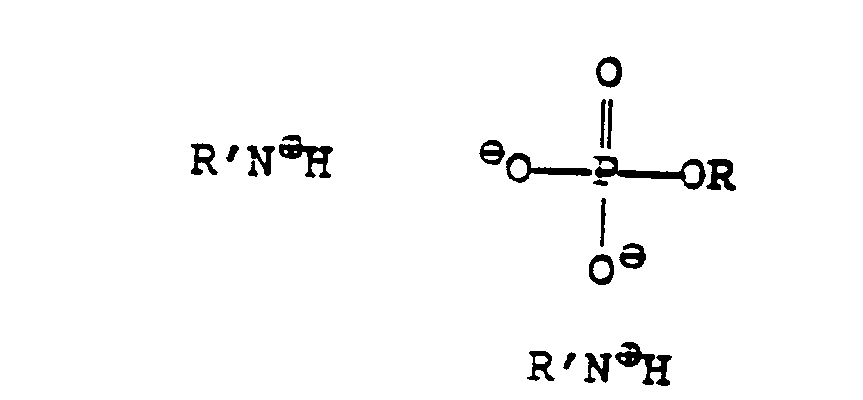
wherein Rand R'N are defined above.
wherein Rand R'N are defined above.
3. A method for inhibiting corrosion of metal surfaces in an aqueous medium, comprising
incorporating into the medium a corrosion inhibitor in an amount sufficient to inhibit
corrosion, the corrosion inhibitor comprising the acid/base reaction product of a
phosphate ester of the formula
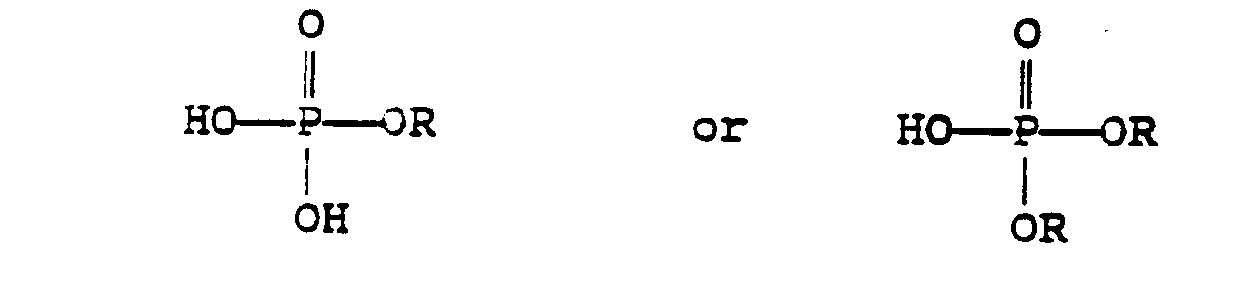
wherein R is R2-O(CH2CH2O)x, wherein R2 is a substituted or unsubstituted alkyl, aryl, or aralkyl group of from about five to about fifteen carbon atoms, each carbon atom having at least one hydrogen and x is an integer of from about one to about ten, and a basic nitrogen compound that is at least water-dispersible.
wherein R is R2-O(CH2CH2O)x, wherein R2 is a substituted or unsubstituted alkyl, aryl, or aralkyl group of from about five to about fifteen carbon atoms, each carbon atom having at least one hydrogen and x is an integer of from about one to about ten, and a basic nitrogen compound that is at least water-dispersible.
4. A method as set forth in claim 3 wherein the agent is a composition of the formula
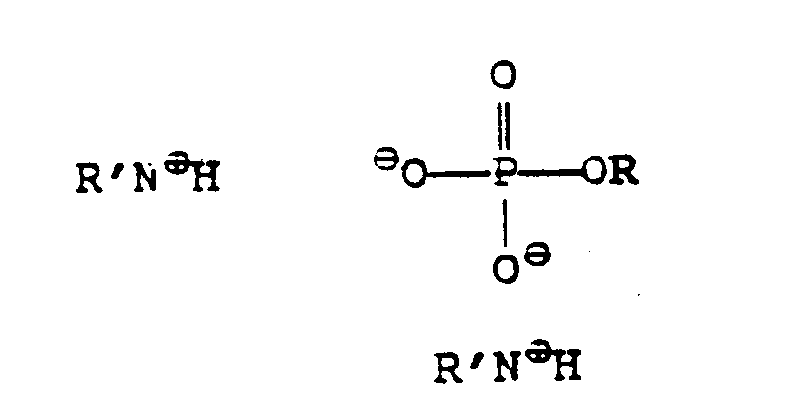
wherein R is defined above and R'N is the basic nitrogen compound.
wherein R is defined above and R'N is the basic nitrogen compound.
5. A method as set forth in any preceding claim wherein R2 is an unsubstituted alkyl group.
6. A method as set forth in any preceding claim wherein the basic nitrogen compound
is a compound of the formula
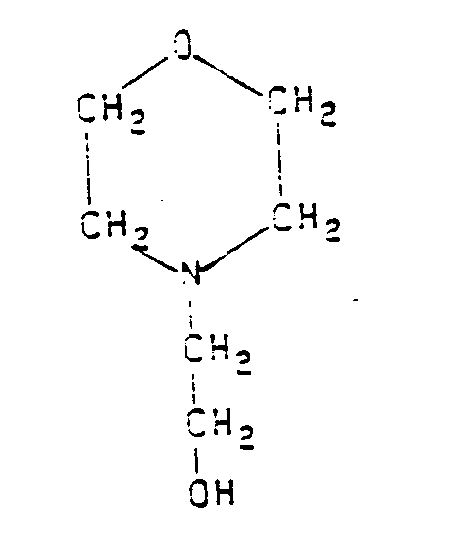
7. A method as set forth in any preceding claim wherein x is from about two to about
five.
8. A method as set forth in any preceding claim wherein the corrosion inhibitor has
an EC50 for Skeletonema costatum of at leat about 1 ppm by weight.
9. A method as set forth in claim 6 wherein the corrosion inhibitor further has a
BOD-28 of at least 70%, partitioning less than about three, a YL of, at most, about
three and a flash point greater than about 56°C.
10. A method as set forth in any preceding claim, wherein the metal surfaces are ferrous
metal surfaces.
11. A method as set forth in any preceding claim, wherein the aqueous medium contains
living organisms.