|
(11) | EP 0 572 723 A1 |

| (12) | EUROPEAN PATENT APPLICATION |
|
|
|
|
||||||||||||||||||||||||
| (54) | Structured liquid detergent compositions |
| (57) Aqueous detergent compositions are described which comprise an anisotropic surfactant
phase. The anisotropic surfactant phase is formed by a mixture of an anionic surfactant
and a polyhydroxy fatty acid amide nonionic surfactant. |
Technical field
[0001] The present invention relates to structured liquid detergent compositions. The compositions according to the present invention are especially suitable for suspending solid particles which are insoluble in the composition or liquids which are immiscible in the detergent composition. The compositions according to this invention are particularly suitable for laundry applications.
Background
[0002] Structured liquid detergents have been extensively described in the art, with a view to suspend solid particles which are insoluble in the detergent matrix, or liquids which are immiscible in the detergent matrix. In non-structured liquid detergents, the presence of such ingredients generally leads to sedimentation or phase separation and therefore renders such detergents unacceptable from a consumer's viewpoint.
[0003] In response to this need, detergent formulators have designed structured liquid detergents which have the capability of stably suspending solids or immiscible liquids. A typical approach to these compositions is the combination of an anionic surfactant with an electrolyte. In most of these compositions, particularly those designed for laundry application, the electrolyte present serves no other purpose than the formation of the suspending structure.
[0004] It is thus an object of the present invention to formulate a structured liquid detergent composition which can suspend solids or immiscible liquids, said composition being free of electrolyte or, more generally, free of any ingredient having the sole purpose of forming the structure. In other words, it is an object of the present invention to formulate a structured liquid detergent composition, using only conventional detergency ingredients which all participate to the laundering process.
[0005] EP 414 549, to Albright & Wilson, discloses structured liquid compositions which are free of electrolyte. The structure is obtained by using particular surface-active systems which are quite unusual in the field of laundry detergents. No laundry cleaning composition is exemplified in EP 414 549.
[0006] EP 295 021, to Albright & Wilson, discloses a structured liquid surfactant system for use in liquid compositions, comprising an anionic surfactant and a highly hydrophobic nonionic surfactant.
[0007] It is thus a further object of the present invention to formulate a structured liquid detergent composition which comprises nothing but detergency ingredients which have already found wide application in this field, thus providing good cleaning performance.
[0008] It has now been found that the above objects could be met by formulating an aqueous composition which comprises a mixture of an anionic surfactant and a hydrophilic polyhydroxy fatty acid amide surfactant. Such polyhydroxy fatty acid amide surfactants have been described in laundry detergent compositions for instance in EP 285 758 and our co-pending applications PCT/US 91/07021, PCT/US 91/07025, PCT/US 91/07026, PCT/US 91/07027, PCT/US 91/07030 and PCT/US 91/06982.
Summary of the invention
[0009] The compositions according to the present invention are aqueous liquid detergent compositions which comprise an anisotropic surfactant phase, comprising from 8% to 60% by weight of the total composition of a mixture of an anionic surfactant and a nonionic surfactant, characterized in that the nonionic surfactant is a polyhydroxy fatty acid amide of the formula:
wherein R¹ is H, a C₁-C₄ hydrocarbyl, 2-hydroxyethyl, 2-hydroxy propyl, or a mixture thereof, R² is C₅-C₃₁ hydrocarbyl and Z is a polyhydroxyhydrocarbyl having a linear hydrocarbyl chain, or an alkoxylated derivative thereof, and the weight ratio of said anionic surfactant to said polyhydroxy fatty acid amide nonionic surfactant is in the range of from 10:1 to 1:10.
Detailed description of the invention
[0010] The compositions according to the present invention are aqueous structured compositions which comprise an anisotropic surfactant phase. The presence of an anisotropic surfactant phase can be readily checked by observing a sample of the composition through an optical microscope, between Nichol prisms.
[0011] The anisotropic surfactant phase is formed by using a mixture of an anionic surfactant and a polyhydroxy fatty acid amide nonionic surfactant. The compositions according to the present invention comprise from 8% to 60% by weight of the total composition of said surfactant mixture, preferably from 15% to 40%.
Polyhydroxy fatty acid amide nonionic surfactant
[0012] The polyhydroxyfatty acid amide nonionic surfactant suitable for use herein is of the formula:
wherein: R¹ is H, a C₁-C₄ hydrocarbyl, 2-hydroxy ethyl, 2-hydroxy propyl, or a mixture thereof, preferably C₁-C₄ alkyl, more preferably C₁ or C₂ alkyl, most preferably C₁ alkyl (i.e., methyl); and R² is C₅-C₃₁ hydrocarbyl, preferably straight chain C₇-C₁₉ alkyl or alkenyl, more preferably straight chain C₉-C₁₇ alkyl or alkenyl, most preferably straight chain C₁₁-C₁₇ alkyl or alkenyl, or mixtures thereof; and Z is a polyhydroxyhydrocarbyl having a linear hydrocarbyl chain with at least 3 hydroxyls directly connected to the chain, or an alkoxylated derivative (preferably ethoxylated or propoxylated) thereof. Z preferably will be derived from a reducing sugar in a reductive amination reaction; more preferably Z is a glycityl. Suitable reducing sugars include glucose, fructose, maltose, lactose, galactose, mannose, and xylose. As raw materials, high dextrose corn syrup, high fructose corn syrup, and high maltose corn syrup can be utilized as well as the individual sugars listed above. These corn syrups may yield a mix of sugar components for Z. It should be understood that it is by no means intended to exclude other suitable raw materials. Z preferably will be selected from the group consisting of -CH₂-(CHOH)n-CH₂OH, -CH(CH₂OH)-(CHOH)n-1-CH₂OH, -CH₂-(CHOH)₂(CHOR')(CHOH)-CH₂OH, where n is an integer from 3 to 5, inclusive, and R' is H or a cyclic or aliphatic monosaccharide, and alkoxylated derivatives thereof. Most preferred are glycityls wherein n is 4, particularly -CH₂-(CHOH)₄-CH₂OH.
[0013] In Formula (I), R¹ can be, for example, N-methyl, N-ethyl, N-propyl, N-isopropyl, N-butyl, N-2-hydroxy ethyl, or N-2-hydroxy propyl.
[0014] R²-CO-N< can be, for example, cocamide, stearamide, oleamide, lauramide, myristamide, capricamide, palmitamide, tallowamide, etc.
[0015] Z can be 1-deoxyglucityl, 2-deoxyfructityl, 1-deoxymaltityl, 1-deoxylactityl, 1-deoxygalactityl, 1-deoxymannityl, 1-deoxymalto-triotityl, etc.
[0016] Methods for making polyhydroxy fatty acid amides are known in the art. In general, they can be made by reacting an alkyl amine with a reducing sugar in a reductive amination reaction to form a corresponding N-alkyl polyhydroxyamine, and then reacting the N-alkyl polyhydroxyamine with a fatty aliphatic ester or triglyceride in a condensation/amidation step to form the N-alkyl, N-polyhydroxy fatty acid amide product. Processes for making compositions containing polyhydroxy fatty acid amides are disclosed, for example, in G.B. Patent Specification 809,060, published February 18, 1959, by Thomas Hedley & Co., Ltd.; U.S. Patent 2,965,576, issued December 20, 1960 to E. R. Wilson, and U.S. Patent 2,703,798, Anthony M. Schwartz, issued March 8, 1955, and U.S. Patent 1,985,424, issued December 25, 1934 to Piggott, each of which is incorporated herein by reference.
[0017] In one process for producing N-alkyl or N-hydroxyalkyl, N-deoxyglycityl fatty acid amides wherein the glycityl component is derived from glucose and the N-alkyl or N-hydroxyalkyl functionality is N-methyl, N-ethyl, N-propyl, N-butyl, N-hydroxyethyl, or N-hydroxypropyl, the product is made by reacting N-alkyl- or N-hydroxyalkyl-glucamine with a fatty ester selected from fatty methyl esters, fatty ethyl esters, and fatty triglycerides in the presence of a catalyst selected from the group consisting of trilithium phosphate, trisodium phosphate, tripotassium phosphate, tetrasodium pyrophosphate, pentapotassium tripholyphosphate, lithium hydroxide, sodium hydroxide, potassium hydroxide, calcium hydroxide, lithium carbonate, sodium carbonate, potassium carbonate, disodium tartrate, dipotassium tartrate, sodium potassium tartrate, trisodium citrate, tripotassium citrate, sodium basic silicates, potassium basic silicates, sodium basic aluminosilicates, and potassium basic aluminosilicates, and mixtures thereof. The amount of catalyst is preferably from about 0.5 mole % to about 50 mole %, more preferably from about 2.0 mole % to about 10 mole %, on an N-alkyl or N-hydroxyalkyl-glucamine molar basis. The reaction is preferably carried out at from about 138°C to about 170°C for typically from about 20 to about 90 minutes. When triglycerides are utilized in the reaction mixture as the fatty ester source, the reaction is also preferably carried out using from about 1 to about 10 weight % of a phase transfer agent, calculated on a weight percent basis of total reaction mixture, selected from saturated fatty alcohol polyethoxylates, alkylpolyglycosides, linear glycamide surfactant, and mixtures thereof.
[0018] Preferably, this process is carried out as follows:
(a) preheating the fatty ester to about 138°C to about 170°C;
(b) adding the N-alkyl or N-hydroxyalkyl glucamine to the heated fatty acid ester and mixing to the extent needed to form a two-phase liquid/liquid mixture;
(c) mixing the catalyst into the reaction mixture; and
(d) stirring for the specified reaction time.
[0019] Also preferably, from about 2% to about 20% of preformed linear N-alkyl/N-hydroxyalkyl, N-linear glucosyl fatty acid amide product is added to the reaction mixture, by weight of the reactants, as the phase transfer agent if the fatty ester is a triglyceride. This seeds the reaction, thereby increasing reaction rate. A detailed experimental procedure is provided below in the Experimental.
[0020] The polyhydroxy "fatty acid" amide materials used herein also offer the advantages to the detergent formulator that they can be prepared wholly or primarily from natural, renewable, non-petrochemical feedstocks and are degradable. They also exhibit low toxicity to aquatic life.
[0021] It should be recognized that along with the polyhydroxy fatty acid amides of Formula (I), the processes used to produce them will also typically produce quantities of nonvolatile by-product such as esteramides and cyclic polyhydroxy fatty acid amide. The level of these by-products will vary depending upon the particular reactants and process conditions. Preferably, the polyhydroxy fatty acid amide incorporated into the detergent compositions hereof will be provided in a form such that the polyhydroxy fatty acid amide-containing composition added to the detergent contains less than about 10%, preferably less than about 4%, of cyclic polyhydroxy fatty acid amide. The preferred processes described above are advantageous in that they can yield rather low levels of by-products, including such cyclic amide by-product.
Anionic Surfactants
[0022] One type of anionic surfactants which can be utilized herein encompasses alkyl benzene sulphonates. The alkyl benzene sulfonate surfactants hereof are well known in the art. These surfactants have C₉ and higher alkyl groups, preferably the alkyl groups are C₉-C₁₈ alkyl groups, more preferably linear, to provide the linear alkyl benzene sulfonate ("LAS") class of commercial surfactants. Especially preferred are C₁₀-C₁₄ LAS surfactant. These surfactants can be used in either the acid or soluble salt form. Suitable salts include metal salts (e.g., sodium, potassium, and lithium) as well as substituted and unsubstituted ammonium salts (e.g., ethanolamines).
[0023] Another type of anionic surfactant useful for use herein are alkyl sulfate surfactants. They include water soluble salts or acids of the formula ROSO₃M wherein R preferably is a C₁₀-C₂₄ hydrocarbyl, preferably branched, preferably an alkyl or hydroxyalkyl having a C₁₀-C₂₀ alkyl component, more preferably a C₁₂-C₁₈ alkyl or hydroxyalkyl, and M is a H or a cation, e.g., an alkali metal cation (e.g., sodium, potassium, lithium), substituted or unsubstituted ammonium cations such as methyl-, dimethyl-, and trimethyl ammonium cations and quaternary ammonium, e.g., tetramethyl-ammonium and dimethyl piperidinium, and cations derived from alkanolamines such as ethanolamine, diethanolamine, triethanolamine, and mixtures thereof, and the like. Alkyl chains of C₁₆₋₁₈ are preferred for higher wash temperatures (above about 50°C) hereof.
[0024] Other types of anionic surfactants useful for use herein include salts (including, for example, sodium, potassium, ammonium, and substituted ammonium salts such as mono-, di- and triethanolamine salts) of soap, C₈-C₂₂ primary or secondary alkanesulphonates, C₈-C₂₄ olefinsulphonates, sulphonated polycarboxylic acids prepared by sulphonation of the pyrolyzed product of alkaline earth metal citrates, e.g., as described in British patent specification No. 1,082,179, alkyl glycerol sulfonates, fatty acyl glycerol sulfonates, fatty oleyl glycerol sulfates, alkyl phenol ethylene oxide ether sulfates, sulfonates, alkyl phosphates, isethionates such as the acyl isethionates, N-acyl taurates, fatty acid amides of methyl tauride, alkyl succinamates and sulfosuccinates, monoesters of sulfosuccinate (especially saturated and unsaturated C₁₂-C₁₈ monoesters), diesters of sulfosuccinates (especially C₆-C₁₄ diesters), N-acyl sarcosinates, sulfates of alkyl-polysaccharides such as the sulfates of alkylpolyglucoside (the nonionic nonsulfated compounds being described below), alkyl alkoxylated sulfates, alkyl polyethoxy carboxylates such as those of the formula RO(CH₂CH₂O)kCH₂COO⁻M⁺ wherein R is a C₈-C₂₂ alkyl, k is an integer from 0 to 10, and M is a soluble salt-forming cation, and fatty acids esterified with isethionic acid and neutralized with sodium hydroxide. Resin acids and hydrogenated resin acids are also suitable, such as rosin, hydrogenated rosin, and resin acids and hydrogenated resin acids present in or derived from tall oil. Further examples are described in " Surface Active Agents and Detergents" (Vol. I and II by Schwartz, Perry and Berch). A variety of such surfactants are also generally disclosed in U.S. Patent 3,929,678, issued December 30, 1975 to Laughlin, et al, at Column 23, line 58 through Column 29, line 23 (herein incorporated by reference).
[0025] Preferred anionic surfactants for use herein are linear alkyl benzene sulfonates and alkyl sulfates, particularly linear alkyl benzene sulfonates.
[0026] In said surfactant mixture, the weight ratio of said anionic surfactant to said polyhydroxy fatty acid amide nonionic surfactant is in the range of from 10:1 to 1:10, preferably from 3:1 to 1:3.
Other ingredients
[0027] The compositions according to the present invention need no electrolyte to form the anisotropic phase. Accordingly, the compositions herein are substantially free of electrolyte. By electrolyte, it is meant herein any material which has the sole function of building the anisotropic phase. It excludes other materials which may be regarded as electrolytes, but which provide detergency benefits, like citric acid, for instance.
[0028] As an optional but preferred ingredient, the compositions according to the present invention can include from 2% to 20% by weight of the total composition, preferably from 8% to 15% of fatty acids. Suitable fatty acids for use herein are fatty acids containing from 10 to 22 carbon atoms. The fatty acids can also comprise from 1 to 10 ethylene oxide units in the hydrocarbon chain. Preferred are fatty acids containing from about 12 to 14 carbon atoms.
[0029] The compositions according to the present invention can also comprise additional surfactants which are well known to the man skilled in the art, other than the anionic and polyhydroxy fatty acid amide nonionic surfactants described hereinbefore, including cationic and zwitterionic surfactants. The compositions according to the present invention may also comprise other nonionic surfactants than the polyhydroxy fatty acid amides described hereinbefore, including ethoxylated alcohols.
[0030] The compositions according to the present invention may further comprise optional ingredients, depending on the use intended for said formulations. Such optional ingredients include builders such as polyphosphates and phosphonates, zeolites and polycarboxylates, including citrates and succinates. Further optionals include enzymes, including cellulases, proteases, lipases, amylases and peroxidases, as well as various enzyme stabilization systems. Yet further ingredients include soil release agents, anti-redeposition agents, chelating agents, suds suppressors and solvents.
[0031] The compositions according to the present invention are preferably formulated at a pH of from 6 to 9, preferably from 7 to 8.5.
[0032] Although not limited thereby, the compositions according to the present invention are particularly suitable for the purpose of suspending solid ingredients which are insoluble in the detergent matrix. Such solid ingredients include for instance bleach particles such as perborate or percarbonate salts, or builder particles such as zeolite and citric acid; or high molecular weight polymers. The compositions according to the present invention are also suitable for suspending liquids which are immiscible in the detergent matrix, for instance antifoam silicone oils, silicone/silica-based matrices and waxes.
Examples
[0033] The following compositions are made by mixing the listed ingredients in the listed proportions (weight %).
| #1 | #2 | #3 | #4 | |
| linear alkyl benzene sulphonate | 10 | 10 | 10 | - |
| Natural Coconut Alkyl sulphate | - | - | - | 10 |
| C₁₂-C₁₄ fatty acids | 10 | 10 | - | 10 |
| C₁₂ N-methyl glucamide | 6 | 6 | 10 | 15 |
| 1,2-propanediol | 0.7 | 0.7 | - | - |
| NaOH up to pH | 8.4 | 8.4 | 8 | 7.8 |
| zeolite | - | 10 | - | - |
| DETMPA | - | - | - | 0.5 |
| water & minors | up to 100% | |||
All four compositions above are structured liquid detergent compositions.
1. An aqueous liquid detergent composition comprising an anisotropic surfactant phase,
comprising from 8% to 60% by weight of the total composition of a mixture of an anionic
surfactant and a nonionic surfactant, characterized in that the nonionic surfactant
is a polyhydroxy fatty acid amide of the formula
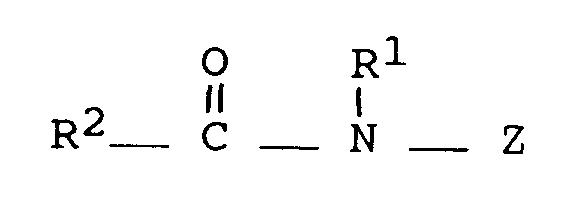
wherein R¹ is H, a C₁-C₄ hydrocarbyl, 2-hydroxyethyl, 2-hydroxy propyl, or a mixture thereof, R² is C₅-C₃₁ hydrocarbyl and Z is a polyhydroxyhydrocarbyl having a linear hydrocarbyl chain, or an alkoxylated derivative thereof, and the weight ratio of said anionic surfactant to said polyhydroxy fatty acid amide nonionic surfactant is in the range of from 10:1 to 1:10.
wherein R¹ is H, a C₁-C₄ hydrocarbyl, 2-hydroxyethyl, 2-hydroxy propyl, or a mixture thereof, R² is C₅-C₃₁ hydrocarbyl and Z is a polyhydroxyhydrocarbyl having a linear hydrocarbyl chain, or an alkoxylated derivative thereof, and the weight ratio of said anionic surfactant to said polyhydroxy fatty acid amide nonionic surfactant is in the range of from 10:1 to 1:10.
2. A composition according to claim 1 which comprises from 15% to 40% of said surfactant
mixture.
3. A composition according to the preceding claims, wherein the weight ratio of said
anionic surfactant to said polyhydroxy fatty acid amide nonionic surfactant is in
the range of from 3:1 to 1:3.
4. A composition according to any of the preceding claims wherein in the formula of said
polyhydroxy fatty acid amide nonionic surfactant, R¹ is a C₁-C₄ alkyl, R² is a C₇-C₁₉
straight chain alkyl or alkenyl, and Z is derived from a reducing sugar in a reductive
amination reaction.
5. A composition according to claim 4, wherein R¹ is methyl, R² is a straight chain C₁₁-C₁₇
alkyl or alkenyl, and Z is a glycityl.
6. A composition according to any of the preceding claims which comprises an ingredient
in the form of solid particles suspended in said composition.
7. A composition according to claims 1-5, which comprises an ingredient in the form of
a liquid which is immiscible in said composition.
8. A composition according to any of the preceding claims which is substantially free
of electrolyte.
9. A composition according to any of the preceding claims wherein the anionic surfactant
is an alkyl benzene sulfonate or an alkyl sulfate.
10. A composition according to any of the preceding claims which further comprises from
2% to 20% by weight of the total composition, preferably from 8% to 15% of fatty acids.
11. A composition according to any of the preceding claims which has a pH of from 7 to
8.5.