|
(11) | EP 0 576 251 A1 |

| (12) | EUROPEAN PATENT APPLICATION |
|
|
|
|
|||||||||||||||||||||||||||
| (54) | Substituted 1,2,4-triazine-3,5-dione derivatives and drug compositions containing them, particularly for coccidiosis treatment |
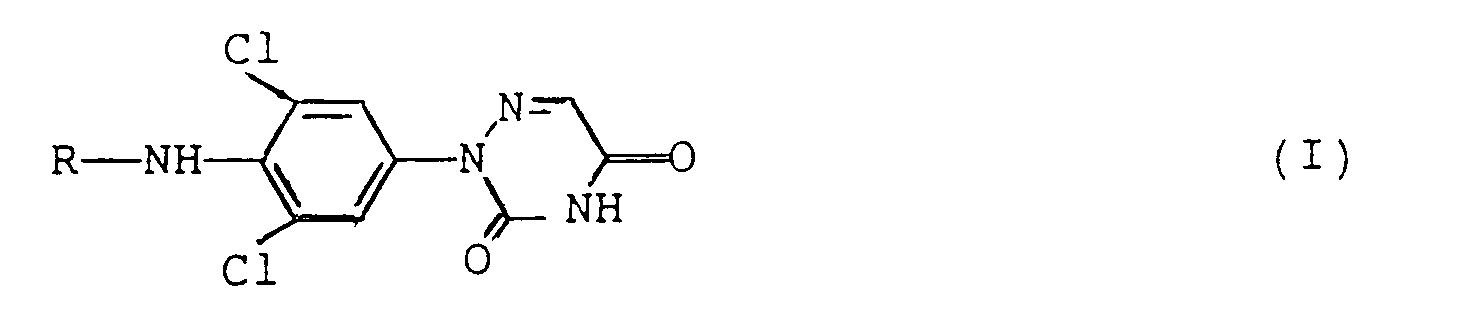
| (57) A substituted 1,2,4-triazine-3,5-dione derivative having the formula (I), of a salt
thereof:
wherein R represents a 5- or 6-membered heterocyclic group which may have at least one substituent selected from the group consisting of a halogen, a lower alkyl group and a halogenated lower alkyl group, and an anticoccidial drug composition containing the same as an active component. |
[0001] The present invention relates to substituted 1,2,4-triazine-3,5-dione compounds, and to their use against coccidiosis.
[0002] Coccidiosis is an infectious disease caused by protozoans belonging to coccidium. Poultry is mainly infected with Eimeria tenella, Eimeria aceruvulina and Eimeria necatrix, and suffers from various troubles such as bleeding of the gastrointestinal tract, mortality, growth inhibition, and so forth. Poultry includes chickens, turkeys, quails and ducks. Mass outbreak of avian coccidiosis in a commercial poultry farm imparts an extremely great loss to an owner and has often become a serious problem. Accordingly, the development of an anticoccidial drug composition which is effective for prevention and remedy of coccidiosis has drawn a keen attention of those concerned in the art.
[0003] Conventionally, sulfanilamides, nitrofurans, quinolines, antithiamines and benzoamides have been put into practical application as anticoccidial drugs, and polyether-based antibiotics are mainly used at present. However, these compounds have drawbacks. Their efficacy against coccidiosis is only moderate. They have toxicity to hosts. Moreover, resistant strains appear in the course of continuous use of thee chemicals, so their efficacy drops progressively with time. It would be desirable to have anticoccidial substances effective against resistant strains, and also with less tendency for strains to become resistant thereto.
[0004] JP-A-47/9998, JP-A-50/19763, DE-A-2532363 and BE-A-851655 disclose that compounds having a basic skeletal structure expressed by the following general formula (II) are 1,2,4-triazine-3,5-dione derivatives having an anticoccidial action:
wherein A represents O, S, SO or SO₂. However, these compounds have not been entirely satisfactory in the aspects of the anti-coccidium action, toxicity and the appearance of resistant strains.
[0005] We address the problem of providing novel chemical compounds, preferably with activity against coccidiosis. In other aspects we provide formulations of such compounds and methods of making and using them.
[0006] In accordance with the present invention, there is provided a substituted 1,2,4-triazine-3,5-dione derivative having the formula (I) (or a salt thereof):
wherein R represents a 5- or 6-membered heterocyclic group. The heterocyclic group may be substituted, e.g. by halogen or lower alkyl group. Such lower alkyl substituent may be halogenated.
[0007] In another aspect of the present invention, there is provided an anticoccidial drug composition comprising an anticoccidially effective amount of at least one compound as defined above as an active component, together with a carrier.
[0008] Having noted the above-mentioned prior art, we have carried out intensive studies of substituted 1,2,4-triazine-3,5-dione compounds. As a result of this work, we have discovered that substituted 1,2,4-triazine-3,5-dione compounds as defined above have notable anticoccidial action, and have thus developed an anticoccidium drug composition containing the substituted 1,2,4-triazine-3,5-dione compound as an active component.
[0009] Namely, according to the present invention, there are provided the substituted 1,2,4-triazine-3,5-dione derivative and a salt thereof, particularly a nontoxic salt thereof. Examples of such nontoxic salts include salts of inorganic acids such as hydrogen halide acids (e.g. hydrochloric acid and hydrobromic acid), sulfuric acid and phosphoric acid, salts of organic acids such as acetic acid, propionic acid, oxalic acid, malonic acid and benzoic acid, and salts of alkali metals such as lithium sodium and potassium.
[0010] The heterocyclic group represented by R in the formula (I) is usually a 5-membered or 6-membered heterocyclic group containing one or two nitrogen atoms, oxygen atoms or sulfur atoms. Examples of the 5-membered heterocyclic group are iso-oxazolyl group, oxazolyl group, thiadiazolyl group, etc, and examples of the 6-membered heterocyclic group are pyridyl group, pyrimidyl (or pyrimidinyl) group, pyrazinyl and so forth. These heterocyclic groups may be substituted by a halogen, a lower alkyl group or a halogenated lower alkyl group.
[0011] The term "halogen" represents fluorine, chlorine, bromine and iodine, and the term "lower alkyl group" represents a straight-chain or branched-chain alkyl group having 1 to 4 carbon atoms such as methyl group, ethyl group, propyl group, isopropyl group, butyl group, isobutyl group, sec-butyl group, tert-butyl group, or the like. Further, the term "halogenated lower alkyl group" represents a lower alkyl group at least one of the hydrogen atoms of which is substituted by halogen, such as monofluoromethyl group, difluoromethyl group, trifluoromethyl group, 2-fluoroethyl group, 1,2-difluoroethyl group, 2,2,2-trifluoroethyl group, 1,1,2,2-tetrafluoroethyl group, perfluoroethyl group, monochloromethyl group, 2-chloroethyl group, 2,2,2-trichloroethyl group, 2,2-dibromoethyl group, or the like.
[0012] Examples of the above-mentioned 5- or -6 membered heterocyclic group which are substituted with at least one substituent are as follows:
3-chloro-2-pyridyl, 5-chloro-2-pyridyl, 5-bromo-2-pyridyl, 5-fluoro-2-pyridyl, 3-methyl-2-pyridyl, 5-methyl-2-pyridyl, 3-trifluoromethyl-2-pyridyl, 5-trifluoromethyl-2-pyridyl, 3,5-dichloro-2-pyridyl, 3-chloro-5-methyl-2-pyridyl, 3-fluoro-5-trifluoromethyl-2-pyridyl, 3-chloro-5-trifluoromethyl-2-pyridyl, 5-chloro-3-methyl-2-pyridyl, 3,5-dimethyl-2-pyridyl, 3-methyl-5-trifluoromethyl-2-pyridyl, 5-chloro-3-trifluoromethyl-2-pyridyl, 5-methyl-3-trifluoromethyl-2-pyridyl, 3,5-ditrifluoromethyl-2-pyridyl, 4,6-ditrifluoromethyl-2-pyridyl, 4-methyl-2-pyridyl, 4-trifluoromethyl-2-pyridyl, 4,6-dimethyl-2-pyridyl, 6-methyl-2-pyridyl, 6-trifluoromethyl-2-pyridyl, 4-chloro-3-pyridyl, 5-bromo-3-pyridyl, 2-methyl-3-pyridyl, 4-methyl-3-pyridyl, 5-methyl-3-pyridyl, 6-methyl-3-pyridyl, 2-trifluoromethyl-3-pyridyl, 4-trifluoromethyl-3-pyridyl, 5-trifluoromethyl-3-pyridyl, 6-trifluoromethyl-3-pyridyl, 4-chloro-2-methyl-3-pyridyl, 2,4-dimethyl-3-pyridyl, 2,6-dimethyl-3-pyridyl, 2-methyl-4-trifluoromethyl-3-pyridyl, 2-methyl-6-trifluoromethyl-3-pyridyl, 4-chloro-2-trifluoromethyl-3-pyridyl, 4-methyl-2-trifluoromethyl-3-pyridyl, 6-methyl-2-trifluoromethyl-3-pyridyl, 2,4-ditrifluorometyl-3-pyridyl, 2,6-ditrifluoromethyl-3-pyridyl, 2-methyl-4-pyridyl, 2-trifluoromethyl-4-pyridyl, 3-chloro-4-pyridyl, 3-methyl-4-pyridyl, 3-trifluoromethyl-4-pyridyl, 5-chloro-4-pyridyl, 5-methyl-4-pyridyl, 5-trifluoromethyl-4-pyridyl, 3,5-dichloro-4-pyridyl, 3-chloro-5-methyl-4-pyridyl, 3-chloro-5-trifluoromethyl-4-pyridyl, 3,5-dimethyl-4-pyridyl, 3-methyl-5-trifluoromethyl-4-pyridyl, 3,5-ditrifluoromethyl-4-pyridyl, 2,6-dimethyl-4-pyridyl, 2,6-ditrifluoromethyl-4-pyridyl;
5-chloro-2-pyrimidinyl, 5-bromo-2-pyrimidinyl, 5-methyl-2-pyrimidinyl, 5-trifluoromethyl-2-pyrimidinyl, 4,6-dimethyl-2-pyrimidinyl, 4,6-ditrifluoromethyl-2-pyrimidinyl, 4-methyl-6-trifluorometyl-2-pyrimidinyl, 2-methyl-4-pyrimidinyl, 2-trifluoromethyl-4-pyrimidinyl, 5-chloro-4-pyrimidinyl, 5-bromo-4-pyrimidinyl, 5-methyl-4-pyrimidinyl, 5-trifluoromethyl-4-pyrimidinyl, 6-methyl-4-pyrimidinyl, 6-trifluoromethyl-4-pyrimidinyl, 2-methyl-5-pyrimidinyl, 2-trifluoromethyl-5-pyrimidinyl, 4-methyl-5-pyrimidinyl, 4-trifluoromethyl-5-pyrimidinyl, 6-methyl-5-pyrimidinyl, 6-trifluoromethyl-5-pyrimidinyl, 2,4-dimethyl-5-pyrimidinyl, 2-methyl-4-trifluoromethyl-5-pyrimidinyl, 4-methyl-2-trifluoromethyl-5-pyrimidinyl, 2,4-ditrifluoromethyl-5-pyrimidinyl, 4,6-dimethyl-5-pyrimidinyl, 4-methyl-6-trifluoromethyl-5-pyrimidinyl, 4,6-ditrifluoromethyl-5-pyrimidinyl, 2,4,6-trimethyl-5-pyrimidinyl, 2,4-dimetryl-6-trifluoromethyl-5-pyrimidinyl, 2-methyl-4,6-ditrifluoromethyl-5-pyrimidinyl, 4,6-dimethyl-2-trifluoromethyl-5-pyrimidinyl, 4-methyl-2,6-ditrifluoromethyl-5-pyrimidinyl, 2,4,6-tri(trifluoromethyl)-5-pyrimidinyl;
3-methyl-2-pyrazinyl, 3-trifluoromethyl-2-pyrazinyl, 5-methyl-2-pyrazinyl, 5-trifluoromethyl-2-pyrazinyl, 6-methyl-2-pyrazinyl, 6-trifluoromethyl-2-pyrazinyl, 3,5-dimethyl-2-pyrazinyl, 3-methyl-5-trifluoromethyl-2-pyrazinyl, 5-methyl-3-trifluoromethyl-2-pyrazinyl, 3,5-ditrifluoromethyl-2-pyrazinyl, 3,6-dimethyl-2-pyrazinyl, 3-methyl-6-trifluoromethyl-2-pyrazinyl, 6-methyl-3-trifluoromethyl-2-pyrazinyl, 3,6-ditrifluoromethyl-2-pyrazinyl.
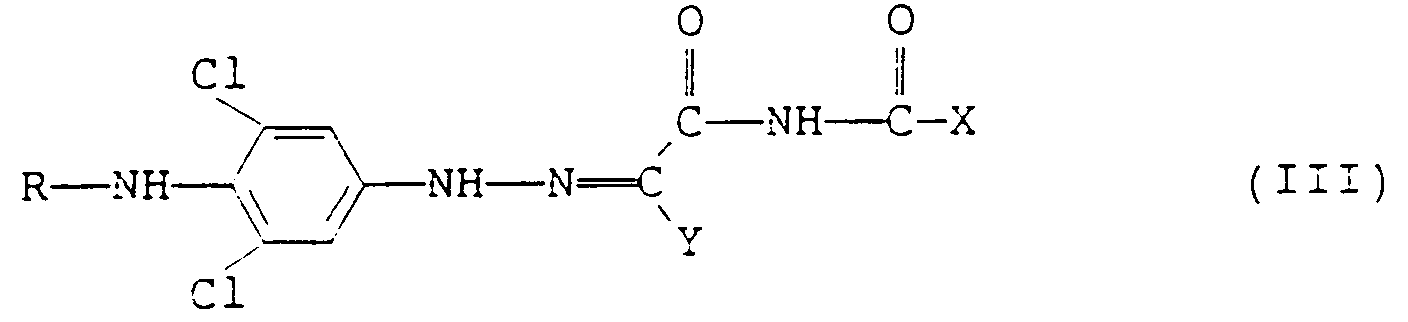
A compound as defined may be obtained by, for example, cyclizing an intermediate compound having the following general formula (III)
(wherein R is the same as defined above, X is a suitable eliminating group, such as an alkyloxy group or halogen, and Y is an electron-attractive group which can be advantageously eliminated, such as a lower alkoxycarbonyl group, a cyano group) in, for example, acetic acid with a metallic alkali salt of an organic acid (e.g., potassium acetate), and removing the group Y from the resulting compound having the following general formula (IV):
wherein each of R and Y is the same as defined above, in for example, acetic acid under a strong acidic condition such as hydrochloric acid to form a carboxylic acid derivative, followed by decarboxylation with thioglycolic acid. The intermediate compounds (III) are known compounds as shown in, for example, J. Medicinal Chemistry, 26, 96-100 (1983).
[0013] A compound as defined above may be formulated into a preventive/curative medicament for poultry against coccidiosis, e.g. in accordance with conventional methods well known in the field of art. Namely, the compound may be formulated into spreads, granules, suspensions, premixes, capsules, emulsions concentrates, tablets, and so forth, using the compound either as a single substance or with or without suitable carrier that are ordinarily used for this kind of medicaments, and using, at times, an excipient, a disintegrating agent, a sliding agent, a coating agent, and so forth.
[0014] The carriers usable in the preparations according to the present invention are not limited,but usually they should be appropriate for addition to livestock feed or drinking water of poultry, and examples include water, milk sugar, cane sugar, talc, colloidal silica, pectin, wheat flour, rice bran, corn flour, soybean, oil cake, ground or powdered grain, and other commercial livestock feeds for poultry.
[0015] Although there are no specific limitations to the content or concentration of the active component, i.e., the compound (I) or the nontoxic salt thereof, the preferable content is 0.1 to 99% by weight, more specifically, 1 to 50% by weight.
[0016] When the compound is used as an additive to the feed, the dose is preferably such that at least 0.1 to 500 ppm and more preferably 0.5 to 100 ppm of the compound, calculated as the original compound, is contained in the livestock feed for poultry. When it is added to drinking water, the dose is about the half of the concentration in the livestock feed described above, and a sufficient effect can usually be obtained at such concentration.
[0017] Furthermore, the compound can be used in combination with other medicaments for animals, e.g. other anticoccidial drugs for poultry, parasiticides, infection prophylaxis, growth promoters, and so forth.
[0018] As will be seen from the later-appearing Test Example, compounds embodying the invention exhibit higher anti-coccidium activities such as the restriction of the drop of a relative body weight increase ratio, the restriction of hematohezia, the decrease of number of oocyst (O.P.G) and the improvement in a cecitis lesion value, in chicks infected with coccidiostat, in comparison with salinomycin and clopidol, used as control anticoccidial drug. The compounds also showed low toxicity as can be appreciated clearly from the data of the number of dead chicks, and can be therefore used as the preventive/curative agent for poultry such as chickens, turkeys, quails and ducks against coccidiosis.
EXAMPLES
Example 1
[0020] Synthesis of 2-[4-(5-chloro-2-pyridylamino)-3,5-dichlorophenyl]-1,2,4-triazine-3-5-(2H, 4H)-dione (Compound 1)
[0021] A 5.4g amount of 4-(5-chloro-2-pyridylamino)-3,5-dichloroaniline was dissolved in a mixed solution of 4.4 mℓ of concentrated hydrochloric acid and 60 mℓ of acetic acid and, while this solution was cooled with ice, 1.4g of an aqueous sodium nitrite solution was dropwise added, followed then by stirring for 30 minutes. Furthermore, a mixture of 3.5g of sodium acetate and 3.2g of ethyl N-cyanoacetylcarbamate was added, and the mixture was stirred at a room temperature for 2 hours. The reaction mixture was poured into water, and the resulting crystal was filtrated and washed with water to give 8.6g of ethyl N-[{cyano-(3,5-dichloro-4-(5-chloro-2-pyridylamino)phenylhydrazynylidene)methyl}carbonyl]- carbamate.
[0022] The compound obtained above was dissolved in 90 mℓ of acetic acid and, after 1.8g of potassium acetate was added, the mixture solution was refluxed under heat for 3 hours. The reaction solution was concentrated and was then crystallized from water to yield 7.6 of a crude crystal of 2-[3,5-dichloro-4-(5-chloro-2-pyridylamino)phenyl]-3,5-(2H, 4H)-dioxo-6-cyano-1,2,4-triazine. This cyclized compound was dissolved in a mixed solution of 25 mℓ of concentrated hydrochloric acid and 125 mℓ of acetic acid, and was refluxed under heat for 15 hours. The reaction solution was concentrated to the half volume, and the resulting crystal was filtrated and then washed with water to yield 5.9g of 2-(3,5-dichloro-4-(5-chloro-2-pyridylamino)phenyl-1,2,4-triazine-3,5-(2H, 4H)-dione-6-carboxylic acid.
[0023] A 4.9g amount of the above-prepared carboxylic acid was mixed with 10mℓ of thioacetic acid and refluxed under heat at 150°C for 1.5 hours. The reaction solution was poured into water, and the resulting crystal was filtrated to yield 4.8g of a crude crystal. This crude crystal was recrystallized from ethyl acetate-hexane to yield 3.9g of the above compound (1).
Example 2
Synthesis of 2-[3,5-dichloro-4-(5-methyl-2-pyridylamino)phenyl]-1,2,4-triazine-3,5-(2H, 4H)-dione (Compound 2)
[0024] A 0.6g amount of the compound (2) identified above was obtained in the same manner as in Example 1 from 1.7g of the starting material, i.e. 3,5-dichloro-4-(5-methyl-2-pyridylamino)aniline.
Example 3
[0025] Synthesis of 2-[4-(3-chloro-5-trifluoromethyl-2-pyridylamino)-3,5-dichlorophenyl]-1,2,4-triazine-3,5-(2H, 4H)-dione (Compound 3)
[0026] A 1.1g amount of the compound (3) identified above was obtained in the same manner as in Example 1 from 1.7g of the starting material, i.e. 4-(3-chloro-5-trifluoromethyl-2-pyridylamino)-3,5-dichloroaniline.
Example 4
[0027] Synthesis of 2-[3,5-dichloro-4-(3-pyridylamino)phenyl]-1,2,4-triazine-3,5-(2H, 4H)-dione (Compound 2)
[0028] A 0.9g amount of the compound (4) identified above was obtained in the same manner as in Example 1 from 1.0g of the starting material, i.e. 3,5-dichloro-4-(3-pyridylamino)aniline.
Example 5
Synthesis of 2-[3,5-dichloro-4-(2-pyrimidinylamino)-phenyl]-1,2,4-triazine-3,5-(2H, 4H)-dione (Compound 5)
[0029] A 2.1g amount of the compound (5) identified above was obtained in the same manner as in Example 1 from 2.0g of the starting material, i.e. 3,5-dichloro-4-(2-pyrimidinylamino)aniline.
Example 6
[0030] Synthesis of 2-[4-(5-chloro-2-pyrimidinylamino)-3,5-dichlorophenyl]-1,2,4-triazine-3,5-(2H, 4H)-dione (Compound 6)
[0031] A 1.1g amount of the compound (6) identified above was obtained in the same manner as in Example 1 from 1.2g of the starting material, i.e. 4-(5-chloro-2-pyrimidinylamino)-3,5-dichloroaniline.
Example 7
[0032] Synthesis of 2-[4-(5-bromo-2-pyrimidinylamino)-3,5-dichlorophenyl]-1,2,4-triazine-(2H, 4H)-dione (Compound 7)
[0033] A 1.1g amount of the compound (7) identified above was obtained in the same manner as in Example 1 from 1.2g of the starting material, i.e. 4-(5-bromo-2-pyrimidinylamino)-3,5-dichloroaniline.
Example 8
[0034] Synthesis of 2-[3,5-dichloro-4-(5-methyl-3-isoxazolylamino)phenyl]-1,2,4-triazine-3,5-(2H, 4H)-dione (Compound 8)
[0035] A 0.9g amount of the compound (8) identified above was obtained in the same manner as in Example 1 from 1.6g of the starting material, i.e. 3,5-dichloro-4-(5-methyl-3-isoxazolylamino)aniline.
Example 9
[0036] Synthesis of 2-[3,5-dichloro-4-(5-trifluoromethyl-1,3,4-thiadiazole-2-ylamino)phenyl]-1,2,4-triazine-3,5-(2H, 4H)-dione (Compound 9)
[0037] A 1.0g amount of the compound (9) identified above was obtained in the same manner as in Example 1 from 1.5g of the starting material, i.e. 3,5-dichloro-4-(5-trifluoromethyl-1,3,4-thiadiazole-2-ylamino)aniline.
[0038] The property (i.e., melting point) of these compounds are listed in Table 1.
TABLE 1
| Compound No. | R | melting point (mp) °C |
| 1 | 5-Cℓ-2-pyridyl | > 250 |
| 2 | 5-CH₃-2-pyridyl | > 250 |
| 3 | 3-Cℓ-5-CF₃-2-pyridyl | 219 |
| 4 | 3-pyridyl | 157 - 159 |
| 5 | 2-pyrimidinyl | > 250 |
| 6 | 5-C,-2-pyrimidinyl | > 250 |
| 7 | 5-Br-2-pyrimidinyl | > 250 |
| 8 | 5-CH₃-3-isooxazolyl | 243 (decomposed) |
| 9 | 5-CF₃-2-thiadiazolyl | > 250 |
Example 10
Preparation of 100X powder (1)
[0040] One percent by weight of the compound 1 was well mixed with 99 wt% of milk sugar to obtain the 100X powder. When in use, this powder was diluted with a feed to a predetermined concentration and could be used.
Example 11
Preparation of 100X powder (2)
[0041] One percent by weight of the compound 3 was well mixed with 99 wt% of cane sugar to obtain 100X powder. When in use, this powder was diluted with drinking water to a predetermined concentration and could be used.
Example 12
Preparation of 10X powder
[0042] Ten percent by weight of the compound 6 was well mixed with 90 wt% of wheat flour to obtain 10X powder. When in use, this powder was diluted with a feed to a predetermined concentration, and could be used.
[0043] The in vivo preventive effect of the anticoccidial drug compositions for poultry was evaluated in the following way.
Test Example
Measurement of preventive/curative effect against coccidiosis in chicks
[0044] Five chicks of white leghorns of 7 to 10 days' age were grouped into groups, and a feed containing the specimen was dosed. Two days after the start of the dosage, the chicks were infected with 50,000 pcs/chick of the sporogenesitic Oocyst of the Eimeria tenella. The specimen was dosed continuously for nine days, and the degree of hematochezia, a survival ratio and a relative body weight increase ratio during that period were observed. Autopsy of the chicks was carried out at eighth day after the dose so as to observe the cecal lesion and to calculate a cecal lesion score.
[0046] Relative body weight increase ratio:
This ratio was expressed by the following formula:
Hematochezia:
[0047] The degree of hematochezia during the test period was evaluated by the following four stage:
| -: | No hematochezia was observed. |
| +: | Light hematochezia was observed. |
| ++: | Medium hematochezia was observed. |
| +++: | Hematochezia equivalent to that of the infected control group was observed. |
[0050] Autopsy of the surviving chicks was carried out on the eighth day after the infection, and the cecal lesion was observed with eye. The degree of the lesion was graded O to 4 (0: no lesion to 4: critical), the strength was measured in this period, and the mean value of the five chicks was employed.
[0053] The test result is tabulated in Table 2 in comparison with a Comparative Control Group treated with a known anticoccidial drug, an untreated Infected Control Group and an untreated Non-Infected Control Group.
Table 2
| Compound | Concentration (ppm) | Relative body weight increase ratio (%) | Number of dead chicks (dead/surviral) | Hematochezia | Oocysts per gram feces (O.P.G.) | Cecal lesion score | |||
| 4th day | 5th day | 6th day | 7th day | ||||||
| (infected control) | 0 | 40.8 | 0/5 | + | +++ | ++ | + | 2.70×10⁶ | 4.0 |
| (non infected control) | 0 | 100.0 | 0/5 | - | - | - | - | 0 | 0 |
| 1 | 20 | 96.9 | 0/5 | - | - | - | - | 0 | 0 |
| 10 | 100.0 | 0/5 | - | ± | + | - | 0 | 0.8 | |
| 5 | 87.5 | 0/5 | - | + | ++ | + | 0 | 1.8 | |
| 3 | 20 | 97.0 | 0/5 | - | - | - | - | 0 | 0 |
| 10 | 95.5 | 0/5 | - | - | - | - | 0 | 0 | |
| 5 | 98.5 | 0/5 | - | - | - | ± | 0 | 0.6 | |
| 6 | 20 | 95.8 | 0/5 | - | - | - | - | 0 | 0.6 |
| 10 | 102.8 | 0/5 | - | - | - | - | 0 | 0.6 | |
| 5 | 97.2 | 0/5 | - | ± | ++ | + | 0 | 2.6 | |
| salinomycin | 80 | 96.0 | 0/5 | - | - | - | - | <10³ | 0.8 |
| 60 | 82.0 | 0/5 | - | ++ | + | - | 1.56×10⁶ | 2.4 | |
| Clopidol | 125 | 105.1 | 0/5 | - | - | - | - | 0 | 0 |
| 31.3 | 67.6 | 0/5 | ± | +++ | ++ | + | 1.56×10⁶ | 4.0 | |
[0054] As can be seen clearly from the result shown in Table 2, the compounds embodying the invention exhibited the anticoccidial activity at a lower concentration than the known anticoccidial drug used for the control. Particularly, the number of Oocysts on the sixth day of the infection was 0(zero) even in the group infected with 5 ppm of the specimen. It became thus clear that the new compounds had a strong activity preventing the infection of individuals, and also preventive action against infection for other infected individuals.
1. A compound which is a substituted 1,2,4-triazine-3,5-dione derivative of the following
formula (I), or a salt thereof:
wherein R represents a 5- or 6-membered heterocyclic group.
wherein R represents a 5- or 6-membered heterocyclic group.
2. A compound according to claim 1 in which the heterocyclic group incorporates one or
two nitrogen, sulphur or oxygen atoms.
3. A compound according to claim 2 in which the heterocyclic group is a pyridyl or pyrimidinyl
group.
4. A compound according to any one of the preceding claims in which the heterocyclic
group has one or more halogen or C₁₋₄ alkyl (which may be halogenated) substituents.
5. A compound according to claim 1 in which the heterocyclic group is
5-chloro-2-pyridyl;
3-chloro-5-trifluoromethyl-2-pyridyl;
5-chloro-2-pyrimidinyl, or
5-bromo-2-pyrimidinyl.
5-chloro-2-pyridyl;
3-chloro-5-trifluoromethyl-2-pyridyl;
5-chloro-2-pyrimidinyl, or
5-bromo-2-pyrimidinyl.
6. A method comprising the preparation of a compound according to any one of claims 1
to 5.
7. A method according to claim 6, comprising the step of cyclising an intermediate of
the formula
in which R is as defined previously, X is a leaving group and Y is an electron-attractive group.
in which R is as defined previously, X is a leaving group and Y is an electron-attractive group.
8. A medicament comprising a compound according to any one of claims 1 to 5.
9. A medicament according to claim 8, comprising the compound in combination with a carrier.
10. Use of a compound according to any one of claims 1 to 5 in the preparation of a medicament
for the treatment of coccidiosis.