|
(11) | EP 0 578 185 A1 |

| (12) | EUROPEAN PATENT APPLICATION |
|
|
|
|
|||||||||||||||||||||||||||
| (54) | 1-AZA-2-silacyclobutane compounds and method for their preparation |
| (57) The present invention unexpectedly introduces 1-aza-2-silacyclobutane compounds whose
nitrogen is substituted by a hydrocarbon group or heteroatom-containing hydrocarbon
group, whose N-Si bond remains highly reactive, and which are very effective as silanol
endblocking agents and silane coupling agents. The present invention also introduces
a method for the preparation of these 1-aza-2-silacyclobutanes by the intramolecular
hydrosilylation reaction of N,N-disubstituted aminosilane. |
[0001] The present invention relates to 1-aza-2-silacyclobutane compounds whose nitrogen is substituted by a hydrocarbon group or a hydrocarbon group that contains a heteroatom-containing functional group. The present invention also relates to a method for the preparation of these compounds.
[0002] The 1-aza-2-silacyclobutane compounds known to date include 1-aza-2-silacyclobutane compounds in which carbon is bonded to the nitrogen in the 4-membered ring and 1-aza-2-silacyclobutane compounds in which silicon is bonded to this ring nitrogen. N-(1,1-dimethylethyl)-2,2,6-trimethyl-8-phenyl-1-aza-8-silabicyclo{4.2.0}octane-8-amine is an example of the former type of compound. This compound contains some very sterical and bulky substituents in order to improve the stability of intermediates generated during its synthesis, but this tactic also reduces the reactivity of this azasilacyclobutane. Furthermore, the synthesis of this compound involves the combination of a number of equivalent reactions, and this compound is problematic from an industrial perspective because of having to deal with by-products as well as the number of steps in its production process. Finally, this azasilacyclobutane is very expensive because the starting reagents used in its synthesis cannot be acquired on an industrial basis.
[0003] 1-benzyl-2,2,4-triphenyl-3-isopropyl-1-aza-2-silacyclobutane is another 1-aza-2-silacyclobutane in which carbon is bonded at the 1 position. Due to the extensive introduction of bulky substituents for the purpose of precursor stabilization, this 1-aza-2-silacyclobutane has bulky substituents bonded on all the atoms in the 4-membered ring, and this again results in a loss of reactivity. This azasilacyclobutane is also very expensive because the starting compounds for the precursors cannot be acquired on an industrial basis.
[0004] With regard to 1-aza-2-silacyclobutanes in which silicon is bonded to the nitrogen in the four-membered ring, Japanese Patent Application Laid Open {Kokai or Unexamined} Number Hei 2-235891 {235,891/1990} discloses the following compound
where R is a hydrocarbon group or hydrogen atom and R' is a hydrocarbon group, as a point of departure for the facile stereospecific preparation of 2-amino alcohols by desilylation. According to this invention, 2-amino alcohols are synthesized utilizing the facile hydrolyzability of the two Si-N bonds in the above compound and conversion of the Si-C bond into the Si-O bond by oxidation. Because this compound contains two readily hydrolyzable Si-N bonds, it is difficult to orient cleavage to a particular Si-N bond. When this compound is used, for example, as an endblocker for silanol-terminated siloxane, the following two species are produced, thus creating the problem of by-products:
and
Moreover, because the substituent group on the nitrogen has the -SiR'₂H structure, any functional group introduced in R' is subject to limitations imposed by the behavior of the Si-N bond. For example, even when a group such as the allyl group is introduced as R', this R' substituent will not be retained in the azasilacyclobutane skeleton and thus cannot be effectively utilized as a functional group in practical applications due to the facile cleavability of the Si-N bond by such reactions as hydrolysis.
[0005] The present invention unexpectedly introduces 1-aza-2-silacyclobutane compounds whose nitrogen is substituted by a hydrocarbon group or heteroatom-containing hydrocarbon group, whose N-Si bond is highly reactive, and which are very effective as silanol endblocking agents and silane coupling agents. The present invention also introduces a method for the preparation of these 1-aza-2-silacyclobutanes by the intramolecular hydrosilylation reaction of N,N-disubstituted aminosilane.
[0006] Furthermore, because a wide selection of N-bonded functional groups is possible for the 1-aza-2-silacyclobutane compounds of the present invention, these compounds are very useful as the corresponding silane coupling agents and endblockers for polysiloxanes, for example, as in the case of allyl, phenyl, substituted phenyl, benzyl, substituted benzyl, and so forth.
[0007] Finally, the preparative method of the present invention makes possible the direct, high yield, and highly selective production, from the dihydrocarbylsilyl derivatives of secondary allylamines, of 1-aza-2-silacyclobutane compounds having a functional group bonded to the nitrogen through carbon
[0008] The first embodiment of the present invention comprises 1-aza-2-silacyclobutane compounds described by formula (I)
where R¹, R², and R³ are independently selected from a group consisting of hydrogen and alkyls comprising one to three carbon atoms; R⁴, R⁵, and R⁶ are independently selected from a group consisting of alkyls comprising one to three carbon atoms; and R⁷ is an organic group selected from a group consisting of (i) saturated or unsaturated monovalent hydrocarbon groups comprising 1 to 14 carbon atoms and (ii) groups described by formula -R¹⁰-A in which R¹⁰ is a saturated or unsaturated divalent hydrocarbon group comprising 1 to 13 carbon atoms, A is a saturated or unsaturated monovalent organic group comprising 1 to 13 carbon atoms that contains at least one atom selected from a group consisting of nitrogen, oxygen, sulfur, silicon, fluorine, chlorine, bromine, and iodine, and the sum of the number of carbon atoms in R¹⁰ and the number of carbon atoms in A is 1 to 14.
[0009] The second embodiment of the present invention comprises a method for the preparation of compounds in accordance with the first embodiment that consists of the execution of an intramolecular hydrosilylation reaction on N,N-disubstituted aminosilane described by formula (II)
where R¹, R², R³, R⁵, R⁶, and R⁷ are defined as in the first embodiment, and R⁸ and R⁹ are independently selected from a group consisting of hydrogen, methyl, and ethyl with the proviso that when either R⁸ or R⁹ is ethyl, the other is hydrogen.
[0010] The third embodiment of the present invention comprises a method for the preparation of compounds in accordance with the first embodiment that consists of the preparation of N,N-disubstituted aminosilane described by formula (II) in the second embodiment by silylation of secondary amine compounds described by formula (III)
where R¹, R², R³, and R⁷ are as defined in the first embodiment and R⁸ and R⁹ are as defined in the second embodiment, with silane described by formula (IV)
where R⁵ and R⁶ are as defined in the first embodiment and X is a halogen atom, followed by execution of the method of the second embodiment.
[0011] The present invention was achieved as the result of research by the present inventor into compounds described by preceding formula (II). Methyl, ethyl, propyl, and isopropyl comprise the hydrocarbon groups represented by R¹, R², R³, R⁵, and R⁶ in formulas (I) through (IV).
[0012] R¹, R², R³, R⁸, and R⁹ are preferably hydrogen or methyl based on considerations of ease of acquisition of the starting secondary amine and obtaining a high reactivity in the azasilacyclobutane product.
[0013] R⁷ includes alkyl groups such as methyl, ethyl, propyl, isopropyl, butyl, and hexyl; alkenyl groups such as vinyl, allyl, and propenyl; aralkyl groups such as benzyl and substituted benzyl; aryl groups such as phenyl and tolyl; the 2-aminoethyl group; and substituents that themselves contain the azasilacyclobutane structure, as described by the following formulas (V) and (VI):
and
[0014] Azasilacyclobutanes in accordance with the present invention are exemplified by 1-allyl-2,2,3-trimethyl-1-aza-2-silacyclobutane, 1-(gamma-trimethoxysilylpropyl)-2,2,3-trimethyl-1-aza-2-silacyclobutane, 1-phenyl-2,2,3-trimethyl-1-aza-2-silacyclobutane, 1-benzyl-2,2,3-trimethyl-1-aza-2-silacyclobutane, 1-vinylbenzyl-2,2,3-trimethyl-1-aza-2-silacyclobutane, and the following formulas (VII) and (VIII):
and
where Me is methyl.
[0015] In the 1-aza-2-silacyclobutane compounds according to the present invention, any functional group is bonded to the nitrogen atom through carbon. Moreover, the Si-N bond in the four-membered ring of the 1-aza-2-silacyclobutanes of the present invention undergoes hydrolysis very readily and is easily cleaved. As a consequence, when these compounds are used, for example, as an endblocking agent for silanol-terminated polysiloxanes, endblocking can be realized without the generation of by-products simply by mixing the siloxane with the invention compound.
[0016] The present invention will be explained in greater detail in the following examples, but the invention is not limited to these examples. Also, in the following examples, unless expressly indicated otherwise, "part" means "weight part" and "%" means "mol%". For the examples provided, the products were isolated and purified by distillation or preparative gas chromatography, and their structures were confirmed by ¹H-NMR, ¹³C-NMR, ²⁹Si-NMR, and mass spectrometric analysis, as appropriate.
[0017] Reference Example 1. (Preparation of N-dimethylsilyldiallylamine) Into a nitrogen-flushed vessel were introduced 21 parts diallylamine, 29 parts triethylamine, and 200 parts heptane, and, while agitating, a mixture of 50 parts heptane and 22 parts dimethylchlorosilane was slowly dripped in. After 2 days, another 200 parts heptane was added, and the mixture was filtered to remove the precipitate. The filtrate was distilled to obtain N-dimethylsilyldiallylamine in a yield of 84% based on diallylamine.
[0018] Reference Example 2. (Preparation of N-dimethylsilyl-N-allylaniline) Into a nitrogen-flushed container were introduced 25 parts N-allylaniline, 28 parts triethylamine, and 200 parts hexane, and, while agitating, a mixture of 25 parts dimethylchlorosilane was slowly dripped in. The resulting slurry was heated at reflux for 18 hours, cooled to room temperature, and filtered to remove the precipitate. The filtrate was distilled to obtain N-dimethylsilyl-N-allylaniline in a yield of 64% based on N-allylaniline.
[0019] Reference Example 3. (Preparation of N-dimethylsilyl-N-benzylallylamine) Into a nitrogen-flushed container were introduced 18 parts N-benzylaniline and 50 parts ethyl ether, and while cooling in a water bath 74 parts n-butyllithium/hexane (1.6 mol/L) was slowly dripped in. Then, 11.5 parts dimethylchlorosilane was slowly dripped in. The resulting precipitate was filtered, and the filtrate was distilled to give N-dimethylsilyl-N-benzylallylamine in a yield of 85% based on N-benzylaniline.
[0020] Example 1. Into a nitrogen-flushed container were introduced 1 part N-dimethylsilyldiallylamine, 3 parts benzene, and 0.003 part bis(triphenylphosphine)dichloroplatinum (PtCl₂(PPh₃)₂), and the mixture was heated at reflux in an oil bath for 4 hours. According to gas chromatographic analysis, no N-dimethylsilyldiallylamine was observed; 1-allyl-2,2,3-trimethy-1-aza-2-silacyclobutane and 1-allyl-2,2-dimethyl-1-aza-2-silacyclopentane were produced in a molar ratio of 83:17 and a combined yield of 77 mol%. A mixture of these two products was obtained at a yield of 70% by reduced pressure distillation.
[0021] Example 2. Into a glass tube with an outside diameter of 10 mm and a length of 10 cm were introduced 0.002 mL of a 20 weight% isopropanolic chloroplatinic acid solution and 2 mL of a mixture of 1 part N-dimethylsilyldiallylamine and 3 parts benzene, and the tube was sealed. After this was heated for 17 hours at 80oC, the conversion was 100 weight%. 1-allyl-2,2,3-trimethyl-1-aza-2-silacyclobutane and 1-allyl-2,2-dimethyl-1-aza-2-silacyclopentane were produced in a molar ratio of 66:34 and a combined yield of 55%.
[0022] Examples 3 to 9. Sealed tube reactions were run as in Example 2 using different platinum catalysts from those used in Examples 1 and 2. The reaction conditions and reaction products are reported in Table 1.
[0023] Example 10. A sealed glass tube reaction was carried out as in Example 2, but in the present case using 10 mg platinum on activated carbon (5 weight% Pt/C) and 2 mL of a mixture of N-dimethylsilyl-N-benzylallylamine and benzene (molar ratio 38:62) and reacting the mixture for 15 hours at 60oC. The conversion of the starting material was 100 weight%. The yield of 1-benzyl-2,2,3-trimethyl-1-aza-2-silacyclobutane was 84% and that of 1-benzyl-2,2-dimethyl-1-aza-2-silacyclopentane was 16%.
[0024] Example 11. A sealed glass tube reaction was carried out as in Example 2, but in this case using 2 mg bis(triphenylphosphine)dichloroplatinum (PtCl₂(PPh₃)₂) and 2 mL of a mixture of N-dimethylsilyl-N-benzylallylamine and benzene (molar ratio 38:62) and reacting for 15 hours at 60oC. The conversion of starting material was 95%. The yield of 1-benzyl-2,2,3-trimethyl-1-aza-2-silacyclobutane was 92% and that of 1-benzyl-2,2-dimethyl-1-aza-2-silacyclopentane was 2%.
[0025] Example 12. A sealed glass tube reaction was carried out as in Example 2, but in this case using 2 mg bis(triphenylphosphine)dichloroplatinum (PtCl₂(PPh₃)₂) and 2 mL of a mixture of N-dimethylsilyl-N-allylaniline and benzene (molar ratio 40:60) and reacting for 9 hours at 80oC. The conversion of starting material was 100 weight%. The yield of 1-phenyl-2,2,3-trimethyl-1-aza-2-silacyclobutane was 94% and that of 1-phenyl-2,2-dimethyl-1-aza-2-silacyclopentane was 2%.
[0026] The results from hydrosilylation reactions using non-platinum catalysts are given below for the purposes of comparison.
[0027] Comparison Example 1. Into a nitrogen-flushed vessel were introduced 1 part N-dimethylsilyldiallylamine, 3 parts benzene, and 0.003 part tris(triphenylphosphine)chlororhodium (RhCl(PPh₃)₃). The mixture was heated at reflux for 4 hours in an oil bath. According to gas chromatographic analysis, no N-dimethylsilyldiallylamine was observed. 1-allyl-2,2-dimethyl-1-aza-2-silacyclopentane and 1-propenyl-2,2-dimethyl-1-aza-2-silacyclopentane were produced in a molar ratio of 98:2 and a combined yield of 95%.
[0028] Comparison Example 2. Into a glass tube with an outside diameter of 10 mm and a length of 10 cm were introduced 2 mg RhCl(PPh₃)₃ and 2 mL of a mixture of 1 part N-dimethylsilyldiallylamine and 3 parts benzene, and the tube was sealed. After heating this for 17 hours at 80oC, the conversion was 100 weight% and 1-propenyl-2,2-dimethyl-1-aza-2-silacyclopentane was obtained in a yield of 98%. No production of 1-allyl-2,2-dimethyl-1-aza-2-silacyclopentane was observed.
[0029] Comparison Example 3. A sealed glass tube reaction was carried out as in Comparison Example 2 using 2 mg tris(triphenylphosphine)chlororhodium (RhCl(PPh₃)₃) and 2 mL of a mixture of N-dimethylsilyl-N-benzylallylamine and benzene (molar ratio 38:62) and reacting for 9 hours at 80oC. The conversion of starting material was 100 weight%, and the yield of 1-benzyl-2,2-dimethyl-1-aza-2-silacyclopentane was 98%. No isomeric azasilacyclobutane was produced.
[0030] Comparison Example 4. A sealed glass tube reaction was carried out as in Comparison Example 2 using 2 mg tris(triphenylphosphine)chlororhodium (RhCl(PPh₃)₃) and 2 mL of a mixture of N-dimethylsilyl-N-allylaniline and benzene (molar ratio 40:60) and reacting for 15 hours at 60oC. The conversion of starting material was 100 weight%. The yield of 1-phenyl-2,2,3-trimethyl-1-aza-2-silacyclobutane was 4%, and that of 1-phenyl-2,2-dimethyl-1-aza-2-silacyclopentane was 72%.
1. 1-aza-2-silacyclobutane compounds described by formula
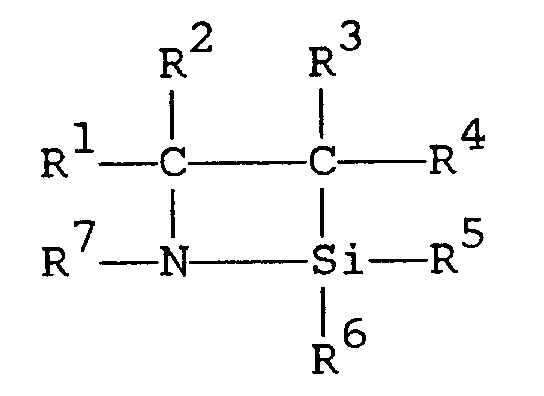
where R¹, R², and R³ are independently selected from hydrogen and alkyls comprising 1 to 3 carbon atoms; R⁴, R⁵, and R⁶ are independently selected from alkyls comprising 1 to 3 carbon atoms; and R⁷ is an organic group selected from (i) saturated or unsaturated monovalent hydrocarbon groups comprising 1 to 14 carbon atoms and (ii) groups described by formula -R¹⁰-A in which R¹⁰ is a saturated or unsaturated divalent hydrocarbon group comprising 1 to 13 carbon atoms, A is a saturated or unsaturated monovalent organic group comprising 1 to 13 carbon atoms that contains at least one atom selected from nitrogen, oxygen, sulfur, silicon, fluorine, chlorine, bromine, and iodine, and the sum of the number of carbon atoms in R¹⁰ and the number of carbon atoms in A is 1 to 14.
where R¹, R², and R³ are independently selected from hydrogen and alkyls comprising 1 to 3 carbon atoms; R⁴, R⁵, and R⁶ are independently selected from alkyls comprising 1 to 3 carbon atoms; and R⁷ is an organic group selected from (i) saturated or unsaturated monovalent hydrocarbon groups comprising 1 to 14 carbon atoms and (ii) groups described by formula -R¹⁰-A in which R¹⁰ is a saturated or unsaturated divalent hydrocarbon group comprising 1 to 13 carbon atoms, A is a saturated or unsaturated monovalent organic group comprising 1 to 13 carbon atoms that contains at least one atom selected from nitrogen, oxygen, sulfur, silicon, fluorine, chlorine, bromine, and iodine, and the sum of the number of carbon atoms in R¹⁰ and the number of carbon atoms in A is 1 to 14.
2. A method for preparation of 1-aza-2-silacyclobutane described by formula
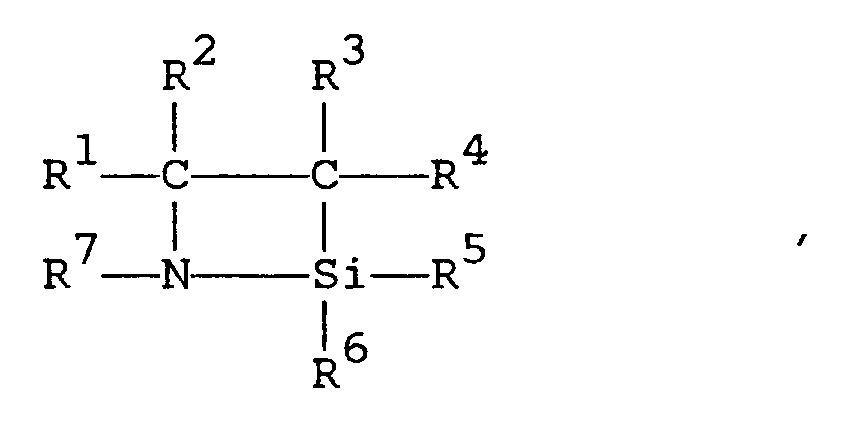
the method comprising: executing an intramolecular hydrosilylation reaction on N,N-disubstituted aminosilane described by formula
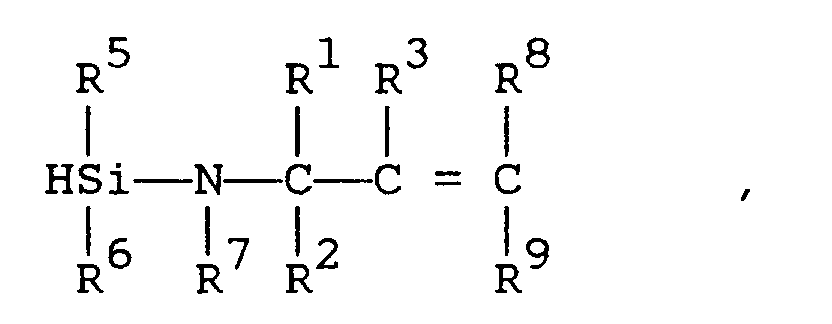
where R¹, R², and R³ are independently selected from hydrogen and alkyls comprising 1 to 3 carbon atoms; R⁴, R⁵, and R⁶ are independently selected from alkyls comprising 1 to 3 carbon atoms; and R⁷ is an organic group selected from (i) saturated or unsaturated monovalent hydrocarbon groups comprising 1 to 14 carbon atoms and (ii) groups described by formula -R¹⁰-A in which R¹⁰ is a saturated or unsaturated divalent hydrocarbon group comprising 1 to 13 carbon atoms, A is a saturated or unsaturated monovalent organic group comprising 1 to 13 carbon atoms that contains at least one atom selected from nitrogen, oxygen, sulfur, silicon, fluorine, chlorine, bromine, and iodine, and the sum of the number of carbon atoms in R¹⁰ and the number of carbon atoms in A is 1 to 14; R⁸ and R⁹ are independently selected from hydrogen, methyl, and ethyl, with the proviso that when either R⁸ or R⁹ is ethyl, the other is hydrogen.
the method comprising: executing an intramolecular hydrosilylation reaction on N,N-disubstituted aminosilane described by formula
where R¹, R², and R³ are independently selected from hydrogen and alkyls comprising 1 to 3 carbon atoms; R⁴, R⁵, and R⁶ are independently selected from alkyls comprising 1 to 3 carbon atoms; and R⁷ is an organic group selected from (i) saturated or unsaturated monovalent hydrocarbon groups comprising 1 to 14 carbon atoms and (ii) groups described by formula -R¹⁰-A in which R¹⁰ is a saturated or unsaturated divalent hydrocarbon group comprising 1 to 13 carbon atoms, A is a saturated or unsaturated monovalent organic group comprising 1 to 13 carbon atoms that contains at least one atom selected from nitrogen, oxygen, sulfur, silicon, fluorine, chlorine, bromine, and iodine, and the sum of the number of carbon atoms in R¹⁰ and the number of carbon atoms in A is 1 to 14; R⁸ and R⁹ are independently selected from hydrogen, methyl, and ethyl, with the proviso that when either R⁸ or R⁹ is ethyl, the other is hydrogen.
3. A method for preparation of 1-aza-2-silacyclobutane described by formula
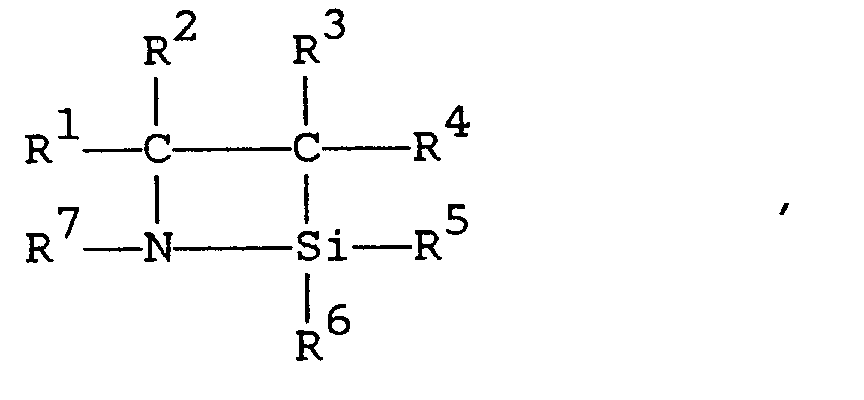
the method comprising: silylating a secondary amine described by formula
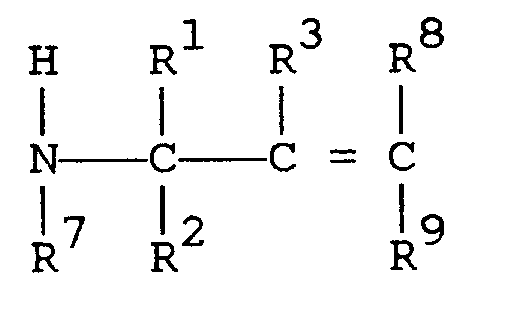
with a silane described by formula
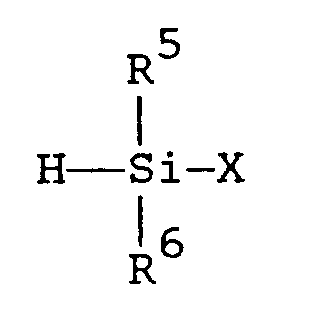
to form a N,N-disubstituted aminosilane described by formula
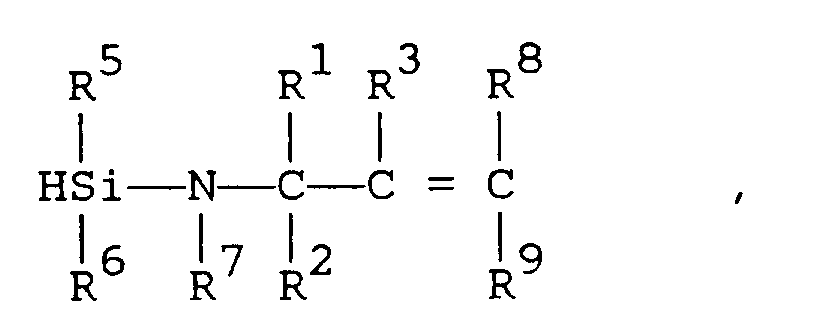
and an intramolecular hydrosilylation reaction of the N,N-disubstituted aminosilane;
where R¹ R² and R³ are independently selected from hydrogen and alkyls comprising 1 to 3 carbon atoms; R⁴, R⁵, and R⁶ are independently selected from alkyls comprising 1 to 3 carbon atoms; R⁷ is an organic group selected from (i) saturated or unsaturated monovalent hydrocarbon groups comprising 1 to 14 carbon atoms and (ii) groups described by formula -R¹⁰-A in which R¹⁰ is a saturated or unsaturated divalent hydrocarbon group comprising 1 to 13 carbon atoms, A is a saturated or unsaturated monovalent organic group comprising 1 to 13 carbon atoms that contains at least one atom selected from nitrogen, oxygen, sulfur, silicon, fluorine, chlorine, bromine, and iodine, and the sum of the number of carbon atoms in R¹⁰ and the number of carbon atoms in A is 1 to 14; and R⁸ and R⁹ are independently selected from hydrogen, methyl, and ethyl, with the proviso that when either R⁸ or R⁹ is ethyl, the other is hydrogen.
the method comprising: silylating a secondary amine described by formula
with a silane described by formula
to form a N,N-disubstituted aminosilane described by formula
and an intramolecular hydrosilylation reaction of the N,N-disubstituted aminosilane;
where R¹ R² and R³ are independently selected from hydrogen and alkyls comprising 1 to 3 carbon atoms; R⁴, R⁵, and R⁶ are independently selected from alkyls comprising 1 to 3 carbon atoms; R⁷ is an organic group selected from (i) saturated or unsaturated monovalent hydrocarbon groups comprising 1 to 14 carbon atoms and (ii) groups described by formula -R¹⁰-A in which R¹⁰ is a saturated or unsaturated divalent hydrocarbon group comprising 1 to 13 carbon atoms, A is a saturated or unsaturated monovalent organic group comprising 1 to 13 carbon atoms that contains at least one atom selected from nitrogen, oxygen, sulfur, silicon, fluorine, chlorine, bromine, and iodine, and the sum of the number of carbon atoms in R¹⁰ and the number of carbon atoms in A is 1 to 14; and R⁸ and R⁹ are independently selected from hydrogen, methyl, and ethyl, with the proviso that when either R⁸ or R⁹ is ethyl, the other is hydrogen.
4. A method according to Claims 2 or 3 further comprising the use of a platinum-containing
catalyst.
5. A method according to Claim 4, where the platinum-containing catalyst is selected
from platinum metal, carrier-supported platinum metal, colloidal platinum metal, a
zero-valent platinum complex, a divalent platinum complex, and a tetravalent platinum
complex.
6. A 1-aza-2-silacyclobutane compound according to Claim 1 selected from a group consisting
of: 1-allyl-2,2,3-trimethyl-1-aza-2-silacyclobutane, 1-(gamma-trimethoxysilylpropyl)-2,2,3-trimethyl-1-aza-2-silacyclobutane,
1-phenyl-2,2,3-trimethyl-1-aza-2-silacyclobutane, 1-benzyl-2,2,3-trimethyl-1-aza-2-silacyclobutane,
1-vinylbenzyl-2,2,3-trimethyl-1-aza-2-silacyclobutane,
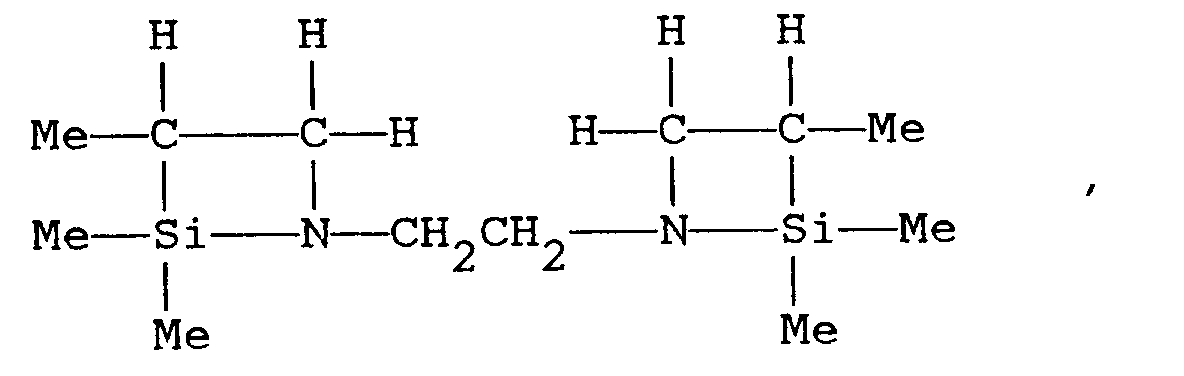
and
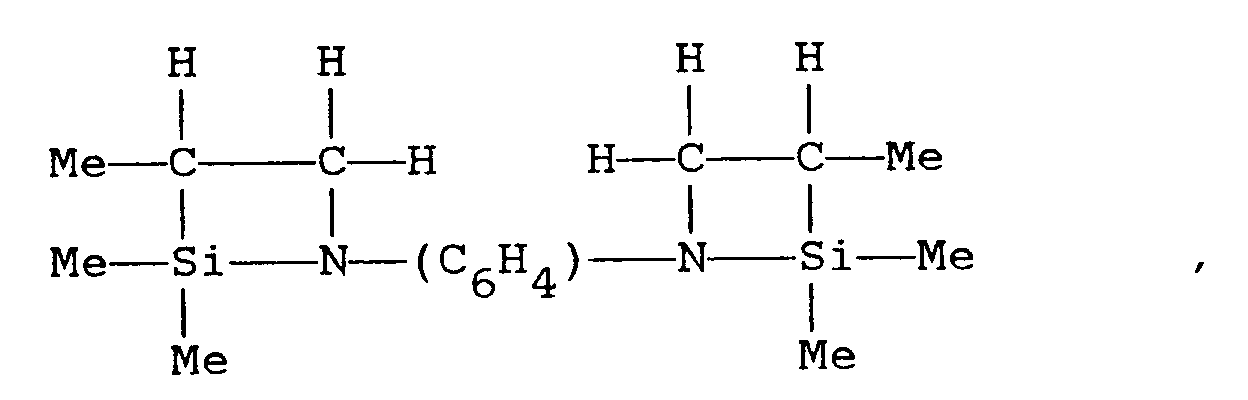
where Me is methyl.
and
where Me is methyl.
7. A method for preparation of 1-aza-2-silacyclobutane according to Claim 3, where the
silane is dimethylchlorosilane.