|
(11) | EP 0 578 363 A1 |

| (12) | EUROPEAN PATENT APPLICATION |
|
|
|
|
|||||||||||||||||||||||||||
| (54) | Method for operating dry-process, desulfurization apparatus |
| (57) A dry-process, desulfurization apparatus using a carbonaceous adsorbent is operated
with less consumption of the adsorbent and without occurrence of hot spots due to
an increase in the adsorbent temperature safely and economically by using a dry-process,
moving bed desulfurization apparatus using a carbonaceous adsorbent for a flue gas
containing SOx and at least 10% by volume of O₂ and at least one of substances capable of reacting
with SOx to form solid compounds at a temperature of not more than 130°C within a region confined
by the following two equations: and Y = -20T +2,800 wherein Y is a SOx concentration, ppm, on dry basis, and T is a flue gas temperature, °C. |
BACKGROUND OF THE INVENTION
1) FIELD OF THE INVENTION
[0001] The present invention relates to a method for operating a dry-process, desulfurization apparatus.
2) PRIOR ART
[0002] It is known that the desulfurization capacity of a dry-process desulfurization apparatus using a carbonaceous adsorbent can be increased generally when a flue gas to be desulfurized has a lower temperature. Thus, to make the apparatus smaller in the size, it is necessary to lower a flue gas temperature to a minimum.
[0003] On the other hand, when a flue gas has a higher O₂ concentration, for example, at least 10% by volume, and when the SO₂ concentration is higher, the temperature of the adsorbent will be increased due to the heat of adsorption reaction evolved when the flue gas is adsorbed onto the adsorbent. It is known that the temperature increased rate is much higher than at a lower O₂ concentration (e.g. less than 10% by volume).
SUMMARY OF THE INVENTION
[0004] An object of the present invention is to provide a method for economically operating a dry-process, desulfurization apparatus using a carbonaceous adsorbent with safety.
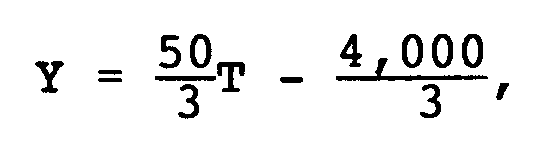
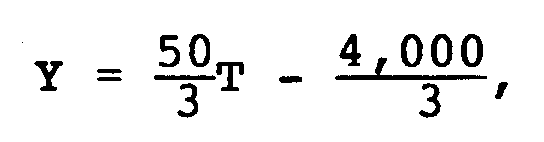
[0005] According to the present invention, a dry-process, moving bed desulfurization apparatus using a carbonaceous adsorbent is operated to desulfurize a flue gas containing SOx, typically SO₂, at least 10% by volume of O₂ and at least one of NH₃, HCℓ, Na₂O, KCℓ, K₂O, etc. capable of reacting with SOx, such as SO₂, SO₃, H₂SO₃, H₂SO₄, etc. to form solid compounds at a temperature of not more than 130°C within a range confined by the following two equations:
and
Y = -20T + 2,800
wherein Y is a SO₂ or SOx concentration, ppm, on dry basis and T is a flue gas temperature, °C.
BRIEF DESCRIPTION OF THE DRAWINGS
[0006] Fig. 1 is a SOx adsorption profile on a carbonaceous adsorbent in a carbonaceous adsorbent moving bed for a flue gas containing SOx and passing in a cross-flow to the moving bed at higher and lower flue gas temperatures.
[0007] Fig. 2 is a diagram showing relations between an amount of adsorbed SO₂ per unit weight of a carbonaceous adsorbent at a flue gas upstream side and a temperature of flue gases containing SO₂ at various concentrations.
[0008] Fig. 3 is a diagram showing relations between percent pulverization of carbonaceous adsorbent and a temperature of flue gases containing SO₂ at various concentrations.
[0009] Fig. 4 is a diagram showing relations between an increase in temperature of adsorbent bed and a temperature of flue gases containing SO₂ at various concentration.
[0010] Fig. 5 is a diagram showing an applicable range of the present invention in relations between a SO₂ concentration of flue gas and a flue gas temperature.
DETAILED DESCRIPTION OF THE INVENTION
[0011] In the present invention, a flue gas having the following conditions is used:
The flue gas contains:
(a) SO₂,
(b) at least 10% by volume of O₂, and
(c) at least one of substances capable of reacting with SOx including SO₂, SO₃, H₂SO₃ and H₂SO₄ contained in the flue gas, for example, at least one of NH₃, HCℓ, NaCℓ, N₂O, KCℓ, and K₂O, where NH₃ may be intentionally added to the flue gas in some cases.
[0012] As is well known, adsorption rate of SO₂ or other SOx components onto a carbonaceous adsorbent such as activated carbon or char is increased at a lower flue gas temperature. That is, SO₂ and other SOx components are adsorbed on a carbonaceous adsorbent in a very thin zone at the flue gas upstream side, and an amount of adsorbed SO₂ or other SOx components for unit weight of the adsorbent is drastically increased, as shown in Fig. 1 by a full line showing a higher flue gas temperature, as compared with a dotted line showing a lower flue gas temperature.
[0013] Phenomenon that the amount of adsorbed SO₂ or other SOx component is drastically increased in a very thin zone at the flue gas upstream side has been clarified by tests conducted by the present inventor. That is, in case of SO₂ as a typical SOx component in a flue gas, an amount of SO₂ adsorbed on unit weight of activated carbon or char as a typical carbonaceous adsorbent in the very thin zone at the flue gas upstream side, e.g. mg SO₂/g activated carbon or char, changes at temperatures of flue gases containing SO₂ at various concentrations, 300 ppm, 200 ppm and 100 ppm, as shown in Fig. 2. At any of SO₂ concentrations of 300 ppm, 200 ppm and 100 ppm, the amount of adsorbed SO₂ per unit weight of activated carbon or char drastically increases at a lower flue gas temperature.
[0014] When the amount of adsorbed SO₂ or other SOx component on per unit weight of activated carbon or char is extremely increased, pores in the activated carbon or char as a carbonaceous adsorbent are broken by volume expansion, i.e. increase in volume, of solid compounds, such as NH₄HSO₄, (NH₄)₂SO₄, Na₂SO₄, K₂SO₄ and or NH₄Cℓ formed in the pores, and the active carbon or char is pulverized, leading to an extreme decrease in the amount of the usable activated carbon, as shown in Fig. 3, where the hatched region is effectively available zone from the viewpoint of smaller percentage pulverization of activated carbon or char.
[0015] As a result of further tests made by the present inventor to solve the problem of extreme decrease in the amount of the usable activated carbon or char, it has been found that the extreme decrease in the amount of activated carbon or char as a carbonaceous adsorbent can be prevented by keeping the SO₂ concentration of a flue gas and a flue gas temperature into a region expressed by the following equation:
where Y is a SO₂ or SOx concentration, ppm, on dry basis, and T is a flue gas temperature, °C.
[0016] It has been found by further tests that when the SO₂ concentration of a flue gas containing at least 10% by volume of oxygen is higher, the temperature of activated carbon or char as a carbonaceous adsorbent tends to be higher, for example, by about 10°C at 300 ppm SO₂, due to an increase of heat of adsorption reaction than at a lower oxygen concentration, for example, less than 10% by volume of O₂ in a flue gas, giving rise to an appreciable difference in a temperature increase in the adsorbent bed, ΔT, between an oxygen concentration of at least 10% by volume and that of less than 10% by volume at a specific SO₂ concentration over a specific temperature level, as shown in Fig. 4. In other words, within the hatched region region, there is no appreciable difference in the increase of activated carbon or char temperature, ΔT, between an O₂ concentration of at least 10% by volume and that of less than 10% by volume.
[0017] When the activated carbon or char temperature is increased at a high O₂ concentration of a flue gas, a spontaneous oxidation rate of activated carbon or char as a carbonaceous adsorbent is increased, and there is a fear of hot spot formation in the adsorbent, leading to a danger of ignition.
[0018] As a result of further tests, it has been found that the adsorbent can be prevented from the formation of hot spots by keeping the SO₂ concentration of a flue gas and temperatures of a flue gases containing oxygen at an oxygen concentration of at least 10% by volume within a region confined by the following equation:
Y = -20T + 2,800
where Y and T are the same as defined above.
[0019] On the basis of the foregoing test results, extreme consumption of an adsorbent and formation of hot spots can be prevented by operating a dry-process, moving bed desulfurization apparatus using a carbonaceous adsorbent, such as activated carbon or char, for desulfurizing a flue gas containing SOx and oxygen at an oxygen concentration of at least 10% by volume within a region confined by the following equations:
and
Y = -20T + 2,800
where Y is a SO₂ concentration, ppm, on dry basis and T is a flue gas temperature, °C, in other words, the hatched region in Fig. 5.
[0020] The present invention includes operation of a dry-process, desulfurizing apparatus using a carbonaceous adsorbent in the hatched region of Fig. 5, and also controlling the flue gas temperature to the temperature range in the hatched region of Fig. 5. For the latter purpose, a flue gas cooling unit can be provided before the dry process, desulfurization apparatus or operating conditions for a flue gas source can be adjusted.
[0021] In the present invention, a sintering waste gas, incineration flue gas, an electric furnace waste gas, etc. can be used as a flue gas.
[0022] According to the present invention, consumption of adsorbent and occurrence of hot spots due to an increase in the adsorbent temperature can be prevented and safe and economical operation can be attained by operating a dry-process, moving bed desulfurization apparatus using a carbonaceous adsorbent for desulfurizing a flue gas containing SOx, at least 10% by volume of O₂, and at least one of substances such as NH₃, HCℓ, NaCℓ, Na₂O, KCℓ, K₂O, etc., capable of reacting with SOx such as SO₂, SO₃, H₂SO₃, H₂SO₄, etc. to form solid compounds at a temperature of not more than 130°C within a region confined by the following equations:
and
Y = -20T + 2,800
1. A method for operating a dry-process, desulfurization apparatus using a carbonaceous
adsorbent, which comprises using a dry-process, desulfurization apparatus using a
carbonaceous adsorbent for a flue gas containing SOx and at least 10% by volume of O₂ and at least one of substances capable of reacting
with SOx to form solid compounds at a temperature of not more than 130°C within a region confined
by the following two equations:
and
Y = -20T + 2,800
wherein Y is a SOx concentration, ppm, on dry basis and T is a flue gas temperature, °C.
and
Y = -20T + 2,800
wherein Y is a SOx concentration, ppm, on dry basis and T is a flue gas temperature, °C.
2. A method according to Claim 1, wherein the substances capable of reacting with SOx to form solid compounds at a temperature of not more than 130°C are NH₃, HCℓ, NaCℓ,
Na₂O, KCℓ and K₂O.
3. A method according to Claim 1, wherein the SOx is SO₂ and at least one of SO₃, H₂SO₃ and H₂SO₄.
4. A method according to Claim 1, wherein the flue gas temperature is controlled to within
a region confined by the following two equations:
and
Y = -20T + 2,800
where Y is a SOx concentration, ppm, on dry basis and T is a flue gas temperature, °C.
and
Y = -20T + 2,800
where Y is a SOx concentration, ppm, on dry basis and T is a flue gas temperature, °C.