| (19) |
 |
|
(11) |
EP 0 578 902 A1 |
| (12) |
EUROPEAN PATENT APPLICATION |
| (43) |
Date of publication: |
|
19.01.1994 Bulletin 1994/03 |
| (22) |
Date of filing: 17.07.1992 |
|
| (51) |
International Patent Classification (IPC)5: A23N 12/08 |
|
| (84) |
Designated Contracting States: |
|
AT BE CH DE DK ES FR GB GR IT LI LU MC NL PT SE |
| (71) |
Applicant: PETRONCINI SpA |
|
I-44047 Sant'Agostino (Ferrara) (IT) |
|
| (72) |
Inventor: |
|
- Farina, Stefano
I-40141 Bologna (IT)
|
| (74) |
Representative: Sassatelli, Franco T., Dr. |
|
c/o INIP
5, via Ruggi
I-40137 Bologna
I-40137 Bologna (IT) |
|
| |
|
(57) The system foresees the production of heat and smoke in combustion chamber (1), by
means of burner (2), which pass through a collector (3) communicating with a heat
exchanger (4) such that heat is exchanged by induction to air drawn from outside by
an air intake (5). The heated air flows from air intake (5) via pipe (6) into chamber
(7) centrally including the combustion chamber (1). In this way said forced flow is
overheated by contact with the walls of the combustion chamber (1) to the required
temperature. The heated air flows via pipe (8) into roasting chamber (9) where it
passes over the product when moving into roasting unit (10). Said hot air flow crosses
the product so as to heat it to the required temperature and then the hot air is discharged
with the roasting smoke in suspension, through pipe (11). The hot air is then sucked
by an intake group (12) producing the forced circulation. Said gaseous flow comes
finally to a cyclone separator (13) having the function to remove the bigger dimension
particles from the air. The air/smoke suspension then passes to the atmosphere through
an after burner (14). Where it is heated to a temperature (400°-700°) such that it
ignites.
|
|
[0001] The invention refers to a new system realizing the heat gaseous flow for the roasting
which principally comes to avoid the contact of the smokes coming from the heat generator
with goods so excluding that polluting combustion residues come to put on the same
goods. In a particular embodiment the system, re-employing the heat flow coming from
the roasting, realizes and energy saving and brings to an ecological problem solution
reducing the air pollution. The invented system may be particularly used in the roasting
of goods for human nourishment such as coffee, barley, cacao, peanuts and similar.
In the current roasting plants both in those intermittent, which generally use a perforated
rotating bin, and in those continuous, which use a vibrator belt, a fluidized bed
or similar, the working goods are crossing by a forced heat flow, coming from the
combustion chamber, consists of a mixture made of the air sucked up from outside and
of the smokes produced by the heat generator. Said gas flow, at a variable temperature
from 200° to 850°, comes to run over the working goods in continuous movement into
the roasting chamber so to exert a licked action on the goods surface which tends
to give up the suspended solid particles such as the combustion residues. This comes
to determine on goods a bringing of polluting substances, such as organic substances
with presence of carbon monoxide, nitrogen, sulfur and other, which come to negatively
affect both on the healthy qualities of the goods and on their own characteristics
so to cause damage also to their aromatic qualities. Moreover said forced flow, getting
out from the roasting chamber, is taken to a variable temperature from 400° to 800°
to reduce the organic substance content in suspension into it before letting out the
same outside. In comparison with this current system the invented system permits the
complete problem solution using a new roasting plant which comes to avoid the contact
of the combustion residues with the goods by means of a set realizing a heat induction
transfer. In this way is preserved into the roasting goods both the healthy characteristic,
so avoiding physical damages for the consumer, and the own characteristics so permitting
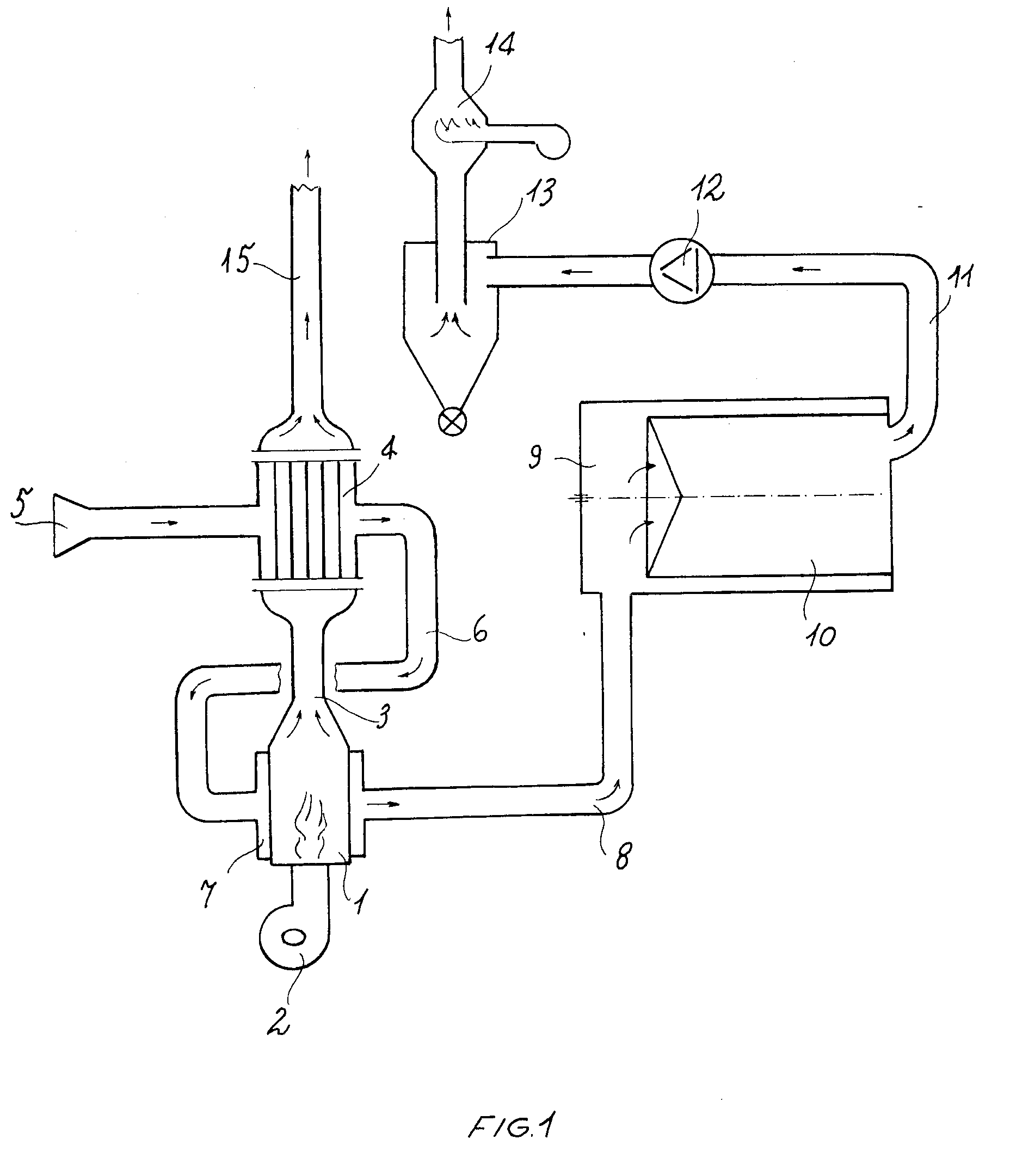
the aromatic quality preservation. The invented system foresees the heat and smokes
production into the combustion chamber 1, by means of the burner 2, and through the
collector 3 their reaching into a heat exchanger 4 with distinct flows where they
make over by induction their heat to an air flow sucked from outside by an air intake
5 and then they are discharged outwardly by natural ventilation pressure or by forced
intake. The flow coming from the air intake 5 so heated is let by pipe 6 into chamber
7 centrally including the combustion chamber 1. In this way said forced flow is overheated
by contact with the walls of the combustion chamber 1 to the needed temperature and
by means of pipe 8 is coming in roasting chamber 9 where it runs over goods in movement
into the roasting unit 10. Said heat air flow crosses the goods so to heat the same
to the needed temperature and then it is discharged through the pipe 11 with in sospension
the roasting smokes and it is then sucked by and intake group 12 forming the forced
circulation. Said gaseous flow comes finally to cyclone separator 13 having the function
to take from the air flow the bigger dimension particles. The flow so cleaning through
a post-combustion unit 14, able to overheat the suspended residues give out by the
working goods to a higher temperature to the ignition temperature, is then turn out
into the outward environment to a variable temperature from 400° to 700°. The combustion
flow, which is realized in the burner 2, after to have given its heat to the flow
sucked by the air intake 5 into the heat exchanger 4 can be turn outward through pipe
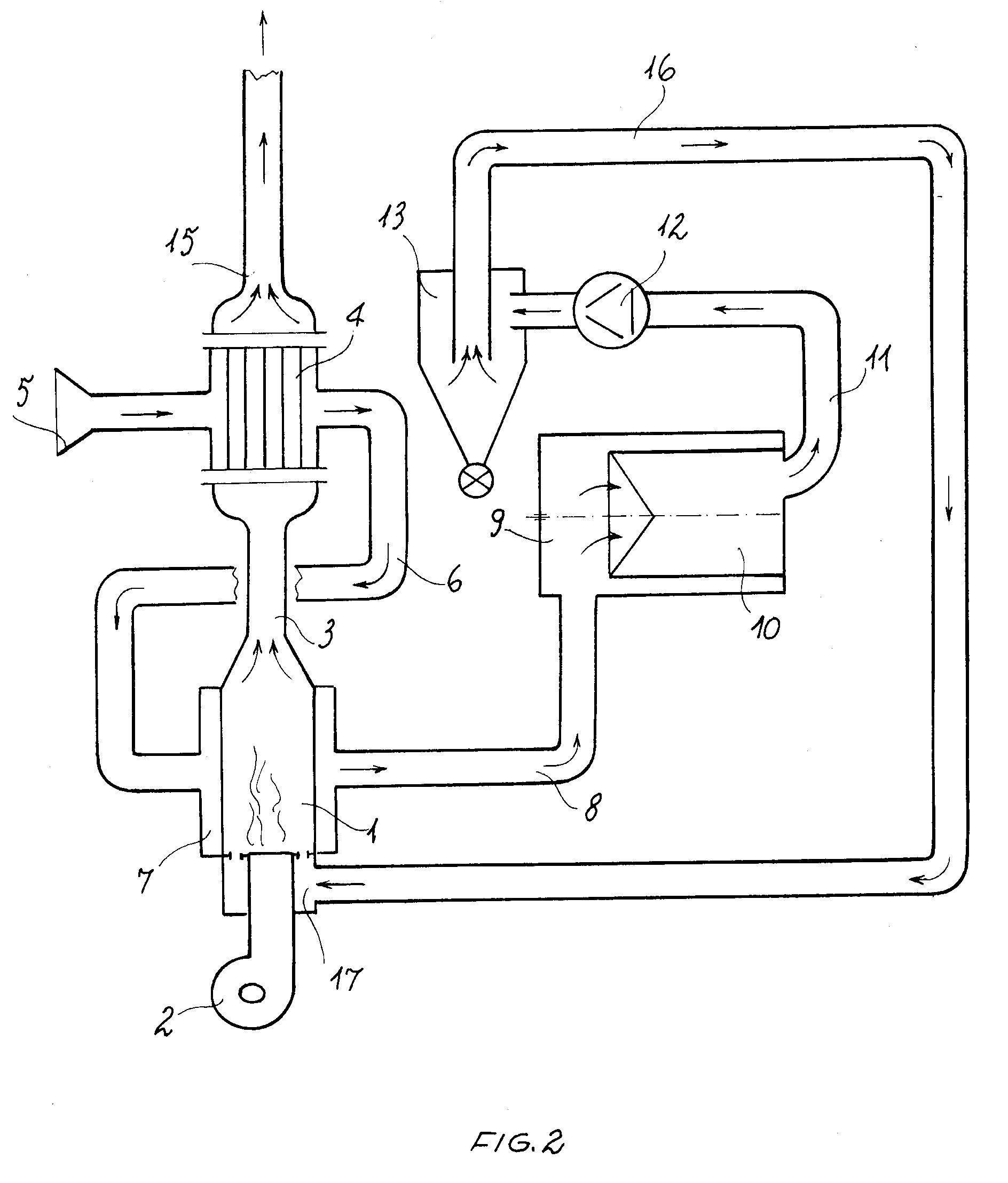
15. In particolar system embodiment from the cyclone separator 13 the air flow, with
in suspension what that still remain from the roasting, by pipe 16 comes to a collector
17, positioned at the lower end of the combustion chamber 1, which lets the same flow
into the same combustion chamber so determining a further heat transfer. Moreover
reaching the gaseous flow acting the heat recovery the combustion temperature, the
suspended volatile substances come to burn in presence of an air overplus so going
through a transformation which originates suspended no-polluting residues such as
carbon dioxide, water vapor and other. Schematic forms of the invented system are
illustrated in sheets 1 and 2. In sheet 1 fig. 1 is schematic view of the invented
roasting plant which foresees the use of a set able to heat transfer by induction
and with outward expulsion of the gaseous flow from which have before been taken the
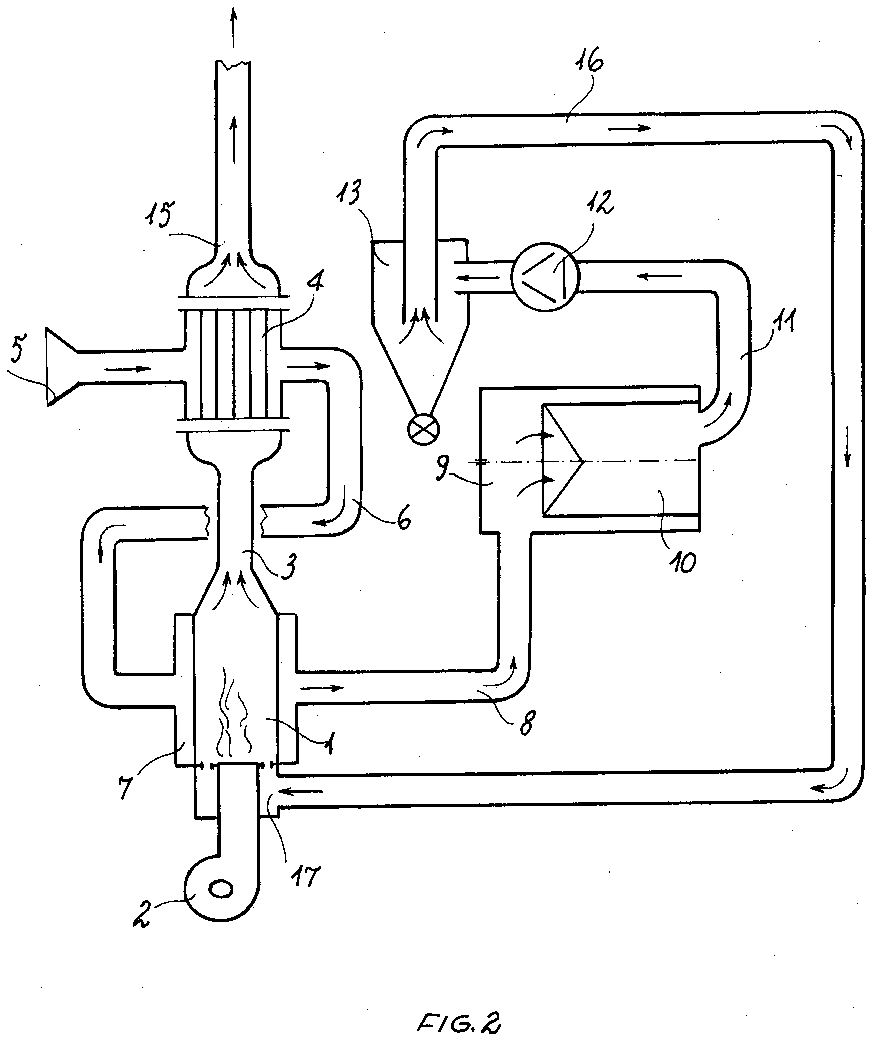
roasting residues of bigger dimensions. In sheet 2 fig. 2 is schematic view of an
invented roasting plant characterized by a set able to heat transfer by induction
as that in fig. 1 and moreover equipped for the heat flow recovering coming from roasting.
In the different embodiments: the different elements, the auxiliary means, the combustion
devices and the intake and heat exchanger devices can be different foreseen depending
on the different needs.
1. Roasting system which foresees the heat and smokes production into combustion chamber
(1), by means of burner (2), and through a collector (3) their reaching into a heat
exchanger (4) with distinct flows where they make over by induction their heat to
an air flow sucked from outside by an air intake (5) and then they are discharged
outwardly by natural ventilation pressure or by forced intake; in that the flow coming
from the air intake (5) so heated is let by pipe (6) into chamber (7) centrally including
the combustion chamber (1); characterized by the fact that said forced flow is overheated
by contact with the walls of the combustion chamber (1) to the needed temperature
and by means of pipe (8) is coming in roasting chamber (9) where it runs over goods
in movement into roasting unit (10). Said heat air flow crosses the goods so to heat
the same to the needed temperature and then it is discharged through pipe (11) with
in sospension the roasting smokes and it is then sucked by and intake group (12) forming
the forced circulation. Said gaseous flow comes finally to a cyclone separator (13)
having the function to take from the air flow the bigger dimension particles. The
flow so cleaning through a post-combustion unit (14), able to overheat the suspended
residues give out by the working goods to a higher temperature to the ignition temperature,
is then turn out into the outward environment to a variable temperature from 400°
to 700°.
2. Roasting system, as per claim 1), characterized by the fact that the combustion flow,
which is realized into the burner (2), after to have given its heat to the flow sucked
by air intake (5) into the heat exchanger (4) can be turn outward through pipe (15).
3. Roasting system, as per claim 1), characterized by the fact that in particolar system
embodiment from the cyclone separator (13) the air flow, with in suspension what that
still remain from the roasting, by pipe (16) comes to a collector (17), positioned
at the lower end of the combustion chamber (1), which lets the same flow into the
same combustion chamber (1) so determining a further heat transfer.
4. Roasting system, as per claim 1), characterized by the fact that reaching the gaseous
flow acting the heat recovery the combustion temperature, the suspended volatile substances
come to burn in presence of an air overplus so going through a transformation which
originates suspended no-polluting residue such as carbon dioxide, water vapor and
other.