|
(11) | EP 0 579 297 A1 |

| (12) | EUROPEAN PATENT APPLICATION |
|
|
|
|
|||||||||||||||||||||||
| (54) | Dye-donor element for use in thermal dye transfer by sublimation |
| (57) Dye-donor element for use according to thermal dye sublimation transfer comprising
a support having thereon a dye layer containing a bis(N,N-dialkyl(ene) or N,N-diaryl
or N-alkyl(ene),N-aryl)aniline azo dye. |
1. Field of the invention.
[0001] The present invention relates to dye-donor elements for use according to thermal dye sublimation transfer.
2. Background of the invention.
[0002] Thermal dye sublimation transfer also called thermal dye diffusion transfer is a recording method in which a dye-donor element provided with a dye layer containing sublimating dyes having heat transferability is brought into contact with a receiver sheet and selectively, in accordance with a pattern information signal, heated with a thermal printing head provided with a plurality of juxtaposed heat-generating resistors, whereby dye from the selectively heated regions of the dye-donor element is transferred to the receiver sheet and forms a pattern thereon, the shape and density of which is in accordance with the pattern and intensity of heat applied to the dye-donor element.
[0003] A dye-donor element for use according to thermal dye sublimation transfer usually comprises a very thin support e.g. a polyester support, one side of which is covered with a dye layer, which contains the printing dyes. Usually an adhesive or subbing layer is provided between the support and the dye layer. Normally the opposite side is covered with a slipping layer that provides a lubricated surface against which the thermal printing head can pass without suffering abrasion. An adhesive layer may be provided between the support and the slipping layer.
[0004] The dye layer can be a monochrome dye layer or it may comprise sequential repeating areas of different colored dyes like e.g. of cyan, magenta, yellow and optionally black hue. When a dye-donor element containing three or more primary color dyes is used, a multicolor image can be obtained by sequentially performing the dye transfer process steps for each color.
[0005] Many of the dyes proposed for use in thermal dye sublimation transfer are not sufficient in performance because they yield inadequate transfer densities at reasonable coating coverages. Especially for transfer on transparant film materials as receiving element, the transfer densities obtained are too low.
[0006] The yellow mono-arylazoaniline dyes described in EP 432314 yield relatively high densities on transparant receiver elements. A disadvantage of these mono-arylazoaniline dyes is their high degree of retransfer, i.e. the re-transfer in course of time of part of the dye transferred to the receiving sheet from the transferred dye image to a sheet of paper or any other substrate in contact with the dye-receiving layer.
[0007] Therefore it is an object of the present invention to provide yellow dyes for use in thermal dye sublimation transfer materials which have high extinction coefficients and yield high transfer densities especially on transparant receiver elements and which show a decreased degree of retransfer.
[0008] A primary colored dye layer, for example, a magenta or cyan or yellow dye layer, may comprise only one primary colored dye (a magenta, cyan or yellow dye respectively) or may comprise a mixture of two or more primary colored dyes of the same hue (two magenta, two cyan or two yellow dyes respectively).
[0009] For obtaining black recording by thermal dye sublimation transfer, transfer is performed using a dye-donor element having a black colored layer usually containing a mixture of yellow, magenta and cyan colored image dyes. Mixtures of yellow, magenta and cyan dyes for the formation of a black colored layer are described in e.g. EP 453020, US 4816435 and JP 01/136787.
[0010] Dye images transferred from dye-donor elements containing mixtures of dyes frequently show an increased fading rate due to a photochemical effect, known as catalytic fading of dye mixtures.
[0011] This phenomenon was investigated in textile dyeing by Rembold and Kramer (see Journal of the Society of Dyers and Colourists, vol. 94 (1978), pages 12-17) and by Asquith and Ingham (see Journal of the Society of Dyers and Colourists, vol.89 (1973), pages 81-85). Catalytic fading is related to the observation that the light fastness of certain dyes applied to textiles alone is much better than when applied as mixtures. In most reported cases, the light fastness of cyan, violet or red dyes deteriorates when a yellow dye is added.
[0012] It is known that indoaniline dyes have a favourable effect on this phenomenon in that mixtures of dyes containing indoaniline dyes show less catalytic fading effects (see, e.g., the description in US 4,933,226; US 5,024,990; US 5,026,679; EP 0 279 330; US 4,816,435). Unfortunately these indoaniline dyes have poor light stability.
According to EP 423796 fading of a thermally transferred image can be obtained by including an anti-fading group in a dye. Amongst the numerous examples given is listed a bisanilino-azodye that has subsituted alkyls or its aniline nitrogens. It has however been found that transfer of this type of dyes is insatisfactory.
[0013] Therefore it is another object of the present invention to provide dye-donor elements, in particular black colored dye-donor elements, containing indoaniline dyes yielding transferred dye images showing no catalytic fading effects and improved light stability.
3. Summary of the invention.
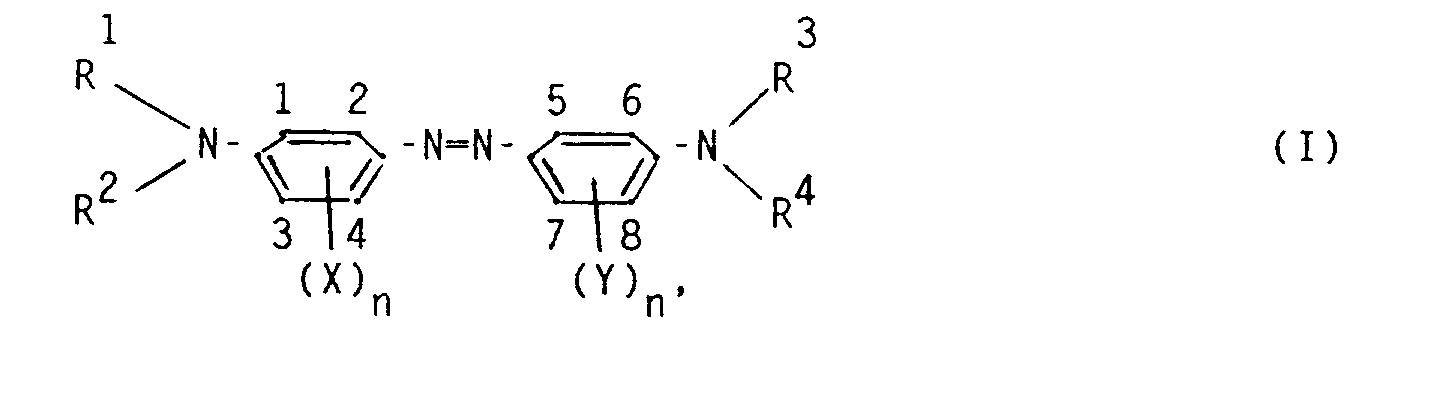
[0014] These and other objects are achieved by using a dye-donor element comprising a support provided with a dye layer containing at least one azo dye corresponding to the following general formula (I):
wherein
each of R¹ to R⁴ (independently) represent hydrogen, an unsubstituted alkyl group, a cycloalkyl group or an aryl group, which groups may be substituted, or R¹ and R² and/or R³ and R⁴ may be joined together to form a 5- or 6-membered heterocyclic ring system which may be substituted, or each of R¹ to R⁴ independently can be joined to the carbon atom of the aromatic ring at a position ortho to the position of attachment of the anilino nitrogen to form a 5- or 6-membered ring, which ring may be substituted;
X and Y (independently) represent any substituent, e.g. SH, OH, halogen, NO₂, CN, alkyl, amino, carbonamido, sulfonamido, acylamino, sulfonylamino, phosphorylamino, alkoxy, thioalkoxy, alkoxycarbonyl, aryloxycarbonyl;
n and n' (independently) represent 0, 1, 2, 3 or 4, the X and Y substituents respectively may be the same or different when n or n' respectively is greater than 1.
[0015] Yellow dye-donor elements containing the present yellow bis(N,N-dialkyl(ene) or N,N-diaryl or N-alkyl(ene),N-aryl aniline) azo dyes give transferred dye images having high densities especially on transparant receiver sheets and showing less retransfer.
[0016] Further dye-donor elements containing the present bis(N,N-dialkyl(ene) or N,N-diaryl or N-alkyl(ene),N-aryl aniline) azo dyes in admixture with indoaniline dyes, for example for the formation of black colored dye-donor elements, give transferred dye images showing no catalytic fading and improved light stability.
4. Detailed description of the invention.
[0018] Preferably R¹ to R⁴ (independently) represent an unsubstituted alkyl group (e.g. ethyl, butyl), X represents hydroxy, amino, acylamino, alkoxy, sulfonylamino, phosphorylamino, carbonamido or sulfonamido, generally in the 4-position, n represents 0 or 1 and n' represents 0.
[0020] Examples of suitable azo dyes according to the general formula (I) are listed in table 1 below together with their wavelength of maximum absorption (λmax) and extinction coefficient (ε), both measured in methanol.
Table 1
| Dye | R¹ | R² | R³ | R⁴ | X | Y | ε (lmol⁻¹cm⁻¹) | λmax (nm) |
| D1 | C₂H₅ | C₂H₅ | C₂H₅ | C₂H₅ | - | - | 4.19.10⁴ | 475 |
| D2 | C₂H₅ | C₂H₅ | C₂H₅ | C₂H₅ | 4-OH | - | 4.12.10⁴ | 495 |
| D3 | C₄H₉ | C₄H₉ | C₂H₅ | C₂H₅ | 4-NHCOCH₃ | - | 4.24 10⁴ | 497 |
| D4 | C₄H₉ | C₄H₉ | C₂H₅ | C₂H₅ | 4-NHSO₂CH₃ | - | 4.48.10⁴ | 495 |
| D5 | CH₃ | CH₃ | CH₃ | CH₃ | 4-OH | - | 3.72 10⁴ | 480 |
| D6 | C₂H₅ | C₂H₅ | C₂H₅ | C₂H₅ | 4-NHCOCH₃ | - | 4.40.10⁴ | 496 |
| D7 | C₂H₅ | C₂H₅ | C₂H₅ | C₂H₅ | 4-NHCOCH₃ | 8-Cl | 4.20.10⁴ | 470 |
| D8 | C₂H₅ | C₂H₅ | CH₃ | CH₃ | 4-NHCOCH₃ | - | ||
| D9 | C₂H₅ | C₂H₅ | C₂H₅ | C₂H₅ | 4-CH₃ | - | ||
| D10 | C₄H₉ | C₄H₉ | C₂H₅ | C₂H₅ | 4-NH₂ | - |
[0021] The dyes mentioned in table 1 can be prepared through coupling of the required aniline with a suitable diazonium salt. By way of example the preparation of dye D2 is described below.
Preparation of dye D2
[0022]
7 grams (0.0424 mole) of compound (a) and 11.2 grams (0.0424 mole) of compound (b) were dissolved in acetic acid and stirred at room temperature for three hours. The solution was poured into a solution of 60 grams of sodium acetate trihydrate in 250 ml of methanol. The mixture was stirred for 90 minutes. The crystals were filtered, washed with methanol and crystallized from 1-methoxy-2-propanol. 8.8 grams of dye D2 were obtained (63 %; melting point 195°C).
[0023] Bis(N,N-dialkyl(ene) or N,N-diaryl or N-alkyl(ene),N-aryl)aniline azo dyes according to formula (I) are also useful in inkjet printing, as is also the case for the dyes described in EP 394563, EP 400706, EP 384990, EP 384040, EP 453020, EP 432829, EP 393252, EP 432313, EP 444327 and EP 485665.
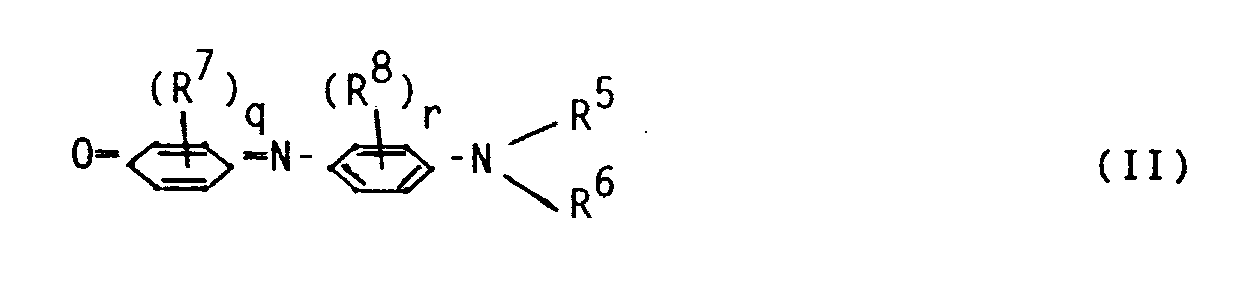
[0024] In a particular embodiment of the present invention the dyes according to the formula (I) are used together with cyan indoaniline dyes (in the same dye area or in another dye area) corresponding to the following general formula (II):
wherein :
R⁵ and R⁶ (independently) represent hydrogen, an alkyl group, a cycloalkyl group, an aryl group, an allyl group or an alkenyl group, which groups may be substituted, or R⁵ and R⁶ together with the nitrogen to which they are attached form the necessary atoms to close a 5- or 6-membered heterocyclic ring, which ring may be substituted, or R⁵ and/or R⁶ together with the nitrogen to which they are attached and either or both carbon atoms of the phenyl ring ortho to said nitrogen atom form a 5- or 6-membered heterocyclic ring, which ring may be substituted;
R⁷ represents halogen, hydroxy, cyano, an alkyl group, a cycloalkyl group, an aryl group, an alkoxy group, an aryloxy group, an alkylthio group, an arylthio group, an amino group, an alkylcarbonylamino group, an arylcarbonylamino group, an arylsulfonylamino group, an alkoxycarbonylamino group, an aryloxycarbonylamino group, an alkylthiocarbonylamino group, an arylthiocarbonylamino group, an alkylphosphoramidate group, an arylphosphoramidate group, an alkylphosphonamidate group, an arylphosphonamidate group, an alkylaminocarbonyl group or an arylaminocarbonyl group, which groups may be substituted, or R⁷ represents the necessary atoms to close an alicyclic or aromatic or heterocyclic ring (which rings may be substituted) fused-on the phenylene ring;
q represents 0, 1, 2, 3 or 4, the R⁷ substituents may be the same or different when q is greater than 1;
R⁸ can have any of the significances given to R⁷ or can represent the necessary atoms to close a alicyclic or aromatic or heterocyclic ring (which rings may be substituted) fused-on the phenyl ring;
r represents 0, 1, 2, 3 or 4, the R⁸ substitutents may be the same or different when r is greater than 1.
[0025] Examples of suitable indoaniline dyes corresponding to the general formula (II) are listed in table 2 below.
In table 3 are listed absorption maxima (λmax) and extinction coefficients (ε) of some of the cyan dyes listed in table 2, measured in methanol.
Table 3
| dye | λmax (nm) | ε (l mol⁻¹ cm⁻¹) |
| C5 | 654 | 28469 |
| C8 | 670 | 38297 |
| C18 | 655 | 27715 |
| C22 | 707 | 31100 |
| C27 | 674 | 29869 |
| C26 | 651 | 26200 |
[0026] In a particular embodiment of the present invention the mixture of dyes according to formula (I) and dyes according to formula (II) are used in a black colored dye-donor element.
[0027] In order to obtain a neutral black density it may then be necessary to combine the yellow dyes of general formula (I) and the cyan dyes of general formula (II), depending on their absorption maxima, with magenta dyes.
[0028] In a preferred embodiment magenta azo dyes as described in EP 216483 (heterocyclic azo aniline dyes) and EP 235939 (arylazoaniline dyes with electron withdrawing substituents on the aryl nucleus) with absorption maxima between 520 and 600 nm are used. Suitable magenta dyes are Dye 1 to Dye 23 and M1 to M20 described in EP 453020.
[0030] Mixtures of magenta dyes are also useful. For example, the magenta 4-chloro,5-formylthiazol-2-ylazoaniline dye M11 can be used in admixture with an arylazoaniline type magenta dye M21.
[0031] Other yellow dyes for use together with the dyes of formula (I) and formula (II) in the formation of a black colored dye layer include the yellow dyes described in EP 400706, EP 432829, EP 432313, EP 432314, US 4816435 and US 4833123.
[0033] In order to obtain a neutral black density, without metameric effects, it may be necessary to add to the mixture of the yellow dyes of formula (I), the cyan dyes of formula (II) and the magenta dyes as described above, a fourth, short absorbing yellow dye with absorption maximum below 460 nm.
[0034] In a preferred embodiment, to obtain a high quality black, free from metameric effect and without introducing again catalytic fading by bringing in a yellow dye, yellow dyes of the following general formula (III) are used:
wherein :
R⁹ and R¹⁰ (same or different) represent hydrogen, an alkyl group, a cycloalkyl group or an aryl group, which groups may be substituted, or R⁹ and R¹⁰ may be joined together to form a 5- or 6-membered heterocyclic ring system, which ring may be substituted, or each of R⁹ and R¹⁰ can be joined to the carbon atom of the aromatic ring at a position ortho to the position of attachment of the anilino nitrogen to form a 5- or 6-membered ring, which ring may be substituted;
R¹¹ represents a substituent, e.g. alkyl, CN, alkoxy, thioalkoxy, halogen, NO₂, acylamino;
s represents 0, 1, 2, 3 or 4, the R¹¹ substituents may be the same or different when s is greater than 1.
[0036] In compounding the dyes for forming a black colored dye layer it is necessary to compound at least one yellow dye of formula I, at least one magenta dye and at least one cyan dye. In other words, a single magenta, cyan and yellow dye may be used in the formation of the black colored layer or a mixture of one or more magenta dyes with one or more cyan dyes and with one or more yellow dyes may be used.
[0037] The compounding ratio of the yellow dyes according to general formula (I), the cyan dyes according to general formula (II), the magenta dyes and optionally other yellow dyes according to general formula (III) in the black mixture is properly from 10 to 50 % by weight for the yellow dyes of formula (I), from 20 to 60 % by weight for the cyan dyes of formula (II), from 10 to 60 % by weight for the magenta dyes and from 0 to 40 % for the yellow dyes of formula (III).
[0038] In a preferred embodiment of this invention the black colored dye layer is composed of the following combination of dyes : M11, C26, Y23, D3 or M21, C21, Y25 and D2.
[0039] The dye layer of the dye-donor element of the present invention is formed preferably by adding the dyes, the polymeric binder medium, and other optional components to a suitable solvent or solvent mixture, dissolving or dispersing the ingredients to form a coating composition that is applied to a support, which may have been provided first with an adhesive or subbing layer, and dried.
[0040] The dye layer thus formed has a thickness of about 0.2 to 5.0 µm, preferably 0.4 to 2.0 µm, and the amount ratio of dye to binder is between 9:1 and 1:3 by weight, preferably between 3:1 and 1:2 by weight.
[0041] As polymeric binder the following can be used : cellulose derivatives, such as ethyl cellulose, hydroxyethyl cellulose, ethylhydroxy cellulose, ethylhydroxyethyl cellulose, hydroxypropyl cellulose, methyl cellulose, nitrocellulose, cellulose acetate formate, cellulose acetate hydrogen phthalate, cellulose acetate, cellulose acetate propionate, cellulose acetate butyrate, cellulose acetate pentanoate, cellulose acetate benzoate, cellulose triacetate; vinyl-type resins and derivatives, such as polyvinyl alcohol, polyvinyl acetate, polyvinyl butyral, copolyvinyl butyral-vinyl acetal-vinyl alcohol, polyvinyl pyrrolidone, polyvinyl acetoacetal, polyacrylamide; polymers and copolymers derived from acrylates and acrylate derivatives, such as polyacrylic acid, polymethyl methacrylate and styrene-acrylate copolymers; polyester resins; polycarbonates; copolystyrene-acrylonitrile; polysulfones; polyphenylene oxide; organosilicones, such as polysiloxanes; epoxy resins and natural resins, such as gum arabic. Preferably cellulose acetate butyrate or copolystyrene-acrylonitrile is used as binder for the dye layer of the present invention.
[0042] The black colored dye donor element of the present invention can be used for the recording of a black and white image. It can also be used for the recording of a colored image together with primary color dye-donor elements comprising respectively a magenta dye or a mixture of magenta dyes, a cyan dye or a mixture of cyan dyes and a yellow dye or a mixture of yellow dyes.
[0043] Any dye can used in such a primary color dye layer provided it is easily transferable to the dye-image-receiving layer of the receiver sheet by the action of heat.
[0044] Typical and specific examples of primary color dyes for use in thermal dye sublimation transfer have been described in, e.g., EP 400706, EP 209990, EP 216483, EP 218397, EP 227095, EP 227096, EP 229374, EP 235939, EP 247737, EP 257577, EP 257580, EP 258856, EP 279330, EP 279467, EP 285665, US 4743582, US 4753922, US 4753923, US 64757046, US 4769360, US 4771035, JP 84/78894, JP 84/78895, JP 84/78896, JP 84/227490, JP 84/227948, JP 85/27594, JP 85/30391, JP 85/229787, JP 85/229789, JP 85/229790, JP 85/229791, JP 85/229792, JP 85/229793, JP 85/229795, JP 86/41596, JP 86/268493, JP 86/268494, JP 86/268495 and JP 86/284489.
[0045] The coating layer may also contain other additives, such as curing agents, preservatives, organic or inorganic fine particles, dispersing agents, antistatic agents, defoaming agents, viscosity controlling agents, etc., these and other ingredients being described more fully in EP 133011, EP 133012, EP 111004 and EP 279467.
[0046] Any material can be used as the support for the dye-donor element provided it is dimensionally stable and capable of withstanding the temperatures involved, up to 400°C over a period of up to 20 msec, and is yet thin enough to transmit heat applied on one side through to the dye on the other side to effect transfer to the receiver sheet within such short periods, typically from 1 to 10 msec. Such materials include polyesters such as polyethylene terephthalate, polyamides, polyacrylates, polycarbonates, cellulose esters, fluorinated polymers, polyethers, polyacetals, polyolefins, polyimides, glassine paper and condenser paper. Preference is given to a support comprising polyethylene terephthalate. In general, the support has a thickness of 2 to 30 µm. The support may also be coated with an adhesive or subbing layer, if desired.
[0047] The dye layer of the dye-donor element may be coated on the support or printed thereon by a printing technique such as a gravure process.
[0048] A dye-barrier layer comprising a hydrophilic polymer may also be employed in the dye-donor element between its support and the dye layer to improve the dye transfer densities by preventing wrong-way transfer of dye towards the support. The dye barrier layer may contain any hydrophilic material which is useful for the intended purpose. In general, good results have been obtained with gelatin, polyacryl amide, polyisopropyl acrylamide, butyl methacrylate grafted gelatin, ethyl methacrylate grafted gelatin, ethyl acrylate grafted gelatin, cellulose monoacetate, methyl cellulose, polyvinyl alcohol, polyethylene imine, polyacrylic acid, a mixture of polyvinyl alcohol and polyvinyl acetate, a mixture of polyvinyl alcohol and polyacrylic acid or a mixture of cellulose monoacetate and polyacrylic acid. Suitable dye barrier layers have been described in e.g. EP 227091 and EP 228065. Certain hydrophilic polymers, for example those described in EP 227091, also have an adequate adhesion to the support and the dye layer, thus eliminating the need for a separate adhesive or subbing layer. These particular hydrophilic polymers used in a single layer in the donor element thus perform a dual function, hence are referred to as dye-barrier/subbing layers.
[0049] Preferably the reverse side of the dye-donor element is coated with a slipping layer to prevent the printing head from sticking to the dye-donor element. Such a slipping layer would comprise a lubricating material such as a surface active agent, a liquid lubricant, a solid lubricant or mixtures thereof, with or without a polymeric binder. The surface active agents may be any agents known in the art such as carboxylates, sulfonates, phosphates, aliphatic amine salts, aliphatic quaternary ammonium salts, polyoxyethylene alkyl ethers, polyethylene glycol fatty acid esters, fluoroalkyl C₂-C₂₀ aliphatic acids. Examples of liquid lubricants include silicone oils, synthetic oils, saturated hydrocarbons and glycols. Examples of solid lubricants include various higher alcohols such as stearyl alcohol, fatty acids and fatty acid esters. Suitable slipping layers are described in e.g. EP 138483, EP 227090, US 4567113, US 4572860, US 4717711. Preferably the slipping layer comprises as binder a styrene-acrylonitrile copolymer or a styrene-acrylonitrile-butadiene copolymer or a mixture hereof or a polycarbonate as described in European patent application no. 91202071.6 and as lubricant in an amount of 0.1 to 10 % by weight of the binder (mixture) a polysiloxane-polyether copolymer or polytetrafluoroethylene or a mixture hereof.
[0050] The support for the receiver sheet that is used with the dye-donor element may be a transparant film of e.g. polyethylene terephthalate, a polyether sulfone, a polyimide, a cellulose ester or a polyvinyl alcohol-co-acetal. The support may also be a reflective one such as baryta-coated paper, polyethylene-coated paper or white polyester i.e. white-pigmented polyester. Blue-colored polyethylene terephthalate film can also be used as support.
[0051] To avoid poor adsorption of the transferred dye to the support of the receiver sheet this support must be coated with a special surface, a dye-image-receiving layer, into which the dye can diffuse more readily. The dye-imaging-receiving layer may comprise, for example, a polycarbonate, a polyurethane, a polyester, a polyamide, polyvinyl chloride, polystyrene-co-acrylonitrile, polycaprolactone or mixtures thereof. The dye-image receiving layer may also comprise a heat-cured product of poly(vinylchloride-co-vinylacetate-co-vinylalcohol) and polyisocyanate. Suitable dye-receiving layers have been described in e.g. EP 133011, EP 133012, EP 144247, EP 227094, EP 228066.
[0052] In order to improve the light resistance and other stabilities of recorded images, UV absorbers, singlet oxygen quenchers such as HALS-compounds (Hindered Amine Light Stabilizers) and/or antioxidants may be incorporated into the receiving layer.
[0053] The dye layer of the dye-donor element or the dye-image-receiving layer of the receiver sheet may also contain a releasing agent that aids in separating the dye-donor element from the dye-receiving element after transfer. The releasing agents can also be applied in a separate layer on at least part of the dye layer or of the receiving layer. For the releasing agent solid waxes, fluorine- or phosphate-containing surfactants and silicone oils are used. Suitable releasing agents are described in e.g. EP 133012, JP 85/19138, EP 227092.
[0054] The dye-donor elements according to the invention are used to form a dye transfer image. Such a process comprises placing the dye layer of the donor element in face-to-face relation with the dye-receiving layer of the receiver sheet and imagewise heating from the back of the donor element. The transfer of the dye is accomplished by heating for about several milliseconds at a temperature of 400°C.
[0055] When the process is performed for but one single color, a monochrome dye transfer image is obtained. A multicolor image can be obtained by using a donor element containing three or more primary color dyes and sequentially performing the process steps described above for each color. The above sandwich of donor element and receiver sheet is formed on three occasions during the time when heat is applied by the thermal printing head. After the first dye has been transferred, the elements are peeled apart. A second dye-donor element (or another area of the donor element with a different dye area) is then brought in register with the dye-receiving element and the process repeated. The third color and optionally further colors are obtained in the same manner.
[0056] In addition to thermal heads, laser light, infrared flash or heated pens can be used as the heat source for supplying heat energy. Thermal printing heads that can be used to transfer dye from the dye-donor elements of the present invention to a receiver sheet are commercially available. In case laser light is used, the dye layer or another layer of the dye element has to contain a compound that absorbs the light emitted by the laser and converts it into heat, e.g. carbon black.
[0057] Alternatively, the support of the dye-donor element may be an electrically resistive ribbon consisting of, for example, a multi-layer structure of a carbon loaded polycarbonate coated with a thin aluminum film. Current is injected into the resistive ribbon by electrically adressing a print head electrode resulting in highly localized heating of the ribbon beneath the relevant electrode. The fact that in this case the heat is generated directly in the resistive ribbon and that it is thus the ribbon that gets hot leads to an inherent advantage in printing speed using the resistive ribbon/electrode head technology compared to the thermal head technology where the various elements of the thermal head get hot and must cool down before the head can move to the next printing position.
[0058] The black dye-donor elements according to the present invention are preferably used in a monochrome black thermal sublimation transfer process for obtaining a hard copy of a medical diagnostic image preferably on a transparant or blue-colored support.
[0059] The following examples are provided to illustrate the invention in more detail without limiting, however, the scope thereof.
EXAMPLE 1
[0060] Black colored dye-donor elements for use according to thermal dye sublimation transfer were prepared as follows.
[0061] A coating solution was prepared consisting of 10 ml 2-butanone as solvent, 50 mg co-acrylonitrile-styrene as binder together with the quantities of dyes as indicated in the tables 7 and 8. From this solution a layer having a wet thickness of 100 µm was coated on 6 µm thick polyethylene terephthalate film. The resulting layer was dried by evaporation of the solvent.
[0062] A commercially available Mitsubishi material type CK 100 TS (transparant receiver) was used as receiving element.
[0063] The dye-donor element was printed in combination with the receiving element in a Mitsubishi CP 100 E printer.
[0064] The receiver sheet was separated from the dye-donor element and the color density of the recorded black image was measured by means of a Macbeth TR 924 densitometer in the red, green and blue region in Status A mode, and with the visual filter.
[0065] This experiment was repeated for each of the dye mixtures identified in tables 7 and 8. As a result thereof black colored records of visual densities shown in table 7 and 8 were obtained.
[0066] Thereafter, the receiver sheet was subjected to irradiation by a Xenon lamp of 150 klux for the hours indicated in the tables 7 and 8, the densities were measured again and the density loss or gain (in %) was calculated and given in the tables 7 and 8.
[0067] In table 7 are given the results obtained with comparative black donor elements of the prior art.
[0068] In table 8 are given the results obtained with black donor elements according to the invention.
[0069] By comparison of the results from table 7 and table 8 it is clear that the light stability of the black mixtures according to the invention is markedly improved, besides an increase in visual density.
EXAMPLE 2
[0071] A coating solution was prepared consisting of 10 ml 2-butanone as solvent, 50 mg co-acrylonitrile-styrene as binder together with 50 mg of dye D1. From this solution a layer having a wet thickness of 100 µm was coated on 6 µm thick polyethylene terephthalate film. The resulting layer was dried by evaporation of the solvent.
[0072] A commercially available Mitsubishi material type CK 100 TS (transparant receiver) was used as receiving element.
[0073] The dye-donor element was printed in combination with the receiving element in a Mitsubishi CP 100 E printer.
1. Dye-donor element for use according to thermal dye transfer methods, said element
comprising a support having thereon a dye layer comprising a dye carried by a polymeric
binder resin, characterized in that said dye is an azo dye corresponding to the following
general formula (I):
wherein
each of R¹ to R⁴ (same or different) represent hydrogen, an alkyl group, a cycloalkyl group or an aryl group, which groups may be substituted, or R¹ and R² and/or R³ and R⁴ may be joined together to form a 5- or 6-membered heterocyclic ring system which may be substituted, or each of R¹ to R⁴ independently can be joined to the carbon atom of the aromatic ring at a position ortho to the position of attachment of the anilino nitrogen to form a 5- or 6-membered ring, which ring may be substituted;
X and Y (same or different) represent any substituent;
n represents 0, 1, 2, 3 or 4, the X substituents may be the same or different when n is greater than 1;
n' represents 0, 1, 2, 3 or 4, the Y substituents may be the same or different when n' is greater than 1.
wherein
each of R¹ to R⁴ (same or different) represent hydrogen, an alkyl group, a cycloalkyl group or an aryl group, which groups may be substituted, or R¹ and R² and/or R³ and R⁴ may be joined together to form a 5- or 6-membered heterocyclic ring system which may be substituted, or each of R¹ to R⁴ independently can be joined to the carbon atom of the aromatic ring at a position ortho to the position of attachment of the anilino nitrogen to form a 5- or 6-membered ring, which ring may be substituted;
X and Y (same or different) represent any substituent;
n represents 0, 1, 2, 3 or 4, the X substituents may be the same or different when n is greater than 1;
n' represents 0, 1, 2, 3 or 4, the Y substituents may be the same or different when n' is greater than 1.
2. Dye-donor element according to claim 1, wherein R¹ to R⁴ (same or different) represent
an alkyl group, X represents hydroxy, carbonamido or sulfonamido, generally in the
4-position, n represents 0 or 1 and n' represents 0.
3. Dye-donor element according to claim 1 or 2, wherein said dye-donor element further
comprises in the same dye area or in another dye area a dye corresponding to the general
formula (II):
wherein :
R⁵ and R⁶ (same or different) represent hydrogen, an alkyl group, a cycloalkyl group, an aryl group, an allyl group or an alkenyl group, which groups may be substituted, or R⁵ and R⁶ together with the nitrogen to which they are attached form the necessary atoms to close a 5- or 6-membered heterocyclic ring, which ring may be substituted, or R⁵ and/or R⁶ together with the nitrogen to which they are attached and either or both carbon atoms of the phenyl ring ortho to said nitrogen atom form a 5- or 6-membered heterocyclic ring, which ring may be substituted;
R⁷ represents halogen, hydroxy, cyano, an alkyl group, a cycloalkyl group, an aryl group, an alkoxy group, an aryloxy group, an alkylthio group, an arylthio group, an amino group, an alkylcarbonylamino group, an arylcarbonylamino group, an arylsulfonylamino group, an alkoxycarbonylamino group, an aryloxycarbonylamino group, an alkylthiocarbonylamino group, an arylthiocarbonylamino group, an alkylphosphoramidate group, an arylphosphoramidate group, an alkylphosphonamidate group, an arylphosphonamidate group, an alkylaminocarbonyl group or an arylaminocarbonyl group, which groups may be substituted, or R⁷ represents the necessary atoms to close an alicyclic or aromatic or heterocyclic ring (which rings may be substituted) fused-on the phenylene ring;
q represents 0, 1, 2, 3 or 4, the R⁷ substituents may be the same or different when q is greater than 1;
R⁸ can have any of the significances given to R⁷ or can represent the necessary atoms to close an alicyclic or aromatic or heterocyclic ring (which rings may be substituted) fused-on the phenyl ring;
r represents 0, 1, 2, 3 or 4, the R⁸ substitutents may be the same or different when r is greater than 1.
wherein :
R⁵ and R⁶ (same or different) represent hydrogen, an alkyl group, a cycloalkyl group, an aryl group, an allyl group or an alkenyl group, which groups may be substituted, or R⁵ and R⁶ together with the nitrogen to which they are attached form the necessary atoms to close a 5- or 6-membered heterocyclic ring, which ring may be substituted, or R⁵ and/or R⁶ together with the nitrogen to which they are attached and either or both carbon atoms of the phenyl ring ortho to said nitrogen atom form a 5- or 6-membered heterocyclic ring, which ring may be substituted;
R⁷ represents halogen, hydroxy, cyano, an alkyl group, a cycloalkyl group, an aryl group, an alkoxy group, an aryloxy group, an alkylthio group, an arylthio group, an amino group, an alkylcarbonylamino group, an arylcarbonylamino group, an arylsulfonylamino group, an alkoxycarbonylamino group, an aryloxycarbonylamino group, an alkylthiocarbonylamino group, an arylthiocarbonylamino group, an alkylphosphoramidate group, an arylphosphoramidate group, an alkylphosphonamidate group, an arylphosphonamidate group, an alkylaminocarbonyl group or an arylaminocarbonyl group, which groups may be substituted, or R⁷ represents the necessary atoms to close an alicyclic or aromatic or heterocyclic ring (which rings may be substituted) fused-on the phenylene ring;
q represents 0, 1, 2, 3 or 4, the R⁷ substituents may be the same or different when q is greater than 1;
R⁸ can have any of the significances given to R⁷ or can represent the necessary atoms to close an alicyclic or aromatic or heterocyclic ring (which rings may be substituted) fused-on the phenyl ring;
r represents 0, 1, 2, 3 or 4, the R⁸ substitutents may be the same or different when r is greater than 1.
4. Dye-donor element according to claim 3, wherein both dyes are contained in the same
dye area that is black colored.
5. Dye-donor element according to claim 4, wherein said dye layer further comprises a
magenta heterocyclic azo aniline dye or a magenta arylazoaniline dye with electron
withdrawing substituents on the aryl nucleus, having an absorption maximum between
520 and 600 nm.
6. Dye-donor element according to claim 5, wherein said magenta dye is a 4-chloro,5-formylthiazol-2-ylazoaniline
dye.
7. Dye-donor element according to any one of claims 4 to 6, wherein said dye layer further
comprises a yellow dye with an absorption maximum below 460 nm.
8. Dye-donor element according to claim 7, wherein said yellow dye corresponds to the
following general formula (III):

wherein :
R⁹ and R¹⁰ (same or different) represent hydrogen, an alkyl group, a cycloalkyl group or an aryl group, which groups may be substituted, or R⁹ and R¹⁰ may be joined together to form a 5- or 6-membered heterocyclic ring system, which ring may be substituted, or each of R⁹ and R¹⁰ can be joined to the carbon atom of the aromatic ring at a position ortho to the position of attachment of the anilino nitrogen to form a 5- or 6-membered ring, which ring may be substituted;
R¹¹ represents a substituent;
s represents 0, 1, 2, 3 or 4, the R¹¹ substituents may be the same or different when s is greater than 1.
wherein :
R⁹ and R¹⁰ (same or different) represent hydrogen, an alkyl group, a cycloalkyl group or an aryl group, which groups may be substituted, or R⁹ and R¹⁰ may be joined together to form a 5- or 6-membered heterocyclic ring system, which ring may be substituted, or each of R⁹ and R¹⁰ can be joined to the carbon atom of the aromatic ring at a position ortho to the position of attachment of the anilino nitrogen to form a 5- or 6-membered ring, which ring may be substituted;
R¹¹ represents a substituent;
s represents 0, 1, 2, 3 or 4, the R¹¹ substituents may be the same or different when s is greater than 1.
9. Dye-donor element according to any one of claims 4 to 8, wherein the compounding ratio
of the dyes is 10 to 50 % by weight for the yellow dyes according to formula (I),
20 to 60 % by weight for the cyan dyes according to formula (II), 10 to 60 % by weight
for the magenta dyes and 0 to 40 % by weight for the yellow dyes of formula (III).
10. Dye-donor element according to any one of the preceding claims, wherein the binder
is cellulose acetate butyrate or co-acrylonitrile-styrene.
11. Dyed receiving element comprising a support provided with a dye-image receiving layer
containing dyes in imagewise distribution, formed by thermal dye sublimation transfer
using a dye-donor element according to any one of the preceding claims.