|
(11) | EP 0 579 586 A1 |

| (12) | EUROPEAN PATENT APPLICATION |
|
|
|
|
|||||||||||||||||||||||||||
| (54) | An absolute capacitive encoder |
| (57) A scale system for absolute measurement includes at least one scale (1) which extends
along a measuring length, and at least one measuring slide which is movable in relation
to the scale. The system includes a fine sensor which functions to measure the absolute
values within each of the intervals lying along the scale (1), and further includes
a rough sensor which functions to measure the absolute values with regard to the interval
in which the fine sensor is located at that time. The scale system is mainly characterized in that it further includes at least one rough scale (2, 3) whose scale electrodes (2a, b, 3a, b) define a predetermined angle to the direction in which a measuring slide is moved along the scale, wherein the measuring electrodes of the measuring slide also define a preferably corresponding angle (α) with the direction of slide movement, whereby a determined displacement of the slide in the slide movement direction will be corresponded by a determined relative movement between the measuring electrodes of the measuring slide and the scale electrodes of the rough scale in a direction perpendicular to the extension of the scale electrodes, this direction defining a predetermined angle with the aforesaid direction of slide movement. |
[0001] The present invention relates to a scale system for absolute measurements, comprising at least one scale which extends along a measuring length and a measuring slide which is movable in relation to the scale, a fine sensor which functions to measure the absolute values within each of the mutually sequential intervals or graduations along the scale, a rough sensor which functions to measure the absolute values with respect to that interval or graduation within which the fine sensor is located at that particular time, and wherein each scale includes scale electrodes which are disposed in a predetermined pattern and which are intended to coact with measuring electrodes mounted at respective measuring heads, wherein a supply voltage is applied to the measuring electrodes to achieve capacitive measuring, and wherein said scale system further comprises a signal processing unit.
[0002] Systems of essential this kind are known to the art. However, such known systems are encumbered with serious drawbacks. In known systems which "switch" between two scales that have mutually different graduations, the electrodes must be spaced apart extremely accurately if a comparatively large total measuring length is to be achieved. Other known systems which employ a photoelectric rough scale based on the so-called gray code, it is necessary to use highly complicated measuring heads which need to surround the scale and which include a light-transmitting unit on one side of the scale and a photoreceptive array on the other side thereof. In order to obtain a reasonable scale length, some known systems also require a measuring slide which has a long axial extension in the direction of movement of the slide.
[0003] The present invention relates to an absolute, capacitive measuring system which, among other things, enables long measuring lengths to be obtained without requiring the electrodes to be spaced apart with high precision and which will also enable relatively simple and short measuring slides to be used. The invention also provides several other important improvements to the known prior art.
[0004] The present invention thus relates to an absolute measurement scale system which includes at least one scale that extends along a measuring length, at least one measuring slide which is movable in relation to the scale, a fine sensor for measuring the absolute values within each of the graduations along the scale, a coarse sensor for measuring the absolute values with regard to the interval in which the fine sensor is located at that particular moment, and a signal processing unit, wherein each scale includes scale electrodes which are disposed in a predetermined pattern and which coact with measuring electrodes mounted adjacent a measuring slide, and wherein a supply voltage is applied to the measuring electrodes for capacitive measurement.
[0005] The system is mainly characterized in that there is provided at least one rough scale whose scale electrodes define a predetermined angle (α) with the direction of movement of a measuring slide along said scale; in that the measuring electrodes of the measuring slide also preferably define a corresponding angle (α) with said direction of slide movement, whereby a given linear displacement (L) in said movement direction is corresponded by a given relative linear displacement (S) between the measuring slide electrodes and the rough scale electrodes in a direction (α') perpendicular to the extension of the scale electrodes, said direction defining a predetermined angle with said direction of linear displacement.
[0006] The invention will now be described in more detail with reference to exemplifying embodiments thereof and also with reference to the accompanying drawings, in which
- Figure 1 illustrates schematically part of a fine scale and a measuring slide of a known scale system;
- Figure 2 illustrates diagrammatically the principles of a rough scale and a measuring slide according to the present invention;
- Figure 3 illustrates schematically a first embodiment of a rough scale, measuring slide and signal transmission in accordance with the present invention;
- Figure 4 illustrates schematically a second embodiment of a rough scale, etc., in accordance with the invention;
- Figure 5 illustrates schematically two different types of rough scales having mutually different period lengths;
- Figure 6 illustrates two scales according to Figure 5 in a compact, superposed configuration;
- Figure 7 illustrates schematically two differentially arranged rough scales, where the scales are mutually mirrored in a longitudinally extending plane;
- Figure 8 illustrates two scales according to Figure 7 where supply is in counterphase between the scales;
- Figure 9 illustrates counterphase supply in signal form;
- Figure 10 illustrates counterphase supply according to Figures 8 and 9 in measuring electrode form at scales according to Figure 8;
- Figure 11 illustrates schematically two fine scales where the scales are mutually phase-shifted and where the transmission parts of the scale electrodes are mutually joined; and
- Figure 12 illustrates schematically part of an inventive scale system according to a third embodiment, this embodiment being preferred in some cases.
[0007] The known scale system illustrated in Figure 1 is described in detail in Swedish Patent Specification No. 7714010-1 and includes, among other things, a graduated scale 1 which is provided with a first system of scale electrodes 2, 3 and a measuring slide 4 which is displaceable along the scale and which is provided with a second electrode system 5-8. The electrode spacing, or electrode division, is chosen so that
where
- p
- = the electrode spacing of the slide;
- P
- = the electrode spacing of the scale; and
- n
- = the number of electrodes in each phase group on the slide.
[0008] The direction of slide movement is shown by the arrow 9. Each electrode of an electrode group is supplied with an alternating voltage in accordance with a cyclic pattern. For the purpose of amplifying the useful signal, there is normally included a plurality of parallel-coupled phase groups on the slide 4, and in order for the scale system to operate efficiently, the slide must include at least one whole phase group of measuring electrodes 5-8.
[0009] Since the length of a phase group is directly connected with the length of the scale period, the greatest permitted length of the slide will also determine the greatest permitted length of the scale period. For practical reasons, among others, the slide cannot be permitted to be excessively long. A maximum length is preferably about 50-100 mm. The maximum working range of the slide is thus about 100 mm, which unfortunately is much too small for the majority of applications.
[0010] The principle, inventive scale system illustrated in Figure 2 also includes a measuring slide 10 provided with measuring electrodes 11-14. The direction in which the slide is moved is shown by the arrow 15. The Figure 2 system also includes a rough scale 18 which is provided with scale electrodes 16, 17 which define a predetermined angle α with the aforesaid direction of slide movement 15, where the measuring electrodes 11-14 of the measuring slide also define a predetermined angle with said movement direction 15, this angle preferably corresponding to the angle α. Thus, given movement L of the slide in said movement direction 15 will be corresponded by a given relative movement between the measuring electrodes 11-14 of the measuring slide and the scale electrodes 16, 17 of the rough scale in a direction α' perpendicular to the extension of the scale electrodes 16, 17, this direction defining a predetermined angle α +90° with the aforesaid movement direction, as will be evident from Figure 2.
[0011] Figures 3 and 4 illustrate exemplifying embodiments of the invention in more detail. The reference numeral 19 identifies a scale which is provided with a plurality of, preferably equidistant, scale electrodes 20, 21. A measuring slide 22 mounted on the scale 19 is movable along the scale and carries a plurality of measuring electrodes 23 (11-14), transmitter electrodes 23 and, in the illustrated case, Figure 3, receiver electrodes 24, which are arranged in a determined pattern. As before mentioned, each of the measuring electrodes is supplied with an alternating voltage in accordance with a cyclic pattern. The scale electrodes include transmission parts 26 and measuring parts 25 and the receiver electrodes 24 are intended to capture through the agency of said transmission parts 26 signals received by said measuring parts 25 and to transmit these signals to a signal processing unit 27 connected to the receiver electrodes.
[0012] Thus, the rough scale measuring electrodes 20, 21 include a measuring part 25 which defines said angle α with said movement direction 15, and a transmission part 26. In the case of the Figure 3 embodiment, this transmission part 26, and similarly the measuring part 25, are separate and electrically isolated from the transmission parts of remaining scale electrodes and are intended to be sensed by means of at least one of the receiver electrodes carried by the measuring slide, from which receiver electrode signals are transmitted to the signal processing unit 27. In the case of the Figure 4 embodiment, the transmission part 26 is connected to and forms part of a transmission part 28 which is common to several scale electrodes and which is connected directly to the signal processing unit 27.
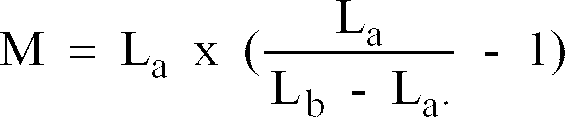
[0013] The embodiment illustrated in Figure 5 includes two types of rough scale 19 which have mutually different period lengths La, Lb, wherein the measuring process "switches" between the two scales so as to achieve an unequivocal determination of the absolute positions along the scales over a determined distance or length M, in accordance with the equation
[0014] For instance, at La = 131.072 mm and Lb = 135.168 mm, phase M will equal 4194 mm which is sufficient for the majority of sizes of coordinate measuring machines or machining tools for instance. Naturally, the choice of La and/or Lb may be different to the aforesaid values, so that M will be commensurately larger or smaller.
[0015] The scale configuration illustrated in Figure 5 has a pronounced extension 6 transversely to the longitudinal axis of the scales. According to one embodiment, Figure 6, which is preferred in some cases, the two rough scales 19 of a pair of rough scales of mutually different types and of different period lengths are arranged within one another, with their respective transmission parts on opposite sides of the scale configuration which includes the two scales, therewith to obtain a compact scale system. In the Figure 6 configuration, one and the same array of measuring electrodes 23 on the slide can be used to deliver signals to both scales.
[0016] As will be seen from Figure 7, in order to further restrict sensitivity for movements perpendicular to the direction of slide movement, for instance as a result of obliqueness of the scale or scales 19, there is provided for each rough scale 29 of determined period length, a first scale 29, a further, corresponding rough scale 29', a second rough scale 29', which is a mirror image of the first rough scale 29 in a plane which is parallel with the aforesaid movement direction and which extends at right angles to the plane of the first scale, wherein a measuring slide 30 includes measuring electrodes 23' for the second rough scale 29', these electrodes being a mirror image of the measuring electrodes 23 of the first scale, similar to the mirror-imaged scales 29, 29', and wherein the signals deriving from the two scales are co-processed to eliminate measuring errors deriving, for instance, from obliqueness of the scale or scales. Thus, when the slide 30 is moved in the direction 15, the measuring electrode groups 23, 23' on the slide will be located simultaneously in the same position in relation to the measuring parts 25, 25' of the scale electrodes. On the other hand, in the event of relative movement between the slide and the scales in a direction Y transversely to the longitudinal axis of the scales, the upper measuring electrode group 23, which in the Figure 7 example is in a position with the S-phase immediately above the measuring part 25, will be moved to a position where the R-phase comes progressively more into effect. In its initial position, the mirrored electrode group 23' is also located in a position with the S-phase immediately above the measuring part 25', and is displaced to a position in which the T-phase is brought further into effect. Since the R-phase and T-phase are mutually phase-shifted through 180°, any error contributions will cancel each other out. The arrangement illustrated in Figure 7 thus renders the scale system insensitive to any movement in the Y-direction and to any lack of parallelity between scale 29, 29' and the movement direction 15 of the measuring system.
[0017] When mutually joined transmission parts 28, Figures 4 and 8, of the scales are used, there is a risk that these transmission parts will form together with the scale electrodes "antennas" which capture external electric interference, for instance interference signals from electric motors, lighting systems and the like. This problem is overcome with a preferred embodiment of the invention illustrated in Figures 8 and 9, according to which the supply for the measuring electrodes 23' for the one 29' of the scales in a pair 29, 29' of mirrored scales is arranged for counterphase signals R', S', T', U' compared with the supply R, S, T, U for the other scale 29, so that the supply of mutually corresponding measuring electrodes will be phase-shifted through 180° relative to one another, wherein an operational amplifier 27' is provided for processing the signals of respective scales 29, 29'. The operational amplifier 27' and the transmission parts 28, 28' are arranged so that one common transmission part 28' is connected to the positive input (+) of the amplifier, whereas the other transmission part 28, delivering counterphase signals, is connected to the negative input (-) of the amplifier, so that both signals, for instance S and S' as shown in Figure 8, will contribute equally to forming the output signal Sut in the operational amplifier. As opposed to the measuring signal, any interference signals will enter on both of the transmission parts 28, 28' with the same phase and direction (sense) and will therefore be suppressed in the amplifier 27'. The amplifier used will preferably be a high so-called common mode rejection amplifier.
[0018] As will be seen from Figure 9, the 180° phase-shifted signals in a 4-phase supply system will result only in a 180° shift of the phase order in the mirrored array of measuring electrodes on the slide, wherein, Figure 9, phase R' is identical with phase T, phase S' is identical with phase U, and so on. The relationship between counterphase and phase is thus:
R' = T
S' = U
T' = R
U' = S
[0019] The final phase supply picture shown in Figure 10 is obtained when R', S', T' and U' are replaced with their equivalents according to the above table.
[0020] The preferred configuration of the fine scale illustrated in Figure 11 includes two scales a, b, where the scale electrodes of each scale has a common transmission part 31, which preferably extends over the full length of the scale, i.e. the scale electrodes are continuous over the full length of the scale. It is preferred in this case that each scale is connected directly to the signal processing unit 27. The scales a, b are preferably mutually phase-shifted through 180°, whereby two differential signals are obtained so as to enable external electrical interferences and disturbances to be suppressed with the aid of an operational amplifier 27 having so-called common mode rejection.
[0021] Figure 12 illustrates another embodiment of rough scales which includes a first type of rough scale 2a, 2b of relatively short period length, for instance a period length of 131.072 mm, and a second type of rough scale 3a, 3b having a relatively long period length, in many cases preferably the full measuring length, for instance 2000 mm. Each rough scale 2, 3 is provided with differential scales and with differential supply, measuring phase/phase, as described with reference to Figures 7, 8 and 9. In the case of this system, absolute measurement is effected by means of the fine scale within its scale period, for instance 2.048 mm, and such that the position of the fine period concerned within a scale period of the most finely graduated rough scale 2 can be established with said rough scale 2, and so that the position of the shorter rough scale period concerned within the rough scale having the longest scale period can be established by means of the rough scale 3 having the longest scale period.
[0022] The manner in which the inventive scale system works will be evident essentially from the aforegoing. Thus, a fundamental feature of the inventive system is that the scale electrodes of the rough scale or scales are angled in relation to the movement direction 15, whereby relative movement in the direction L, Figure 2, will also result in relative movement between the measuring electrodes of the measuring slide and the electrodes of the scale in the movement sensitive direction α' of the system, wherein α can be chosen so as to enable desired transmission ratio between the movements in directions L (15) and α' to be disengaged in principle from the movement in the L-direction and adapted to current requirements concerning resolution, acceptable slide length, etc.
[0023] It will also be evident that the present invention provides important advantages over the known technique. Less precision is required with respect to scale electrode spacing. The measuring slide can be given a simple construction. The system can be given a large absolute measuring range without needing to increase the length of the measuring slide to unreasonable limits. Other advantages are also afforded.
[0024] Although the invention has been described in the aforegoing with reference to exemplifying embodiments thereof, it will be understood that other embodiments and minor changes are conceivable within the concept of the invention.
[0025] For instance, according to the preferred embodiments, the scale period of the fine scale is 2.048 mm. Furthermore, the resolution of the signal processing unit is 1/4096 of the scale electrode spacing or division in the α'-direction, this spacing being 4.096 mm in the case of the preferred embodiments. The resolution is thus 1 µm in said direction. With regard to the most finely graduated rough scale, a is preferably chosen so that L, i.e. the length travelled in the movement direction 15, Figure 2, will be a binary multiple, 64, of the period length of the fine scale, 2.048 mm. In this case, a is 1.7908°. One unit in the resolution of the signal processing unit will then give a resolution in the slide movement direction 15, according to Resolution in
1. A scale system which includes at least one scale extending along a measuring length,
at least one measuring slide which is movable in relation to the scale, a fine sensor
for measuring the absolute values within each of the intervals lying along the scale,
a coarse sensor for measuring the absolute values with regard to the interval in which
the fine sensor is located at that particular moment, and a signal processing unit,
wherein each scale includes scale electrodes which are disposed in a predetermined
pattern and which coact with measuring electrodes mounted adjacent a measuring slide,
and wherein a supply voltage is applied to the measuring electrodes for capacitive
measurement, characterized in that the scale system further includes at least one rough scale (2, 3, 18, 19)
whose scale electrodes (2a, b, 3a, b, 16, 17, 20, 21, 25, 25') define a predetermined
angle (α) with the direction of movement of a measuring slide along said scale; in
that the measuring electrodes (11-14, 23, 23') of the measuring slide also preferably
define a corresponding angle (α) with said direction of slide movement, whereby a
given linear displacement (L) in said movement direction (15) is corresponded by a
given relative linear displacement (S) between the measuring slide electrodes and
the scale electrodes of the rough scale in a direction (α') perpendicular to the extension
of the scale electrodes, said direction defining a predetermined angle with said direction
of linear displacement.
2. A system according to Claim 1, characterized in that the scale electrodes of the rough scale include a measuring part (25, 25')
which defines said angle (α) with said movement direction, and a transmission part
(26, 28, 28') which is either separate from the transmission parts (26) of remaining
scale electrodes and intended to be sensed by means of at least one of the receiver
electrodes (24) carried by the measuring slide and from which signals are intended
to be transmitted to the signal processing unit (27), or is connected to and comprises
part of a transmission part (28, 28') which is common to several scale electrodes
and which is connected directly to the signal processing unit (27).
3. A system according to Claim 1 or 2, characterized by two types of rough scales which have mutually different period lengths (La, Lb), wherein alternations between the two scales are employed for unequivocally determining
the absolute positions over a determined distance or length (M) according to the relationship
4. A system according to Claim 1, 2 or 3, characterized in that the two rough scales in a pair of rough scales of different types and having
different period lengths are arranged one within the other with their respective transmission
parts on opposite sides of the scale arrangement including the two scales, so as to
obtain a compact scale system.
5. A system according to Claim 1, 2, 3 or 4, characterized in that for each rough scale, a first rough scale, there is provided a further, corresponding
rough scale, a second rough scale, which is a mirror image of the first rough scale
in a plane which extends parallel with said movement direction and which is perpendicular
to the plane of the first scale; in that the measuring scale also includes measuring
electrodes for the second rough scale which, in a manner corresponding to the scales,
are in mirror image with the measuring electrodes of the first scale, wherein the
signals from the two scales are intended to be co-processed so as to eliminate measuring
errors which derive from measuring slide movement transversely to said movement direction,
for instance due to obliqueness of the scale or scales.
6. A system according to Claim 1, 2, 3, 4 or 5, characterized in that the supply for the measuring electrodes of one of the scales in a pair of
mirror-imaged scales is arranged for counterphase signals (R', S', T', U') compared
with the supply for the other scale, so that the supplies to mutually corresponding
measuring electrodes will be phase-shifted through 180° relative to one another; and
in that the system includes an operational amplifier for processing the signals of
respective scales, preferably with the aid of so-called common mode rejection for
eliminating interference.
7. A system according to Claim 1, 2, 3, 4, 5 or 6, characterized by a first type of rough scale having a relatively short period length (La) and a second type of rough scale having a relatively long period length (Lb), which has the same size as the total measuring length.
8. A scale system according to Claim 1, 2, 3, 4, 5, 6 or 7, characterized by a fine scale (1) where the transmission parts (31) of the scale electrodes are
connected preferably over the full length of the scale; and in that the transmission
parts are preferably connected directly to the signal processing unit (27).
9. A scale system according to Claim 8, characterized by two fine scales which are mutually phase-shifted through 180°; in that the system
includes an operational amplifier (27') for processing the differential signals obtained
from the two scales so as to suppress external electrical interferences, preferably
in accordance with so-called common mode rejection.