|
(11) | EP 0 582 727 A1 |

| (12) | EUROPEAN PATENT APPLICATION |
|
|
|
|
||||||||||||||||||||||||
| (54) | Transdermal therapeutic formulation |
| (57) A transdermal therapeutic formulation is made of a composition comprising a polymer
and ingredients mixed with the polymer which are a pharmacologically active substance,
an alcohol, a percutaneous absorption promoter utilized according to necessity and
water utilized according to necessity. The polymer comprises lipophillic monomer units
and hydrophillic monomer units in a specific ratio. The alcohol, the percutaneous
absorption promoter and water are mixed with the polymer in specific amounts. The transdermal therapeutic formulation has excellent percutaneous absorption, has many kinds of applicable pharmacologically active substances, shows good stability of percutaneous absorption with time because of absence of crystallization of the pharmacologically active substance, has good adhesive strength and thus favorably utilized as transdermal therapeutic plaster. |
BACKGROUND OF THE INVENTION
1. Field of the invention
[0001] The present invention relates to a novel transdermal therapeutic formulation and a method of administration thereof. More particularly, the present invention relates to a transdermal therapeutic formulation having excellent percutaneous absorption of pharmacologically active substances, capable of delivering desired pharmocologically active substance rapidly to location of treatment or to all parts of the body through the circulating system, effective for curing various disease and favorably utilized as transdermal therapeutic plaster. The present invention relates also to a novel method of administration of the transdermal therapeutic formulation.
2. Description of the prior art
[0002] During the recent progress of medical treatment, transdermal therapeutic formulations have been developed to absorb percutaneously and deliver desired pharmacologically active substances to all parts of the body and thus to maintain the curing effect for a prolonged time. For example, transdermal therapeutic formulations containing nitroglycerol or isosorbide dinitrate for curing angina pectoris, those containing clonidine for curing hypertonia and those containing estradiol for curing climacteric difficulties have actually been utilized.
[0003] However, even though these transdermal therapeutic formulations show many advantages such as evasion of metabolism of the pharmacologically active substances at intestine and liver, reduction of side reaction and increased retention of the pharmacological effect, they have problem that, because skin essentially has the barrier function against invasion of foreign substances, only limited kinds of pharmocologically active substances can attain the concentration of the substances in blood high enough to show the pharmacological effect and the pharmacologically active substances which can be utilized for the formulations are naturally very limited.
[0004] Various methods have been tried to improve the percutaneous absorption of pharmacologically active substances. For example, pharmacologically active substance were modified to form prodrugs and complexes. Ionic pharmacologically active substances were utilized with use of iontophoresis. These methods have a problem that the actual administration requires detailed studies on the individual pharmacologically active substance and a long period of time and a large amount of investment are inevitably required. On the other hand, percutaneous absorption promoters which increase percutaneous absorption of pharmacologically active substances by decreasing the barrier property of skin have been actively developed. Absorption promoters so far developed have problems that they do not always satisfy both of the promotion of the percutaneous absorption and safety and that a long time is required for exhibition of the pharmacological activity because of a long lag time in the percutaneous absorption of the pharmacologically active substances.
[0005] As the form of application of the transdermal therapeutic formulation, plaster, ointment, cream, gel, lotion, liquid and spray have been known and plaster is most widely used among them because of easiness of application and good retention of the pharmacological activity. The plaster of the transdermal therapeutic formulation has a structure comprising a soft supporter and an adhesive layer in which the pharmacologically active substance is dissolved or dispersed. The plaster has problems that percutaneous absorption of the pharmacologically active substance is low and that the kind of the applicable pharmacological substance is limited.
[0006] Various trials have been made to solve the problems described above. For example, plasters having increased percutaneous absorption by increasing concentration of the pharmacologically active substance in the plasters were disclosed in Laid Open Japanese Patent Applications Showa 60-185713 and Showa 63-93714. However, the disclosed plasters have problems that the improvement of the percutaneous absorption is not sufficient and that some of the pharmacologically active substances may sometimes show change of the percutaneous absorption with time caused by crystallization.
SUMMARY OF THE INVENTION
[0007] The present invention accordingly has an object to provide a transdermal therapeutic formulation which can solve the problems of conventional transdermal therapeutic formulations, has improved percutaneous absorption, has more kinds of applicable pharmacologically active substances, does not show change of the percutaneous absorption with time and is favorably utilized as a transdermal therapeutic plaster.
[0008] Extensive investigations undertaken by the present inventors with an object to develop the transdermal therapeutic formulation having the favorable properties described above lead to a discovery that the object can be achieved by a transdermal therapeutic formulation made of a composition comprising a specific polymer and ingredients mixed with the polymer which are a pharmacologically active substance, a specific amount of an alcohol, a specific amount of a percutaneous absorption promoter utilized according to necessity and a specific amount of water utilized according to necessity. The present invention was completed on the basis of this discovery.
[0009] Thus, the transdermal therapeutic formulation has adhesive strength of at least 25 g/12 mm and is made of a composition comprising a polymer and ingredients mixed with the polymer, the polymer comprising lipophillic monomer units and hydrophillic monomer units in a weight ratio in the range from 98 : 2 to 0 : 100 and the ingredients comprising a pharmacologically active substance, 5 to 100 weight parts of an alcohol, 0 to 50 weight parts of a percutaneous absorption promoter and 0 to 50 weight parts of water, respectively based on 100 weight parts of the polymer
In the method of administration of a transdermal therapeutic formulation, a patient is applied locally and percutaneously with the transdermal therapeutic formulation which has adhesive strength of at least 25 g/12 mm and is made of a composition comprising a polymer and ingredients mixed with the polymer, the polymer comprising lipophillic monomer units and hydrophillic monomer units in a weight ratio in the range from 98 : 2 to 0 : 100 and the ingredients comprising a pharmacologically active substance, 5 to 100 weight parts of an alcohol, 0 to 50 weight parts of a percutaneous absorption promoter and 0 to 50 weight parts of water, respectively based on 100 weight parts of the polymer.
DETAILED DESCRIPTION OF THE INVENTION
[0010] In the transdermal therapeutic formulation of the invention, a polymer comprising lipophillic monomer units and hydrophillic monomer units in a specific ratio is utilized as the polymer base material.
[0011] Preferable examples of the lipophillic monomer from which the lipophillic monomer units are derived are acrylic ester monomers, such as esters of acrylic acid or metharylic acid with an alcohol having 1 to 14 carbon atoms, like methanol, ethanol, n-propanol, isopropanol, n-butanol, isobutanol, n-pentanol, 2-pentanol, 3-pentanol, 2-methyl-1-butanol, 3-methyl-1-butanol, 1-methyl-1-pentanol, 2-methyl-1-pentanol, 3-methyl-1-pentanol, 2-ethyl-1-butanol, 3,5,5-trimethyl-1-hexanol, 3-heptanol, 2-ethylhexanol, n-decanol, lauryl alcohol and the like. The lipophillic monomer may be utilized singly or as a combination of two or more kinds.
[0012] Examples of the hydrophillic monomer from which the hydrophillic monomer units are derived are: (meth)acrylic acid, itaconic acid, maleic acid, 2-hydroxyethyl (meth)acrylate, 2-hydroxypropyl (meth)acrylate, 3-hydroxypropyl (meth)acrylate, diethylene glycol (meth)acrylates, triethylene glycol (meth)acrylates, polyethylene glycol (meth)acrylates, dipropylene glycol (meth)acrylates, tripropylene glycol (meth)acrylates, polypropylene glycol (meth)acrylates, trimethylolpropane (meth)acrylates, tetramethylolmethane (meth)acrylates, pentaerythritol (meth)acrylates, glycerol (meth)acrylates, (meth)acrylamide, N,N-dimethylacrylamide, N-vinylpyrrolidone, vinyl ethers and the like. Preferable examples of the hydrophillic monomer are compounds having the formula:
wherein R is hydrogen atom or methyl group and n is an integer of 1 to 5, such as 2-hydroxyethyl (meth)acrylate, diethylene glycol (meth)acrylates, triethylene glycol (meth)acrylates and the like. The hydrophillic monomer may be utilized singly or as a combination of two or more kinds.
[0013] The weight ratio of the content of the lipophillic monomer unit and the content of the hydrophillic monomer unit is selected in the range from 98 : 2 to 0 : 100. When the content of the hydrophillic monomer unit is less than the specified range, the percutaneous absorption is not sufficiently enhanced. The weight ratio is selected preferably in the range from 90 : 10 to 20 : 80, more preferably in the range from 80 : 20 to 60 : 40. When a homopolymer of the hydrophillic monomer is utilized as the polymer in the formulation, the object of the invention can be sufficiently achieved by using, for example, a polyvinyl ether having a low glass transition temperature.
[0014] In the preparation of the polymer, a crosslinking monomer is generally utilized in combination with the lipophillic monomer and the hydrophillic monomer. As the crosslinking monomer, compounds having at least two polymerizable double bonds can be utilized. Examples of the crosslinking monomer are: ethylene glycol di(meth)acrylate, propylene glycol di(meth)acrylate, trimethylolpropane tri(meth)acrylate, polyethyleneglycol di(meth)acrylate, polypropylene glycol di(meth)acrylate, tetramethylolmethane tetra(meth)acrylate, pentaerythritol tri(meth)acrylate, glycerol di(meth)acrylate, dipentaerythritol hexa(meth)acrylate, divinylbenzene and the like. The crosslinking monomer is generally utilized in an amount in the range from 0.01 to 1 mol % per total of the lipophillic monomer and the hydrophillic monomer.
[0015] The method of preparation of the polymer is not particularly limited but conventional methods utilized for preparation of acrylic resins may be adopted. Examples of such conventional methods are: the method of mixing of a photopolymerization initiator, such as benzyl dimethyl ketal, to a mixture of the lipophillic monomer, the hydrophillic monomer and the crosslinking monomer in a specified ratio, followed by photopolymerization of the mixture by irradiation of ultraviolet ray; the method of addition of a radical polymerization initiator, such as azo-bis-isobutyronitrile, to a mixture of the lipophillic monomer, the hydrophillic monomer and the crosslinking monomer in a specified ratio, followed by polymerization of the mixture by heating; the method of addition of a crosslinking agent, such as polyfunctional isocyanate, an epoxy resin, a metal chelate compound and the like, to a solution of non-crosslinked polymer of the lipophillic monomer and the hydrophillic monomer in a solvent, followed by heating of the mixture; and other like methods.
[0016] The kind of the pharmocologically active substance which is mixed in the polymer is not particularly limited but a suitable substance can be selected and utilized from the generally known pharmacologically active substances. Examples of the pharmacologically active substance are: steroid anti-inflammatory drugs, such as prednisolone, dexamethasone, hydrocortisone, fluocinolone acetonide, betamethasone varelate; betamethasone dipropionate and the like; non-steroid anti-inflammatory drugs, such as indomethacin, diclofenac, ibufenac, ibuprofen, ketoprofen, flufenamic acid, mefenamic acid, phenylbutazone, methyl salicylate and the like; antihistamic drugs, such as diphenhydramine, chlorpheniramine, promethazine, tripelenamine and the like; central nervous system acting drugs, such as chlorpromazine, nitrazepam, diazepam, phenobarbital, reserpine and the like; hormones, such as insuline, testosterone, methyltestosterone, progesterone, estradiol and the like; antihypertensive drugs, such as clonidine, reserpine, guanethidine sulfate and the like; cardiotonics, such as digitoxin, digoxine and the like; antiarrhythmic drugs, such as propranolol hydrochloride, procainamide hydrochloride, ajmaline, pindolol and the like; coronary vaso dilators, such as nitroglycerin, isosorbide dinitrate, erythritose tetranitrate, papaverine hydrochloride, nifedipine and the like; local anesthetics, such as lidocaine, benzocaine, procaine hydrochloride and the like; hypnotics and sedatives, such as barbital, thiopental, phenobarbital, cyclobarbital and the like; analgesics, such as morphine, aspirin, codeine, acetanilide, aminopyrine and the like; antibiotics, such as pencillin, tetracycline, erythromycin, streptomycin, gentamicin and the like; fungicides, such as benzalkonium chloride, acetophenylamine, nitrofurazone, pentamycin, naphthiomate and the like; anticancer drugs, such as 5-fluorouracil, busulfan, actinomycin, bleomycin, mitomycin and the like; diuretics, such as hydrochlorothiazide, penflutide, reserpine and the like; parasympatholytic drugs, such as scopolamine, atropine and the like; antiepileptics, such as nitrazepam, meprobamate and the like; antiparkinsonism drugs, such as chlorzoxazone, levodopa and the like; sulfa drugs, such as sulfamine, sulfamonomethoxine, sulfamethizole and the like; vitamins; prostaglandins; antipasm drugs; contraceptives and the like. The pharmacologically active substances of the invention are, of course, not limited to these examples. The pharmocologically active substance may be utilized singly or as a combination of two or more kinds.
[0017] The content of the pharmacologically active substance in the formulation is not particularly limited but suitably selected according to the function of the pharmacologically active substance. The content of the pharmacologically active substance is generally in the range from 1 to 30 weight parts based on 100 weight parts of the polymer.
[0018] It is essential in the invention that the alcohol is mixed with the polymer together with the pharmacologically active substance. Examples of the alcohol are: ethyl alcohol, n-propyl alcohol, isopropyl alcohol, ethylene glycol, propylene glycol and the like. Preferable examples among them are ethyl alcohol and propylene glycol. The alcohol may be utilized singly or as a combination of two or more kinds.
[0019] The alcohol may also be utilized in combination with water. The amount of the alcohol utilized in the formulation is in the range from 5 to 100 weight parts, preferably in the range from 10 to 80 weight parts, based on 100 weight parts of the polymer. The amount of water utilized in the formulation is in the range from 0 to 50 weight parts, preferably in the range from 10 to 40 weight parts, based on 100 weight parts of the polymer.
[0020] In the invention, a percutaneous absorption promoter may be mixed with the polymer according to necessity along with the pharmacologically active substance, the alcohol and water which is also utilized according to necessity. The kind of the percutaneous absorption promoter is not particularly limited but conventional percutaneous absorption promoters may be be utilized. Examples of the percutaneous absorption promoter are: polar solvents, such as dimethylsulfoxide, decylmethylsulfoxide, dimethylformamide, dimethylacetamide and the like; cycloalkanes, such as azacycloheptane-2-one and the like; ester of alcohols and carboxylic acids, such as isopropyl myristate, isopropyl palmitate, diethyl sebacate and the like; glycols; surface active agents, such as sodium laurylsulfate and the like; oils and fats, such as olive oil, squalene, lanolin and the like; fatty acids, pyroglutamic acid and urea derivatives which are natural moisturizing element of skin; mono and diethanolamides of fatty acids; D-limonene; L-limonene and the like. The preferable example among these compounds is D-limonene.
[0021] The percutaneous absorption promoter may be utilized singly or as a combination of two or more kinds. The amount of the percutaneous absorption promoter utilized in the formulation is in the range from 0 to 50 weight parts, preferably in the range from 2 to 40 weight parts based on 100 weight parts of the polymer.
[0022] The transdermal therapeutic formulation of the invention is made of the composition comprising the specific polymer and the ingredients mixed with the polymer which are the pharmacologically active substance, the alcohol, the percutaneous absorption promoter utilized according to necessity and water utilized according to necessity. The method of preparation of the composition is not particularly limited. For example, the composition can be prepared by dipping the polymer in a solution containing the desired pharmacologically active substance, the alcohol, the percutaneous absorption promoter utilized according to necessity and water utilized according to necessity in specific amounts and having the the polymer impregnated with the solution. As another example of the preparation of the composition, a solution containing the non-crosslinked polymer, the crosslinking agent, the desired pharmacologically active substance, the alcohol, the percutaneous absorption promoter utilized according to necessity and water utilized according to necessity in specific amounts is cast to a form of sheet and then the sheet is heated.
[0023] In the composition, various kinds of pharmacologically permissible additives, such as stabilizers, aging preventing agents, antioxidants, perfumes, fillers and the like, may be mixed so long as they do not make harm to the object of the invention.
[0024] The transdermal therapeutic formulation of the invention made of the composition thus prepared show excellent percutaneous absorption of the pharmacologically active substance and no change of the percutaneous absorption with time because the pharmacologically active substance does not crystallize. Furthermore, the formulation has excellent adhesive strength as high as 25 g/12 mm which is measured according to the method of adhesion test of an adhesive plaster described in the dispensatory of the Pharmacopoeia Japonica. Preferable adhesive strength of the transdermal therapeutic formulation of the invention is in the range from 25 to 500 g/12 mm.
[0025] The transdermal therapeutic formulation of the invention can be favorably utilized in the form of transdermal therapeutic plasters and the like. The transdermal therapeutic plaster can be prepared, for example, by coating a suitable substrate with a layer of the composition described above to the thickness of about 10 ∼ 1000 µm, preferably about 20 ∼ 100 µm, followed by application of a release film treated with a silicone resin or the like to the surface of the layer of the composition. Examples of the substrate utilized herein are: sheet and film of a synthetic resin, such as polyester, polyvinyl chloride, polypropylene, polyethylene, polyurethane and the like; synthetic paper; sheet and film of cellulose based materials; and non-woven fabrics, woven fabrics and knit fabrics of various materials.
[0026] The administration of the transdermal therapeutic formulation of the invention to a patient can be made by pasting the formulation to the local portion of the skin of the patient.
DESCRIPTION OF THE PREFERRED EMBODIMENTS
[0027] The invention will be understood more readily with reference to the following examples; however, these examples are intended to illustrate the invention and are not to be construed to limit the scope of the invention.
[0028] Properties of the transdermal therapeutic formulation were evaluated according to the following methods.
(1) Adhesive strength
[0029] Adhesive strength was evaluated according to the method of adhesion test of an adhesive plaster described in the dispensatory of the Pharmacopoeia Japonica.
[0030] A test piece having width of 12 mm and length of 250 mm was cut out from a tape plaster and the release film was removed. A test plate of phenolic resin having width of about 25 mm, length of about 125 mm and thickness of about 5 mm was conditioned in advance by standing in a thermostatted chamber at 37°C for 30 minutes. The test piece was quickly pasted to the test plate so that an end of the test piece was placed to an end of the test plate. Immediately after pasting the test piece, a rubber roller having weight of 850 g was passed over the test piece twice at the speed of 300 mm per minute. After the test piece was left standing in a thermostatted chamber at 37°C for 30 minutes, the free end of the test piece pasted to the test plate was folded to the angle of 180° and peeled by the length of 25 mm from the end of the test plate. The test piece thus prepared was loaded to a tensile tester by lightly cramping the free end of the test piece and the test plate by the upper cramp and the lower cramp, respectively. The test piece was peeled continuously at the speed of 300 mm per minute. The load of peeling was measured four times at the interval of 20 mm and the results were averaged.
(2) Percutaneous absorption
[0031] A test piece of 3.14 cm² was cut out from a tape plaster and the release film was removed. Hairs of abdominal area of a male Wister rat having a weight of 180 to 200 g were removed by using an animal clipper and the test piece was sticked to the skin. After 2, 4, 6 and 8 hours, a sample of blood of 0.3 ml every time was taken from jugular vein and the concentration of the pharmacologically active substance in the blood was quantitatively determined by high speed liquid chromatography to evaluate the percutaneous absorption.
Example 1
[0032] To a mixture of 60 weight parts of 2-ethylhexyl acrylate and 40 weight parts of acrylic acid, 0.1 mol % of trimethylpropane triacrylate and 1 mol % of benzyl methyl ketal as the photopolymerization initiator were mixed. After oxygen dissolved in the mixture was replaced with nitrogen, the mixture was poured into a vessel of 1mm depth and irradiated with ultraviolet ray in the nitrogen atmosphere to obtain the crosslinked polymer.
[0033] The polymer was purified by removing the monomer remaining in the polymer by extraction with methanol and chloroform successively and dried in vacuo.
[0034] The polymer prepared above was dipped into a solution containing 10 weight parts of ketoprofen as the model pharmacologically active substance, 60 weight parts of ethanol and 30 weight parts of water and a transdermal therapeutic formulation containing 40 weight parts of water-ethanol solution of the pharmacologically active substance was prepared.
[0035] A layer of the transdermal therapeutic formulation having thickness of 50 µm was formed on a polyester film having thickness of 25 µm and a tape plaster was prepared by pasting to it a release polyester film having thickness of 38 µm which had one of the surfaces treated with a silicone resin in advance. Adhesive strength and percutaneous absorption of the tape plaster thus prepared were evaluated.
Example 2
[0036] A tape plaster was prepared and the properties of the tape plaster were evaluated by the same method as in Example 1 except that 2-hydroxyethyl acrylate was used in place of acrylic acid in Example 1.
Example 3
[0037] A tape plaster was prepared and the properties of the tape plaster were evaluated by the same method as in Example 1 except that N-vinyl pyrrolidone was used in place of acrylic acid in Example 1.
Example 4
[0038] A tape plaster was prepared and the properties of the tape plaster were evaluated by the same method as in Example 1 except that diethylene glycol methacrylate was used in place of acrylic acid in Example 1.
Example 5
[0039] A tape plaster was prepared and the properties of the tape plaster were evaluated by the same method as in Example 1 except that N,N-dimethylacrylamide was used in place of acrylic acid in Example 1.
Example 6
[0040] A tape plaster was prepared and the properties of the tape plaster were evaluated by the same method as in Example 1 except that ethyl acrylate was used in place of 2-ethylhexyl acrylate in Example 1 and that diethylene glycol methacrylate was used in place of acrylic acid in Example 1.
Example 7
[0041] A tape plaster was prepared and the properties of the tape plaster were evaluated by the same method as in Example 6 except that butyl acrylate was used in place of ethyl acrylate in Example 6.
Example 8
[0042] A tape plaster was prepared and the properties of the tape plaster were evaluated by the same method as in Example 6 except that lauryl acrylate was used in place of ethyl acrylate in Example 6.
Example 9
[0043] A tape plaster was prepared and the properties of the tape plaster were evaluated by the same method as in Example 6 except that 30 weight pars of ethyl acrylate and 30 weight parts of lauryl acrylate were used in place of 60 weight parts of ethyl acrylate in Example 6.
Example 10 to 18
[0044] A tape plaster was prepared and the properties of the tape plaster were evaluated by the same method as in each of Example 1 to 9 except that 4 weight parts of D-limonene were further added to the respective formulation in each of Example 1 to 9.
Example 19
[0045] A tape plaster was prepared and the properties of the tape plaster were evaluated by the same method as in Example 1 except that 90 weight parts of ethanol alone were used in place of 60 weight parts of ethanol and 30 weight parts of water in Example 1.
Comparative example 1
[0046] The transdermal therapeutic formulation prepared in Example 1 was dried at 100°C for 3 minutes and then dried in vacuo for one day and one night to remove water and ethanol. Thus, a formulation containing ketoprofen alone was prepared. A tape plaster was prepared by using this formulation and the properties were evaluated by the same method as in Example 1.
Comparative example 2
[0047] An ethyl acetate solution containing 40 weight % of a copolymer prepared by using 40 weight parts of 2-ethylhexyl acrylate, 55 weight parts of butyl acrylate and 5 weight parts of acrylic acid was prepared. To the solution, 4 weight parts of ketoprofen as the model pharmacologically active substance per 100 weight parts of the solid copolymer prepared above were added and the mixture was stirred.
[0048] The mixture prepared above was coated on a polyester film having thickness of 25 µm in an amount to form a layer of dried thickness of 50 µm. After the coated film was dried at 90 °C for 3 minutes and then the remaining solvent was removed in vacuo, a tape plaster was prepared by pasting to it a release polyester film having the thickness of 38 µm in which one of the surfaces was treated with a silicone resin in advance. Properties of the tape plaster thus prepared were evaluated.
Comparative example 3
[0049] A tape plaster was prepared and the properties of the tape plaster were evaluated by the same method as in Example 1 except that 110 weight parts of ethanol alone were used in place of 60 weight parts of ethanol and 30 weight parts of water in Example 1.
[0050] Results of the evaluation are shown in Table 1.
Table 1
| adhesive strength (g/12 mm) | concentration in blood (ng/ml) | ||||
| 2 hr | 4 hr | 6 hr | 8 hr | ||
| Example 1 | 130 | 630 | 770 | 780 | 870 |
| Example 2 | 125 | 540 | 330 | 770 | 1010 |
| Example 3 | 215 | 300 | 430 | 290 | 280 |
| Example 4 | 200 | 710 | 880 | 1050 | 1410 |
| Example 5 | 285 | 520 | 420 | 700 | 660 |
| Example 6 | 75 | 220 | 440 | 340 | 360 |
| Example 7 | 125 | 490 | 810 | 1420 | 1650 |
| Example 8 | 195 | 900 | 1250 | 2310 | 2350 |
| Example 9 | 180 | 1940 | 1890 | 2980 | 3040 |
| Example 10 | 145 | 1430 | 1510 | 2050 | 1950 |
| Example 11 | 140 | 720 | 930 | 950 | 1070 |
| Example 12 | 225 | 1210 | 1260 | 1550 | 2040 |
| Example 13 | 195 | 1310 | 2340 | 2820 | 2790 |
| Example 14 | 275 | 480 | 520 | 740 | 890 |
| Example 15 | 80 | 1850 | 4080 | 4860 | 5340 |
| Example 16 | 140 | 1820 | 2550 | 3300 | 3230 |
| Example 17 | 185 | 2650 | 3840 | 3970 | 4120 |
| Example 18 | 140 | 3430 | 3030 | 4270 | 4360 |
| Example 19 | 45 | 720 | 930 | 950 | 1030 |
| Comparative Example 1 | 315 | 140 | 190 | 170 | 210 |
| Comparative Example 2 | 410 | 200 | 250 | 230 | 240 |
| Comparative Example 3 | 0 | 590 | 320 | 270 | 290 |
[0051] As the results in Table 1 show, all of the transdermal therapeutic formulation of the invention had a higher concentration in blood than those of Comparative examples.
[0052] The conventional acrylic adhesive became tack-free by the effect of water. On the other hand, the present invention show that compositions having good adhesive property could be prepared by increasing the content of the hydrophillic monomer unit even when water and ethanol were contained.
[0053] While the invention has been particularly shown and described with reference to preferred embodiments thereof, it will be understood by those skilled in the art that the foregoing and other changes in form and details can be made therein without departing from the spirit and scope of the invention.
[0054] To summarize the advantages obtained by the invention, the transdermal therapeutic formulation has excellent percutaneous absorption, has many kinds of applicable pharmacologically active substances, shows good stability of percutaneous absorption with time because of absence of crystallization of the pharmacologically active substance, has good adhesive strength and thus favorably utilized as transdermal therapeutic plaster.
1. A transdermal therapeutic formulation which has adhesive strength of at least 25 g/12
mm and is made of a composition comprising a polymer and ingredients mixed with the
polymer, the polymer comprising lipophillic monomer units and hydrophillic monomer
units in a weight ratio in the range from 98 : 2 to 0 : 100 and the ingredients comprising
a pharmacologically active substance, 5 to 100 weight parts of an alcohol, 0 to 50
weight parts of a percutaneous absorption promoter and 0 to 50 weight parts of water,
respectively based on 100 weight parts of the polymer.
2. A transdermal therapeutic formulation as claimed in Claim 1 wherein the hydrophillic
monomer units is derived from the monomer having the formula:

wherein R is hydrogen atom or methyl group.
wherein R is hydrogen atom or methyl group.
3. A transdermal therapeutic formulation as claimed in Claim 1 wherein lipophillic monomer
unit is derived from acrylic ester monomer.
4. A transdermal therapeutic formulation as claimed in Claim 1 wherein the weight ratio
of the content of the lipophillic monomer unit and the content of the hydrophillic
monomer unit is in the range from 90 : 10 to 20 : 80.
5. A transdermal therapeutic formulation as claimed in Claim 1 wherein the weight ratio
of the content of the lipophillic monomer unit and the content of the hydrophillic
monomer unit is in the range from 80 : 20 to 60 : 40.
6. A transdermal therapeutic formulation as claimed in Claim 1 wherein the polymer furthermore
comprises crosslinking monomer units in the range from 0.01 to 1 mol % based on the
total of the lipophillic monomer units and the hydrophillic monomer units.
7. A transdermal therapeutic formulation as claimed in Claim 1 wherein the amount of
the alcohol is in the range from 10 to 80.
8. A transdermal therapeutic formulation as claimed in Claim 1 wherein the amount of
the percutaneous absorption promoter is in the range from 2 to 40 weight parts based
on 100 weight parts of the polymer.
9. A method of administration of a transdermal therapeutic formulation in which a patient
is applied locally and percutaneously with the transdermal therapeutic formulation
which has adhesive strength of at least 25 g/12 mm and is made of a composition comprising
a polymer and ingredients mixed with the polymer, the polymer comprising lipophillic
monomer units and hydrophillic monomer units in a weight ratio in the range from 98
: 2 to 0 : 100 and the ingredients comprising a pharmacologically active substance,
5 to 100 weight parts of an alcohol, 0 to 50 weight parts of a percutaneous absorption
promoter and 0 to 50 weight parts of water, respectively based on 100 weight parts
of the polymer.
10. A method of administration of a transdermal therapeutic formulation as claimed in
Claim 9 wherein the hydrophillic monomer units is derived from the monomer having
the formula:
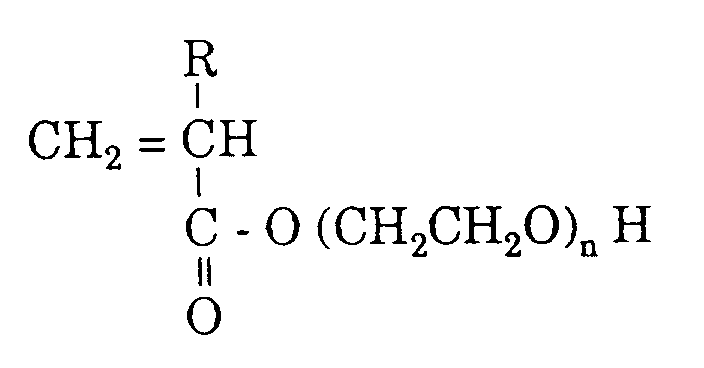
wherein R is hydrogen atom or methyl group.
wherein R is hydrogen atom or methyl group.