| (19) |
 |
|
(11) |
EP 0 583 974 B1 |
| (12) |
EUROPEAN PATENT SPECIFICATION |
| (45) |
Mention of the grant of the patent: |
|
12.02.1997 Bulletin 1997/07 |
| (22) |
Date of filing: 17.08.1993 |
|
|
| (54) |
Diamond temperature and radiation sensor
Diamanttemperatursensor
Capteur de température en diamant
|
| (84) |
Designated Contracting States: |
|
AT BE CH DE FR GB IE IT LI NL SE |
| (30) |
Priority: |
17.08.1992 GB 9217436
|
| (43) |
Date of publication of application: |
|
23.02.1994 Bulletin 1994/08 |
| (73) |
Proprietor: DE BEERS INDUSTRIAL DIAMOND DIVISION
(PROPRIETARY) LIMITED |
|
Johannesburg,
Transvaal (ZA) |
|
| (72) |
Inventor: |
|
- Jones, Barbara Lynn
Bracknell
RG12 3TX (GB)
|
| (74) |
Representative: Ellis-Jones, Patrick George Armine et al |
|
J.A. KEMP & CO.
14 South Square
Gray's Inn
London WC1R 5LX
London WC1R 5LX (GB) |
| (56) |
References cited: :
EP-A- 0 314 458
GB-A- 676 411
|
EP-A- 0 392 467
US-A- 2 760 078
|
|
| |
|
|
- IEEE TRANSACTIONS ON NUCLEAR SCIENCE vol. NS-22, no. 1 , February 1975 , NEW YORK
US pages 160 - 170 S.F. KOZLOV 'PREPARATION AND CHARACTERISTICS OF NATURAL DIAMOND
NUCLEAR RADIATION DETECTORS'
|
|
| |
|
| Note: Within nine months from the publication of the mention of the grant of the European
patent, any person may give notice to the European Patent Office of opposition to
the European patent
granted. Notice of opposition shall be filed in a written reasoned statement. It shall
not be deemed to
have been filed until the opposition fee has been paid. (Art. 99(1) European Patent
Convention).
|
BACKGROUND OF THE INVENTION
[0001] This invention relates to a temperature sensor formed from diamond material which
is sensitive to temperature and also to ionising or nuclear radiation.
[0002] A diamond temperature sensor is known from EP-A-0 392 467, while a radiation sensor
is known from EP-A-0 314 458.
SUMMARY OF THE INVENTION
[0003] According to the invention a temperature sensor comprises a body of insulating diamond
material and a pair of spaced apart electrical contacts applied to the body, the body
of diamond material having a predetermined thickness between the contacts, and the
contacts having a predetermined area, so that the sensor has a corresponding capacitance
between the contacts which is temperature dependent.
[0004] The diamond body may comprise a type Ia, type Ib or type IIa natural or synthetic
diamond crystal.
[0005] The diamond body may further comprise a layer of undoped diamond material deposited
by a chemical vapour deposition process.
[0006] The layer of diamond may be deposited on a conductive or semi-conductive substrate.
[0007] The substrate may comprise doped silicon.
[0008] The doped silicon substrate may function as one of the electrical contacts.
[0009] At least one of the electrical contacts may be metallic and may comprise, for example,
titanium, aluminium, nickel or chrome.
[0010] At least one of the electrical contacts may comprise doped amorphous semiconductor
material deposited on the diamond body.
[0011] The invention extends to temperature measurement apparatus which comprises a temperature
sensor as defined above and which further comprises an oscillator circuit, the sensor
being connected as a feedback element in the circuit so that the output frequency
of the oscillator varies with the temperature of the sensor.
[0012] The invention further extends to radiation measurement apparatus which comprises
a temperature sensor of the invention and further comprises charging means for applying
an electrical charge to the sensor at a predetermined charging rate, and monitoring
means for monitoring the resultant voltage on the sensor, thereby to measure the intensity
of ionising radiation incident on the sensor.
[0013] The invention still further extends to radiation measurement apparatus which comprises
a temperature sensor of the invention and further comprises pulse or conduction mode
measuring means for measuring pulse or conduction mode electrical signals due to ionising
radiation incident on the sensor and for generating a first electrical signal corresponding
thereto, capacitance measuring means for measuring the capacitance of the sensor as
a function of temperature and for generating a second electrical output signal corresponding
thereto, and compensating means responsive to the first and second electrical output
signals to generate an output signal corresponding to the intensity of the radiation
incident on the sensor, which is compensated for changes in temperature.
[0014] The invention additionally extends to a method of measuring temperature including
the steps of providing a temperature sensor which comprises a body of insulating diamond
material and a pair of spaced apart electrical contacts applied to the body, the body
of diamond material having a predetermined thickness between the contacts, and the
contacts having a predetermined area, so that the sensor has a corresponding capacitance
between the contacts which is temperature dependent; locating the sensor in an environment
or against an object to be measured; measuring the capacitance between the contacts
or an electrical parameter related thereto; and relating the measured capacitance
or electrical parameter to a reference capacitance or electrical parameter to determine
the temperature of the environment or the object.
[0015] The method may include connecting the sensor as a feedback element in an oscillator
circuit, and relating variations in the temperature measured by the sensor to corresponding
variations in the oscillation frequency of the oscillator circuit.
[0016] The invention includes a method of measuring radiation including the steps of providing
a temperature sensor which comprises a body of insulating diamond material and a pair
of spaced apart electrical contacts applied to the body, the body of diamond material
having a predetermined thickness between the contacts, and the contacts having a predetermined
area, so that the sensor has a corresponding capacitance between the contacts which
is temperature dependent; applying an electrical charge to the sensor at a predetermined
charging rate; and monitoring the resultant voltage on the sensor, thereby to measure
the intensity of ionising radiation incident on the sensor.
[0017] The invention further includes a method of measuring radiation including the steps
of providing a temperature sensor which comprises a body of insulating diamond material
and a pair of spaced apart electrical contacts applied to the body, the body of diamond
material having a predetermined thickness between the contacts, and the contacts having
a predetermined area, so that the sensor has a corresponding capacitance between the
contacts which is temperature dependent; subjecting the sensor to ionising radiation;
measuring pulse or conduction mode electrical signals due to the ionising radiation
and generating a first electrical output signal corresponding thereto; measuring the
capacitance of the sensor as a function of temperature and generating a second electrical
output signal corresponding thereto; and processing the first and second electrical
output signals to generate an output signal corresponding to the intensity of the
radiation incident on the sensor, which s compensated for changes in temperature.
BRIEF DESCRIPTION OF THE DRAWINGS
[0018]
Figure 1 is a schematic sectional side view of a first embodiment of a diamond temperature
sensor according to the invention;
Figure 2 is a schematic sectional side view of a second embodiment of the temperature
sensor;
Figure 3 is a graph indicating the electrical characteristic of the sensor with temperature;
Figures 4 and 5 illustrate circuits which can be used with the sensor of the invention
to measure temperature; and
Figure 6 illustrates a circuit which can be used with the sensor of the invention
to measure radiation and/or temperature.
DESCRIPTION OF EMBODIMENTS
[0019] Figure 1 illustrates a temperature sensor according to the invention which comprises
a body 10 of diamond material with electrical contacts 12 and 14 applied thereto.
Conductors 16 and 18 are connected to the contacts 12 and 14, respectively.
[0020] The body 10 is typically a 1 mm cube of insulating diamond material, such as a type
Ia, Ib, or IIa natural or synthetic diamond crystal. The crystal is selected for low
levels of impurities such as boron or phosphorous, which would impair its insulating
properties. The contacts 12 and 14 are preferably metallic and may comprise, for example,
titanium, aluminium, nickel, chrome or other metals. The contacts need not necessarily
be ohmic.
[0021] Figure 2 illustrates an alternative embodiment of the temperature sensor, in which
a diamond body 20 is formed as a layer on a doped silicon substrate by a chemical
vapour deposition (CVD) process. Again, the diamond layer has a low concentration
of impurities which would increase its conductivity. The doped substrate 22 is conductive
or semi-conductive and acts as a first electrical contact to the diamond layer.
[0022] The substrate can be made from a silicon wafer with a thickness of about 100 microns
or greater, and having a crystallographic orientation which is within 3 to 4° of one
of the main crystallographic planes.
[0023] A second, metallic contact 24 is applied to the diamond body 20. Instead of a metallic
contact, a non-metallic contact could be provided, for example, by the deposition
of doped amorphous semi-conductor material such as amorphous silicon or germanium
on the body 20. The semi-conductor material is doped with boron or phosphorous to
a sufficiently high concentration to give the semi-conductor material a resistivity
of 10
3 Ω cm or less. A prototype sensor had a size of 1mm square, with the diamond layer
20 being about 100 microns thick.
[0024] In both versions of the sensor, the device exhibits a capacitance between the electrical
contacts which is temperature dependent. Figure 3 illustrates schematically the relationship
between the capacitance of the sensor and temperature. A prototype of the first embodiment
of the sensor according to Figure 1 had a capacitance of approximately 5 pF at 20°C,
while a prototype of the second embodiment had a capacitance of about 50 pF.
[0025] The capacitance C of the sensor is determined by the dielectric constant ε of the
diamond material, according to the formula :
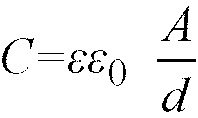
where A is the area of the contacts and d is the width or thickness of the diamond
material between the contacts.
ε
o is a constant, while ε is a function of temperature:

where T is absolute temperature.
[0026] Thus, it can be seen that the capacitance of the sensor changes as a function of
temperature, in a non-linear way.
[0027] The basic capacitance of the temperature sensors of the invention can be selected
by adjusting the size (area) of the contacts and the width or thickness of the diamond
material between the contacts. A typical range of thicknesses of the diamond material
for both the above described embodiments is in the range of 10 microns to 1 mm. In
the case of the first embodiment of the sensor, employing a diamond crystal, the sensor
will generally not be more than 1 or 2 mm in size, but sensors of the second embodiment
can be much larger, with an area of several square centimeters, and a correspondingly
greater capacitance, if desired.
[0028] Although it is convenient to provide a sensor with a relatively large capacitance,
which reduces the sensitivity of temperature measurement apparatus incorporating the
sensor to stray capacitance, it will be appreciated that increasing the size of the
sensor will also reduce its speed of response, since there will be a greater mass
of material to be heated by the object or environment which is being measured. Thus,
a compromise must be reached according to the intended application of the sensor.
[0029] In the described embodiments of the sensor, charge carriers are mobilised or localised
as a function of changes in temperature, which is different from the mechanism of
operation of other sensors such as radiation sensors. In a radiation sensor, carriers
are generated by the interaction of ionising particles with the structure of the diamond
material. However, the described sensor responds in both modes, which can be used
to advantage, as described below.
[0030] The temperature sensor of the invention may be used in conjunction with a nulling
capacitance bridge, typically with a reference diamond capacitor, to measure temperature.
[0031] Figures 4 and 5 show circuits which can be used with the sensor of the invention
to measure temperature and to provide an output voltage corresponding to the measured
temperature.
[0032] Figure 4 illustrates a voltage controlled oscillator (VCO) circuit in which the temperature
sensor C is used as a feedback element The VCO is preset to run at a nominal operating
frequency, which varies according to variations in the capacitance of the sensor with
temperature. In the illustrated circuit, the capacitance of the sensor is given by
the following formula:
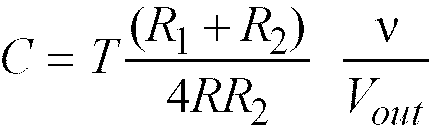
where T is the period of oscillation of the VCO. From the above relationship between
the capacitance of the sensor and the absolute temperature T (not to be confused with
the period of oscillation above) a temperature value can be calculated.
[0033] The circuit of Figure 5 is a relatively simple square wave oscillator in which the
temperature sensor C is used as a non-linear feedback element. This circuit generates
a square wave output waveform witb a frequency which is determined by the capacitance
of the sensor C and the resistors in the circuit, according to the relationship:
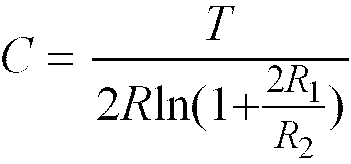
where T is the period of oscillation of the square wave generator.
[0034] Again, from the capacitance value thus obtained, a temperature value can be calculated.
[0035] In Figure 6, a simple circuit comprising field effect transistors (FETs) T
1 and T
2 is fed with a square pulse train from an oscillator. This causes the transistor T
1 to switch at the repetition rate of the pulse train, charging the temperature sensor
C at a constant rate. When the sensor C is subjected to nuclear or ionising radiation,
it discharges at a rate proportional to the intensity of the incident radiation. The
transistor T
2 monitors the charge on the sensor C and provides an output voltage V
out, corresponding thereto.
[0036] It will be appreciated that the fact that the sensor of the invention is sensitive
both to ionising radiation and to temperature can be utilised to provide a measuring
device which measures both temperature and incident radiation, or a radiation measuring
device which is temperature compensated. In the latter case, a reference temperature
compensation capacitor could be provided in the circuits of Figures 4 and 5, with
an appropriate compensation circuit.
[0037] The described temperature sensor is physically similar to known radiation sensors
which operate in a pulse mode or conduction mode, and can therefore be connected to
a composite measuring circuit which measures both the capacitance of the sensor as
a function of temperature, and pulse or conduction mode signals resulting from radiation
incident on the sensor.
[0038] The temperature dependent capacitance measurement is used to compensate for variations
in the pulse or conduction mode output of the sensor due to variation in temperature.
[0039] Because the diamond body of the temperature sensor is non conductive, it can be used
in strong magnetic fields without being susceptible to errors due to induced currents.
The temperature sensor of the invention is thus suited to use in conjunction with
superconductors, where conventional thermistors may be unsuitable.
[0040] Due to the excellent thermal conductivity of diamond, the temperature sensors of
the invention can provide a relatively rapid response compared with prior art sensors,
which may use electrically insulating materials which are also thermal insulators.
1. A temperature sensor characterised in that it comprises a body (10; 20) of insulating
diamond material and a pair of spaced apart electrical contacts (12, 14; 22, 24) applied
to the body, the body of diamond material having a predetermined thickness between
the contacts, and the contacts having a predetermined area, so that the sensor has
a corresponding capacitance between the contacts which is temperature dependent.
2. A temperature sensor according to claim 1 characterised in that the diamond body comprises
a type Ia, type Ib or type IIa natural or synthetic diamond crystal (10).
3. A temperature sensor according to claim 1 characterised in that the diamond body comprises
a layer (20) of undoped diamond material deposited by a chemical vapour deposition
process.
4. A temperature sensor according to claim 3 characterised in that the layer (20) of
diamond is deposited on a conductive or semi-conductive substrate (22).
5. A temperature sensor according to claim 4 characterised in that the substrate (22)
comprises doped silicon.
6. A temperature sensor according to claim 4 or 5 characterised in that the substrate
(22) functions as one of the electrical contacts.
7. A temperature sensor according to any one of claims 1 to 6 characterised in that at
least one of the electrical contacts (12, 14; 22, 24) is metallic.
8. A temperature sensor according to claim 7 characterised in that the at least one electrical
contact (12, 14; 22, 24) comprises titanium, aluminium, nickel or chrome.
9. A temperature sensor according to any one of claims 1 to 8 characterised in that at
least one of the electrical contacts (24) comprises doped amorphous semiconductor
material deposited on the diamond body (20).
10. Temperature measurement apparatus characterised in that it comprises a temperature
sensor (C) according to any one of claims 1 to 9 and further comprising an oscillator
circuit, the sensor being connected as a feedback element in the circuit so that the
output frequency of the oscillator varies with the temperature of the sensor.
11. Radiation measurement apparatus characterised in that it comprises a temperature sensor
(C) according to any one of claims 1 to 9 and further comprising charging means (T1) for applying an electrical charge to the sensor at a predetermined charging rate,
and monitoring means (T2) for monitoring the resultant voltage on the sensor, thereby to measure the intensity
of ionising radiation incident on the sensor.
12. Radiation measurement apparatus characterised in that it comprises a temperature sensor
(C) according to any one of claims 1 to 9, pulse or conduction mode measuring means
for measuring pulse or conductive mode electrical signals due to ionising radiation
incident on the sensor and for generating a first electrical signal corresponding
thereto, capacitance measuring means for measuring the capacitance of the sensor as
a function of temperature and for generating a second electrical output signal corresponding
thereto, and compensating means responsive to the first and second electrical output
signals to generate an output signal corresponding to the intensity of the radiation
incident on the sensor, which is compensated for changes in temperature.
13. A method of measuring temperature characterised in that it includes the steps of providing
a temperature sensor which comprises a body (10; 20) of insulating diamond material
and a pair of spaced apart electrical contacts (12, 14; 22, 24) applied to the body,
the body of diamond material having a predetermined thickness between the contacts,
and the contacts having a predetermined area, so that the sensor has a corresponding
capacitance between the contacts which is temperature dependent; locating the sensor
in an environment or against an object to be measured; measuring the capacitance between
the contacts or an electrical parameter related thereto; and relating the measured
capacitance or electrical parameter to a reference capacitance or electrical parameter
to determine the temperature of the environment or the object.
14. A method according to claim 13 characterised in that it includes connecting the sensor
(C) as a feedback element in an oscillator circuit, and relating variations in the
temperature measured by the sensor to corresponding variations in the oscillation
frequency of the oscillator circuit.
15. A method of measuring radiation characterised in that it includes the steps of providing
a temperature sensor which comprises a body (10; 20) of insulating diamond material
and a pair of spaced apart electrical contacts (12, 14; 22, 24) applied to the body,
the body of diamond material having a predetermined thickness between the contacts,
and the contacts having a predetermined area, so that the sensor has a corresponding
capacitance between the contacts which is temperature dependent; applying an electrical
charge to the sensor at a predetermined charging rate; and monitoring the resultant
voltage on the sensor, thereby to measure the intensity of ionsing radiation incident
on the sensor.
16. A method of measuring radiation characterised in that it includes the steps of providing
a temperature sensor which comprises a body (10; 20) of insulating diamond material
and a pair of spaced apart electrical contacts (12, 14; 22, 24) applied to the body,
the body of diamond material having a predetermined thickness between the contacts,
and the contacts having a predetermined area, so that the sensor has a corresponding
capacitance between the contacts which is temperature dependent; subjecting the sensor
to ionising radiation; measuring pulse or conduction mode electrical signals due to
the ionising radiation and generating a first electrical output signal corresponding
thereto; measuring the capacitance of the sensor as a function of temperature and
generating a second electrical output signal corresponding thereto, and processing
the first and second electrical output signals to generate an output signal corresponding
to the intensity of the radiation incident on the sensor, which is compensated for
changes in temperature.
1. Temperatursensor, gekennzeichnet durch einen Körper (10; 20) aus isolierendem Diamantmaterial
und einem Paar an dem Körper angebrachter, voneinander beabstandeter elektrischer
Kontakte (12,14;22,24), und dadurch, daß der aus Diamantmaterial bestehende Körper
zwischen den Kontakten eine vorbestimmte Dicke aufweist und die Kontakte einen vorbestimmten
Flächenbereich aufweisen, derart, daß der Sensor zwischen den Kontakten eine entsprehende
Kapazität aufweist, die temperaturabhängig ist.
2. Temperatursensor nach Anspruch 1, dadurch gekennzeichnet, daß der Diamantenkörper
einen natürlichen oder synthetischen Diamantenkristall (10) vom Typ Ia, Typ Ib oder
Typ IIa aufweist.
3. Temperatursensor nach Anspruch 1, dadurch gekennzeichnet, daß der Diamantenkörper
eine durch einen chemischen Aufdampfvorgang aufgetragene Schicht (20) aus undotiertem
Diamantmaterial aufweist.
4. Temperatursensor nach Anspruch 3, dadurch gekennzeichnet, daß die aus Diamant bestehende
Schicht (20) auf ein leitendes oder halbleitendes Substrat (22) aufgetragen ist.
5. Temperatursensor nach Anspruch 4, dadurch gekennzeichnet, daß das Substrat (22) dotiertes
Silicium aufweist.
6. Temperatursensor nach Anspruch 4 oder 5, dadurch gekennzeichnet, daß das Substrat
(22) als einer der elektrischen Kontakte funktioniert.
7. Temperatursensor nach einem der Ansprüche 1 bis 6, dadurch gekennzeichnet, daß mindestens
einer der elektrischen Kontakte (12,14;22,24) metallisch ist.
8. Temperatursensor nach Anspruch 7, dadurch gekennzeichnet, daß der mindestens eine
elektrische Kontakt (12,14;22,24) Titan, Aluminium, Nickel oder Chrom aufweist.
9. Temperatursensor nach einem der Ansprüche 1 bis 8, dadurch gekennzeichnet, daß mindestens
einer der elektrischen Kontakte (24) auf den Diamantenkörper (20) aufgetragenes dotiertes
amorphes Halbleitermaterial aufweist.
10. Temperaturmeßvorrichtung, gekennzeichnet durch einen Temperatursensor (C) nach einem
der Ansprüche 1 bis 9 und ferner durch eine Oszillatorschaltung, wobei der Sensor
derart als Rückkopplungselement an die schaltung angeschlossen ist, daß die Ausgangsfrequenz
des Oszillators mit der Temperatur des Sensors variiert.
11. Strahlungsmeßvorrichtung, gekennzeichnet durch einen Temperatursensor (C) nach einem
der Ansprüche 1 bis 9, ferner durch eine Ladeeinrichtung (T1) zum Anlegen einer elektrischen Ladung an den Sensor mit einer vorbestimmten Laderate
und eine Überwachungseinrichtung (T2) zum Überwachen der resultierenden Spannung an dem Sensor, um die Intensität der
auf den Sensor auftreffenden Ionisierungsstrahlung zu messen.
12. Strahlungsmeßvorrichtung, gekennzeichnet durch einen Temperatursensor (C) nach einem
der Ansprüche 1 bis 9, eine Impuls- oder Leitend-Modus-Meßeinrichtung zum Messen elektrischer
Impuls- oder Leitend-Modus-Signale, die aufgrund auf den Sensor auftreffender Ionisierungsstrahlung
erzeugt werden, und zum Erzeugen eines entsprechenden ersten elektrischen Signals,
eine Kapzitätsmeßeinrichtung zum Messen der Kapazität des Sensors als Funktion der
Temperatur und zum Erzeugen eines entsprechenden zweiten elektrischen Ausgangssignals,
und eine Kompensationseinrichtung, die als Reaktion auf die ersten und die zweiten
elektrischen Ausgangsignale ein Ausgangssignal erzeugt, das der Intensität der auf
den Sensor auftreffenden strahlung entspricht und in dem Temperaturänderungen kompensiert
sind.
13. Verfahren zum Messen von Temperatur, gekennzeichnet durch die folgenden Schritte:
Bereitstellen eines Temperatursensors, der einen Körper (10;20) aus isolierendem Diamantmaterial
und zwei an dem Körper angebrachte, voneinander beabstandete elektrische Kontakte
(12,14;22,24) aufweist, wobei der aus Diamantmaterial bestehende Körper zwischen den
Kontakten eine vorbestimmte Dicke aufweist und die Kontakte einen vorbestimmten Flächenbereich
aufweisen, derart, daß der Sensor zwischen den Kontakten eine entsprechende Kapazität
aufweist, die temperaturabhängig ist; Plazieren des Sensors in der Nähe eines zu messenden
Objektes oder an diesem; Messen der zwischen den Kontakten bestehenden Kapazität oder
eines mit der Kapazität in Beziehung stehenden elektrischen Parameters; und In-Beziehung-Setzen
der gemessenen Kapazität oder des gemessenen elektrischen Parameters zu einer Referenz-Kapazität
oder einem elektrischen Referenz-Parameter zum Bestimmen der Temperatur der Umgebung
oder des Objektes.
14. Verfahren nach Anspruch 13, gekennzeichnet durch Anschließen des Sensors (C) als Rückkopplungselement
an eine Oszillatorschaltung und In-Beziehung-Setzen der Variationen der durch den
Sensor gemessenen Temperatur zu entsprechenden Variationen der Oszillationsfrequenz
der Oszillatorschaltung.
15. Verfahren zum Messen von Strahlung, gekennzeichnet durch die folgenden Schritte: Bereitstellen
eines Temperatursensors, der einen Körper (10;20) aus isolierendem Diamantmaterial
und zwei an dem Körper angebrachte, voneinander beabstandete elektrische Kontakte
(12,14;22,24) aufweist, wobei der aus Diamantmaterial bestehende Körper zwischen den
Kontakten eine vorbestimmte Dicke aufweist und die Kontakte einen vorbestimmten Flächenbereich
aufweisen, derart, daß der Sensor zwischen den Kontakten eine entsprechende Kapazität
aufweist, die temperaturabhängig ist; Anlegen einer elektrischen Ladung an den Sensor
mit einer vorbestimmten Laderate; und Überwachen der resultierenden Spannung an dem
Sensor, um die Intensität der auf den Sensor auftreffenden Ionisierungsstrahlung zu
messen.
16. Verfahren zum Messen von Strahlung, gekennzeichnet durch die folgenden Schritte: Bereitstellen
eines Temperatursensors, der einen Körper (10;20) aus isolierendem Diamantmaterial
und zwei an dem Körper angebrachte, voneinander beabstandete elektrische Kontakte
(12,14;22,24) aufweist, wobei der aus Diamantmaterial bestehende Körper zwischen den
Kontakten eine vorbestimmte Dicke aufweist und die Kontakte einen vorbestimmten Flächenbereich
aufweisen, derart, daß der Sensor zwischen den Kontakten eine entsprechende Kapazität
aufweist, die temperaturabhängig ist; Einwirkenlassen einer Ionisierungsstrahlung
auf den Sensor; Messen aufgrund Ionisierungsstrahlung erzeugter elektrischer Impuls-
oder Leitend-Modus-Signale und Erzeuger eines entsprechenden ersten elektrischen Ausgangssignals;
Messen der Kapazität des Sensors als Funktion der Temperatur und zum Erzeugen eines
entsprechenden zweiten elektrischen Ausgangssignals, und Verarbeiten der ersten und
zweiten elektrischen Ausgangsignale zum Erzeugen eines Ausgangssignals, das der Intensität
der auf den Sensor auftreffenden Strahlung entspricht und in dem Temperaturänderungen
kompensiert sind.
1. Capteur de température, caractérisé en ce qu'il comprend un corps (10 ; 20) en diamant
isolant et une paire de contacts électriques espacés entre eux (12, 14 ; 22, 24),
appliqués sur le corps, le corps de diamant présentant une épaisseur prédéterminée
entre les contacts, et les contacts ayant une aire de surface prédéterminée de sorte
que le capteur possède une capacitance correspondante entre les contacts, capacitance
qui est fonction de la température.
2. Capteur de température selon la revendication 1, caractérisé en ce que le corps de
diamant comprend un cristal de diamant synthétique ou naturel (10) de type la, type
Ib ou type IIa.
3. Capteur de température selon la revendication 1, caractérisé en ce que le corps de
diamant comprend une couche (20) de diamant non dopé, déposée par déposition en phase
gazeuse par procédé chimique (CVD).
4. Capteur de température selon la revendication 3, caractérisé en ce que la couche (20)
de diamant est déposée sur un substrat conducteur ou semi-conducteur (22).
5. Capteur de température selon la revendication 4, caractérisé en ce que le substrat
(22) comprend du silicium dopé.
6. Capteur de température selon la revendication 4 ou 5, caractérisé en ce que le substrat
(22) fonctionne comme l'un des contacts électriques.
7. Capteur de température selon l'une quelconque des revendications 1 à 6, caractérisé
en ce qu'au moins l'un des contacts électriques (12, 14 ; 22, 24) est métallique.
8. Capteur de température selon la revendication 7, caractérisé en ce que au moins un
contact électrique (12, 14 ; 22, 24) comprend du titane, de l'aluminium, du nickel
ou du chrome.
9. Capteur de température selon l'une quelconque des revendications 1 à 8, caractérisé
en ce qu'au moins l'un des contacts électriques ( 24 ) comprend un semi-conducteur
amorphe dopé, déposé sur le corps de diamant (20).
10. Dispositif de mesure de température, caractérisé en ce qu'il comprend un capteur de
température (C) selon l'une quelconque des revendications 1 à 9 et qui, de plus, comprend
un circuit d'oscillateur, le capteur étant raccordé comme élément de rétroaction dans
le circuit de sorte que la fréquence de sortie de l'oscillateur varie avec la température
du capteur.
11. Dispositif de mesure de radiation, caractérisé en ce qu'il comprend un capteur de
température (C) selon l'une quelconque des revendications 1 à 9 et qui, de plus, comprend
des moyens de charge (T1) pour appliquer une charge électrique au capteur à une vitesse de charge prédéterminée
et des moyens de contrôle (T2) pour contrôler la tension résultante sur le capteur, de façon à mesurer l'intensité
de la radiation ionisante incidente sur le capteur.
12. Appareil de mesure de radiation, caractérisé en ce qu'il comprend un capteur de température
(C) selon l'une quelconque des revendications 1 à 9, des moyens de mesure de mode
conducteur ou impulsionnel pour mesurer des signaux électriques en mode conducteur
ou impulsionnel dus à la radiation ionisante incidente sur le capteur et pour générer
un premier signal électrique correspondant, des moyens de mesure de capacitance pour
mesurer la capacitance du capteur en fonction de la température et pour générer un
second signal de sortie électrique correspondant, et des moyens de compensation sensibles
aux premier et second signaux de sortie électrique pour générer un signal de sortie
correspondant à l'intensité de la radiation incidente sur le capteur qui est compensé
pour les changements de température.
13. Procédé de mesure de température, caractérisé en ce qu'il comprend les étapes consistant
à prévoir un capteur de température qui comprend un corps (10; 20) de diamant isolant
et une paire de contacts électriques séparés entre eux (12, 14 ; 22, 24) appliqués
au corps, le corps de diamant ayant une épaisseur prédéterminée entre les contacts
et les contacts ayant une aire de surface prédéterminée de sorte que le capteur possède
une capacitance correspondante entre les contacts qui est fonction de la température
; à positionner le capteur dans un environnement ou contre un objet à mesurer ; à
mesurer la capacitance entre les contacts ou un paramètre électrique rapporté à celui-ci
; et à rapporter le paramètre électrique ou la capacitance mesurée à un paramètre
électrique ou à une capacitance de référence pour déterminer la température de l'environnement
ou de l'objet.
14. Procédé selon la revendication 13, caractérisé en ce qu'il comprend les étapes consistant
à connecter le capteur (C) comme élément de rétroaction dans un circuit d'oscillateur
et à rapporter les variations de températures mesurées par le capteur ou variations
correspondantes de la fréquence d'oscillation du circuit d'oscillateur.
15. Procédé pour mesurer la radiation, caractérisé en ce qu'il comprend les étapes consistant
à prévoir un capteur de température qui comprend un corps (10; 20) de diamant isolant
et une paire de contacts électriques espacés entre eux (12, 14 ; 22, 24) appliqués
au corps, le corps de diamant ayant une épaisseur prédéterminée entre les contacts
et les contacts ayant une aire de surface prédéterminée de sorte que le capteur possède
une capacitance correspondante entre les contacts qui est fonction de la température
; à appliquer une charge électrique au capteur à une vitesse de charge prédéterminée
; et à contrôler la tension résultante sur le capteur, permettant ainsi de mesurer
l'intensité de la radiation ionisante incidente sur le capteur.
16. Procédé de mesure de radiation caractérisé en ce qu'il comprend les étapes consistant
à prévoir un capteur de température qui comprend un corps (10; 20) en diamant isolant
et une paire de contacts électriques espacés entre eux (12, 14 ; 22, 24) appliqués
au corps, le corps de diamant ayant une épaisseur prédéterminée entre les contacts,
et les contacts ayant une aire de surface prédéterminée de sorte que le capteur a
une capacitance correspondante entre les contacts, capacitance qui est fonction de
la température ; à soumettre le capteur à une radiation ionisante ; à mesurer les
signaux électriques en mode conducteur ou impulsionnel qui sont dus à la radiation
ionisante et à générer un premier signal de sortie électrique correspondant ; à mesurer
la capacitance du capteur en fonction de la température et à générer un second signal
de sortie électrique correspondant ; et à traiter les premier et second signaux de
sortie électriques pour générer un signal de sortie correspondant à l'intensité de
la radiation incidente sur le capteur qui est compensé pour les changements de température.