|
(11) | EP 0 584 062 B1 |

| (12) | EUROPEAN PATENT SPECIFICATION |
|
|
| (54) |
METHOD AND COMPOSITION FOR TREATING HYPERPROLIFERATIVE SKIN DISEASES USING 6-AMINOPURINE CYTOKININS VERFAHREN UND ZUSAMMENSETZUNG ZUR BEHANDLUNG VON HYPERPROLIFERATIVEN HAUTERKRANKUNGEN UNTER VERWENDUNG VON 6-AMINOPURIN-CYTOKININEN PROCEDE ET COMPOSTION POUR LE TRAITEMENT DES AFFECTIONS CUTANEES HYPERPROLIFERANTES A L'AIDE DE CYTOKININES D'AMINOPURINE-6 |
|
|
||||||||||||||||||||||||||||
| Note: Within nine months from the publication of the mention of the grant of the European patent, any person may give notice to the European Patent Office of opposition to the European patent granted. Notice of opposition shall be filed in a written reasoned statement. It shall not be deemed to have been filed until the opposition fee has been paid. (Art. 99(1) European Patent Convention). |
[0001] The present invention concerns methods and compositions for treating diseases associated with hyperproliferating epidermal cells, particularly disorders of skin in humans.
[0002] Among diseases afflicting mammals, and particularly humans, are many which are due to hyperproliferation of epidermal cells. Among such diseases are skin diseases such as basal cell carcinoma, malignant melanoma, squamous cell carcinoma, actinic keratosis, Bowen's Disease, papilloma, seborrheic kera- tosis, toxic eczema, allergic eczema, atopic dermatitis, ichthyosis, and psoriasis.
[0003] The present invention provides methods and compositions for treating such hyperproliferative skin diseases.
[0004] The methods and compositions of the invention involve cytokinins. Cytokinins are plant hormones involved in promoting growth and cell division in explants of plant tissue in culture in standard media, which contain auxins (another class of plant hormones) as well as vitamins, mineral salts, and sugar.
[0005] Among cytokinins are those which are 6-(substituted amino)purines, including kinetin (6-(furfuryl)aminopurine), zeatin (6-(3-hydroxymethyl, 3-methylallyl)aminopurine, 6-(3,3-dimethylallyl)aminopurine, 6-(benzyl)aminopurine, 6-(phenyl)aminopurine, 6-(n-alkyl)aminopurine, wherein the alkyl group has 4, 5 or 6 carbon atoms, and 6-(cyclohexyl)methylaminopurine.
[0006] Cytokinins have been observed to have various effects on mammalian cells in culture. Orr and McSwain, Cancer 10, 617 - 624 (1957); Johnson et al., Exptl. Cell Res. 85, 47 - 56 (1974); Hecht et al., Proc. Natl. Acad. Sci. (USA) 71, 4670 - 4674 (1974); Mookerjee et al., J. Reticuloendoth. Soc. 25, 299 - 314 (1979); Gordon and Seglen, Arch. Biochem. Biophys. 217, 282 - 294 (1982); Vesely et at., Endocrinology 116, 1887 - 1892 (1985), US 4 853, 386 discloses N6-Disubstituted purine derivatives useful for treating bronchospastic and bronchoconstrictory conditions.
[0007] It has been found unexpectedly that hyperproliferating epidermal cells associated with hyperproliferative skin diseases of mammals, when exposed to 6-(substituted amino)purine cytokinins, are caused to differentiate and slow in their rate of proliferation.
[0008] Thus, the present invention entails compositions for treating hyperproliferative skin diseases of mammals, including humans. Differentiation-inducing-effective amounts of a 6-(substituted amino)purine may be administered to the hyperproliferating epidermal cells associated with such a disease in a mammal suffering therefrom.
[0009] In one of its aspects, the present invention comprises use of a 6-(substituted amino)purine cytokinin in a differentiation inducing effective amount in the preparation of a medicament for the treatment of a hyperproliferative skin disease in a mammal, preferably a human.
[0010] The present invention is preferably employed to treat hyperproliferative skin disease of humans.
[0011] Such diseases, in humans and other mammals, are due to hyperproliferating epidermal cells of the skin. Among such diseases, that can be treated in accordance with the present invention, are basal cell carcinoma, malignant melanoma, squamous cell carcinoma, actinic keratosis, Bowen's Disease, papilloma, seborrheic keratosis, toxic eczema, allergic eczema, atopic dermatitis, ichthyosis, and psoriasis.
[0012] Preferably the 6-(substituted amino)purine cytokinins which can be employed in accordance with the invention are those of formula I:
wherein R1 is selected from the group consisting of furfuryl, phenyl, benzyl, n-alkyl of 4, 5 or 6 carbon atoms, (cyclohexyl)methyl (-CH2 C6H11)),
and 3, 3-dimethylallyl (-CH2CH=C(CH3)2). Most preferred among these is kinetin (R1 being furfuryl).
[0013] In another of its aspects, the invention entails a pharmaceutical composition for treating an hyperproliferative skin disease of a mammal, which composition comprises a 6-(substituted amino)purine cytokinin of the formula I:
wherein R1 is selected from the group consisting of furfuryl, phenyl, benzyl, n-alkyl of 4, 5 or 6 carbon atoms, (cyclohexyl)methyl, (3-hydroxymethyl-3-methyl) allyl and 3,3-dimethylallyl and a physiologically acceptable vehicle in which advantageously is for application of said cytokinin to the outer surface of the skin of a mammal preferably a human, suffering from said disease such that said cytokinin is brought into contact with (i.e., administered to) the hyperproliferating cells associated with the disease.
[0014] The 6-(substituted amino)purine cytokinin may be combined, at a concentration of between about 0.01 % (w/v) and about 0.5 % (w/v), preferably about 0.1 % (w/v) with physiologically acceptable vehicle, such as a standard, commonly used skin-moisturizing vehicle. One example of the many such skin-moisturizing vehicles is a composition of 4 - 8 wt. % (e.g., 6.2 wt. %) glycerol monostearate 40 - 50, 12 - 16 wt. % (e.g., 14.3 wt. %) white petroleum, 0.5 - 2 wt. % (e.g., 1 wt. %) lanolin, 9 -13 wt. % (e.g., 11.4 wt. %) mineral oil, 0.5 - 2 wt. % (e.g., 1 wt. %) propylene glycol, 1 - 2 wt. % (e.g., 1.4 wt. %) triethanolamine (bp-80), 1 - 5 wt. % (e.g., 3.3 wt. %) stearin, 0.5 - 2 wt. % (e.g., 1 wt. %) parahydroxybenzoic acid, and the remainder (e.g., 60.4 wt. %) water. Alternatively, the 6-(substituted amino)purine cytokinin can be combined with a lipogel-type vehicle, such as that being sold by Rhone-Poulenc (Courbevoie, France) under the tradename CERIDAL™, at a concentration of between about 1 and about 5 mg/ml. The resulting composition according to the invention is applied topically to the surface of the area of the skin affected by the hyperproliferative disease (i.e., the area under, or as a part of, which the hyperproliferating epidermal cells associated with the disease are located), usually with light rubbing or message or the like as commonly employed in the application of moisturizing vehicles or lipogel-based compositions.
[0015] It is contemplated that treatment with the compositions of the invention will be carried out under the guidance of a dermatologist or other physician or, in the case of a non-human mammal, veterinarian.
[0016] The frequency of application most suitable for treating a particular disease in a particular mammal with a particular composition according to the invention will be readily determined by the skilled and will depend, as the skilled will understand, on numerous factors, such as the species of mammal, the nature of the disease, the severity of the disease, the moisturizing vehicle, lipogel-based vehicle or other physiologically acceptable vehicle employed in the composition, and the concentration of the 6-(substituted amino)purine cytokinin in the composition. Generally, application of a composition according to the invention to an affected area of the skin between once and four times daily (preferably twice) for between about a week and about a year, more typically about a month, will be effective to induce hyperproliferating cells under, or in, the area to differentiate to a non-proliferating or normally proliferating state and thereby substantially cure the hyperproliferative disease of the affected area.
EXAMPLE
[0018] Primary explant cultures of human epidermal cells from psoriatic skin of two persons suffering from psoriasis were established by taking skin samples, cutting the samples into small (approx. 2 x 2 mm2) pieces, and explanting the pieces into ordinary tissue culture flasks, where culture growth was carried out at 35 °C with a standard keratinocyte culture medium (Dulbecco's Modified Eagle's Medium + 20 % fetal calf serum + 10 ng/ml epidermal growth factor + 0.4 µg/ml hydrocortisone).
[0019] Cultures were stripped by a standard procedure after growth for one month. That is, they were incubated for 72 hours in low Ca++ medium prior to selectively stripping off all the supra basal layers. After the stripping, the cultures were re-fed with medium with normal Ca++ concentration
[0020] In half of the cultures from each patient, kinetin was present in the culture medium at 200 µM concentration.
[0021] The morphology of cells in the primary, unstripped cultures was examined after one month plus ten days of growth. In the cultures fed with kinetin, in comparison with those not so fed, there was a large decrease in mitotic figures and some indication of increased differentiation (accumulation of numerous, filament-containing cells in discrete, elevated areas).
[0022] The morphology of cells in the stripped cultures was also examined, after seven days of growth after the stripping. In the cultures fed with kinetin, in comparison with those not so fed, there was much more heterogeneity in morphology. In the cultures fed with kinetin, in comparison with those not so fed, there was a reduction of mitotic figures, reduction of multilayering, no lateral growth, early in the observation period a vacuolization of the cytoplasm in many cells, late in the observation period areas with numerous cornified envelope-containing cells alternating with empty looking areas.
[0023] At seven days post-stripping, cultures were labeled using 3H-labeled thymidine for 30 minutes. S-phase cells were sorted out onto glass slides, on the basis of EtBr-Mithramycin staining using a FACS-II cell sorter, and then subjected to autoradiography. The numbers of labeled and unlabeled S-phase cells, and the number of grains per nucleus in the labeled cells, were then measured microscopically. In cultures with kinetin, more than 70 % of S-phase cells were unlabeled (i.e., 0 - 3 grains per nucleus) and about 5 % of S-phase cells were highly labeled (>25 grains per nucleus). In cultures without kinetin, about 30 % of S-phase cells were unlabeled and about 40 % of S-phase cells were highly labeled. These results indicate that kinetin inhibited the regenerative response in psoriatic cells.
[0024] The cornified envelope formed by cultured keratinocytes is regarded as a marker of differentiation. The fraction of cells in a culture that has acquired a cornified envelope can be measured by a standard method, wherein the cells in the culture are counted, then treated with SDS and reducing agents, which destroys cells without the envelope but to which the envelope is resistant, and then recounted. With cultures of psoriatic cells from one of the persons suffering from psoriasis, in which cells with cornified envelope were determined 7-days post-stripping, 37 % of the cells in cultures treated with kinetin had a cornified envelope while 18 % of the cells in cultures not treated with kinetin had a cornified envelope. With cultures of psoriatic cells from the other of the persons suffering from psoriasis, in which cells with cornified envelope were determined 7-days post-stripping, 14 % of the cells in cultures treated with kinetin had a cornified envelope while 12 % of the cells in cultures not treated with kinetin had a cornified envelope. These results indicate that kinetin stimulated differentiation of the psoriatic cells.
1. Use of a 6-(substituted amino)purine cytokinin in a differentiation inducing effective
amount in the manufacture of a medicament for the treatment of a hyperproliferative
skin disease in a mammal.
2. Use as claimed in claim 1 wherein the hyperproliferative skin disease is a disease
of a human.
3. Use as claimed in claim 2 wherein the hyperproliferative skin disease is basal cell
carcinoma, malignant, melanoma, squamous cell carcinoma, actinic keratosis, Bowen's
disease, papilloma, seborrheic keratosis, toxic eczema, allergic eczema, atopic dermatis
or ichthyosis.
4. Use as claimed in claim 2 wherein the hyperproliferative skin disorder is psoriasis.
5. Use as claimed in any one of claims 1 to 4 wherein the 6-(substituted amino)purine
cytokinin is of formula I:
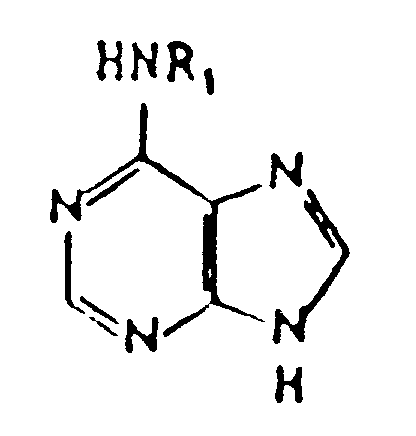
wherein R1 is selected from the group consisting of furfuryl, phenyl, benzyl, n-alkyl of 4, 5 or 6 carbon atoms, (cyclohexyl)methyl, (3-hydroxymethyl-3-methyl) allyl and 3,3-dimethylallyl.
wherein R1 is selected from the group consisting of furfuryl, phenyl, benzyl, n-alkyl of 4, 5 or 6 carbon atoms, (cyclohexyl)methyl, (3-hydroxymethyl-3-methyl) allyl and 3,3-dimethylallyl.
6. Use as claimed in any one of claims 1 to 4 wherein the 6-(substituted amino)purine
cytokinin is kinetin.
7. A pharmaceutical composition for treatment of a hyperproliferative skin disease in
a mammal which comprises a 6-(substituted amino)purine cytokinin of formula I
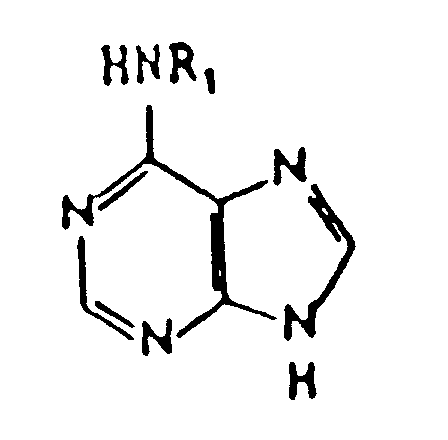
wherein R1 is selected from the group consisting of furfuryl, phenyl, benzyl, n-alkyl of 4, 5 or 6 carbon atoms, (cyclohexyl)methyl, (3-hydroxymethyl-3-methyl) allyl and 3,3-dimethylallyl and a physiologically acceptable vehicle.
wherein R1 is selected from the group consisting of furfuryl, phenyl, benzyl, n-alkyl of 4, 5 or 6 carbon atoms, (cyclohexyl)methyl, (3-hydroxymethyl-3-methyl) allyl and 3,3-dimethylallyl and a physiologically acceptable vehicle.
1. Verwendung eines 6-(substituierten Amino)purincytokinins in einer für eine Induzierung
einer Differenzierung wirksamen Menge bei der Herstellung eines Medikaments zur Behandlung
einer hyperproliferativen Hauterkrankung in einem Säuger.
2. Verwendung nach Anspruch 1, worin die hyperproliferative Hauterkrankung eine Erkrankung
eines Menschen ist.
3. Verwendung nach Anspruch 2, worin die hyperproliferative Hauterkrankung ein Basalzellenkarzinom,
ein bösartiges Melanom, ein Schuppenzellkarzinom, aktinische Keratose, die Bowen'sche
Erkrankung, ein Papillom, seborrheische Keratose, ein toxisches Ekzem, ein allergisches
Ekzem, eine atopische Dermatitis oder Ichthyosis ist.
4. Verwendung nach Anspruch 2, worin die hyperproliferative Hauterkrankung Psoriasis
ist.
5. Verwendung nach einem der Ansprüche 1 bis 4, worin das 6-(substituierte Amino)purincytokinin
von Formel I ist:
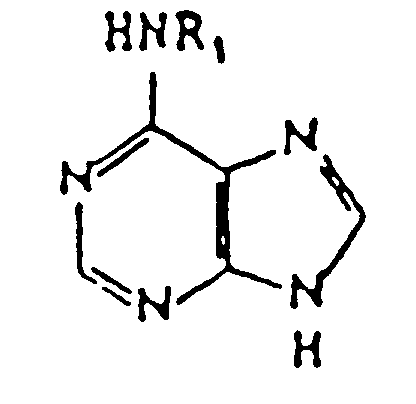
worin R1 ausgewählt ist aus der Gruppe, bestehend aus Furfuryl, Phenyl, Benzyl, n-Alkyl mit 4, 5 oder 6 Kohlenstoffatomen, (Cyclohexyl)methyl, (3-Hydroxymethyl-3-methyl)allyl und 3,3-Dimethylallyl.
worin R1 ausgewählt ist aus der Gruppe, bestehend aus Furfuryl, Phenyl, Benzyl, n-Alkyl mit 4, 5 oder 6 Kohlenstoffatomen, (Cyclohexyl)methyl, (3-Hydroxymethyl-3-methyl)allyl und 3,3-Dimethylallyl.
6. Verwendung nach einem der Ansprüche 1 bis 4, worin das 6-(substituierte Amino)purincytokinin
Kinetin ist.
7. Pharmazeutische Zusammensetzung zur Behandlung einer hyperproliferativen Hauterkrankung
in einem Säuger, umfassend ein 6-(substituiertes Amino)purincytokinin der Formel I
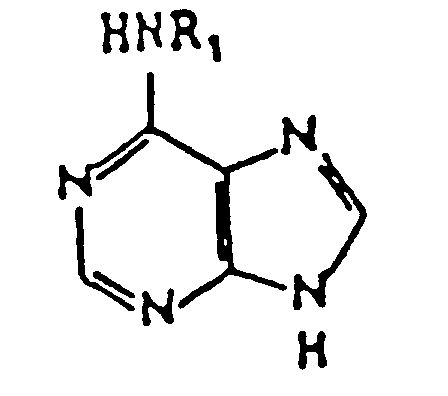
worin R1 ausgewählt ist aus der Gruppe, bestehend aus Furfuryl, Phenyl, Benzyl, n-Alkyl mit 4, 5 oder 6 Kohlenstoffatomen, (Cyclohexyl)methyl, (3-Hydroxymethyl-3-methyl)allyl und 3,3-Dimethylallyl und ein physiologisch annehmbares Vehikel.
worin R1 ausgewählt ist aus der Gruppe, bestehend aus Furfuryl, Phenyl, Benzyl, n-Alkyl mit 4, 5 oder 6 Kohlenstoffatomen, (Cyclohexyl)methyl, (3-Hydroxymethyl-3-methyl)allyl und 3,3-Dimethylallyl und ein physiologisch annehmbares Vehikel.
1. Utilisation d'une cytokinine 6-(amino substitué)purine dans une différenciation induisant
une quantité efficace dans la fabrication d'un médicament pour le traitement d'une
affection cutanée hyperproliférante chez un mammifère.
2. Utilisation comme revendiquée dans la revendication 1, dans laquelle l'affection cutanée
hyperproliférante est une maladie d'humain.
3. Utilisation comme revendiquée dans la revendication 2, dans laquelle l'affection cutanée
hyperproliférante est le carcinome basocellulaire, le mélanome malin, le carcinome
épidermoïde, la kératose actinique, la maladie de Bowen, le papillome, la kératose
séborrhéique, l'eczéma toxique, l'eczéma allergique, la dermatite atopique ou l'ichtyose.
4. Utilisation comme revendiquée dans la revendication 2, dans laquelle l'affection cutanée
hyperproliférante est le psoriasis.
5. Utilisation comme revendiquée dans l'une quelconque des revendications 1 à 4, dans
laquelle la cytokinine 6-(amino substitué)purine est de formule I :
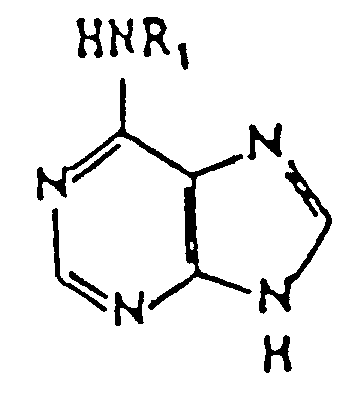
dans laquelle R1 est choisi parmi le groupe constitué par le furfuryle, le phényle, le benzyle, le n-alkyle de 4, 5 ou 6 atomes de carbone, le (cyclohexyl)méthyle, le (3-hydroxyméthyl-3-méthyl)allyle et le 3,3-diméthylallyle.
dans laquelle R1 est choisi parmi le groupe constitué par le furfuryle, le phényle, le benzyle, le n-alkyle de 4, 5 ou 6 atomes de carbone, le (cyclohexyl)méthyle, le (3-hydroxyméthyl-3-méthyl)allyle et le 3,3-diméthylallyle.
6. Utilisation comme revendiquée dans l'une quelconque des revendications 1 à 4, dans
laquelle la cytokinine 6-(amino substitué)purine est la kinétine.
7. Composition pharmaceutique pour le traitement d'une affection cutanée hyperproliférante
chez un mammifère qui comporte une cytokinine 6-(amino substitué)purine de formule
I
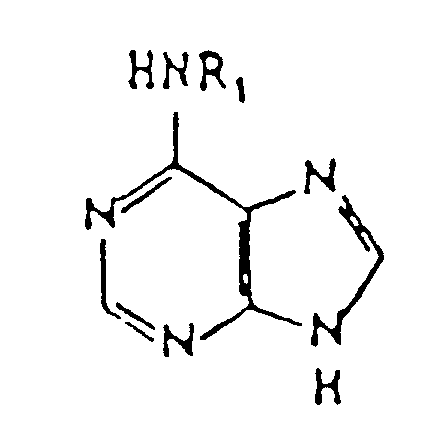
dans laquelle R1 est choisi parmi le groupe constitué par le furfuryle, le phényle, le benzyle, le n-alkyle de 4, 5 ou 6 atomes de carbone, le (cyclohexyl)méthyle, le (3-hydroxyméthyl-3-méthyl)allyle et le 3,3-diméthylallyle et un véhicule physiologiquement acceptable.
dans laquelle R1 est choisi parmi le groupe constitué par le furfuryle, le phényle, le benzyle, le n-alkyle de 4, 5 ou 6 atomes de carbone, le (cyclohexyl)méthyle, le (3-hydroxyméthyl-3-méthyl)allyle et le 3,3-diméthylallyle et un véhicule physiologiquement acceptable.