|
(11) | EP 0 585 040 A1 |

| (12) | EUROPEAN PATENT APPLICATION |
|
|
|
|
|||||||||||||||||||||||||||
| (54) | Use of fabric softening composition |
| (57) Use as a cotton fibre damage inhibitor or fibre protector of a fabric softening composition
comprising at least 1% by weight of a quaternary ammonium material having two C₁₂₋₂₈
alkyl or alkenyl groups connected via an ester link to a hydrocarbon chain which is
connected to the quaternary nitrogen atom. |
[0001] The present invention relates to the use as a fabric damage inhibitor or fibre protector of a fabric softening composition comprising a biodegradable quaternary ammonium material.
[0002] Rinse added fabric softening compositions are well known. Typically such compositions contain a water insoluble quaternary ammonium fabric softening material dispersed in water at a level of quaternary ammonium material up to 7% by weight in which case the compositions are considered dilute, or at levels from 7% to 50% in which case the compositions are considered concentrates. In addition to softening, fabric softening compositions desirably have other benefits. Such other benefits are particularly important for consumers who believe that the use of fabric softening compositions causes damage to the environment and that the damage outweighs the softening benefit obtained.
[0003] A typical wash will include some fabric containing cotton fibres. Abrasion of cotton fibres under wet conditions results in cotton fibre fibrillation whereby the cotton fibres are gradually broken down into their component fibrils and into fibrillar sheets. Such fibrillation is an important mechanism by which fabrics are damaged during wash processes. Damaged fabrics scatter light to a greater extent than undamaged fabrics and the scattering causes dulling of fabric colours. Ultimately the damage will result in mechanical disintegration of the fibre and the consequent failure of cotton garments. The main causes of fibrillation have been found to be swelling of the fibres when wet and friction. Both wet and dry friction cause damage.
[0004] It is an object of the present invention to provide a method of inhibiting damage to cotton fibres and thereby to increase the life of garments containing the fibres.
[0005] According to the invention there is provided the use as a fabric damage inhibitor or reducer of a fabric softening composition comprising a quaternary ammonium material having two C₁₂₋₂₈ alkyl or alkenyl groups connected via an ester link to the quaternary nitrogen atom.
[0006] Throughout this specification the term inhibitor includes a component which confers protective care or protection on a fibre. In particular it encompasses those materials which reduce the damage to the fibre which would otherwise occur during the course of wearing and washing a garment.
[0008] A preferred type of ester-linked quaternary ammonium material for use in the compositions according to the invention is represented by the formula:
wherein each R₁ group is independently selected from C₁₋₄ alkyl, alkenyl or hydroxyalkyl groups; and wherein each R₂ group is independently selected from C₈₋₂₈ alkyl or alkenyl groups; and n is an integer from 0 to 5.
[0009] Preferred materials of this class and their method of preparation are, for example, described in US 4 137 180 (Lever Brothers). Preferably these materials comprise small amounts of the corresponding monoester as described in US 4 137 180 for example 1-tallowoxy2-hydroxytrimethyl ammonium propane chloride.
[0010] Preferably the level of ester linked quaternary ammonium compound is at least 1% by weight of the composition, more preferably more than 3% by weight of the composition; especially interesting are concentrated compositions which comprise more than 7% of ester-linked quaternary ammonium compound. The level of ester-linked quaternary ammonium compound is preferably is between 1% and 80% by weight, more preferably 3% to 50%, most preferably 8% to 50%.
[0011] The softening composition may be stabilised at low temperatures by the addition of nonionic stabilisers. Suitable nonionic stabilisers which can be used include the condensation products of C₈ - C₂₂ primary linear alcohols with 10 to 20 moles of ethylene oxide. The alcohols may be saturated or unsaturated. In particular Genapol T-110, Genapol T-150, Genapol T-200, Genapol C-200 all ex Hoeschst AG, Lutensol AT18 ex BASF, Genapol 0-100 and Genapol 0-150 ex Hoechst, or fatty alcohols for example Laurex CS, ex Albright and Wilson or Adol 340 ex Sherex. Preferably the nonionic stabiliser has an HLB of between 10 and 20, more preferably between 12 and 20.
[0012] Preferably, the level of nonionic stabiliser is within the range from 0.1 to 10% by weight, more preferably from 0.5 to 5% by weight, most preferably from 1 to 4% by weight. The mole ratio of the quaternary ammonium compound to the nonionic stabilising agent is within the range from 40:1 to about 1:1, preferably within the range from 18:1 to about 3:1.
[0013] The composition can also contain fatty acids for example C₈ - C₂₄ alkyl or alkenyl monocarboxylic acids or polymers thereof. Preferably saturated fatty acids are used, in particular, hardened tallow C₁₆-C₁₈ fatty acids. Preferably the fatty acid is non-saponified, more preferably the fatty acid is free; for example oleic acid, lauric acid or tallow fatty acid.
[0014] The level of fatty acid material is preferably more than 0.1% by weight, more preferably more than 0.2% by weight. Especially preferred are concentrates comprising from 0.5 to 20% by weight of fatty acid, more preferably 1% to 10% by weight. The weight ratio of quaternary ammonium material to fatty acid material is preferably from 10:1 to 1:10.
[0015] The compositions of the invention preferably have a pH of more than 2, more preferably between 2 and 5.
[0016] The composition can also contain one or more optional ingredients, selected from non-aqueous solvents, pH buffering agents, perfumes, perfume carriers, fluorescers, colorants, hydrotropes, anti-foaming agents, anti-redeposition agents, enzymes, freeze-thaw stabilisers, optical brightening agents, opacifiers, anti-shrinking agents, anti-wrinkle agents, anti-spotting agents, germicides, fungicides, anti-oxidants, anti-corrosion agents, drape imparting agents, antistatic agents and ironing aids.
[0017] The composition may also contain nonionic fabric softening agents such as lanolin and derivatives thereof.
[0018] The invention will now be illustrated by the following non-limiting examples and with reference to the accompanying drawing which is a diagrammatic representation of the fibre damage test apparatus used. In the examples all percentages are expressed by weight.
[0019] The figure shows a yarn on yarn abrasion tester with a test yarn 1 comprising fibres. The two ends of the yarn are attached to metal links 2 and 3. Metal link 2 joins the yarn to a cord 4 which passes over a first upper yarn guide pulley 4A and is attached to a tensioning weight 5. Typically a 20g tensioning weight is used. The other end of the yarn is attached to a second cord 6 by the metal link 3. Between the metal links the yarn is twisted about itself in the test region 7 and is weighed down by passing the yarn around a lower yarn guide pulley 8. The second cord 6 passes over a second upper yarn guide pulley 9 and is attached to an electrically driven reciprocating means 10. A beaker 11 is provided for containing water or aqueous media used to test the yarn in wet conditions.
[0020] The test method consists of attaching the yarn to be tested to one of the metal links, passing the yarn around the lower yarn guide pulley 9 and then twisting the yarn around itself a predetermined number of times to form the test region 7, before attaching it to the other metal link. If required, the beaker is filled with an aqueous test medium. The reciprocating means is then switched on. A record is kept of the number of oscillations of the reciprocating means before failure. In each of the following examples the test was repeated a number of times and very high or low results discarded before a statistical analysis was made of the remaining data.
Example 1
[0021] 100% extracted Terry Cotton yarns were washed for 15 minutes at 50°C using the recommended dose of a wasing powder sold under the trade mark "New Persil automatic" and having the composition:
- 6.0
- Alkyl benzene sulphonate
- 4.5
- Nonionic 7EO
- 3.5
- Nonionic 3EO
- 25.0
- Sodium tripolyphosphate
- 10.0
- perborate tetrahydrate
- 25.0
- sodium sulphate
- 5.0
- sodium carbonate
water and minor ingredients to balance
[0022] The yarns were then rinsed. Some yarns were rinsed in water as a control and others were rinsed in fabric softening compositionsr. Two fabric softening compositions were used, one containing the cationic quaternary ammonium Arquad 2HT as the quaternary ammonium material and the other containing HT TMAPC as the biodegradable cationic quaternary ammonium material.
COMPOSITION A
[0024]
- 12.8
- DHTDMAC¹
- 3.2
- HTFA²
- 0.75
- PERFUME
water to balance
1. DHTDMAC is dihardened tallow dimethyl ammonium chloride available as Arquad 2HT from Akzo Chemie.
2. is hardened tallow fatty acid, Pristerin 4916 ex Unichema.
COMPOSITION B
[0025]
- 11.6
- HT TMAPC³
- 1.9
- HTFA²
- 1.5
- GENAPOL T-150⁴
- 0.75
- PERFUME
water to balance
3. HT TMAPC is 1,2 dihardened tallowoyloxy-3-trimethylammonio propane chloride ex Hoechst.
4. is tallow alcohol ethoxylated with 15 moles of ethylene oxide.
[0026] The compositions were used at recommended concentrations in cold water. After rinsing, the yarns were allowed to dry for 24 hours at room temperature. They were then individually abraided on the yarn on yarn abrasion tester. Abrasion tests were carried out dry and in washing powder solution. All tests were carried out using tap water at room temperature.
[0027] Table 1 shows the mean number of cycles before 24 samples of yarn failed in a dry abrasion test.
TABLE 1
| Treatment | Number of cycles to failure |
| Water | 964 |
| DHTDMAC | 1503 |
| HT TMAPC | 2407 |
[0028] The difference in the number of cycles to failure between the samples rinsed with fabric softening composition according to the present invention and the other samples is very large. In order to check whether the differences were statistically significant F and T tests were performed on the data. It can be concluded from this analysis that the use of a fabric conditioner gives reduced fibre damage during the dry abrasion that would occur when a garment is being worn. Furthermore it can be seen that the use of a fabric softening composition containing a quaternary ammonium material with ester linkages according to the present invention provides the best protection. A photomicrograph of the failed fibre shows that the yarn has not suffered fibrillation damage.
Example 2
[0029] Example 1 was repeated with the yarn immersed in a solution of "New Persil automatic". This simulated the effect of a faric softening composition on fibre damage caused during the next wash. The variation in the number of cycles until breakage in this example was found to be less than that for example 1. This means that smaller differences in the mean number of cycles to failure become statistically significant. The results are given in table 2.
TABLE 2
| Treatment | Number of cycles to failure |
| Water | 1487 |
| DHTDMAC | 1533 |
| HT TMAC | 1615 |
[0030] Again the use of a fabric softening composition according to the invention is seen to provide the greatest inhibition of fibre damage. It is important that the fabric softening composition gives protection in the next wash as well as during wear, because the garments are particularly prone to damage during the washing process when the fibres are swollen.
1. Use as fibre damage inhibitor or fibre protector of a fabric softening composition
comprising at least 1% by weight of a quaternary ammonium material having two C₁₂₋₂₈
alkyl or alkenyl groups connected via an ester link to a hydrocarbon chain which is
connected to the quaternary nitrogen atom.
2. Use of a quaternary ammonium material as claimed in claim 1 wherein the fabric softening
composition comprises a nonionic stabilising agent which is
i. a linear C₈ to C₂₂ alcohol alkoxylated with 10 to 20 moles of alkylene oxide or
ii. a C₁₀ to C₂₀ alcohol or mixtures thereof.
3. Use of a quaternary ammonium material as claimed in claim 1 or claim 2 wherein the
fabric softening composition comprises a fatty acid material.
4. Use of a quaternary ammonium material as claimed in claim 2 wherein the composition
comprises from 0.1 to 10% by weight of the nonionic stabilising agent.
5. Use of a quaternary ammonium material as claimed in claim 3 wherein the composition
also comprises more than 0.1% by weight of a fatty acid material.
6. Use of a quaternary ammonium material as claimed in any preceding claim wherein the
composition comprises from 3% to 50% by weight of the quaternary ammonium material,
from 0.5% to 5% by weight of the nonionic stabilising agent and from 0.5 to 20% by
weight of fatty acid material.
7. Use of a quaternary ammonium material as claimed in any one of claims 2 to 6 wherein
the nonionic stabilising agent has an HLB of between 10 and 20.
8. Use of a quaternary ammonium material as claimed in claim 7 wherein the nonionic stabilising
agent has an HLB of between 12 and 20.
9. Use of a quaternary ammonium material as claimed in any preceding claim wherein the
quaternary ammonium material is represented by the formula:
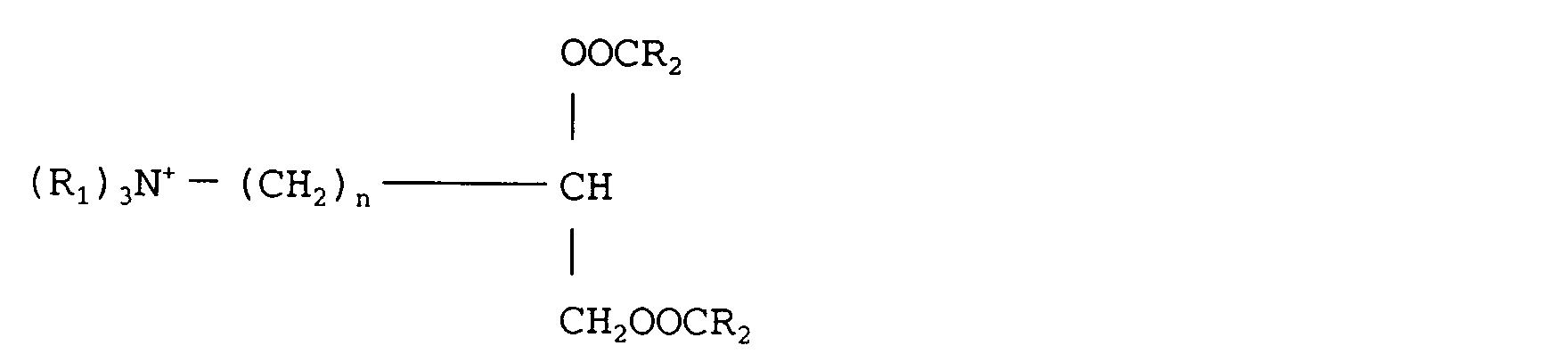
wherein each R₁ group is independently selected from C₁₋₄ alkyl, alkenyl or hydroxyalkyl groups; and wherein each R₂ group is independently selected from C₈₋₂₈ alkyl or alkenyl groups; and n is an integer from 0 to 5.
wherein each R₁ group is independently selected from C₁₋₄ alkyl, alkenyl or hydroxyalkyl groups; and wherein each R₂ group is independently selected from C₈₋₂₈ alkyl or alkenyl groups; and n is an integer from 0 to 5.