|
(11) | EP 0 586 241 A1 |

| (12) | EUROPEAN PATENT APPLICATION |
|
|
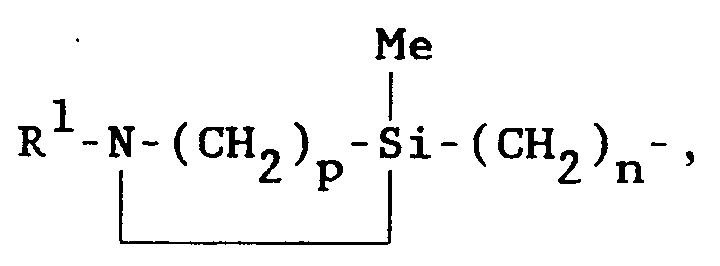
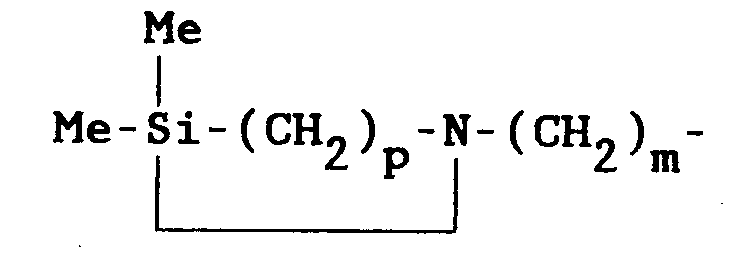
|
|
|||||||||||||||||||||||||||
| (54) | Azasilacycloalkyl functional alkoxysilanes and azasilacycloalkyl functional tetramethyldisiloxanes |
| (57) Azasilacycloalkyl functional alkoxysilanes which are useful for making polymers for
room temperature vulcanizable compositions and as adhesion promoters are exemplified
by 1-(3-(2,2,4-trimethyl-1-aza-2-silacyclopentyl)propyl)-3-(2-trimethoxysilylethyl)-1,1,3,3-tetramethyldisiloxane
and 1-(2-(1,2,4-trimethyl-1-aza-2-silacyclopentyl)ethyl)-3-(2-trimethoxysilylethyl)-1,1,3,3-tetramethyldisiloxane.
The methoxy functional azasilacycloalkyl functional compounds can be made from disiloxanes
having a silicon-bonded hydrogen atom such as 1-(3-(2,2,4-trimethyl-1-aza-silacyclopentyl)propyl-1,1,3,3-tetramethyldisiloxane. |
[0002] A search for new crosslinkers for room temperature vulcanizing silicones (RTVS) have lead to the azasilacyclopentanes of our U.S. Patent No. 5,136,064. The olefinic and acetylenic azasilacyclopentanes were found to be useful as RTVS by reacting the aliphatic unsaturation of the azasilacyclopentane with Si-H containing siloxane compounds which would then cure by exposure to moisture or by reaction with siloxane compounds that contained silanol groups. These latter compositions are described in our U.S. Patent No. 5,110,967. These patents show azasilacyclopentanes and methods for their preparation, as well as their reactions with silicon compounds containing Si-H groups.
[0003] Silicone compositions which contain silicon-bonded alkoxy groups and which are RTVS, are desirable products because they produce non-corrosive by-products during curing. However, these compositions exhibit slow cure and low substrate adhesion.
[0004] An object of the present invention is to produce azasilacycloalkyl functional alkoxy silicon compounds.
[0005] This invention relates to an azasilacycloalkyl functional alkoxysilane selected from the group consisting of
in which Z is selected from the group consisting of
and
where R is an alkyl radical of from 1 to 3 carbon atoms, Me is methyl radical, R¹ is an alkyl radical having from 1 to 6 inclusive carbon atoms, R'' is a divalent hydrocarbon radical selected from the group consisting of -(CH₂)b- and -CH(Me)(CH₂)c-, a is 0 or 1, b is from 2 to 6 inclusive, c is from 0 to 4 inclusive, d has a value of 1 to 3 inclusive, m has a value of 3 to 6 inclusive, n has a value of 2 to 6 inclusive and p has a value of 4 to 6 inclusive.
[0006] The azasilacycloalkyl functional alkoxysilanes of this invention are made by reacting an azasilacycloalkane containing aliphatic unsaturation with dimethylsiloxane having silicon-bonded hydrogen atoms at the terminals, where the dimethylsiloxane has from 2 to 4 silicon atoms per molecule, in the presence of a platinum catalyst. The resultant product is in turn reacted with an alkoxysilane having aliphatic unsaturation in the presence of a platinum catalyst.
[0007] An azasilacyclopentyl functional alkoxysilane of Formula (A) where Z is Formula (C) can be prepared in accordance with this invention by reacting a dimethylsiloxane having silicon-bonded hydrogen atoms at the terminals, where the dimethylsiloxane has 2 to 4 inclusive silicon atoms per molecule, such as 1,1,3,3-tetramethyldisiloxane with 1-allyl-2,2,4-trimethyl-1-aza-2-silacyclopentane in the presence of a platinum catalyst. The resulting product is 1-(3-(2,2,4-trimethyl-1-aza-2-silacyclopentyl)propyl)-1,1,3,3-tetramethyldisiloxane. This reaction is preferably carried out by heating under conditions which prevents the ingress of moisture or water into the reaction mixture. A preferred method is described in Example 1, but, in general, the dimethylsiloxane, a small amount of the azasilacyclopentane and platinum catalyst are heated and the remainder of the azasilacyclopentane is then slowly added. The amount of the azasilacyclopentane is such that the moles of the dimethylsiloxane exceed the moles of azasilacyclopentane. The product preferably is recovered by distillation. The following equation illustrates the reaction in which 1,1,3,3-tetramethyldisiloxane is used as the dimethylsiloxane having silicon-bonded hydrogen atoms at the terminals
[0008] Product A' is 1-(3-(2,2,4-trimethyl-1-aza-2-silacyclo-pentyl)propyl)-1,1,3,3-tetramethyldisiloxane. Product A' is further reacted with either methylalkenyldialkoxysilane or alkenyltrialkoxysilane to make the azasilacyclopentyl functional alkoxysilane of Formula (A). Examples of methylalkenyldialkoxysilane include methylvinyldimethoxysilane, methylvinyldiethoxysilane, methylvinyldipropoxysilane, methylvinyldiisopropoxysilane, methylallyldimethoxysilane, methylallyldiethoxysilane, methylallyldipropoxysilane, methylbuten-1-yldimethoxysilane, methylpenten-l-yldimethoxysilane, methylpenten-1-yldiethoxysilane, methylhexen-1-yldimethoxysilane and methyl-hexen-l-yldiethoxysilane. Examples of alkenyltrialkoxysilane include vinyltrimethoxysilane, vinyltriethoxysilane, vinyltripropoxysilane, allyltrimethoxysilane, allyltriethoxy-silane, allyltripropoxysilane, buten-1-yltrimethoxysilane, buten-1-yltriethoxysilane, buten-1-yltripropoxysilane, penten-1-yltrimethoxysilane, penten-1-yltriethoxysilane, penten-1-yltri-propoxysilane, hexen-1-yltrimethoxysilane and hexen-1-yltri-ethoxysilane. Product A' is combined with an alkoxysilane in the presence of platinum catalyst and preferably heated to cause the alkenyl group of the alkoxysilane to add across the Si-H group of Product A'. This reaction is illustrated by the following equation:
Product B' is 1-(3-(2,2,4-trimethyl-1-aza-2-silacyclopentyl)propyl)-3-(2-trimethoxysilylethyl)-1,1,3,3-tetramethyldisiloxane. Product B' can be further purified by distillation of the reaction product under reduced pressure.
[0009] Other azasilacyclopentyl functional alkoxysilanes in which m is 4, 5 or 6, can be prepared in the same manner by substituting for the 1-allyl-2,2,4-trimethyl-1-aza-2-silacyclopentane, 1-(buten-1-yl)-2,2,4-trimethyl-1-aza-2-silacyclopentane, 1-(penten-1-yl)-2,2,4-trimethyl-1-aza-2-silacyclopentane or 1-(hexen-1-yl)-2,2,4-trimethyl-1-aza-2-silacyclopentane.
[0010] An azasilacyclopentyl functional alkoxysilane of Formula (A) where Z is Formula (B) can be prepared by reacting a dimethylsiloxane having a silicon-bonded hydrogen atom at one terminal and a trimethoxysilylalkyl at the other terminal and having a formula
in which R, R'' and a are defined above with 1,2,4-trimethyl-2-alkyl-1-aza-2-silacyclopentane in the presence of a platinum catalyst. These azasilacyclopentyl functional alkoxysilanes of Formula (A) where Z is Formula (B) can be illustrated by the reaction of 1-(2-trimethoxysilylalkyl)-1,1,3,3-tetramethyldi-siloxane; 1-(1-trimethoxysilylalkyl)-1,1,3,3-tetramethyldi-siloxane; or a mixture of these with 1,2,4-trimethyl-2-vinyl-1-aza-2-silacyclopentane in the presence of a platinum catalyst. This reaction is preferably carried out by heating under conditions which prevent the ingress of moisture or water into the reaction mixture. A preferred method is described in Example 2. These siloxanes can be prepared by reacting R'MeaSi(OR)(3-a) in which R' is an alken-1-yl radical having from 2 to 6 carbon atoms with
H(Me₂SiO)dSiMe₂H
in which d is as defined above, in the presence of a platinum catalyst. The alken-1-yl alkoxysilanes are illustrated above. The method for preparing these siloxanes and their examples are further described in U.S. Patent No. 4,888,404. The product is preferably recovered by distillation. The following equation illustrates the reaction
Product C' is 1-(2-(1,2,4-trimethyl-1-aza-2-silacyclopentyl)ethyl)-3-(2-trimethoxysilylethyl)-1,1,3,3-tetramethyldisiloxane. The reaction product which contains Product C' can be further purified by distillation at reduced pressure. In the above reaction, the Me (methyl radical) on the ring nitrogen atom is used for illustrative purposes as an example of R¹ which can be an alkyl radical selected from the methyl radical, ethyl, propyl, butyl, pentyl and hexyl. In the reactions which follow, in each case, where a methyl radical is shown on the ring nitrogen atom, it is used as the preferred alkyl radical for R¹.
[0011] The aliphatic unsaturated azasilacyclopentanes used to make the azasilacyclopentyl functional alkoxysilanes of the present invention have the general formulae
and
in which y has a value of from 0 to 4 inclusive; z has a value of from 1 to 4 inclusive; and Me is methyl radical. These azasilacyclopentanes and methods for their preparation are described in our U.S. Patent No. 5,136,064.
[0012] An azasilacyclopentyl functional alkoxysilanes of Formula (A) where Z is Formula (D) can be made by the same method as the preparation for the azasilacyclopentyl functional alkoxysilanes of Formula (A) where Z is Formula (C). In these preparations, the aliphatic unsaturated azasilacycloalkane has the formula
This azasilacycloalkane can be prepared by the method described in U.S. Patent No. 5,136,064, where the reaction for the preparation is
[0013] An azasilacyclobutyl functional alkoxysilane of Formula (A) where Z is Formula (E) can be prepared by reacting a dimethylsiloxane having silicon-bonded hydrogen atoms at the terminals of the formula
H(Me₂SiO)dSiMe₂H
in which d is defined above, with an azasilacyclobutane of the formula
where z has a value of 1 to 4 inclusive. This reaction is done in the presence of a platinum catalyst and the following equation illustrates such a reaction
[0014] Product D' is further reacted with either methylalkenyldialkoxysilane or alkenyltrialkoxysilane to make the azasilacyclobutyl functional alkoxysilane Formula (A) where Z is Formula (E). Examples of other alkoxysilanes which can be used are described above. Product D' is combined with an alkoxysilane in the presence of platinum catalyst and preferably heated to cause the alkenyl group of the alkoxysilane to add across the Si-H group of Product D'. This reaction is illustrated by the following equation:
[0015] The preparation of azasilacyclobutanes can be illustrated by the following: Diallylamine was reacted with chlorodimethylsilane in heptane in the presence of triethylamine to give diallylaminodimethylsilane as shown by the following equation
The silane product was obtained by ambient pressure distillation after removal of triethylamine hydrochloride by filtration. 1-allyl-2,2,3-trimethyl-1-aza-2-silacyclobutane was made by intramolecular hydrosilation of the diallyldimethylsilane. This reaction was carried out at 80°C. in the presence of PtCl₂(PPh₃)₂ in benzene. The starting material was consumed in four hours to give a product mixture of 83 mole percent of the azasilacyclobutane and 17 mole percent of azasilacyclopentane as illustrated by the following equation
Total yield of product was 77 weight percent. The azasilacyclo-butane can be reacted with 1,1,3,3-tetramethyldisiloxane in the presence of a platinum catalyst which in turn can be reacted with an alkoxysilane having aliphatic unsaturation as described above to make an azasilacyclobutyl functional alkoxysilane of Formula (A).
[0016] An azasilacycloalkyl functional alkoxysilane of Formula (A) where Z is Formula (F) can be prepared by reacting a dimethylsiloxane having silicon-bonded hydrogen atoms at the terminals of the formula
H(Me₂SiO)dSiMe₂H
in which d is defined above, with an azasilacycloalkane of the formula
where y has a value of 0 to 4 inclusive and p has a value of 4 to 6 inclusive. This reaction is done in the presence of a platinum catalyst and the following equation illustrates such a reaction
where n has a value of 2 to 6 inclusive.
[0017] Product F' is further reacted with either methylalkenyldialkoxysilane or alkenyltrialkoxysilane to make the azasilacycloalkyl functional alkoxysilane Formula (A) where Z is Formula (F). Examples of other alkoxysilanes which can be used are described above. Product F' is combined with an alkoxysilane in the presence of platinum catalyst and preferably heated to cause the alkenyl group of the alkoxysilane to add across the Si-H group of Product F'. This reaction is illustrated by the following equation:
[0018] An azasilacycloalkane used to provide the functionality of Formula (F), 2-vinyl-1,2-dimethyl-1-aza-2-silacycloalkane, can be made by reacting
with methylamine using the procedure described in U.S. Patent No. 3,146,250. The chlorosilane of the formula
can be made by reacting
with vinyl magnesium bromide, followed by reaction with acetyl chloride in the presence of ferric trichloride catalyst. The methoxysilane of the formula
can be made by reacting
with CH₂=CH-(CH₂)(p-2)Cl in the presence of a platinum catalyst. Other reactions are described in an article by Speier et al, in the Journal of Organic Chemistry, vol. 36, pages 3120-3126, (1971), entitled "Syntheses of (3-Aminoalkyl)silicon Compounds."
[0019] An azasilacycloalkyl functional alkoxysilane of Formula (A) where Z is Formula (G), 1-allyl-2,2-dimethyl-1-aza-2-silacycloalkane, can be prepared by reacting a dimethylsiloxane having silicon-bonded hydrogen atoms at the terminals of the formula
H(Me₂SiO)dSiMe₂H
in which d is defined above, with an azasilacycloalkane of the formula
where z has a value of 1 to 4 inclusive and p has a value of 4 to 6 inclusive. This reaction is done in the presence of a platinum catalyst and the following equation illustrates such a reaction
where m has a value of 3 to 6 inclusive.
[0020] Product H' is further reacted with either methylalkenyldialkoxysilane or alkenyltrialkoxysilane to make the azasilacycloalkyl functional alkoxysilane Formula (A) where Z is Formula (G). Examples of other alkoxysilanes which can be used are described above. Product H' is combined with an alkoxysilane in the presence of platinum catalyst and preferably heated to cause the alkenyl group of the alkoxysilane to add across the Si-H group of Product H'. This reaction is illustrated by the following equation:
The 1-allyl-2,2-dimethyl-1-aza-2-silacycloalkanes can be made by reacting
with CH₂=CHCH₂NH₂ using a procedure described in U.S. Patent No. 3,146,250. The chlorosilane of the formula
can be made by reacting
with CH₂=CH(CH₂)(P-2)Cl in the presence of a platinum catalyst.
[0021] The olefinic unsaturation of the azasilacycloalkane reacts with the Si-H group of the tetramethyldisiloxane in the presence of a platinum catalyst. The reaction resulting from this combination is termed an "addition reaction" or a "hydrosilylation reaction" where the olefinic bond reacts with the silicon-bonded hydrogen such that the Si-H adds across the double bond. Platinum catalysts are well know in the art for catalyzing this reaction. These platinum catalysts include the chloroplatinic acid described in U.S. Patent No. 2,823,218; complexes of chloroplatinic acid with low molecular weight vinyl-containing polydiorganosiloxanes such as syn-divinyltetramethyldisiloxane described in U.S. Patent No. 3,419,593; alkene complexes described in U.S. Patent No. 3,159,601 and U.S. Patent No. 3,159,662; the platinum acetylacetonate described in U.S. Patent No. 3,723,497; the platinum alcoholates described in U.S. Patent No. 3,220,972; and in many more patents for platinum catalysts.
[0022] The azasilacycloalkyl functional alkoxysilanes of the present invention can be used as adhesion promoters in RTV compositions and as precusors for preparing polymers useful for making RTV compositions.
[0023] The following syntheses and examples are presented for illustrative purposes and should not be construed as limiting the invention delineated by the claims. In the following examples, "part" and "parts" are respectively "part by weight" and "parts by weight" and Me = methyl.
SYNTHESIS 1
[0024] 2,2,4-trimethyl-1-allyl-1-aza-2-silacyclopentane was prepared as follows. Chlorodimethyl(3-chloro-2-methylpropyl)silane (100 g.) was slowly added to 211.73 g of undistilled allyl amine resulting in an exothermic reaction. This reaction mixture was stirred at room temperature for 15 hours, heated to reflux at atmospheric pressure for 72 hours and heated to 120°C. under 344.7 kPa (50 psi) gage pressure for 16 hours. The following GC-MS ratios shown in the Table exemplify the reaction progression and the spectra observed.
TABLE
| RETENTION TIME, MIN | 15 HOURS 20°C | 24 HOURS REFLUX | 72 HOURS REFLUX | 16 HOURS 120°C | COMPOUND |
| 2.70 | 0.0 | 3.9 | 21.3 | 71.9 | E |
| 2.82 | 0.0 | 1.0 | 1.1 | 0.9 | F |
| 3.20 | 50.4 | 11.0 | 4.1 | 0.0 | G |
| 5.19 | 29.5 | 63.0 | 40.2 | 0.0 | H |
| 8.46 | 20.0 | 8.8 | 8.1 | 2.4 | I |
| 9.58 | 0.0 | 9.3 | 10.1 | 6.1 | J |
| 10.58 | 0.0 | 3.1 | 15.1 | 18.7 | K |
[0025] Compound E was 2,2,4-trimethyl-1-allyl-1-aza-2-silacyclopentane and the spectra was 169 (819), M⁺; 154 (1326), M⁺-CH₃; 142 (1074), M⁺-Vi; 127 (375), M⁺ -C₃H₆; 126 (354), M⁺-C₃H₇; 100 (784), M-69; 86 (8734), Me₂SiN=CH₂⁺; 59 (10000), Me₂SiH⁺. Compound F was not determined.
[0026] Compound G was chlorodimethyl(3-chloro-2-methylpropyl)silane and the spectra was 184 (0), M⁺; 169 (233), M⁺-Me; 137 (292), M⁺-47; 113 and 115 (2459 and 1991), Cl₂MeSi⁺; 93 (9786), ClMe₂Si⁺; 56 (10000), C₄H₈.
[0027] Compound H was allylaminodimethyl(3-chloro-2-methylpropyl)silane and the spectra was 205 (10), M⁺; 190 (79), M⁺-Me; 170 (153), M⁺-Cl; 149 (618), M⁺-C₄H₈; 134 and 136 (1263 and 508), M⁺-CH₃-C₄H₈; 120 and 122 (1250 and 625), unassigned; 114 (10000), CH₂=CHCH₂NHSiMe₂⁺; 98 (4709), unassigned; 93 and 95 (4999 and 1948), ClMe₂Si⁺.
[0028] Compound I was 1,1,3,3-tetramethyl-1,3-bis(3-chloro-2-methylpropyl)disiloxane and the spectra was 314 (0), M⁺; 187 and 189 (2045 and 1291), ClMe₂SiOSiMeCl⁺; 167 and 169 (10000 and 3897), ClMe₂SiOSiMe₂⁺.
[0029] Compound J was 1,1,3,3-tetramethyl-1-(3-chloro-2-methylpropyl)-1-(3-allylamino-2-methylpropyl)disiloxane and the spectra was 335 (0), M⁺; 320 (52), M⁺-Me; 167 and 169 (1216 and 463), ClMe₂SiOSiMe₂⁺; 70 (10000), CH₂ =CHCH₂NH=CH₂⁺.
[0030] Compound K was 1,1,3,3-tetramethyl-1,3-bis(3-allylamino-2-methylpropyl)disiloxane and the spectra was 356 (0), M⁺; 170 (1017), CH₂=CHCH₂NHCH₂CH(CH₃)CH₂SiMe₂⁺; 169 (1177), peak 170-H; 70 (10000), CH₂=CHCH₂NH=CH₂⁺.
[0031] Upon cooling the product of the reaction, a two phase system resulted. The upper phase weighed 111.85 g and contained most of the product 2,2,4-trimethyl-1-allyl-1-aza-2-silacyclopentane. The lower phase weighed 177.12 g and was an amber viscous liquid. This lower phase was concentrated at atmospheric pressure with a pot temperature of 120°C. to 122 g. Another 4.0 g of the upper phase was separated upon cooling. The combined product phases were distilled under vacuum. After a slow evolution of allylamine, the product codistilled with an ammonium salt at 78°C. and 4.0 kPa (30 mmHg). Filtration gave 51.63 g (56% yield) of essentially pure 2,2,4-trimethyl-1-allyl-1-aza-2-silacyclopentane. The 13C NMR was: 138.13, vinyl; 114.39, vinyl; 58.98, allyl CH₂; 50.31, ring CH₂N; 31.88, CH; 21.94 and 21.50, SiCH₂ and C-Me; 0.22 and -0.76, SiMe. The ²⁹Si NMR spectra had one peak at 15.56 ppm relative to tetramethylsilane.
SYNTHESIS 2
[0032] 1,2,4-trimethyl-2-vinyl-1-aza-2-silacyclopentane was prepared as follows. To a solution of 50.0 g of dimethoxy-methyl(3-chloro-2-methylpropyl)silane in 250 ml of diethyl ether contained in a three-necked, 1 L (liter) round-bottom flask fitted with a mechanical stirrer, nitrogen inlet and addition funnel was added over one hour, a solution of 290 ml of 1 M (molar) vinyl magnesium bromide in tetrahydrofuran (THF). The reaction mixture was allowed to stir overnight under a nitrogen atmosphere at room temperature and the slightly yellowish liquid was decanted from the solids. The solvents were removed at 40°C. and 1.2 kPa (9 mmHg) to yield 68.09 g of a yellow liquid with considerable amounts of solids. To this was added 50 ml of benzene and the salts were removed by filtration through a course glass frit funnel. The collected solids were washed with two 30 ml portions of benzene. The combined organic fractions were stripped at 50°C. and 1.2 kPa (9 mmHg) to yield 40.19 g of liquid with a small amount of salts. The results of gas chromatography-mass spectroscopy (GC-MS) showed the following composition of the liquid:
[0033] 3.1 wt % of 9 unidentified impurites at an order of magnitude lower level.
The mass spectra were used to identify these compounds and the results were:
[0034] For B compound: 192, not observed, M⁺; 165(10), M-Vi; 137 (10),NA; 121(210), (MeO)ViClSi⁺; 109(230), (MeO)MeClSi⁺; 101(780), (MeO)MeViSi⁺; 56(1000), C₄H₈⁺ where data are presented as charge (m/e), (relative intensity).
[0035] For C compound: 188, not observed, M⁺; 161(8), M-Vi; 117 (280), Vi₂ClSi⁺; 105(284), MeViSi⁺; 97(489), Vi₂MeSi⁺; 56(1000), C₄H₈⁺.
[0036] For D compound: 204, not obverved, M⁺; 177(10), M-Vi; 121 (290), (MeO)ViClSi⁺; 113(620), (MeO)Vi₂Si⁺; 56(1000), C₄H₈⁺.
[0037] The ²⁹Si nuclear magnetic resonance (NMR) had one major peak at 6.63 ppm relative to tetramethylsilane. The crude product was purified by short path distillation. The fraction boiling at 75°C. at 0.8 kPa (6 mmHg.) weighed 28.22 g (58% yield) and was identified as compound B, methoxymethylvinyl(3-chloro-2-methylpropyl)silane.
[0038] Chloromethylvinyl(3-chloro-2-methylpropyl)silane was prepared as follows. A mixture of 28.00 g. of compound B in 15.5 ml of acetyl chloride was allowed to sit at ambient temperature for 12 hours. A slight exotherm was noted. The low boiling material was removed by distillation and the product distilled at 88°C. to 90.5°C. and 4.0 kPa (30 mmHg.) to give 25.2 g of material (88% yield). The product was chloromethylvinyl(3-chloro-2-methylpropyl)silane as was identified by ¹³C NMR: 134.79 and 134.73 and 134.68 (1:2:1, 1.67), SiVi; 52.93 (1.00), CH₂Cl; 31.51 and 31.48 (0.83), CH; 22.88 and 22.84 (0.97), CHMe; 20.13 and 20.10 (1.01), SiCH₂; 0.59 and 0.54 (0.68), SiMe and by ²⁹Si NMR: 17.81 and 17.78 (1:1) where data are presented as ppm (relative intensity).
[0039] Methylamine was condensed into a 1L round-bottom flask and distilled from sodium. To 490 ml of methylamine was slowly added 309.8 g of chloromethylvinyl(3-chloro-2-methylpropyl)silane, which resulted in two phases. The two phase system was transfered to a Parr reactor and heated at 110°C. and 1.59 MPa (230 psig) for 10 hours. The reaction mixture was cooled to -10°C., transfered to a 2 L round-bottom flask and 400 ml of cold pentane was added. The layers were separated and the upper organic phase concentrated. After concentration, some ammonium salts had precipitated. These salts were removed by filtration and the product purified by distillation at reduced pressure to yield about 160 g (60% yield) of aza-silacyclopentane with a small amount of ammonium salts. The distilled product was 97% pure 1,2,4-trimethyl-2-vinyl-1-aza-2-silacyclopentane with two major higher boiling impurities (about 1 wt% each) and numerous minor higher boiling impurities. The GC-MS data were: 1,2,4-Trimethyl-2-vinyl-1-aza-2-silacyclopentane, Retention Time 2.00 min; 155 (365), M⁺; 154 (243),M⁺-H; 140(97), M⁺-Me; 126 (113), M⁺-Vi; 113 (962, M⁺-C₃H₇; 112 (1000), M⁺-C₃H₇; 89 (396), MeViSiN=CH₂⁺; 71 (465) MeViSiH⁺. The ¹³C NMR spectra was: 138.23 and 137.98, terminal vinyl; 132.86 and 137.98, internal vinyl; 62.19 and 61.92, N-CH₂; 33.93 and 33.80, methine; 32.09 and 32.06, NMe; 21.48 and 21.54, CHMe; 21.23 and 20.95 Si-CH₂; -3.43 and -4.29, SiMe. The ²⁹Si NMR had peaks at 6.229 and 6.039 relative to tetramethylsilane.
EXAMPLE 1
[0040] To 169 g of 1,1,3,3-tetramethyldisiloxane, 0.25 g of a chloroplatinic acid-1,3-divinyl-1,1,3,3-tetramethyldisiloxane complex having about 0.7 weight percent platinum and 17 g of 1-allyl-2,2,4-trimethyl-1-aza-2-silacyclopentane as prepared by Synthesis 1, at 80°C., were added into a 500 ml round-bottom flask fitted with a magnetic stirrer, condenser and addition funnel. 153.44 g of 1-allyl-2,2,4-trimethyl-l-aza-2-silacyclopentane was slowly added to this flask over a 35 minute period. The resulting reaction mixture was allowed to stir at 80°C. overnight and the product was isolated by distillation at reduced pressure. The portion boiling between 78°C. and 82°C. at 13.3 Pa (0.1 mm Hg) weighed 181 g and was identified as 1-(3-(2,2,4-trimethyl-1-aza-2-silacyclopentyl)propyl-1,1,3,3-tetramethyldisiloxane.
[0041] A mixture of 20.67 g of 1-(3-(2,2,4-trimethyl-1-aza-2-silacyclopentyl)propyl-1,1,3,3-tetramethyldisiloxane, 10.6 g of vinyltrimethoxysilane which had been distilled from sodium and 0.03 g of a chloroplatinic acid-1,3-divinyl-1,1,3,3-tetramethyldisiloxane complex having about 0.7 weight percent platinum was heated for one hour at 120°C. The resulting product was distilled and the distillate was collected at 152°C. and 13.3 Pa (0.1 mm Hg). The amount of distillate collected was 28.2 g of 1-(3-(2,2,4-trimethyl-1-aza-2-silacyclo-pentyl)propyl)-3-(2-trimethoxysilylethyl)-1,1,3,3-tetramethyldisiloxane which was identified by ¹³C and 29Si NMR (nuclear magnetic resonance) and GC-MS.
[0042] To 59.2 g of a 2:1 mole ratio of 1-(2-trimethoxysilyl-ethyl)-1,1,3,3-tetramethyldisiloxane and 1-(1-trimethoxysilyl-ethyl)-1,1,3,3-tetramethyldisiloxane and 32.8 g of 1,2,4-trimethyl-2-vinyl-1-aza-2-silacyclopentane as prepared by Synthesis 2 were added 0.07 g of a chloroplatinic acid-1,3-divinyl-1,1,3,3-tetramethyldisiloxane complex having about 0.7 weight percent platinum. The resulting mixture was then heated for 2 hours at 160°C. and then distilled collecting the distillate coming off at 115°C. to 125°C. and 13.3 Pa (0.1 mm Hg). The amount of distillate collected was 86.0 g and was identified by ¹³C and ²⁹Si NMR and GC-MS to be a mixture of 1-(2-(1,2,4-trimethyl-1-aza-2-silacyclopentyl)ethyl)-3-(2-trimethoxysilylethyl)-1,1,3,3-tetramethyldisiloxane and 1-(2-(1,2,4-trimethyl-1-aza-2-silacyclopentyl)ethyl)-3-(1-trimethoxy-silylethyl)-1,1,3,3-tetramethyldisiloxane.
1. An azasilacycloalkyl functional alkoxysilane selected from the group consisting of
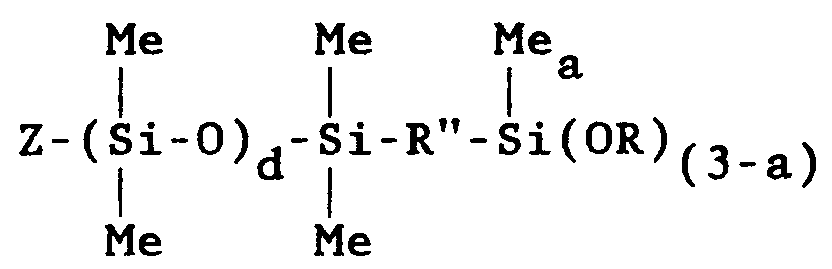
in which Z is selected from the group consisting of
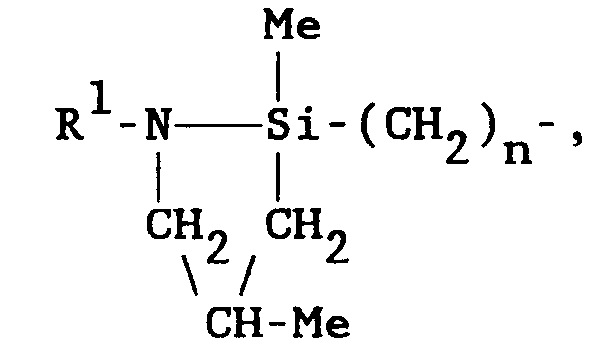
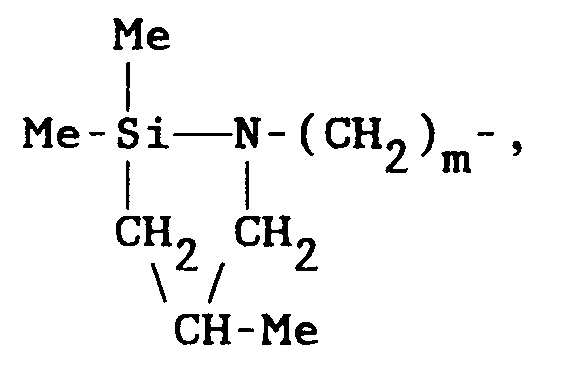
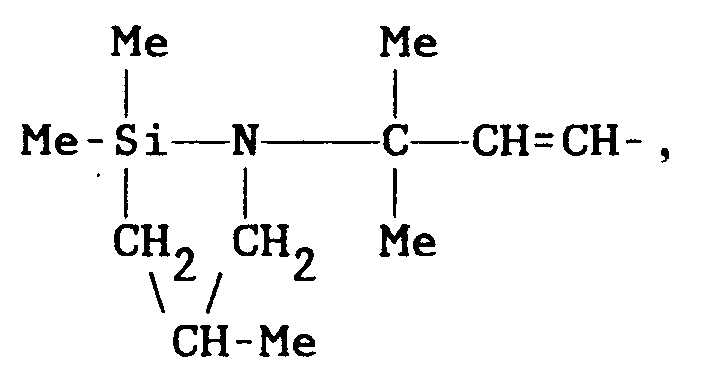

and
where R is an alkyl radical of from 1 to 3 carbon atoms, Me is methyl radical, R¹ is an alkyl radical having from 1 to 6 inclusive carbon atoms, R" is a divalent hydrocarbon radical selected from the group consisting of -(CH₂)b- and -CH(Me)(CH₂)c-, a is 0 or 1, b is from 2 to 6 inclusive, c is from 0 to 4 inclusive, d has a value of 1 to 3 inclusive, m has a value of 3 to 6 inclusive, n has a value of 2 to 6 inclusive and p has a value of 4 to 6 inclusive.
in which Z is selected from the group consisting of
and
where R is an alkyl radical of from 1 to 3 carbon atoms, Me is methyl radical, R¹ is an alkyl radical having from 1 to 6 inclusive carbon atoms, R" is a divalent hydrocarbon radical selected from the group consisting of -(CH₂)b- and -CH(Me)(CH₂)c-, a is 0 or 1, b is from 2 to 6 inclusive, c is from 0 to 4 inclusive, d has a value of 1 to 3 inclusive, m has a value of 3 to 6 inclusive, n has a value of 2 to 6 inclusive and p has a value of 4 to 6 inclusive.
2. The azasilacycloalkyl funcitonal alkoxysilane in accordance with claim 1 in which
R¹ is methyl.
3. The azasilacycloalkyl functional alkoxysilane in accordance with claim 2 in which
Z is an azasilacyclopentyl group of the formula
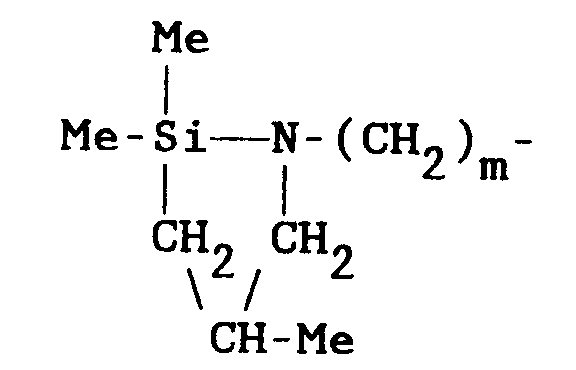
and d is 1.
and d is 1.
4. The azasilacycloalkyl functional alkoxysilane in accordance with claim 2 in which
Z is an azasilacyclopentyl group of the formula
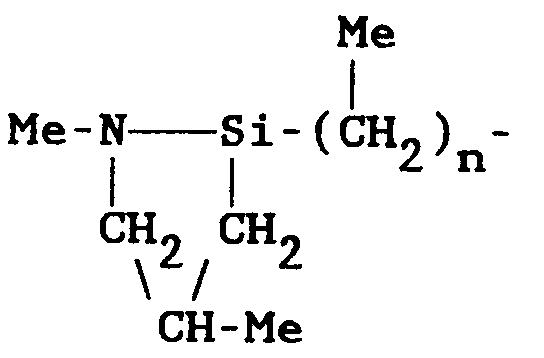
and d is 1.
and d is 1.
5. The azasilacyclopentyl functional alkoxysilane of claim 3 which is 1-(3-(2,2,4-trimethyl-1-aza-2-silacyclopentyl)propyl)-3-(2-trimethoxysilylethyl)-1,1,3,3-tetramethyldisiloxane.
6. The azasilacyclopentyl functional alkoxysilane of claim 4 which is 1-(2-(1,2,4-trimethyl-1-aza-2-silacyclopentyl)ethyl)-3-(2-trimethoxysilylethyl)-1,1,3,3-tetramethyldisiloxane.
7. The azasilacyclopentyl functional alkoxysilane of claim 4 which is 1-(2-(1,2,4-trimethyl-1-aza-2-silacyclopentyl)ethyl)-3-(1-trimethoxysilylethyl)-1,1,3,3-tetramethyldisiloxane.
8. The azasilacyclopentyl functional alkoxysilane of claim 4 which is a mixture of 1-(2-(1,2,4-trimethyl-1-aza-2-silacyclopentyl)ethyl)-3-(2-trimethoxysilylethyl)-1,1,3,3-tetramethyldisiloxane
and 1-(2-(1,2,4-trimethyl-1-aza-2-silacyclopentyl)ethyl)-3-(1-trimethoxysilylethyl)1,1,3,3-tetramethyldisiloxane.
9. An azasilacyclopentyl functional tetramethyldisiloxane of the formula

in which Me is methyl radical and m has a value of 3 to 6 inclusive.
in which Me is methyl radical and m has a value of 3 to 6 inclusive.
10. An azasilacyclopentyl functional tetramethyldisiloxane of the formula
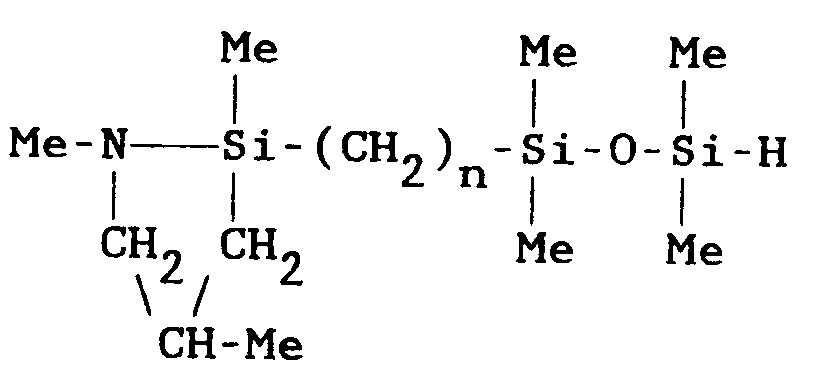
in which Me is methyl radical and n has a value of 2 to 6 inclusive.
in which Me is methyl radical and n has a value of 2 to 6 inclusive.
11. An azasilacyclobutyl functional tetramethyldisiloxane of the formula
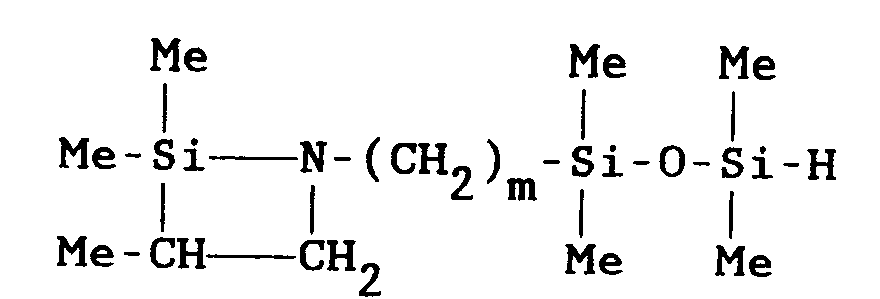
in which Me is methyl radical and m has a value of 3 to 6 inclusive.
in which Me is methyl radical and m has a value of 3 to 6 inclusive.
12. An azasilacycloalkyl functional tetramethyldisiloxane of the formula
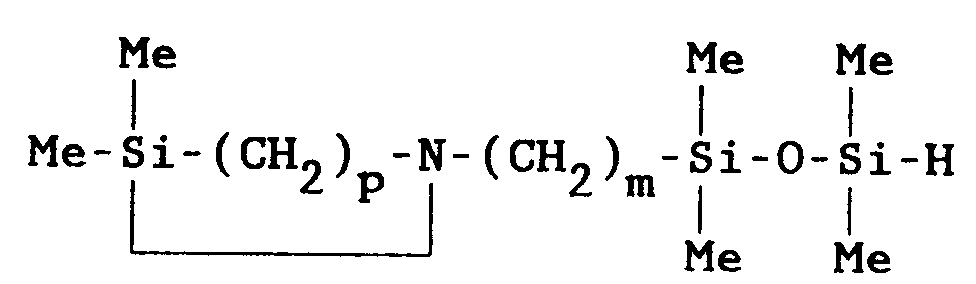
in which Me is methyl radical, m has a value of 3 to 6 inclusive and p has a value of 4 to 6 inclusive.
in which Me is methyl radical, m has a value of 3 to 6 inclusive and p has a value of 4 to 6 inclusive.
13. An azasilacyclalkyl functional tetramethyldisiloxane of the formula

in which Me is methyl radical, n has a value of 2 to 6 inclusive and p has a value of 4 to 6 inclusive.
in which Me is methyl radical, n has a value of 2 to 6 inclusive and p has a value of 4 to 6 inclusive.