|
(11) | EP 0 587 141 A1 |

| (12) | EUROPEAN PATENT APPLICATION |
|
|
|
|
|||||||||||||||||||||||||||
| (54) | Organic transition metal complex |
| (57) An organometal complex is provided which is represented by the general formula (1)
below:
wherein Cp¹ and Cp² are independently a substituted or unsubstituted cyclopentadienyl group; R¹ is an alkylene or arylalkylene group having 1 to 20 carbons, a dialkylsilylene, dialkylgermanylene, alkylphosphinediyl, or alkylimino group, linking Cp¹ and Cp²; m is 0 or 1; M is titanium, zirconium, or hafnium; R², R³, and R⁴ are independently hydrogen, a hydrocarbon group of 1 to 12 carbons, an alkoxyl or aryloxy group; and MAO is a methylaluminoxane group. This organometal complex is capable of producing selectively an olefin polymer without use of any other additional catalyst component. |
[0001] The present invention relates to a novel organometal complex useful for the production of olefin polymers.
[0002] It is the object of the invention to provide an organometal complex which is capable of producing selectively an olefin polymer without use of any other additional catalyst component.
[0003] This object has been achieved by a novel organometal complex useful for the production of olefin polymers and represented by the general formula (1) below:
wherein Cp¹ and Cp² are independently a substituted or unsubstituted cyclopentadienyl group; R¹ is an alkylene or arylalkylene group having 1 to 20 carbons, a dialkylsilylene, dialkylgermanylene, alkylphosphinediyl, or alkylimino group, linking Cp¹ and Cp²; m is 0 or 1; M is titanium, zirconium, or hafnium; R², R³, and R⁴ are independently hydrogen, a hydrocarbon group of 1 to 12 carbons, an alkoxyl or aryloxy group; and MAO is a methylaluminoxane group.
[0004] The compound represented by the general formula (1) above is a novel compound. This compound can be prepared, for example, by reacting an organometallic compound represented by the general formula (2):
with an aluminoxane represented by the general formula (3) or (4):
In the formula (2), Cp¹ and Cp² are respectively a substituted or unsubstituted cyclopentadienyl group; R¹ is an alkylene or arylalkylene group having 1 to 20 carbons, a dialkylsilylene, dialkylgermanylene, alkylphosphinediyl, or alkylimino group, linking Cp¹ and Cp²; m is 0 or 1; M is titanium, zirconium, or hafnium; R², R³, and R⁴ are independently hydrogen, a hydrocarbon group of 1 to 12 carbons, an alkoxyl or aryloxy group; and MAO is a methylaluminoxane group.
[0005] In the formulas (3) and (4), n is an integer of from 4 to 60, and R⁵ is a hydrocarbon group of 1 to 6 carbons.
[0006] The reaction of the compound of the general formula (2) with the compound of the general formula (3) or (4) is conducted generally in the presence of a solvent.
[0007] The molar ratio of the compound of the formula (2) to the compound of the formula (3) or (4) is not specifically limited. However, the molar ratio of the compound of the formula (2) to the compound of the formula (3) is preferably in the range of from 1:0.5 to 1:100, more preferably from 1:2 to 1:30, and the molar ratio of the compound of the formula (2) to the compound of the formula (4) is preferably in the range of from 1:0.5 to 1:100, more preferably from 1:2 to 1:30.
[0008] The solvent for the reaction includes halogenated hydrocarbons such as chloroform and carbon tetrachloride, and aromatic hydrocarbons such as benzene, toluene, and xylene.
[0009] The reaction temperature depends on the starting material, the solvent, and other conditions, and is usually in the range of from -50°C to 100°C.
[0010] The intended compound can be isolated in high purity from the above reaction mixture by recrystallization from a mixed solvent such as toluene-hexane.
[0011] The structure of the compound of the present invention can be identified by investigation of reactivity thereof with deutrium chloride.
Example 1
Synthesis of Methylenebis(cyclopentadienyl)-2-phenyltitanacyclobutane Methylaluminoxane Complex:
[0012] In a nitrogen-purged Schlenk vessel, 3.0 g of methylbis(cyclopentadienyl)-2-phenyltitanacyclobutane was placed.
[0013] It was dissolved by addition of 15 ml of toluene. The solution was cooled to -10°C. Thereto 10 equivalents of methylaluminoxane (16-mer, made by Tosoh-Akzo Co.) was added and the mixture was allowed to react with stirring with gradual rise of reaction temperature to room temperature in 10 hours. Further, the resulting red solution was heated with stirring to 50°C in 3 hours. The reaction mixture was cooled to room temperature. Thereto 10 ml of hexane was added to form immediately a reddish brown solid. The solid was collected by filtration, and recrystallized from a mixed solvent of toluene/hexane (1:2 by volume ratio). The resulting reddish brown complex was dried under high vacuum to obtain 1.7 g of reddish brown complex.
[0014] The obtained complex was confirmed to be the methylenebis(cyclopentadienyl)-2-phenyltitanacyclobutane/methylaluminoxane complex by formation of 1-phenylpropane-1,3-d₂ and 1-phenylpropylene-3-d by reaction of the complex with deutrium chloride (DCl) at -20°C.
Example 2
[0015] In a nitrogen-purged Schlenk vessel, 3 mg of methylenebis(cyclopentadienyl)-2-phenyltitanacyclobutane/methylaluminoxane complex was placed, and 10 ml of toluene was added thereto to dissolve the complex. Ethylene was bubbled into the resulting red solution of the complex at room temperature. The bubbling was continued for 10 minutes to form a white precipitate in the solution. The bubbling of ethylene was stopped to discontinue the reaction. The reaction mixture was poured into 100 ml of a hydrochloric acid-methanol solution. The formed polyethylene was dried in vacuo to obtain 0.34 g of polyethylene.
Example 3
[0016] In a nitrogen-purged Schlenk vessel, 0.0042 mmol of methylenebis(cyclopentadienyl)-2-phenyltitanacyclobutane/methylaluminoxane complex was placed, and 10 ml of toluene was added thereto to dissolve the complex. 10 ml of styrene was added to this red solution. The mixture was stirred for 2 hours, and then heated to 60°C to proceed the reaction at that temperature for 10 hours. Thereto 1 ml of methanol was added and the suspension was poured into a hydrochloric acid-methanol solution. The formed polystyrene was dried in vacuo to obtain 1.2 g of polystyrene.
[0017] The polymer was extracted with methyl ethyl ketone by Soxhlet extraction. As the result, 0.58 g of methyl ethyl ketone-insoluble polystyrene was obtained.
1. An organometal complex, represented by the general formula (1) below:
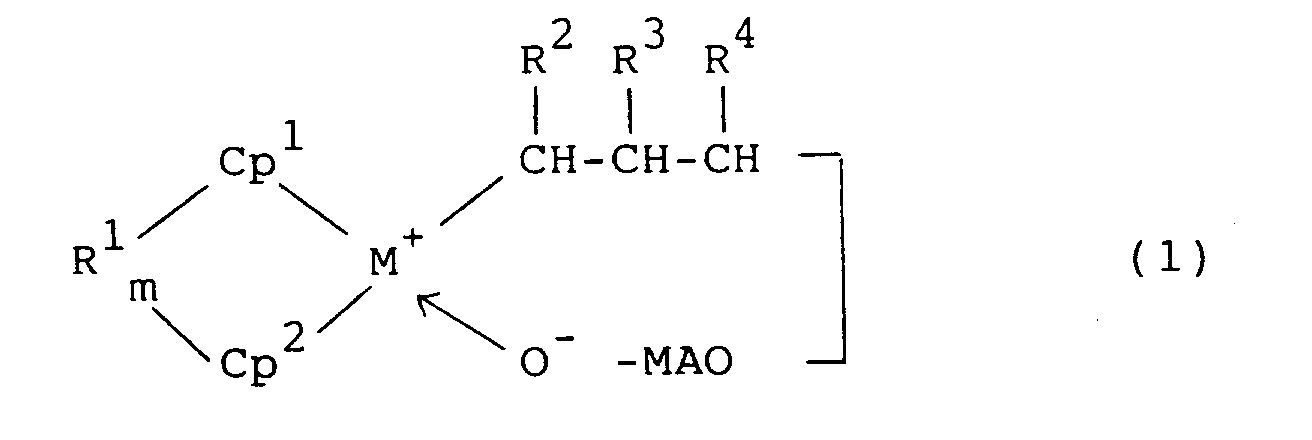
wherein Cp¹ and Cp² are independently a substituted or unsubstituted cyclopentadienyl group; R¹ is an alkylene or arylalkylene group having 1 to 20 carbons, a dialkylsilylene, dialkylgermanylene, alkylphosphinediyl, or alkylimino group, linking Cp¹ and Cp²; m is 0 or 1; M is titanium, zirconium, or hafnium; R², R³, and R⁴ are independently hydrogen, a hydrocarbon group of 1 to 12 carbons, an alkoxyl or aryloxy group; and MAO is a methylaluminoxane group.
wherein Cp¹ and Cp² are independently a substituted or unsubstituted cyclopentadienyl group; R¹ is an alkylene or arylalkylene group having 1 to 20 carbons, a dialkylsilylene, dialkylgermanylene, alkylphosphinediyl, or alkylimino group, linking Cp¹ and Cp²; m is 0 or 1; M is titanium, zirconium, or hafnium; R², R³, and R⁴ are independently hydrogen, a hydrocarbon group of 1 to 12 carbons, an alkoxyl or aryloxy group; and MAO is a methylaluminoxane group.
2. An organometal compound according to Claim 1, wherein M is titanium, R² is a phenyl
group, and R³ and R⁴ are each hydrogen.
3. An organometal compound according to Claim 1, wherein M is titanium, R³ is a methyl
group, and R² and R⁴ are each hydrogen.
4. A process for producing an olefin polymer, which employs the organometal complex defined
in any of Claims 1 to 3.