|
(11) | EP 0 587 419 A1 |

| (12) | EUROPEAN PATENT APPLICATION |
|
|
|
|
|||||||||||||||||||||||||||
| (54) | Louse and tick repellent compositions |
(57) A louse or tick repellent composition comprising
|
[0002] It has been surprisingly found that a range of 3,4-methylene dioxyaromatic derivatives have pediculicidal, lice and tick repellent properties.
[0003] According to the invention therefore there is provided the use of a compound of general formula I in repelling lice or ticks.
[0004] According to the invention there is also provided a compound of general formula I as a medicament.
[0005] According to the invention there is further provided the use of a compound of general formula I in the manufacture of a medicament for destroying or repelling ticks or lice.
[0007] The compounds of the invention are readily available. They may be obtained commercially or synthetically for example by esterification of piperonylic acid or piperonyl alcohol.
[0008] R is conveniently C₁ to C₆ preferably C₁, C₂ or C₃ alkyl. Straight, branched and cyclo substituents which may be saturated or unsaturated are envisaged as within the scope of the invention.
[0009] The above compounds are conveniently presented in alcohol solution. The alcohol composition is, preferably, a mixture of ethanol and propanol especially iso-propanol. High concentrations of alcohol are preferably avoided to reduce the possibility of the alcohol irritating the skin.
[0010] The amount of alcohol present can be reduced by incorporation of at least one emulsifier, preferably an hydroxy fatty acid, or a nonionic emulsifier such as alkoxylated fatty alcohol or alkoxylated fatty acid in the composition.
[0011] Preferably two emulsifiers are used for example a hydroxy fatty alcohol alkoxylate and an alkoxylated fatty, especially castor oil, acid. These two emulsifiers appear to act synergistically in keeping the active ingredient in solution.
[0012] Some of the compounds of use in the invention are solid at ambient temperature. For example piperonylic acid, has a melting point of 230°C and methyl piperonylate has a melting point of 53°. The presence of emulsifier stabilises the composition against crystallisation at low temperature e.g. down to 0°C which reduces the danger of crystals forming and blocking the dispenser in use. The preferred composition tends to form a film on the skin or hair without the rapid formation of crystals. The preferred compositions therefore have a good appearance when applied to the hair or skin.
[0013] The preferred embodiments of the invention have high water content and thus can be more pleasant to use than high alcohol content compositions. The active can be employed in relatively low concentrations and still be effective.
[0014] Those skilled in the art will be able to devise suitable concentrations of ingredients on the basis of the present disclosure and routine experimentation.
[0015] By way of example the compound of general formula I is generally present in amounts of at least 0.5 wt% preferably 1 wt%. Little extra benefit is generally achieved with concentrations in excess of 10 wt% and in general maxima of around 3 to 5 wt% will be found to be satisfactory.
[0016] The amount of emulsifier (where present) will depend upon the amount and solubility of the compound of formula I. In general 1 to 10 wt% preferably 2 to 5 wt% each emulsifier will be found satisfactory.
[0017] Typically around 20 to 60 wt% of the preferred compositions is alcohol. The preferred composition may include an antimicrobial agent such as phenoxyethanol in biostatic concentration e.g. 1 wt%. The balance of the composition may be water. If desired colouring agents perfumes or other materials may be included. The active ingredient may be presented in other ways.
Example 1
[0019]
- Piperonylacetate
- 2.0
- EMULGIN L
- 3.0
- EMULGIN RO4O
- 3.0
- Phenoxyethanol
- 1.0
- Denatured ethanol
- 25.3
- Iso-propanol
- 7.6
- Mains water - UV treated
- 58.1
[0020] EMULGIN is a registered trade mark of Henkel AG. EMULGIN L is a 2-hydroxy fatty acid alkoxylate. EMULGIN RO4O contains polyglcol esters of castor oil fatty acids and small amounts of ethoxylated glycerine.
[0021] The EMULGINS were dissolved in the water together with the phenoxyethanol. The piperonyl acetate was dissolved in the ethanol. The isopropanol was added to the ethanol solution and the components mixed to form a clear solution. The resulting solution can be packaged in an aerosol or pump-type dispenser.
Example 2
1. A compound of general formula I for use as an active pharmaceutical substance
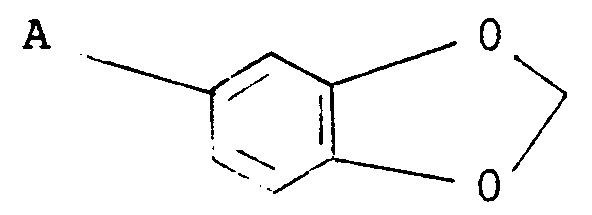
where A is -CO₂R or -CH₂OCOR
and R is H or a C₁ to C₆ substituent.
where A is -CO₂R or -CH₂OCOR
and R is H or a C₁ to C₆ substituent.
2. A compound as claimed in claim 1 for use in repelling ticks or lice.
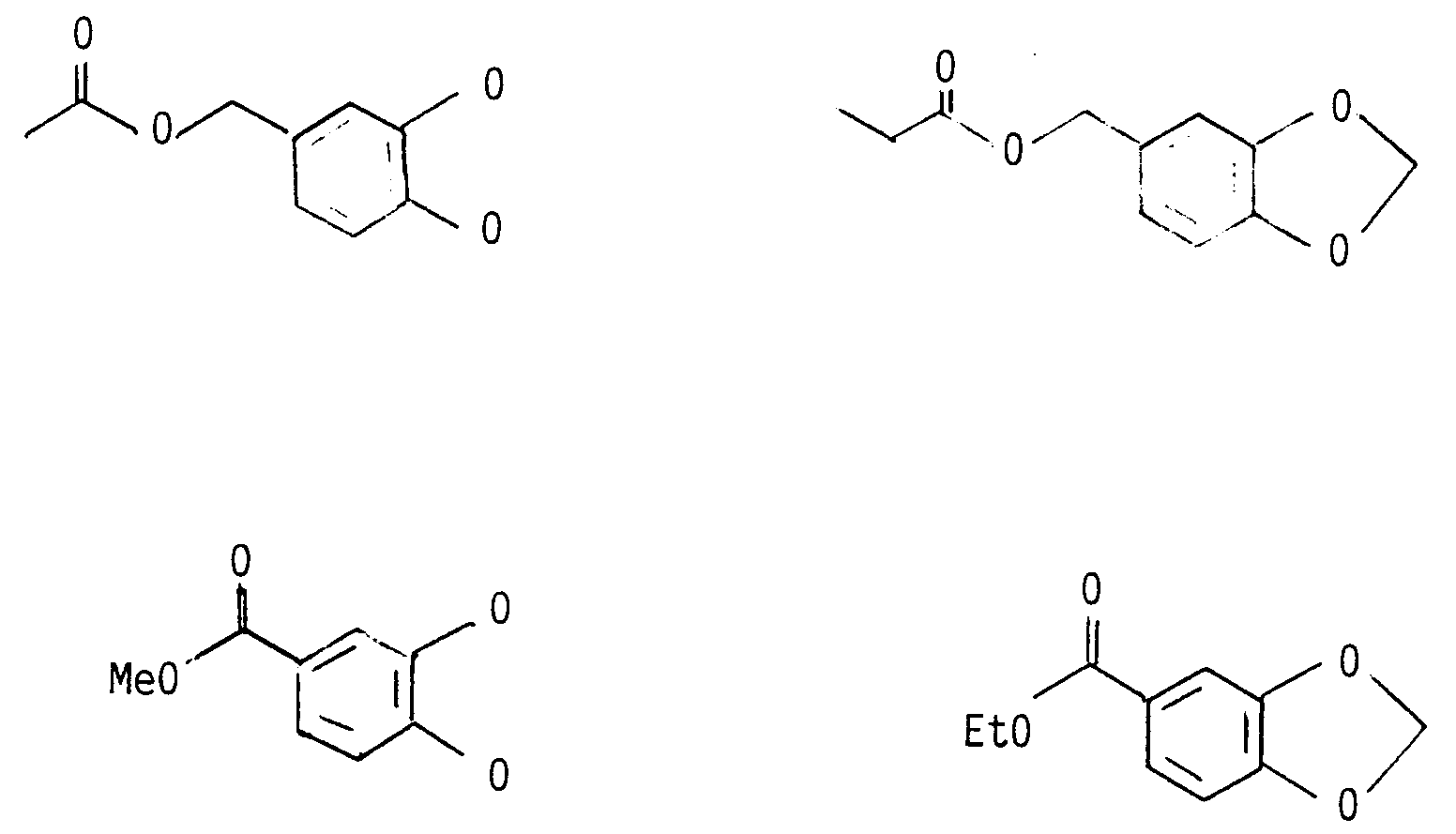
3. A compound as claimed in claim 1 or claim 2 selected from
4. The use of a compound of general formula I in the manufacture of a medicament for
repelling lice or ticks

where A is -CO₂R or CH₂OCOR
and R is H or a C₁ to C₆ substituent.
where A is -CO₂R or CH₂OCOR
and R is H or a C₁ to C₆ substituent.
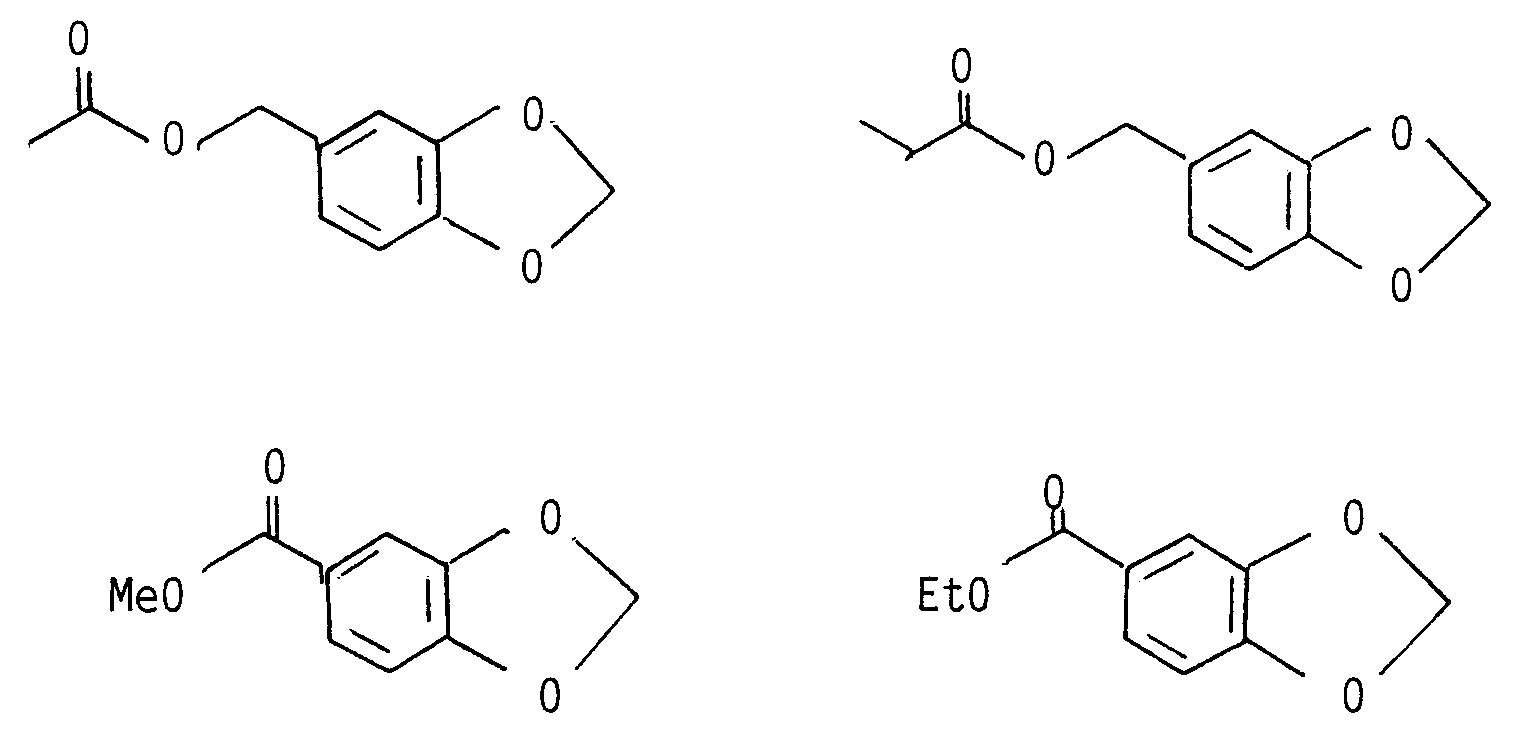
5. A use as claimed in claim 4 wherein the compound of general formula I is selected
from
6. A louse or tick repellent composition comprising
i at least 0.5 wt% of a compound of general formula I,
ii aqueous alcohol and
iii an alkoxylated alcohol or fatty acid nonionic emulsifier.
7. A composition as claimed in claim 6 wherein component III comprises hydroxy fatty
alcohol alkoxylate and an alkoxylated fatty acid.
8. A composition as claimed in claim 6 or claim 7 wherein the alcohol comprises ethanol
and isopropanol.
9. A composition as claimed in any one of claims 6 to 8 wherein the compound of general
formula I is solid at 25°C the composition being capable of forming a film on the
skin without the rapid formation of crystals.