|
(11) | EP 0 591 937 B1 |

| (12) | EUROPEAN PATENT SPECIFICATION |
|
|
| (54) |
Use of isoquinolinone derivatives for treating hyperlipoproteinemia Verwendung von Isoquinolinon-Derivaten zur Behandlung von Hyperlipoproteinemia Utilisation des dérivés de l'isoquinolinone dans le traitement de l'hyperlipoproteinemie |
|
|
|||||||||||||||||||||||||||||||
| Note: Within nine months from the publication of the mention of the grant of the European patent, any person may give notice to the European Patent Office of opposition to the European patent granted. Notice of opposition shall be filed in a written reasoned statement. It shall not be deemed to have been filed until the opposition fee has been paid. (Art. 99(1) European Patent Convention). |
FIELD OF THE INVENTION
[0001] This invention relates to the use of isoquinolinone derivatives for the treatment of hyperlipemia. More particularly, the invention relates to antihyperlipoproteinemics which comprise an effective amount of those isoquinolinone derivatives or the pharmaceutically acceptable salts thereof.
BACKGROUND OF THE INVENTION
[0002] U.S. Patents 4,129,565 and 4,517,365 disclose that the isoquinolinone derivatives of the formula
wherein R₁ is hydrogen or an alkyl group and R₂ is an alkyl group and the pharmaceutically acceptable salts thereof possess β-adrenergic blocking activity and are useful for the treatment of heart diseases such as hypertension, stenocardia and arrhythmia.
[0003] U.S. Patent 5,061,714 also discloses that the isoquinolinone derivatives having the above formula are useful for the treatment of glaucoma or ocular hypertension.
[0004] However, there is no report on other pharmaceutical uses of those isoquinolinone derivatives.
[0005] 4-[3-(tert-Butylamino-2-hydroxypropoxy]-N-methylisocarbostyril hydrochloride is shown to reduce vascular lesions and nephrosclerosis. (J. Pharmacobiodyn., 1985, 8(2), 134-41). EP-A-0 326 386 discloses a different class of isoquinolinone derivatives which lowers the concentrations of cholesterol and of low density lipoproteins in the blood.
DISCLOSURE OF THE INVENTION
[0006] In view of such situations, the present inventors have investigated other medical uses of the isoquinolinone derivatives of the above-identified formula and found that they possess, potent anti-hyperlipemia activity and are useful for the treatment of hyperlipemia.
[0007] Thus the present invention is directed to the use of a compound of formula (I)
wherein R₁ is hydrogen or a C₁-C₆ alkyl group and R₂ is a C₁-C₆ alkyl group or the pharmaceutically acceptable salt thereof, for the manufacture of a medicament for treating hyperlipemia in a mammal.
[0008] In the above formula (I), the C₁-C₆ alkyl group includes preferably straight or branched alkyl groups of 1-4 carbon atoms, e.g., methyl, ethyl, n-propyl, isopropyl, n-butyl isobutyl and tert.-butyl.
[0009] Representative examples of the compounds of formula (I) are illustrated below.
4-(3-tert.-Butylamino-2-hydroxypropoxy)-1-isoquinolinone.
4-(3-tert.-Butylamino-2-hydroxypropoxy)-2-methyl-1-isoquinolinone,
4-(3-Isopropylamino-2-hydroxypropoxy)-1-isoquinolinone,
4-(3-Isopropylamino-2-hydroxypropoxy)-2-methyl-1-isoquinolinone,
4-(3-Ethylamino-2-hydroxypropoxy)-1-isoquinolinone,
4-(3-Ethylamino-2-hydroxypropoxy)-2-methyl-1-isoquinolinone and
4-(3-Ethylamino-2-hydroxypropoxy)-2-ethyl-isoquinolinone.
[0010] The pharmaceutically acceptable salts include the salts of the isoquinolinone compounds with inorganic or organic acids such as hydrochloric, sulfuric, nitric, hydrobromic, oxalic, maleic, fumaric, citric, tartaric and malic acid.
[0011] When the isoquinolinone compounds of formula (I) or the pharmaceutically acceptable salts thereof are used for the preparation of an antihyperlipoproteinemic, they can be formulated into pharmaceutical preparations in various dosage forms. Those preparations can be administered orally in the form of tablets, sugar-coated tablets, hard capsules, soft capsules or liquids such as solutions, emulsions or suspensions. Alternatively, the preparations may be administered parenterally in the form of injections.
[0012] The pharmaceutical preparations can be produced by known processes using additives well known in the art such as excipients, binders, diluents, stabilizers, preservatives, solubilizers, wetting agents, emulsifiers, lubricants, sweeteners, colorants, flavoring agents, buffers and antioxidants. Further, the pharmaceutical preparations of the isoquinolinone compounds with a stabilizing agent may be formed in such manner as described in U.S Patent 4,666,919 which is incorporated herein by reference.
[0013] For pharmaceutical preparations comprising the present compounds, the dose will vary depending on the manner of administration, the particular disease being treated and its severity, the overall health and condition of the patient, and the judgment of the prescribing physician, but generally a daily dose is orally 10 to 1200 mg for an adult.
EXAMPLE 1
[0016] In this example, the effects of the present compound on the wall of a blood vessel, a serum lipid and a blood glucose level were studied on the experimental sclerosis rabbits from the determination of the arterial sclerosis action, the assay of the components constituting the wall of the blood vessel and the transitional analysis of the damage of the blood wall with time.
[0017] Male Japanese white rabbits (25 months age) were randomly divided into three groups. A normal diet was given to one group (called hereafter "healthy group"). The remaining two groups were fed with 100 g/day of a high α-starch, high salinity and low protein, sclerosis diet containing 0.3% cholesterol (manufactured by Funabashi Farm), simultaneously injected intramuscularly with norepinephrine (3 mg) and bred for 150 days. One group of them was called hereafter "sclerosis group". To the remaining one group was orally administered at one dose per day a capsule which is filled with 3 mg of (±)-4-(3-tert.-butylamino-2-hydroxypropoxy)-2-methyl-1(2H)-isoquinolinone hydrochloride, which group is called hereafter "drug administered group". Every 50 days, Aortic Pulse Wave Velocity (PWV) was measured to determine a average hardness of aorta of the rabbits. After five months and just before slaughter of the rabbits, blood was drawn to determine cholesterol in blood (T-Cho), triglyceride (TG), β-lipoprotein (β-Lp), HDL choresterol and a blood glucose level. After slaughter, a fifth intercostal pars in the thoracic aorta was extracted and then subjected to formalin fixation and embedding in paraffin. Subsequently, each component of smooth muscle cell (SMC), elastin (EL), collagen (CL), glycosaminoglycan (GAGs), PAS positive substance (PAS), calcium (Ca) and cholesterol (Cho) was histochemically observed and assayed.
[0018] The results are shown in the following tables.
Table 1
| Δ PWV (m/sec) | |||
| 0-50 days | 51-100 days | 101-150 days | |
| Healthy group | 0.120 | 0.110 | 0.250 |
| Sclerosis group | -0.180 | 0.010 | 0.580 |
| Drug administered group | -0.110 | -0.290 | -0.890 |
Table 2
| Proportion of Components Constituting the Wall of Aorta (%E) | |||
| Healthy group | Sclerosis group | Drug administered group | |
| SMC | 48.01 | 37.98 | 46.72 |
| EL | 44.47 | 34.62 | 40.56 |
| CL | 34.26 | 28.26 | 30.33 |
| GAGs | 11.63 | 18.28 | 16.03 |
| PAS | 26.73 | 33.82 | 27.83 |
| Ca | 2.31 | 4.77 | 1.92 |
| Cho | 0.49 | 0.78 | 0.68 |
Table 3
| Serum Lipid and Blood Glucose Level (mg/dl) | |||
| Healthy group | Sclerosis group | Drug administered group | |
| T-Cho | 18.29 | 78.00 | 25.25 |
| TG | 79.43 | 130.67 | 65.40 |
| β-Lp | 9.00 | 23.83 | 2.75 |
| HDL-C | 9.00 | 18.33 | 15.44 |
| Blood glucose | 130.29 | 219.33 | 162.50 |
[0019] PWV is increasing with the advance of growth, maturation and ageing. Thus an increase in PWV value is an indication of arterial sclerosis (see Arterial Sclerosis, vol. 8, No. 1 April 1980, pp 91-95). Table 1 shows a change of PWV with time (Δ PWV) for each group, indicating that the PWV of the drug administered group was significantly improved in 150 days as compared with the sclerosis group. Table 2 shows that there was a remarkable improvement in arterial sclerosis.
EXAMPLE 2
[0020] 4-(3-tert.-Butylamino-2-hydroxypropoxy)-2-methyl-1-isoquinolinone hydrochloride and 4-(3-tert.-butylamino-2-hydroxypropoxy)-1-isoquinolinone hydrochloride, respectively were orally administered to male and female mice to determine the LD₅₀ value. The results are shown in Table 4.
Table 4
| Sex | LD₅₀ |
| Male | average 1393 mg/kg (1223-1587 mg/kg) |
| Female | average 1290 mg/kg (1063-1566 mg/kg) |
Preparation 1 - Tablets (one tablet)
[0022]
| (±)-4-(3-tert.-Butylamino-2-hydroxypropoxy)-2-methyl-1(2H)-isoquinolinone hydrochloride | 20 mg |
| Magnesium silicate | 20 mg |
| Lactose | 98 mg |
| Hydroxypropylcellulose | 7.5 mg |
| Magnesium stearate | 1 mg |
| Hydrogenated vegetable oil | 3 mg |
| Total | 150 mg |
[0023] The above isoquinolinone compound, magnesium silicate and lactose were mixed and the mixture was kneaded with a solution of 5% hydroxypropyl cellulose in ethyl alcohol, followed by granulating the mixture to give granules of suitable particle sizes. These granules were dried and screened and then mixed with magnesium stearate and hydrogenated vegetable oil so that the granules were uniformly coated with the mixture of magnesium stearate and the oil. The granules were formulated by a rotary tableting machine into tablets each 7.0 mm in diameter, weighing 100 mg and having the hardness of 6 kg.
Preparation 2 - Granules
[0024]
| (±)-4-(3-tert.-Butylamino-2-hydroxypropoxy)-2-methyl-1(2H)-isoquinolinone hydrochloride | 10 mg |
| Magnesium oxide | 40 mg |
| Calcium hydrogenphosphate | 38 mg |
| Lactose | 10 mg |
| Hydroxypropylcellulose | 20 mg |
[0025] The above components except for hydroxypropylcellulose were mixed and the mixture was kneaded with a solution of 5% hydroxypropylcellulose in ethyl alcohol. The kneaded mixture was granulated by extrusion granulation. The granules were dried and screened to give the granules having particle size of 12-48 mesh.
Preparation 3 - Syrups
[0026]
| (±)-4-(3-tert.-Butylamino-2-hydroxypropoxy)-2-methyl-1(2H)-isoquinolinone hydrochloride | 1.000 g |
| Saccharose | 30.000 g |
| D-sorbitol 70 w/v % | 25.000 g |
| Ethyl paraoxybenzoate | 0.030 g |
| Propyl paraoxybenzoate | 0.015 g |
| Flavors | 0.200 g |
| Glycerin | 0.150 g |
| 96% Ethanol | 0.500 g |
| Distilled water | q.s. |
| Total | 100 ml |
[0027] Saccharose, D-sorbitol, methyl paraoxybenzoate, propylparaoxybenzoate and the above isoquinolinone compound were dissolved in 60 g of warm water. After cooling, glycerin and a solution of the flavors in ethanol were added. To the mixture was then added water to make up 100 ml.
Preparation 4 - Injections
[0028]
| (±)-4-(3-tert.-Butylamino-2-hydroxypropoxy)-2-methyl-1(2H)-isoquinolinone hydrochloride | 10.0 mg |
| Sodium chloride | 81.0 mg |
| Sodium hydrogencarbonate | 8.40 mg |
| Distilled water for injection | q.s. |
| Total 10.0 ml |
[0029] Sodium hydrogencarbonate, sodium chloride and the isoquinolinone compound were added to distilled water and dissolved therein to make up 10.0 ml.
Preparation 5 - Suppositories
1. Use of a compound of formula (I)
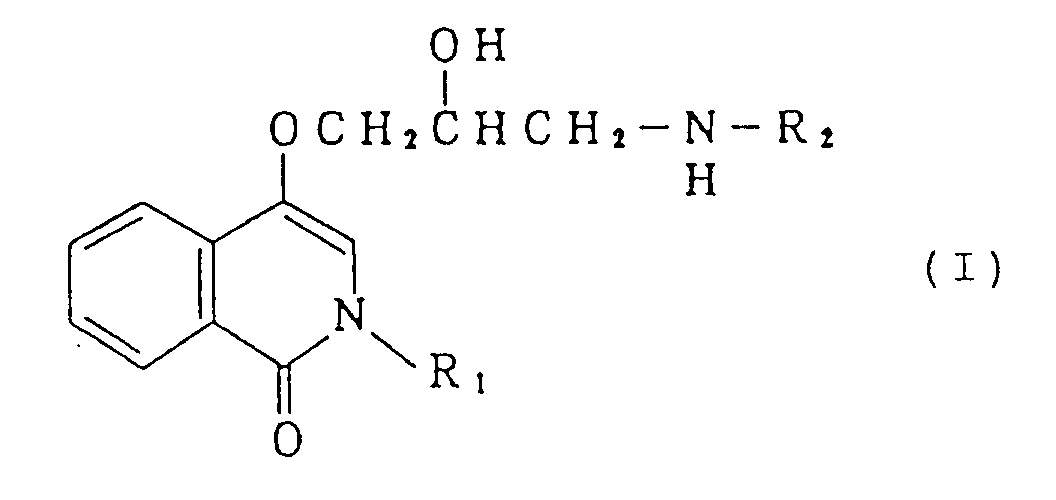
wherein R₁ is hydrogen or a C₁-C₆ alkyl group and R₂ is a C₁-C₆ alkyl group or the pharmaceutically acceptable salt thereof, for the manufacture of a medicament for treating hyperlipemia in a mammal.
wherein R₁ is hydrogen or a C₁-C₆ alkyl group and R₂ is a C₁-C₆ alkyl group or the pharmaceutically acceptable salt thereof, for the manufacture of a medicament for treating hyperlipemia in a mammal.
2. Use of claim 1 wherein R₁ is hydrogen and R₂ is a C₁-C₄ alkyl group.
3. Use of claim 1 wherein R₁ is a C₁-C₄ alkyl group and R₂ is a C₁-C₄ alkyl group.
1. Verwendung einer Verbindung der Formel (I)
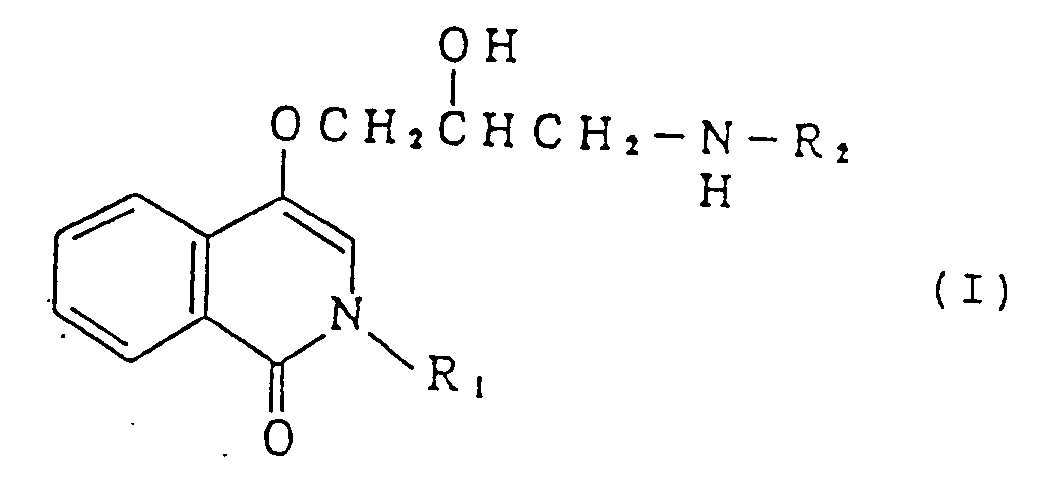
wobei R₁ Wasserstoff oder eine C₁-C₆ Alkylgruppe ist und R₂ eine C₁-C₆ Alkylgruppe ist oder von deren pharmazeutisch verträglichem Salz für die Herstellung eines Medikaments zur Behandlung von Hyperlipämie bei einem Sauger.
wobei R₁ Wasserstoff oder eine C₁-C₆ Alkylgruppe ist und R₂ eine C₁-C₆ Alkylgruppe ist oder von deren pharmazeutisch verträglichem Salz für die Herstellung eines Medikaments zur Behandlung von Hyperlipämie bei einem Sauger.
2. Verwendung aus Anspruch 1, wobei R₁ Wasserstoff ist und R₂ eine C₁-C₄ Alkylgruppe
ist.
3. Verwendung aus Anspruch 1, wobei R₁ eine C₁-C₄ Alkylgruppe ist und R₂ eine C₁-C₄ Alkylgruppe
ist.
1. Utilisation d'un composé ayant la formule (I)
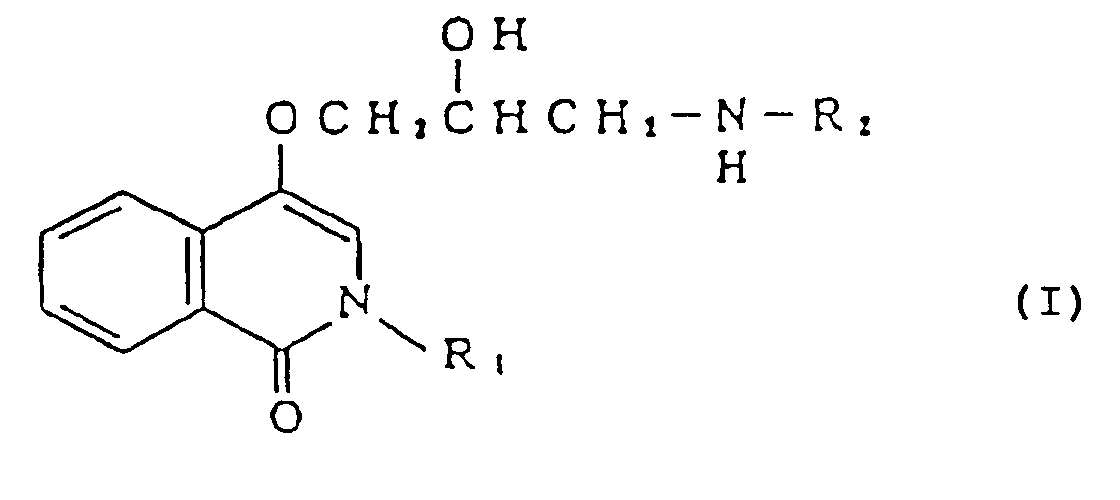
dans laquelle R₁ est un hydrogène ou un groupe alkyle en C₁-C₆ et R₂ est un groupe alkyle en C₁-C₆ ou d'un sel de celui-ci pouvant être accepté de manière pharmaceutique, destiné à la fabrication d'un médicament pour le traitement de l'hyperlipémie chez un mammifère.
dans laquelle R₁ est un hydrogène ou un groupe alkyle en C₁-C₆ et R₂ est un groupe alkyle en C₁-C₆ ou d'un sel de celui-ci pouvant être accepté de manière pharmaceutique, destiné à la fabrication d'un médicament pour le traitement de l'hyperlipémie chez un mammifère.
2. Utilisation selon la revendication 1, dans laquelle R₁ est un hydrogène et R₂ est
un groupe alkyle en C₁-C₄.
3. Utilisation selon la revendication 1, dans laquelle R₁ est un groupe alkyle en C₁-C₄
et R₂ est un groupe alkyle en C₁-C₄.