|
(11) | EP 0 595 126 B1 |

| (12) | EUROPEAN PATENT SPECIFICATION |
|
|
| (54) |
Herbicidal composition and weeding method Herbizide Zusammensetzung und Verfahren zur Unkrautbekämpfung Composition herbicide et procédé de désherbage |
|
|
|||||||||||||||||||||||||||||||
| Note: Within nine months from the publication of the mention of the grant of the European patent, any person may give notice to the European Patent Office of opposition to the European patent granted. Notice of opposition shall be filed in a written reasoned statement. It shall not be deemed to have been filed until the opposition fee has been paid. (Art. 99(1) European Patent Convention). |
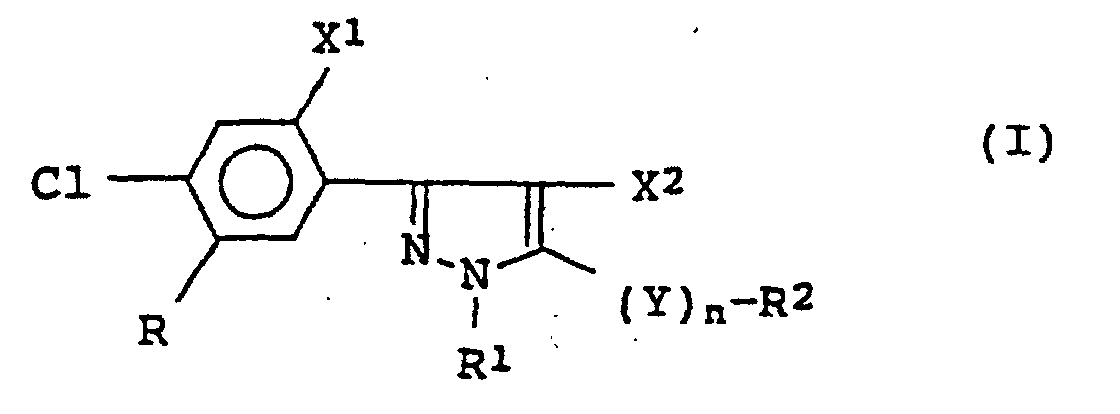
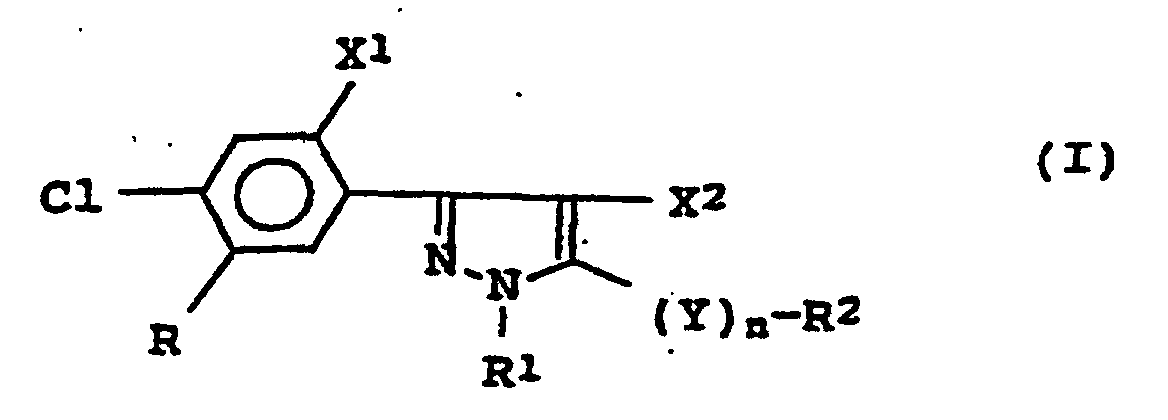
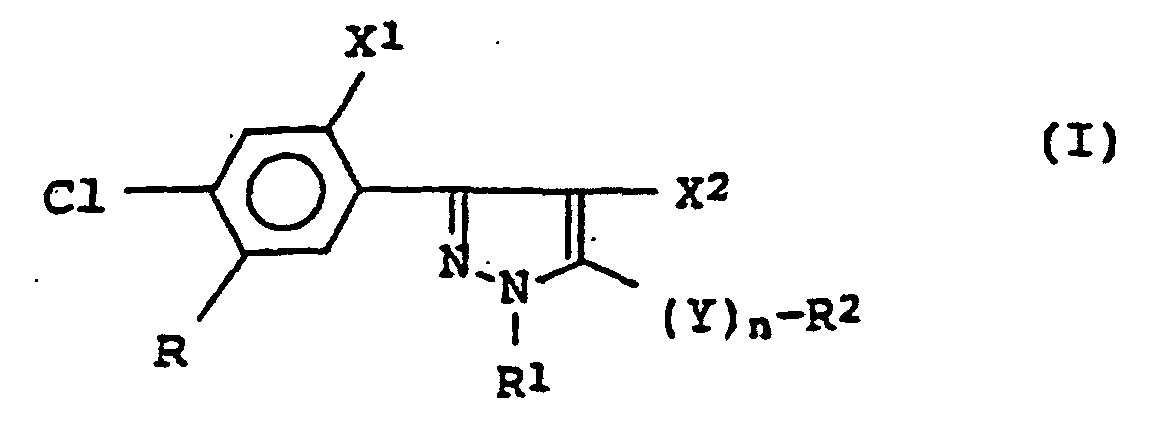
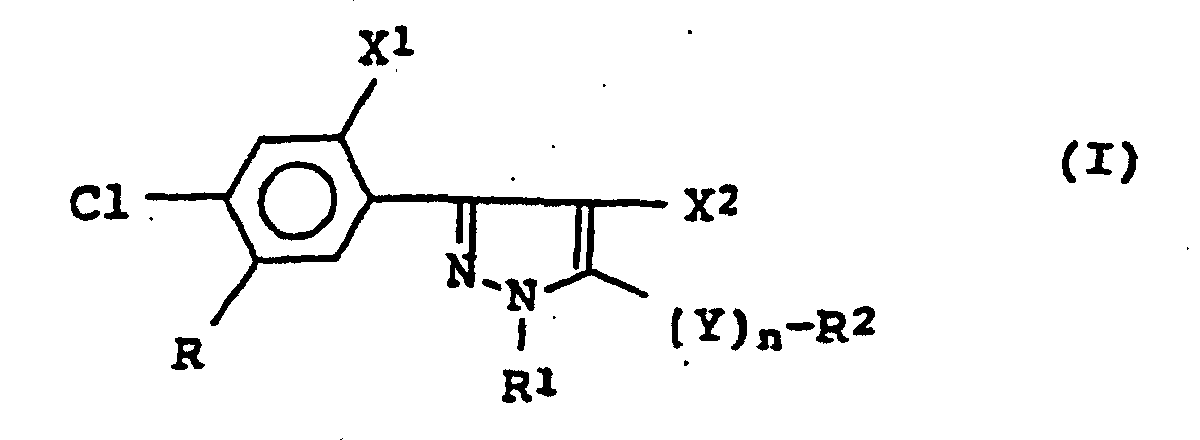
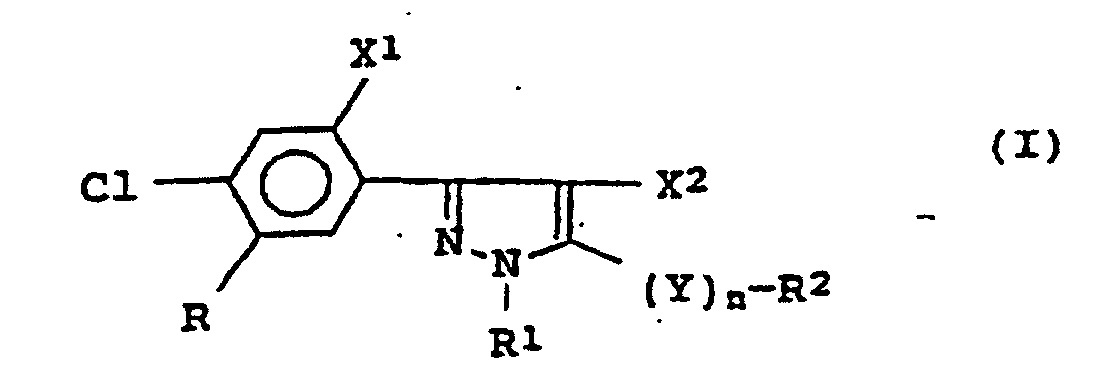
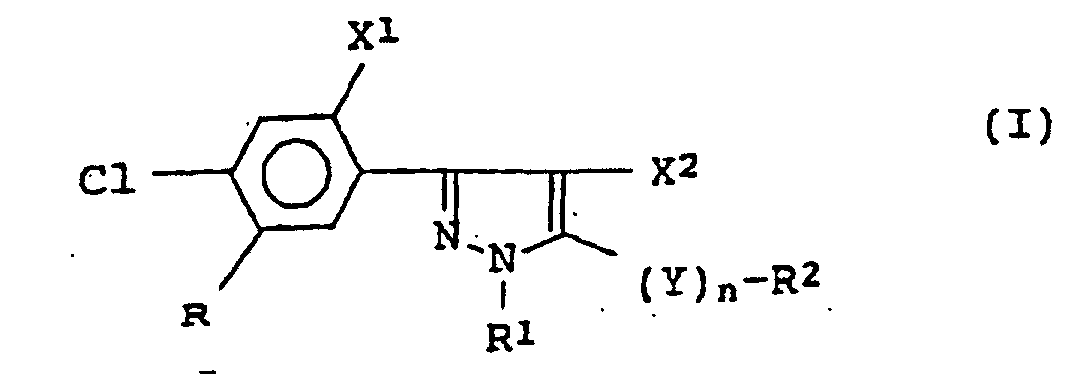
[0001] This invention relates to a herbicidal composition containing as active ingredients at least one organophosphorous compound, selected from the group consisting of N-(phosphonomethyl)glycine or a salt thereof, 4-[hydroxy(methyl)phosphinoyl]-DL-homoalanine or a salt thereof, and 4-[hydroxy(methyl)phosphinoyl]-L-homoalanyl-L-alanyl-L-alanine or a salt thereof, and a 3-substituted phenylpyrazole derivative represented by the general formula (I):
wherein R is
-Y1R3
(wherein R3 is a lower alkyl group, a lower haloalkyl group, a lower alkenyl group or a lower alkynyl group, and Y1 is -O- or -S-),
-Y2CH(R4)CO-OR5
(wherein R4 is a hydrogen atom or a lower alkyl group, R5 is a hydrogen atom, a lower alkyl group, a lower haloalkyl group, a lower alkenyl group or a lower alkynyl group, and Y2 is -O-, -S- or -NH-),
-COOCH(R4)CO-Y1R5
(wherein R4, R5 and Y1 are as defined above), or
-COOR6
(wherein R6 is a lower alkyl group, a lower alkenyl group or a lower alkynyl group), R1 is a lower alkyl group, R2 is a hydrogen atom, a lower alkyl group or a lower haloalkyl group, X1 and X2, which may be the same or different, are halogen atoms, Y is -O-, -S-, -SO- or -SO2-, and n is zero or 1; and a weeding method using said composition.
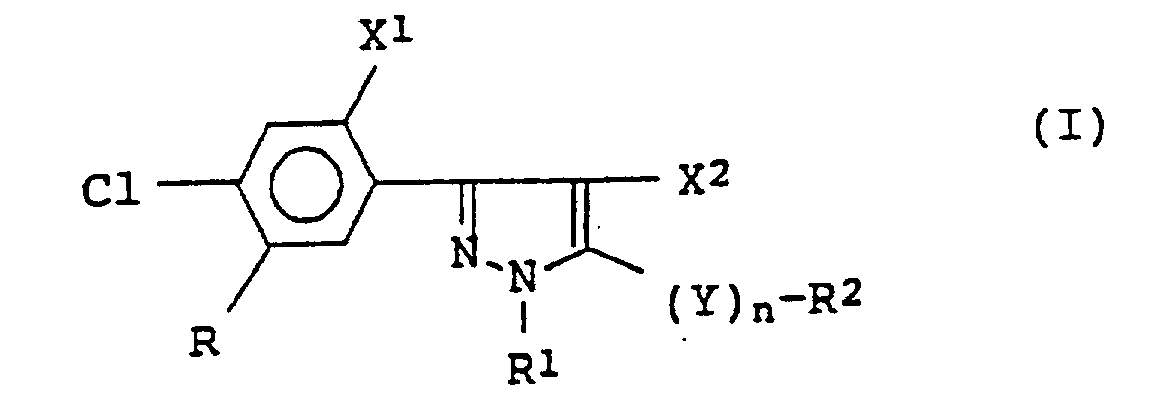
[0002] Furthermore, this invention relates to a herbicidal composition comprising as active ingredients at least one organophosphorous compound, selected from the group consisting of N-(phosphonomethyl)glycine or a salt thereof, 4-[hydroxy(methyl)phosphinoyl]-DL-homoalanine or a salt thereof, and 4-[hydroxy(methyl)phosphinoyl]-L-homoalanyl-L-alanyl-L-alanine or a salt thereof, and a 3-substituted phenylpyrazole derivative represented by the general formula (I):
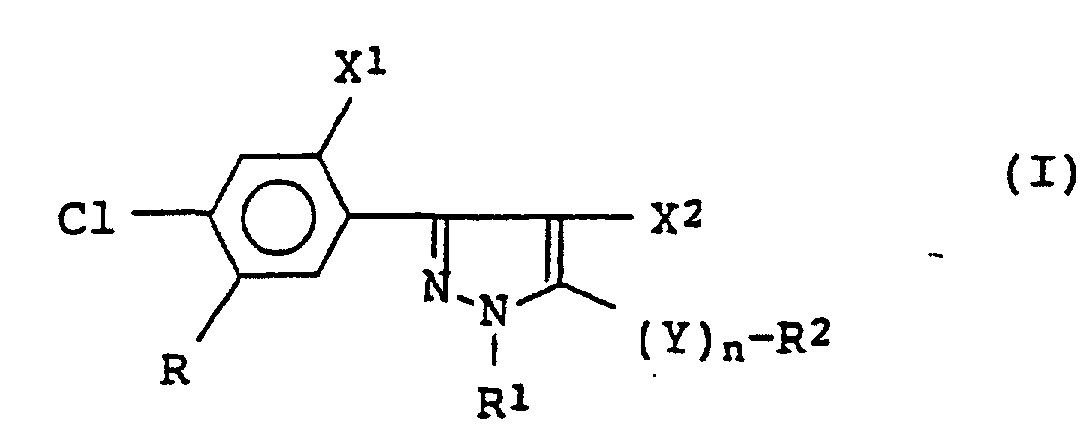
wherein R1 is CH3, R is OCH2CH2 = CH2, R2 is CHF2, X1 and X2 are each Cl, Y is NH and n is 1, and to a herbicidal composition comprising as active ingredients at least one organophosphorous compound, selected from the group consisting of N-(phosphonomethyl)glycine or a salt thereof, 4-[hydroxy(methyl)phosphinoyl]-DL-homoalanine or a salt thereof, and 4-[hydroxy(methyl)phosphinoyl]-L-homoalanyl-L-alanyl-L-alanine or a salt thereof, and a 3-substituted phenylpyrazole derivative represented by the general formula (I):
wherein R1 is CH3, R is OCH2C ≡ CH, R2 is CHF2, X1 and X2 are each Cl, Y is NH and n is 1,
and to weeding methods using said compositions.
[0003] The 3-substituted phenylpyrazole derivative of the general formula (I) is a compound described in JP-A-3163063, corresponding to EP-A-361114,and JP-A-4211065 and were found to be useful as a herbicide.
[0004] JP-A-4059706 and JP-A-3246204 disclose herbicidal compositions comprising the following 3-substituted phenylpyrazole derivative,
wherein R is a lower alkyl group and X is halogen, in combination with a sulphonylurea, phenylurea or phenoxy-fatty acid compound as active ingredients. These compositions are especially used for eradicating weeds from cereals, such as wheat or barley.
[0005] The organophosphorus compound used in the present invention is a well-known herbicide, for example, N-(phosphonomethyl)glycine or a salt thereof which are described in JP-A-4739538 and JP-A-5795994, 4-[hydroxy(methyl)phosphinoyl]-DL-homoalanine described in Japanese Patent Post-examined Publication No. 57-26564, or 4-[hydroxy(methyl)-phosphinoyl]-L-homoalanyl-L-alanyl-L-alanine described in Japanese Patent Post-examined Publication No. 59-23282.
[0006] The organophosphorus compounds are foliage applied herbicides widely used as non-selective herbicides, which may also be combined with other herbicidal compounds, such as 3-chloro-2-(4-chloro-2-fluoro-5-propargyloxyphenyl)-4,5,6,7-tetrahydro-2H-indazole, as disclosed in EP-A-232504, certain oxazolidinedione derivatives, as disclosed in EP-A-350880, or oxyfluorofen type herbidcides as disclosed in EP-A-143547. However, the organophosphorus compounds exhibit initial effect slowly and are not sufficiently effective against herbaceous weeds in developed leaf stage or reproduction stage. Therefore, there is an eager desire for the advent of a herbicide which exhibits herbicidal effect soon after application and has a sufficient herbicidal effect also on the herbaceous weeds in developed leaf stage or reproductive stage.
[0007] For solving these problems the present invention providers a herbicidal composition comprising as active ingredients at least one organophosphorus compound selected from the group consisting of N-(phosphonomethyl)glycine or a salt thereof, 4-[hydroxy(methyl)phosphinoyl]-DL-homoalanine or a salt thereof, and 4-[hydroxy(methyl)phosphinoyl]-L-homoalanyl-L-alanyl-L-alanine or a salt thereof and a 3-substituted phenylpyrazole derivative of the above general formula (I), wherein the organophosphorus compound is contained in an amount of 0.01 to 1,000 parts by weight per part by weight of the 3-substituted phenylpyrazole derivative of the general formula (I).
[0008] This composition exhibits fast-acting properties and a wide weed control spectrum and moreover brings about an excellent synergistic effect at a dosage required when each of the compounds is used alone.
[0009] Further, the present invention provides a weeding method comprising applying the herbicidal composition of the present invention in a dosage chosen in the range of 1 g to 5 kg (in terms of the active ingredients of the composition) per 10 area for controlling indesirable weeds.
[0010] In the following the drawings are briefly described.
Fig. 1 is a graph showing the synergistic effect of a herbicidal composition (containing compound 19 and compound B) of the present invention by isobole analysis.
Fig. 2 is a graph showing the synergistic effect of a herbicidal composition (containing compound 19 and compound C) of the present invention by isobole analysis.
[0013] The herbicidal organophosphorus compound is according do the present invention, selected from the group consisting of N-(phosphonomethyl)glycine or salts thereof, such as the N-(phosphonomethyl)glycine isopropylammonium salt (hereinafter referred to as "compound A") or the N-(phosphonomethyl)glycine trimethyl-sulfonium salt (hereinafter referred to as "compound B"); 4-[hydroxy(methyl)phosphinoyl]-DL-homoalanine or salts thereof, such as the 4-[hydroxy(methyl)phosphinoyl]-DL-homoalanine ammonium salt (hereinafter referred to as "compound C"); 4-[hydroxy(methyl)phosphinoyl]-L-homoalanyl-L-alanyl-L-alanine or salts thereof, such as the 4-[hydroxy(methyl)phosphinoyl]-L-homoalanyl-L-alanyl-L-alanine sodium salt (hereinafter referred to as "compound D").
[0014] For applying the herbicidal composition of the present invention, it may be prepared into suitable forms according to an ordinary manner for preparation of agrochemicals, depending on purposes. For example, said composition is blended with one or more materials selected from the group consisting of solid carriers, liquid carriers and surfactants, and optionally adjuvants; and prepared into a preparation form, such as water dispersible granules, a wettable powder, dust, a suspension concentrate or a soluble concentrate.
[0015] The active ingredients of the herbicidal composition of the present invention are blended, depending on the type of formulation, in the following range: the proportion of organophosphorus compound is 0.01 to 1,000 parts by weight, preferably 1 to 500 parts by weight, per part by weight of 3-substituted phenylpyrazole derivative of the general formula (I).
[0016] The herbicidal composition of the present invention is useful as a non-selective herbicidal composition. The composition has fast-acting property which the organophosphorus compound does not have, by virtue of the simultaneous use of the 3-substituted phenylpyrazole derivative and the organophosphorus compound, and moreover the composition permits reduction of the dosage because the simultaneous use brings about a synergistic effect which cannot be expected when each of the two agents is used alone.
[0017] The herbicidal composition of the present invention is useful particularly as a non-selective herbicide. The composition can be used, for example, for controlling weeds emerging in non-crop lands, such as roads, building sites, railbeds, parks and playgrounds, and ground covering weeds in orchards, managed forests, forests or tame forests. Furthermore, the composition can be used also as a weed management agent for levees of paddy fields and a clean up herbicide for fallow fields, and upland fields before planting. The composition is effective in controlling, for example, dicotyledons such as asiatic dayflower (Commelina communis), tufted knotweed (Polygonum longisetum), sweet scabious (Erigeron annuus), horseweed (Erigeron canadensis), shepherd's purse (Capsella bursa-pastoris), pale persicaria (Polygonum lapathifolium), livid amaranth (Amaranthus lividus), cudweed (Gnaphalium affine), three seeded copper leaf (Acalypha australis), slender amaranth (Amaranthus varidis) and chickweed (Stellaria media); gramineous weeds, such as large crabgrass (Digitaria adscendens), barnyard grass (Echinochloa crus-galli), annual bluegrass (Poa annua) and water foxtail (Alopecurus aequalis); and perennial weeds, such as curly dock (Rumex juponicus), mugwort (Artemisia princeps), field horsetail (Equisetum arvense), asiatic plantain (Plantago asiatica), philadelphia fleabane (Erigeron philadelphicus), dandelion (Taraxacum officinale), cogon grass (Imperata cylindrica), eulalia grass (Miscanthus sinensis) and sorrel vine (Cayratia japonica).
[0018] The present invention is applicable not only to the above places and weeds but also to all places and objective weeds for controlling undesirable weeds.
[0019] Although the herbicidal composition of the present invention is applied preferably during the early-post emergence or vegetative growth stage of weeds, its application time is not limited to these periods.
[0020] The dosage of the herbicidal composition of the present invention may be chosen in the range of 1 to 5,000 g (in terms of the active ingredients) per 10 ares.
EXAMPLES
Example 1
[0023]
| Compound 19 | 0.2 part |
| Compound C | 18.5 parts |
| Genapol® LRD | 20.0 parts |
| Glauber's salt | 20.0 parts |
| Clay | 16.3 parts |
| Bentonite | 10.0 parts |
| Hydrated silicic acid | 10.0 parts |
| Calcium ligninsulfonate | 5.0 parts |
| Total | 100.0 parts |
Example 2
[0024]
| Compound 19 | 0.2 part |
| Compound C | 18.5 parts |
| Pluronic® L-64 | 5.0 parts |
| Sodium alkylbenzensulfonate | 2.0 parts |
| Methylnaphtalene | 10.0 parts |
| Water | 64.3 parts |
| Total | 100.0 parts |
[0025] An aqueous suspension concentrate was prepared by mixing the predetermined amounts of compound 19 and methylnaphthalene to obtain a solution, adding compound C, Pluronic® L-64, Sodium alkylbenzensulfonate and water to the solution, and mixing them uniformly by means of a high-speed agitator.
Example 3
[0026]
| Compound 19 | 0.2 part |
| Compound B | 38.0 parts |
| Pluronic® L-64 | 5.0 parts |
| Sodium alkylbenzenesulfonate | 2.0 parts |
| Methylnaphtalene | 10.0 parts |
| Water | 44.8 parts |
| Total | 100.0 parts |
[0027] An aqueous suspension concentrate was prepared by mixing the predetermined amounts of compound 19 and methylnaphthalene to obtain a solution, adding compound B, Pluronic® L-64, sodium alkylbenzenesulfonate and water to the solution, and mixing them uniformly by means of a high-speed agitator.
Example 4
[0028]
| Compound 19 | 0.2 part |
| Compound C | 18.5 parts |
| Hitenol No. 8 (trade name) | 3.0 parts |
| Calcium ligninsulfonate | 3.0 parts |
| Carplex #80 (trade name) | 5.0 parts |
| Clay | 70.3 parts |
| Total | 100.0 parts |
Example 5
[0030]
| Compound 19 | 0.2 part |
| Compound B | 38.0 parts |
| Hitenol No. 8 (trade name) | 3.0 parts |
| Calcium ligninsulfonate | 3.0 parts |
| Carplex #80 (trade name) | 5.0 parts |
| Clay | 50.8 parts |
| Total | 100.0 parts |
Test Example 1
Synergistic-effect test on compositions of the present invention
[0032] A pot with a diameter of 12 cm and a height of 11 cm was filled with upland soil (sandy loam) and seeded with barnyard grass (Echinochloa crus-galli) so as to adjust the depth of covering soil to 0.5 cm, and the barnyard grass was grown in a greenhouse.
[0033] When the barnyard grass was grown to a leaf stage of 3 and a height of 10 cm in a test co-using compound B or a leaf stage of 5 and a height of 15 cm in a test co-using compound C, a predetermined amount of each herbicidal composition of the present invention was diluted with water and the dilution was sprayed from above uniformly on the whole surfaces of the stem and leaves in a spray volume of 1,000 liters per hectare by the use of a small-sized sprayer.
[0034] On the 10th day after the spraying, the degree of growth of the above-ground part of surviving barnyard grass plants was visually judged in the range of zero (ineffective) to 100 (complete kill) by comparison with that on the untreated plot.
[0035] The test results obtained in the composition of compound 19 and B or compound 19 and C are shown in Table 2 and Table 3, respectively.
The above results are shown in the drawings for facilitating the understanding.
[0036] Fig. 1 shows a constant-effect curve drawn on the basis of the herbicidal effect on barnyard grass shown in Table 2 in the test example.
[0037] The axis of abscissa refers to the amount (g/ha) of compound 19 as active ingredient and the axis of ordinate to the amount (g/ha) of compound B as active ingredient.
[0038] The expected ED 90 isobole of additive effect is shown in the broken line and ED 90 isobole of the combination between compound 19 and compound B obtained in practice is shown in the solid line.
1. A herbicidal composition comprising as active ingredients at least one organophosphorous
compound, selected from the group consisting of N-(phosphonomethyl)glycine or a salt
thereof, 4-[hydroxy(methyl)phosphinoyl]-DL-homoalanine or a salt thereof, and 4-[hydroxy(methyl)phosphinoyl]-L-homoalanyl-L-alanyl-L-alanine
or a salt thereof, and a 3-substituted phenylpyrazole derivative represented by the
general formula (I):
wherein R is
-Y1R3
wherein R3 is a lower alkyl group, a lower haloalkyl group, a lower alkenyl group or a lower alkynyl group, and Y1 is -O- or -S-,
-Y2CH(R4)CO-OR5
wherein R4 is a hydrogen atom or a lower alkyl group, R5 is a hydrogen atom, a lower alkyl group, a lower haloalkyl group, a lower alkenyl group or a lower alkynyl group and Y2 is -O-, -S- or -NH,
-COOCH(R4)CO-Y1R5
wherein R4, R5 and Y1 are as defined above, or
-COOR6
wherein R6 is a lower alkyl group, a lower alkenyl group or a lower alkynyl group,
R1 is a lower alkyl group, R2 is a hydrogen atom, a lower alkyl group or a lower haloalkyl group, X1 and X2, which may be the same or different, are halogen atoms, Y is -O-, -S-, -SO- or -SO2-, and n is zero or 1,
wherein the organophosphorus compound is contained in an amount of 0,01 to 1,000 parts by weight per part by weight of the 3-substituted phenylpyrazole derivative of the general formula (I).
wherein R is
-Y1R3
wherein R3 is a lower alkyl group, a lower haloalkyl group, a lower alkenyl group or a lower alkynyl group, and Y1 is -O- or -S-,
-Y2CH(R4)CO-OR5
wherein R4 is a hydrogen atom or a lower alkyl group, R5 is a hydrogen atom, a lower alkyl group, a lower haloalkyl group, a lower alkenyl group or a lower alkynyl group and Y2 is -O-, -S- or -NH,
-COOCH(R4)CO-Y1R5
wherein R4, R5 and Y1 are as defined above, or
-COOR6
wherein R6 is a lower alkyl group, a lower alkenyl group or a lower alkynyl group,
R1 is a lower alkyl group, R2 is a hydrogen atom, a lower alkyl group or a lower haloalkyl group, X1 and X2, which may be the same or different, are halogen atoms, Y is -O-, -S-, -SO- or -SO2-, and n is zero or 1,
wherein the organophosphorus compound is contained in an amount of 0,01 to 1,000 parts by weight per part by weight of the 3-substituted phenylpyrazole derivative of the general formula (I).
2. A herbicidal composition comprising as active ingredients at least one organophosphorous
compound, selected from the group consisting of N-(phosphonomethyl)glycine or a salt
thereof, 4-[hydroxy(methyl)phosphinoyl]-DL-homoalanine or a salt thereof, and 4-[hydroxy(methyl)-phosphinoyl]-L-homoalanyl-L-alanyl-L-alanine
or a salt thereof, and a 3-substituted phenylpyrazole derivative represented by the
general formula (I):
wherein R1 is CH3, R is OCH2CH2 = CH2, R2 is CHF2, X1 and X2 are each Cl, Y is NH and n is 1.
wherein R1 is CH3, R is OCH2CH2 = CH2, R2 is CHF2, X1 and X2 are each Cl, Y is NH and n is 1.
3. A herbicidal composition comprising as active ingredients at least one organophosphorous
compound, selected from the group consisting of N-(phosphonomethyl)glycine or a salt
thereof, 4-[hydroxy(methyl)phosphinoyl]-DL-homoalanine or a salt thereof, and 4-[hydroxy(methyl)phosphinoyl]-L-homoalanyl-L-alanyl-L-alanine
or a salt thereof, and a 3-substituted phenylpyrazole derivative represented by the
general formula (I):
wherein R1 is CH3, R is OCH2C ≡ CH, R2 is CHF2, X1 and X2 are each Cl, Y is NH and n is 1.
wherein R1 is CH3, R is OCH2C ≡ CH, R2 is CHF2, X1 and X2 are each Cl, Y is NH and n is 1.
4. A method for controlling weeds which comprises applying the herbicidal composition
of any one of claims 1 to 3 in a dosage chosen in the range of 1 g to 5 kg (in terms
of the active ingredients of the composition) per 10 ares for controlling undesirable
weeds.
1. Herbizide Zusammensetzung, umfassend, als Wirkstoffe, mindestens eine Organophosphorverbindung,
ausgewählt aus der Gruppe, bestehend aus N-(Phosphonomethyl)glycin oder einem Salz
davon, 4-[Hydroxy(methyl)phosphinoyl]-DL-homoalanin oder einem Salz davon, und 4-[Hydroxy(methyl)phosphinoyl]-L-homoalanyl-L-alanyl-L-alanin
oder einem Salz davon, und ein 3-substituiertes Phenylpyrazolderivat, dargestellt
durch die allgemeine Formel (I):
worin R
-Y1R3
worin R3 eine niedere Alkylgruppe, eine niedere Haloalkylgruppe, eine niedere Alkenylgruppe oder eine niedere Alkinylgruppe ist, und Y1 ist -O- oder -S-,
-Y2CH(R4)CO-OR5
worin R4 ein Wasserstoffatom oder eine niedere Alkylgruppe ist, R5 ist ein Wasserstoffatom, eine niedere Alkylgruppe, eine niedere Haloalkylgruppe, eine niedere Alkenylgruppe oder eine niedere Alkinylgruppe, und Y2 ist -O-, -S- oder -NH-,
-COOCH(R4)CO-Y1R5
worin R4, R5 und Y1 die gleiche Bedeutung wie zuvor beschrieben haben,
oder
-COOR6
worin R6 eine niedere Alkylgruppe, eine niedere Alkenylgruppe oder eine niedere Alkinylgruppe ist,
bedeutet,
R1 ist eine niedere Alkylgruppe, R2 ist ein Wasserstoffatom, eine niedere Alkylgruppe oder eine niedere Haloalkylgruppe, X1 und X2, die gleich oder verschieden sein können, sind Halogenatome, Y ist -O-, -S-, -SO- oder -SO2-, und n ist 0 oder 1,
wobei die Organophosphorverbindung in einer Menge im Bereich von 0,01 bis 1000 Gewichtsteilen pro Gewichtsteil des 3-substituierten Phenylpyrazolderivats der allgemeinen Formel (I) enthalten ist.
worin R
-Y1R3
worin R3 eine niedere Alkylgruppe, eine niedere Haloalkylgruppe, eine niedere Alkenylgruppe oder eine niedere Alkinylgruppe ist, und Y1 ist -O- oder -S-,
-Y2CH(R4)CO-OR5
worin R4 ein Wasserstoffatom oder eine niedere Alkylgruppe ist, R5 ist ein Wasserstoffatom, eine niedere Alkylgruppe, eine niedere Haloalkylgruppe, eine niedere Alkenylgruppe oder eine niedere Alkinylgruppe, und Y2 ist -O-, -S- oder -NH-,
-COOCH(R4)CO-Y1R5
worin R4, R5 und Y1 die gleiche Bedeutung wie zuvor beschrieben haben,
oder
-COOR6
worin R6 eine niedere Alkylgruppe, eine niedere Alkenylgruppe oder eine niedere Alkinylgruppe ist,
bedeutet,
R1 ist eine niedere Alkylgruppe, R2 ist ein Wasserstoffatom, eine niedere Alkylgruppe oder eine niedere Haloalkylgruppe, X1 und X2, die gleich oder verschieden sein können, sind Halogenatome, Y ist -O-, -S-, -SO- oder -SO2-, und n ist 0 oder 1,
wobei die Organophosphorverbindung in einer Menge im Bereich von 0,01 bis 1000 Gewichtsteilen pro Gewichtsteil des 3-substituierten Phenylpyrazolderivats der allgemeinen Formel (I) enthalten ist.
2. Herbizide Zusammensetzung, umfassend, als Wirkstoffe, mindestens eine Organophosphorverbindung,
ausgewählt aus der Gruppe, bestehend aus N-(Phosphonomethyl)glycin oder einem Salz
davon, 4-[Hydroxy(methyl)phosphinoyl]-DL-homoalanin oder einem Salz davon, und 4-[Hydroxy(methyl)phosphinoyl]-L-homoalanyl-L-alanyl-L-alanin
oder einem Salz davon, und ein 3-substituiertes Phenylpyrazolderivat, dargestellt
durch die allgemeine Formel (I):
worin R1 CH3 ist, R ist OCH2CH=CH2, R2 ist CHF2, X1 und X2 bedeuten jeweils Cl, Y ist NH und n ist 1.
worin R1 CH3 ist, R ist OCH2CH=CH2, R2 ist CHF2, X1 und X2 bedeuten jeweils Cl, Y ist NH und n ist 1.
3. Herbizide Zusammensetzung, umfassend, als Wirkstoffe, mindestens eine Organophosphorverbindung,
ausgewählt aus der Gruppe, bestehend aus N-(Phosphonomethyl)glycin oder einem Salz
davon, 4-[Hydroxy(methyl)phosphinoyl]-DL-homoalanin oder einem Salz davon, und 4-[Hydroxy(methyl)phosphinoyl]-L-homoalanyl-L-alanyl-L-alanin
oder einem Salz davon, und ein 3-substituiertes Phenylpyrazolderivat, dargestellt
durch die allgemeine Formel (I):
worin R1 CH3 ist, R ist OCH2C≡CH, R2 ist CHF2, X1 und X2 bedeuten jeweils Cl, Y ist NH und n ist 1.
worin R1 CH3 ist, R ist OCH2C≡CH, R2 ist CHF2, X1 und X2 bedeuten jeweils Cl, Y ist NH und n ist 1.
4. Verfahren zur Unkrautbekämpfung, umfassend das Aufbringen der herbiziden Zusammensetzung
nach einem der Ansprüche 1 bis 3 in einer Menge im Bereich von 1 g bis 5 kg (bezogen
auf die Wirkstoffe der Zusammensetzung) pro 10 Ar, um das unerwünschte Unkraut zu
bekämpfen.
1. Composition herbicide comprenant en tant qu'ingrédients actifs au moins un composé
organophosphoré choisi dans le groupe constitué par la N-(phosphonométhyl)-glycine
ou un sel de celle-ci, la 4-[hydroxy(méthyl)-phosphinoyl]-DL-homoalanine ou un sel
de celle-ci et la 4-[hydroxy(méthyl)phosphinoyl]-L-homoalanyl-L-alanyl-L-alanine ou
un sel de celle-ci, et un dérivé de phénylpyrazole 3-substitué représenté par la formule
générale (I) :
dans laquelle R est
-Y1R3
où R3 est un groupe alkyle inférieur, un groupe halogénoalkyle inférieur, un groupe alcényle inférieur ou un groupe alcynyle inférieur et Y1 est -O- ou -S-,
-Y2CH(R4)CO-OR5
où R4 est un atome d'hydrogène ou un groupe alkyle inférieur, R5 est un atome d'hydrogène, un groupe alkyle inférieur, un groupe halogénoalkyle inférieur, un groupe alcényle inférieur ou un groupe alcynyle inférieur et Y2 est -O-, -S- ou -NH,
-COOCH(R4)CO-Y1R5
où R4, R5 et Y1 sont tels que définis ci-dessus, ou
-COOR6
où R6 est un groupe alkyle inférieur, un groupe alcényle inférieur ou un groupe alcynyle inférieur,
R1 est un groupe alkyle inférieur, R2 est un atome d'hydrogène, un groupe alkyle inférieur ou un groupe halogénoalkyle inférieur, X1 et X2, qui peuvent être identiques ou différents, sont des atomes d'halogène, Y est -O-, -S-, -SO- ou -SO2- et n est zéro ou 1,
dans laquelle le composé organophosphoré est contenu en une quantité de 0,01 à 1 000 parties en poids par partie en poids du dérivé de phénylpyrazole 3-substitué de formule générale (I).
dans laquelle R est
-Y1R3
où R3 est un groupe alkyle inférieur, un groupe halogénoalkyle inférieur, un groupe alcényle inférieur ou un groupe alcynyle inférieur et Y1 est -O- ou -S-,
-Y2CH(R4)CO-OR5
où R4 est un atome d'hydrogène ou un groupe alkyle inférieur, R5 est un atome d'hydrogène, un groupe alkyle inférieur, un groupe halogénoalkyle inférieur, un groupe alcényle inférieur ou un groupe alcynyle inférieur et Y2 est -O-, -S- ou -NH,
-COOCH(R4)CO-Y1R5
où R4, R5 et Y1 sont tels que définis ci-dessus, ou
-COOR6
où R6 est un groupe alkyle inférieur, un groupe alcényle inférieur ou un groupe alcynyle inférieur,
R1 est un groupe alkyle inférieur, R2 est un atome d'hydrogène, un groupe alkyle inférieur ou un groupe halogénoalkyle inférieur, X1 et X2, qui peuvent être identiques ou différents, sont des atomes d'halogène, Y est -O-, -S-, -SO- ou -SO2- et n est zéro ou 1,
dans laquelle le composé organophosphoré est contenu en une quantité de 0,01 à 1 000 parties en poids par partie en poids du dérivé de phénylpyrazole 3-substitué de formule générale (I).
2. Composition herbicide comprenant en tant qu'ingrédients actifs au moins un composé
organophosphoré choisi dans le groupe constitué par la N-(phosphonométhyl)-glycine
ou un sel de celle-ci, la 4-[hydroxy(méthyl)-phosphinoyl]-DL-homoalanine ou un sel
de celle-ci et la 4-[hydroxy(méthyl)phosphinoyl]-L-homoalanyl-L-alanyl-L-alanine ou
un sel de celle-ci, et un dérivé de phénylpyrazole 3-substitué représenté par la formule
générale (I) :
dans laquelle R1 est CH3, R est OCH2CH2=CH2, R2 est CHF2, X1 et X2 sont chacun Cl, Y est NH et n est 1.
dans laquelle R1 est CH3, R est OCH2CH2=CH2, R2 est CHF2, X1 et X2 sont chacun Cl, Y est NH et n est 1.
3. Composition herbicide comprenant en tant qu'ingrédients actifs au moins un composé
organophosphoré choisi dans le groupe constitué par la N-(phosphonométhyl)-glycine
ou un sel de celle-ci, la 4-[hydroxy(méthyl)-phosphinoyl]-DL-homoalanine ou un sel
de celle-ci et la 4-[hydroxy(méthyl)phosphinoyl]-L-homoalanyl-L-alanyl-L-alanine ou
un sel de celle-ci, et un dérivé de phénylpyrazole 3-substitué représenté par la formule
générale (I) :
dans laquelle R1 est CH3, R est OCH2C≡CH, R2 est CHF2, X1 et X2 sont chacun Cl, Y est NH et n est 1.
dans laquelle R1 est CH3, R est OCH2C≡CH, R2 est CHF2, X1 et X2 sont chacun Cl, Y est NH et n est 1.
4. Procédé pour lutter contre les mauvaises herbes, qui comprend l'application de la
composition herbicide de l'une quelconque des revendications 1 à 3 en une dose choisie
dans la gamme de 1 g à 5 kg (en termes des ingrédients actifs de la composition) par
10 ares pour lutter contre les mauvaises herbes indésirables.