| (19) |
 |
|
(11) |
EP 0 595 893 B1 |
| (12) |
EUROPEAN PATENT SPECIFICATION |
| (45) |
Mention of the grant of the patent: |
|
09.09.1998 Bulletin 1998/37 |
| (22) |
Date of filing: 06.07.1992 |
|
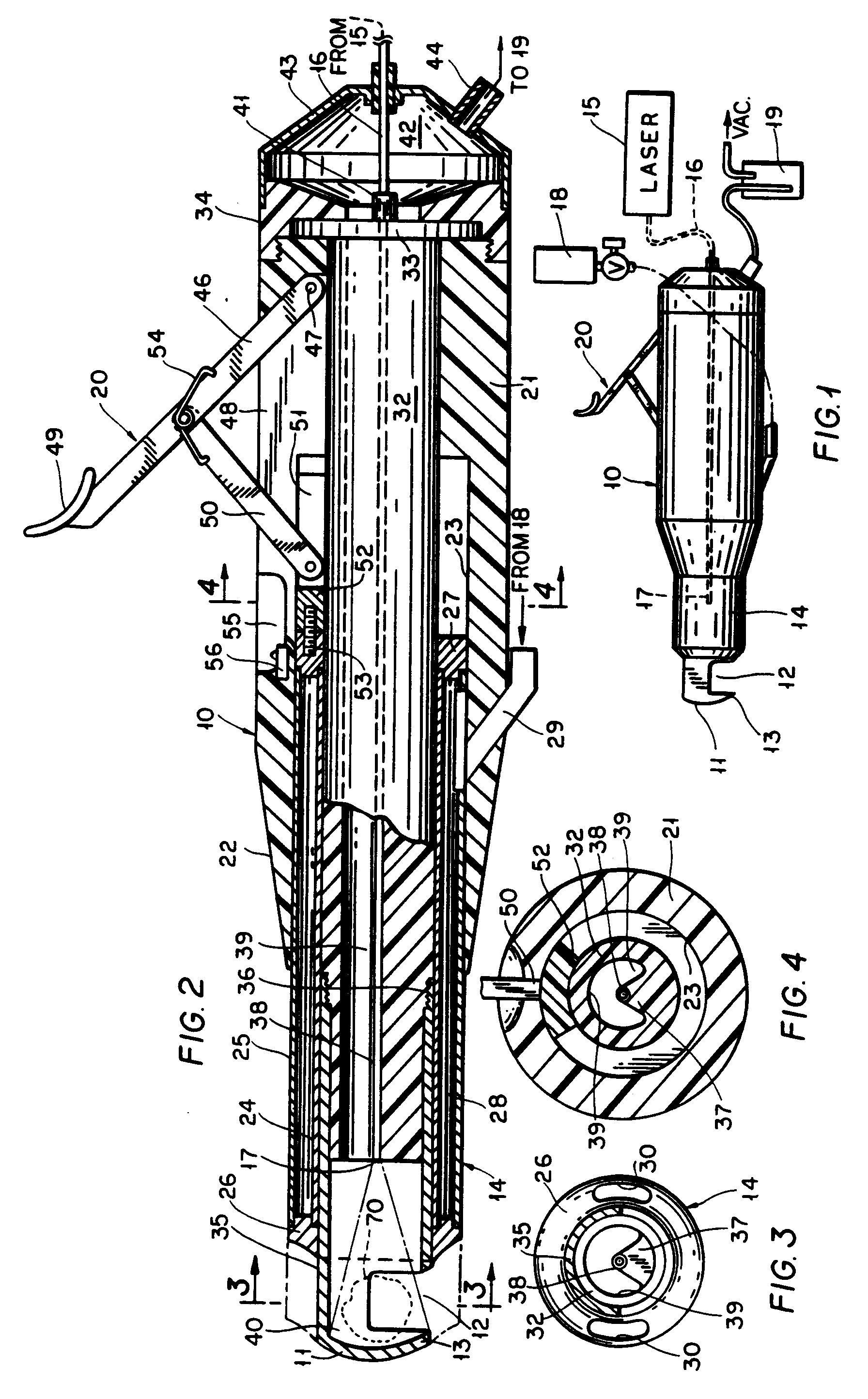
| (86) |
International application number: |
|
PCT/US9205/637 |
| (87) |
International publication number: |
|
WO 9301/757 (04.02.1993 Gazette 1993/04) |
|
| (54) |
APPARATUS FOR REMOVING CATARACTOUS-LENS TISSUE
VORRICHTUNG ZUM ENTFERNEN VON LINSENTRÜBUNGSGEWEBE
DISPOSITIF D'ELIMINATION DE TISSUS DU CRISTALLIN ATTEINT DE CATARACTE
|
| (84) |
Designated Contracting States: |
|
AT BE CH DE DK ES FR GB GR IT LI LU MC NL SE |
| (30) |
Priority: |
19.07.1991 US 732801
|
| (43) |
Date of publication of application: |
|
11.05.1994 Bulletin 1994/19 |
| (73) |
Proprietor: L'ESPERANCE MEDICAL TECHNOLOGIES, INC. |
|
New York, NY 10021 (US) |
|
| (72) |
Inventor: |
|
- L'ESPERANCE, Francis, A.
Englewood, NJ 07631 (US)
|
| (74) |
Representative: Milhench, Howard Leslie et al |
|
R.G.C. Jenkins & Co.
26 Caxton Street
London SW1H 0RJ
London SW1H 0RJ (GB) |
| (56) |
References cited: :
EP-A- 0 365 228
DE-A- 3 630 203
US-A- 4 589 414
US-A- 4 825 865
US-A- 5 061 266
|
WO-A-88/04157
US-A- 3 732 858
US-A- 4 760 840
US-A- 4 955 882
US-A- 5 129 896
|
|
| |
|
|
|
|
| |
|
| Note: Within nine months from the publication of the mention of the grant of the European
patent, any person may give notice to the European Patent Office of opposition to
the European patent
granted. Notice of opposition shall be filed in a written reasoned statement. It shall
not be deemed to
have been filed until the opposition fee has been paid. (Art. 99(1) European Patent
Convention).
|
BACKGROUND OF THE INVENTION
[0001] The present invention relates to surgically invasive apparatus for accessing a cataracted
natural lens via the anterior chamber-and a dilated iris, and for removing cataractous
material from the lens.
[0002] Within the last ten years, there have been important advances in instrumentation
and techniques for removal of cataractous-lens material. What has been termed phacoemulsification
is perhaps the most important of these advances, and it should be noted that this
term has applied to the use of ultrasonic energy, delivered at the small tip of a
piezoelectric or magnetostrictive device as shown in US 4,825,865. This is the currently
favoured means of locally fragmenting cataractous tissue, for extraction via a continuous
flow of benign liquid. But use of such phacoemulsification devices calls for great
skill, in that excessive delivery or misdirected delivery of ultrasonic energy can
result in irreparable damage to the capsulary bag, the corneal endothelium, the retina
and/or other parts of the eye.
[0003] It has also been proposed, but not generally accepted, to use local delivery of laser
radiation to fragment cataractous material, to an extent permitting extraction in
a continuous flow of irrigating liquid. But again, there is the prospect of irreversible
damage to other parts of the eye, and great surgical skill is required.
[0004] Recent announcements have described another potential improvement in cataract surgery,
attributed to Dr. J.M. Dodick, who uses the expression "laser phacolysis" in describing
his procedure. See for example "Use of Neodymium-YAG Laser for Removal of Cataracts
is Reported",
Ophthalmology Times, Dec. 15, 1989, pages 1, 6; "Nontarget Tissue of Rabbit Eyes Unharmed by Nd:YAG Phacolysis";
Ophthalmology Times, April 15, 1990, pages 1, 31; and "Will Laser Become the Cataract Surgery Instrument
of the '90s?",
Ophthalmology Times, August 1, 1990, page 40. The Dodick procedure uses a 1,064-nm Nd-YAG laser to supply
energy via an optical fibre. The energy is delivered within the probe tip of his instrument,
for reflection by a titanium target that is inclined within the otherwise open end
of the probe tip. Resulting shock waves are said to cause the nucleus and cortex to
be lysed, and the debris is then aspirated out of the eye.
[0005] Throughout this application, the terms phacoemulsification, phacolysis and tissue-fragmentation
are deemed to be synonymous, in the sense that they apply to the use of externally
supplied and locally delivered energy, whether ultrasonically applied or laser radiated,
to break up and reduce cataractous material to a particular size small enough for
external removal by the flow of an irrigating liquid.
SUMMARY OF THE INVENTION
[0006] It is an object of the invention to provide an improved apparatus and technique for
removal of cataractous-lens tissue.
[0007] More particularly, it is desired to achieve the foregoing object by means whereby
tissue-fragmentation or emulsification can proceed in an instrument-protected environment,
such that the energy delivered for fragmentation or emulsification cannot damage other
parts of an eye.
[0008] It is also desired to achieve the above with an instrument which embodies its own
means of infusing and extracting a flow of liquid at the situs of fragmentation.
[0009] In addition, it is desired to provide in apparatus of the character indicated, a
safety feature whereby no laser energy can be radiated within the eye unless the cataractous
tissue to be fragmented is in an instrument-protected environment.
[0010] According to the present invention, there is provided a phaco-extractor tool for
fragmenting and removing cataractous-lens tissue from the situs of fragmentation,
said tool comprising: elongate rigid tubular means having a central axis and having
a distal working end and a proximal manipulation end; said tubular means having an
elongate internal passage communicating with said distal end and having an aspiration-port
connection at said manipulation end; a rigid closure wall at said distal end; an arcuate
side port locally adjacent said closure wall; and selectively operable actuating means
carried by said tubular means for opening and for closing said side port, whereby
when the side port is closed an enclosed chamber is defined within the distal end
of the tubular means;
characterised in that said tool further comprises: phacoemulsification means including an active element
contained within said tubular means and selectively operable upon tissue that has
been scooped via the side port and into the distal end of said tubular means prior
to closure of the side port; and an interlock element responsive to closure of the
side port, said interlock element being operatively connected to effectively disable
said phacoemulsification means unless said side port is in closed condition.
[0011] An embodiment of the present invention is realised in an instrument having an elongate
stem which enables external manipulation at its proximal end and which at its distal
end presents a cutter adjacent a transiently open cavity into which cut or chopped
tissue can be manipulated. The instrument provides for selectively operated closure
of the thus-loaded cavity, an event which must occur before a laser radiation can
issue within the cavity, in fragmenting or emulsifying reduction of cut or chopped
tissue within the cavity. Thus, reduced, the fragmented material is extracted by an
aspirating flow of liquid. This process is repeated until the capsulary bag has been
cleared of cataractous material, be it nuclear or cortical.
[0012] The above and further features of the present invention are set forth with particularity
in the appended claims and will become clearer by consideration of the following detailed
description of exemplary embodiments given with reference to the accompanying drawings.
[0013] In the drawings:
Fig. 1 is a simplified overall view of a phacoemulsifying instrument embodying the
invention, together with external devices involved in operation of the instrument;
Fig. 2 is an enlarged longitudinal sectional view of the instrument of Fig. 1;
Fig. 3 is a sectional view, taken at 3-3 in Fig. 2;
Fig. 4 is another sectional view, taken at 4-4 in Fig. 2;
Fig. 5 is a simplified block diagram of a control system for the instrument of Fig.
2;
Fig. 6 is a highly schematic diagram to illustrate a basic function of the instrument
of Fig. 2;
Fig. 7 is a diagram similar to Fig. 6, to show a first modification;
Fig. 8 is a diagram similar to Fig. 6, to show a second modification;
Fig. 9 is an enlarged sectional view, taken at 9-9 in Fig. 8; and
Fig. 10 is a diagram similar to Fig. 6, to show a third modification.
DETAILED DESCRIPTION OF THE EMBODIMENTS
[0014] The system of Fig. 1 is seen to comprise a hand-held instrument 10 that is centrally
open to a wall 11 at its distal end. Wall 11 is adjacent a side port 12, thereby defining
a laterally projecting free cutter 13 whereby cataractous tissue may be excavated
and scooped through the side port and into the centrally open or chamber region of
the distal end. The side port 12 is open or closed by-selective manipulation of a
sleeve member 14 which, in the present embodiment, can be longitudinally shifted between
its retracted position (as shown), to its forward position of total side-port closure,
thus totally enclosing the scooped lens material within the chamber region of the
distal end. Laser radiation from an external source 15 is deliverable via an optical-fibre
cable 16 that is guided within the instrument for laser discharge at 17, directed
at scooped material in the closed chamber region of the distal end of the instrument.
Provision is made for a controlled flow of infusion liquid from a source 18 to a first
elongate cannula within the instrument, for ported external discharge near the distal
end, and a second elongate cannula within the instrument communicates between the
distal chamber region and an external evacuation system including a trap 19 for aspiration
and collection of fragmented lens material. A lever system 20 is shown for actuated
forward displacement of sleeve 14 into port (12) closing position.
[0015] Referring now to Figs. 2 to 4, the instrument 10 will be seen to be contained and
manipulated via an elongate tubular handle member 21, which will be understood in
Fig. 2 to have been longitudinally foreshortened for better showing of detail. The
distal end of handle member 21 is characterized by a gently reducing external surface
22 and by a cylindrical bore 23 for longitudinal guidance of the port-closing sleeve
14.
[0016] Sleeve 14 is shown to comprise inner and outer tubular members 24, 25 which are concentrically
spaced by distal and proximal end figments 26, 27, to thereby define a first or outer
annular cannula 28 which receives a flow of infusion liquid, such as a balanced saline
solution, via an inlet-port connection 29 from source 18, and which discharges this
flow via end ports 30 (Fig. 3) in the distal figment 26. The concave sectional profile
of the distal end figment 26 will be understood to suggest a sharp circular cutting
edge of figment 26, adjacent the cylindrical outer surface of the inner cannula on
which it is slidably guided.
[0017] The distal end-closure wall 11 is a part of a second or inner cannula assembly having
a cylindrical outer surface for further stabilizing guidance of the displaceable sleeve.
As shown, this assembly comprises an elongate proximal member 32 having a radial flange
formation 33 whereby member 33 may be fixedly retained by and between clamp formations
of a nut figment 34 that is removably threaded to the proximal end of handle 21. The
distal end wall 11 and its side port 12 are distal formations of an otherwise tubular
end member 35 having removably threaded engagement at 36 to the distal end of member
32. A local sector formation 37 (Fig. 4) in the otherwise open bore 39 of member 32
extends longitudinally for central rigid positioning of a piloting tube 38 for guided
retention of the optical fiber cable 16. As previously explained, the distal end of
the optical fiber is poised for discharge at 17, which is seen in Fig. 2 to be the
distal end of member 32 and which is also seen to be at sufficient longitudinal offset
from end wall 11 to permit divergent laser discharge from the optical-fiber end to
cover the entire sectional area of the containment chamber 40 defined upon closure
of side port 12. The optical-fiber cable 16 is protected at proximal-end entry into
its guide tube 38, by a resilient bushing 41, as of silicone rubber, carried locally
by member 32 and having light frictional retaining engagement to cable 16, whereby
to retain fiber discharge at 17.
[0018] The open bore 39 of member 32 establishes the inner cannula which communicates from
the distal fragmentation chamber 40 to a proximal chamber 42 defined by an end-bell
portion 43 which, with nut formation 34, is a detachable subassembly to handle 21.
The end-bell portion 43 is shown with a port figment 44, adapted for slip-fitted flexible
connection to the aspiration device 19.
[0019] Various means may be devised for selective or automated actuation of sleeve 14 between
its displacement limits of side-port (12) opening and closure. The lever system 20
that is shown is somewhat schematic, involving a primary lever 46 which has pivoted
reference at 47 to handle 21 via an elongate slot, one wall 48 of which is depicted
in Fig. 2. Lever 46 projects outwardly when sleeve 14 is retracted, exposing its finger-pad
formation 49 in readiness for squeezed displacement between slot walls 48. A link
50 connects lever 46 to the slotted end 51 of a cylindrically arcuate slide block
52, and a close-threaded element 53 connects block 52 to the proximal-end closure
figment of slide 14. A spring 54 at connection of link 50 to lever 46 is preloaded
to normally draw lever 46 to its outward position, thus normally returning slide 14
to its retracted position. When lever 46 has been fully squeezed into slot 48, with
finger pad 46 contained within a local recess 55, an electrical interlock switch 56
will have been actuated, to certify that slide 14 has fully closed port 12 to chamber
40. Switch 56 will be understood to provide a safety function, precluding laser discharge
into the optical-fiber delivery cable 16, unless and until port 12 is thus certified
to have been fully closed.
[0020] Operation and use of the instrument and system of Figs. 1 to 4 will be illustratively
described in further connection with control components schematically shown in Fig.
5, wherein a foot-operated master control unit 60 includes a multiple-position control
lever 61, for determining selectively available sequencing operations of an infusion-flow
control 62 for liquid from source 18, a vacuum-flow control 63 for control of aspirating
flow into the collection device 19, and on-off control means 64 for the release of
laser (15) radiation into the optical-fiber cable 16. Control means 64 is schematically
shown with manual-adjustment means 65, whereby selection can be made of the duration
of any given laser radiation within chamber 40; for example, for a pulsed-laser delivery,
adjustment at 65 may preset the desired number and strength of pulsed-laser delivery
to chamber 40, for a given exposure release. Finally, the interlock switch 56 is shown
with connection to the laser-control means 64 whereby, regardless of the foot-operated
positioning of the master-control element 61, there can be no laser discharge into
chamber 40, unless chamber 40 is certified (by switch 56) to have been fully closed
at port 12.
[0021] In assembling the described instrument prior to cataract extraction, the autoclavable
or otherwise aseptic portion (e.g., the disposable distal end member 35) is first
assembled to the more proximal member 32, thereby assuring that the distal cataract-grasping
portion for each patient operation will be new and shaft (at 13) for every cataract
extraction. Next, the fiber optic cable 16, which is preferably steel-clad, flexible
and sterile, is threaded, first loosely through silicone bushing in end bell 43 and
then through bushing 41 and the central guide tube 38 until the fiber end at 17 is
flush with the distal end or the inner cannula member 32. At the proximal end of accommodation
by member 32, the fiber optic cable 16 is frictionally held in place by the silicone
bushing 41, which minimizes destructive movement of cable 16. The entire inner cannula
assembly is then inserted within handle 21 and the bore of sleeve 14, to the point
of flange 33 abutment with the proximal end of handle 21; this position is retained
by removable assembly of nut 34 to handle 21. The inner cannula has then become fixed
to the handle, with the wall 11, side port 12 and chamber 40 located forward of the
retracted distal end of sleeve 16. And the ports to infusion and aspiration parts
of the instrument can be connected to devices 18, 19, while the fiber optic cable
is detachably coupled to laser 15.
[0022] In operation, the instrument is first manipulated to remove cortex tissue from the
anterior surface of a cataracted lens, and it is further manipulated to engage and
pass through port 12 a relatively large chunk 70 of cataractous nuclear tissue. Lever
46 is then depressed to close the side port 12 and in the process to sever the chunk
of cataract tissue which passed through port 12 and which is therefore positioned
in chamber 40, in readiness for laser irradiation from the locally contained source
17. The fully isolated and contained chunk 70 of cataract tissue can then be fragmented
or emulsified by a delivered burst of 3 to 30 pulses of a neodymium-YAG or other laser,
involving pulse energies ranging from 1 to 40 millijoules, illustratively with pulse
durations of 150 to 300 microseconds. The emulsified or fragmented cataractous material
is then vacuum-aspirated with a scavenging liquid flow, back through passage 39 in
the inner cannula 32 to aspiration port 44 and then to the external drip container
or trap 19. Illustratively, aspiration of the described system is controlled by a
commercially available, selectively variable aspiration device, set to create a vacuum
condition in the range 100 to 500-mm Hg.
[0023] Concurrently with the aspiration procedure, balanced saline or other solution is
allowed to enter the instrument and to discharge at 30, to refill or replace the portion
of the cataract that has been aspirated. The balanced saline solution contained at
18 would be located approximately 65-cm above the level of eye surgery, but it will
be understood that this particular level should be adjustable in the range 10 to 65-cm,
as required to maintain appropriate intralenticular or intraocular pressure.
[0024] When the entire nuclear portion of the cataract has been removed, having been emulsified
or fragmented by the laser energy, the procedure of irrigation (infusion) via ports
30 and aspiration of the cortex of the cataract cap be performed in customary manner.
For this purpose, one of the settings of the master control 60 will be understood
to determine solely the concurrent flows of infusion and aspiration, with side port
12 open (i.e., sleeve 14 retracted). Such concurrent flows can continue until all
cortical material has been stripped from the inner wall of the capsulary bag, thus
leaving the lens capsule free of cortical and nuclear material.
[0025] In describing various embodiments of the invention in connection with Figs. 6 to
9, it is convenient to adopt a schematic technique, from which individual differences
between embodiments can be readily identified. In all of these cases, it will be understood
that provision for infusion and aspiration flows can be substantially as described
for Figs. 1 to 4. For purposes of comparison, the first of these schematic showings
(Fig. 6) will be recognized as illustrating for exemplary embodiment of Figs. 1 to
4, wherein a longitudinally slidable actuating button 75 replaces the lever system
20 as the means of selective longitudinal displacement of sleeve 14, to control opening
and closure of side port 12, it being noted that end wall 11, its adjacent side port
12 and chamber region 40 are all fixedly related to handle 21. The directional arrow
75' indicates the direction of button 75 actuation, to drive sleeve 14 from the open
to the closed condition of side port 12.
[0026] The arrangement of Fig. 7 will accomplish the purposes of Figs. 1 to 4 and 6, but
in Fig. 7, a longitudinally slidable actuating button 76 is displaced in the opposite
direction (arrow 76') to effect side port (12) closure by a rearward retraction of
the inner cannula, via button 76 engagement to the flange 33. In this arrangement,
the outer-sleeve cannula 14' is fixed to handle 21.
[0027] In the arrangement of Figs. 8 and 9, both the inner and outer cannulas 80, 81 are
longitudinally fixed with respect to handle 21. The inner cannula structure 80 has
the same distal-end wall 11 and adjacent side port 12, as well as the posterior flange
33, via which it is additionally retained, as by keying means 82, against rotation
with respect to handle 21. On the other hand, an externally exposed actuating button
83 has a radially inward stem formation locally engaged to the posterior end of the
outer cannula structure 81, and a local arcuate slot in handle 21 will be understood
to enable limited rotational displacement of the outer cannula structure 81. As seen
in Fig. 9, the outer cannula structure 81 features an arcuate formation 84 of the
limited angular extent, such that at one limit of angular displacement the side port
12 is closed by formation 84, while at the other limit of angular displacement, the
formation 84 clears side port 12, thus fully opening the same. Such angular displacement
is suggested by arrow 83' in Fig. 9.
[0028] In the arrangement of Fig. 10, rotary actuation via button 85 effects rotation of
the inner cannula 80' with respect to handle 21, while the outer cannula structure
81' is fixed as by a radial pin 86 to handle 21. Thus, the port-closure formation
84 of the outer cannula 81' may appear as in Fig. 9, but this is fixed to handle 21,
while limited angular displacement of the inner cannula and its side port 21 is operative
to determine the selectively open or closed condition of the distal end of the instrument.
It will be understood that the stem portion of button 85 is accommodated in an arcuate
slot, of limited angular extent, through the adjacent body thickness of handle 21.
[0029] In all embodiments of the invention, the leading edge of the distal end of the outer
cannula will be understood to be preferably sharpened, as described above for the
leading circular edge of the distal figment 26, at adjacency with the cylindrical
outer surface of the inner cannula. In the case of Figs. 1 to 4, 6, and 7, the sharpened
edge is on the distal figment (26) at the distal end of the outer cannula. In the
case of Figs. 7 to 10, wherein relative rotation accomplishes opening and or closure
of side port 12, it is the angularly spaced longitudinal edges of the formation 84
that are preferably sharpened, for equivalent tissue-cutting and port-closing purposes.
[0030] The described embodiments of the invention will be seen to achieve all stated objects
of the invention. Cataractous lens material, be it nuclear or cortical, can be chopped
away and fully engulfed within the cavity of chamber 40, and any connection between
the engulfed material and material outside chamber 40 is guillotined by the sharp
leading edge of the closure element, namely, the distal-end concaved contour of the
outer cannula in the respective embodiments of Figs. 1 to 4, 6, and 7, and the angularly
limiting longitudinal edges of the arcuate closure formation 84, in the respective
embodiments of Figs. 8 and 9, and 10. Thus, a cutting or nibbling action can be observed
in the course of cataract removal, without the potentially damaging consequences of
ultrasonic phacoemulsification or other present-day practices. Furthermore, in contrast
to experimental instruments presently known to use laser energy to remove cataractous
tissue, the laser energy is applied within the fully closed chamber 40; thus, with
the present invention, laser radiation affects no other tissue than the cataractous
tissue contained within the closed chamber 40. Moreover, no laser energy is allowed
to escape from the instrument to any portion of the eye, so that use of laser energy
presents no damage potential to any part of the eye.
[0031] Having described the invention with reference to several particular embodiments,
it is to be understood that the described embodiments are exemplary only and are susceptible
to variation and modification without departure from the scope of the invention as
determined by the appended claims.
[0032] It should be clear that the present invention is not limited to use of any particular
laser. For example, any polychromatic or monochromatic laser radiation can be used
if the radiated energy is sufficiently high and of short enough duration to produce
a hydrodynamic and acoustic shock wave that will micro-fragment or emulsify the cataractous
tissue within the closed chamber 40.
1. A phaco-extractor tool (10) for fragmenting and removing cataractous-lens tissue from
the situs of fragmentation, said tool (10) comprising: elongate rigid tubular means
(32) having a central axis and having a distal working end and a proximal manipulation
end; said tubular means (32) having an elongate internal passage (39) communicating
with said distal end and having an aspiration-port connection (44) at said manipulation
end; a rigid closure wall (11) at said distal end; an arcuate side port (12) locally
adjacent said closure wall (11); and selectively operable actuating means (20,75,76,83,85)
carried by said tubular means (32) for opening and for closing said side port (12),
whereby when the side port is closed an enclosed chamber (40) is defined within the
distal end of the tubular means (32); characterised in that said tool further comprises: phacoemulsification means (15) including an active element
(16) contained within said tubular means (32) and selectively operable upon tissue
that has been scooped via the side port (12) and into the distal end of said tubular
means (32) prior to closure of the side port (12); and an interlock element (56) responsive
to closure of the side port (12), said interlock element (56) being operatively connected
to effectively disable said phacoemulsification means (15) unless said side port (12)
is in closed condition.
2. A phaco-extractor tool of claim 1, further comprising: an elongate annular cannula
(14) slidably guided on and by said rigid tubular means (32), said cannula (14) having
a proximal infusion-port connection (29) and distal-end porting (30) for distal discharge
of infusion liquid; wherein said side port (12) has a longitudinal dimension approximating
the internal diametral extent of said tubular means (32) and an arcuate extent in
the range between 60° and 180° about said central axis; and said selectively operable
actuating means is provided at the manipulation end for imparting relative reciprocation
of said cannula (14) and of said tubular means (32) with respect to each other such
that at one limit of relative displacement said cannula (14) closes said side port
(12) and at an opposite limit of relative displacement said cannula (14) no longer
closes said side port (12).
3. A phaco-extractor tool of claim 2, further comprising a manipulating handle (20,75,76)
fixed to said rigid tubular means (32), whereby said cannula (14) is longitudinally
reciprocable to open and/or close said side port (12).
4. A phaco-extractor tool of claim 2, further comprising a manipulating handle (20,75,76)
fixed to said cannula (14), whereby said tubular means (32) is longitudinally reciprocable
to open and/or close said side port (12).
5. A phaco-extractor tool of any of claims 2 to 4, wherein the distal end of said annular
cannula (14) has a sharpened circular cutting edge (26) at its inner diameter of guidance
by said rigid tubular means (32).
6. A phaco-extractor tool of claim 1, further comprising: an elongate annular cannula
(14) rotatable on said rigid tubular means (32) and having a proximal infusion-port
connection (29) and distal-end porting (30) for distal discharge of infusion liquid,
the distal end of said cannula (14) having an arcuate closure-flap (84) which in one
angular position closes said side port (12) and in another angular position no longer
closes said side port (12); wherein said side port (12) has a longitudinal dimension
approximating the internal diametral extent of said tubular means (32) and an arcuate
extent in the range between 60° and 180° about said central axis; and the selectively
operable actuating means (83,85) are provided at said manipulation end for imparting
relative rotation of said cannula end of said tubular means (32) with respect to each
other to establish one or the other of said angular positions.
7. A phaco-extractor tool of claim 6, further comprising a manipulating handle (83,85)
fixed to said rigid tubular means (32), whereby said cannula (14) is rotationally
displaceable to open and/or close said side port (12).
8. A phaco-extractor tool of claim 6, further comprising a manipulating handle (83,85)
fixed to said cannula (14), whereby said tubular means (32) is rotationally displaceable
to open and/or close said side port (12).
9. A phaco-extractor tool of any of claims 6 to 8, wherein said closure flap (84) has
a sharpened longitudinal cutting edge at least at one of the angular limits of said
closure flap (84).
10. A phaco-extractor tool of any preceding claim, wherein said phacoemulsification means
(15) is a laser system (15) with fibre-optic delivery (16) of laser radiation within
said tubular means (32) to a location (17) of discharge short of the distal end.
11. A phaco-extractor tool of claim 10, wherein said tubular means (32) comprises a fixed
tubular guide (38) for an optical fibre (16) forming the delivery portion (16) of
said laser system (15).
12. A phaco-extractor tool of claim 10 or 11, wherein said laser system (15) is positioned
remote from said tool (10) and said laser system (15) includes a flexible-cable connection
(16) for optical-fibre delivery of laser energy.
13. A phaco-extractor tool of claim 12 as dependent on claim 11, wherein said rigid guide
tube (39) is provided on the central axis of said tubular means (32), said flexible
cable (16) is insertable in and removably guidable by said guide tube (38), and said
tool further comprises clamping means (34) at the proximal end of said tool (10) for
frictionally engaging and locating said cable (16) such that its distal end of laser
irradiation into said chamber (40) is retained at a longitudinal offset (17) from
said end wall (11).
14. A phaco-extractor tool of claim 13, wherein said clamping means (34) is a bushing
of elastomeric material mounted at the proximal end of said tool (10).
15. A phaco-extractor tool of any of claims 12 to 14, wherein said flexible cable connection
is a steel-sheathed optical fibre (16).
16. A phaco-extractor tool of claim 11 or any of claims 12 to 15 as dependent on claim
11, wherein said guide tube (38) is made of stainless steel.
17. A phaco-extractor tool of any of claims 10 to 16, wherein the optical-fibre delivery
is via a detachable flexible-cable connection (16) to said laser system (15).
18. A phaco-extractor tool of any preceding claim, further comprising infusion means (30)
forming part of said tool (10) for discharging infusion liquid near but external to
the distal end of said tubular means (32), and aspiration means including a through
passage (39) within said tubular means (32) for externally extracting a flow of aspirated
liquid and fragmented lens-tissue material from said chamber (40).
19. A phaco-extractor tool of claim 18, wherein the proximal end of said tool (10) has
separate infusion and aspiration ports (29,44) for flexible connection to an external
source of infusion liquid (18) and for flexible connection to an external aspiration
system (19).
20. A phaco-extractor tool of any preceding claim wherein said rigid end-wall closure
(11) has a locally sharpened cutting edge (13) adjacent to said side port (12).
21. A phaco-extractor tool of claim 1, wherein said selectively operable actuating means
(20,75,76,83,85) includes manipulating means (20,75,76,83,85) carried at the proximal
end of the tool (10), and a separate side port-closing element (14) at the distal
end of the tool (10), said manipulating means (20,75,76,83,85) and said side port-closing
element (14) being detachably connected.
22. A phaco-extractor tool of claim 1 or 21, wherein said selectively operable actuating
means (20,75,76,83,85) has a cutting edge at a region of lap with the side port (12)
in the course of displacement to close the side port (12).
23. A phaco-extractor tool of any of claims 10 to 17 or any of claims 18 to 20 as dependent
on claim 10, further comprising control means (64) responsive to said interlock element
(56) for controlling the operation of said laser system (15).
24. A phaco-extractor tool of claim 23, wherein said control means (64) includes selectively
operable means (65) for predetermining the total energy of laser irradiation for a
given controlled irradiation discharge into said chamber (40).
25. A phaco-extractor tool of claim 24, wherein said laser system (15) comprises a pulsed
laser (15).
26. A phaco-extractor tool of claim 24 or 25, wherein said total energy of a given controlled
irradiation discharge is in the range of 0.05 to 3.0 Joules.
27. A phaco-extractor tool of claim 24 or 25, wherein said total energy of a given controlled
irradiation discharge is at least 0.05 Joules.
28. A phaco-extractor tool of claim 24 or 25, wherein said total energy of a given controlled
irradiation discharge is at least no greater than substantially 3.0 Joules.
29. A phaco-extractor tool of any of claims 25 to 28, wherein the total energy of a given
controlled irradiation discharge is in the form of a burst of 3 to 50 pulses wherein
each pulse is of 50 to 300 microseconds duration.
30. A phaco-extractor tool of any of claims 25 to 28, wherein the total energy of a given
controlled irradiation discharge is in the form of a burst of 3 to 25 pulses per second
for a period which is at least no greater than 2 seconds.
1. Linsenextraktionswerkzeug (10) zum Fragmentieren und Entfernen von kataraktischem
Linsengewebe von der Fragmentierstelle, umfassend ein längliches starres Rohrelement
(32) mit einer Mittelachse, einem distalen Arbeitsenden und einem proximalen Manipulierende,
wobei das Rohrelement (32) eine mit dem distalen Ende kommunizierende längsliche innere
Durchführung (39) aufweist, die am Manipulierende einen Aspirationsanschluß (44) hat,
eine am distalen Ende vorgesehene starre Verschlußwand (11), eine räumliche nahe an
der Verschlußwand (11) angeordnete bogenförmige Seitenöffnung (12), sowie eine an
dem Rohrelement (32) angebrachte selektiv betreibbare Betätigungseinrichtung (20,
75, 76, 83, 85) zum Öffnen und Schließen der Seitenöffnung (12), wobei im geschlossenen
Zustand der Seitenöffnung eine geschlossene Kammer (40) innerhalb des distalen Endes
des Rohrelements (32) definiert ist, dadurch gekennzeichnet, daß das Werkzeug ferner umfaßt: eine Linsen-Emulgiereinrichtung (15) mit einem in
dem Rohrelement (32) enthaltenen aktiven Element (16), das an Gewebe, das vor dem
Verschließen der Seitenöffnung (12) durch diese hindurch in das distale Ende des Rohrelements
(32) geschöpft worden ist, selektiv betätigbar ist, sowie ein auf das Verschließen
der Seitenöffnung (12) ansprechendes Verriegelungselement (56), das betriebsmäßig
so angeschlossen ist, daß es die Linsen-Emulgiereinrichtung (15) wirkungsmäßig abschaltet,
falls die Seitenöffnung (12) sich nicht im geschlossenen Zustand befindet.
2. Linsenextraktionswerkzeug nach Anspruch 1 mit ferner einer auf dem starren Rohrelement
(32) gleitenden und von ihm geführten länglichen ringförmigen Kanüle (14) mit einem
proximalen Infusionsanschluß (29) und einer distalen Öffnung (30) zur distalen Abgabe
von Infusionsflüssigkeit aufweist, wobei die Seitenöffnung (12) eine Längsabmessung
annähernd gleich dem Innendurchmesser des Rohrelements (32) und ein Bogenmaß im Bereich
zwischen 60° und 180° bezüglich der Mittelachse hat, und wobei die selektiv betriebbare
Betätigungseinrichtung am Manipulierende vorgesehen ist, um zwischen der Kanüle (14)
und dem Rohrelement (32) eine relative Hin- und Herbewegung derart auszuführen, daß
am einen Ende der relativen Bewegung die Kanüle (14) die Seitenöffnung (12) schließt,
am anderen Ende dagegen nicht mehr schließt.
3. Linsenextraktionswerkzeug nach Anspruch 2, mit ferner einem an dem starren Rohrelement
(32) befestigten Manipuliergriff (20, 75, 76), mit dem die Kanüle (14) zum Öffnen
bzw. Schließen der Seitenöffnung (12) in Längsrichtung hin und her bewegbar ist.
4. Linsenextraktionswerkzeug nach Anspruch 2, mit ferner einem an der Kanüle (14) befestigten
Manipuliergriff (20, 75, 76), mit dem das Rohrelement (32) zum Öffnen bzw. Schließen
der Seitenöffnung (12) in Längsrichtung hin und her bewegbar ist.
5. Linsenextraktionswerkzeug nach einem der Ansprüche 2 bis 4, wobei das distale Ende
der ringförmigen Kanüle (14) an seinem Innendurchmesser, an dem es von dem starren
Rohrelement (32) geführt ist, eine geschärfte ringförmige Schneidkante (26) aufweist.
6. Linsenextraktionswerkzeug nach Anspruch 1, ferner umfassend: eine auf dem starren
Rohrelement (32) drehbare längliche ringförmige Kanüle (14) mit einem proximalen Infusionsanschluß
(29) und einer distalen Öffnung (30) zur distalen Abgabe von Infusionsflüssigkeit,
wobei das distale Ende der Kanüle (14) eine bogenförmige Verschlußklappe (84) aufweist,
die in einer Winkelstellung die Seitenöffnung (12) verschließt, in der anderen dagegen
nicht mehr verschließt, wobei die Seitenöffnung (12) eine Längsabmessung annähernd
gleich dem Innendurchmesser des Rohrelementes (32) sowie ein Bogenmaß im Bereich zwischen
60° und 180° bezüglich der Mittelachse hat, und wobei die selektiv betriebbare Betätigungseinrichtung
(83, 85) am Manipulierende vorgesehen ist, um zwischen der Kanüle und dem Rohrelement
(32) eine relative Drehung zur Herstellung der einen oder der anderen Winkelstellung
auszuführen.
7. Linsenextraktionswerkzeug nach Anspruch 6 mit ferner einem an dem starren Rohrelement
befestigten Manipuliergriff (83, 85), mit dem die Kanüle (14) zum Öffnen bzw. Schließen
der Seitenöffnung (12) verdrehbar ist.
8. Linsenextraktionswerkzeug nach Anspruch 6 mit ferner einem an der Kanüle (14) befestigten
Manipuliergriff (83, 85), mit dem das Rohrelement (32) zum Öffnen und/oder Schließen
der Seitenöffnung (12) verdrehbar ist.
9. Linsenextraktionswerkzeug nach einem der Ansprüche 6 bis 8, wobei die Verschlußklappe
(84) an mindestens einem ihrer winkelmäßigen Begrenzungen eine längliche geschärfte
Schneidkante aufweist.
10. Linsenextraktionswerkzeug nach einem der vorhergehenden Ansprüche, wobei die Linsen-Emulgiereinrichtung
(15) ein Lasersystem (15) mit einer Faseroptik (16) zur Abgabe von Laserstrahlung
innerhalb der Rohrelements (32) an einer kurz vor dem distalen Ende gelegene Abgabestelle
(17) ist.
11. Linsenextraktionswerkzeug nach Anspruch 10, wobei das Rohrelement (32) eine feste
Rohrführung (38) für eine den Abgabeteil (16) des Lasersystems (15) bildende optische
Faser (16) aufweist.
12. Linsenextraktionswerkzeug nach Anspruch 10 oder 11, wobei das Lasersystem (15) von
dem Werkzeug (10) entfernt angeordnet ist und eine flexible Kabelverbindung (16) für
die Faseroptik-Abgabe von Laserenergie aufweist.
13. Linsenextraktionswerkzeug nach Anspruch 12, soweit er sich auf Anspruch 11 rückbezieht,
wobei das starre Führungsrohr (39) auf der Mittelachse des Rohrelements (32) vorgesehen
ist, das flexible Kabel (16) in das Rohrelement (38) ein- und herausführbar ist, und
wobei das Werkzeug (10) an seinem proximalen Ende ferner eine Klemmeinrichtung (24)
zum Reibeingriff mit dem Kabel (16) aufweist, um das Kabel so anzuordnen, daß sein
distales Ende, an dem Laserstrahlung in die Kammer (40) austritt, in Längsversatz
(17) von der Stirnwand (11) gehalten ist.
14. Linsenextraktionswerkzeug nach Anspruch 13, wobei die Klemmeichrichtung (34) eine
am proximalen Ende des Werkzeugs (10) montierte Buchse aus Elastomermaterial ist.
15. Linsenextraktionswerkzeug nach einem der Ansprüche 12 bis 14, wobei die flexible Kabelverbindung
eine stahlummantelte optische Faser (16) ist.
16. Linsenextraktionswerkzeug nach Anspruch 11 oder einem der Ansprüche 12 bis 15, soweit
sie sich auf Anspruch 11 rückbeziehen, wobei das Führungsrohr (38) aus rostfreiem
Stahl besteht.
17. Linsenextraktionswerkzeug nach einem der Ansprüche 10 bis 16, wobei die Faseroptik
über eine abnehmbare flexible Kabelverbindung (16) an das Lasersystem (15) angeschlossen
ist.
18. Linsenextraktionswerkzeug nach einem der vorhergehenden Ansprüche von Infusieiner
Teil des Werkzeugs (10) bildenden Infusionseinrichtung (30) zur Abgabe von Infusionsflüssigkeit
nahe jedoch außerhalb des distalen Endes des Rohrelements (32) und einer Aspirationseinrichtung
mit einer innerhalb des Rohrelements (32) vorhandenen Durchführung (39) zum Abführen
eines Stroms von aspirierter Flüssigkeit und fragmentiertem Linsengewebematerial aus
der Kammer (40) nach außen.
19. Linsenextraktionswerkzeug nach Anspruch 18, wobei das proximale Ende des Werkzeugs
(10) separate Infusions- und Aspirationsöffnungen (29, 44) zum flexiblen Anschluß
an eine externe Infusionflüssigkeitsquelle (18) bzw. ein externes Aspirationssystem
(19) aufweist.
20. Linsenextraktionswerkzeug nach einem der vorhergehenden Ansprüche, wobei der starre
Stirnwandverschluß (11) eine örtlich geschärfte Schneidkante (13) nahe der Seitenöffnung
(12) aufweist.
21. Linsenextraktionswerkzeug nach Anspruch 1, wobei die selektiv betriebbare Betätigungseinrichtung
(20, 75, 76, 83, 85) eine am proximalen Ende des Werkzeugs (10) angebrachte Manipuliereinrichtung
(20, 75, 76, 83, 85) sowie ein am distalen Ende des Werkzeugs (10) vorhandenes separates
Schließelement (14) für die Seitenöffnung aufweist, wobei die Manipuliereinrichtung
(20, 75, 76, 83, 85) und das Schließelement (14) für die Seitenöffnung lösbar verbunden
sind.
22. Linsenextraktionswerkzeug nach Anspruch 11 oder 21, wobei die selektiv betriebbare
Betätigungseinrichtung (20, 75, 76, 83, 85) in einem Bereich, der beim Verschieben
zum Schließen der Seitenöffnung (12) diese überlappt, eine Schneidkante aufweist.
23. Linsenextraktionswerkzeug nach einem der Ansprüche 10 bis 17 oder einem der Ansprüche
18 bis 20, soweit sich diese auf Anspruch 10 rückbeziehen, mit ferner einer auf das
Verriegelungselement (56) ansprechenden Steuereinrichtung (64) zur Betriebssteuerung
des Lasersystems (15).
24. Linsenextraktionswerkzeug nach Anspruch 23, wobei die Steuereinrichtung (64) eine
selektiv betätigbare Einrichtung (65) aufweist, die die Gesamtenergie an Laserstrahlung
für eine vorgegebene gesteuerte Strahlungsabgabe in die Kammer (40) bestimmt.
25. Linsenextraktionswerkzeug nach Anspruch 24, wobei das Lasersystem (15) einen gepulsten
Laser (15) aufweist.
26. Linsenextraktionswerkzeug nach Anspruch 24 oder 25, wobei die Gesamtenergie einer
vorgegebenen gesteuerten Strahlungsabgabe im Bereich von 0,5 bis 3,0 J liegt.
27. Linsenextraktionswerkzeug nach Anspruch 24 oder 25, wobei die Gesamtenergie einer
vorgegebenen gesteuerten Strahlungsabgabe mindestens 0,05 J beträgt.
28. Linsenextraktionswerkzeug nach Anspruch 24 oder 25, wobei die Gesamtenergie einer
vorgegebenen gesteuerten Strahlungsabgabe mindestens nicht größer als im wesentlichen
3,0 J ist.
29. Linsenextraktionswerkzeug nach einem der Ansprüche 25 bis 28, wobei die Gesamtenergie
einer vorgegebenen gesteuerten Strahlungsabgabe in Form einer Impulsgruppe mit 3 bis
50 Impulsen vorliegt, deren jeder einer Dauer von 50 bis 300 ms hat.
30. Linsenextraktionswerkzeug nach einem der Ansprüche 25 bis 28, wobei die Gesamtenergie
einer vorgegebenen gesteuerten Strahlungsabgabe in Form einer Impulsgruppe von 3 bis
25 Impulsen pro Sekunde über eine Zeitdauer von mindestens nicht mehr als 2 s vorliegt.
1. Outil phacoextracteur (10) pour fragmenter et ôter du tissu cristallin cataracté du
site de fragmentation, ledit outil (10) comprenant : un moyen tubulaire rigide allongé
(32) comportant un axe central et muni d'une extrémité de travail distale et d'une
extrémité de manipulation proximale; ledit moyen tubulaire (32) comportant un passage
interne allongé (39) qui communique avec ladite extrémité distale et qui possède un
raccord d'orifice d'aspiration (44) au niveau de ladite extrémité de manipulation,
une paroi de fermeture rigide (11) au niveau de ladite extrémité distale; un orifice
latéral arqué (12) localement adjacent à ladite paroi de fermeture (11); et des moyens
d'actionnement aptes à agir sélectivement (20, 75, 76, 83, 85) supportés par ledit
moyen tubulaire (32) pour ouvrir et fermer ledit orifice latéral (12), afin qu'ainsi
lorsque l'orifice latéral est fermé, une chambre fermée (40) soit définie à l'intérieur
de l'extrémité distale du moyen tubulaire (32); caractérisé en ce que ledit outil comprend en outre : un moyen de phacoémulsification (15) comportant
un élément actif (16) contenu dans ledit moyen tubulaire (32) et apte à agir sélectivement
sur du tissu cureté par l'intertmédiaire de l'orifice latéral (12) et dans l'extrémité
distale dudit moyen tubulaire (32) avant la fermeture de l'orifice latérale (12);
et un élément de verrouillage réciproque (56) sensible à la fermeture de l'orifice
latéral (12) ledit élément de verrouillage réciproque (56) étant relié de manière
fonctionnelle pour en réalité désactiver ledit moyen de phacoémulsification (15) à
moins que ledit orifice latéral (12) ne soit à l'état fermé.
2. Outil phacoextracteur selon la revendication 1, comprenant également : une canule
annulaire allongée (14) guidée de manière coulissante sur et par ledit moyen tubulaire
rigide (32), canule (14) qui possède un raccord d'orifice d'infusion proximal (29)
et un orifice d'extrémité distale (30) pour délivrer à distance un liquide d'infusion;
ledit orifice latéral (12) ayant une dimension longitudinale approchante de l'étendue
diamétrale intérieure dudit moyen tubulaire (32) et une étendue en arc dans la plage
entre 60° et 180° autour dudit axe central; et lesdits moyens d'actionnement aptes
à agir sélectivement étant prévus au niveau de l'extrémitê de manipulation pour impartir
un mouvement de va-et-vient relatif de ladite canule (14) et dudit moyen tubulaire
(32) l'un par rapport à l'autre de façon qu'au niveau d'une limite du déplacement
relatif ladite canule (14) ferme ledit orifice latéral (12) et qu'au niveau d'une
limite opposée du déplacement relatif ladite canule (14) ne ferme plus ledit orifice
latéral (12).
3. Outil phacoextracteur selon la revendication 2, comprenant également une manette de
manipulation (20, 75, 76) fixée audit moyen tubulaire rigide (32), pour qu'ainsi ladite
canule (14) puisse être déplacée longitudinalement suivant un mouvement de va-et-vient
afin d'ouvrir et/ou fermer ledit orifice latéral (12).
4. Outil phacoextracteur selon la revendication 2, comprenant également une manette de
manipulation (20, 75, 76) fixée à ladite canule (14), pour qu'ainsi ledit moyen tubulaire
(32) puisse être déplacé longitudinalement suivant un mouvement de va-et-vient afin
d'ouvrir et/ou fermer ledit orifice latéral (12).
5. Outil phacoextracteur selon l'une quelconque des revendications 2 à 4, dans lequel
ladite extrémité distale de ladite canule annulaire (14) possède un bord de coupe
circulaire affilé (26) au niveau de son diamètre intérieur de guidage par ledit moyen
tubulaire rigide (32).
6. Outil phacoextracteur selon la revendication 1, comprenant également : une canule
annulaire allongée (14) mobile en rotation sur ledit moyen tubulaire rigide (32) et
comportant un raccord d'orifice d'infusion proximal (29) et un orifice d'extrémité
distale (30) en vue de délivrer à distance un liquide d'infusion, l'extrémité distale
de ladite canule (14) comportant un clapet de fermeture arqué (84) qui, dans une position
angulaire, ferme ledit orifice latéral (12) et qui, dans une autre position angulaire,
ne ferme plus ledit orifice latéral (12); ledit orifice latéral (12) ayant une dimension
longitudinale approchante de l'étendue diamétrale intérieure dudit moyen tubulaire
(32) et une étendue en arc dans la plage entre 60° et 180° autour dudit axe; et les
moyens d'actionnement aptes à agir sélectivement (83, 85) étant prévus au niveau de
ladite extrémité de manipulation pour impartir un mouvement de rotation relatif de
ladite canule et dudit moyen tubulaire (32) l'un par rapport à l'autre afin d'établir
l'une ou l'autre desdites positions angulaires.
7. Outil phacoextracteur selon la revendication 6, comprenant également une manette de
manipulation (83, 85) fixée audit moyen tubulaire rigide (32), pour qu'ainsi ladite
canule (14) puisse être déplacée en rotation afin d'ouvrir et/ou fermer ledit orifice
latéral (12).
8. Outil phacoextracteur selon la revendication 6, comprenant également une manette de
manipulation (83, 85) fixée à ladite canule (14), pour qu'ainsi ledit moyen tubulaire
(32) puisse être déplacé en rotation afin d'ouvrir et/ou fermer ledit orifice latéral
(12).
9. Outil phacoextracteur selon l'une quelconque des revendications 6 à 8, dans lequel
ledit clapet de fermeture (84) possède un bord de coupe longitudinal affilé au niveau
de l'une au moins de ses limites angulaires.
10. Outil phacoextracteur selon l'une quelconque des revendications précédentes, dans
lequel ledit moyen de phacoémulsification (15) est un système laser (15) comportant
une propogation par fibre optique (16) d'un rayonnement laser à l'intérieur dudit
moyen tubulaire (32) jusqu'à un emplacement (17) de sortie situé avant l'extrémité
distale.
11. Outil phacoextracteur selon la revendication 10, dans lequel ledit moyen tubulaire
(32) comprend un élément de guidage tubulaire fixe (38) pour une fibre optique (16)
formant la partie de propagation (16) dudit système laser (15).
12. Outil phacoextracteur selon la revendication 10 ou 11, dans lequel ledit système laser
(15) est situé a distance dudit outil (10) et comprend un raccord en câble flexible
(16) pour ladite propagation par fibre optique d'une énergie laser.
13. Outil phacoextracteur selon la revendication 12 lorsqu'elle est dépendante de la revendication
11, dans lequel ledit tube de guidage rigide (38) est prévu sur l'axe central dudit
moyen tubulaire (32), ledit câble flexible (16) étant apte à être inséré et guidé
de manière amovible dans et par ledit tube de guidage (38), et ledit outil (10) comprenant
également un moyen de serrage (34) au niveau de son extrémité proximale pour venir
en prise par frottement avec ledit câble (16) et positionner celui-ci de telle façon
que son extrémité distale de rayonnement laser dans ladite chambre (40) soit retenue
au niveau d'une position décalée longitudinalement (17) par rapport à ladite paroi
d'extrémité (11).
14. Outil phacoextracteur selon la revendication 13, dans lequel ledit moyen de serrage
(34) est un manchon en matière élastomère monté au niveau de l'extrémité proximale
dudit outil (10).
15. Outil phacoextracteur selon l'une quelconque des revendications 12 à 14, dans lequel
ledit raccord en câble flexible est une fibre optique gainée d'acier (16).
16. Outil phacoextracteur selon la revendication 11 ou l'une quelconque des revendications
12 à 15 lorsqu'elles sont dépendantes de la revendication 11, dans lequel ledit tube
de guidage (38) est formé d'acier inoxydable.
17. Outil phacoextracteur selon l'une quelconque des revendications 10 à 16, dans lequel
la propagation par fibre optique s'effectue par l'intermédiaire d'un raccord en câble
flexible détachable (16) relié audit système laser (15).
18. Outil phacoextracteur selon l'une quelconque des revendications précédentes, comprenant
également des moyens d'infusion (30) qui font partie dudit outil (10) pour délivrer
un liquide d'infusion à proximité mais a l'extérieur de l'extrémité distale dudit
moyen tubulaire (32), et un moyen d'aspiration comprenant un passage traversant (39)
à l'intérieur dudit moyen tubulaire (32) pour extraire de l'extérieur un écoulement
de liquide aspiré et de substance de tissu cristallin fragmenté hors de ladite chambre
(40).
19. Outil phacoextracteur selon la revendication 18, dans lequel l'extrémité proximale
dudit outil (10) comporte des orifices d'infusion et d'aspiration (29, 44) séparés
destinés à être raccordés respectivement par flexible à une source extérieure de liquide
d'infusion (18) et à un système d'aspiration extérieur (19).
20. Outil phacoextracteur selon l'une quelconque des revendications précédentes, dans
lequel ladite paroi de fermeture d'extrémité rigide (11) possède un bord de coupe
taillé en pointe (13) adjacent audit orifice latéral (12).
21. Outil phacoextracteur selon la revendication 1, dans lequel lesdits moyens d'actionnement
aptes à agir sélectivement (20, 75, 76, 83, 85) comprennent des moyens de manipulation
(20, 75, 76, 83, 85) supportés au niveau de l'extrémité proximale de l'outil (10),
et un élément de fermeture d'orifice latéral séparé (14) au niveau de l'extrémité
distale de l'outil (10), lesdits moyens de manipulation (20, 75, 76, 83, 85) et ledit
élément de fermeture d'orifice latéral (14) étant reliés de manière détachable.
22. Outil phacoextracteur selon la revendication 1 ou 21, dans lequel lesdits moyens d'actionnement
aptes à agir sélectivement (20, 75, 76, 83, 85) comportent un bord de coupe au niveau
d'une zone de chevauchement avec l'orifice latéral (12) au cours d'un déplacement
de fermeture de l'orifice latéral (12).
23. Outil phacoextracteur selon l'une quelconque des revendications 10 à 17 ou l'une quelconque
des revendications 18 à 20 lorsqu'elles sont dépendantes de la revendication 10, comprenant
également un moyen de commande (64) sensible audit élément de verrouillage réciproque
(56) pour commander le fonctionnement dudit système laser (15).
24. Outil phacoextracteur selon la revendication 23, dans lequel ledit moyen de commande
(64) comprend des moyens aptes à agir sélectivement (65) pour prédéterminer l'énergie
totale de rayonnement laser pour une sortie de rayonnement contrôlée donnée dans ladite
chambre (40).
25. Outil phacoextracteur selon la revendication 24, dans lequel ledit système laser (15)
comprend un laser pulse (15).
26. Outil phacoextracteur selon la revendication 24 ou 25, dans lequel ladite énergie
totale d'une sortie de rayonnement contrôlée donnée se situe dans la plage de 0,05
à 3,0 Joules.
27. Outil phacoextracteur selon la revendication 24 ou 25, dans lequel ladite énergie
totale d'une sortie de rayonnement contrôlée donnée est d'au moins 0,05 Joules.
28. Outil phacoextracteur selon la revendication 24 ou 25, dans lequel ladite énergie
totale d'une sortie de rayonnement contrôlée donnée n'est tout au moins pas supérieure
à sensiblement 3,0 Joules.
29. Outil phacoextracteur selon l'une quelconque des revendications 25 à 28, dans lequel
l'énergie totale d'une sortie de rayonnement contrôlée donnée se présente sous la
forme d'une salve de 3 à 50 impulsions, chaque impulsion ayant une durée de 50 à 300
microsecondes.
30. Outil phacoextracteur selon l'une quelconque des revendications 25 à 28, dans lequel
l'énergie totale d'une sortie de rayonnement contrôlée donnée se présente sous la
forme d'une salve de 3 à 25 impulsions par seconde pendant une période qui n'est tout
au moins pas supérieure à 2 secondes.